Wilting on Jackfruit: Causes, Checks & Fixes
Quick answer
Before watering a wilting Jackfruit, check moisture several inches down around the root ball. Dry soil points toward a water deficit; persistently wet soil calls for a drainage and root check because Jackfruit is sensitive to flooding.
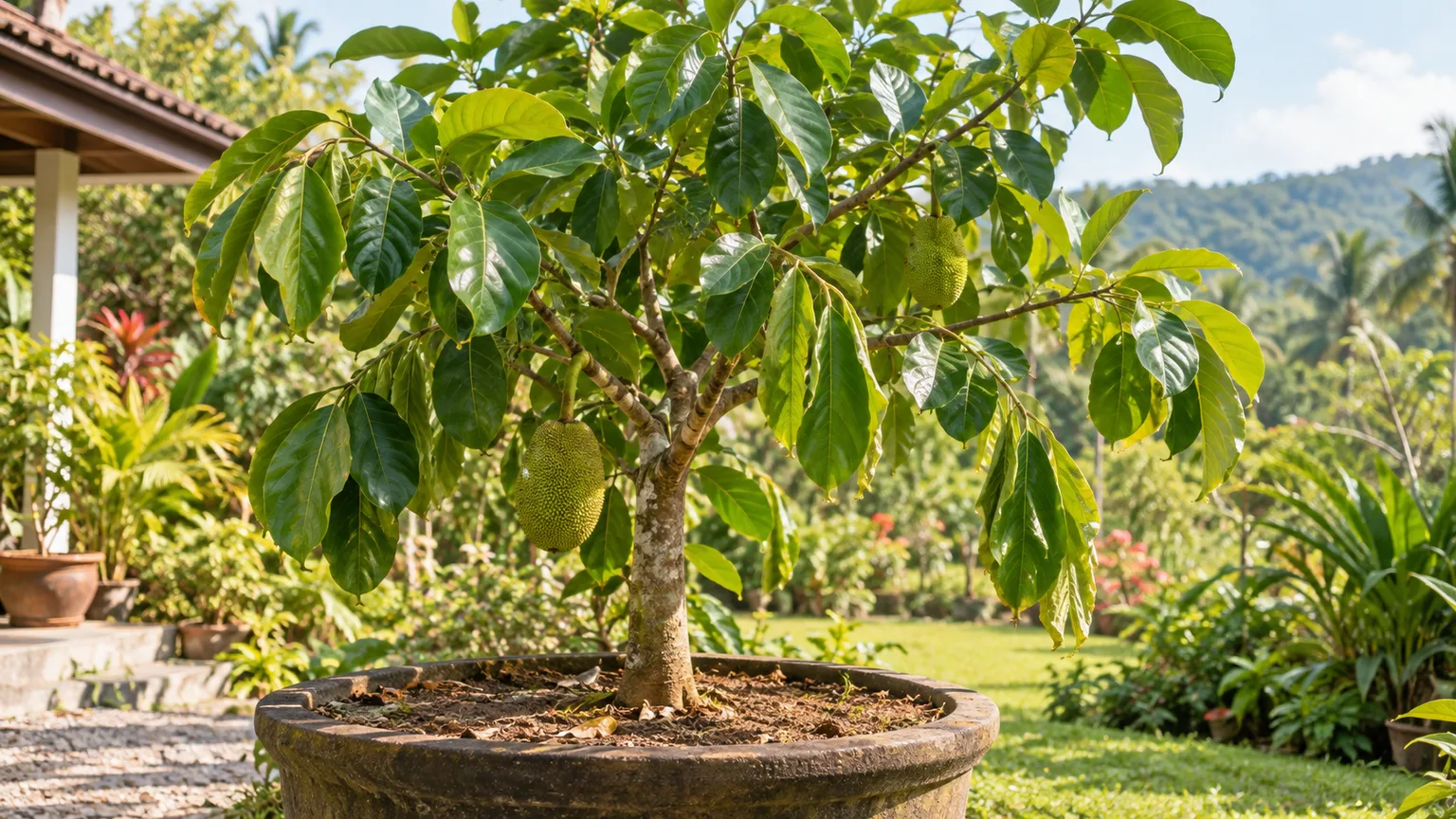
Wilting on Jackfruit: Causes, Checks & Fixes
This guide covers wilting on Jackfruit. See also the general Wilting guide, watering, and light pages for this plant.
Wilting on Jackfruit: Causes, Checks & Fixes
Quick answer
Before you water a wilting Jackfruit, check the soil several inches down around its root ball. If it is dry at that depth, rehydrate the root zone slowly and evenly. If it is still wet, do not add more water: Jackfruit tolerates some dry weather better than prolonged saturation, and the UF/IFAS wet-soil warning is particularly serious for this species.
The same drooping canopy can come from opposite problems. A young tree may be short of water after planting or during a hot, rainless stretch; a tree in soggy ground may be wilting because damaged roots cannot take up water. Start with moisture and recent weather, then use the condition of the trunk, leaves, and new growth to decide whether this is a routine watering correction or a drainage problem. The general wilting guide explains the symptom across plants; this page focuses on Jackfruit’s particular sensitivity to flooding, root restriction, and dry spells.
What wilting looks like on Jackfruit
Jackfruit has glossy, oval leaves on mature growth, with more deeply lobed leaves often appearing on young shoots, as described in Purdue’s Jackfruit profile. Wilting usually shows as a loss of firmness: leaf blades hang lower than usual, petioles bend, and the canopy may look slack rather than simply smaller or pale. The whole tree can be affected when the root zone is dry or damaged, while one branch changing after a physical injury suggests a more localized problem.
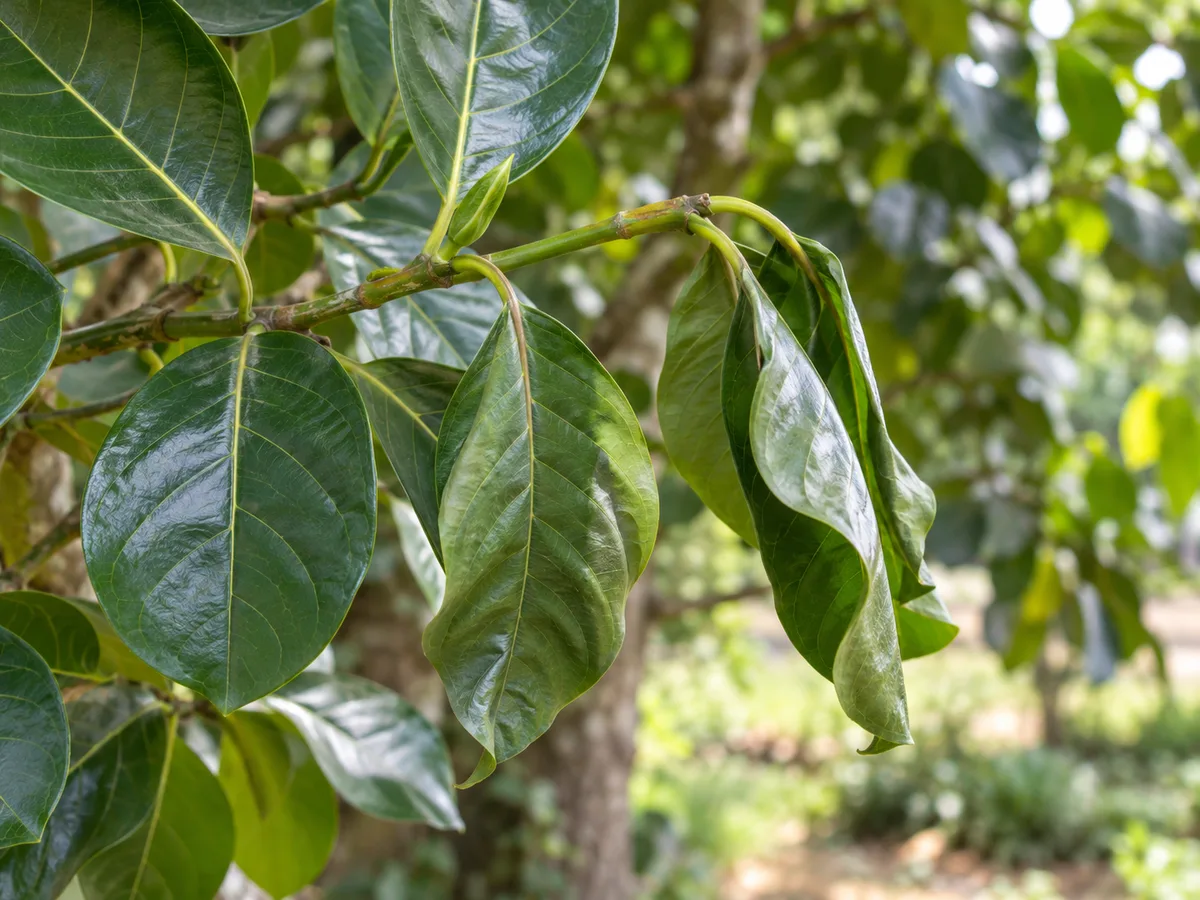
A few limp leaves are a cue to inspect soil moisture and recent weather before watering.
Do not diagnose from leaf position alone. Heat can increase water demand in fruit trees, but posture by itself does not confirm that the roots are dry (UF/IFAS drought guidance). Compare the affected leaves with the same tree earlier in the morning and look for a matching change in soil moisture. If leaf firmness is not returning by cooler hours, or if more of the canopy is affected from one day to the next, treat it as persistent stress rather than assuming normal movement.
A newly planted tree with wilt and dry soil has a different problem from an established tree with wilt above saturated soil. The second pattern deserves more urgency because Jackfruit roots are vulnerable to flooding.
Why a newly planted Jackfruit can wilt between waterings
A recently planted Jackfruit does not yet have the same established root system as a mature tree. Purdue notes that Jackfruit seedlings have a long, delicate taproot that makes advanced seedlings difficult to transplant (Purdue’s transplant note). A transplant can therefore run short of available moisture even when the wider garden looks damp, especially if its root ball is small, the soil is sandy, or rain has missed the planting area. TNAU recommends weekly irrigation until establishment and then as needed; UF/IFAS also recommends watering young trees during dry periods. These are regional cultivation guides, not a universal calendar: local rainfall and how quickly the root ball dries should decide the actual interval.
Check both the original nursery root ball and the soil around it. Water may run down a gap between the root ball and surrounding soil, leaving the roots dry even though the surface looks recently watered. Conversely, a heavy clay pocket or a low planting spot can hold water around the roots after rain. Probe gently with a finger or narrow trowel near the outer edge of the root ball, taking care not to sever roots. A dry root ball confirms that water needs to reach that zone; wet, sticky soil means the next step is to inspect drainage, not to repeat the watering.
Root restriction can complicate recovery in container-grown Jackfruit. UF/IFAS notes that Jackfruit grows poorly when pot-bound and is strongly affected by restricted roots (Jackfruit root guidance). If the tree is still in a nursery pot, check whether roots are circling densely, whether water is running straight through without wetting the root ball, and whether the pot has open drainage holes. A root-bound tree may dry unevenly and struggle after planting, so follow the Jackfruit repotting guide if the container is clearly constricting the root system. Do not move it into a much larger, water-retentive pot solely because one hot afternoon caused drooping.
Why fruiting makes dry spells more important
Established Jackfruit trees are moderately drought tolerant, but that does not mean a dry spell is harmless. UF/IFAS recommends water during prolonged dry periods for optimum growth and fruit production, and says watering is especially important from bloom through fruit development (Jackfruit growing guide). A tree that is wilting while flowering or carrying developing fruit should be checked promptly rather than left to endure repeated dry-downs. The Jackfruit watering guide covers the normal routine; this wilt page is for adjusting that routine when the canopy is already losing firmness.
The response should still be moisture-led. If soil at root depth is dry, water slowly over the area occupied by the active roots, not just against the trunk. If the soil is moist, adding more water will not create a useful reserve; it can leave the roots in the condition that Jackfruit handles poorly. Mature Jackfruit roots can spread beyond the canopy drip line, so a small wet circle beside the trunk is not proof that the full root area has been irrigated (UF/IFAS Jackfruit guidance).
If the tree is flowering or bearing, avoid a second stress while it recovers. Do not add a heavy fertilizer dose, prune healthy branches, or make a major soil change as a substitute for correcting the water problem. Cultivar, weather, cultural care, and fruit load all affect production, so wilting alone cannot tell you whether a particular crop is lost (UF/IFAS Jackfruit yield guidance). Keep notes on rainfall, irrigation, and which parts of the canopy change; that evidence will help separate a short water deficit from a worsening root issue.
Why Jackfruit may wilt in wet soil
Jackfruit is unusually unforgiving of sustained waterlogging for a tropical fruit tree. UF/IFAS reports that it does not tolerate continuously wet or flooded soil well and that trees may decline or die after two to three days of wet-soil conditions. The same profile lists root-rot organisms and says the disease risk is greater when trees are subjected to flooding (Jackfruit flooding and root-rot notes). If your Jackfruit is wilting after heavy rain, repeated irrigation, or a timer-controlled lawn sprinkler, check for standing water and slow drainage before assuming it is thirsty.
The basic mechanism is not simply “too much water in the leaves.” Saturated soil limits air exchange around roots, and waterlogging can reduce oxygen availability and increase disease pressure in plants. That is why a tree can look dehydrated aboveground while its root zone is wet: injured roots cannot supply water normally. A peer-reviewed review in Frontiers in Plant Science summarizes oxygen and disease effects under waterlogging; UF/IFAS provides the Jackfruit-specific warning.
For a landscape tree, look at the ground after ordinary rain. Does water remain in a shallow depression? Does the soil stay glossy and sticky for days, or does a sprinkler run on a schedule even after rain? UF/IFAS specifically warns that a lawn sprinkler timer can overwater Jackfruit and lead to decline and root rot. In a container, check that drainage holes are open and that the pot is not standing in a saucer or decorative cover full of water. The Jackfruit soil guide explains why well-drained ground matters for this species.
If the soil is wet and the canopy is still firming less each day, stop routine irrigation until the root zone begins to drain. Do not try to fix saturated soil by poking deep holes beside the trunk, cutting large roots, or adding fertilizer. If the planting site remains wet after rain, improve surface drainage or get local advice about a raised planting area before the next wet season. For a persistent wet-soil decline, use the Jackfruit root-rot guide to distinguish root disease from a temporary moisture imbalance.
How to confirm the cause before watering
Use a short check in this order. You are looking for a pattern that agrees with the tree’s recent care, not one clue that seems to explain everything.
- Check moisture where the roots are. Test soil near the edge of the root ball several inches below the surface. Dry soil through that zone, especially after a rainless spell, supports a water deficit. Wet soil that stays wet points away from underwatering.
- Review the last week of weather and irrigation. Note heavy rain, a broken hose, a newly started sprinkler schedule, high heat, or a recent transplant. If the tree is young, compare the root ball with the surrounding soil rather than relying on a single surface reading.
- Look at the spread of symptoms. A canopy-wide droop fits a root-zone or heat-demand problem more than one broken limb. One branch wilting while the rest remains normal calls for a close look at that branch’s attachment, bark, and any recent pruning or impact.
- Check whether the ground can drain. Standing water, persistently glossy soil, or a container that keeps draining slowly makes overwatering and root injury more plausible. Jackfruit should not be planted where typical rainfall leaves the site flooded or continually wet.
- Compare morning and afternoon. If leaves droop only during the hottest hours and are firmer again by morning while soil remains evenly moist, heat may be adding demand. Treat this as a clue, not proof: if the morning canopy also worsens, continue checking roots and drainage.
For the bigger care picture, compare your observations with the Jackfruit overview and its problem hub. Those routes help you distinguish wilting from the tree’s other documented problems. If the soil is dry and the plant is declining, the underwatering guide covers a confirmed dry-root condition in more detail.
The first fix: correct the moisture reading you actually find
The first action is to check soil moisture at root depth before adding water. That single check prevents the common mistake of treating every wilt as drought. Once you know whether the root zone is dry or wet, use the matching path below and make one correction at a time.
If the root zone is dry
Water slowly enough that the root ball and nearby soil absorb it instead of letting water escape down the sides. For a newly planted tree, focus first on the original root ball, then widen the watering area as roots extend. For an established tree, irrigate broadly around the canopy’s root zone rather than pouring water at the trunk. UF/IFAS Extension’s fruit-tree drought guidance recommends targeted delivery to the root zone; it also notes that drought stress can reduce growth and fruit production.
After watering, let excess water drain away. Check the same location later rather than adding another full irrigation by habit. If water beads off or travels through a narrow channel, reapply more slowly in short passes so the soil can take it in. A dry, water-repellent root ball may need several gradual applications, but stop if the surrounding soil becomes saturated.
If the root zone is wet
Do not water again until the area begins to drain. Empty standing water from a container saucer, pause automatic irrigation, and check whether runoff from a roof, slope, or paved surface is reaching the tree. If the tree is in a low site that stays wet, a drainage correction is more important than a different watering calendar. Do not fertilize a wet, wilting tree to “green it up”; stressed or damaged roots cannot make good use of an extra feed.
Only disturb the root ball if evidence points to an actual root problem or a failed container. For a potted Jackfruit with blocked holes, root circling, or saturated compacted mix, repotting may be warranted, but do it carefully and preserve as many sound roots as possible. For a large tree in the ground, do not dig around the trunk to inspect roots without an experienced local professional: Jackfruit has a substantial root system and excavation can create more injury.
Recovery: watch new condition, not yesterday’s damaged leaves
There is no reliable Jackfruit-specific number of hours or days in which every wilted tree should recover. A mildly dehydrated container tree may look better after the root ball is rehydrated, while a newly planted or fruiting tree may need more time to resume steady growth. If wilt resulted from waterlogged roots, improvement may take longer because drainage and root function have to recover first. The UF/IFAS profile documents serious decline under prolonged wet-soil conditions, so do not wait passively if saturation persists.
Use the same observations each day: soil moisture at the same depth, whether leaves are firmer by morning, and whether the affected area is spreading. Improvement means new leaves are holding their shape and no new branches are collapsing. Old leaves with crisp brown edges or dead tissue may remain damaged even after the cause is corrected; do not use their appearance alone to judge whether the tree is recovering.
Escalate if the trunk base softens, bark becomes dark and sunken, large branches begin dying back, or the canopy continues to collapse while the soil is neither very dry nor draining. These signs can point beyond routine watering to root, stem, or vascular injury. A local extension office can help assess a young tree or confirm what is common in your area; for a mature landscape Jackfruit with progressive dieback, ask a qualified arborist to inspect it on site.
Prevent repeat wilting in Jackfruit
For a young tree, establish a repeatable moisture check instead of following a fixed weekly calendar without regard to rain. TNAU’s once-a-week recommendation until establishment is useful context, but Florida, India, and other growing regions differ in soil texture, temperature, and rainfall. Check the actual root ball and adjust interval so it does not become bone dry during establishment or remain saturated between waterings. The best way to improve the routine is to keep short notes after watering and rain, especially through the first growing season.
For an established landscape tree, do not let a lawn sprinkler calendar decide irrigation. Jackfruit roots extend beyond the immediate trunk area, and UF/IFAS warns that frequent lawn irrigation can contribute to decline. If your region has a prolonged dry period, irrigate the root zone in a way that wets a broad area and then allow normal drainage. When trees are blooming or setting fruit, monitor moisture more closely because UF/IFAS identifies that period as especially important for water supply.
Choose the planting location for drainage before you plant. TNAU says well-drained soil is necessary for Jackfruit, and UF/IFAS recommends avoiding flooded sites after typical summer rain. If your yard has a high water table or recurring ponding, ask a local horticulture extension service whether a raised mound can improve fruit-tree survival or another site is more appropriate. The Jackfruit light guide can help you keep the tree in suitable sun without confusing light placement with a moisture correction; UF/IFAS recommends full sun for growth and fruit production.
Container trees need a pot that drains freely and enough room for the root system. UF/IFAS notes that Jackfruit is affected by root restriction, so a densely circling root mass can compromise establishment. Choose a container with open drainage, use a free-draining growing mix, and avoid moving a small tree into an oversized pot that stays wet for too long. If a container is root-bound, follow the Jackfruit repotting guide and reassess moisture after transplanting instead of applying the old schedule.
Finally, keep the area around the trunk clear enough to monitor soil, but do not use a lawn sprinkler or frequent shallow watering as a substitute for checking the tree. Mulch can help retain moisture around Jackfruit, but keep it several inches from the trunk so you can see the soil and trunk flare (UF/IFAS mulch guidance). Do not let mulch conceal standing water or a constantly wet root collar. When the canopy first looks limp, record the weather and soil condition before intervening. That small habit turns the next episode of Jackfruit wilting into a diagnosis instead of a guess.
When to use this page vs other Jackfruit guides
Use this page when the whole tree or several branches have lost firmness and you are unsure whether the cause is drought, saturation, heat, or root injury. If the root zone is clearly dry, switch to the underwatering guide for a confirmed dry-soil diagnosis; if it is wet and the decline continues, the root-rot guide covers that specific problem. For routine care rather than active symptoms, start with the Jackfruit overview and its watering and soil pages.
Related Jackfruit guides
- Jackfruit watering — use for seasonal irrigation planning after the tree has stabilized.
- Jackfruit soil — use when water drains slowly or the planting site stays wet.
- Jackfruit problems hub — use to compare wilting with other plant-specific symptoms.
Use this wilting guide to decide whether the tree needs a moisture correction or a closer root and drainage assessment; use the linked care pages for ongoing conditions after the immediate decline has stopped.
Related tool
After the immediate wilt has stabilized, use the Plant Watering Calculator to plan a starting interval for your Jackfruit. Treat the result as a reminder to check local rain and soil moisture, not as a schedule that overrides a wet root zone.