Not Enough Light on Jackfruit: Sun Checks & Fixes
Quick answer
Jackfruit is a tropical fruit tree that UF/IFAS recommends growing in full sun for best growth and fruit production. First, record how many hours of direct sun reach the canopy and remove the main shade source where feasible; there is no verified Jackfruit-specific lux or hour threshold in the sources reviewed.
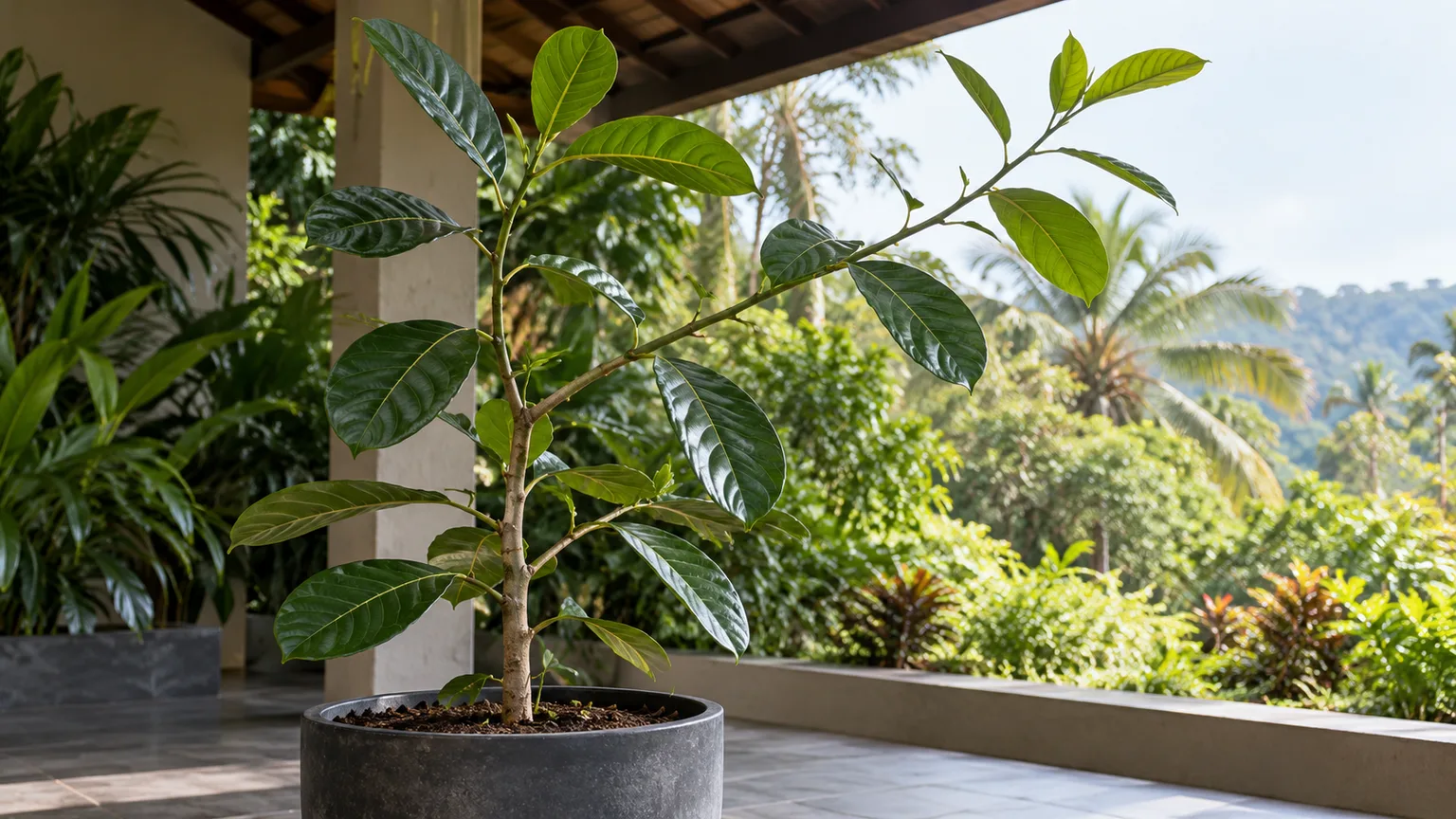
Not Enough Light on Jackfruit: Causes, Checks & Fixes
This guide covers not enough light on Jackfruit. See also the general Not Enough Light guide, watering, and light pages for this plant.
Not Enough Light on Jackfruit: Causes, Checks & Fixes
Quick answer: check direct sun before feeding
Jackfruit is not a shade-tolerant indoor foliage plant. UF/IFAS recommends planting it in full sun for best growth, but the species sources do not set a Jackfruit-specific number of sunlight hours or a lux reading that confirms a problem. Start by logging direct sun at the canopy through a clear day. If the tree is in a pot, move it toward a warm, open-sky outdoor position; if it is planted in the ground, identify which tree, wall, or roof blocks the light before pruning or fertilizing.
A room can feel bright to a person and still be a poor place for a Jackfruit tree. In warm climates this is usually a site or canopy problem: a wall, balcony roof, neighbor’s tree, or taller part of the Jackfruit itself has shortened the period of direct sun. For the tree’s scale, climate, and long-term placement, start with the Jackfruit overview. For the general symptoms and mechanics of inadequate light across plants, see the not-enough-light guide.
What not enough light looks like on Jackfruit
On an established Jackfruit, the most useful clue is often the growing pattern rather than a dramatic leaf color. A tree in lasting shade may make weak or sparse growth and produce poorly; UF/IFAS specifically warns that Jackfruit planted too close to other trees or structures may not grow normally or produce much fruit because of shading. A young potted tree in a dim room may instead develop stretched, thin new shoots that lean toward the window. Treat those shoot signs as general seedling clues, not a symptom unique to Jackfruit.
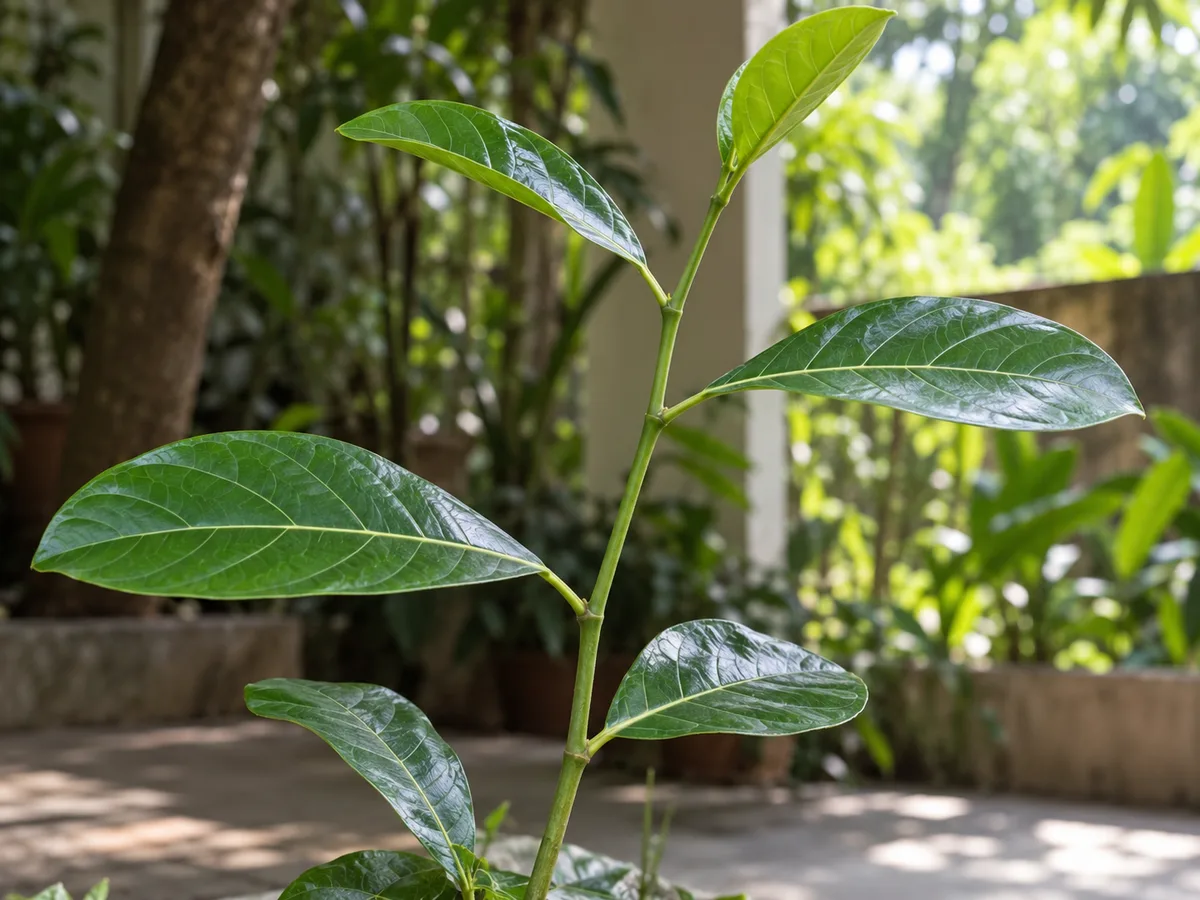
An elongated, sparse shoot can suggest that a young seedling is reaching toward light; compare the newest growth with the sun reaching the entire canopy before changing care.
Oklahoma State Extension describes indoor plants in too little light as becoming tall and lanky with small leaves, and Gardening Know How describes leggy seedlings as thin, pale, and leaning. Those are broad indoor and seedling patterns, not a verified Jackfruit symptom checklist. A mature outdoor tree may show the problem mainly as a shaded, thin canopy or poor growth and fruiting rather than a neat leaf-level symptom.
Do not diagnose light deficiency from yellow leaves alone. Yellowing can accompany drought, saturated roots, cold injury, pests, or ordinary leaf aging. A Jackfruit with long, weak stems is more suggestive of inadequate light when it has been kept indoors or under a roof and the root ball is not persistently dry or wet. If the visible issue is slow extension rather than the direction of growth, compare it with the Jackfruit leggy-growth guide and the Jackfruit problems hub.
Why shade affects Jackfruit differently from a houseplant
Jackfruit (Artocarpus heterophyllus) is a large evergreen tropical fruit tree. Purdue’s NewCROP account describes it as adapted to humid tropical and near-tropical climates, and UF/IFAS recommends open sun rather than a dim room for strong growth and production. The tree’s light demand is tied to building a broad, long-lived canopy and producing fruit, so the indoor labels “low,” “medium,” and “bright indirect” are not suitable Jackfruit targets.
Shade from nearby vegetation or structures can affect the whole crown. UF/IFAS notes that Jackfruit planted too close to other trees or structures may not grow normally or produce much fruit because of shading. For an in-ground tree, check the sun-facing and blocked sides separately: if one side receives direct sun while the other remains under a roof or neighboring canopy for much of the day, the weak side may be a site pattern rather than a root disease. A large tree cannot be fixed by rotating it like a pot.
The growing habit also matters. Jackfruit flowers and bears fruit on the trunk and large branches, so light reaching only the thin outer edge of a crowded canopy may not be the same as a well-lit planting site. UF/IFAS describes the species’ fruiting habit on the trunk and large branches; selective pruning can open the tree’s own inner canopy, but it cannot make an unsuitable shaded corner sunny. Use the Jackfruit pruning guide when crowded branches within the tree are the issue.
Confirm the light problem without confusing it with water stress
Track sunlight where the leaves are
For three or four clear days, note when direct sun reaches the Jackfruit’s upper and lower canopy. Check in the morning, around midday, and later in the afternoon; include shade from a balcony slab, compound wall, roof edge, coconut or mango tree, and the Jackfruit’s own branches. “Bright” ambient light is not the same as a sunbeam landing on the leaves. The Jackfruit light guide has placement advice for gardens, courtyards, terraces, and temporary indoor holding.
A light meter can help compare two locations, but use it as a relative tool: measure at the leaves, at similar times, and in the same weather. University of Georgia Extension describes general indoor light categories and shows that window direction, roof overhangs, trees, curtains, and season change indoor readings. Its indoor categories are not a Jackfruit minimum. The Spruce likewise explains that a north-facing or partially shaded window can count as low light for houseplants; do not use that label to claim a particular Jackfruit threshold.
Check the new growth and the root ball together
Look at the newest shoot tips and note whether the internodes are getting longer, whether the plant leans consistently toward one opening, and whether the whole canopy is sparse. Compare new leaves with older leaves of the same branch. For a seedling, weak elongation in a dim room supports the light hypothesis only when the plant’s watering and roots look reasonable; it does not prove a disease or a nutrient deficiency.
Next, feel the mix below the surface and lift the container if practical. If the pot is very light and the mix is dry, correct the root-ball drought before waiting for a light response; use the Jackfruit watering guide for a safe dry-down check. If the pot remains heavy and wet, improve drainage rather than watering more; the Jackfruit soil guide covers the tree’s need for a freely draining root zone. In a shaded location growth is slower, so do not keep watering on a hot-weather schedule without checking the mix.
Separate shade from sun injury and other lookalikes
| What you see | More likely explanation | First check |
|---|---|---|
| Long, thin new shoots leaning toward one window; the seedling stays in a room or under a roof | Insufficient light is plausible | Count direct sun at leaf height and compare with a more open position |
| An outdoor tree has a sparse or weakly growing side under a building edge or taller canopy | Persistent shade on that side | Trace the shadow through the day; do not assume roots are the cause |
| Leaves wilt when the root ball is dry and the pot is light | Root-zone drought may be contributing | Water thoroughly and let excess drain before rechecking growth |
| Yellowing or decline while soil remains wet for days | Drainage or root injury needs attention | Stop routine irrigation and check the soil guide |
| Bleached or crisp patches appear only after a sudden move into hard direct sun | Abrupt exposure injury is more plausible than a need for more light | Acclimate gradually and protect the pot from terrace heat |
| Brown tips appear near dry air or a heater while the shoot shape remains normal | A different environmental problem may fit better | Check the Jackfruit low-humidity guide |
The key distinction is the pattern and exposure history. A tree in full sun with drooping leaves does not need a brighter site simply because it looks tired. A seedling stretching toward a window is not automatically thirsty, and brown tips do not establish a low-light diagnosis. Use the Jackfruit problems hub if pests, spots, or a broader decline dominate the picture.
First fix: give a movable Jackfruit an open-sun position
If the Jackfruit is a container tree or small seedling, the first action is to move it to the warmest safe outdoor position with the longest open-sky exposure. Choose a place where the whole canopy can receive direct sun and rainwater can drain away. Do not park the pot under a balcony roof just because it is convenient to water, and do not move it into a permanently dim room to protect it from ordinary weather. Jackfruit is a fruit tree that needs outdoor space; for container roots or a failing pot, use the Jackfruit repotting guide before changing containers.
If the plant was grown in nursery shade or kept indoors, raise the light in stages rather than all at once. Start with a bright outdoor position that receives morning sun, then lengthen exposure while watching new leaves for bleached or scorched leaves. UGA Extension illustrates those overexposure signs for light-sensitive houseplants, so use them as a warning about abrupt transitions rather than a Jackfruit-specific sun limit. Keep the root ball evenly moist during the transition but let every watering drain. Oklahoma State Extension recommends artificial lights when indoor natural light is lacking. That is a holding measure for a small Jackfruit seedling, not a replacement for an outdoor fruiting site; follow fixture directions and keep the lamp clear of leaves and fabric.
For a Jackfruit planted in the ground, do not cut down a large neighboring tree immediately. First observe the shadow path and decide whether the obstruction is the neighboring canopy, a building, or the Jackfruit’s own dense growth. If selective pruning of the Jackfruit can open inner branches, make a measured cut at the appropriate season and preserve its main framework. If a young tree is permanently trapped in deep shade, moving it while it is still manageable may be more realistic than repeatedly feeding it. A mature tree under a building shadow may need local arboriculture advice rather than aggressive topping.
What to avoid while correcting Jackfruit light
Do not add fertilizer as a substitute for sun. Fertilizer cannot replace the energy the canopy receives from light, and a tree with weak or stalled growth may not use an increased nutrient dose well. Correct the exposure first, then use the Jackfruit fertilizer guide if new growth remains weak after light, water, and drainage are appropriate.
Do not overwater a shaded container because it is not growing quickly. With fewer hours of sun and less active growth, the mix may dry more slowly. Oklahoma State Extension notes that indoor watering frequency depends on the amount of light; use that as a principle, not as a Jackfruit schedule. Check moisture before each watering and empty the saucer or cachepot after rain. Conversely, do not allow a small pot to become completely dry in hot weather just because it has been moved outdoors; Jackfruit seedlings need consistent root-zone care during dry spells.
Avoid hard-pruning the entire tree in one attempt to “let more light in.” Removing too much leaf area can set back a tree that is already weak, and an in-ground Jackfruit that is shaded by a wall will remain shaded after its own branches are cut away. Open only the crowded parts that you can identify, and use the Jackfruit pruning guide for a controlled canopy plan.
Recovery: judge the next Jackfruit flush, not old stems
Existing long internodes will not contract after you improve the site, and old small or misshapen leaves will not enlarge. Recovery appears in new growth: shoots should develop in the improved exposure without the same extreme stretching, and the canopy should gradually fill where the tree is healthy. Keep a simple photo record from the same angle every few weeks so that you can compare the next flush rather than relying on memory.
A mature Jackfruit may take longer to show a change in flowering or fruiting than a seedling takes to show new leaf growth. The timing depends on cultivar, age, season, pruning, water, temperature, and general health. Do not promise a crop in the next cycle just because the tree is moved. If you have corrected light but the canopy continues to yellow or die back, reassess root drainage, dry periods, cold exposure, pests, and pot restriction before adding fertilizer or pruning further.
A severely stretched young tree can often continue growing once it receives better light, but moving it does not undo weak structural growth already formed. If the trunk is unstable or the main stem has bent sharply, use a loose support while the tree adjusts rather than tying it tightly against the trunk. If the roots are firm and the growing tip is alive, give it a stable sunny site and time to make better new shoots. If the roots are soft, the trunk base is rotting, or the main stem has died back to the graft or root collar, light alone will not rescue the damaged tissue.
Prevent Jackfruit light problems before planting or potting
Choose the site before you put a Jackfruit in the ground. A full-sun area that floods in monsoon weather is not a good site either, so balance open sky with the freely draining conditions described in the Jackfruit soil guide. If nearby trees will shade the future canopy as they mature, allow more clearance or plan a realistic pruning schedule before planting.
For a young potted tree, use a container position you can adjust while it remains portable. Check the sun path again when the season changes or a nearby tree leafs out; a spot that is sunny in winter can become shaded in summer under a different canopy. Do not let a young seedling’s first success near a window turn into a long-term indoor plan. A window can help hold a small plant temporarily, but it cannot provide the growing area and open-sun exposure of a proper Jackfruit site.
When nursery stock moves from shade to outdoor sun, acclimate it rather than leaving it in a dim room indefinitely or setting it suddenly into the harshest midday exposure. Keep the pot stable, maintain drainage, and change one major condition at a time so that sun injury, root disturbance, and drought do not overlap. The Jackfruit overview explains the tree’s mature size and outdoor needs; the watering guide helps you adjust irrigation once the new site changes how quickly the pot dries.
When to use this page vs other Jackfruit guides
Use this page when the canopy receives little direct sun and the new growth is thin, sparse, leaning, or consistently weak. If the Jackfruit is getting full sun but the pot is dry, start with the watering guide. If it stays wet after rain, the soil guide is the better next step. If indoor air or a heater is damaging the leaf edges, use the low-humidity guide; if roots are crowded or the pot dries unusually fast, use the repotting guide. The Jackfruit problems hub helps route symptoms that do not fit a shade pattern.
Related Jackfruit guides
- Jackfruit overview — check tree size, climate, and whether your site can support a sun-loving fruit tree.
- Jackfruit light guide — compare outdoor locations and plan gradual acclimation.
- Jackfruit watering — distinguish low-light slow growth from dry root stress and adjust watering after moving a pot.
- Jackfruit soil guide — correct drainage when the root zone remains wet.
- Jackfruit fertilizer guide — review nutrition only after the light and root-zone conditions are right.
- Jackfruit pruning guide — open a crowded Jackfruit canopy without removing too much framework.
- Jackfruit repotting guide — use when roots restrict growth or the current container is failing.
Related tool
Use the Why Is My Plant Dying? diagnostic tool to compare light, water, and other symptoms for your Jackfruit before changing several care conditions at once.