Jackfruit Leggy Growth: Light, Pruning & Fixes
Quick answer
A tall Jackfruit is not automatically leggy: this tropical fruit tree naturally grows a strong central leader and can become a large tree. If new shoots are unusually thin, widely spaced, sparse, or leaning toward an opening, first map direct sun at the canopy. Move a container tree gradually into open sun or reduce a confirmed shade source before pruning or feeding.
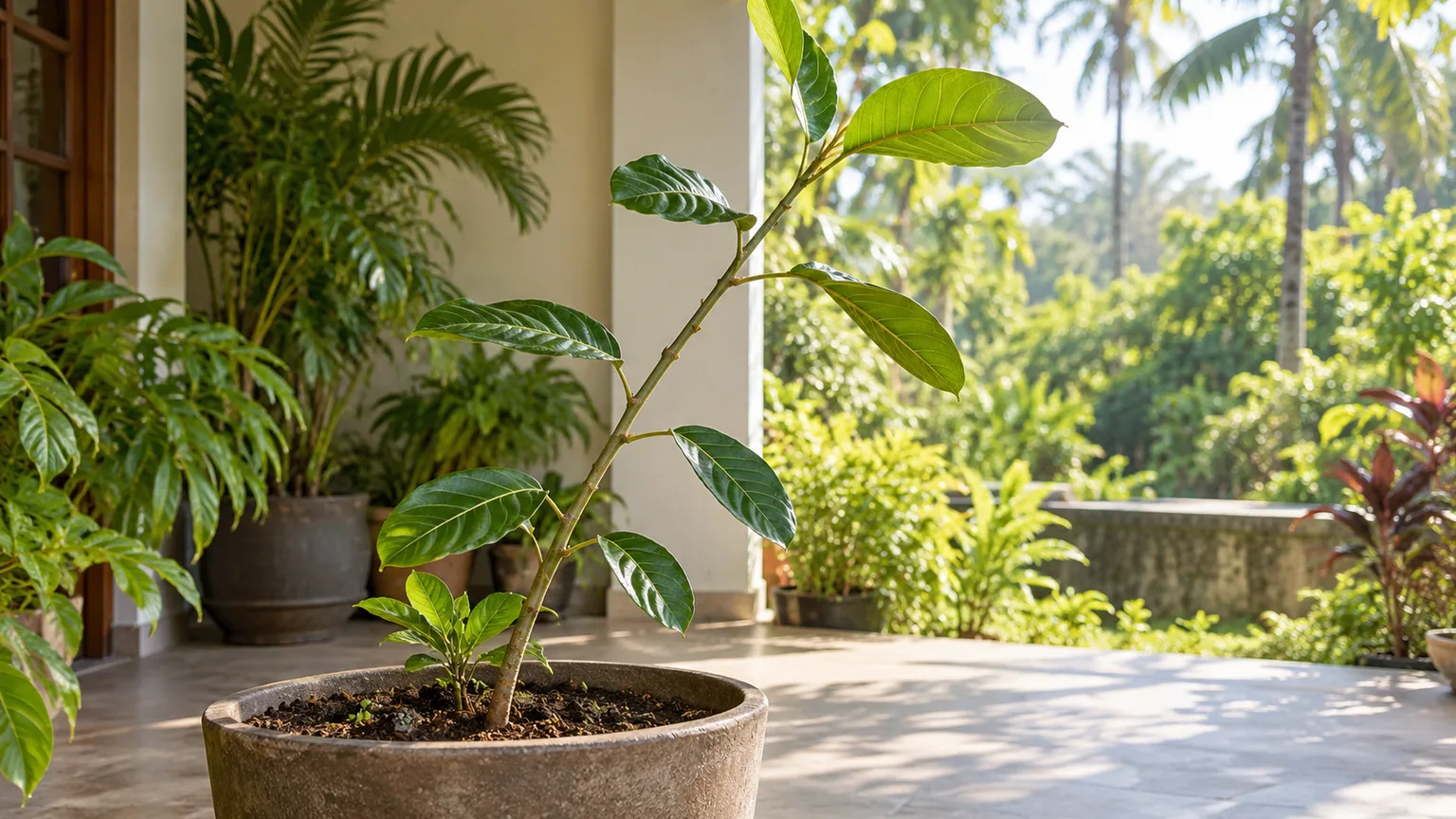
Leggy Growth on Jackfruit: Causes, Checks & Fixes
This guide covers leggy growth on Jackfruit. See also the general Leggy Growth guide, watering, and light pages for this plant.
Leggy Growth on Jackfruit: Causes, Checks & Fixes
Quick answer
A tall Jackfruit seedling is not automatically leggy. Artocarpus heterophyllus is a tropical fruit tree that naturally develops a central leader and can become a large canopy tree. If the newest shoot is thin, has long bare gaps between leaves, carries sparse growth, or bends toward one bright opening, first check how much direct sun reaches the canopy across the day. For general leggy-growth signs, see the global leggy growth guide; the Jackfruit-specific checks here help separate low-light stretching from normal tree form.
If a container tree has been kept indoors or under a shaded roof, the first correction is a gradual move toward open sun, not a hard cut or a dose of fertilizer. Jackfruit grows best in full sun, but young trees can suffer sunscald after shade if foliage is moved straight into harsh midday exposure. For a tree planted in the ground, map the shade source before changing the canopy.
What leggy growth looks like on Jackfruit
Leggy growth is a pattern in the newest stem extension, not a height measurement. Look for shoots that lengthen while leaf spacing opens up, leaves are scattered rather than filling the stem, and the stem looks too slender to hold its leaves upright. A young tree that leans toward a window, gap between buildings, or the open side of a veranda is giving a useful clue about where light is coming from. General horticulture sources describe low-light plants as stretching toward brighter conditions and becoming tall or spindly; on Jackfruit, that clue matters because the species is meant for open sun, not a dim indoor corner (Gardening Know How’s leggy-growth guide).
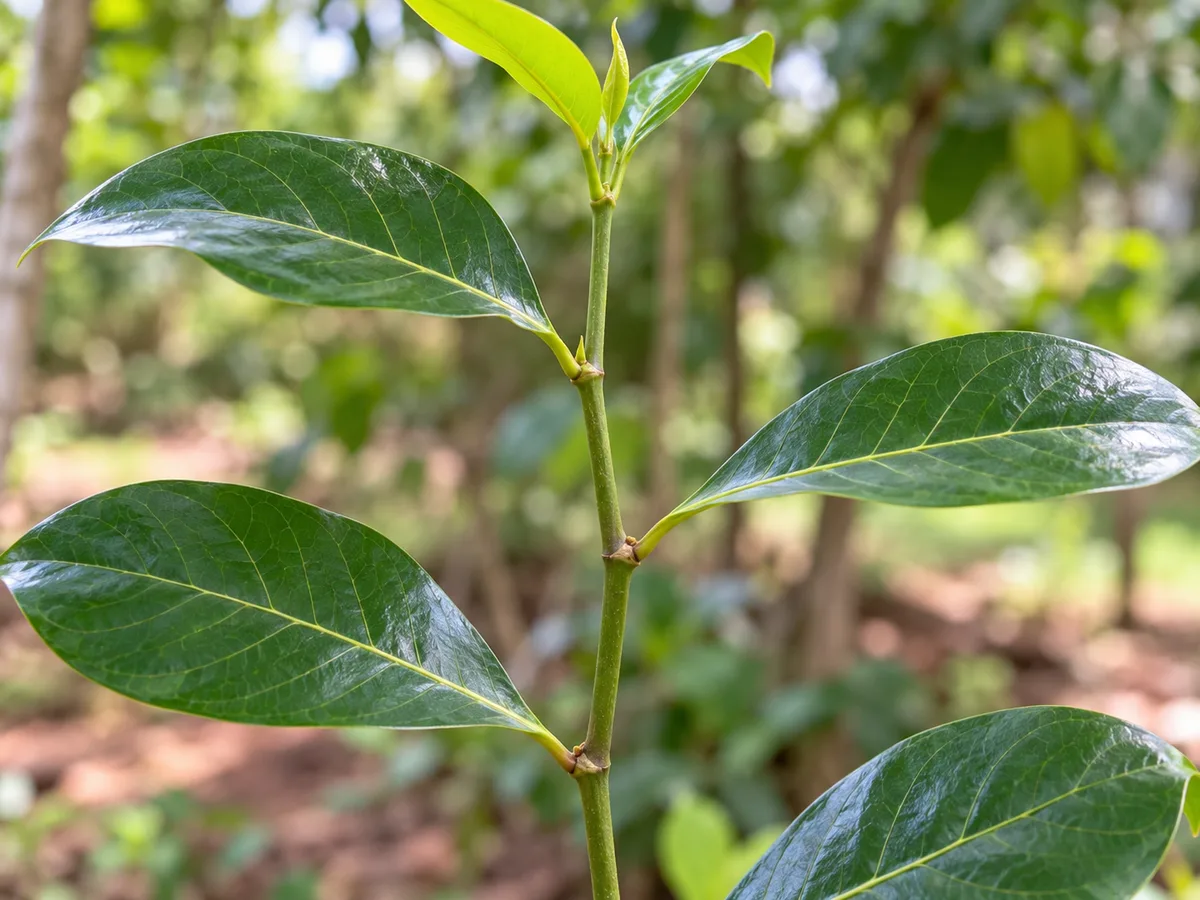
Long gaps on a young shoot can signal weak light, but check the whole tree and recent care before pruning.
A tall central shoot by itself is not a diagnosis. UF/IFAS notes that young Jackfruit trees commonly develop a strong central leader if left unpruned, and Purdue describes a naturally tall evergreen tree with broad leaves. Jackfruit leaves may also differ in shape between mature wood and young shoots, including oblong or lobed forms, so a change in leaf outline alone does not prove a growth disorder (Purdue’s Jackfruit profile). Look at the overall structure: Are there healthy side branches and reasonably full leaves, or only a thin extension reaching toward the one place with direct light?
First check: normal central leader or weak, stretched shoot?
Start with the age and setting of the tree. In a seedling’s early growth, one upright leader is ordinary. In a healthy outdoor tree, that leader should be supported by firm stem tissue and a canopy that continues to develop. It is more concerning when each new flush repeats the same long internodes, leaves become smaller or fewer, and the shoot bends or flops instead of carrying itself.
Compare the newest growth with the section below it. Measure or photograph the space between several leaf nodes rather than relying on a single long gap. If the older part of the stem is sturdier and fuller but the new section is thin and widely spaced, investigate a recent change in light, feeding, or container conditions. If both old and new growth are structurally sound and only one leader rises above lateral branches, the tree may simply be following its normal form.
Then note the direction of the lean. A shoot that reaches toward a window or an opening in the canopy suggests uneven light. A whole plant that leans but has compact, evenly spaced growth may instead need support or a more balanced position. Do not pull a young tree upright by tightening a tie around a narrow stem; if support is needed, use a loose tie and allow room for the trunk to thicken.
Low direct light is the first cause to test
Jackfruit is a sun-loving fruit tree. UF/IFAS recommends planting it in full sun for best growth and fruit production and notes that close planting beside other trees or structures can reduce normal growth through shading (UF/IFAS Jackfruit guidance). In a home setting, the same issue can happen when a seedling is left behind a balcony wall, under a deep terrace overhang, or several metres from a bright window. A room that looks bright to a person may still give the leaves little direct sun.
For a container Jackfruit, record when sun reaches the leaves rather than the pot or floor. Check from morning through afternoon, including whether a wall or neighbouring tree blocks the middle of the day. North-facing rooms and partly shaded windows are examples of low-light placements for many houseplants, but Jackfruit’s needs are more demanding than those indoor examples; do not use a low-light houseplant chart to justify keeping this fruit tree in a dim room (The Spruce’s light guide).
If the canopy receives only brief direct light and the latest shoots are sparse and elongated, correct exposure before pruning. Shift a pot to a brighter open-sky position in stages, starting with morning sun and gradually increasing its exposure; a sudden full-day jump can scorch a shade-grown tree. The Jackfruit light guide covers placement and acclimation in more detail.
For a tree in the ground, the light source may be another tree, a wall, or a building. Do not top the Jackfruit in an attempt to make it bushy while the lower canopy remains shaded. Assess whether a nearby obstruction can be reduced safely; if the site cannot receive more light, accept that growth may stay less compact and fruiting may be limited. Use the Jackfruit overview to weigh the tree’s mature size and site needs before planning a major relocation.
Jackfruit training: shape the leader in stages
Jackfruit needs its own pruning logic. UF/IFAS says first-year trees do not need structural pruning, although light shoot-tip pruning once or twice during spring and summer can encourage lateral bud break and a more compact shape. By the second season, its guidance is to prune to the first lateral branch to slow upward growth and encourage a spreading canopy. That is deliberate training, not an emergency treatment for every tall seedling (UF/IFAS young-tree pruning).
If the plant has not had enough light, improve exposure first so new lateral shoots can develop under better conditions. Do not remove most of the living top from a weak, recently transplanted, or root-restricted tree. If the young tree is healthy and you want a lower framework, use a clean tool to make a modest tip cut at the planned time, then wait to see which lateral buds break. The Jackfruit pruning guide explains how to choose those cuts and how the approach changes as the tree matures.
Mature Jackfruit is not trained like a hedge. It bears flowers and fruit on the trunk and large branches, so a hard shearing cut can remove productive wood without correcting the shade around it. UF/IFAS recommends selectively removing vigorous upright shoots and thinning older limbs after harvest to improve light penetration through the inner canopy (UF/IFAS pruning guidance). If a mature tree looks sparse because its centre is shaded, selective canopy work is more appropriate than repeatedly cutting every long shoot back to the same height.
Check fertilizer before trying to force thicker growth
A rapid, soft flush after feeding can resemble a light problem, especially if the tree was given a high-nitrogen product or a larger dose than its label calls for. General plant-care references include excess nitrogen among possible causes of tall, weak growth, but that is not proof that Jackfruit needs less nutrition in every case (Gardening Know How). Jackfruit feeding recommendations vary with tree age and whether it is in a pot or the ground; UF/IFAS gives distinct schedules for young and mature trees.
Write down the product, dilution, and date of the last feeding. If the tree was fed recently and the new extension is unusually soft, pause extra fertilizer and review the dose before adding anything else. Do not use a stronger fertilizer to make the stem “catch up” or apply a bloom formula to correct sparse leaves. For normal age-based feeding, use the Jackfruit fertilizer guide, and return to feeding only when the tree is growing actively and its root zone is sound.
Rule out root restriction and water stress
A cramped container does not usually explain a long internode pattern on its own, but a root-bound tree can establish poorly and fail to support vigorous, balanced growth. UF/IFAS notes Jackfruit is affected by root restriction and that pot-bound trees do not establish well after planting. Check for a dense mat of circling roots, roots emerging from drainage holes, or mix that dries unusually quickly. If those signs are present, address pot size and root structure through the Jackfruit repotting guide rather than repeatedly cutting the canopy.
If a leggy Jackfruit also droops, yellows, or stops producing leaves, do not assume the stem spacing explains every symptom. Check the root zone before changing water: Jackfruit does not tolerate prolonged waterlogging and may decline after only a few days of wet soil (UF/IFAS on wet soil). For a container, compare pot weight and feel the mix below the surface; for an in-ground tree, account for recent rain and irrigation. Use the Jackfruit watering guide for dry-down checks and the Jackfruit soil guide if the mix stays soggy or drains poorly.
Recovery: judge the next flush, not the old stem
Existing long sections of stem will not shrink or fill in between their old leaf nodes. The practical sign of improvement is new growth after the light or feeding correction: leaves appear at more regular intervals, laterals remain upright, and the tree no longer bends toward one small opening. Keep healthy leaves on the plant because they support the tree while it builds a better framework.
Do not expect a seedling to become a compact bush immediately. Jackfruit is a large tree, and its mature form is not comparable with a compact indoor foliage plant. A healthy young plant may still grow vertically as it establishes its leader. If the stem is so weak that it cannot remain upright, provide temporary loose support while improving the growing conditions; remove or loosen the support as the stem strengthens so it does not rub or constrict the trunk.
If the next flush remains thin despite open sun, reconsider the diagnosis rather than repeating the same cut. Review fertilizer history, root restriction, pot stability, and whether the plant has been repeatedly pruned before it could make lateral growth. A single photo of the whole tree and close-ups of the newest shoot, pot surface, and branching point can help a local extension agent advise on a young tree that continues to decline.
Prevent leggy growth on Jackfruit
Choose a site based on direct light at the canopy, not how bright the ground feels. Plant Jackfruit where buildings and neighbouring trees do not shade it through most of the day, and avoid a low spot that stays wet after rain. Tamil Nadu Agricultural University also recommends deep, well-drained soil for Jackfruit cultivation (TNAU Jackfruit guidance). For container growing, use the largest practical well-drained pot and place the canopy where it can receive open sun; a dark corner beside a bright window is still a poor long-term site for this species.
Train a young tree gradually rather than repeatedly topping it. Allow the leader to establish, then use the UF/IFAS young-tree approach when you want to encourage lateral structure. As the tree matures, selectively remove vigorous upright shoots after harvest and maintain light through the inner canopy. The Jackfruit problems hub helps you compare a structural issue with other symptoms if leaves are also yellowing or dropping.
Avoid excess fertilizer and keep roots healthy. Match feeding to age and season, and water according to the actual pot or soil rather than a fixed calendar. A monthly record of sun exposure, fertilizer, pot changes, and new-shoot spacing makes it easier to see whether the same stress returns after each flush.
Related Jackfruit guides
Use this page when the main concern is a thin, stretched Jackfruit shoot or an uneven canopy. The Jackfruit overview is for site and mature-tree context; the light guide is for exposure changes; and the pruning guide is for choosing a training cut. Use the fertilizer guide if a recent feed may have driven a soft flush, and the problems hub when other symptoms accompany the weak growth.
Related tool
Use the Plant Problem Diagnosis Tool to compare leggy growth with light, feeding, or other visible stresses before making several changes. Treat its result as a starting point; the direct-sun and leader checks above are still needed for a Jackfruit tree.