Lotus Light Guide: Sun Hours, Shade & Placement
Lotus Light Guide: Sun Hours, Shade & Placement
Lotus Light Guide: Sun Hours, Shade & Placement
Lotus light care starts with one non-negotiable fact: true lotus is a full-sun aquatic, not a foliage plant for a dim indoor corner. The target here is Nelumbo nucifera—sacred or Indian lotus—grown with its rhizome rooted in submerged soil and its leaves rising to or above the water. Kew describes the accepted species as a rhizomatous hydrogeophyte, while UF/IFAS classifies it plainly as an aquatic plant that requires a full-sun site.
If your lotus makes leaves but no buds, measure the direct sun reaching the leaves before changing fertilizer. A terrace may look bright while a parapet, tree, roof overhang, or neighboring tower blocks half the useful day. Record when direct rays first touch the leaves and when they leave for three clear days; that simple check is more reliable than calling a balcony “south-facing” or a courtyard “sunny.”
Quick answer: how much light lotus needs
Give Nelumbo nucifera at least six hours of unobstructed direct outdoor sun each day, with a longer sunny period usually preferable during active growth. NC State defines the species’ full-sun category as six or more hours of direct sunlight, and UF/IFAS likewise says lotus needs plenty of space and full sun to thrive. Count sun at leaf level, not daylight in the sky.
A healthy plant may remain alive in less light, especially after the rhizome has stored energy, but survival is not the same as reliable flowering. In partial shade, expect fewer aerial leaves, thinner or leaning petioles, and delayed or absent buds. First move the container to a sunnier position; do not try to replace missing photons with extra fertilizer.
True lotus is not a water lily
This guide does not cover Nymphaea water lilies. Lotus belongs to the family Nelumbonaceae, and the RHS profile for Nelumbo nucifera describes a rhizomatous aquatic with flowers held well above the water. Water lilies are different plants with different cultivar tolerances, even though nurseries and common names sometimes blur the labels.
The distinction matters when interpreting light advice. A seller’s claim that a “lily” tolerates partial shade does not establish that sacred lotus will flower there. Confirm the botanical name on the label and use the Lotus overview when you need whole-plant identification and care context.
The leaf position gives the plant away
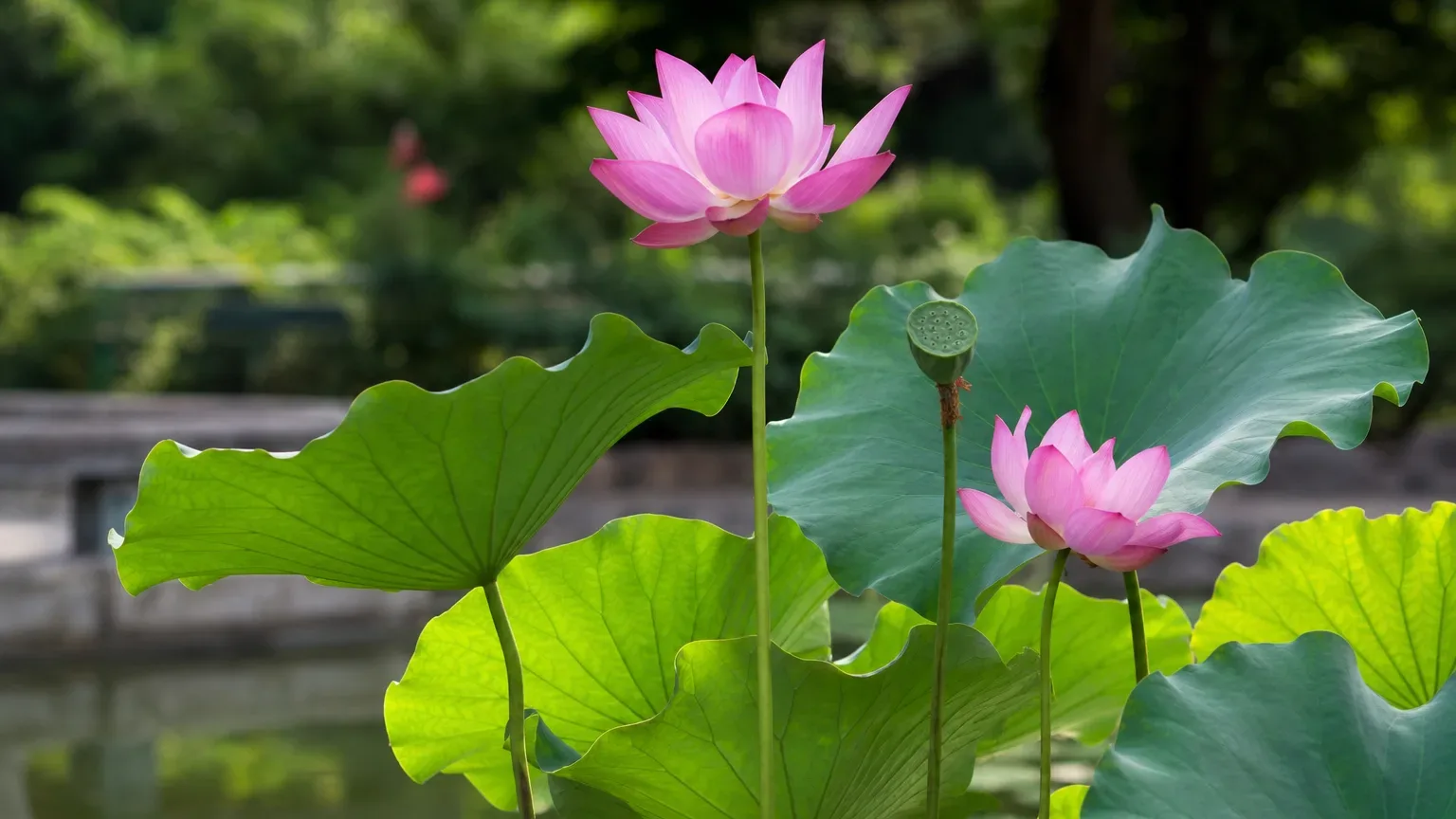
Established true lotus commonly produces round, centrally attached leaves held above the water like shallow umbrellas, along with raised flowers and seed pods. Clemson Extension contrasts Asian lotus with water lilies by noting the lotus’s upright leaves, flowers, and seed pods above the surface. Early lotus leaves can still float, so use the botanical name and later growth habit together rather than identifying one new leaf in isolation.
That raised canopy also changes placement. A low wall that does not shade the water can still shade aerial leaves, and a tall stand of lotus can eventually enter shade cast by a roof edge that missed it when growth began. Recheck the sun path after the leaves gain height.
How much direct sun does lotus need?
The practical range is six hours as a minimum target and most of a sunny growing day as the better flowering position. RHS specifies full sun in an outdoor pool, as does the Missouri Botanical Garden’s species profile, which recommends calm water in full sun. These recommendations apply to rooted aquatic culture, not to submerging the whole plant in an aquarium.
Sun does not act alone. A newly planted division, a crowded rhizome, cool water, an undersized cultivar, or badly timed feeding can all delay flowering despite good light. Treat full sun as a necessary growing condition, not a guarantee that every lotus will bloom on a fixed date.
Why six hours is a useful minimum
Six hours gives growers a clear threshold they can observe without specialized equipment. Count only direct rays on the leaf surface; bright open shade before or after that period is useful but does not turn four hours of sun into six. In an urban setting, track moving shadows from railings and towers, because fragmented exposure can look longer than it is.
If your site provides five hours and the plant grows strongly, you do not need to dismantle the pond immediately. Watch whether new leaves stand firmly and whether a mature, established plant sets buds during warm weather. If growth remains leafy but flowerless, gaining another one or two hours of direct sun is a better first experiment than increasing feed.
Duration matters more than a brief bright spell
A fierce two-hour noon blast is not equivalent to a long sunny morning and early afternoon. Lotus needs sustained daily energy to build its large aerial canopy and flowers. Missouri Botanical Garden records the species as a summer-flowering plant with large leaves and flowers, and its collection shows rapid spring growth followed by summer bloom.
Observe the entire day rather than checking once at lunchtime. Morning sun lost behind a building, monsoon cloud, and late-afternoon tree shade can reduce the useful total even when the tub is dazzlingly bright at noon.
Best pond and container placement
Choose the most open, stable outdoor site that receives at least six direct-sun hours and allows the mature leaves to rise without entering shade. A sunny terrace, open courtyard, roof garden, pond edge, or large watertight tub can work. A covered balcony, screened veranda, or spot under a dense tree usually cannot support dependable flowering.
Shelter from severe wind is helpful because large aerial leaves catch gusts. NC State recommends a sheltered position with little wind and wave exposure. Do not solve wind by moving the lotus into deep shade; use a wind-permeable screen or a lower, more protected sunny position instead.
Placement in India and tropical climates
In much of India, an open east-to-south exposure can provide a long bright period before the hottest late-afternoon conditions. The exact compass direction is less important than the measured sun path, local obstructions, and season. During monsoon weeks, maximize openness because clouds already reduce total light; avoid adding permanent shade based on one hot pre-monsoon afternoon.
Place pale or reflective walls with care. They can increase brightness, but they can also raise leaf and water temperature in a small dark tub. Monitor water temperature, leaf posture, and evaporation after moving a container beside concrete or metal, and use the Lotus watering guide to keep the submerged root zone stable.
When brief afternoon shade can help
Healthy, established lotus generally belongs in full sun. Brief late-afternoon shade can be a reasonable heat-management compromise where extreme reflected heat repeatedly overheats a small container, but it should not cut the plant below the six-hour target. Shade is a site correction for excessive thermal load, not the normal light prescription.
Before adding shade cloth, separate sun injury from water or root problems. Top up evaporated water, confirm the rhizome remains submerged correctly, and move a heat-absorbing container away from a radiant wall. If shading is still needed, block only the harshest late period and keep the morning-to-early-afternoon sun intact.
Can lotus grow indoors or under grow lights?
Ordinary indoor window light is rarely enough for a mature lotus to flower well. Glass, roof overhangs, distance from the pane, and the changing sun angle all reduce useful exposure, while a full-size lotus also needs a wide submerged-soil container and substantial vertical room. RHS allows culture under glass but specifies a large container in an indoor pool in full light—closer to a bright conservatory or greenhouse than a living-room shelf.
Artificial-only culture is possible in principle, but it is an advanced setup rather than a dependable shortcut. The fixture must evenly illuminate a wide, rising canopy without overheating leaves or water; decorative bulbs and ceiling lights are inadequate. Use a horticultural fixture whose manufacturer provides measured output, start with a consistent long-day schedule, and judge success by compact aerial growth and eventual buds rather than by the fact that leaves remain green.
The University of Bristol Botanic Garden grows sacred lotus in a tropical glasshouse and describes winter slowdown during short, cold UK days. That example shows the scale and environmental control involved. For most homes, outdoor seasonal culture is simpler and more reliable than trying to turn a room into a lotus house.
Signs a lotus is getting too little light
The strongest pattern is persistent leaf production without flowers on an otherwise mature plant, especially when the site receives fewer than six direct-sun hours. New petioles may lean toward the open sky, aerial leaves may remain smaller or less numerous, and growth may lose momentum even while water and warmth are adequate. A fresh rhizome or dwarf cultivar can also be slow, so diagnose the whole setup rather than one symptom.
Use a short decision sequence:
- Measure direct sun at the leaves for three clear days.
- Confirm the plant is true Nelumbo nucifera, not a water lily.
- Check that the rhizome has room, correct water depth, and warm active-season conditions.
- Move to more sun before adding fertilizer.
- Evaluate new growth over the following warm weeks; old leaves will not change their history.
Do not assume yellowing automatically means shade. Nutrient depletion, natural leaf aging, pests, damaged rhizomes, and poor water conditions can produce overlapping symptoms. Use the Lotus fertilizer guide and Lotus soil guide when the measured light is already adequate.
Can lotus get too much sun?
For an established lotus with submerged roots and stable water, outdoor full sun is normally appropriate. The more common danger is combined heat and water stress, not sunlight alone: a small dark container beside a hot wall can warm rapidly and lose water while tender leaves are still adjusting. Recently moved or newly emerged foliage deserves closer observation than a mature canopy.
Watch for damage confined to the most exposed side, such as bleached patches, crisp margins, or repeated midday collapse that recovers after the heat falls. First stabilize the water level and reduce reflected heat. If the pattern continues, provide brief late shade while preserving at least six hours of direct sun; avoid shifting the plant from full sun to deep shade in one move.
Seasonal light changes and flowering
Lotus is a warm-season perennial. UF/IFAS lists it as summer flowering, and the Missouri Botanical Garden collection moves from spring leaf growth to summer flowers before seasonal decline. Day length, sun angle, cloud cover, and temperature therefore change what the same fixed position delivers.
In India, check the site before active spring growth, again as monsoon cloud and sun angles change, and after nearby plants leaf out. A position that clears six hours in May may drop below it when a tree canopy fills or when a roof edge intercepts the lower seasonal sun. Dormant or cooling-season lotus does not need forced flowering light; let the plant follow its cultivar and climate while protecting the rhizome appropriately.
How light interacts with water, warmth and feeding
Light powers growth, but lotus can use that energy only when its aquatic root system is functioning. Keep the heavy soil submerged at the cultivar-appropriate depth, and avoid lowering a newly planted rhizome so deeply that young leaves cannot reach the surface. UF/IFAS recommends beginning around six inches of water and lowering the container as growth starts, with the container bottom no more than 18 inches below the surface for its general species guidance.
Do not feed a weak, shaded lotus aggressively. Fertilizer supplies nutrients; it does not supply light, and excess nutrients can worsen water quality without fixing the energy shortage. Correct exposure first, then follow plant stage and aquatic-product directions in the fertilizer guide.
Container size also changes the response to sun. Full-size sacred lotus can become large and fast-growing, while dwarf selections remain much smaller; Missouri Botanical Garden describes ‘Momo Botan’ as a one-to-two-foot dwarf lotus. Dwarf does not mean shade-loving. It means the cultivar may fit a smaller sunny water container.
When to use this page vs other Lotus guides
- Use the Lotus overview to confirm identity, growth habit, mature size, and complete aquatic care.
- Use Lotus watering for water depth, topping up, submerged soil, and seasonal water management.
- Use Lotus soil when the medium floats, clouds the water, or fails to anchor the rhizome.
- Use Lotus fertilizer after adequate light is confirmed but established growth still appears nutrient-limited.
- Use Lotus repotting when circling, crowded rhizomes reduce vigor despite full sun.
Related Lotus guides
- Lotus care overview
- Lotus watering guide
- Lotus soil guide
- Lotus fertilizer guide
- Lotus propagation guide
- Lotus repotting guide
Conclusion
True lotus light requirements are straightforward: grow Nelumbo nucifera as an outdoor aquatic in full sun, with at least six hours of direct light at leaf level. Give it a longer open-sky day when possible, especially if flowering is the goal. Do not transfer partial-shade claims from water lilies to lotus, and do not treat a bright-looking room as the equivalent of a sunny pond.
When growth is weak or flowers fail, measure sun before changing feed. Then check warmth, water depth, rhizome maturity, and container space. In very hot sites, manage reflected heat and evaporation first; use only brief late shade if needed so the plant keeps its full-sun day.