Yellow Leaves on Lotus: Causes, Checks & Fixes
Quick answer
Yellow leaves on lotus often trace to water depth, sun, or aging—not a dry-soil houseplant problem. First step: mark the waterline, confirm submerged soil, and check whether the newest leaf stalk can reach the surface.
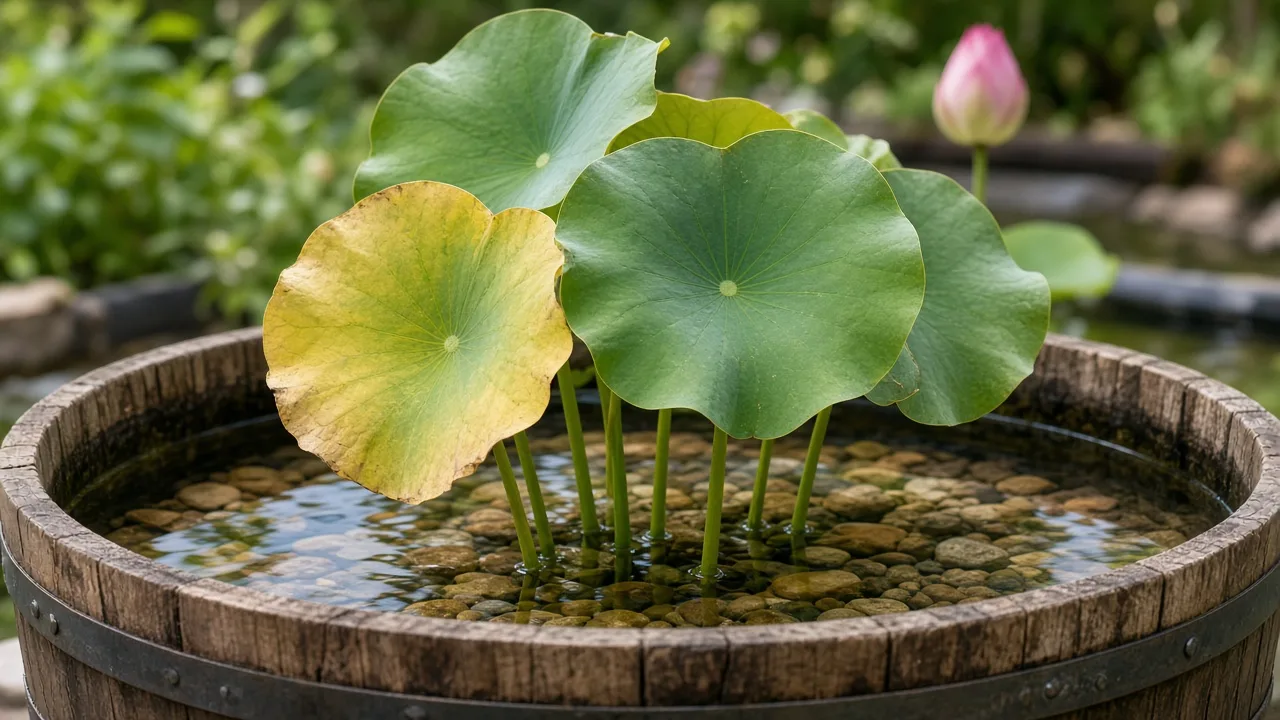
Yellow Leaves on Lotus: Causes, Checks & Fixes
This guide covers yellow leaves on Lotus. See also the general Yellow Leaves guide, watering, and light pages for this plant.
Yellow Leaves on Lotus: Causes, Checks & Fixes
Quick answer
Round lotus leaves turning pale or yellow look alarming in a pond tub, but on Nelumbo nucifera the diagnosis starts with water depth and sun, not whether the soil feels dry. Lotus roots live in submerged heavy loam; yellowing usually means the rhizome cannot support a leaf, the leaf is simply aging out, or minerals and fouled water are stressing new growth.
First step: mark the waterline and inspect the newest leaf stalk. Confirm the soil cap stays underwater and that the emerging leaf can reach the surface without exhausting itself. If the newest pad stalls below the water or the soil surface is exposed after evaporation, correct depth or top up before touching fertilizer or pesticides.
For how chlorosis develops on plants in general, see our yellow leaves hub. On lotus, the pattern almost always ties to pond depth, full sun, hard-water buildup in small containers, or normal fading of older pads—not a missed weekly watering on dry potting mix.
When to use this page vs other lotus guides
This page is the symptom-first entry for yellow foliage. Use it to read leaf pattern against water level and rhizome health.
- Overwatering — go here when the container was lowered too deeply too soon, young leaves drown below the surface, or stagnant fouled water surrounds the rhizome
- Underwatering — go here when evaporation exposes the soil cap, margins crisp, or aerial leaves wilt from a dropped waterline
- Root rot — go here when rhizomes are soft, black, or sour-smelling despite submerged soil
- Not enough light — go here when leaves stay small, pale, and sparse in shade without dependable flowers
- Watering guide — go here for long-term depth schedules, top-ups, and hard-water flushing after yellowing stabilizes
What yellow leaves look like on lotus
Healthy lotus sends up small floating pads first, then larger peltate aerial leaves held above the water on stiff hollow stalks. Trouble shows in patterns that map to pond conditions:
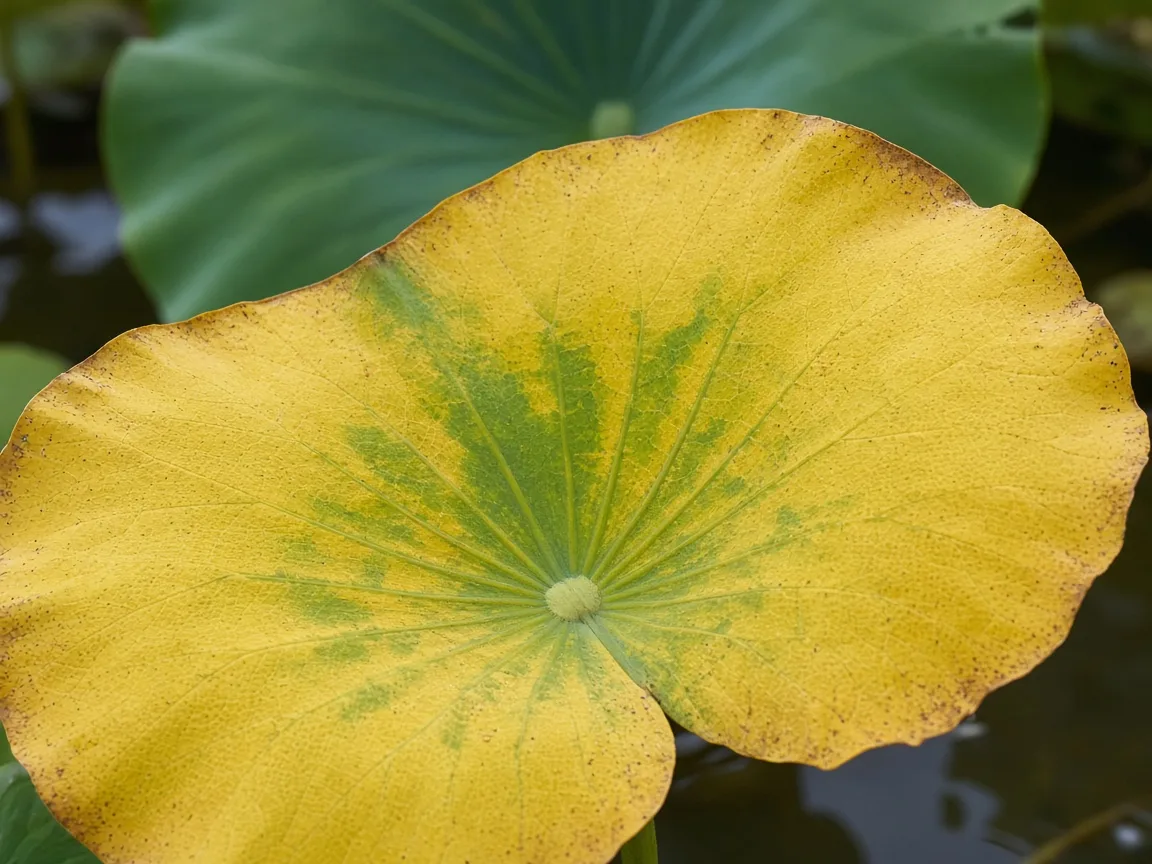
Yellow leaves on lotus — compare fading outer pads with the color and firmness of the newest aerial leaf.
- Oldest outer pads yellow from the edge inward while newer aerial leaves stay deep green — often normal senescence or end-of-season fade
- New floating leaves pale, fold, or decay underwater before opening — classic excessive depth or cool spring water delaying emergence
- Whole plant looks chartreuse in partial shade with thin stalks and no flowers — insufficient sun for this full-sun aquatic
- Yellowing with brown crisp margins on aerial leaves after hot windy weather — evaporation dropped the waterline and exposed the crown briefly
- Patchy yellow pads with sticky residue or stippling — suspect aphids or spider mites on the undersides of floating leaves
Because lotus stores energy in thick rhizomes rather than individual pads, one yellow leaf does not always mean crisis. Several new leaves failing together while water smells stagnant does.
Normal vs alarming:
- One fading pad on an otherwise vigorous plant in full sun is often expected; the RHS advises removing fading foliage as part of routine care
- Multiple new stalks yellowing or rotting below the surface within a week is urgent
- Late-season yellowing across many pads before dormancy can be natural if rhizomes stay firm
Reading floating vs aerial leaf yellowing
Lotus growth follows a sequence houseplants do not share. After spring planting, the rhizome pushes short floating leaves that lie on the water, then standing aerial leaves on longer stalks, and only later flowers on stiff stems above the foliage. The International Waterlily & Water Gardening Society notes that lotus make floating leaves first, then standing leaves—and that timing matters for feeding and depth changes.
Floating pad yellowing alone on the plant’s outer ring often means that pad has finished its job. Aerial leaf yellowing on the newest stalks usually means the rhizome or water conditions are failing now: depth, rot, minerals, or starvation. Always inspect the newest stalk, not the largest old pad, when deciding urgency.
Why lotus gets yellow leaves
Excessive water depth (most common grower mistake)
Sacred lotus is not overwatered in the houseplant sense—the soil should stay submerged—but it can be set too deep too soon. UF/IFAS starts newly planted lotus with about 6 inches of water over the container, then allows the bottom to sit up to 18 inches below the surface once growth is established. Missouri Botanical Garden notes container crowns may sit under up to 24 inches of water in large ponds—but that applies to established plants, not fresh rhizomes with short stalks.
When depth outpaces stalk length, new leaves exhaust themselves underwater, turn yellow, and decay before opening. Dwarf cultivars need shallower water than standard lotus; IWGS recommends 2–12 inches for dwarfs versus up to 18 inches for tall standards.
Evaporation and exposed soil (functional underwatering)
Lotus cannot tolerate a dry soil cap. Hot, windy weather pulls water down quickly in shallow tubs. When the sand or gravel cap breaks the surface, the rhizome crown dries, aerial leaves wilt, and margins yellow. This is a waterline problem, not a signal to switch to fast-draining potting mix. See the watering guide for top-up rhythm and the underwatering page when soil exposure is the main clue.
Insufficient sun
Lotus is built for full outdoor sun. UF/IFAS lists full sun as a requirement, and IWGS states lotus prefer full sunlight to grow and bloom their best—with shade mainly useful against extreme desert heat. In partial shade or a dim indoor pool, leaves stay pale yellow-green, stalks weaken, and flowering fails even when water depth is correct. Cross-check the light guide and not enough light page if the whole plant looks washed out, not just one pad.
Hard-water mineral buildup in small tubs
In above-ground pots, evaporation leaves minerals behind while fresh top-ups add more. IWGS warns that very hard, alkaline water can accumulate harmfully in containers and recommends occasional over-filling to flush minerals, noting lotus tolerate little over 1000 ppm hardness. Chronic buildup can yellow new growth and stall vigor even when depth and sun look fine—especially in small tubs without overflow.
Feeding mistakes
Lotus needs buried aquatic fertilizer during warm active growth, but timing matters. IWGS advises beginning fertilizer when standing leaves form, because it is easy to over-fertilize sprouting rhizomes yet hard to over-feed a fast-growing established plant. Early tablet placement against a fresh rhizome can burn tender shoots; skipping feed all season after several aerial leaves open can produce pale, weak pads. Follow the fertilizer guide and push tablets deep into heavy loam away from the growing tip.
Rhizome rot in stagnant or fouled water
Black, soft rhizome tissue in sour, stagnant tubs stops supporting new leaves. Leaves yellow, collapse, or fail to open even though the pot is “wet.” This overlaps with overwatering in the pond sense—fouled stagnant water rather than dry soil. Firm ivory rhizomes with a intact pointed growing tip suggest rot is not the driver.
Normal aging and dormancy fade
Large lotus plants continuously shed older outer pads. The RHS includes removing fading foliage in routine culture. Late-summer yellowing across many pads before leaves die back for dormancy can be normal if new spring growth the following year emerges clean. Do not confuse this with spring depth stress on a newly planted rhizome.
Less common causes
- Cool spring water — shallow water warms faster; deep cold tubs delay emergence and pale early leaves (IWGS)
- Stem cuts below the waterline — IWGS warns never to cut flower or leaf stems below water because rhizomes use even dead stems for oxygen; bad pruning can stress the plant
- Pests — Missouri Botanical Garden lists aphids and spider mites as occasional lotus pests; inspect floating leaf undersides before assuming a care error
- Koi or large fish disturbance — soil clouding and torn pads from fish can yellow damaged tissue locally
How to confirm the cause
Work through these checks in order:
- Waterline mark — Is the soil cap fully submerged? Has evaporation dropped the tub more than usual this week?
- Newest leaf stalk — Does the emerging pad reach the surface and open flat, or stall/yellow underwater?
- Depth vs cultivar — Is a new rhizome sitting at maximum depth while stalks are still short? Dwarf or bowl lotus in deep water?
- Sun exposure — At least six hours of direct outdoor sun on most of the foliage?
- Water smell and clarity — Sour stagnant odor or thick algae mat around the crown?
- Rhizome tip — Gently inspect the growing point at the container edge: firm and pointed, or black and soft?
- Leaf age pattern — Only outer pads fading, or new aerial leaves too?
- Feed history — Tablets placed before standing leaves formed, or no feed despite months of strong growth?
- Hard-water history — Small tub topped up for weeks without an overflow flush?
Depth stress vs aging vs mineral buildup
| Clue | Excessive depth | Normal aging | Hard-water buildup |
|---|---|---|---|
| Which leaves | New floating or aerial leaves fail | Oldest outer pads only | Newest growth pale; older pads may look mottled |
| Waterline | Stable and submerged | Stable | Stable but tub rarely flushed |
| New stalk behavior | Stalls or rots below surface | New stalks open green | Slow, thin new leaves |
| Rhizome tip | Firm unless rot added | Firm | Firm |
| Sun | Usually adequate | Full sun | Usually adequate |
| First action | Raise pot or reduce depth | Prune spent pad above water | Over-fill flush; review feed timing |
First fix for lotus
Mark the waterline and adjust depth so the soil stays submerged while the newest leaf can reach the surface.
That single correction fixes the most common yellow-leaf mistakes on lotus: exposed crowns from evaporation and drowned new leaves from excessive depth. Top up immediately if soil shows. If the newest stalk is struggling underwater, raise the container on a brick or shelf—or remove one depth step—and wait for the next leaf before lowering again.
Do not repot, heavily fertilize, or spray pesticides on the same day you change depth. Make one water-level correction, observe the next two leaves, then branch to root rot or pest pages if yellowing persists.
Step-by-step recovery
Path A — Depth or waterline stress, firm rhizome
- Mark the normal waterline inside the tub.
- Top up if the soil cap is exposed; use gentle refills down the container wall.
- If new leaves stall underwater, raise the pot until several aerial leaves open reliably (UF/IFAS shallow start).
- Remove yellow pads by cutting stems above the waterline only (IWGS pruning note).
- Watch the next two floating or aerial leaves over two to three weeks before deepening again.
Path B — Hard-water or feeding imbalance
- Over-fill the tub slowly until water overflows, diluting accumulated minerals (IWGS flush guidance).
- If no standing leaves have been fed yet, wait until they form before burying aquatic tablets per the fertilizer guide.
- If the plant has many aerial leaves but pale new pads, add one labeled tablet deep in the loam away from the rhizome—not on the surface where algae bloom.
- Re-check new leaf color after one monthly feed cycle.
Path C — Soft rhizome or foul water
- Lift the container carefully without breaking the growing tip.
- Rinse away foul sludge; trim black soft tissue back to firm rhizome.
- Repot into fresh heavy loam with sand cap if media has collapsed; see soil guide and root rot guide.
- Restart in shallow warm water until new leaves prove the rhizome is recovering.
- Do not deepen or fertilize until standing leaves return.
Recovery walkthrough
A bowl lotus in a patio tub showed two new floating leaves yellowing underwater while older pads stayed green. The owner had lowered the pot to 14 inches over the soil after one good leaf—too deep for a dwarf cultivar with short stalks. Raising the container to 4 inches of water above the soil and topping up daily during a heat wave stopped new yellowing within ten days. The next aerial leaf opened flat and deep green; the old yellow pads were cut above the waterline and not replaced on those stalks.
Recovery timeline
| Situation | What to expect |
|---|---|
| Waterline top-up after brief exposure | New leaves stabilize within 1–2 weeks; old yellow pads do not re-green |
| Depth corrected, firm rhizome | Next floating then aerial leaves open clean in 2–4 weeks |
| Mineral flush plus corrected feeding | Gradual greening of new growth over 3–6 weeks |
| Rhizome trim after rot | Slow recovery over 6–10 weeks; one or two new stalks may be all you get |
| Growing tip destroyed | Plant unlikely to recover—replace rhizome in spring |
Judge recovery by new pads opening above the water, not by old yellow tissue turning green.
Lookalike symptoms
- Wilting with firm green pads — may be brief heat wilt; see wilting and drooping leaves
- Brown crisp margins without full yellowing — often evaporation stress; see brown tips
- Slow overall growth, not just color — see slow growth and light cross-check
- White cottony clusters on stalks — mealybugs, not nutrient fade
- Leggy sparse stalks in shade — leggy growth from low light rather than chlorosis alone
What not to do
- Pull a moisture meter from a houseplant kit and treat lotus like dry potting mix—the soil stays submerged
- Lower the container to “pond depth” on a newly planted rhizome before stalks lengthen
- Cut yellow stems below the waterline; hollow stalks can funnel water toward the crown (IWGS)
- Dump surface granular fertilizer into the tub—it feeds algae and can burn the rhizome (fertilizer guide)
- Spray oil or detergent insecticides on lotus hairy leaves; IWGS warns these harm lotus even when labeled organic
- Repot and deepen and fertilize on the same stressful day
- Assume every yellow pad means rot—check the growing tip before major surgery
How to prevent yellow leaves next time
- Start rhizomes in shallow warm water and deepen gradually (UF/IFAS, RHS)
- Grow in full outdoor sun with stable waterline checks during hot weather
- Flush small tubs periodically to prevent mineral accumulation (IWGS)
- Feed with buried aquatic tablets only after standing leaves form; stop by late summer
- Remove fading pads above the waterline per the pruning guide
- Confine rhizomes in solid containers and avoid stagnant, debris-filled water around the crown
- Match depth to cultivar—dwarfs stay shallower than standard sacred lotus
When to worry
Treat as urgent when:
- Several new leaves yellow or rot below the surface within days
- Water smells sour or the rhizome tip is soft and black
- Yellowing spreads to every new stalk while depth and sun seem unchanged
- The growing point snaps off or shows no new emergence for weeks in warm water
You can observe when one outer pad yellows, the rhizome tip is firm, new stalks open green, and water stays clear with a stable line.
Related lotus guides
- Lotus overview — culture basics, container size, and rhizome planting
- Watering — depth schedules, top-ups, and flushing
- Light — full-sun placement and shade exceptions
- Soil — heavy loam, sand cap, and why mix must not float
- Fertilizer — tablet timing away from the rhizome
- Overwatering — too-deep placement and stagnant tub water
- Root rot — soft rhizome rescue
- Pruning — cutting stems above the waterline safely
Conclusion
Yellow lotus leaves rarely mean “water less.” They mean read the pond: depth against stalk length, sun on peltate pads, minerals in a small tub, and whether the rhizome tip is still firm. Mark the waterline, free the newest leaf to reach the surface, and let the next two stalks tell you whether you fixed it—before repotting, feeding, or spraying your way into a bigger problem.