Low Humidity on Monstera Siltepecana: Causes, Checks & Fixes
Quick answer
Monstera siltepecana features thin, delicate juvenile leaves that rapidly develop crispy brown margins, inward leaf curl, and stuck unfurling spikes when indoor relative humidity drops below 50%. While boosting ambient air moisture with a humidifier is essential, always check the potting mix moisture first rather than watering more to compensate for dry air. Never rely on daily misting, which raises humidity for only minutes and can provoke fungal spotting on thin foliage.
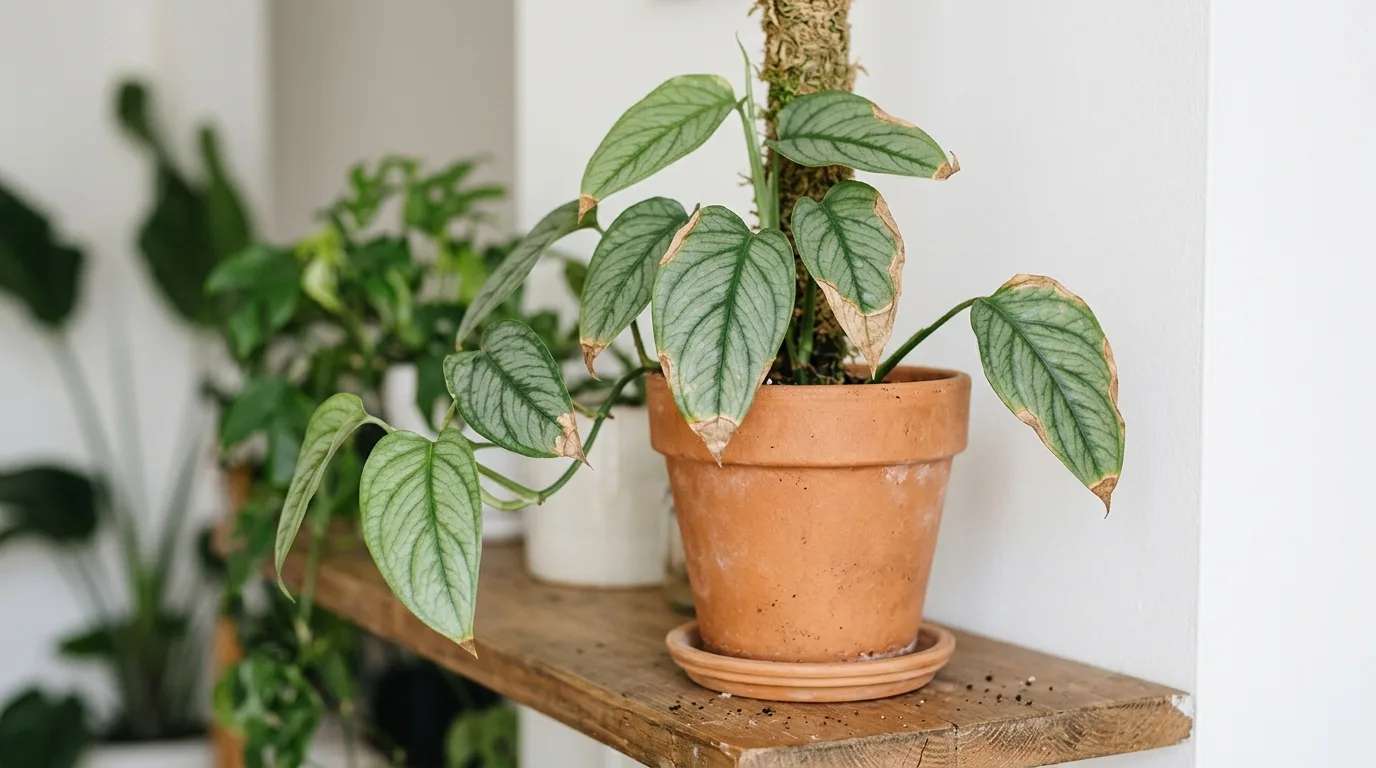
Low Humidity on Monstera Siltepecana: Causes, Checks & Fixes
This guide covers low humidity on Monstera Siltepecana. See also the general Low Humidity guide, watering, and light pages for this plant.
Low Humidity on Monstera Siltepecana: Causes, Checks & Fixes
Quick answer
Monstera siltepecana carries distinctive lanceolate, silver-green juvenile foliage patterned with dark green veins. Because these juvenile leaves are substantially thinner than the thick, leathery blades of mature Monstera deliciosa or succulent aroids, they lose cellular moisture rapidly when ambient indoor relative humidity drops below 50%. Dry air causes papery brown margins, lateral leaf curling, and stunted new leaves that become trapped in drying petiolar sheaths.
For how dry indoor air accelerates plant moisture loss across houseplants in general, explore our comprehensive low humidity hub. On Monstera siltepecana, dry air targets the delicate leaf perimeters and climbing vine tips first, frequently mimicking the symptoms of drought even when the potting substrate is completely moist.
First step: set up a digital hygrometer directly at plant canopy level and position a cool-mist room humidifier 3 to 5 feet away to re-establish a steady 50% to 60% relative humidity zone. Do not saturate the root ball or mist the foliage; correcting atmospheric moisture deficit requires elevating ambient vapor levels, not drowning the root system.
When to use this page vs other Monstera Siltepecana guides
| Leaf symptom pattern | Likely underlying stressor | Diagnostic guide to consult |
|---|---|---|
| Papery brown margins and tips on firm stems; leaves curling inward | Atmospheric moisture deficit (<50% RH) | This low humidity guide |
| Isolated crisp brown points at leaf apex; potting mix at normal moisture | Localized moisture loss or water chemistry | Brown tips |
| Stems drooping with soft petioles, leaves curling downwards | Turgor loss from hydration imbalance | Drooping leaves |
| Entire vine drooping, leaves limp, lightweight pot with desiccated soil | True root-zone drought | Underwatering |
| Lower leaves yellowing, mushy stems, saturated mix that stays heavy | Lack of root oxygen / waterlogging | Overwatering |
| Fine webbing on undersides, silver foliage stippled with yellow specks | Pest infestation aggravated by dry air | Spider mites |
| Bleached, pale parchment patches on upper surfaces facing window glass | Direct thermal or solar radiation | Light guide |
Use this page specifically when your Monstera siltepecana exhibits crispy leaf margins, lateral curling, or failed leaf unfurling while the underlying potting soil is monitored and adequately hydrated.
What low humidity looks like on Monstera Siltepecana
Low humidity does not cause a sudden, catastrophic collapse of the entire vine overnight. Instead, it produces progressive peripheral desiccation that begins at the most vulnerable cellular boundaries of the leaf blade.
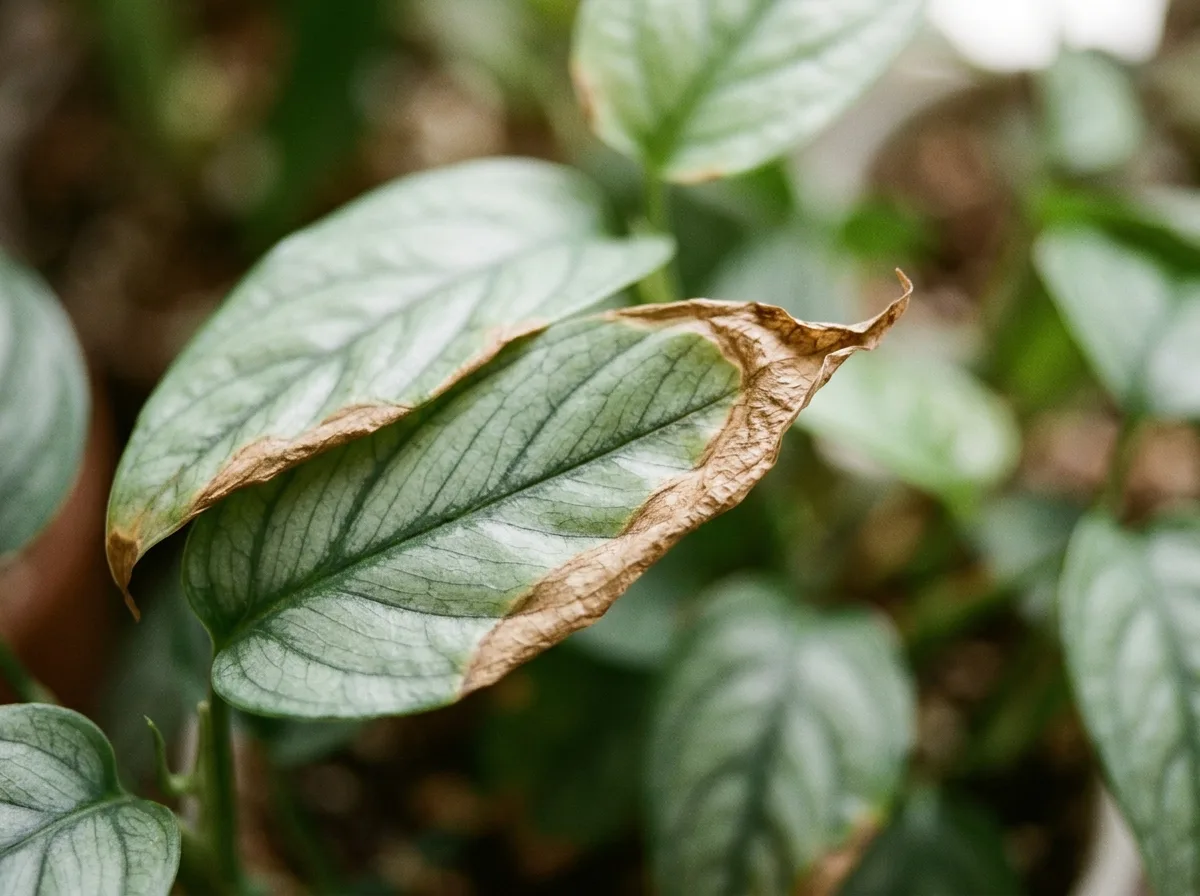
Close-up of low humidity damage on Monstera siltepecana juvenile foliage—crisp, papery brown margins and curling tips contrast against the silver-green leaf blade.
Diagnostic visual indicators of low humidity on this species:
- Crisp, papery brown leaf perimeters: The thin outer borders of the lanceolate leaf turn brittle and light tan to brown, developing a sharp, defined boundary against the healthy silver-green leaf tissue.
- Inward lateral leaf curling: Leaf blades curl upward and inward along the central midrib, an active defensive response to reduce the exposed surface area and limit transpirational water loss.
- Accordion-folded or stuck new leaves: Emerging leaf spikes fail to slide smoothly out of the petiolar sheath, binding tightly and unfurling with torn, notched, or crinkled margins once forced open.
- Shriveled aerial root tips: Aerial root nubs along climbing nodes dry into hard, blackened, non-functional tips rather than extending fleshy green or white tips toward support structures.
- Rapid potting soil dry-down: The upper 3 to 5 cm of potting mix dries out significantly faster than normal due to high atmospheric vapor pressure deficit.
Signs that indicate a problem other than low humidity:
- Yellowing that starts at the leaf base and spreads outward into soft, translucent petioles (points toward overwatering).
- Limp, floppy vines where the entire stem loses turgor pressure simultaneously with dust-dry soil (indicates root-zone underwatering).
- Irregular necrotic spots surrounded by chlorotic yellow halos across the center of leaf blades (suggests fungal or bacterial leaf spot).
- Pale, bleached patches with scorched centers restricted only to leaves pressed directly against sunlit windowpanes.
Healthy Monstera siltepecana juvenile foliage should rest completely flat, displaying vibrant metallic silver-green sheen with dark emerald veins, crisp pointed tips, and supple, flexible stems as outlined in our Monstera siltepecana overview.
Why Monstera Siltepecana struggles in dry indoor air
To understand why this species responds so dramatically to dry air, one must look at its natural evolutionary ecology and physical leaf structure.
Thin juvenile leaf cuticles vs waxy mature aroids
In its native habitats across southern Mexico and Central America, NC State Extension Plant Toolbox describes Monstera siltepecana as an epiphytic climbing aroid inhabiting warm, humid tropical rainforest canopies. Unlike mature Monstera deliciosa, which produces thick, coriaceous (leathery) leaves protected by a dense waxy cuticle, juvenile Monstera siltepecana leaves are structurally thin and papery.
The University of Florida IFAS Extension notes that tropical foliage aroids regulate transpiration through specialized stomatal cells, but when atmospheric vapor pressure deficit (VPD) rises in dry indoor air, moisture evaporates from thin leaves faster than roots can replenish it. The outermost cells along the thin silver leaf margins are situated furthest from the primary vascular bundles, making them the first to suffer irreversible cell death and necrosis.
Petiolar sheath desiccation and stuck unfurling spikes
A climbing Monstera siltepecana produces new leaves from a protective petiolar sheath (cataphyll) along the stem. Under ideal conditions, microscopic plant lubricants and high ambient humidity maintain a slippery micro-environment within the sheath, allowing the tightly rolled new leaf spike to slide free effortlessly as it expands.
When ambient humidity plummets below 50%—such as when residential central heating runs during winter—the delicate margins of the emerging leaf dry out and adhere to the inner walls of the petiolar sheath. As the stem continues its elongation, the trapped leaf is subjected to mechanical shear stress. The leaf either buckles into an accordion-like distortion or tears itself as it emerges, leaving permanent physical scallops and ragged holes that can never heal.
Aerial root dehydration on moss poles and climbing stakes
Monstera siltepecana is naturally dimorphic: it trails as a juvenile with compact silver foliage, but climbs trees in nature, utilizing adventitious aerial roots at every node to anchor itself and absorb atmospheric moisture. As documented by the Wisconsin Horticulture Extension in its analysis of climbing Monstera culture, aerial roots play a functional role in absorbing ambient humidity and supplemental water from supports.
When trained on a moss pole or wooden cedar plank in an arid room, these aerial root tips desiccate and abort before penetrating the substrate. Without functional aerial roots to supply moisture directly to the upper climbing nodes, the growing tip must rely exclusively on water transported up a long, slender stem from the primary root system in the pot. This extended hydraulic pathway leaves the topmost foliage chronically vulnerable to leaf margin crisping.
How to confirm low humidity before taking action
Before modifying your plant care routine, execute this four-step diagnostic procedure to verify that low atmospheric humidity is the genuine root cause.
- Deploy a digital hygrometer directly at canopy level: Never rely on a thermostat reading located across the hallway or in another room. The Royal Horticultural Society emphasizes that indoor microclimates vary substantially based on proximity to heaters, windows, and air drafts. Place a dedicated digital hygrometer right next to the Monstera siltepecana foliage for 48 hours. If the daytime or nighttime relative humidity consistently registers below 45%, low humidity is confirmed.
- Evaluate root-zone potting moisture: Insert a wooden skewer or digital moisture meter 5 cm into the pot, or lift the container to gauge its weight. If the root zone is evenly moist and drying at a standard pace—as recommended in our Monstera siltepecana watering guide—yet the leaf margins are turning crisp and brittle, you are witnessing an atmospheric problem, not a soil moisture deficit.
- Inspect the spatial pattern of damage: Compare the leaves facing open room air against those nestled near the interior of the plant or against a wall. Crisping that predominantly affects leaves exposed to forced-air drafts or ceiling fan currents strongly indicates dry-air desiccation.
- Conduct a magnifying lens pest scan: The Penn State Extension highlights that hot, dry indoor air creates ideal breeding conditions for spider mites. Use a 10x hand lens or smartphone macro camera to inspect the silvery undersides of affected leaves. Look closely for microscopic moving dots or ultra-fine silky webbing along the vein junctions to rule out pest-induced stippling.
First fix for a stable Monstera Siltepecana
If your plant is structurally firm, its potting mix is properly balanced, and your hygrometer indicates relative humidity below 50%, enact this single decisive first fix:
The First Fix: Install a cool-mist ultrasonic or evaporative room humidifier placed 3 to 5 feet away from your Monstera siltepecana, adjusting the output setting to maintain a stable ambient relative humidity between 50% and 60%.
Crucial placement guidance: Position the humidifier so the vapor plume dissipates into the surrounding room air rather than blowing directly onto the plant. Wetting the delicate silver leaves with cold condensation encourages foliar fungal pathogens and bacterial spotting. Keep the plant in its established bright, indirect light location—detailed in our Monstera siltepecana light guide—so that photosynthesis and transpiration remain balanced.
What NOT to do during the initial response
- Do NOT pour extra water into the pot: The most dangerous mistake plant owners make when observing crispy brown leaf tips is assuming the roots are thirsty. If the potting mix is still damp, adding more water suffocates root hairs and invites fungal pathogens, triggering root rot on top of environmental stress.
- Do NOT rely on routine leaf misting: Spraying leaves with a handheld mister provides an ephemeral moisture spike lasting only 10 to 15 minutes before evaporating. Penn State Extension confirms that misting fails to provide meaningful long-term humidity and leaves water droplets that foster foliar diseases on indoor aroids.
- Do NOT apply chemical fertilizers: Stressed foliage cannot process excess mineral salts. Fertilizing a plant struggling with atmospheric desiccation leads to fertilizer burn, exacerbating tip necrosis.
- Do NOT unpot or repot the plant: Unless the potting soil is severely sour or waterlogged, repotting inflicts severe root shock, depriving the plant of the hydraulic stability it needs to combat dry air.
Step-by-step humidity correction strategy
Once your room humidifier is established, integrate these complementary environmental adjustments to stabilize your indoor microclimate long term.
Low Humidity Remediation Workflow:
[ Canopy Hygrometer Check (<50% RH) ]
                  │
                  ▼
[ Position Cool-Mist Humidifier 3–5 ft Away ]
                  │
                  ▼
[ Group Companion Aroids to Share Transpiration ]
                  │
                  ▼
[ Maintain Moist Moss Pole for Climbing Nodes ]
                  │
                  ▼
[ Verify Pot Dry-Down via Top 3–5 cm Check ]
1. Group companion plants to build a localized transpiration pocket
Plants naturally release moisture vapor into the air through stomatal transpiration. As recommended by the Royal Horticultural Society, clustering your Monstera siltepecana with other tropical foliage plants—such as ferns, philodendrons, and calatheas—creates a mutually beneficial microclimate that raises localized relative humidity by 5% to 10%. Ensure you maintain 5 to 10 cm of breathing space between foliage clusters to preserve gentle air circulation and prevent pest crossover.
2. Utilize humidity trays with realistic expectations
Pebble trays filled with water and clean gravel can offer modest localized evaporative support for small shelf displays. However, as noted by The Spruce in its Monstera siltepecana care guide, pebble trays cannot compete with high-volume forced-air heating or dry winter drafts in open floor plans. Ensure the bottom of the nursery pot rests firmly on the dry upper gravel, completely above the water line, so the soil does not wick moisture upward and become waterlogged.
3. Maintain climbing moss pole hydration
If your Monstera siltepecana is trained on a sphagnum moss pole to encourage larger foliage and mature growth, keeping that pole lightly moist is essential. A dry moss pole acts as a desiccating sponge, pulling moisture out of aerial roots. Moisten the pole using a slow-drip bottle applicator or gentle targeted spray applied directly to the moss core, taking care that runoff does not saturate the main potting container.
4. Optimize potting substrate aeration
A plant in dry air experiences accelerated evaporation from the soil surface. Ensure your substrate consists of a chunky, well-aerated aroid mix containing orchid bark, coarse perlite, and peat or coco coir, as specified in our Monstera siltepecana soil guide. This porous structure allows you to water thoroughly when the top 3 to 5 cm dries without the risk of bottom soil compaction.
Recovery timeline and trimming damaged foliage
Horticultural expectations must remain realistic: cell necrosis on plant leaves is permanent. Crisp, papery brown margins and desiccated tips will never re-green or regenerate living chlorophyll.
Aesthetic trimming of crispy leaf tissue
If the brown margins detract from the ornamental beauty of your silver vine, you can perform clean cosmetic maintenance:
- Disinfect a pair of sharp precision pruning shears with 70% isopropyl alcohol.
- Carefully snip away the dead, papery brown tissue, following the natural lanceolate curvature of the leaf blade.
- Leave a narrow, 1-millimeter buffer of brown dead tissue intact. Never slice directly into the living green or silver tissue, as opening a fresh wound on the leaf blade invites bacterial entry and triggers renewed browning along the cut edge.
- Never remove an entire leaf if more than 50% of the blade remains healthy, silver-green, and photosynthetic.
Cosmetic Margin Pruning Guide:
┌──────────────────────────────────────────────┐
│  [ Living Silver-Green Blade ]               │
│  ──────────────────────────────────────────  │
│  [ 1 mm Protective Brown Buffer Margin ]     │
│  - - - - - - - - Cut Line Here - - - - - - - │
│  [ Dead Brittle Papery Tip (Discard) ]       │
└──────────────────────────────────────────────┘
Realistic recovery milestones
- Days 1 to 7: Following humidifier installation and placement away from drafts, existing leaves cease further lateral curling. Leaf margins feel pliable rather than brittle.
- Weeks 2 to 3: Trapped leaf spikes begin to soften within their cataphylls. New leaf spears unfurl without sticking, tearing, or exhibiting crinkled, accordion-like margins.
- Weeks 4 to 6: Emerging juvenile leaves expand into smooth, pristine silver-green lance shapes with sharp emerald veins and immaculate, unblemished leaf margins.
- Months 2 to 3: Active climbing nodes develop fleshy, healthy aerial root buds that successfully grip climbing supports, signaling full physiological recovery.
Lookalike symptoms and causes to rule out
Because leaf browning and curling can stem from multiple indoor environmental factors, cross-reference your plant’s symptoms against this detailed differential matrix:
| Observed symptom pattern | Primary cause | Key distinguishing factors | Next diagnostic action |
|---|---|---|---|
| Brittle tan/brown margins; leaves curling inward; firm stems | Low humidity | Soil moisture is normal; damage limited to thin leaf perimeters | Raise ambient RH to 50–60%; avoid draft paths |
| Entire vine drooping; limp, papery leaves; ultra-light pot | Underwatering | Soil is dry to the bottom; immediate turgor recovery after thorough watering | Water deeply; see our underwatering guide |
| Yellowing lower leaves; soft brown leaf centers; damp, heavy pot | Overwatering / Root rot | Soil remains saturated >10 days; stem base feels squishy; sour smell | Inspect root health; refer to our overwatering guide |
| Speckled yellow stippling; fine webbing beneath silver leaves | Spider mites | Visible webbing in leaf axils; pest damage accelerates in dry rooms | Isolate plant; consult our spider mites guide |
| Brown tips restricted to leaf apex; white crust on pot rim | Fertilizer salt build-up | Follows heavy feeding; occurs even in humid rooms | Flush mix thoroughly with distilled or pure water |
| Bleached, crisp parchment patches on upper leaf surfaces | Sun scorch | Confined strictly to foliage receiving intense midday glass exposure | Move to filtered indirect light; see our light guide |
As noted by Clemson Cooperative Extension in its indoor plant watering guidelines, moisture stress at the roots and humidity stress in the air often present overlapping symptoms; confirming soil status is the critical diagnostic pivot.
Mistakes to avoid when addressing dry air
Avoid these common horticultural pitfalls that often worsen plant health:
- The Overwatering Reflex: Assuming crispy foliage means the plant needs soaking. Roots absorb water from soil pores, but atmospheric dry air pulls moisture from leaves. Drenching an already damp root ball leads directly to anaerobic root suffocation.
- Misting as a Primary Solution: Misting provides a negligible, short-lived moisture spike. Wetting juvenile leaves in low-airflow environments creates the ideal breeding ground for bacterial leaf blights.
- Placing the Plant Directly in Front of Humidifier Plumes: Concentrated mist droplets pooling on leaves cause cold shock and tissue rot. Keep the humidifier at least 3 feet away.
- Ignoring Heat Registers and AC Vents: Placing Monstera siltepecana along the direct air path of a forced-hot-air heating register or air conditioner will desiccate foliage regardless of room humidity.
- Premature Repotting: Disturbing root systems while a plant is already dealing with transpirational stress compromises its ability to draw moisture when it needs it most.
Preventing low-humidity damage in every season
Maintaining optimal microclimatic conditions requires adjusting your care routines across changing indoor seasons:
Winter indoor heating protocol
During winter, indoor relative humidity frequently drops below 25% due to artificial furnace heating. Relocate your Monstera siltepecana at least 4 to 6 feet away from baseboard heaters, forced-air vents, and radiators. Run a humidifier continuously on low to medium output, aiming for a consistent 50% to 55% RH. Because plants experience slower metabolic activity during winter, verify that the top 3 to 5 cm of mix is dry before watering, rather than adhering to a strict summer schedule.
Summer air conditioning precautions
Air conditioning systems function by extracting ambient moisture from indoor air, frequently reducing indoor RH to 35% to 45%. Ensure your climbing vine is not positioned in the direct cold downdraft of an air conditioning unit or ceiling fan. Maintain airflow in the room, but keep air currents gentle and indirect.
Routine weekly health checks
Incorporate a 60-second microclimate check into your weekly maintenance routine:
- Glance at the digital hygrometer located near your vine.
- Inspect the newest unfurling leaf spike to confirm it is emerging smoothly without friction or tearing.
- Check leaf margins on mid-stem foliage to ensure they remain flat and flexible.
- Feel the top 3 cm of potting substrate to confirm your watering schedule remains in sync with current room evaporation rates.
Related Monstera Siltepecana guides
Deepen your plant-care knowledge with our species-specific guides for Monstera siltepecana:
- Monstera Siltepecana Overview — Botanical background, juvenile silver leaf characteristics, climbing vs trailing growth habits, and pet safety warnings.
- Watering Guide — Master the top 3–5 cm dry-down testing technique and seasonal watering frequency.
- Light Requirements Guide — Ideal foot-candle targets, east-window placement, and avoiding sun scorch.
- Soil & Substrate Guide — Crafting an airy, chunk-rich aroid potting mix with perlite and orchid bark.
- Problems Hub — Complete index of pest, pathogen, and environmental symptoms affecting this species.
Conclusion
Low humidity stress on Monstera siltepecana is an atmospheric challenge that reflects the plant’s tropical rainforest origins. Because its juvenile silver leaves are thin and delicate, they serve as early warning indicators when indoor relative humidity dips below 50%. By verifying canopy humidity with a hygrometer, providing stable moisture through a room humidifier, and protecting the root zone from compensatory overwatering, you will ensure every new leaf unfurls cleanly, maintaining the radiant silver-and-emerald foliage that makes this climbing aroid exceptional.
Related tool
Calculate optimal hydration cycles tailored to your home’s current temperature, light, and humidity levels with our interactive tool:
Use the Plant Watering Calculator to calibrate watering intervals for Monstera siltepecana across shifting seasons and indoor humidity levels.