Wilting Monstera Thai Constellation: Causes & Turgor
Quick answer
Wilting on Monstera Thai Constellation is driven by a loss of hydrostatic turgor pressure within petiole collenchyma cells, preventing the plant from supporting its heavy, fenestrated leaves. The critical first step is lifting the container and probing 2–3 inches into the substrate to resolve the diagnostic fork: feather-light bone-dry mix requires an immediate bottom-soak rehydration, whereas heavy, waterlogged soil indicates anaerobic root rot requiring root debridement and repotting into an open, chunky aroid mix.
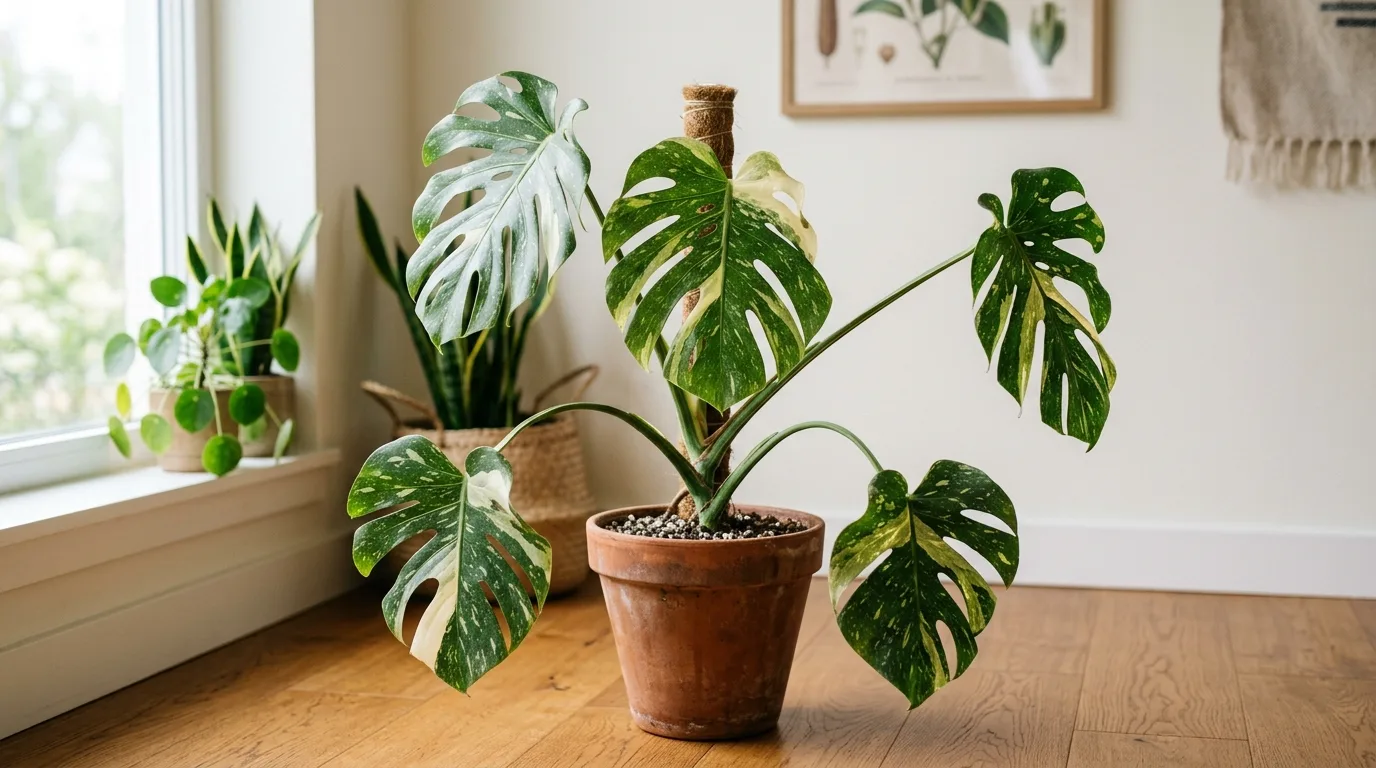
Wilting on Monstera Thai Constellation: Causes, Diagnosis & Turgor Recovery
This guide covers wilting on Monstera Thai Constellation. See also the general Wilting guide, watering, and light pages for this plant.
Wilting on Monstera Thai Constellation: Causes, Diagnosis & Turgor Recovery
Quick answer
When the magnificent, marble-splashed foliage of a Monstera Thai Constellation begins to sag, soften, and bow limply toward the floor, you are observing an acute collapse of hydrostatic turgor pressure. Turgor pressure is the internal hydraulic force that drives water against the cellulose cell walls of plant tissue, holding massive fenestrated leaves and thick petioles upright against the relentless pull of gravity. When water stops reaching foliar cells, the vascular pressure drops, and the entire architectural framework of the plant collapses into a limp, wilted posture.
For a broader overview of how cellular dehydration and hydraulic failure impact indoor foliage, consult our comprehensive wilting symptom guide. On Monstera Thai Constellation, however, wilting presents a high-stakes diagnostic paradox: the collapse can be triggered by bone-dry soil, but it is just as often caused by waterlogged, suffocated roots that have rotted and lost their ability to absorb moisture. Because Thai Constellation carries genetic chimeric variegation with diminished photosynthetic reserves, misdiagnosing the cause can destroy weeks of growth or lead to lethal stem rot.
First step: Do not immediately pour water into the pot or add fertilizer. Lift the pot to evaluate its weight and probe 2 to 3 inches into the substrate with a wooden skewer. Distinguishing whether the root zone is completely desiccated or saturated and suffocating is the essential foundation of your recovery strategy.
When to use this page vs other Monstera Thai Constellation guides
Wilting shares visual similarities with several other common physiological and cultural disorders. Use the triage matrix below to ensure you are applying the right corrective protocol for your plant’s specific symptoms.
| Observed Symptom Pattern | Primary Diagnostic Locus | Correct Guide to Consult |
|---|---|---|
| Limp, drooping petioles, sagging leaf blades, soft petiolar tissue with dry or wet soil | Loss of hydrostatic turgor pressure in vascular bundles | This guide (Wilting) |
| Petioles bowing gradually under foliar weight without soft cellular collapse | Lack of mechanical moss pole climbing anchor | Drooping Leaves Guide |
| Lower leaves turning pale translucent yellow with damp, sodden soil | Chronic over-saturation and early root asphyxiation | Overwatering Guide |
| Crispy, curled leaf edges, contracted substrate pulling from pot rim, dry skewer | Extended drought and severe cellular dehydration | Underwatering Guide |
| Dark, water-soaked petiole bases, foul swampy odor, decaying root sheaths | Advanced fungal pathogen attack in root system | Root Rot Guide |
| White or cream variegated sectors developing paper-thin, dry brown patches | Extreme vapor pressure deficit or light scorch | Light Care Guide |
What wilting looks like on Monstera Thai Constellation
On a vigorously growing specimen, Monstera Thai Constellation displays stout, structural petioles that support broad, perforated leaf blades at an assertive 45-to-60-degree angle toward ambient light. When cellular turgor collapses, this rigid posture degrades rapidly through three distinctive visual phases:
- Failure of the geniculum: The geniculum—the flexible, pulvinus-like joint connecting the upper petiole to the base of the leaf blade—acts as the hydraulic steering mechanism of the leaf. When internal water pressure falls, the geniculum loses rigidity first. The leaf blade angles sharply downward, pointing toward the container base while the lower petiole may remain partially upright.
- Petiole bending and basal creasing: As fluid exits the collenchyma tissue within the petiolar sheath, the thick stalk softens and bends into an exaggerated downward arc. Because mature Thai Constellation leaves carry substantial mass, this sagging can cause physical pinching or longitudinal creasing near the stem node.
- Inward leaf cupping and loss of surface gloss: The broad leaf margins curl subtly inward as stomata close to prevent further transpiration. The lustrous, deep green lamina turns dull and matte, while the creamy-yellow variegated patches feel thin, papery, and flexible rather than firm and leathery.
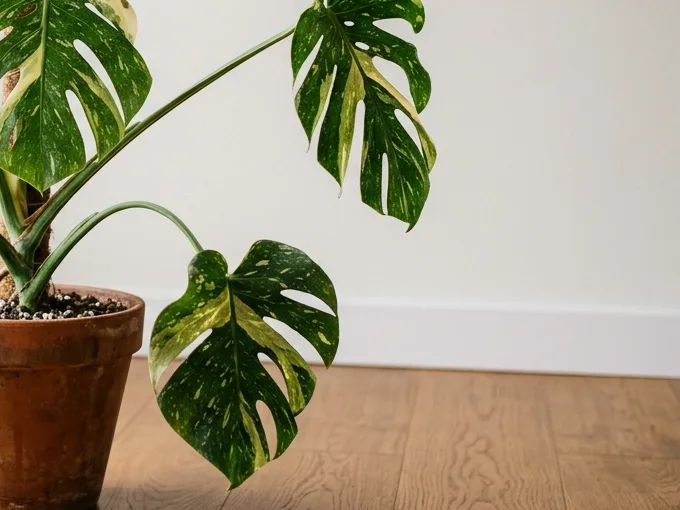
Loss of petiole hydrostatic turgor causes heavy variegated Monstera Thai Constellation leaves to arch downward toward the rim.
Unlike common green Monstera deliciosa, Thai Constellation foliage carries unique structural properties that complicate wilting:
- Variegation asymmetry: The achlorophyllous cream sectors have thinner epidermal cell walls and fewer structural carbohydrates than emerald-green tissue. During wilting, these cream sectors wrinkle and crease before the green portions of the leaf blade.
- Heavy cantilever strain: The fenestrations and thick leaf blades create significant gravitational drag. When turgor drops by even 15%, the weight of the leaf blade acts as a cantilever lever that forces the petiole down against the rim of the pot.
The botany and biomechanics of wilting: Cellular turgor in variegated Aroids
To reverse wilting effectively, it is helpful to examine the plant’s internal fluid mechanics. Plants do not have bony skeletons; they depend on hydrostatic turgor pressure generated within living cells to maintain mechanical rigidity. Under healthy conditions, water absorbed by root hairs travels through the vascular xylem bundles and enters parenchyma cells. The internal fluid volume presses the cell membrane against the outer cellulose wall, creating internal tension analogous to an inflated air mattress.
Several botanical characteristics documented by horticultural research dictate how this pressure behaves in Monstera deliciosa ‘Thai Constellation’:
1. Vascular resistance and climbing habit
NC State Extension notes that Monstera deliciosa is an evergreen hemiepiphytic climber that relies on thick petioles and stout stem nodes to anchor itself onto host trees in tropical rainforests. The plant moves water along high-volume xylem conduits under negative transpirational pull. If water flow is interrupted—either because the substrate is dry or because root cortical tissue is non-functional—the xylem column experiences cavitation (microscopic air bubble formation). Without continuous water tension, cell walls lose support and the foliage wilts under its own weight.
2. Metabolic costs of chimeric variegation
The Royal Horticultural Society highlights that ‘Thai Constellation’ is a stable, laboratory-selected tissue culture chimera characterized by sectors lacking functional chloroplasts. Because these white and cream sectors do not perform photosynthesis, the total photosynthetic output per square decimeter of foliage is substantially lower than in all-green monsteras. Consequently, the plant has smaller reserves of non-structural carbohydrates to deposit into secondary cell wall lignification. When drought or root stress hits, Thai Constellation wilts significantly faster and takes longer to regain structural rigidity than wild-type monsteras.
3. Evaporative demand and vapor pressure deficit (VPD)
Indoor air with low relative humidity (under 40%) creates a steep vapor pressure deficit between the moist leaf interior and ambient air. Even when soil contains moderate moisture, transpiration through the large surface area of fenestrated leaves can outpace root uptake during warm afternoons. This causes temporary transient wilting that self-corrects at night once stomata close and roots catch up.
The two primary causes of wilting: Desiccation vs. Root Suffocation
Accurate diagnosis determines whether your plant needs rehydration or immediate surgical intervention. Applying the wrong remedy is the most frequent cause of plant mortality.
                   [Wilted Monstera Thai Constellation]
                                     │
                                     ▼
                          [Check Pot & Substrate]
                                     │
           ┌─────────────────────────┴─────────────────────────┐
           ▼                                                   ▼
   [Feather-Light Pot]                                 [Heavy, Wet Pot]
   [Substrate Bone-Dry]                                [Substrate Saturated]
   [Soil Pulling From Rim]                             [Sour Anaerobic Smell]
           │                                                   │
           ▼                                                   ▼
 ┌─────────────────────┐                             ┌─────────────────────┐
 │    UNDERWATERING    │                             │      ROOT ROT       │
 │ Cellular Drought    │                             │ Vascular Blockage   │
 └─────────────────────┘                             └─────────────────────┘
           │                                                   │
           ▼                                                   ▼
  [Deep Bottom Soak]                                  [Root Debridement &]
  [Capillary Rehydration]                             [Chunky Aroid Repot]
Cause 1: Severe substrate desiccation (Underwatering)
When the potting mix dries past the permanent wilting point, root hairs shrivel, water tension collapses, and cells throughout the petioles lose fluid.
- Physical signs: The nursery pot feels feather-light when lifted. The potting soil has shrunk and pulled away from the inner rim of the pot, creating an empty gap. Petioles feel soft, limp, and rubbery, and the foliage feels papery.
- Vascular consequence: If dry soil persists, root hairs desiccate and die back. When water is eventually added, the plant cannot absorb it immediately until new root hairs regenerate.
Cause 2: Anaerobic root rot (The Overwatering Paradox)
This is the most deceptive and perilous scenario for Thai Constellation growers. When an aroid is potted in a dense, moisture-retentive peat or potting mix without sufficient perlite or bark, stagnant water fills the macropores between soil particles.
- University of Florida IFAS Extension explains that saturated substrates rapidly deplete dissolved oxygen, suffocating root cells and preventing normal cellular respiration. Without oxygen to fuel ATP synthesis, active nutrient and water transport across cell membranes ceases.
- Opportunistic water molds and fungal pathogens such as Pythium, Phytophthora, and Fusarium exploit the asphyxiated tissue, decaying the root cortex into a mushy, foul-smelling mass.
- The paradox: Even though the pot is saturated with moisture, the plant experiences physiological drought because the decayed root system can no longer pump water upward to the leaves. Adding more water to a wilted plant in wet soil accelerates root death.
Cause 3: Acute repotting trauma or root disturbance
When a Thai Constellation is repotted, especially if old soil is vigorously scraped or root balls are separated, microscopic feeder roots break. Until new root tips establish capillary contact with the surrounding substrate, water uptake drops abruptly, resulting in a temporary post-transplant wilt that lasts 5 to 10 days.
Cause 4: Cold exposure and root chilling
Monstera deliciosa is indigenous to frost-free tropical environments. If a Thai Constellation is subjected to temperatures below 55°F (13°C)—from an air conditioner draft, single-pane window chill in winter, or transit exposure—root metabolic activity drops to near zero and xylem vessels constrict. Chilled roots cannot absorb water even in moist soil, leading to sudden petiole drooping and foliar limpness.
The wet vs. dry diagnostic fork: How to identify the true cause
Never guess your plant’s water needs based purely on the calendar or surface appearance. Execute this systematic diagnostic inspection:
Step 1: The pot heft evaluation
Gently lift the container by its base:
- Extremely light: The root ball is devoid of moisture. Pine bark and coco peat have dried thoroughly, confirming simple underwatering.
- Heavy and waterlogged: The container feels like a solid brick. Excess moisture is pooling in the bottom third of the vessel, confirming root hypoxia or active rot.
Step 2: The deep root-zone probe
Insert a slender wooden skewer, chopstick, or electronic moisture meter 2 to 3 inches down into the central core of the root ball, following Penn State Extension recommendations for inspecting soil depth rather than relying on dry surface crust.
- If the skewer pulls out completely clean, dry, and free of moisture, the root zone is parched.
- If the skewer emerges dark, damp, and coated with wet, muddy particles, the substrate is saturated.
Step 3: Olfactory and root-collar inspection
Bring your nose close to the top of the substrate and drainage holes:
- Fresh, earthy aroma: The microflora is balanced and aerobic.
- Sour, sulfurous, or swamp-like smell: Anaerobic bacteria and root-rotting fungi are actively breaking down dead tissue.
- Gently ease the root ball out of the pot if moisture is high. Healthy Thai Constellation roots are thick, firm, and white-to-cream with fuzzy tips. Rotted roots appear dark brown or black, feel slimy, and the outer cortex easily pulls away from the wire-like central vascular strand.
First fix: Immediate interventions by diagnostic path
Once you have identified your plant’s position on the diagnostic fork, take immediate corrective action.
Path A: For dry soil (Underwatering) — The deep capillary bottom-soak
When chunky aroid mixes dry completely, organic components like pine bark become hydrophobic, causing top-poured water to channel down the sides of the pot and exit drainage holes without wetting the root ball.
- Submerge container base: Place the nursery pot into a basin or tub filled with 3 to 4 inches of lukewarm, room-temperature water.
- Capillary absorption: Allow the plant to sit for 35 to 45 minutes. Water will wick upward into the dry bark and peat through capillary pull until the top inch of mix is evenly moist.
- Complete drainage: Remove the pot and allow it to drain thoroughly in a sink for 20 minutes. Never leave the container resting in standing runoff water inside a decorative cachepot.
- Turgor restoration: Return the plant to a warm, humid environment with bright, indirect light. Petioles should begin to stiffen within 12 to 24 hours.
Path B: For wet soil with rotted roots — Debridement and sterile repotting
If the soil is wet and roots have deteriorated, waiting for the dense mix to dry naturally will result in the loss of the entire plant. Immediate physical intervention is required.
- Unpot and rinse: Gently slide the root ball from the pot. Under a gentle stream of lukewarm tap water, rinse away all sodden, contaminated soil to expose the root network.
- Surgical debridement: Using pruning shears sterilized with 70% isopropyl alcohol, excise every brown, soft, hollow, or slimy root back into firm, healthy white root tissue.
- Disinfection treatment: Lightly mist the trimmed root system with a 3% hydrogen peroxide solution (or dip briefly for 60 seconds in a solution of 1 part 3% hydrogen peroxide to 3 parts water) to oxygenate tissue and destroy lingering fungal spores. Allow to air dry for 3 to 5 minutes on a clean paper towel.
- Repot in chunky aroid mix: Replant into a clean pot with ample drainage holes using an ultra-airy soil mix containing 40% coarse orchid bark, 30% perlite or pumice, and 30% coco coir or peat moss.
- Aftercare: Lightly moisten the fresh mix once, place the plant in bright indirect light, and refrain from fertilizing for 4 to 6 weeks while the root system regenerates. Review our dedicated repotting guide for detailed container sizing and drainage recommendations.
Staking, petiole support, and aerial root hydration
Because Monstera Thai Constellation develops heavy foliage with dense tissue, mechanical support plays a critical role in preventing petiole kinking when plants experience temporary turgor loss.
            [Support & Training Framework]
                          │
     ┌────────────────────┴────────────────────┐
     ▼                                         ▼
[Sturdy Moss Pole]                     [Aerial Root Training]
Anchor rigid pole to base              Guide aerial roots into
of pot; tie central main stem          moist sphagnum or potting mix
with wide, soft velcro ties.           to establish secondary hydraulic
Leave petioles free to move.           water absorption pipelines.
Moss pole attachment
In their natural rainforest habitat, monsteras climb tree trunks, anchoring themselves with adventitious aerial roots. NC State Extension stresses that indoor monsteras need rigid physical supports to prevent stems from sprawling and petioles from breaking under leaf weight.
- Install a sturdy sphagnum moss pole, coco coir totem, or cedar plank behind the back of the vine (where aerial roots emerge).
- Fasten wide, soft garden velcro or plant tape strictly around the central main stem just beneath leaf nodes. Never bind or tape individual petioles to the pole. Petioles must remain flexible and mobile so the leaf blade can orient itself toward the light source.
Aerial root management
Guide emergent aerial roots into the moist moss pole core or direct them down into the potting mix. Once an aerial root enters the substrate, it branches into hundreds of microscopic terrestrial feeder roots. These secondary conduits dramatically boost water absorption capacity, providing extra hydraulic resilience that prevents wilting during hot summer days.
Step-by-step recovery timeline and monitoring protocol
Patience and consistency are essential when nursing a wilted Thai Constellation back to health. Follow this timeline to track your plant’s progress:
[Phase 1: Days 1–5]          [Phase 2: Weeks 2–3]           [Phase 3: Weeks 4–6]
Hydraulic Equilibrium        Root Regeneration              New Turgid Growth
─────────────────────────►   ───────────────────────────►   ──────────────────────────►
• Moisture corrected         • Fine root tips develop       • New leaf spear emerges
• Drafts eliminated          • Geniculum stiffens           • Erect petiole posture
• Humidity at 55–65%         • Leaf blades lift 20–35°      • Chlorophyll synthesis
• No fertilizer applied      • Stable cream margins         • Full turgor restored
Phase 1: Hydraulic stabilization (Days 1 to 5)
- Keep ambient room temperature steady between 68°F and 82°F (20°C–28°C) and protect the plant from cold drafts or dry air blasts.
- Maintain relative humidity at 55% to 65%. Higher humidity reduces leaf transpiration, allowing weakened vascular bundles to refill with minimal moisture loss.
- Position the plant in gentle, bright indirect light. Avoid direct sun, which can scorch limp, un-turgid cream sectors.
Phase 2: Root regeneration and cellular repair (Weeks 2 to 3)
- Monitor moisture closely: allow the top 2 to 3 inches of chunky substrate to dry before watering again. Use the Plant Watering Calculator to calibrate irrigation intervals based on your pot dimensions and indoor temperature.
- Observe the geniculum: as hydraulic pressure re-establishes, the leaf hinge will stiffen, raising the leaf blade 20 to 35 degrees above its wilted posture.
- Avoid repotting, moving, or disturbing the plant during this delicate rooting stage.
Phase 3: Consolidation and new growth (Weeks 4 to 6)
- The ultimate proof of vascular recovery is the emergence of a fresh leaf spear from the newest petiolar sheath. When this leaf unfurls upright, firm, and with crisp margins, the vascular system is functioning normally.
- Reintroduce a balanced, urea-free liquid houseplant fertilizer diluted to one-quarter strength, as recommended in the RHS Thai Constellation profile, to fuel active vegetative growth.
Common mistakes that worsen wilting
Avoid these critical errors when managing a wilted Monstera Thai Constellation:
- Mistake 1: Pouring water onto an already waterlogged pot. Many growers see wilting leaves and instinctively assume the plant needs water. If the roots are decaying in wet soil, adding water seals their fate by eliminating the last traces of oxygen. Always inspect soil moisture depth first.
- Mistake 2: Applying fertilizer to a wilted plant. Mineral fertilizers introduce concentrated mineral salts into the root zone. In an un-turgid plant, these salts create reverse osmotic pressure, drawing water out of roots and worsening cellular collapse. Never feed a stressed, wilted plant.
- Mistake 3: Misting wilted foliage. Spraying water onto limp leaves does not hydrate the plant; water must enter through the root system. Misting leaves stagnant water droplets on non-transpiring cream sectors, encouraging bacterial leaf rot (Xanthomonas) and fungal blight.
- Mistake 4: Binding limp petioles to stakes with wire or twine. Tying individual petioles directly to stakes with thin string or wire crushes soft vascular bundles, creating permanent necrosis at the binding site. Always fasten only the central stem with broad plant velcro.
- Mistake 5: Cutting off all wilted leaves prematurely. Even a wilted leaf with sagging petioles carries functional chlorophyll in its green sectors that synthesizes carbohydrates to fuel root recovery. Unless a leaf is more than 75% blackened or rotted, leave it attached until fresh, upright foliage takes its place.
Monstera Thai Constellation ongoing care cross-check
Prevent future wilting episodes by keeping your ongoing cultivation parameters aligned with Thai Constellation’s specific requirements:
- Watering Protocol: Water deeply only after the top one-third (approx. 2 to 3 inches) of the potting medium has dried out. Always empty drain trays within 15 minutes of watering to prevent perched water tables.
- Soil Mix Requirements: Maintain an open, chunky aroid substrate with 40% orchid bark, 30% perlite or pumice, and 30% coco coir to maximize root-zone oxygenation and prevent compaction.
- Light Requirements: Provide 8 to 10 hours of bright, indirect light daily (2,500 to 5,000 lux). Variegated cream sectors lack chlorophyll, so the remaining green sectors require robust illumination to fuel continuous root pumping.
- Plant Problems Hub: Routinely inspect petioles and leaf undersides for sap-sucking pests like spider mites, thrips, and mealybugs, which drain plant juices and cause localized turgor collapse.
Related tool
To take the guesswork out of your moisture schedule and safeguard your valuable variegated aroid against both under- and overwatering:
Use the Plant Watering Calculator to calculate accurate watering intervals and volume requirements based on your container dimensions, pot material, ambient temperature, and seasonal sunlight levels.
Related Monstera Thai Constellation guides
Expand your cultivation and diagnostic knowledge with these companion resources from the Monstera Thai Constellation care cluster:
- Monstera Thai Constellation Care Overview: The complete foundational guide to cultivation, placement, and cultivar verification.
- Watering Guide for Monstera Thai Constellation: Detailed moisture parameters, seasonal schedule shifts, and dry-down management.
- Soil Mix & Repotting Guide: How to blend chunky aroid mixes that balance maximum oxygenation with adequate moisture retention.
- Repotting Guide for Monstera Thai Constellation: Step-by-step repotting methods, pot selection, and root-ball handling.
- Light Requirements Guide: Optimizing foot-candles and grow-light spectrums to support stable cream variegation without burning.
- Monstera Thai Constellation Problems Hub: Diagnostic index for identifying pest damage, nutrient imbalances, and physiological disorders.