Neem Fertilizer Guide: When, How & How Much
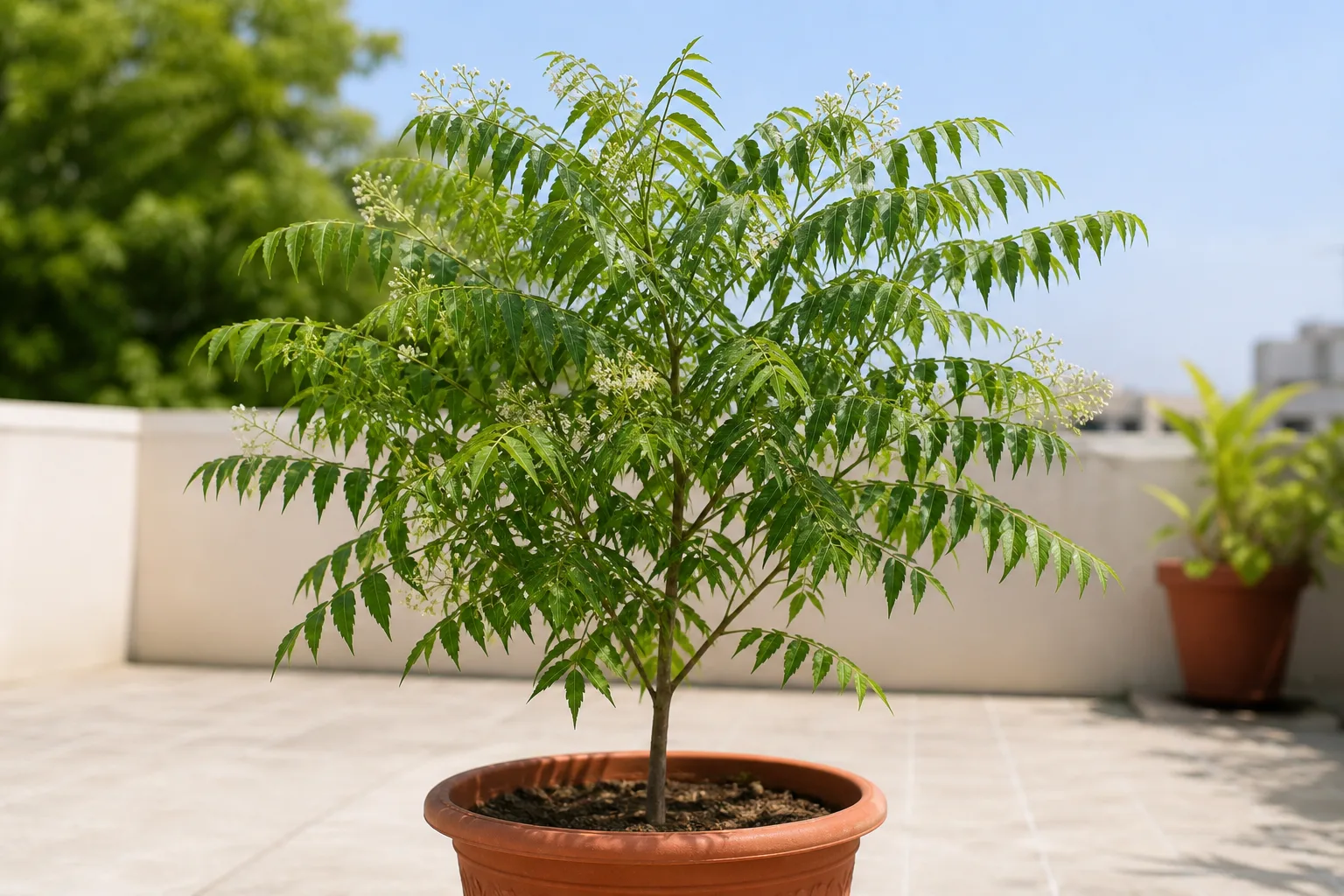
Neem Fertilizer Guide: When, How & How Much
Neem Fertilizer Guide: When, How & How Much
Neem (Azadirachta indica) is a heat-loving mahogany-family tree that evolved for dry tropical forests—not a hungry balcony herb that needs weekly full-strength doses. The practical default for most home growers is light, seasonal feeding: a balanced water-soluble fertilizer at half the label strength about once a month from March through October while new compound leaves keep flushing, plus modest compost or vermicompost at the surface. Skip fertilizer when growth stalls in cool weather, when the mix stays wet, or when the tree is newly repotted and still settling.
That lean approach matches how neem actually grows. It tolerates nutritionally poor soils outdoors, and heavy feeding in small pots mainly produces soft, salt-stressed growth rather than a tougher canopy. This page is the dedicated feeding reference. For the sun that drives nutrient use, see neem light needs. For dry-down timing that must align with feeding, see neem watering. For the sandy mix that keeps salts from trapping roots, see neem soil. The neem care hub covers the full cluster.
Why Neem Prefers Light Feeding
Treat fertilizer as a support for an already working system—sun, drainage, and a watering rhythm that lets the upper mix dry—not as a substitute for any of those. Missouri Botanical Garden describes neem as a tropical tree with excellent drought tolerance in deep, sandy, well-drained soils, and notes that container plants are less drought-resilient than field trees. Winrock’s FACT sheet adds that neem can thrive on rocky, dry, shallow, infertile soils once established. A plant built for lean ground rarely needs the aggressive nitrogen schedules used for leafy kitchen crops.
Lean soils, deep roots, and drought biology
Plants For A Future records that neem can grow in nutritionally poor soil, prefers well-drained conditions, and dies quickly when waterlogged. USDA Forest Service silviculture notes also describe neem as useful for improving soil fertility on degraded dry sites through leaf litter and relatively rapid leaf decomposition—evidence that the species is adapted to extract and recycle nutrients rather than demand constant soluble feed. In containers, that biology still applies: you are growing a tree that expects sharp drainage and intermittent dry-down, so soluble fertilizer should arrive in small, infrequent doses while roots are actively working.
ICAR agroforestry research in semi-arid India found that neem plantations increased soil organic carbon and available N, P, and K relative to open control plots over several years. That helps explain why established in-ground neem often looks fine with compost alone, while pot-grown plants—with a finite nutrient bank and frequent leach from watering—still benefit from light liquid feeds during peak flush.
When to Fertilize Neem in Indian Climates
Feed when neem is actively pushing new compound leaves and extending shoots—typically the warm, bright months across most of India. Hold feed when temperatures drop, when growth stalls after cool nights, or when the tree is shedding leaves from drought or overwatering rather than from nutrient lack. Clemson Extension’s tree-and-shrub guidance is blunt on timing: apply fertilizer when plants are actively growing, and avoid fertilizing drought-stressed plants because moisture is required for uptake.
Warm-season active growth window
For terrace and garden neem in India, the reliable window is roughly March through October, with peak response from late spring through the monsoon and early post-monsoon flush. Start only after you see fresh leaflets unfurling—not on a calendar day alone. Young plants in full sun that dry every few days may use a monthly half-strength liquid through this window; larger in-ground trees in compost-amended beds may need only two to four organic top-dressings across the same season.
If you live somewhere cooler and overwinter containers indoors, keep the same rule: feed only while new growth is visible under strong light. Artificial heat without adequate sun does not create a feeding season.
Cool-season pause and drought holds
From November through February in most Indian regions, taper to a stop. Give a final light feed in early autumn only if soft new growth is still forming, then pause. Resume in late winter or early spring when you see the first consistent flush again.
Also pause during acute drought stress on containers: wilted leaflets, crispy margins, or a bone-dry root ball that has gone too far. Clemson’s fertilizer environmental guidance likewise stresses applying nutrients at the right time when plants can absorb them, and delaying applications when conditions will waste nutrients. Water first, restore turgor, then feed days later on moist—not soggy—mix. Never fertilize a neem sitting in waterlogged soil; fix drainage and watering first.
Best Fertilizer Types for Neem
The best neem fertilizer for most home growers is a complete, water-soluble, balanced formula (for example 10-10-10 or 20-20-20) used at half label strength, optionally paired with slow organic matter. You do not need a specialty “neem tree” bottle. You do need restraint.
Balanced liquids and half-strength dilution
Balanced NPK supports foliage, roots, and overall vigor without pushing the soft, overly leafy flush that excess nitrogen encourages on woody plants. Clemson notes that excessive nitrogen stimulates lush shoot growth that is more susceptible to cold, drought, and pests—exactly the opposite of the tough canopy you want on a terrace neem. Measure dilutions with a spoon or syringe. If the label says one tablespoon per gallon for outdoor vegetables, use half for container neem; if it lists a houseplant rate, still start at half of that and watch the next flush before increasing frequency.
Organic liquids such as diluted compost tea, seaweed extract, or fish emulsion can substitute at half strength or weaker during warm months. Use fish emulsion outdoors or near ventilation; skip it when pots stay damp and fungus gnats are already a problem.
Compost, FYM, vermicompost, and neem cake
For in-ground or large patio tubs, well-rotted compost, farmyard manure, or vermicompost worked lightly into the top few centimeters once or twice in the warm season builds a slower nutrient base that matches neem’s lean preference better than frequent full-strength synthetic doses.
Neem cake—the residue after oil is pressed from seeds—is widely used as an organic manure and soil amendment. Missouri Botanical Garden notes that neem cake is used as a fertilizer and a nematicide. PFAF likewise reports that farmers in India use cake as organic manure believed to slow nitrification and discourage some soil pests. USDA Forest Service silviculture describes seed cake as rich in nitrogen and other nutrients, and Winrock lists cake as a fertilizer with insecticidal and fungicidal effect. On your own neem tree, treat cake as a modest top-dress (roughly a thin handful worked into the surface of a 30–40 cm pot once or twice per warm season, scaled up for beds)—not a license to stack cake plus strong liquid NPK every week. Keep cake off the stem collar, and water in after application.
Skip high-phosphorus bloom boosters, fertilizer-pesticide combos, and undiluted “boost” spikes in small pots. They add salt without solving the light or drainage limits that usually stall neem.
How Much and How Often: Containers vs Ground
Use this as a starting schedule, then adjust to flush quality and salt signs.
| Setup | Warm-season schedule | Strength / amount | Notes |
|---|---|---|---|
| Container 20–35 cm, full sun terrace | Every 4 weeks, March–October | Half-strength balanced liquid | Pause if tips brown or white crust appears |
| Large tub / half-barrel | Every 4–6 weeks | Half-strength liquid + light compost top-dress midseason | Bigger root volume buffers salts |
| Young in-ground tree | 2–3 organic top-dressings per warm season | Compost/FYM/cake at drip line | Optional dilute liquid if flush is pale in strong sun |
| Established ground tree in decent soil | 1–2 compost applications per year | Lean organic matter only | Often needs little or no synthetic feed |
Always apply liquid feed to moist soil, then water lightly so nutrients move into the root zone without dumping concentrate on dry roots. After any strong feed—or if you suspect salt buildup—flush the pot thoroughly until water runs freely from drainage holes, then wait for the next dry-down before feeding again.
Seedlings and freshly transplanted plants need even less. Hold soluble fertilizer for several weeks after repotting or propagation until new growth confirms roots are working. Fresh seed started in a compost-amended nursery mix usually needs only dilute feed after true leaves are established—not day-one fertilizer.
Underfeeding vs Overfeeding Warning Signs
Underfeeding on an otherwise healthy, sunny neem usually looks like slow or sparse new flushes, uniformly pale older leaflets without soft stems, and smaller leaves than the previous flush—especially in containers that have been watered heavily for months. Confirm light and root health before reaching for a stronger bottle; pale growth in shade is often etiolation, not nitrogen hunger.
Overfeeding is the more common container mistake. Watch for white crust on the soil surface or pot rim, brown or scorched leaflet tips and margins, overly soft lush shoots that flop, sudden leaf drop after a feed, or a plant that looks thirsty even when the mix is moist. Clemson explicitly warns that applying too much fertilizer may injure or kill plants through fertilizer burn. If those signs appear, stop feeding, flush the pot, and correct watering before you resume at a weaker dilution.
Do not confuse cold damage, waterlogging, or pest damage with a nutrient story. Soft roots and sour soil need a soil and watering reset, not more NPK.
How Light, Water, and Soil Change Nutrient Use
Neem in full sun with a fast-drying sandy mix uses water and nutrients faster than the same cultivar in part shade with dense mix. Feeding a shaded, slow-growing plant on a sunny-plant schedule is how salts accumulate. Match frequency to visible flush and dry-down speed, not to a neighbor’s mango calendar.
Watering and fertilizer are linked. Chronic overwatering leaches nutrients and damages roots so the plant cannot use what you apply; chronic underwatering leaves fertilizer sitting in dry mix where it burns feeder roots on the next soak. Keep the watering rhythm steady before you escalate feed strength.
Soil chemistry matters too. Neem prefers a roughly neutral sandy mix; preferred container pH around the mid-6s supports uptake without locking nutrients. If the mix is compacted, peat-heavy, or chronically wet, fix the soil and drainage before diagnosing a fertilizer deficiency.
Common Fertilizer Mistakes With Neem
The first mistake is treating neem like a heavy-feeding vegetable. Full-strength weekly feeds in a 25 cm pot create soft growth and tip burn long before they create a better tree. The second is feeding through winter or during stalled cool-weather growth, when roots cannot use the dose. The third is fertilizing a stressed plant—newly moved, root-bound and thirsty, sitting in a saucer of water, or recovering from cold nights—hoping nutrients will “wake it up.” Clemson’s tree guidance says not to assume fertilizer will correct poor growth when roots, drought, excess water, or pH are the real limits.
The recovery path is simple: stop feeding, flush salts if crust or tip burn is present, restore sun and drainage, wait for a clean new flush, then restart at half strength on a longer interval. Prune only after the plant stabilizes if you need to remove damaged tips—see the neem pruning guide for structure work that is separate from nutrition.
When to use this page vs other Neem guides
Use this fertilizer page when you need schedules, product types, dilution, and burn-versus-deficiency diagnosis for Azadirachta indica. Use the overview for the whole-care snapshot and placement decisions. Use light when pale or stretched growth tracks weak sun more than nutrient history. Use watering when yellowing pairs with a heavy pot or bone-dry extremes. Use soil when drainage, mix recipe, or pH is the bottleneck. Use repotting when roots circle the pot and the mix collapses faster than fertilizer can help. Use propagation when you are starting seed or cuttings and need aftercare doses, not mature-tree schedules.
Related Neem guides
- Neem overview — identity, placement, and full-care map
- Neem light — sun hours that drive feeding response
- Neem watering — dry-down checks before and after fertilizing
- Neem soil — sandy lean mix and pH for uptake
- Neem repotting — when to refresh mix instead of adding more feed
- Neem propagation — dilute feeding for seedlings and cuttings
- Neem pruning — canopy control after growth resumes
- Neem plant hub — species profile and cluster entry point
Conclusion
Neem fertilizer success is restraint plus timing. Feed Azadirachta indica lightly while warm-season flushes are active, prefer half-strength balanced liquids and modest organic top-dressings, and stop when cool weather, drought stress, or wet roots take over. Lean-soil biology and drought tolerance mean more product rarely equals a better tree—especially in containers. Get sun, drainage, and watering honest first; then let a simple monthly warm-season schedule support strong compound leaves without salt burn.