Yellow Leaves on Neem: Causes, Checks & Fixes
Quick answer
Yellow leaves on neem (Azadirachta indica) usually stem from one of four distinct triggers: generalized lower leaflet yellowing from nitrogen remobilization or waterlogged root damage, striking interveinal chlorosis on fresh terminal leaflets from alkaline iron lockout, or sudden seasonal shedding during chilly cold snaps. First step: inspect where the yellowing begins (lowest basal leaves vs. newest shoot tips) and lift the pot to evaluate moisture before applying any fertilizer or water.
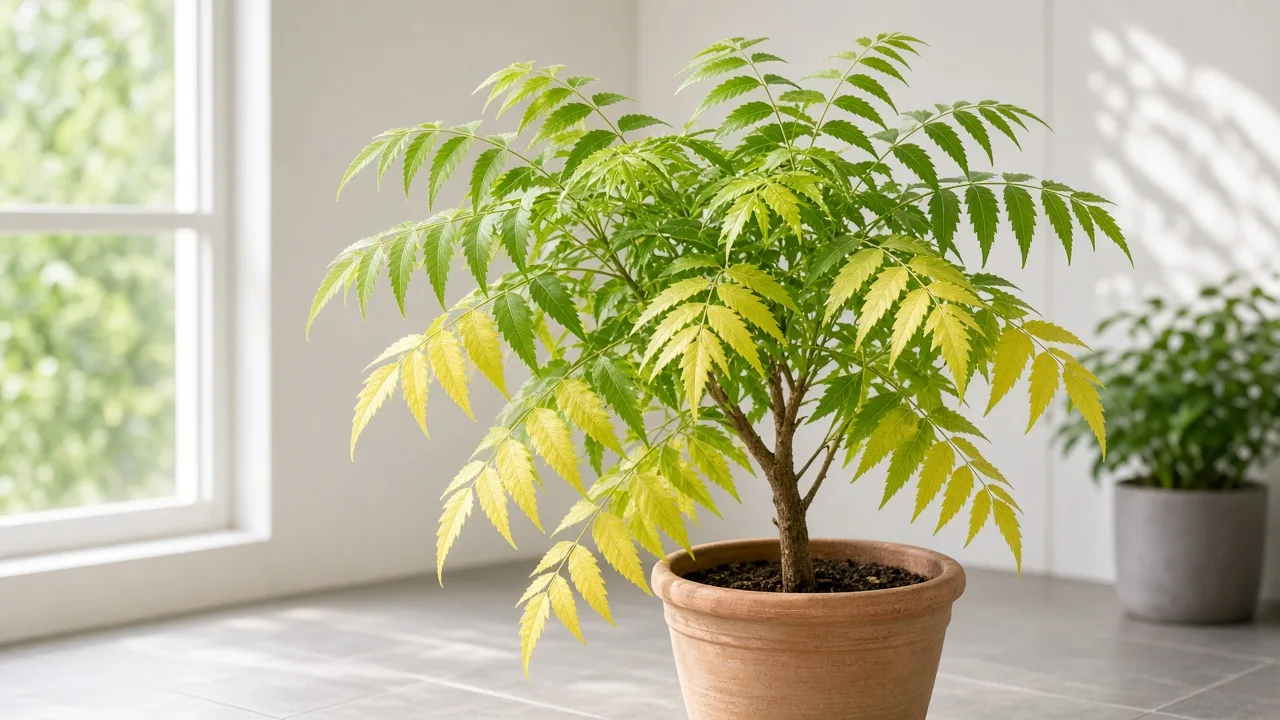
Yellow Leaves on Neem: Causes, Checks & Fixes
This guide covers yellow leaves on Neem. See also the general Yellow Leaves guide, watering, and light pages for this plant.
Yellow Leaves on Neem: Causes, Checks & Fixes
Quick answer
Yellow leaves on neem (Azadirachta indica) signal physiological distress in the root zone or foliage, but treating all chlorosis identically often worsens the decline. In potted and cultivated neem trees, yellowing almost always reflects one of four distinct mechanisms: generalized lower leaf yellowing from nitrogen remobilization, root hypoxia and rot caused by overwatering, interveinal iron chlorosis on young leaflets in high-pH substrates, or protective seasonal shedding during sudden cold snaps.
Your immediate first action: identify the precise anatomical location of the chlorosis (lowest, mature leaves versus newest terminal flushes) and lift the pot to assess moisture before applying any water, fertilizer, or pesticides. If the pot is heavy, soggy, and cool, pause all watering and inspect root health. If the pot is light and dry while mature lower leaves fade evenly to pale yellow, nitrogen deficiency is the likely culprit. If newest leaflets emerge with bright yellow blades and stark dark green veins, suspect alkaline iron lockout rather than a watering error.
For a broad overview of chlorosis mechanics across indoor and outdoor plants, consult our general yellow leaves guide. On neem specifically, accurate diagnosis depends on understanding how this fast-growing tropical mahogany manages nutrient transport across its pinnately compound canopy.
When to use this page vs other Neem guides
Yellowing foliage is a symptom, not a single disease. Use this routing table to match your tree’s exact presentation to the right guide:
| Pattern & Observation | Primary Suspicion | Recommended Guide |
|---|---|---|
| Lower leaves yellowing on soggy, heavy soil; musty odor; limp stems | Root hypoxia & rot from excess moisture | Neem Overwatering or Root Rot |
| Lower leaves fading evenly to pale lime-yellow; pot dry; active tip growth | Nitrogen remobilization in nutrient-depleted mix | Neem Fertilizer Guide |
| Youngest terminal leaflets yellow with vivid green veins; alkaline tap water | Iron deficiency induced by high substrate pH | Stay on this page & check Neem Soil |
| Rapid yellowing & mass leaf drop after temperatures dip below 12°C (54°F) | Cold shock or seasonal dormancy response | Neem Overview |
| Crispy brown leaflet tips alongside pale yellow margins; dry light pot | Chronic moisture deficit & root desiccation | Neem Underwatering or Brown Tips |
| Stippled yellow dots, fine webbing, or sticky honeydew on leaf undersides | Sucking pest infestation (mites, aphids, mealybugs) | Neem Spider Mites or Neem Aphids |
| Pale stretched stems with sparse yellowing leaflets in dim indoor rooms | Severe light starvation (insufficient PPFD) | Neem Light Guide |
| Comprehensive diagnostic directory across all neem symptoms | Multiple overlapping issues | Neem Problems Hub |
Recognizing yellow leaves on neem foliage
Neem trees produce alternate, once-pinnately compound leaves measuring 20 to 40 cm in length, each carrying 20 to 31 lanceolate-falcate leaflets with distinctly serrated margins. Because the compound leaf functions as a unified photosynthetic unit, chlorosis manifests across individual leaflets or entire frond-like leaves depending on the underlying stressor.
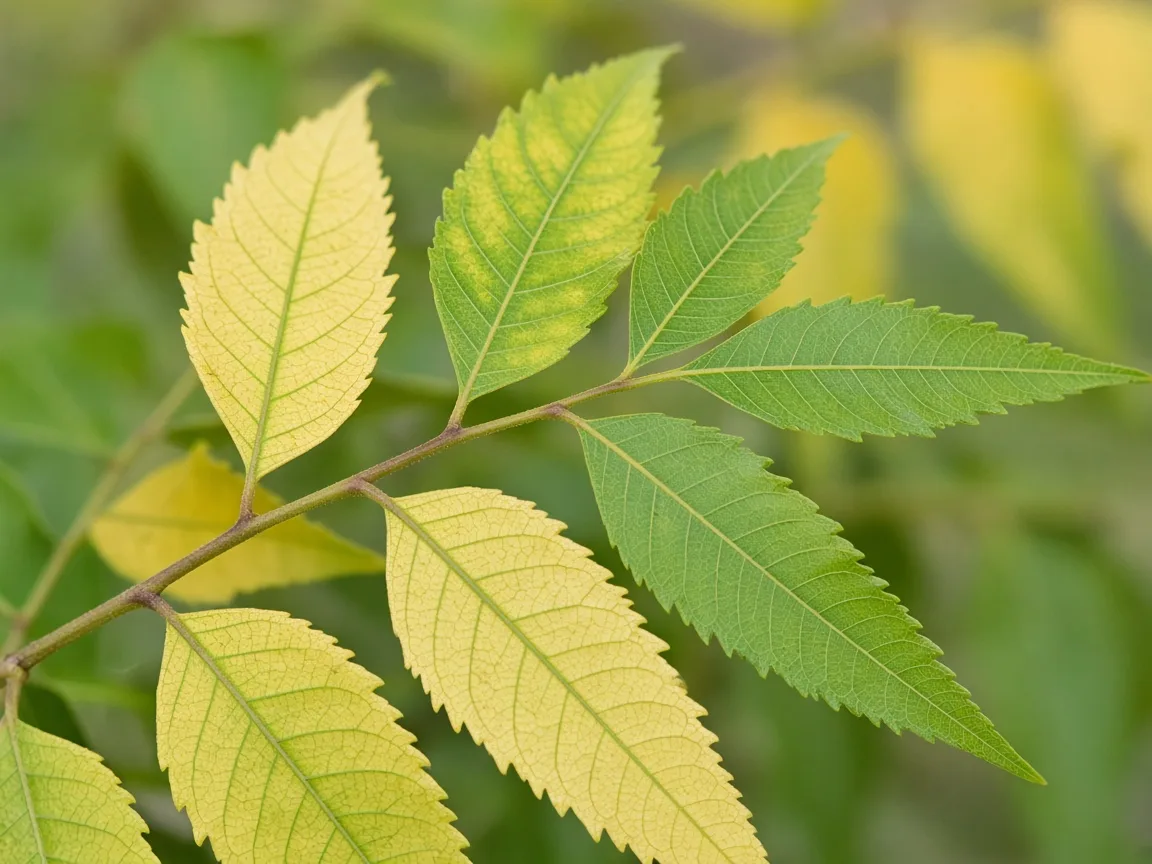
Chlorosis patterns on neem (Azadirachta indica) leaflets—differentiating whole-leaf fading from interveinal chlorosis and cold-induced shedding helps isolate the true stressor.
Early warning signs
- Pale lime-green shading developing uniformly across the lowest 2 to 4 compound leaves while upper branches remain vibrant green.
- Interveinal yellowing on terminal leaflets, where the delicate leaf tissue between primary and secondary veins fades to lemon-yellow while the veins stay emerald green.
- Gradual yellowing of the petiole and rachis on mature basal leaves, indicating the tree is withdrawing nutrients before abscission.
- Translucent or dull yellowish-brown cast on lower leaflets accompanied by soil that remains damp for more than 7 days.
Advanced or urgent signs
- Sudden yellowing and drop of dozens of compound leaves within 48 hours, leaving lower branches bare.
- Mushy, dark brown bark at the soil line accompanied by yellowing leaves that fail to perk up after watering.
- Bleaching of young terminal growth to near-white or ivory, indicating complete chlorophyll failure from severe micronutrient lockout.
- Foul, sour sulfur odor emanating from the container drainage holes, signaling severe anaerobic root decay.
Diagnosing chlorosis patterns on Neem
Because Azadirachta indica is genetically tailored to hot, semi-arid tropical environments, its physiological reactions to cultivation stress are highly predictable. Four primary causes account for virtually all yellow leaves on container and garden specimens:
1. Nitrogen remobilization: uniform fading of basal compound leaves
Nitrogen is a highly mobile macronutrient within plant vascular systems. When nitrogen levels in the potting substrate become exhausted, or when a rootbound tree exhausts its soil reserves, the plant cannot absorb sufficient nitrogen to fuel rapid new growth at branch tips.
To sustain active apical meristems, the tree translocates nitrogen compounds (primarily amino acids and proteins) out of older, fully expanded foliage and redirects them toward emerging shoot tips. As a result, the lowest, oldest compound leaves lose their chlorophyll evenly. Leaflets fade from deep green to light green, then to uniform yellow—including both the veins and interveinal lamina. The yellow leaves remain firm and crisp rather than mushy, eventually developing an abscission layer and dropping cleanly from the stem.
2. Overwatering and root hypoxia: waterlogged yellowing and premature leaf drop
While established neem trees in open ground possess legendary drought tolerance, container-grown specimens have zero tolerance for waterlogged media. Missouri Botanical Garden notes that overwatering fills soil pores with water, depriving roots of essential oxygen and causing feeder roots to die. When roots suffocate in stagnant, saturated soil, they can no longer absorb water or nutrients, causing lower leaves to turn yellow and droop even while the soil is soaking wet.
Botanical field monographs from the USDA Forest Service emphasize that Azadirachta indica requires well-drained, permeable soils and rapidly suffers root dieback in waterlogged substrates. In container cultivation, excessive watering leads to anaerobic conditions that encourage fungal root pathogens like Fusarium and Pythium. Unlike nitrogen-deficient leaves, overwatered neem leaflets often appear dull, water-soaked, and limp before turning yellow, frequently displaying soft brown patches near leaflet bases.
3. Iron chlorosis: interveinal yellowing on young leaflets in high-pH substrates
When yellowing occurs at the very top of the neem tree on newly emerging growth rather than at the bottom, the problem is almost never nitrogen or overwatering. Iron is an immobile micronutrient essential for chlorophyll biosynthesis and electron transfer during photosynthesis.
The Royal Horticultural Society indicates that chlorosis caused by iron deficiency affects the youngest expanding leaves first because the plant cannot remobilize iron from older foliage. On neem, this creates a striking visual pattern: the leaf tissue between the fine veins of newly expanding leaflets turns bright yellow or creamy white, while the intricate network of veins remains dark green.
In container cultivation, true soil iron deficiency is rare; instead, iron becomes chemically unavailable due to substrate alkalinity. As New Mexico State University Extension explains, iron chlorosis commonly develops when substrate pH rises above 7.0 to 7.5. In this alkaline range, soluble iron oxidizes into insoluble ferric hydroxides that roots cannot absorb. Potted neem trees irrigated with hard, alkaline municipal tap water frequently suffer pH drift over several months, resulting in acute iron lockout even in fertile potting mixes.
4. Cold snaps and seasonal shedding: tropical deciduous response
Neem is an obligate tropical heliophyte adapted to warm climates. Authoritative research published through the National Center for Biotechnology Information highlights that neem ceases vegetative growth when ambient temperatures fall below 14°C (57°F) and suffers severe physiological stress when exposed to temperatures approaching freezing. Similarly, Missouri Botanical Garden Plant Finder documents that neem is intolerant of temperatures below 40°F (4°C) and sheds foliage in response to cold weather.
When autumn temperatures drop sharply or a potted indoor neem is exposed to cold drafts from windows or air conditioners, the tree initiates a protective deciduous dormancy response. Lower and mid-canopy compound leaves turn golden-yellow almost simultaneously and drop in large numbers. If the primary stem remains green and the apical buds stay firm and plump, this cold-induced shedding is not fatal; the tree is simply reducing transpirational surface area to survive low temperatures.
Pinnate leaf architecture: reading nutrient mobility on neem
Understanding the botanical structure of Azadirachta indica allows growers to read nutrient deficiencies like an open book. Neem leaves are once-pinnately compound, consisting of an elongated petiole, a slender central rachis, and up to 31 individual leaflets.
Water and nutrients travel through the primary xylem of the main trunk, branch into the petiole, traverse the rachis, and distribute into each leaflet’s vascular network. When assessing chlorosis, the distinction between mobile and immobile elements is written directly into this leaf architecture:
- Phloem-mobile nutrients (Nitrogen, Magnesium, Potassium): The tree can actively retrieve these elements from existing chlorophyll complexes in mature foliage. Vascular phloem carries these salvaged nutrients out of the basal compound leaves and transports them to the active growing tips. Consequently, mobile deficiencies always cause chlorosis on the oldest basal compound leaves, while terminal flushes remain vibrant green.
- Phloem-immobile nutrients (Iron, Calcium, Sulfur): Once incorporated into cellular structures in mature leaves, these minerals cannot be remobilized. If roots fail to absorb fresh supplies—due to alkaline pH lockout, root rot, or substrate exhaustion—new foliage expanding from the terminal buds is starved of the building blocks needed for chlorophyll synthesis. Consequently, immobile deficiencies appear strictly on the youngest terminal leaflets at branch tips, while mature lower compound leaves remain deep green.
By checking whether chlorosis is concentrated at the base of the branch or at the growing tip, you instantly eliminate half of all possible nutritional causes.
Root-zone dynamics: taproot confinement in containers
In open ground, a juvenile neem tree rapidly drives a substantial, deep vertical taproot into the earth, followed by an extensive lateral root network that scavenges moisture and nutrients from deep subsoil layers. When cultivated in a container, this natural morphology creates unique challenges:
- Taproot coiling and circling: The vigorous vertical taproot reaches the bottom of the pot early in the tree’s development. Unable to grow downward, it circles the container base, forming dense root coils that crowd drainage holes and trap perched water.
- Perched water table effect: Standard peat-based potting mixes retain high levels of gravitational water in the bottom third of the container. Because neem roots require continuous air exchange, this saturated zone suffocates feeder roots, precipitating lower leaf chlorosis and root rot.
- Substrate buffering breakdown: Confined root balls quickly deplete organic buffers, making container soil vulnerable to rapid pH shifts from tap water carbonates or concentrated synthetic fertilizers.
To maintain healthy foliage, container neem trees must be planted in tall, deep pots filled with lean, gritty, highly permeable substrates such as 50% sandy loam, 25% coarse horticultural sand or perlite, and 25% compost, as detailed in our Neem Soil Guide.
How to confirm the cause on your neem tree
Before applying any treatments, systematically inspect your plant using this step-by-step diagnostic matrix:
| Diagnostic Check | What You Observe | Confirmed Diagnosis | Immediate Action |
|---|---|---|---|
| Location of yellowing | Oldest lower compound leaves yellowing; newest terminal leaves healthy and green | Nitrogen deficiency or early overwatering | Check pot weight and soil moisture depth |
| Location of yellowing | Youngest terminal leaflets displaying yellow blades with dark green veins | Alkaline iron chlorosis | Test substrate pH; prepare chelated iron |
| Pot weight & soil check | Pot feels heavy; skewer inserted 5 cm deep emerges wet; lower leaves limp | Overwatering / root hypoxia | Pause irrigation; review Neem Watering |
| Pot weight & soil check | Pot feels feather-light; soil pulled from pot edges; lower leaves dry yellow | Nitrogen deficiency / underwatering | Bottom-water deeply; plan dilute feeding |
| Temperature check | Night temperatures recently dropped below 14°C (57°F); drafty window | Cold shock dormancy response | Move to warm, sunny area (>18°C / 65°F) |
| Foliage underside check | Tiny webbing, speckling, or sticky honeydew on chlorotic leaflets | Pest pressure (spider mites or aphids) | Wash foliage; consult Neem Problems Hub |
The first fix: targeted triage based on symptom pattern
Avoid the temptation to apply multiple treatments simultaneously. Stacking fertilizer, repotting, heavy pruning, and systemic chemicals on a stressed neem tree frequently causes irreversible shock. Choose the single corrective action that matches your confirmed diagnosis:
If caused by overwatering and saturated soil
First action: cease all irrigation immediately and elevate the container to facilitate bottom aeration.
- Empty any standing water from the saucer or cachepot. Never allow a container neem to sit in runoff water.
- Carefully slip the root ball out of the pot to inspect root health. Healthy neem roots are firm, pale cream, and fibrous; rotting roots are brown, black, slimy, and emit a sour odor.
- If roots are sound but media is soggy, place the root ball on several layers of dry newspaper or cardboard for 4 to 6 hours to wick out excess moisture, then return it to the container.
- Withhold water until the top 4 to 6 cm of substrate is completely dry. When resuming irrigation, follow our deep-soak guidelines in the Neem Watering Guide.
If caused by alkaline iron lockout
First action: flush the potting substrate with clean rainwater or distilled water and drench with chelated iron.
- Pour pure, low-mineral water (distilled, reverse osmosis, or clean rainwater) equal to twice the container volume through the soil to leach accumulated alkaline carbonates and salts.
- Apply a soil drench containing EDDHA-chelated iron (FeEDDHA). Unlike standard EDTA chelates which become ineffective at pH levels above 6.5, EDDHA remains fully bioavailable to roots up to pH 9.0.
- Mix according to package instructions (typically 1/4 teaspoon per gallon of water) and apply to moist soil. Do not apply concentrated iron drenches to bone-dry roots.
- Discontinue the use of alkaline tap water and consider amending the top layer of mix with elemental sulfur or acidic peat compost to gently correct substrate pH.
If caused by nitrogen deficiency
First action: provide one thorough drink of balanced, dilute liquid organic fertilizer.
- Confirm that the soil is dry and roots are healthy before feeding. Never fertilize a waterlogged or root-damaged neem tree.
- Select a balanced organic liquid fertilizer (such as fish emulsion, seaweed extract, or a balanced 3-1-2 liquid formulation) diluted to half the manufacturer’s recommended strength.
- Water the tree thoroughly until runoff drains freely from the bottom.
- Establish a regular growing-season feeding routine as outlined in our Neem Fertilizer Guide, feeding monthly from March through October and suspending all fertilizer during cool winter months.
If caused by cold shock
First action: relocate the container to a warm, sunlit interior space protected from drafts.
- Move the plant away from cold window glass, external doors, and unheated patio spaces.
- Ensure ambient temperatures remain consistently above 18°C to 24°C (65°F–75°F).
- Maximize sunlight exposure by placing the tree directly in a south-facing window or supplementing with a high-output LED grow light providing at least 400–600 µmol/m²/s PPFD, as recommended in our Neem Light Guide.
- Reduce watering frequency substantially; a semi-dormant, defoliated neem consumes only a fraction of its normal water volume.
Step-by-step recovery and realistic timeline
When managing chlorosis on Azadirachta indica, setting realistic expectations prevents unnecessary interventions.
What can and cannot recover
- Yellow leaflets will not turn green again. Once chlorophyll degradation and cellular senescing occur, the leaflet tissue cannot regenerate functional chloroplasts. These leaves will eventually dry and shed from the rachis.
- Recovery is measured by new growth. True recovery is demonstrated when existing chlorosis stops spreading to adjacent leaves, the terminal buds remain green and firm, and newly unfurling compound leaves emerge with vibrant, rich green coloration.
Realistic recovery timeline
| Timeframe | Expected Milestones | What to Do |
|---|---|---|
| Days 1–7 | Yellowing stops spreading to healthy foliage; root zone begins to stabilize | Maintain stable temperature and bright sun; do not add extra fertilizer |
| Weeks 2–3 | Severely chlorotic lower leaves shed naturally; terminal buds begin swelling | Check soil moisture weekly; water only when the top 3–5 cm is dry |
| Weeks 4–6 | Fresh compound leaf flushes unfurl from branch terminals with rich green leaflets | Resume normal light feeding if nitrogen was the primary issue |
| Months 2–3 | Full canopy density restored with robust, serrated pinnate foliage | Maintain sharp drainage and full direct sun; monitor pot drainage |
Lookalike symptoms and misdiagnoses
Avoid confusing physiological chlorosis with other common neem disorders:
- Spider Mite Damage: Sucking mites puncture individual plant cells, creating fine yellow stippling across leaflet surfaces that can mimic nutrient deficiency from a distance. Inspect leaflet undersides with a 10x hand lens for moving specks and delicate webbing. Consult our Neem Spider Mites Guide if active pests are found.
- Aphids and Scale: Clustered sucking insects along new green shoots and leaf petioles cause curled, distorted yellow leaflets and excrete sticky honeydew. Review our Neem Aphids Guide for organic control measures.
- Sunscald vs. Chlorosis: Moving an indoor neem tree abruptly into blazing summer sun can bleach upper leaflets white or pale yellow. Unlike systemic chlorosis, sunscald causes papery, scorched patches strictly on upper leaf surfaces exposed to direct solar radiation.
- Natural Senescence: It is completely normal for a mature neem tree to shed a few of its very oldest basal compound leaves each month as the canopy expands upward. If leaf loss is limited to 1 or 2 bottom leaves while the plant pushes vigorous growth, no intervention is needed.
Mistakes to avoid
When dealing with yellowing neem foliage, well-intentioned care mistakes can accelerate decline:
- Fertilizing an overwatered tree: Applying fertilizer to a plant with water-damaged roots burns compromised root hairs and accelerates root rot. Never feed a neem tree until roots are healthy and soil moisture is balanced.
- Repotting a cold-stressed or defoliating plant: Unpotting and disturbing the root system of a dormant or cold-shocked tree adds severe transplant shock to existing thermal stress. Keep the plant in its container until warm spring weather arrives.
- Using chemical pesticides for nutrient yellowing: Spraying neem oil or insecticidal soap on chlorotic leaves caused by soil pH or watering stress clogs leaf stomata and burns sensitive leaflets.
- Watering on a fixed calendar schedule: Neem water consumption fluctuates dramatically based on ambient temperature, humidity, container material, and sunlight. Always check soil dryness at depth rather than watering on set days.
- Ignoring drainage saucers: Allowing the container to sit in runoff water trapped in an attached saucer ensures the bottom root ball remains waterlogged, guaranteeing persistent lower leaf chlorosis.
How to prevent yellow leaves next time
Preventing chlorosis on Azadirachta indica requires aligning cultivation practices with its evolutionary biology as an arid tropical shade tree:
- Provide full, unfiltered sunlight: Neem requires 6 or more hours of direct sunlight daily. Outdoors, place containers on sunny terraces, balconies, or patios; indoors, position the tree directly in an unshaded south-facing window or provide supplemental LED grow lighting.
- Implement the soak-and-dry watering rhythm: Water deeply until water runs freely from the drainage holes, then allow the top 3 to 5 cm of potting mix to dry out thoroughly before irrigating again. In hot summer weather, check every 4 to 7 days; during cooler months, extend intervals to 10 to 14 days. Review our Neem Watering Guide for seasonal schedules.
- Use lean, fast-draining substrate: Pot your tree in a sandy, gritty potting mix with excellent permeability. Avoid heavy clay, water-retentive moisture gels, or dense garden soils that compact and suffocate roots.
- Monitor irrigation water quality: If your municipal tap water is hard (pH > 7.5 or high carbonate hardness), periodically flush containers with rainwater or use an acidic fertilizer formula to prevent upward soil pH drift.
- Maintain warm thermal conditions: Protect container neem trees whenever temperatures fall below 12°C (54°F). Move outdoor containers indoors well before the first autumn cold snap and provide a stable indoor environment between 18°C and 32°C (65°F–90°F).
When to worry
A few yellowing lower leaflets during active spring growth or seasonal temperature transitions is normal for a vigorous neem tree. However, escalate your response to urgent triage if you observe:
- More than 30% of the canopy turning yellow within a single week.
- Yellowing accompanied by black or mushy discoloration along the main stem base.
- Soil remaining wet and heavy for longer than 10 days despite warm temperatures.
- Complete defoliation accompanied by dry, brittle branch tips that snap when bent.
If the main trunk remains green beneath the outer bark (revealed by a gentle thumbnail scratch test) and roots retain firm white cores, even a severely defoliated neem tree possesses remarkable regenerative capacity once environmental stress is resolved.
Related Neem guides
Explore these species-specific guides across our neem care cluster to maintain a resilient, vigorous tree:
- Neem Overview — Complete cultural overview, native ecology, and growth habits.
- Neem Watering Guide — Detailed moisture requirements, seasonal watering intervals, and container management.
- Neem Light Guide — Full sun thresholds, indoor grow light targets, and photoperiod requirements.
- Neem Soil Guide — Ideal substrate formulations, drainage specifications, and pH balance.
- Neem Fertilizer Guide — Organic feeding schedules, NPK ratios, and micronutrient management.
- Neem Problems Hub — Complete index of pests, fungal disorders, and physiological stresses on neem.
Conclusion
Yellow leaves on neem (Azadirachta indica) are an informative diagnostic signal rather than a death sentence. By examining the location of the chlorosis—distinguishing uniform lower-leaf nitrogen remobilization from waterlogged root rot, interveinal terminal iron deficiency, and cold-snap shedding—you can pinpoint the true cultural breakdown immediately. Avoid indiscriminate feeding or watering, address root-zone moisture and substrate pH directly, and protect your tree from chilling temperatures. With sound cultural care, your neem tree will rapidly resume pushing its characteristic compound flushes of deep green, aromatic foliage.
Related tool
Use the Watering Calculator to calculate optimal irrigation intervals and water volumes for your neem tree based on container dimensions, ambient room temperature, and seasonal sunlight levels.