Brown Tips on Neem: Causes, Checks & Fixes
Quick answer
Brown tips and scorched leaflet margins on neem are most often triggered by fertilizer salt accumulation in container soil or fluoride and chlorine in municipal tap water, followed by low indoor humidity and chronic moisture deficits. Flush the pot thoroughly with rainwater or distilled water and suspend feeding until clean new leaflets emerge.
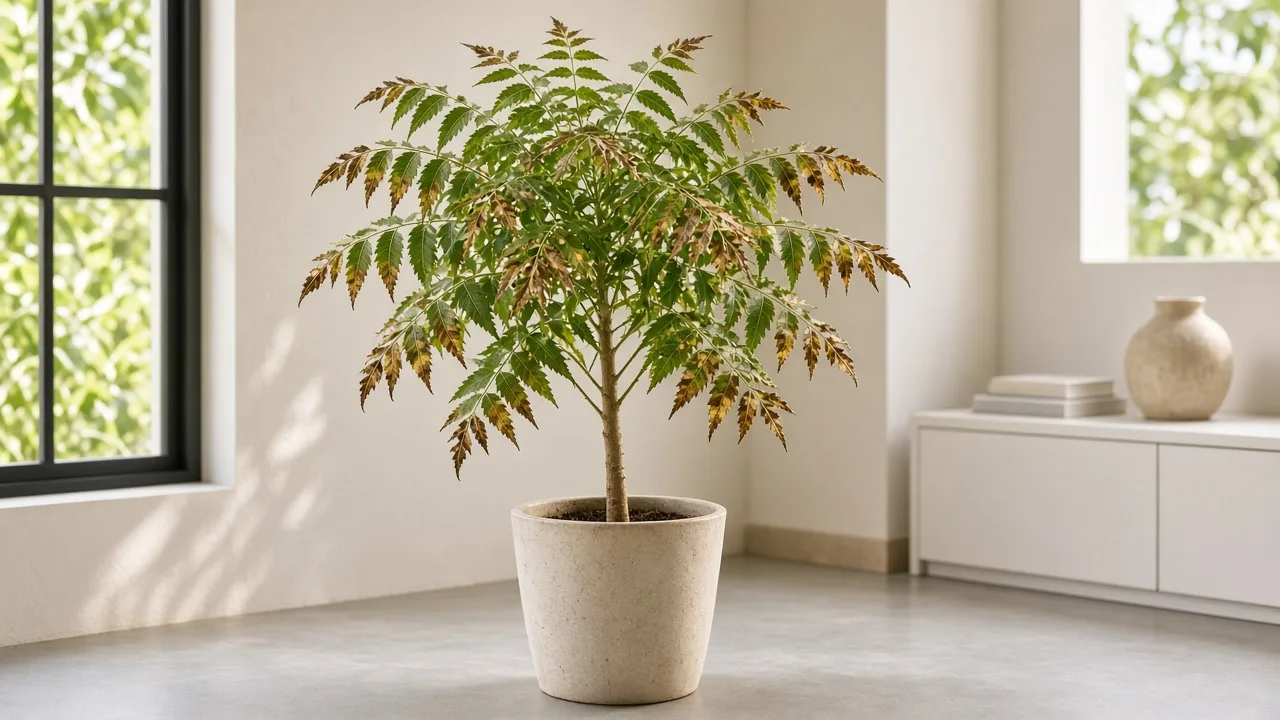
Brown Tips on Neem: Causes, Checks & Fixes
This guide covers brown tips on Neem. See also the general Brown Tips guide, watering, and light pages for this plant.
Brown Tips on Neem: Causes, Checks & Fixes
Quick answer
Brown necrotic tips and crispy margins on neem (Azadirachta indica) leaflets usually signal root-zone chemical or moisture imbalances rather than a primary foliar disease. In container-grown neem trees, the most common trigger is soluble fertilizer salt accumulation in the potting mix, closely followed by sensitivity to municipal tap water chemicals (fluoride and chlorine), dry indoor air during winter heating, and chronic underwatering.
Your immediate first action: thoroughly leach the container substrate using clean rainwater or distilled water, and pause all fertilizer applications. Pour pure water equal to two to three times the container volume through the pot to dissolve and wash out concentrated mineral salts. Keep the tree in bright, warm sun, maintain consistent soil moisture, and monitor the newest compound flushes. While necrotic leaflet tissue will not turn green again, correcting root-zone chemistry allows healthy, serrated green leaflets to emerge rapidly.
Recognizing brown tips on neem foliage
Neem trees feature alternate, pinnately compound leaves consisting of 20 to 31 distinct, serrated leaflets arranged along a central rachis. When physiological stress occurs, symptoms do not appear as a broad blotch on a simple leaf; instead, necrosis begins at the pointed tip of each individual leaflet and spreads backward along the serrated outer margins.
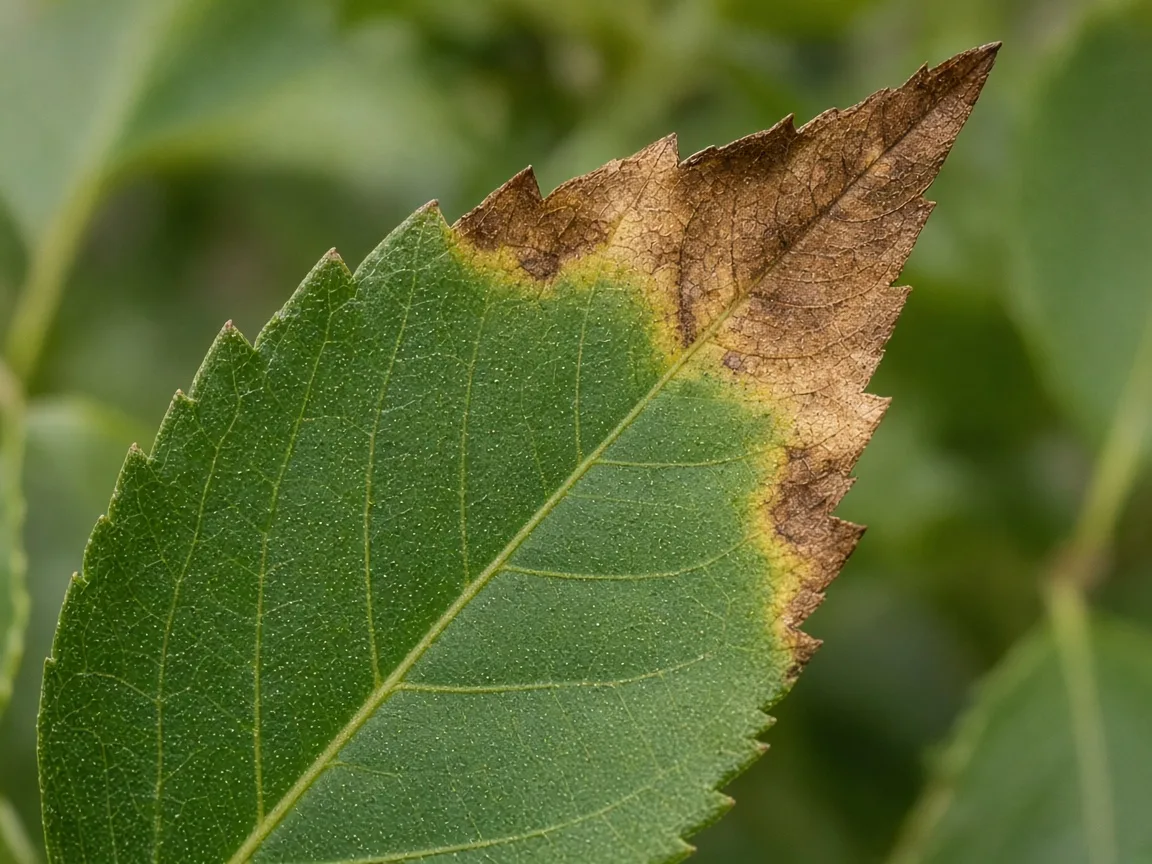
Necrotic brown tips and scorched margins on neem leaflets typically begin at the apex and outer serrations where vascular salt accumulation or dehydration is most severe.
Affected leaflets develop tan, golden-brown, or dark brown margins that become brittle and papery to the touch. In mild cases, only the terminal 2 to 5 millimeters of each leaflet brown, while the center of the blade and the main petiole remain vivid green. Under prolonged stress, marginal scorch advances inward toward the central midvein, causing entire leaflets to curl upward, desiccate, and shed from the rachis.
For a broad overview of how moisture stress affects houseplant leaves across species, explore our general brown tips guide. On neem specifically, diagnosis hinges on understanding how container boundaries restrict a tree naturally adapted to deep tropical soils.
Primary causes of necrotic leaflet tips on neem
Neem is celebrated for its rugged drought resilience in open ground, but container cultivation alters root physiology. Confined to a pot, neem cannot send taproots deep into the earth to escape surface chemical buildup or extreme drying cycles. Four primary factors cause brown leaflet tips in domestic cultivation:
1. Fertilizer salt accumulation in container substrate
Neem evolved in relatively lean, rocky soils and requires modest nutrient inputs. When container-grown trees receive frequent liquid fertilizer doses or heavy chemical feedings without adequate runoff, soluble mineral salts (nitrates, phosphates, potassium, and sulfates) accumulate in the substrate. As Washington State University Extension notes, high concentrations of salts in the soil damage root hairs and accumulate in distal foliage tissues, causing dieback and necrosis of leaf tips and margins. As the soil dries between waterings, the soil solution becomes hypertonic, pulling moisture away from roots via reverse osmosis and driving concentrated salts into leaflet tips where cells dehydrate and collapse.
2. Fluoride and chlorine sensitivity in municipal tap water
Municipal water supplies frequently contain chlorine, chloramines, and added fluorides for public sanitation. Unlike outdoor shade trees watered by rainfall, container neem trees irrigated exclusively with municipal tap water accumulate these compounds over months. Fluoride ions are absorbed by root tips and translocated through the vascular xylem until they reach the terminal ends of the veins at the leaflet apex and margins. Once toxic concentrations accumulate in the leaf margins, tissue necrosis inevitably follows.
3. Low ambient humidity during winter heating
While adult neem trees in arid regions endure dry heat, young potted specimens brought indoors for winter protection struggle with artificial indoor heating. Modern heating systems drop indoor relative humidity to 10–25%. The Royal Horticultural Society indicates that a dry atmosphere accelerates transpiration rates from leaf pores, resulting in brown tips and dried margins when roots cannot transport water fast enough to offset transpiration losses.
4. Chronic moisture deficit and hydrophobic substrate
Although neem tolerates brief dry spells, chronic underwatering or shallow surface watering leaves the bottom half of the root ball bone-dry. Fine capillary feeder roots responsible for water uptake shrivel and die. When water finally arrives, the plant cannot absorb sufficient volume to rehydrate the furthest foliage cells, producing crispy tan margins across entire compound leaves.
Compound leaf anatomy: how pinnate leaflets signal root-zone distress
Understanding the botanical architecture of Azadirachta indica explains why leaflet tips are the first parts of the plant to suffer. National Research Council documentation highlights that neem produces pinnately compound leaves with numerous asymmetrical, lanceolate-falcate leaflets featuring sharply serrated edges.
Water and dissolved minerals travel from the roots up through the trunk, into the petiole, along the elongated rachis, through the petiolules, and finally into the primary and secondary veins of each leaflet. The tips and serrated outer margins represent the terminus of this hydraulic system—the furthest anatomical distance from the root system.
When toxic fertilizer salts or tap water fluorides travel through the xylem transpiration stream, they have nowhere else to go. They concentrate in the hydathodes and marginal parenchyma cells. Once the concentration exceeds cellular tolerance thresholds, the cells suffer osmotic desiccation and die, creating the classic dry, crispy brown outline characteristic of salt scorch.
How to confirm the cause on your neem tree
Before treating your neem tree, confirm the specific stressor by inspecting the pot, soil surface, and leaf pattern:
| Symptom Presentation | Soil & Container Clues | Likely Cause | Immediate Diagnostic Action |
|---|---|---|---|
| Brown crispy tips on multiple leaflets; white crust on soil rim or saucer | Soil dry or damp; history of regular full-strength feeding; terracotta efflorescence | Fertilizer salt accumulation | Test runoff EC; flush soil with pure water; review neem fertilizer guide |
| Uniform browning along outer serrated leaflet edges across older leaves | Regular tap water irrigation; no salt crust; healthy feeding cadence | Fluoride / chlorine sensitivity | Switch to clean rainwater or distilled water immediately |
| Crispy tips accompanied by curled leaflet tips; indoor winter placement | Dry indoor air (RH < 30%); tree placed near heating vent or radiator | Winter low humidity | Move away from heat sources; check neem low-humidity guide |
| Pale, limp compound leaves with brittle tips; pot feels exceptionally light | Potting mix pulled away from pot walls; water runs straight through gaps | Chronic moisture deficit / underwatering | Bottom-soak container; review neem watering guide |
| Yellowing lower leaflets with soft brown tips and sour-smelling soil | Pot remains heavy for weeks; drainage holes blocked; soggy root zone | Overwatering / early root stress | Pause irrigation; inspect root health; consult neem problems hub |
The first fix: leaching the substrate and switching water sources
When brown leaflet tips appear, take one decisive corrective action: leach the potting substrate with clean, pure water.
Do not apply fertilizer, do not spray foliar chemicals, and do not immediately repot the tree into fresh soil, which adds severe mechanical root disturbance on top of chemical stress.
- Move the container: Take the potted neem outdoors, to a wash basin, or onto a patio where water can drain completely without pooling in a saucer.
- Apply pure water: Use collected rainwater, reverse osmosis water, or distilled water. University of Maryland Extension advises that flushing growing media from the top with several volumes of pure water effectively leaches out accumulated mineral and fertilizer salts. Pour water equal to double or triple the pot’s volume slowly through the soil surface in batches, allowing each pour to drain through the bottom holes.
- Dissolve surface crusts: Gently scrape off any visible white crystalline mineral crust from the top centimeter of potting mix and discard it before the final flush.
- Drain fully: Allow the container to drain freely for 30 to 45 minutes until dripping ceases. Never allow the pot to sit in drained leachate, as the plant would reabsorb the concentrated salts.
- Switch ongoing water: For all subsequent waterings, use rainwater or filtered water. Missouri Botanical Garden explains that excess salts in the root zone cause marginal leaf burn and emphasizes that softened water containing sodium chloride should never be applied to plants.
Leaching container substrate: flushing accumulated salts from confined neem roots
Because neem is a fast-growing woody perennial, its root system is vigorous and active in warm temperatures. As noted in USDA Forest Service botanical data, neem develops extensive lateral root systems adapted to deep, well-drained sandy substrates. When confined to a container, these roots quickly fill the pot volume.
Standard potting mixes rich in peat moss or uncomposted organic matter tend to bind mineral salts and become acidic over time, exacerbating nutrient toxicity. To ensure long-term root health:
- Substrate composition: Grow container neem in a porous, gritty substrate composed of 50% coarse sandy loam, 25% perlite or coarse horticultural grit, and 25% mature compost, as detailed in our neem soil guide. This structure allows mineral salts to flush away cleanly during every watering.
- Routine leaching: Every 4 to 6 weeks during the active summer growing season, irrigate with an extra 20% volume of water so that approximately one-fifth of the applied water exits the drainage holes, washing away routine mineral residues before they reach damaging levels.
- Saucer hygiene: Always discard drained effluent within 15 minutes of watering.
Overwintering stress: dry indoor air versus root dormancy
Neem trees are native to tropical frost-free zones and drop foliage when temperatures dip below 10°C (50°F). When temperate growers bring potted neem indoors for winter, two conflicting environmental conditions often trigger widespread brown leaflet tips:
- Warm dry ambient air: Radiators and forced-air heating lower indoor humidity drastically while heating the foliage canopy, signaling the leaves to transpire moisture rapidly.
- Cold, inactive root zones: If pots sit on cold tile floors or near drafty floorboards, root activity slows to a near-dormant crawl. Cold roots cannot absorb water quickly enough to supply the transpirational demand created by dry heated air above, resulting in desiccated leaflet margins.
To protect indoor neem in winter:
- Elevate pots off cold floors using plant stands or cork mats.
- Keep the canopy at least 2 meters away from heating vents, radiators, and space heaters.
- Group container plants together on broad gravel trays filled with water (ensuring the pot bottoms remain above water level) to elevate localized relative humidity above 40%.
- Restrict watering to when the top 5 centimeters of substrate are dry, and cease all fertilizer applications until vigorous spring flushes resume.
Step-by-step recovery plan
Recovery in neem trees is measured by healthy emerging compound leaves, not by the rejuvenation of brown tissue. Follow this timeline:
Day 1 to 3: Salt removal and environmental stabilization
- Flush the container substrate thoroughly with pure rainwater or distilled water.
- Scrape away any white mineral crust from the soil surface and container rim.
- Ensure the tree is positioned in bright, indirect light or filtered sun, shielded from harsh midday heat while recovering from root stress.
Weeks 1 to 3: Moisture equilibrium
- Allow the top 3 to 5 centimeters of soil to dry before watering again. Check pot weight before each irrigation; lift the pot to confirm it feels light.
- If underwatering caused the browning, practice the soak-and-dry method described in the neem watering guide.
- Do not apply any fertilizer, bio-stimulants, or chemical sprays. Existing brown leaflet tips will remain brown; check that necrosis does not advance further down the rachis.
Weeks 4 to 8: New compound flush
- Under adequate warmth (24°C–32°C / 75°F–90°F) and sunlight (6+ hours daily), the terminal apical buds will begin swelling and unfurling fresh pinnate leaves.
- Inspect the newly unfurling leaflets: healthy leaflets emerge bronze or tender light green and mature into deep green with crisp, unblemished serrations.
- Once two full sets of healthy compound leaves have developed, resume feeding at half the manufacturer’s recommended strength using a balanced water-soluble formula once every 4 to 6 weeks during active growth, as outlined in our neem fertilizer guide.
Mistakes to avoid with neem leaf tips
When gardeners spot brown leaflet tips, well-intentioned interventions often worsen the condition:
- Do not apply fertilizer to ‘help it bounce back’: Adding fertilizer to a plant suffering from fertilizer burn or salt toxicity dramatically increases osmotic stress, accelerating leaf necrosis and causing total leaf drop.
- Do not strip off entire compound leaves prematurely: If a compound leaf has brown leaflet tips but the main leaf blade remains 70% green, it is still conducting photosynthesis and generating energy for root recovery. Only pluck leaflets that have turned completely brown or crisped.
- Do not mist leaves with hard tap water: Spraying neem foliage with hard tap water leaves alkaline mineral residues on the leaflets, which block stomatal gas exchange and fail to raise ambient humidity in any lasting way.
- Do not repot a stressed tree into an oversized pot: Moving a salt-stressed or moisture-stressed neem into a substantially larger container surrounds the compromised roots with a massive volume of wet potting mix that dries too slowly, elevating the risk of secondary root rot.
Lookalike symptoms on neem
Differentiating true brown tips from other foliar disorders ensures targeted care:
- Underwatering leaf drop vs. tip burn: Severe underwatering typically causes entire lower compound leaves to yellow, wilt, and drop cleanly at the petiole base, whereas salt burn leaves the rachis firmly attached while individual leaflet tips scorch. Explore the neem underwatering guide for full drought protocols.
- Sun scorch vs. salt burn: Sudden exposure to intense outdoor sun after overwintering indoors causes bleached, papery white or silvery patches on the upper surface of foliage facing the light. Salt burn is confined strictly to the tips and outer margins across all sides of the tree.
- Fungal leaf spot vs. abiotic scorch: Fungal infections (Colletotrichum or Alternaria) create circular or irregular dark brown lesions surrounded by prominent yellow chlorotic halos scattered randomly across the leaf blade, rather than uniform tip and margin necrosis.
Related Neem guides
- Neem overview — Complete botanical background and container care fundamentals
- Neem watering guide — Soak-and-dry irrigation rhythm and seasonal water requirements
- Neem fertilizer guide — Dilution rates, feeding calendars, and salt management
- Neem soil guide — Sandy, sharp-draining potting mixtures for healthy root aeration
- Neem problems hub — Triage index for pest, fungal, and physiological issues
- Neem underwatering — Distinguishing systemic drought from localized tip burn
- Neem low humidity — Winter indoor climate controls and pebble tray setups
Related tool
Use the Plant Watering Calculator to calculate optimal irrigation intervals and water volumes for your neem tree based on container dimensions, ambient room temperature, and seasonal sunlight levels.