Underwatering on Neem: Causes, Checks & Fixes
Quick answer
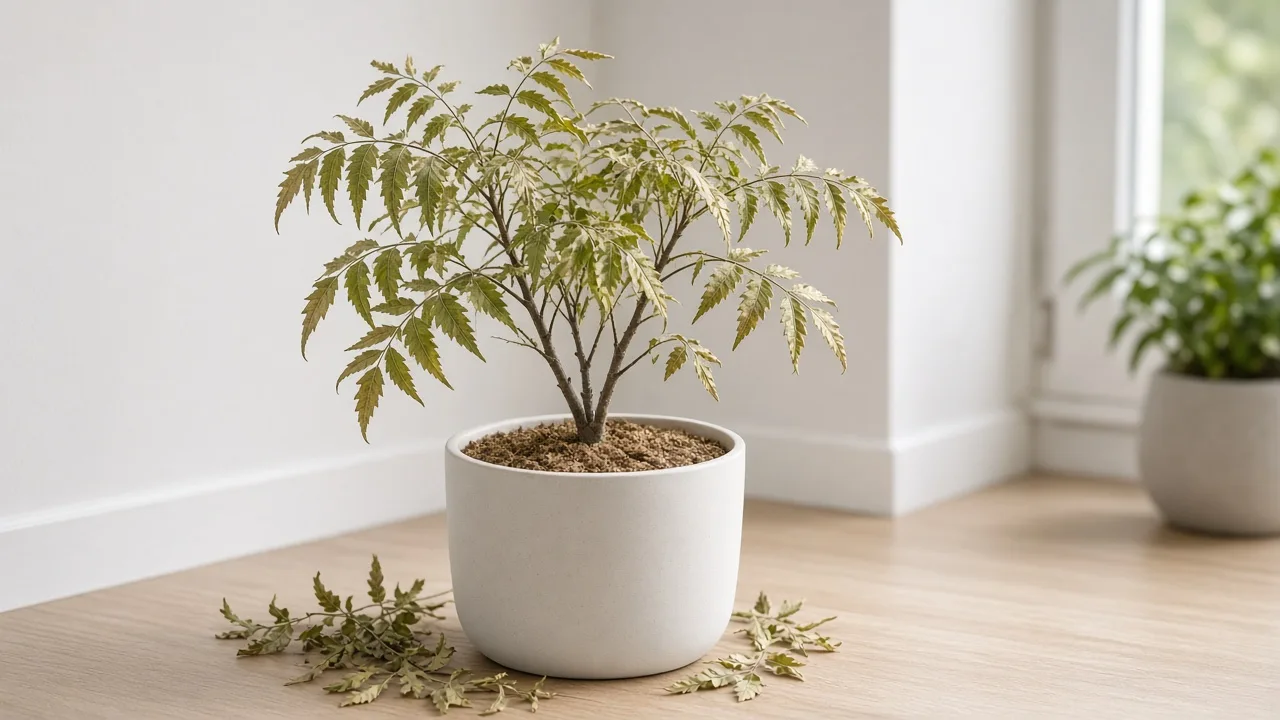
Underwatering on Neem (Azadirachta indica) occurs when confined root balls exhaust available soil moisture in warm, sunny conditions, causing loss of petiolar turgor, curled and crispy leaflet margins, and shedding of lower compound leaves. First step: Lift the container to verify a feather-light dry weight and check for soil shrinking away from the pot wall; if bone-dry, submerge the bottom third of the pot in a water basin for 30 to 45 minutes to rehydrate the hydrophobic core.
Underwatering on Neem: Causes, Checks & Fixes
This guide covers underwatering on Neem. See also the general Underwatering guide, watering, and light pages for this plant.
Underwatering on Neem: Causes, Checks & Fixes
Quick answer
Underwatering on Neem (Azadirachta indica) presents a sharp contrast between the species’ celebrated wild resilience and the strict physical limits of container culture. While mature Neem trees in open ground survive prolonged droughts by sinking vertical taproots deep into subterranean water tables, containerized specimens are confined to a restricted soil volume. In warm weather or direct sunlight, rapid transpiration quickly exhausts this limited water supply, causing a loss of turgor pressure in the petioles, inward curling and crisping of leaflet margins, and targeted shedding of lower compound fronds.
For the universal physics of moisture deficit and transpiration in indoor plants, see our comprehensive underwatering guide. On container Neem, underwatering is uniquely distinguished by a feather-light pot, soil pulling away from the container rim, and brittle, papery leaflets that crumble rather than soften.
First step: Lift the container to verify its weight, probe the core of the root zone, and inspect the perimeter of the potting mix. If the pot feels weightless, the soil has shrunk away from the sides, and a skewer emerges bone-dry, bypass standard top-watering and perform a 30- to 45-minute deep bottom-watering soak to break soil hydrophobicity.
When to use this page vs other Neem guides
Because foliage flagging and leaf drop can stem from multiple cultural stressors, it is essential to distinguish true dehydration from soggy root hypoxia, sudden chilling, or nutrient burn. Use the differential triage table below to route your diagnosis:
| Canopy symptom on Neem | Underlying condition | Recommended guide |
|---|---|---|
| Feather-light pot; crisp, curled leaflets; soil gap along pot rim | Acute moisture deficit and soil hydrophobicity | Stay on this guide |
| Heavy, cold, soggy pot; limp yellowing leaves; sour earthy odor | Saturated soil causing root hypoxia and decay | Root Rot on Neem |
| Soggy soil remaining wet >7 days; soft, drooping foliage without crispness | Excess watering volume or poorly draining substrate | Overwatering on Neem |
| Flexible downward flagging of petioles; soil mildly dry; leaves soft | Initial turgor loss before tissues become brittle | Drooping Leaves on Neem |
| Crispy brown tips and scorched margins despite damp soil; white crust | Soluble fertilizer salt accumulation or tap chemical burn | Brown Tips on Neem |
| Sudden total canopy collapse overnight after low temperatures | Chilling injury below 10°C (50°F) or vascular collapse | Wilting on Neem |
For general routine maintenance and optimal baseline culture, consult our core Neem care overview and species-specific Neem watering guide.
What underwatering looks like on Neem
Neem foliage is taxonomically distinct: as a member of the mahogany family (Meliaceae), Missouri Botanical Garden notes Azadirachta indica develops alternate, pinnately compound leaves with 20 to 30 serrated leaflets carried along an elongated central rachis. Because each compound frond spans 20 to 40 cm, the plant requires constant hydrostatic vascular pressure to hold its canopy upright.
When roots can no longer extract water from the potting mix, symptoms progress across the canopy in distinct stages:
Early dehydration cues
- Loss of foliar luster: Healthy Neem foliage has a vibrant, semi-glossy emerald sheen. As water reserves fall, leaflets turn matte, pale, and slightly grayish-green.
- Rachis curvature and petiolar sag: The long central stalk (rachis) softens at its junction with the woody branch, causing compound fronds to hang downward rather than extending horizontally.
- Leaflet margin curling: Individual serrated leaflets roll inward longitudinally toward the midrib to shield their stomatal pores and reduce evaporative surface exposure.
Advanced desiccation and leaflet crisping
- Brittle, papery texture: Unlike overwatered leaves that become limp, water-soaked, or mushy, underwatered Neem leaflets turn paper-thin and brittle, crumbling instantly between your fingers.
- Marginal scorch: The outer serrated teeth of each leaflet dry out first, turning pale tan to reddish-brown while central veins remain dull green.
- Selective lower canopy defoliation: The tree begins dropping entire compound leaves from the lower branches while retaining apical clusters near growing branch tips.
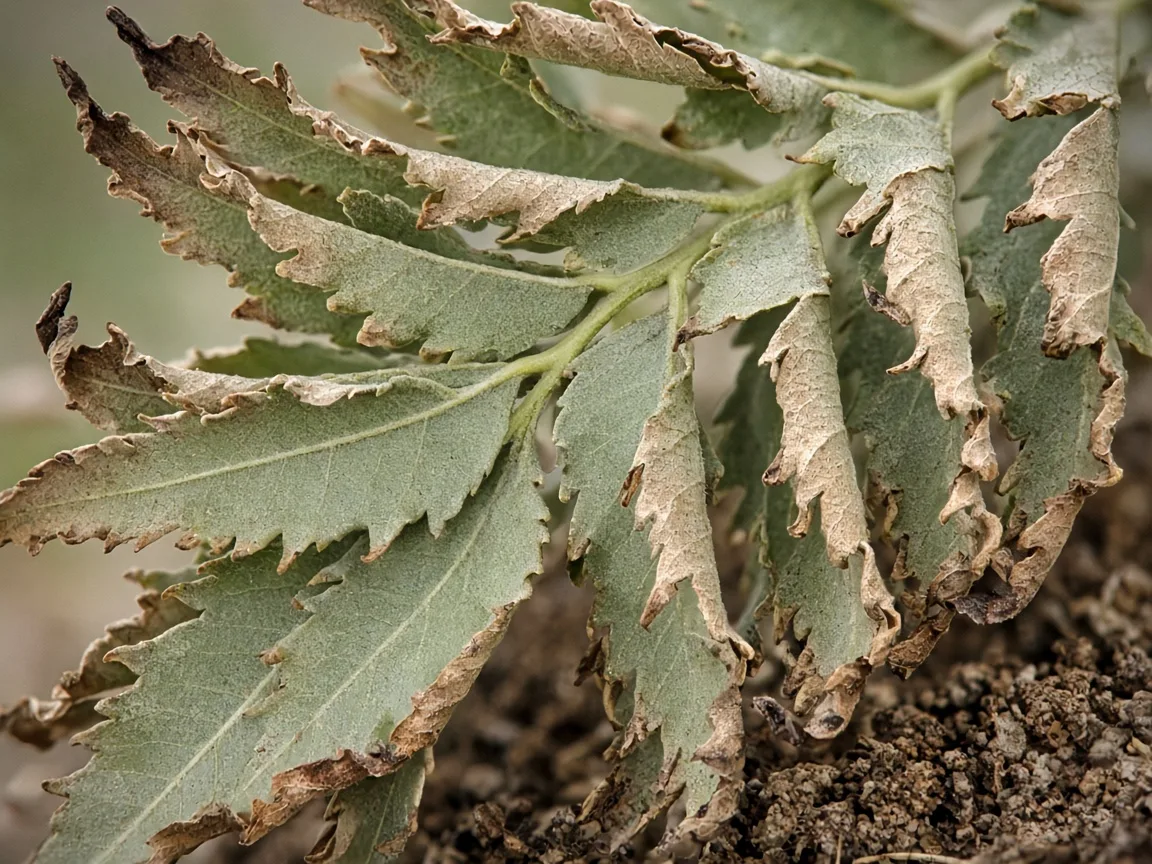 Crisp leaflet margins and loss of petiole turgor on Azadirachta indica indicate acute container dehydration.
Evolutionary drought adaptation vs container dehydration
To understand why containerized Neem trees dehydrate quickly despite their reputation as tough, desert-friendly plants, one must examine their evolutionary biology.
Ground taproots vs container confinement
In its native range across dry deciduous forests of South Asia, the National Research Council highlights Neem’s deep taproot drought adaptations, where mature wild trees anchor deep into rocky, semi-arid soils to draw moisture from several meters below ground. However, when grown as a containerized patio or houseplant specimen, this taproot cannot descend.
Instead, the tree develops a dense, fibrous root mass bounded entirely by the walls of the pot. As NC State Extension explains for plants grown in containers, container substrates dry rapidly in warm sunlight because root density is exponentially higher than in native open soil, while the total volume of water held within the container is strictly limited. Under high light conditions, a healthy Neem transpires moisture through hundreds of leaflets within 48 to 72 hours, quickly triggering water stress if irrigation does not keep pace with transpirational loss.
Lower canopy defoliation as a survival mechanism
When drought intensifies, Neem initiates an evolutionary defense mechanism described in the USDA Forest Service monograph on Azadirachta indica: drought-deciduous leaf shedding. To safeguard its woody trunk, cambium layer, and apical growth buds, the tree synthesizes abscisic acid and ethylene, forming an abscission layer at the base of the petioles on older compound leaves.
By voluntarily jettisoning lower foliage, the tree dramatically reduces its total evaporative surface area, cutting transpiration losses to prevent full vascular embolism. Recognizing this behavior prevents growers from misinterpreting lower leaf drop as a fungal disease or nutritional deficiency; it is the tree’s natural self-pruning response to severe dehydration.
Hydrophobic soil shrinkage: The dry-pot trap
A primary reason chronic underwatering persists in container Neem is the physical degradation of dried potting media. Most standard nursery soils incorporate peat moss or coconut coir for moisture retention and perlite for aeration.
When allowed to dry past a critical moisture threshold, Clemson Cooperative Extension documents that dry peat moss becomes hydrophobic and repels water. Instead of absorbing moisture like a sponge, the organic particles shrink and pull inward, creating a visible 1 to 2 cm gap between the soil root ball and the interior perimeter of the pot.
When an unsuspecting grower applies water from the top, liquid takes the path of least resistance: it rushes down the perimeter gap, completely bypassing the desiccated root ball, and pours directly out the drainage holes into the saucer. The grower sees water draining freely and assumes the tree is thoroughly watered, while the interior roots remain bone-dry and suffocated in hydrophobic peat. Over weeks, this perimeter bypass leads to progressive canopy decline and severe root dieback.
Step-by-step diagnostic confirmation
Before applying water or adjusting care variables, confirm acute underwatering using this 3-step physical checklist:
1. The container lift test
Grip the rim of the pot and lift it upward. A properly hydrated container of sandy loam potting mix possesses substantial mass. If the container feels feather-light, almost as if filled with styrofoam or dry leaves, the root zone is devoid of usable moisture.
2. Soil core probe and perimeter gap inspection
Inspect the soil surface closely. Is there a hollow gap separating the potting mix from the pot walls? Insert a slim wooden skewer or chopstick 8 to 10 cm (3 to 4 inches) deep into the center of the root ball:
- Clean and dusty skewer: Confirms total soil desiccation. The soil cannot hold particles to the probe.
- Difficulty penetrating: If the soil feels rock-hard and resists insertion, severe peat compaction and hydrophobic crusting are present.
3. Foliar texture and petiole flexibility test
Gently pinch several lower leaflets and feel the main leaf rachis:
- If leaflets are brittle, have crisp curled edges, and snap or crumble when bent, moisture deficit is confirmed.
- If leaves hang downward but feel soft, cool, and leathery without brittle margins, the plant may simply be at the early flagging stage or suffering from root damage in wet soil. Always cross-reference with the Neem soil guide to ensure proper medium composition.
The first fix: Deep bottom-watering rehydration protocol
Do not attempt to fix a severely dried, hydrophobic container Neem by simply pouring a cup of water over the top of the soil. Top-watering will only channel down the side gaps, leaving the core parched while giving a false sense of security.
Instead, execute this single, targeted first fix: a deep bottom-watering rehydration soak.
+--------------------------------------------------------------------------+
|            NEEM DEEP BOTTOM-WATERING REHYDRATION PROTOCOL                |
+--------------------------------------------------------------------------+
|  Step 1: Fill a tub or deep basin with 8-10 cm (3-4 in) of tepid water.  |
|  Step 2: Submerge container; water level should reach bottom 1/3 of pot. |
|  Step 3: Soak for 30-45 min; capillary action draws moisture to the top. |
|  Step 4: Top-mist surface soil if top 2 cm remains dry after 30 minutes. |
|  Step 5: Lift container and let drain freely for 15-20 min. Empty saucer.|
+--------------------------------------------------------------------------+- Prepare a soaking basin: Fill a deep wash basin, sink, or large tub with 8 to 10 cm (3 to 4 inches) of room-temperature water. Avoid ice-cold water, which shocks tropical root systems.
- Submerge the container: Place the Neem pot into the water. Ensure the water level sits around the lower third of the pot.
- Allow capillary absorption: Let the pot sit undisturbed for 30 to 45 minutes. Water will enter through the bottom drainage holes, moving upward through capillary action to steadily rehydrate the compressed peat particles from the inside out.
- Inspect surface saturation: Once the topsoil feels cool, moist, and dark to the touch, the core is fully rewetted. If the very top layer remains crusty after 30 minutes, gently pour a small volume of water across the surface to close the gap.
- Drain completely: Lift the container from the basin and place it in a location where excess water can drain freely for 15 to 20 minutes. Never leave the container standing in a saucer filled with runoff water; as noted by Plants For A Future, Azadirachta indica is intolerant of waterlogged conditions and will quickly develop root rot if roots sit in stagnant water.
Recovery timeline and what to expect
Once deep rehydration is accomplished, monitor the plant closely over the following three weeks:
- Hours 4 to 24 (Turgor Restoration): Leaves that were merely flagging and had not yet reached permanent cellular desiccation will regain hydraulic pressure. Their petioles will stiffen, raising the compound fronds back toward a horizontal posture.
- Days 2 to 7 (Foliar Drop): Leaflets that sustained irreversible cellular damage or had already formed basal abscission layers will turn pale yellow or brown and drop. Do not panic; shedding desiccated foliage is normal and allows the tree to direct metabolic energy toward healthy tissue.
- Days 10 to 14 (Apical Flush): Under warm temperatures and bright light, the dormant apical buds on the tips of the branches will swell and burst, unfurling delicate, reddish-bronze new compound fronds that quickly turn vibrant green.
- Week 3 and Beyond (Stabilization): The root zone stabilizes, and normal transpiration resumes. Resume routine dry-down checks, watering deeply whenever the top 3 to 5 cm of soil dries.
Critical mistakes to avoid
When nursing a dehydrated Neem back to health, growers frequently make secondary care errors that compound stress:
- Applying fertilizer to parched roots: Never feed an underwatered Neem. Applying liquid or granular fertilizer to dry root systems causes immediate chemical burn, as concentrated fertilizer salts draw remaining moisture out of root cells through reverse osmosis. Delay fertilization until the tree has produced healthy new flushes for at least three weeks.
- Repotting immediately during acute drought stress: Do not unpot or prune roots while the tree is severely dehydrated. The root system is already brittle and fragile; disturbing root hairs during active drought exacerbates shock. Wait until the tree is fully rehydrated and showing steady new growth before considering repotting into fresh mix.
- Leaving the pot sitting in drainage runoff: After soaking, always empty the drainage saucer. Trapping saturated soil in standing water cuts off oxygen, turning an underwatering problem directly into root suffocation and fungal rot.
- Moving the plant into deep shade: While moving a thirsty plant out of blistering afternoon heat temporarily reduces transpirational demand, banishing Neem to a dim corner causes leaf drop from insufficient light. Keep the tree in bright, indirect light or filtered morning sun during initial rehydration, returning to full direct sun once turgor recovers. For lighting requirements, review our Neem light guide.
How to prevent underwatering next time
Preventing recurrent dehydration requires aligning your irrigation technique with the physiological demands of containerized Neem:
- Water by soil depth, not the calendar: Container water needs fluctuate wildly depending on season, ambient humidity, and temperature. Probe the top 3 to 5 cm (1 to 2 inches) of soil with your finger or a wooden moisture meter. When dry, water immediately and thoroughly until water exits the drainage holes.
- Adopt a sandy, well-draining soil mix: If your tree is potted in heavy peat that shrinks when dry, repot in early spring into an open, mineral-rich medium. As detailed in our Neem soil guide, combine 50% sandy loam, 25% coarse grit or perlite, and 25% organic compost. This structure prevents hydrophobicity and ensures rapid, uniform rewetting.
- Size containers appropriately: A mature Neem in an undersized container becomes root-bound rapidly, leaving inadequate soil volume to retain water for more than 24 hours. If roots circle the drainage holes and the pot dries out daily, upgrade to a container 5 cm (2 inches) wider in diameter.
- Adjust seasonally: Increase watering vigilance during peak summer heat when direct sunlight and high temperatures accelerate evaporation. Reduce frequency during cooler winter months when metabolic activity slows.
Related Neem guides
Explore these specialized guides across the Neem problems hub to keep your tree healthy and resilient:
- Neem care overview — Complete botanical characteristics, light requirements, and indoor container care.
- Neem watering guide — Seasonal irrigation frequencies, moisture testing protocols, and proper drainage.
- Neem light guide — Sunlight requirements, photoperiod demands, and sunburn prevention.
- Neem soil guide — Porous potting mixes, drainage amendments, and soil pH balancing.
- Neem problems hub — Complete index of pests, fungal pathogens, and environmental stressors.
- Overwatering on Neem — Recognizing saturated potting soil, root hypoxia, and lower foliage yellowing.
- Drooping leaves on Neem — Distinguishing petiole turgor loss from cold shock and overwatering.
- Brown tips on Neem — Diagnosing fertilizer salt scorch, low humidity, and municipal water sensitivity.
Related tool
Use the Plant Watering Calculator to calculate an accurate dry-down interval for your container neem based on pot size, sunlight, and seasonal temperatures.