Spider Mites on Neem: Causes, Checks & Fixes
Quick answer
Spider mites attack container neem trees indoors under high vapor pressure deficit (VPD) and dry air. Isolate the plant, carry it to a shower or hose, and thoroughly rinse the undersides of the compound leaflets with lukewarm water to dislodge active colonies and knock down webbing. Follow up with insecticidal soap or release predatory mites (Phytoseiulus persimilis) while raising ambient humidity to prevent resurgence.
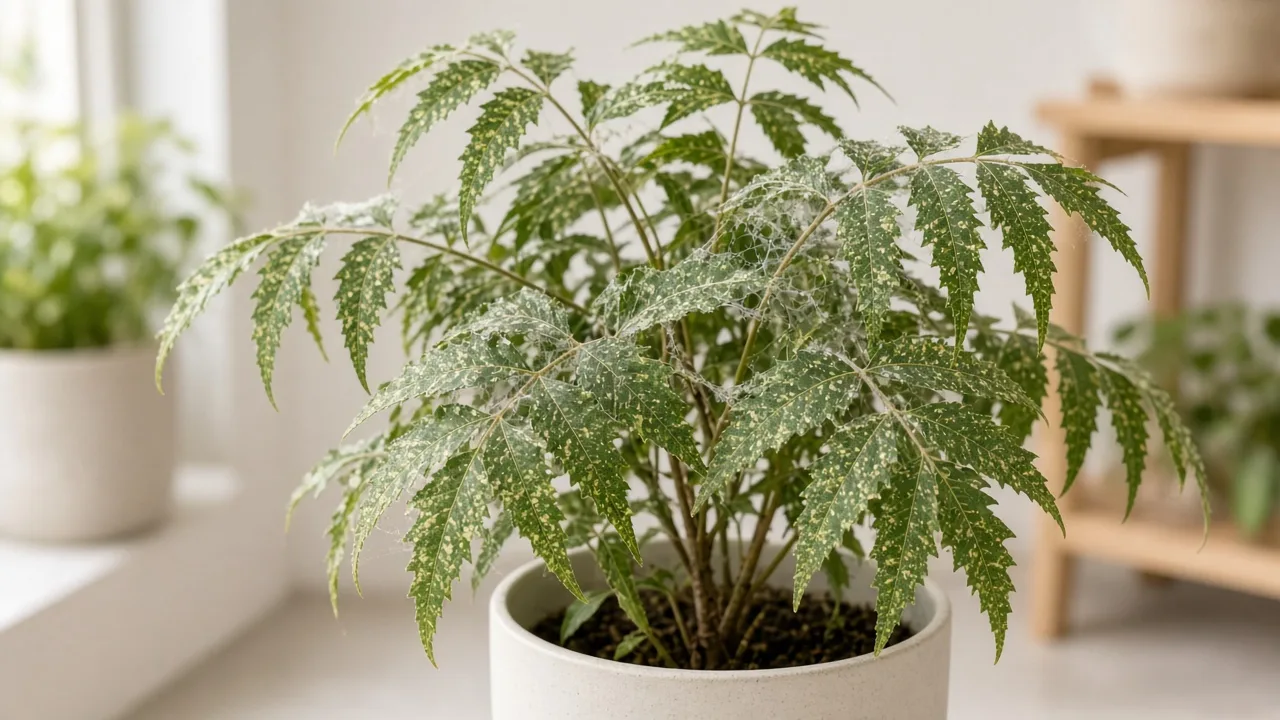
Spider Mites on Neem: Causes, Checks & Fixes
This guide covers spider mites on Neem. See also the general Spider Mites guide, watering, and light pages for this plant.
Spider Mites on Neem: Causes, Checks & Fixes
Quick answer
Spider mites (Tetranychidae) target container neem trees (Azadirachta indica) primarily when plants are brought indoors or placed in hot, dry, sheltered environments. The tiny pests spin fine, silken webbing along leaflet axils and drain cellular sap from the undersides of compound leaves, creating a telltale dusting of chlorotic stippling and bronzed foliage.
First step: Immediately isolate the neem tree from neighboring houseplants. Take the plant to a shower, wash basin, or outdoor patio and wash the undersides of every compound leaf with a steady, lukewarm stream of water to physically dislodge adult mites, eggs, and webs. Tilt the container so runoff does not saturate the root ball. Once foliage dries out of direct sun, treat with an insecticidal soap or introduce predatory mites (Phytoseiulus persimilis) while correcting the dry air that fueled the infestation.
For universal spider mite life cycles, feeding mechanisms, and seasonal ecology across indoor greenery, see our spider mites pest guide. Below, we detail the species-specific diagnostic nuances, the botanical paradox of why neem trees succumb to pests, and safe treatment steps tailored specifically to Azadirachta indica.
When to use this page vs other Neem guides
This guide focuses specifically on diagnosing, treating, and preventing micro-arachnid spider mite infestations on neem foliage.
| Foliage Symptom on Neem | Most Likely Issue | Primary Guide |
|---|---|---|
| Fine webbing in leaf axils with yellow stippling and dusty leaf undersides | Spider Mites | This guide |
| White fluffy cotton-like cushions nestled in branch crotches and leaf bases | Mealybugs | Neem mealybugs guide |
| Clustered translucent green, yellow, or dark soft-bodied insects on new flush | Aphids | Neem aphids guide |
| Uniform yellowing and premature drop of lower compound leaves without pests | Overwatering or Low Light | Neem watering guide or Light guide |
| Crispy brown leaflet tips without webs or feeding punctures | Severe Drought or Dry Air | Neem brown tips guide |
| Sudden leaf wilt with soft, waterlogged, sour-smelling soil | Root Rot | Neem root rot guide |
The botanical paradox: why spider mites attack the neem tree
It strikes many gardeners as an ironic contradiction: neem oil is one of the world’s most widely recommended botanical insecticides for eradicating spider mites, yet living neem trees frequently suffer severe spider mite attacks. Understanding the plant’s chemical ecology and physiology explains why this paradox occurs.
As documented in the Royal Horticultural Society’s Azadirachta indica profile, neem belongs to the mahogany family (Meliaceae). The tree produces a suite of complex tetranortriterpenoid limonoids—most famously azadirachtin, alongside salannin and nimbin—that act as insect antifeedants and hormonal growth disruptors. However, in a living tree, these defensive compounds are synthesized primarily in the woody bark, roots, and mature seed kernels. The circulating sap within vegetative foliage carries far lower, variable concentrations of these limonoids.
Furthermore, spider mites are not chewing insects that consume bulk woody tissue, nor are they vascular phloem suckers like aphids. Instead, as the UC Statewide IPM Program spider mites guidelines explain, spider mites are arachnids with stylet-like mouthparts adapted to puncture individual epidermal and mesophyll cell walls on the lower leaf surface. By drinking out individual cell contents, they largely bypass the deeper vascular veins.
In indoor cultivation, greenhouses, or dry balconies, container neem trees encounter a high vapor pressure deficit (VPD)—air that is warm and critically low in humidity. Under these microclimatic conditions, spider mite metabolism accelerates dramatically. According to Epic Gardening’s spider mite analysis, two-spotted spider mites (Tetranychus urticae) can complete their entire life cycle from egg to reproductive adult in as little as five to seven days during hot, dry spells. Without the outdoor rains, predatory mites, and lady beetles that keep populations in check, spider mite colonies rapidly multiply, overwhelming the neem tree’s subtle endogenous chemical defenses.
What spider mites look like on Neem foliage
Early spider mite feeding on Azadirachta indica is subtle. Because neem produces once-pinnately compound leaves composed of 20 to 30 lanceolate, serrated leaflets, the initial feeding marks easily escape casual observation until hundreds of mites are active.
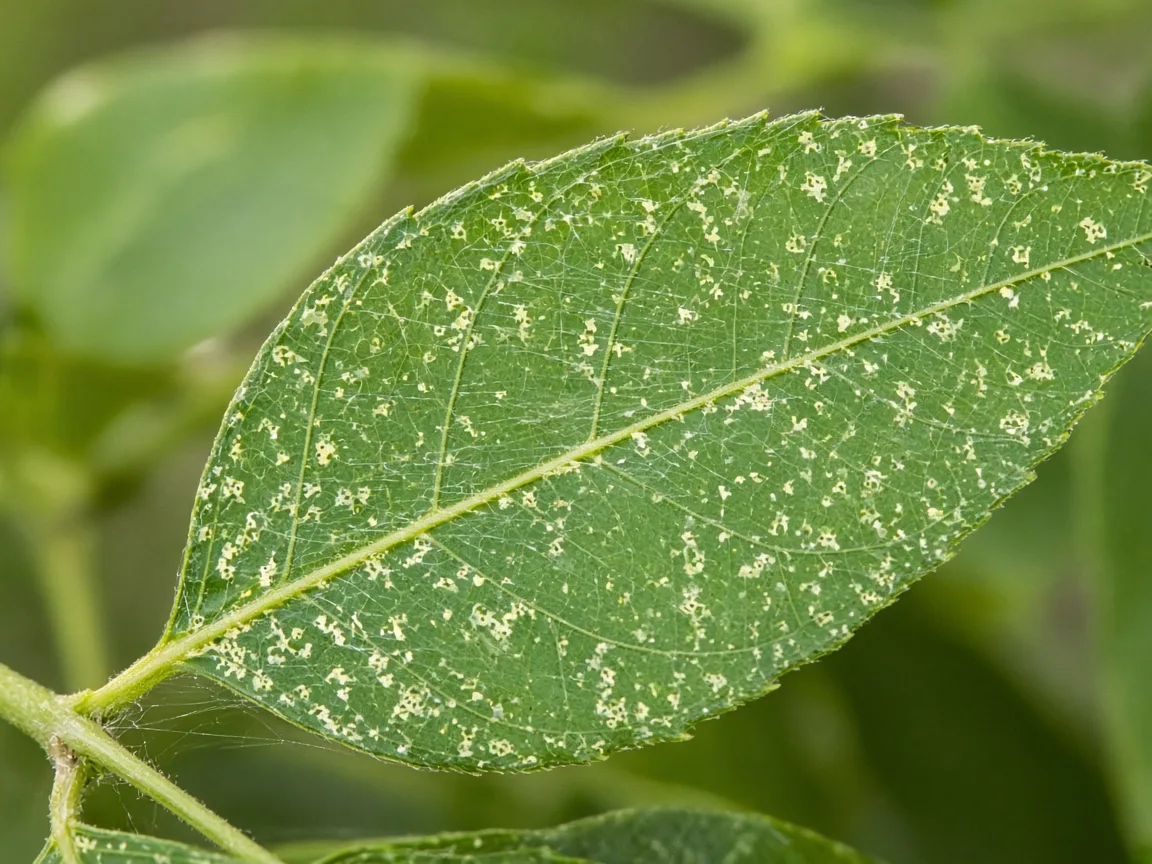
Microscopic spider mites and pale stippling along the leaflet midrib and petiolule axils on a container neem tree.
Key diagnostic indicators to look for include:
- Chlorotic flecking and stippling: As mites feed on individual cells on the underside of the leaflet, tiny pale yellow or white pinpoint dots appear on the upper leaf surface. The leaf blade loses its lustrous deep green sheen and appears matte, bleached, or dusty.
- Fine silken webbing in leaflet axils: Mites produce micro-fine webbing to protect themselves, their eggs, and their juveniles from air currents and desiccation. Look closely at the junction where individual leaflets attach to the central leaf rachis (the petiolule), as well as where compound leaves join the main branches.
- Bronzing and leaflet curling: As feeding intensifies and thousands of cells collapse, entire leaflets turn a dull bronze or muddy yellow-brown color. The edges of the serrated leaflets may curl upward or inward as tissue dehydrates.
- Premature leaflet drop along the rachis: Neem trees respond to severe spider mite stress by shedding damaged leaflets. Often, leaflets drop one by one from the compound leaf, leaving a bare, spindly rachis attached to the stem.
- Microscopic crawling specks: The mites themselves are oval, eight-legged arachnids measuring less than 0.5 mm (1/50 inch). Depending on the species and diet, they range in color from pale amber and translucent yellowish-green with two dark lateral spots to bright carmine red.
Species-specific inspection protocol: compound leaves and leaflet petiolules
To accurately confirm an infestation on Azadirachta indica, perform a systematic step-by-step diagnostic check:
- Conduct the white paper tap test: Hold a clean sheet of white printer paper directly beneath a symptomatic compound leaf branch. Tap the branch firmly two or three times with your hand or a pencil. Inspect the paper under bright light. If tiny specks begin crawling slowly across the sheet, you have confirmed active spider mites. If you press a finger against a speck and it leaves a green or yellow-orange streak, it is a plant-feeding mite.
- Examine the abaxial (lower) leaflet surface with a 10× hand lens: Turn compound leaves over. Focus on the central midrib of each leaflet. Under magnification, you will clearly see spherical, translucent eggs, cast skins (white flakes), and active eight-legged adults nestled among fine silk threads.
- Check the terminal flushes: Tender apical leaf flushes have thinner cuticles and higher moisture content, making them preferred targets for newly hatched mite nymphs. Inspect expanding terminal tips for dense silken webbing spanning across emerging leaflets.
- Inspect indoor microclimate and root zone: Spider mite infestations rarely arise in isolation. Check the soil moisture in your container; underwatered or heat-stressed neem trees transpire heavily, making foliage more palatable. Verify how close the tree sits to forced-air heating vents or air conditioners that strip ambient moisture.
Lookalike symptoms and differential diagnosis
Do not spray pesticides until you rule out other common neem afflictions that mimic mite injury.
| Observed Symptom | Suspected Cause | Differentiating Confirmation Check |
|---|---|---|
| Pinpoint chlorotic stippling with fine silk webs on leaflet undersides | Spider Mites (Tetranychidae) | White paper test reveals crawling oval micro-arachnids; webbing spans leaflet axils. |
| Silvery, bleached patches speckled with tiny tar-like black fecal droplets | Thrips (Thripidae) | Slender, elongate insects with fringed wings; no silken webs; distinctive black frass spots. |
| Dry, crispy leaflet margins without webbing or chlorotic stippling | Low Ambient Humidity | Leaf undersides are completely clean; occurs on dry winter edges; consult our neem brown tips guide. |
| Fluffy white waxy masses clustered at the petiole base and branch crotches | Mealybugs (Pseudococcidae) | Oval segmented insects beneath dense cottony wax; produce sticky honeydew; see our neem mealybugs guide. |
| Lower compound leaves turn bright yellow and drop during cool, cloudy periods | Overwatering / Wet Feet | Soil remains heavy and damp for over a week; roots appear brown and soft; read the neem watering guide. |
| Dull, dusty foliage that washes clean with plain water and shows no leaf damage | Environmental Dust / Mineral Build-up | Leaves wipe clean instantly; no chlorotic stippling or webbing remains under 10× magnification. |
The first fix for Neem: physical water knockdown
When dealing with spider mites on Azadirachta indica, resist the immediate urge to spray harsh synthetic chemical pesticides. Many synthetic chemicals, such as broad-spectrum pyrethroids, actually exacerbate spider mite outbreaks by killing off natural mite predators while leaving mite eggs unharmed.
Your immediate first fix is mechanical water knockdown:
- Isolate the tree: Move the neem tree away from all other houseplants to halt mite migration via silken draglines or air currents.
- Shield the soil mix: Because neem requires a lean, sandy, fast-draining substrate and is intolerant of saturated soil, wrap a plastic bag or plastic wrap around the base of the trunk and over the container rim. This prevents the potting mix from becoming waterlogged during the wash.
- Rinse foliage thoroughly: Take the plant to an outdoor hose or shower. Using a handheld sprayer set to a moderate, steady pressure, direct lukewarm water (20–25°C / 68–77°F) upward into the undersides of every compound leaf. Pay particular attention to the leaflet petiolules and branch crotches.
- Physical disruption: The physical force of the water washes away adult mites, destroys silken protective canopies, and dislodges unhatched eggs. Research from the University of Minnesota Extension on indoor pests emphasizes that regular mechanical water washing is one of the most effective non-chemical strategies for reducing mite densities on sturdy indoor foliage.
- Air-dry in indirect light: Allow the foliage to air dry completely in a warm, sheltered spot with good air circulation before returning the tree to direct sunlight. Water droplets on neem leaflets exposed to intense afternoon sun can act as lenses, resulting in foliar scorch.
Step-by-step recovery and treatment plan
After the initial water knockdown, implement a systematic follow-up strategy over the subsequent two to three weeks to intercept newly hatching nymphs.
Step 1: Follow-up foliar treatment with insecticidal soap
Water washing removes active mites, but eggs cemented to leaflet veins can survive. Three to four days after the initial wash, inspect the leaf undersides. If mites remain active, apply an insecticidal soap or diluted potassium salts of fatty acids.
- Spot-test first: Spray a single compound leaf 24 hours before treating the entire tree to ensure the formulation does not cause phytotoxicity on your neem tree’s foliage.
- Complete coverage: Spray early in the morning or in the evening. Coat the undersides of all leaflets until the liquid runs off. Insecticidal soaps work by dissolving the protective waxy cuticles of soft-bodied mites, causing rapid desiccation on contact. Once dry, they offer no residual toxicity, so direct contact with the pests is mandatory.
- Repeat application: Apply every 5 to 7 days for two cycles to break the reproductive cycle as eggs hatch.
Step 2: Biological control with predatory mites (Phytoseiulus persimilis)
For greenhouse setups, sunny enclosed balconies, or plant collections where chemical sprays are undesirable, releasing beneficial predatory mites is an outstanding, sustainable management approach.
As documented by Oregon State University Extension on biological control, Phytoseiulus persimilis is a specialist predatory phytoseiid mite that feeds voraciously on two-spotted spider mites. An adult female P. persimilis can consume up to 20 spider mite eggs or five to ten adult mites per day.
- Release criteria: Introduce predatory mites when spider mite populations are low to moderate (immediately following a water knockdown rinse).
- Environmental requirements: P. persimilis thrives in temperatures between 20°C and 27°C (68–81°F) and relative humidity between 60% and 90%. In very dry rooms, maintain local humidity around the canopy using a cool-mist humidifier.
- Compatibility caution: Never apply chemical miticides, synthetic pyrethroids, or horticultural soaps within 10 to 14 days of releasing biological predators, as residual sprays will eradicate the beneficial mites.
Step 3: Optimizing the indoor microclimate
Spider mites exploit dry air. Elevating relative humidity to 50–60% slows mite reproduction while enhancing the neem tree’s natural physiological vitality. Place a digital hygrometer near your tree and use a humidifier to stabilize the vapor pressure deficit.
Recovery timeline: what to expect
Understanding the botanical recovery process prevents premature panic and prevents growers from over-treating their plants:
- Days 1–3: Following water knockdown and isolation, active crawling mites should drop by 80–90%. Silken webbing should be visibly absent.
- Days 4–7: Newly hatched nymphs may appear from surviving eggs. This is the window for your second inspection and targeted soap treatment or beneficial insect release.
- Days 8–14: Spider mite activity ceases. Severely damaged, bronzed leaflets will continue to yellow and drop off the rachis. Do not be alarmed by this leaflet drop; the plant is naturally shedding non-functional, depleted tissue.
- Weeks 3–5: Provided the tree receives adequate full sun and balanced soil moisture, dormant terminal and lateral buds will activate. You will observe fresh, bronze-to-green compound leaf flushes unfurling cleanly without stippling or webbing.
Signs of improvement: Clean, web-free leaflet axils, firm compound leaf rachises, and vibrant new green leaflets emerging from branch tips.
Signs of worsening: Dense silken webbing re-forming across multiple branches, extensive leaflet yellowing spreading to the top canopy, or stunted, blackened new growth flushes.
Care cross-check: strengthening Neem resistance
A healthy, unstressed neem tree is far more resilient to pest pressure. Cross-check your cultural practices against the species’ baseline requirements:
- Light: Azadirachta indica demands full sun—at least 6 hours of direct sunlight daily. Weak indoor light softens foliage cuticles, making leaves vulnerable to piercing pests. Cross-reference our Neem light guide to optimize lighting.
- Watering: Container neem trees need deep, thorough soakings only when the top 3–5 cm (1–2 inches) of soil has dried out. Drought-stressed trees transpire poorly, drawing mites, while soggy soil induces root rot. Review the Neem watering guide for seasonal cadence.
- Soil and drainage: Neem requires lean, sandy, sharply draining soil with a pH between 6.2 and 7.0. Heavy, compacted potting mixes choke roots and weaken natural defenses. Consult the Neem soil guide to verify your mix.
- Fertilization: Avoid excessive high-nitrogen chemical fertilizers during an active mite outbreak. Excess nitrogen produces soft, lush, nitrate-rich tissue that stimulates mite egg production. Stick to light, balanced feeding during active growth as outlined in the Neem overview.
- Temperature and airflow: Missouri Botanical Garden’s neem profile notes that neem is a frost-tender tropical tree that suffers injury below 4°C (40°F). Maintain room temperatures between 18°C and 32°C (65–90°F) with gentle room air circulation to discourage stagnant microclimates.
Common mistakes to avoid
- Spraying oil in direct midday sun: Applying horticultural or neem oil sprays when the plant is exposed to hot, direct sunlight will scorch neem leaflets and cause catastrophic foliar drop. Always spray in the early evening or move the container to shade while leaves dry.
- Reaching for broad-spectrum pyrethroid insecticides: Synthetic insecticides eliminate predatory mites, minute pirate bugs, and lacewings while triggering rapid reproductive surges (mite flare-ups) among spider mites.
- Neglecting the undersides of leaflets: Spider mites live almost exclusively on the abaxial (lower) leaf surface. Misting water or spraying soap exclusively over the top of the foliage accomplishes virtually nothing.
- Overwatering a defoliated tree: If severe spider mite feeding causes your neem tree to shed a substantial portion of its compound leaves, the tree’s transpirational water demand drops dramatically. Reduce watering volume accordingly until new leaves emerge to avoid waterlogging the roots.
- Assuming one treatment is enough: Because no household contact spray reliably destroys all mite eggs, failing to repeat treatment 5 to 7 days later guarantees a resurgence.
Long-term prevention strategies
Preventing spider mites on container neem requires proactive cultural maintenance:
- Routinely rinse foliage: Make a gentle leaf rinse part of your monthly routine during warm, dry summer months or when indoor heating is active in winter.
- Quarantine incoming plants: Always isolate newly purchased nursery plants or outdoor potted plants for a minimum of 14 days before introducing them near your indoor neem tree.
- Maintain elevated humidity: Keep indoor relative humidity above 50% around your container neem canopy, particularly in winter when central heating creates desert-like indoor conditions.
- Scout weekly with a hand lens: Check the undersides of lower and mid-canopy compound leaves once a week. Catching a localized colony on two leaflets prevents a full-canopy crisis.
Related Neem guides
- Neem overview — Complete cultural profile and species background
- Neem watering — Soak-and-dry watering rhythms for healthy roots
- Neem light — Full-sun placement and indoor light management
- Neem soil — Sandy, sharply draining potting mixes for containers
- Neem problems hub — Comprehensive symptom diagnostic index
Conclusion
Spider mites on Azadirachta indica may initially seem like a puzzling paradox, but they are a solvable cultural and biological challenge. By recognizing that indoor vapor pressure deficits allow cell-piercing arachnids to bypass the tree’s native chemical defenses, you can respond with targeted interventions: mechanical water knockdown, selective contact insecticidal soaps, biological control agents like Phytoseiulus persimilis, and microclimate adjustments. Stippled leaflets will not turn green again, but with consistent care, your container neem tree will quickly push a clean, vigorous flush of compound foliage.
Related tool
Use the Humidity Calculator to calculate the vapor pressure deficit (VPD) and evaluate whether dry indoor air is accelerating spider mite reproduction on your neem tree.