Mealybugs on Neem: Causes, Checks & Fixes
Quick answer
Isolate the neem tree immediately to prevent crawlers from spreading. Check the protected branch crotches, compound leaf petiolule bases, and loose trunk bark; mealybugs show as soft-bodied pinkish or yellowish insects beneath fluffy white wax. Swab individual clusters with a 70% isopropyl alcohol-tipped cotton swab, spot-test foliage before broader treatments, and apply horticultural oil in indirect light to smother crawlers.
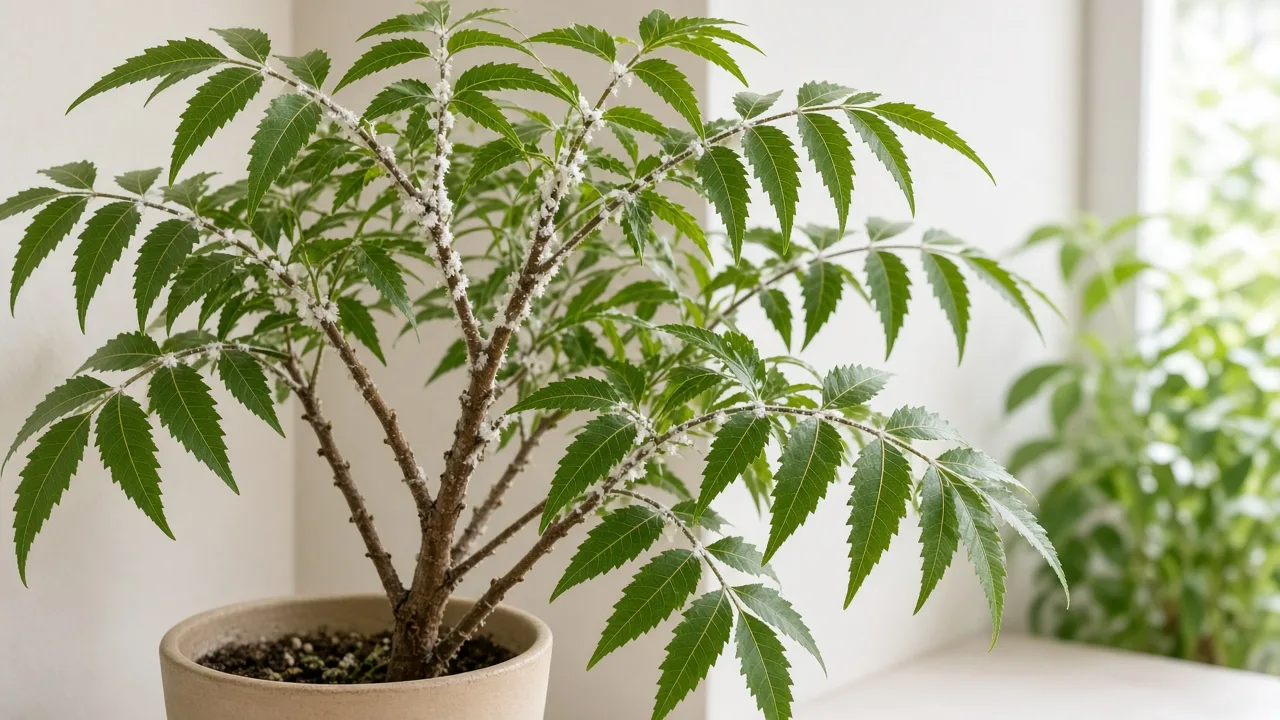
Mealybugs on Neem: Causes, Checks & Fixes
This guide covers mealybugs on Neem. See also the general Mealybugs guide, watering, and light pages for this plant.
Mealybugs on Neem: Causes, Checks & Fixes
Quick answer
Isolate your neem tree (Azadirachta indica) immediately from adjacent plants. Mealybugs appear as small, oval, soft-bodied insects hidden beneath cottony white wax deposits. On neem, they congregate primarily in the narrow crotches where lateral branches meet woody stems, at the base of compound leaf petioles, and beneath flaky, loose bark.
Dip a cotton swab into 70% isopropyl alcohol and dab visible waxy clusters directly to dissolve their protective coating and eliminate the pests on contact. Avoid immediately spraying the entire tree with harsh chemicals or concentrated horticultural oils, which can scorch neem’s delicate compound foliage under warm sunlight. For broader background on the pest’s biology across houseplants, see our global mealybugs guide; the following guide details species-specific inspection, treatment, and recovery for container and landscape neem.
The neem paradox: why natural azadirachtin does not stop mealybugs
Many indoor gardeners are surprised to discover mealybugs feeding vigorously on a neem tree. Commercial neem oil extracts and pure cold-pressed neem seed oil are renowned worldwide as organic botanical pest controls. However, the living tree is not automatically immune to sucking insects.
According to the Royal Horticultural Society’s Azadirachta indica profile, neem is a tropical evergreen tree in the mahogany family (Meliaceae). In nature, the tree synthesizes its most potent insecticidal limonoids—chiefly azadirachtin, salannin, and nimbin—concentrated primarily within its seed kernels and to a lesser extent in its mature bark and roots. In green vegetative shoots and foliage, endogenous azadirachtin concentrations in the vascular phloem sap are relatively low and variable.
Mealybugs belong to the insect family Pseudococcidae, as detailed in UC IPM’s mealybug guide. These unarmored scale relatives use specialized piercing-sucking stylets to feed on plant sap. Because azadirachtin functions primarily as an insect growth regulator and antifeedant rather than a broad-spectrum neurotoxin, mobile crawlers and adult females feeding on vegetative sap can ingest low levels of native compounds without immediate mortality. When a container neem tree is brought indoors, placed in a greenhouse, or positioned on a warm balcony where natural predatory insects are absent, mealybug populations reproduce exponentially and overcome the plant’s baseline chemical defenses.
What mealybugs look like on Azadirachta indica
Early mealybug activity on neem often goes unnoticed because the white waxy deposits blend into pale stem scars or mimic harmless mold spores. A healthy neem tree produces alternate, once-pinnately compound leaves bearing 20 to 30 lanceolate, serrated leaflets. The architecture of these compound leaves provides numerous sheltered crevices where colonies can establish before spreading to the outer canopy.
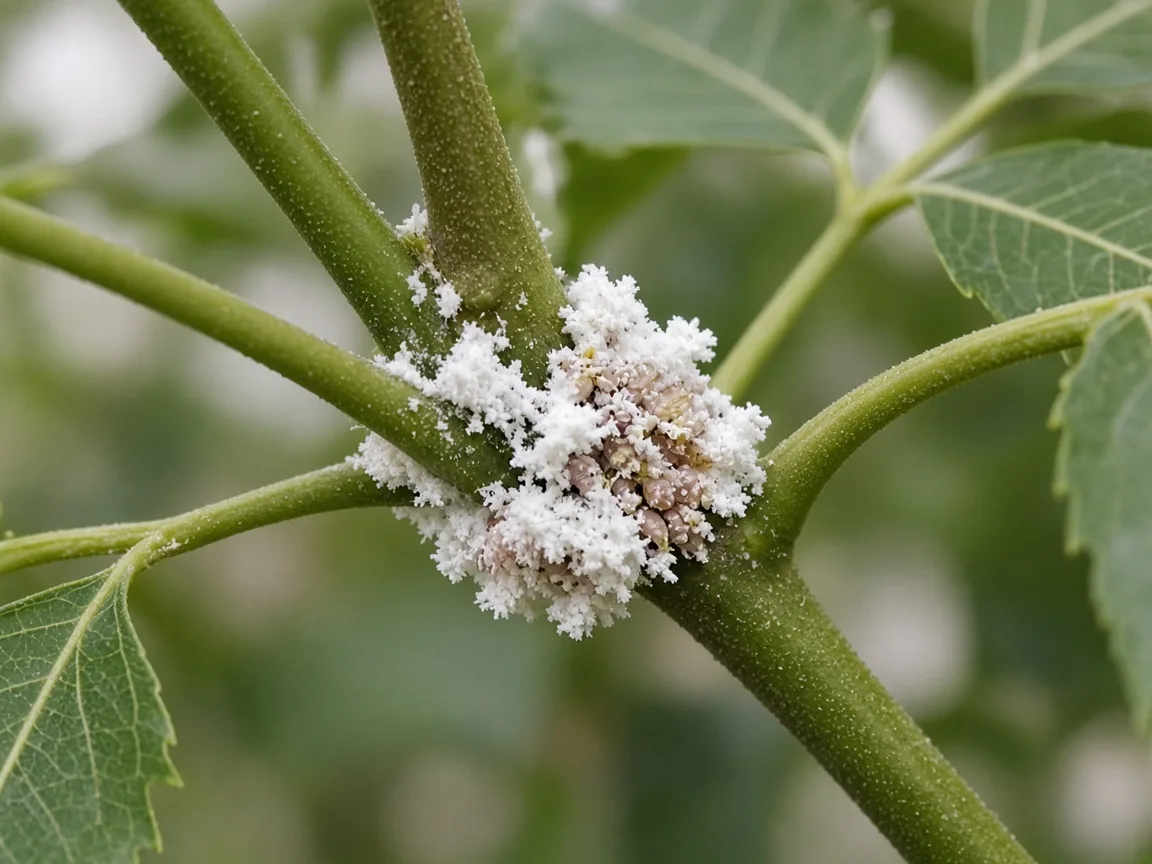
Inspect the narrow junction where compound leaf petioles join woody stems; white cottony wax shields soft-bodied mealybugs from surface sprays.
Key symptoms of mealybugs on neem include:
- Cottony white wax tufts: Adult females produce filamentous, hydrophobic waxy threads that form dense, cotton-like masses around egg clusters (ovisacs).
- Sticky foliage and honeydew: As phloem-feeders, mealybugs excrete large volumes of clear, sugar-rich liquid that coats lower leaflets and the pot rim.
- Sooty mold accumulation: Airborne mold spores germinate on sticky secretions, leading to sooty mold colonization on honeydew that appears as a dark, dusty soot layer across leaf surfaces.
- Chlorosis and leaflet drop: Sap depletion causes lower leaflets on affected compound leaves to develop irregular yellow blotching and shed prematurely. Compare this with yellow leaves on neem to distinguish nutrient or watering imbalances from insect feeding.
- Stunted apical flushes: Heavy colonies feeding at terminal growing tips cause emerging leaflets to twist, cup, or abort entirely.
Where mealybugs hide on Neem: compound leaf axils, branch crotches, and bark
To eradicate an infestation, you must inspect the specific morphological microhabitats unique to Azadirachta indica. Because mealybugs avoid bright, exposed leaf blades, spraying only the tops of the foliage will leave most of the population untouched.
The Royal Horticultural Society notes that glasshouse mealybugs congregate under loose bark and inside leaf axils. On container neem trees, systematically check these four zones:
- Compound leaf petiole bases (pulvini): The base of each compound leaf attaches to the stem with a swollen hinge called a pulvinus. Mealybugs wedge themselves tightly into the axil above and below this junction.
- Branch junctions and pruning cuts: The crotches where lateral branches diverge from the central trunk form shaded V-shaped pockets that trap moisture and shield mealybug egg sacs.
- Rough, peeling stem bark: As young green neem stems mature into woody branches, the outer bark develops shallow fissures and loose papery flakes. Mealybugs crawl underneath these bark flakes where standard foliar sprays cannot reach them.
- Tender terminal buds: Look closely at the delicate new growth tips where emerging compound leaves unfurl. Crawlers aggregate here to feed on the tender, thin-walled plant tissues.
How to confirm mealybugs instead of lookalike pests
Before applying treatments, confirm that the white residue on your neem tree is an active mealybug colony rather than mineral salts, fungal mycelium, or another pest species.
| Symptom / Sign on Neem | Most Likely Cause | Confirmation Check |
|---|---|---|
| White cottony cushions in branch crotches and leaf axils; soft pink/yellow insect revealed when wax is parted | Mealybugs (Pseudococcidae) | Part the waxy mass with a toothpick; confirm an oval, segmented insect body beneath. |
| Tiny translucent green, yellow, or black pear-shaped insects gathered openly on new shoots | Aphids | Look for exposed clusters with visible cornicles (tailpipes) at the rear; consult our neem aphids guide. |
| Fine silk webbing under compound leaflets with minute yellow stippling and tiny moving dots | Spider Mites | Tap branch over white paper to dislodge micro-arachnids; see our neem spider mites guide. |
| Flat, waxy, immobile brown or tan discs fixed firmly to woody stems | Scale Insects | Pry gently with a fingernail; scale insects have a distinct rigid or leathery shell. |
| Powdery chalk-like coating across the upper leaflet surface without insects or honeydew | Mineral or Fungicide Residue | Wipes off easily with a damp cloth; leaflets remain flat without distorted margins. |
If you are unsure whether your neem tree is battling mealybugs, scale, or a watering disorder, run our interactive Plant Problem Diagnosis tool to cross-reference multiple symptoms.
What to do first: isolation and precision alcohol swabbing
Step 1: Isolate the tree immediately. Move your container neem into a dedicated quarantine area separated from other houseplants by at least 2 to 3 meters. First-instar nymphs (crawlers) are minuscule, active, and can easily walk across touching foliage or be carried by gentle indoor air currents.
Step 2: Manually swab visible clusters. Do not begin by dousing the entire plant in oil or harsh insecticides. The safest and most effective initial knockdown is using 70% isopropyl rubbing alcohol applied with a cotton swab or small artist’s paintbrush.
- Dip the cotton swab into the 70% alcohol solution until saturated but not dripping.
- Press the swab firmly against each visible cottony cluster, turning the tip to lift away the waxy mass, adult females, and egg sacs.
- The alcohol immediately dissolves the protective epicuticular wax coating of the mealybug, dehydrating and killing the insect within seconds.
- Discard used swabs into a sealed plastic bag as you work to avoid recontaminating cleaned sections.
Step 3: Conduct a leaf spot test. While neem foliage is resilient, delicate young compound leaves can suffer chemical burn from alcohol or oils. Follow university extension guidance and test alcohol on a small area first, monitoring the test leaflet for 24 to 48 hours for browning or localized leaf drop before applying treatments widely.
Secondary treatment: horticultural oils and predatory Cryptolaemus
Manual swabbing eliminates conspicuous adult colonies, but microscopic crawlers often remain hidden within bark crevices and deep leaf axils. Secondary treatments provide systemic suppression across the entire canopy.
Horticultural oil and insecticidal soap applications
As outlined in Missouri Botanical Garden’s pest management guide, superior horticultural oils and insecticidal soaps work by physical contact rather than chemical poisoning. They coat and suffocate mobile crawlers and young nymphs before they can secrete heavy waxy defenses.
When applying horticultural oils to container neem:
- Dilute a refined mineral or vegetable-based horticultural oil strictly according to the product label (typically a 1% to 2% solution).
- Spray thoroughly, ensuring complete coverage of the underside of every compound leaf, all lateral branch crotches, and the lower trunk.
- Temperature and sunlight caution: Never spray neem trees when ambient temperatures exceed 32°C (90°F) or under full, direct midday sun. Move the container to a bright, shaded spot until the spray has completely dried to prevent severe leaf scorch.
- Repeat the application every 7 to 10 days for 3 to 4 treatment cycles to intercept newly hatched crawlers as eggs hatch.
Biological control with predatory beetles
For neem trees maintained in greenhouses, sunrooms, or sheltered courtyards, beneficial insects offer a sustainable, non-chemical solution. The Australian ladybird beetle Cryptolaemus montrouzieri, the mealybug destroyer, is an exceptionally effective predator. Both adult beetles and their waxy larvae (which cleverly mimic mealybugs) feed voraciously on all mealybug life stages, including egg sacs. For optimal activity, ensure temperatures remain between 20°C and 30°C (68°F–86°F) and discontinue all broad-spectrum insecticide sprays prior to release.
Realistic recovery timeline and monitoring
Recovery on Azadirachta indica is measured by the health of newly emerging vegetative growth, not by the instantaneous disappearance of historical feeding marks.
- Weeks 1–2: Existing colonies dry up, turn brown, and lose their fluffy white appearance. Sticky honeydew production ceases. Some heavily damaged lower leaflets may turn yellow and drop; this is normal self-pruning as the tree sheds compromised foliage.
- Weeks 3–4: Terminal buds resume active division. New compound leaves should emerge without cupping, crinkling, or waxy residues. Continue weekly inspections of branch crotches with a magnifying lens.
- Weeks 5–6: If no live crawlers or fresh cottony wax appear across two consecutive weeks, the infestation is considered under control. The tree can gradually be reintegrated into its primary growing space.
Remember that older damaged leaves will never uncurl or repair torn tissues. Once new growth is flourishing, you can lightly prune unsightly stems using clean shears according to our neem pruning guide.
Care mistakes that worsen mealybug pressure on Neem
Environmental and cultural stress significantly weakens a neem tree’s natural vitality, making it far more vulnerable to insect colonization:
- Excessive nitrogen fertilization: Pushing container neem trees with synthetic high-nitrogen fertilizers creates an abundance of soft, succulent vegetative growth. This tender phloem tissue is ideal for mealybug colonization and egg-laying.
- Inadequate sunlight and poor ventilation: Neem requires 6+ hours of full direct sunlight daily. Placing a tree in dim, stagnant indoor rooms softens leaf cuticles and creates the sheltered, humid microclimate that mealybugs favor. Review our neem light guide to optimize light intensity.
- Chronic overwatering: Neem is naturally adapted to dry tropical regions and insists on a well-draining, sandy potting substrate. Saturated roots inhibit nutrient uptake and stress the vascular system. Follow our neem watering guide and ensure sharp drainage as outlined in the neem soil guide.
- Spraying once and quitting: A single contact spray never eliminates an infestation because mealybug eggs sheltered within hydrophobic ovisacs are virtually impervious to sprays. Consistent follow-up applications are mandatory.
Preventing future mealybug outbreaks on container Neem
Long-term protection requires diligent cultural hygiene:
- Strict quarantine for new arrivals: Always isolate new houseplants or outdoor nursery stock for 14 to 21 days before introducing them to your indoor garden or patio neem collection.
- Seasonal trunk and canopy washes: During warm weather, periodically rinse your neem’s canopy and trunk with a firm spray of tepid water. This physically dislodges solitary crawlers and washes away dust and early honeydew before sooty mold can germinate.
- Weed and ant management: Outdoors, ground-dwelling ants actively farm mealybugs, protecting them from predatory lacewings and ladybugs in exchange for sweet honeydew. Apply sticky barriers around the base of the container or trunk to exclude ants.
- Inspect during seasonal transitions: When bringing outdoor potted neem trees indoors before autumn temperatures drop below 10°C (50°F), perform a deep inspection of all compound leaf bases and bark cracks.
When to use this page vs other Neem guides
Use this guide when you detect cottony white wax deposits, pinkish soft-bodied insects, or sticky honeydew along stems and branch junctions.
- If you observe tiny, exposed pear-shaped bugs on green growing tips without cottony wax, consult our neem aphids guide.
- If you find fine webbing, speckled pale yellow leaflets, and bronzing foliage, reference our neem spider mites guide.
- If leaflets turn yellow across the lower canopy without any visible insects, webbing, or sticky residue, check for moisture imbalances with our neem yellow leaves guide and neem watering guide.
Related Neem guides
- Neem overview — Complete botanical background, outdoor hardiness, and container culture for Azadirachta indica.
- Neem problems hub — Diagnostic directory comparing fungal, environmental, and insect disorders on neem.
- Neem watering guide — Drought-smart moisture schedules and signs of root waterlogging.
- Neem light guide — Full sun requirements, indoor light positioning, and grow light parameters.
- Neem soil guide — Formulating lean, sandy, fast-draining potting mixes to protect neem root health.
- Neem pruning guide — Managing canopy density, removing pest-damaged branches, and shaping indoor patio trees.
Diagnostic tool
To quickly evaluate whether your neem tree’s symptoms stem from mealybugs, environmental stress, or root conditions, use our interactive Plant Problem Diagnosis tool for real-time triage.
Conclusion
While Azadirachta indica is famous as the botanical source of neem oil, container trees are not naturally immune to mealybug infestations. Because endogenous azadirachtin levels in vegetative phloem sap are low, Pseudococcidae mealybugs readily exploit the sheltered crevices of neem’s compound leaves, branch crotches, and flaky bark. By isolating the plant immediately, dabbing accessible clusters with 70% isopropyl alcohol, and following with targeted horticultural oil applications or beneficial predators, you can thoroughly eradicate the colony and restore vigorous, healthy growth to your tree.