Root Rot on Neem: Causes, Checks & Fixes
Quick answer
Root rot on Neem (Azadirachta indica) is a lethal condition caused by opportunistic soilborne pathogens—principally Pythium, Phytophthora, and Fusarium species—attacking the tree's deep central taproot in saturated, poorly draining substrates. The hallmark symptom is the 'wet wilt' paradox: rapid foliar drooping and compound leaflet drop while the soil remains wet, accompanied by a foul sulfurous stench from anaerobic decay. First step: Stop watering immediately, unpot the tree to expose the taproot, surgically excise all squishy, dark brown or black decayed tissue back to clean ivory wood, apply a fungicidal drench, and repot into bone-dry, gritty sandy loam.
Root Rot on Neem: Causes, Checks & Fixes
This guide covers root rot on Neem. See also the general Root Rot guide, watering, and light pages for this plant.
Root Rot on Neem: Causes, Checks & Fixes
Quick answer
Root rot on Neem (Azadirachta indica) is an acute vascular emergency that strikes when this drought-hardy, heat-loving mahogany relative is subjected to saturated, oxygen-depleted soil. While renowned globally for its natural insecticidal compounds and rugged resilience under scorching tropical heat, Neem has a critical anatomical vulnerability: a thick, fleshy central taproot engineered for deep moisture seeking rather than enduring stagnant water. When trapped in dense, waterlogged container substrates, the tree’s subterranean respiration stops, causing root cells to asphyxiate. Opportunistic soilborne oomycetes and fungal pathogens—specifically Pythium and Phytophthora water molds along with Fusarium and Rhizoctonia root rot fungi—rapidly invade the dying tissue, decomposing the subterranean storage core into a squishy, dark brown mush.
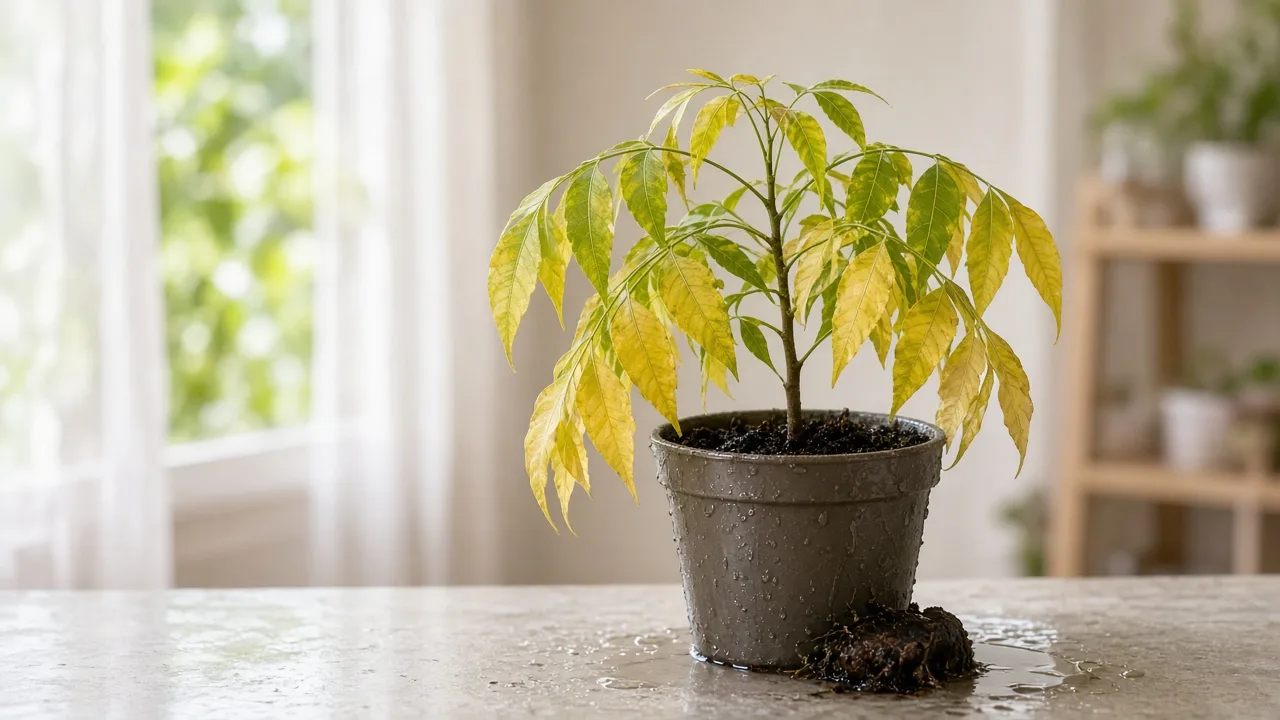
For comprehensive details on how chronic moisture damages containerized root systems across various plant families, review our foundational root rot guide. On Neem, root rot manifests as the classic “wet wilt” paradox: compound leaves droop, turn dull yellow, and drop in rapid showers even though the potting soil is drenched, accompanied by a foul sulfurous stench rising from the container.
First step: Stop watering immediately, unpot the Neem tree to inspect its central taproot, surgically excise all squishy, blackened pulp back to healthy ivory sapwood, drench the remaining root mass with an antifungal solution, and repot into bone-dry, gritty sandy soil. Never let a wilting Neem sit in damp soil hoping it will perk up; every hour spent in hypoxic mud allows rot to travel closer to the fatal crown zone.
When to use this page vs other Neem guides
Root rot is an internal subterranean vascular breakdown, not a surface cosmetic issue or simple watering timing misstep. Use the differential triage table below to ensure you are treating true root rot rather than a less urgent cultural imbalance.
| Observed Symptom | Primary Diagnostic Indicator | Action & Guide |
|---|---|---|
| Sudden foliar wilt, compound leaf drop, damp/heavy mix, foul odor | Collapsed, squishy brown taproot; anaerobic decay | Follow this root rot guide |
| Lower leaflets yellowing gradually; roots firm and white | High watering frequency before soil dries; pot stays wet | Neem overwatering guide |
| Drooping leaves with dry crispy tips; pot light as a feather | Prolonged moisture deficit; roots dry and fibrous | Neem underwatering guide |
| Flocks of tiny dark flies rising from damp surface soil | Bradysia larvae feeding on root hairs; no taproot decay | Neem fungus gnats guide |
| White or yellowish fluffy crust across substrate surface | Harmless surface saprophytic mold; good root health | Neem mold on soil guide |
| Determining safe watering depth and dry-down intervals | Container volume and seasonal evapotranspiration checks | Neem watering guide |
| Choosing coarse sand, perlite, and mineral loam recipes | Replacing moisture-trapping peat or garden clay | Neem soil guide |
| Calibrating full-sun thresholds and terrace placements | Meeting high light demands to accelerate transpiration | Neem light guide |
| Exploring full botanical care, pest profiles, and pruning | Holistic cultivation guide for containerized specimens | Neem overview |
The botanical paradox: Deep taproot vs waterlogged substrate
To understand why root rot devastates Azadirachta indica so rapidly, one must look at how the species evolved in the wild. As detailed in botanical profiles by the Missouri Botanical Garden, Neem is native to the dry tropical and subtropical deciduous forests of the Indian subcontinent, thriving in deep, sandy, well-drained soils and displaying extraordinary drought tolerance once established.
Research published by Winrock International documents that Neem develops an extensive, penetrating taproot and lateral root system that can explore soil depths exceeding several meters to anchor the tree and tap subterranean moisture reserves during seven- to eight-month arid dry seasons. However, this drought adaptation creates an acute physiological vulnerability in containers:
- Intense Root-Zone Oxygen Demand: The metabolically vigorous cambium and parenchyma cells of the Neem taproot require continuous aerobic gas exchange. When container potting mix becomes saturated, water displaces all oxygen from the soil macropores. As emphasized by the Missouri Botanical Garden, roots die because they cannot absorb oxygen in waterlogged media. Within 24 to 48 hours of complete saturation, root respiration halts.
- Cellular Lysis and Anaerobic Exudation: Without oxygen to synthesize ATP through oxidative phosphorylation, root cells switch to anaerobic fermentation. Ethanol and lactic acid build up internally, membrane integrity dissolves, and cellular lysis occurs. The collapsed taproot leaks sucrose, amino acids, and minerals straight into the surrounding substrate.
- Chemotactic Infiltration by Water Molds and Fungi: Stagnant water and exudate leaks trigger dormant oospores of Pythium ultimum and Phytophthora spp. to germinate flagellated zoospores. These mobile spores swim along moisture films toward the wounded root zone, while necrotrophic fungi like Fusarium oxysporum penetrate the cortical cylinders. Because Neem wood is non-resinous and the juvenile taproot cortex is rich in soft parenchymatous tissue, the pathogens advance rapidly, turning structural anchor tissue into liquefied rot.
This biological reality disproves the common misconception that withholding water while leaving the plant in wet soil will cure the issue. Once pathogens establish colonies inside the living vascular bundles of the taproot, only immediate physical extraction and surgical excision will halt the rot.
What root rot looks like on Neem
Recognizing taproot rot in its initial stages is critical to saving an Azadirachta indica specimen before the subterranean infection reaches the trunk collar.
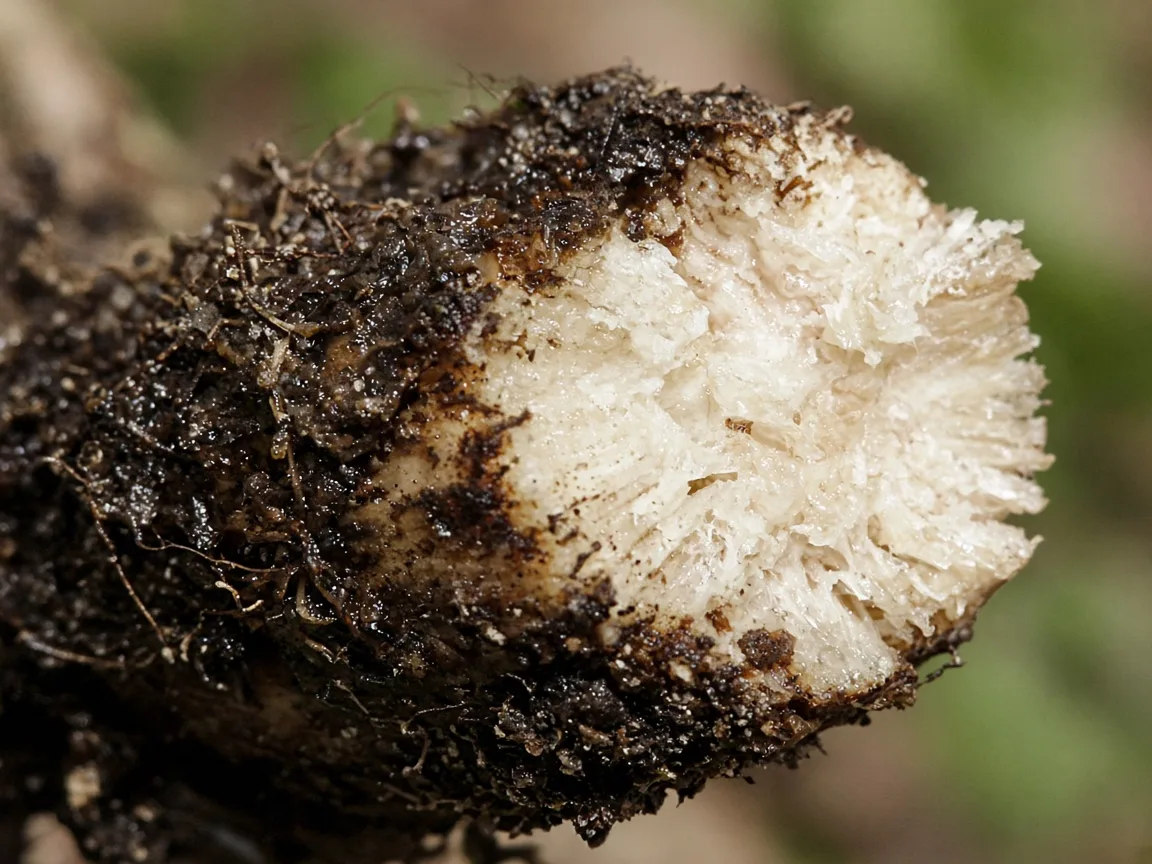
Surgical inspection of Azadirachta indica taproot rot: diseased cortical tissue collapses into dark brown, water-soaked pulp while healthy central xylem remains firm and ivory-white.
1. The “wet wilt” paradox
The most prominent above-ground diagnostic indicator of Neem root rot is profound canopy wilting in a pot that feels heavy and thoroughly moist. Inexperienced growers often associate wilting exclusively with dehydration and mistakenly pour more water into the pot. The true mechanism is vascular blockage: because root rot destroys the tender root hairs and plugs the xylem vessels with necrotic fungal mycelium and tyloses, the tree can no longer uptake or conduct water. The leaves lose turgor and droop limply while standing in mud.
2. Sudden, premature foliar drop
Neem foliage consists of alternate, imparipinnate compound leaves carrying 8 to 18 serrated leaflets. When root rot cuts off hydration and releases stress hormones like ethylene, the tree initiates emergency leaflet abscission. Entire compound leaves turn dull, chlorotic yellow and drop in showers at the slightest touch. In severe infestations, a lush container tree can drop 70 percent of its foliage within 48 to 72 hours.
3. Squishy, discolored dark brown taproot
Upon removing the tree from its container, inspect the subterranean anatomy. A healthy Neem root system features firm, cream-to-tan lateral roots branching from an anchor taproot that resists thumb pressure like a crisp piece of hardwood. Under pathogen attack, soft, brown, or black decaying roots dominate the root ball. The taproot feels spongy, hollow, or water-soaked, easily indenting or collapsing when pressed.
4. The “glove test”: sloughing cortical tissue
When you gently pull a suspicious lateral root between your fingers, the outer cortical sheath and epidermis slide off smoothly like a wet sleeve or glove. This leaves behind nothing but a thin, stringy, thread-like stele (the dead vascular bundle), confirming that root rot organisms have completely digested the root parenchyma.
5. Foul sulfurous and swampy smell
Healthy Neem roots produce a clean, slightly bitter, medicinal, or earthy aroma. A rotting root ball emits an unmistakable, nauseating odor reminiscent of swamp gas or rotting eggs. This foul stench is caused by anaerobic bacteria (such as Clostridium and Desulfovibrio) multiplying in the oxygen-depleted substrate and releasing hydrogen sulfide gas as organic root tissues decay.
Root rot vs lookalike conditions on Neem
Misdiagnosing root rot leads to fatal care errors. Cross-reference your Neem tree’s symptoms with this differential diagnosis matrix before beginning surgery.
| Diagnostic Feature | Root Rot (Pythium / Fusarium) | Overwatering (Pre-rot) | Underwatering | Cold Shock (<10°C / 50°F) |
|---|---|---|---|---|
| Soil moisture state | Saturated, damp, or heavy | Consistently moist to wet | Bone-dry, dusty, light pot | Dry or damp |
| Canopy appearance | Sudden limp wilt; heavy leaf drop | Lower leaves yellow gradually | Dry, curled, brittle leaflets | Leaflets curl inward, bronze |
| Root texture | Spongy, mushy, hollow taproot | Firm, white to pale tan | Firm, dry, fibrous, intact | Firm, dormant, pale |
| Root color | Dark brown, olive-black, mottled | Cream, pale buff, or tan | Tan to light brown | Normal cream-to-tan |
| Root smell | Sour, swampy, foul sulfur stench | Earthy, slightly damp | Earthy, clean | Normal bitter scent |
| Response to watering | Accelerated collapse and death | Prolongs saturation stress | Fully perks up within 4–8 hrs | No change; risks rot |
First fix for Neem: Emergency surgical intervention
When root rot is confirmed, you must act decisively. Do not wait for the substrate to dry out naturally on a windowsill. Follow this clinical surgical procedure to salvage your Neem tree:
Step 1: Unpotting and root washing
Carefully slide the Neem tree out of its container. Gently tap the root ball to dislodge excess soil. Place the roots under a basin of lukewarm running water to gently rinse away all old substrate until the root architecture, lateral roots, and central taproot are fully visible. Discard the old soil in outdoor waste—never reuse rot-contaminated mix for other houseplants.
Step 2: Surgical root pruning
Sterilize a pair of sharp pruning shears or a grafting scalpel with 70% isopropyl alcohol or a 10% bleach solution. Carefully inspect the entire length of the taproot and primary lateral roots:
- Cut away every millimeter of dark brown, black, or squishy root tissue.
- Continue paring back until you hit firm, healthy, crisp ivory-white sapwood. If you leave even a small patch of rotted cortex behind, the anaerobic pathogens will continue spreading upward.
- If lateral feeder roots exhibit the sloughing “glove test” symptom, prune them back to their origin at the main root axis.
Step 3: Fungicidal drench and disinfection
After excising diseased tissue, immerse or thoroughly spray the remaining root system with a sanitizing fungicidal drench:
- Hydrogen Peroxide Wash: Submerge the roots for 10 to 15 minutes in a solution of 1 part standard 3% hydrogen peroxide to 3 parts water. The peroxide releases oxygen on contact, mechanically cleaning microscopic spores and killing anaerobic water molds.
- Copper or Biofungicide Drench: Alternatively, apply a broad-spectrum copper octanoate drench or a biological suspension of Bacillus subtilis to colonize root wounds and prevent secondary fungal spores from germinating.
- Wound Sealing: Dust cut taproot surfaces with sulfur powder or ground horticultural cinnamon, both of which serve as natural desiccants and fungistatic barrier agents.
Step 4: Canopy reduction (transpiration balance)
Because you have pruned away a portion of the tree’s root system, the remaining roots cannot support the original foliage volume. Using sterilized shears, prune away 30 to 50 percent of the leafy vegetative branches, cutting just above outward-facing nodes. Pruning reduces canopy transpiration demand, prevents total shoot desiccation, and channels the tree’s internal energy into subterranean callus formation.
Step 5: Repotting into bone-dry, gritty mineral mix
Select a clean pot—preferably unglazed terracotta with multiple drainage holes—that matches the reduced size of the remaining root system. Disinfect used containers thoroughly before planting.
- Pot the Neem tree into a bone-dry, fast-draining substrate formulated with 50% coarse sandy loam, 25% pumice or perlite, and 25% coarse grit (per our Neem soil guide).
- Position the root collar precisely at the soil surface; burying the lower trunk promotes stem canker.
- Do not water on day one. Leave the potting mix dry for 5 to 7 days to allow all surgical wounds to callus over safely without moisture triggering fresh decay.
Recovery timeline and realistic prognosis
Recovering from taproot rot requires patience and strict adherence to dry-zone care. Monitor the tree across these physiological benchmarks:
- Days 1 to 7 (Callus Phase): Keep the potted tree in a warm (24°C–28°C / 75°F–82°F), bright location out of scorching direct afternoon sun. The soil remains completely dry. You may observe a few remaining compromised leaves drop, which is normal as the plant sheds unsupportable mass.
- Weeks 2 to 4 (Root Initiation Phase): Introduce moisture conservatively. Administer a light perimeter drizzle—never a drenching soak—using lukewarm water. Check the root collar weekly; it should remain rock-solid and woody.
- Weeks 4 to 8 (Vegetative Budbreak): If the surgery was successful, dormant axillary buds along the pruned branches will swell and unfurl fresh, emerald-green pinnate leaflets. When new leaf flushes emerge, it confirms that functional feeder roots have formed.
- Months 2 to 4 (Stabilization): Gradually reintroduce the tree to full sun (6+ hours daily per our Neem light guide) and resume deep soak-and-dry watering. Withhold all chemical fertilizers until the tree has produced two consecutive flushes of mature foliage.
When to give up: signs of terminal decline
Neem is remarkably resilient, but root rot can advance beyond the threshold of recovery. Discard the plant if you observe:
- The squishy, dark brown rot has traveled past the taproot into the root collar and lower trunk above the soil line.
- The inner cambium of the main trunk, when lightly scraped with a fingernail, shows dull brown or black wood rather than bright, moist green tissue.
- More than 80 percent of the taproot mass had to be removed, leaving only a hollow trunk stump with no viable lateral anchors.
Mistakes to avoid when rescuing a rotting Neem
Avoid these common missteps that derail root-rot recovery:
- Watering immediately after repotting: Soaking fresh surgical wounds guarantees reinfection. Wounded root tissues lack protective suberin and need several days of dry air contact to form a protective wound callus.
- Fertilizing a recovering tree: Applying high-nitrogen or chemical fertilizers to a damaged root system causes salt burn on delicate regenerating root tips and feeds latent soil pathogens.
- Placing the plant in deep indoor shade: While harsh midday sun should be avoided immediately after heavy root pruning, placing a stressed Neem in a dark room halts photosynthesis. The tree needs bright indirect light to generate the sugars required for root regeneration.
- Using moisture-retentive indoor potting soils: Standard store-bought potting soils dominated by fine sphagnum peat moss or coco peat stay waterlogged for weeks indoors, recreating the exact anaerobic conditions that triggered the rot.
- Leaving drainage water in saucers: Never allow the nursery pot to stand in runoff water inside a decorative cachepot. Empty saucers within 15 minutes of watering to prevent capillary resaturation of the lower root zone.
How to prevent root rot permanently
Preventing root rot on Azadirachta indica is straightforward once you respect its evolutionary heritage as a dry-tropical sun tree:
- Implement the soak-and-dry watering method: Water container Neems deeply until liquid flows from the drainage holes, but never water again until the top 3 to 5 cm (1 to 2 inches) of potting soil is bone-dry to the touch. Lift the pot to confirm it feels lightweight before watering. Consult our dedicated Neem watering guide for seasonal volume adjustments.
- Provide 6+ hours of direct sunlight: Maximum solar energy fuels active transpiration, which rapidly pulls moisture out of the root zone and prevents stagnant water pockets. Review our Neem light guide for terrace and south-facing positioning advice.
- Use open, mineral-based potting substrate: Pot your Neem in a high-drainage blend containing coarse horticultural sand, pumice, and loam as detailed in our Neem soil guide.
- Choose porous containers: Unglazed terracotta pots allow gas exchange through their porous clay walls, drying the substrate substantially faster than plastic or glazed containers.
- Reduce winter watering frequency: When ambient temperatures drop below 18°C (65°F) and photoperiods shorten, Neem growth slows dramatically. Cut watering frequency in half during cooler months to match lower plant water consumption.
Related Neem guides
- Neem Overview — Complete botanical history, container culture, and environmental requirements
- Neem Watering Guide — Soak-and-dry schedules, container depth tests, and seasonal adjustments
- Neem Soil Guide — Gritty mineral mixes, aeration formulas, and drainage requirements
- Neem Light Guide — Full-sun thresholds, indoor positioning, and seasonal terrace transitions
- Neem Fertilizer Guide — Organic feeding protocols, neem cake application, and micronutrient management
- Neem Problems Hub — Complete diagnostic index for pests, leaf drop, and cultural disorders
Conclusion
Root rot on Neem (Azadirachta indica) is a severe, life-threatening disorder caused by substrate waterlogging and root-zone hypoxia, not a flaw in the tree’s natural hardiness. When prolonged saturation cuts off vital oxygen, opportunistic pathogens including Pythium, Phytophthora, and Fusarium rapidly consume the subterranean taproot, severing water transport and triggering the characteristic “wet wilt” paradox and compound leaflet drop. By intervening immediately with emergency unpotting, surgical excision of all necrotic tissues, fungicidal sanitizing washes, and potting into bone-dry, sharp-draining sandy loam, you can reverse taproot rot and restore this majestic tropical tree to robust, vigorous health.
Related tool
Use the Plant Watering Calculator to calculate optimal watering intervals for Neem based on your container dimensions, soil porosity, and ambient temperature before resuming regular irrigation.