Drooping Leaves on Panda Plant: Causes, Checks & Fixes
Quick answer
On Panda Plant (Kalanchoe tomentosa), drooping leaves stem from three distinct triggers: severe underwatering (thin, wrinkled leaves on a firm stem), overwatering and root rot (mushy, translucent leaves that drop easily above a softening stem base), or low light etiolation (downward-curling leaves stretching for sun). First step: test pot weight and probe soil moisture 2 inches deep before changing watering.
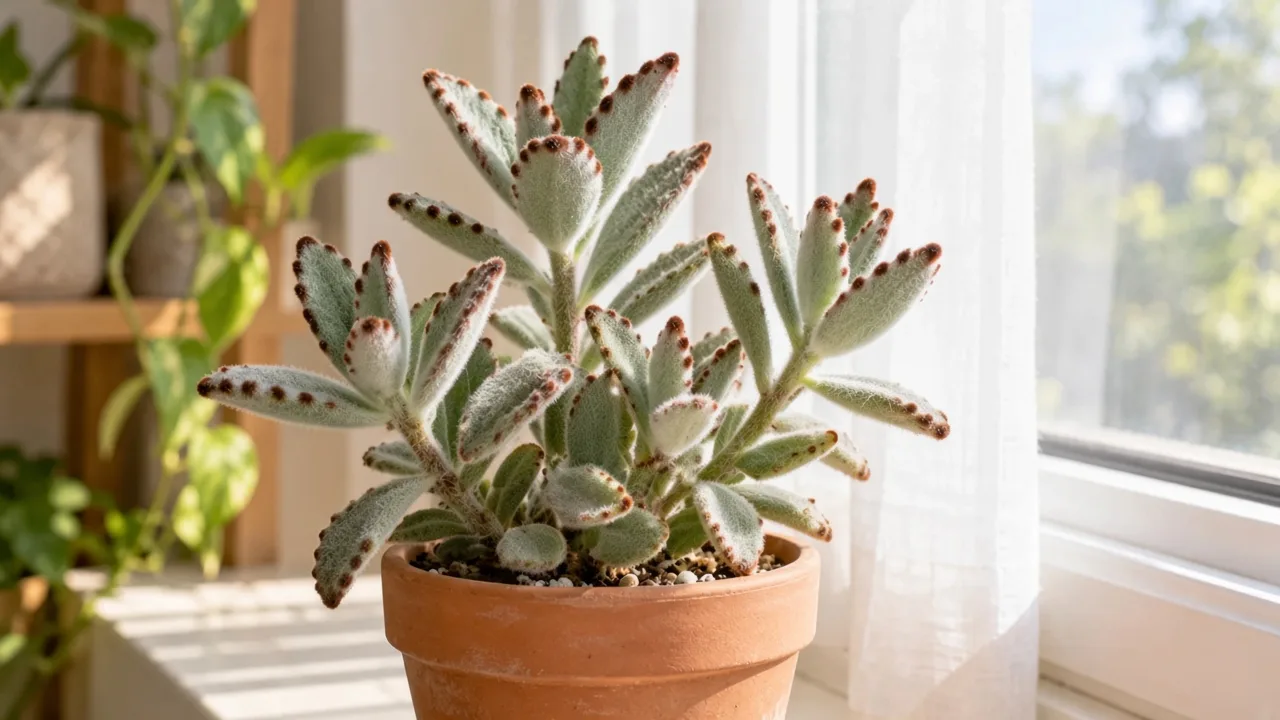
Drooping Leaves on Panda Plant: Causes, Checks & Fixes
This guide covers drooping leaves on Panda Plant. See also the general Drooping Leaves guide, watering, and light pages for this plant.
Drooping Leaves on Panda Plant: Causes, Checks & Fixes
Quick answer
Drooping leaves on Panda Plant (Kalanchoe tomentosa) are an urgent visual signal that cellular moisture dynamics have broken down. Because this Madagascar succulent normally holds thick, velvety, spoon-shaped leaves upright at roughly 45-degree angles from its central woody stem, downward-hanging foliage immediately reveals a loss of structural support.
The diagnostic trap is that underwatering, overwatering, and low light can all make leaves droop downward, yet their remedies are complete opposites. Dehydrated roots cannot supply hydraulic pressure to keep leaves plump; saturated, decaying roots suffocate and rot, completely halting water absorption despite soggy mix; and light-starved foliage curls downward to angle surface area toward weak room illumination.
Before reaching for the watering can or pruning shears, lift the pot and inspect the stem base. A feather-light container with dry, wrinkled leaves calls for a deep drink; a heavy container with yellowing, mushy leaves requires emergency root surgery; and stretched stems with downward-curved leaves demand brighter light. For how moisture stress triggers cellular wilt across houseplants in general, see our global drooping leaves guide. On Kalanchoe tomentosa, your path to recovery begins by distinguishing these root and light signals.
Diagnostic differential: Three distinct triggers for drooping
Because succulent leaves store significant reserves of water, diagnosing Kalanchoe tomentosa requires looking past the droop to evaluate tissue texture, stem firmness, and container weight.
                              DROOPING PANDA PLANT LEAVES
                                           │
                    ┌──────────────────────┴──────────────────────┐
            Pot Weight & Soil                             Stem & Leaf Posture
                    │                                             │
      ┌─────────────┴─────────────┐                 ┌─────────────┴─────────────┐
      ▼                           ▼                 ▼                           ▼
Light Pot / Dry Mix       Heavy Pot / Wet Mix   Stems Stretched / Pale     Mushy Base / Leaf Drop
      │                           │                 │                           │
Deflated, wrinkly         Translucent, mushy    Downward-curving leaves    Advancing root rot
hydraulic turgor loss     wilt paradox          etiolation light trap      emergency intervention
      │                           │                 │                           │
[Deep Soak & Dry]         [Unpot & Rot Check]   [Acclimate to Sun]         [Behead / Salvage]
1. Severe drought: deflated turgor on firm stems
When a panda plant goes without water for too long during warm weather or in a porous clay pot, it burns through its internal leaf reserves.
- Leaf texture: The thick, fleshy succulent pads deflate and flatten. Fine horizontal wrinkles form on the leaf surface beneath the velvety hairs. The leaves feel soft, flexible, and rubbery rather than brittle or plump.
- Stem condition: The central and lateral stems remain stiff, upright, and firm, with normal pale grayish-brown coloration.
- Root zone: The pot feels noticeably feather-light. A wooden skewer inserted 2 inches into the mix emerges bone-dry with dry dust clinging to it.
- Recovery reaction: When bottom-soaked or thoroughly drenched, dehydrated cells absorb moisture and re-inflate within 12 to 24 hours, with leaves visibly lifting back to their upright stance.
2. Overwatering and root rot: the mushy wilt paradox
The most fatal cause of drooping on Kalanchoe tomentosa is waterlogged soil leading to root asphyxiation and fungal root rot.
- Leaf texture: Leaves droop heavily and feel squishy, slimy, or water-logged rather than leathery. They frequently lose their silvery-green hue, turning pale yellow, glassy, or translucent.
- Leaf attachment: Severely overwatered leaves detach and drop off at the slightest nudge or vibration, accumulating on the soil surface.
- Stem condition: The stem base near the soil line softens, turns dark brown or black, and may yield to gentle pressure or exude foul-smelling sap.
- Root zone: The pot feels dense and heavy days after watering. The potting mix stays persistently wet, cool, and poorly aerated, often accompanied by a sour, swampy odor.
- Recovery reaction: Adding more water accelerates decay. Leaves will not re-stand, and damaged tissue quickly rots. Survival depends on immediately unpotting the plant, cutting away dead roots, and repotting in completely dry mineral mix.
3. Insufficient light (etiolation): downward-curving leaves
Often mistaken for watering stress, inadequate sunlight produces a distinct structural droop termed etiolation.
- Leaf posture: Leaves arch downward in an umbrella-like curve, positioning the maximum surface area perpendicular to overhead light. Instead of standing upright at compact 45-degree angles, the leaves spread flat or bend down toward the pot rim.
- Coloration: The rich, rusty chocolate-brown margins along the scalloped leaf tips fade to dull, washed-out greenish-brown, and new leaves emerge small and pale.
- Stem structure: Internodes (the stem spacing between consecutive leaf pairs) stretch unusually long. The stem turns thin and weak, unable to support the weight of top growth.
- Root zone & recovery: Pot weight and soil moisture dry normally. Adding water does not correct leaf angle. Only gradual acclimation to bright indirect sunlight and direct morning sun restores compact, upright future growth.
When to use this page vs other Panda Plant guides
This guide focuses specifically on diagnosing and resolving limp, drooping, or downward-curved foliage. If your plant displays different symptoms, consult our dedicated cluster resources:
| Observed Symptom | Primary Diagnostic Focus | Next Guide |
|---|---|---|
| Complete stem collapse, black squishy base | Advanced vascular rot in main trunk | Root Rot Guide |
| Stems stretching with pale, spaced-out leaves | Light starvation and internodal elongation | Panda Plant Light Guide |
| Dry, crinkled leaves shedding from bottom | Extended dehydration in coarse substrate | Underwatering Guide |
| Yellowing, glassy leaves dropping without droop | Early overwatering before full root failure | Overwatering Guide |
| Brown crispy patches on leaf tips or margins | Fertilizer burn or extreme heat scorch | Brown Tips Guide |
| White cottony clusters in leaf axils | Sap-sucking mealybug infestation | Mealybugs Guide |
| General seasonal maintenance & watering depth | Soak-and-dry irrigation schedule | Panda Plant Watering |
| Comprehensive species care overview | Soil, temperature, and feeding fundamentals | Panda Plant Overview |
What drooping leaves look like on Panda Plant
Under optimal conditions, Kalanchoe tomentosa exhibits thick, fleshy, obovate leaves densely cloaked in soft, felted trichomes. These hairs give the plant its characteristic silvery-white appearance, punctuated by prominent dark brown teeth along the upper margins. Each leaf is held erect and rigid.
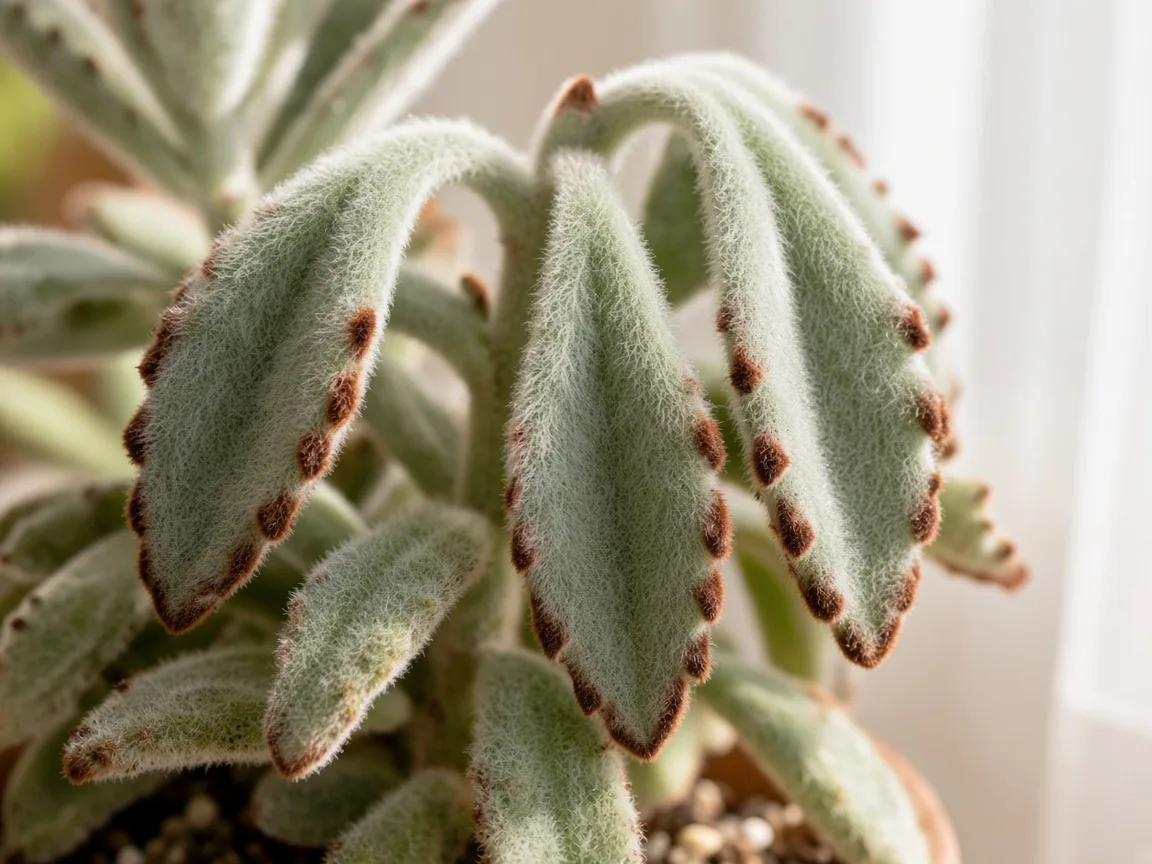
Drooping leaves on Panda Plant (Kalanchoe tomentosa) displaying downward leaf curvature and loss of hydraulic turgor pressure.
When turgor fails, the change is immediate and striking:
- Angle deflection: The angle of the leaf petiole and blade drops from a jaunty 45 degrees upward to horizontal or downward against the stem.
- Tactile change: Gently pinching the leaf between your fingers reveals deflated, spongy flesh instead of crisp, firm succulent tissue.
- Margin softening: The dark brown notched margins lose their crisp definition, looking sunken or curled.
- Lower leaf sacrifice: In chronic drought, the plant drops its lowest, oldest leaves first to recycle moisture into the growing crown. In root rot, lower leaves turn to yellow jelly and drop in clusters.
Madagascar arid physiology and hydraulic turgor
To understand why a panda plant droops, one must look at where and how it evolved. NC State Extension Plant Toolbox notes that Kalanchoe tomentosa is native to east central Madagascar, where it grows naturally on dry, sun-drenched granite rocks and exposed slopes.
In this semi-arid habitat, rainfall is sporadic and followed by prolonged dry periods. To survive, the plant evolved specialized xerophytic adaptations:
- Cellular Water Storage: Panda plant leaves are composed primarily of large, thin-walled parenchyma cells specialized for water storage (the hydrenchyma). When these cells are filled with water, they exert hydrostatic pressure—known as hydraulic turgor—against the cell walls. This internal hydraulic pressure is the sole reason the leaves stand upright without woody skeletal veins.
- Dense Tomentose Trichomes: The species name tomentosa means densely covered with matted hairs. According to the Royal Horticultural Society, Kalanchoe tomentosa produces a thick coat of silvery-white felted trichomes. These microscopic hairs create a boundary layer of still air around the leaf, reflecting harsh solar radiation and minimizing moisture loss through transpiration.
- Crassulacean Acid Metabolism (CAM): Panda plants utilize CAM photosynthesis, keeping their stomata closed during the blazing day to prevent evaporation and opening them only at cool night to absorb carbon dioxide.
Because the plant is engineered to hold every drop of moisture within its leaves, its roots require constant access to oxygen. In rock crevices, water runs off within minutes. When grown indoors in heavy potting soil, the roots are deprived of oxygen. The Missouri Botanical Garden highlights that Kalanchoe species demand sharply drained soils and are highly susceptible to root and stem rot if overwatered. When saturated roots suffocate, their cell membranes collapse and opportunistic fungal pathogens (Pythium and Phytophthora) enter. The plant loses its root system and can no longer draw water upward—producing the confusing symptom of dehydration droop in soaking wet soil.
The pot-weight, leaf texture, and stem base test
Never guess whether your panda plant needs water. Use this diagnostic sequence to identify the exact cause in under two minutes:
Step 1: The Pot-Weight Lift Test
Pick up the container with two hands:
- Feather-light: The soil has surrendered all available moisture. If leaves are limp and thin, severe drought is confirmed.
- Noticeably heavy: The potting core contains significant moisture. Limp leaves indicate root asphyxiation, rot, or etiolation.
Step 2: The Two-Inch Skewer Probe
Insert a thin wooden skewer or chopstick 2 inches deep into the root ball:
- Clean and dry: Clemson Cooperative Extension HGIC emphasizes allowing houseplant soil to dry adequately before watering, particularly for succulents. A bone-dry skewer confirms drought.
- Cool, damp, or dark with clinging soil: Moisture remains high around the taproots. Do not add water.
Step 3: The Leaf Flexibility Check
Gently press the middle of a drooping leaf between your thumb and forefinger:
- Thin, wrinkly, and leather-pliable: Dehydration. The leaf has consumed its internal water storage.
- Mushy, water-logged, or translucent: Cellular rupture from waterlogging or freezing temperatures.
Step 4: The Stem Base Firmness Squeeze
Examine the bottom inch of the main stem right where it enters the potting mix:
- Firm, woody, or solid green/gray: Healthy vascular system.
- Squishy, discolored brown/black, or hollow: Active stem rot. The roots and lower vascular bundles have died.
Step-by-step recovery based on confirmed diagnosis
Once you have verified the cause, apply the single appropriate protocol below. Avoid stacking multiple interventions at once.
Protocol A: Rehydrating severely drought-stressed leaves
If your plant passed the drought criteria (feather-light pot, firm stem, dry deflated leaves), your first action is a controlled, deep rehydration.
- Avoid the splash mistake: When succulent soil dries completely, peat and organic matter shrink and become hydrophobic, causing top-poured water to channel down the inside pot walls and exit the drainage hole without wetting the root core.
- Execute a bottom-soak: Fill a basin or bowl with 2 to 3 inches of room-temperature water. Place the potted panda plant into the basin and allow it to draw water upward through the bottom drainage holes via capillary action for 30 to 45 minutes.
- Check surface moisture: Once the topsoil feels cool and barely damp to the touch, remove the pot from the basin.
- Drain thoroughly: Allow the pot to drain freely on a rack for 15 minutes. Never let the pot sit in standing saucer runoff.
- Observe recovery: Within 12 to 24 hours, the deflated leaves will re-pressurize and lift back toward their normal 45-degree angle. Resume normal soak-and-dry watering per the Panda Plant Watering Guide.
Protocol B: Rescuing root rot and saturated roots
If drooping foliage is accompanied by heavy wet soil, mushy leaves, or a softening stem, immediate physical intervention is mandatory.
- Unpot immediately: Gently tip the container and slide the panda plant out of the pot. Avoid pulling on the fuzzy leaves, as skin oils can damage trichomes and waterlogged leaves shed easily.
- Inspect the root ball: Gently brush away wet soil to examine the root system. Healthy panda plant roots are fibrous, pale tan to cream, and firm. Rotted roots are dark brown or black, slimy, and pull away from the vascular core like wet thread.
- Prune damaged tissue: Using shears sterilized in 70% isopropyl alcohol, excise all black, mushy, and foul-smelling roots back into healthy, firm root tissue.
- Allow cut surfaces to callous: Place the bare-root plant on a clean paper towel in a warm, shaded, well-ventilated location for 24 to 48 hours to allow trimmed root tips to form a protective callous.
- Repot into dry gritty mix: Choose a clean terracotta pot with a large drainage hole. Repot the plant into completely dry, mineral-rich gritty soil.
- Withhold water for 7 days: Do not water immediately after repotting. Damaged succulent roots cannot absorb moisture and will rot if exposed to water before healing. After 5 to 7 days, provide a modest drink.
[!WARNING] Stem Rot Salvage (Beheading): If the stem base is already black and squishy, root pruning will not save the plant. Slice through the stem with a sterile blade 1 inch above any soft or dark discoloration. Verify that the stem interior is pristine, creamy-green with no brown vascular rings. Dust the cut with cinnamon or sulfur, allow the cutting to air-callous for 5 to 7 days, and insert it into dry pumice or perlite to grow a completely new root system.
Protocol C: Reversing etiolation and correcting light
If drooping leaves are firm, curved downward, and accompanied by pale stretched stems, the plant requires more light energy rather than water adjustments.
- Relocate to optimal light: Move the plant to an unobstructed east-facing windowsill or 1 to 2 feet back from an unshaded south- or west-facing window.
- Acclimate gradually: Avoid moving a shade-stressed panda plant directly into intense afternoon sun, which will cause white bleached burn patches on the fuzzy leaves. Acclimate over 10 to 14 days by increasing direct sun exposure by 30 minutes each day.
- Pruning for shape: Downward-curled etiolated leaves will not straighten back up. Once the plant has stabilized in bright light for 3 weeks, prune stretched stem tops with sharp shears to encourage compact lateral branching.
Gritty soil and pot physics to prevent future droop
The primary defense against drooping leaves on Kalanchoe tomentosa is providing a soil and pot environment that mimics its native Malagasy granite outcrops. Clemson Cooperative Extension HGIC advises that container soil mixes must provide adequate aeration and rapid drainage to prevent root rot in potted plants.
Standard bagged potting soil contains high concentrations of milled peat moss, coir, and vermiculite. While suitable for tropical foliage like ferns or aroids, these ingredients retain moisture for weeks indoors, suffocating succulent root hairs.
The Ideal Mineral Soil Recipe for Panda Plant
To maintain long-term root health, blend a high-porosity mineral substrate:
- 40% Quality Cactus & Succulent Soil: Provides essential organic loam and mild nutrient-holding capacity.
- 30% Coarse Horticultural Perlite or Pumice: Creates permanent aeration pores and prevents soil compaction.
- 30% Coarse Quartz Grit, Crushed Granite, or Volcanic Scoria: Adds mineral weight, facilitates rapid drainage, and speeds dry-down times.
For complete soil formulation tips and ingredient ratios, review our Panda Plant Soil Guide.
Pot Selection: Why Terracotta Matters
Container material dramatically influences root-zone respiration:
- Terracotta (Clay): Highly recommended. Unfinished clay is porous, allowing air and water vapor to diffuse outward through the pot walls. This accelerates dry-down and prevents moisture stagnation around deep roots.
- Plastic and Glazed Ceramic: Non-porous containers trap water inside the root ball twice as long. If using glazed pots, increase the mineral grit ratio to 70% and verify that unobstructed drainage holes exist.
- Pot Sizing: Never place a panda plant in an oversized pot. NC State Extension notes that panda plants are slow-growing. Excess soil volume that contains no roots holds stagnant water for weeks, creating an inevitable rot zone. Keep container size proportionate to the active root ball.
What not to do
When a prized panda plant begins drooping, growers often make panic-induced mistakes that worsen the decline:
- Do not water on a rigid calendar schedule: Pouring water every Saturday regardless of soil state is the leading cause of root rot. Always verify pot weight and soil depth dryness first.
- Do not mist the fuzzy leaves: Misting provides zero systemic hydration to succulents. Because the felted trichomes trap water droplets against the cuticle, misting invites powdery mildew, fungal leaf spots, and bacterial rot.
- Do not apply fertilizer to a drooping plant: Stressed or root-compromised plants cannot absorb nitrogen salts. Feeding will scorch remaining root hairs and intensify osmotic stress.
- Do not use pots without drainage holes: Cachepots without drainage trap stagnant runoff, drowning root tips within days.
- Do not handle fuzzy foliage roughly: The velvet coat is easily abraded. Hand oils and rough handling leave permanent dark thumbprints on the silvery leaves.
[!CAUTION] Pet Safety Warning: The ASPCA Animal Poison Control Center identifies Kalanchoe species as toxic to dogs and cats. Panda plants contain cardiac glycoside toxins known as bufadienolides, which can cause severe vomiting, diarrhea, drooling, and dangerous abnormal heart rates if chewed by pets. Keep this plant and all pruned cuttings safely out of reach of curious animals.
Recovery timeline and expectations
Recovery speed depends directly on the underlying cause:
- Underwatering: Extremely fast. A thoroughly bottom-soaked panda plant will restore internal hydraulic turgor within 12 to 24 hours. Leaves will feel plump and firm to the touch by the following morning.
- Root Rot Rescue: Moderate. Plants subjected to root pruning and repotting enter a dormant stabilization phase lasting 3 to 4 weeks. Do not expect old, damaged leaves to look perfect. Success is defined by the cessation of leaf drop and the emergence of fresh, firm leaves at the crown after 4 to 6 weeks.
- Etiolation Recovery: Slow. Downward-bent leaves remain bent. However, within 2 to 3 weeks in proper bright light, the growing tip will produce tight, compact leaf rosettes with rich chocolate margins.
Explore our full symptom catalog across the Panda Plant Problems Hub to diagnose other emerging issues early.
Related Panda Plant guides
- Panda Plant Care Overview — Complete indoor growing requirements and profile.
- Panda Plant Watering Guide — Seasonal soak-and-dry irrigation protocols.
- Panda Plant Light Guide — Preventing etiolation and achieving rich leaf margins.
- Panda Plant Soil & Mix Guide — Gritty succulent soil recipes and pot physics.
- Panda Plant Repotting Guide — Safe root handling and container sizing.
- Panda Plant Problems Index — Triage and troubleshooting for pests, rot, and marks.
Related tool
Need help calculating exact moisture needs and dry-down intervals for your specific pot size and home environment? Use our interactive Plant Watering Calculator to optimize watering frequency for your Panda Plant.