Fungus Gnats on Panda Plant: Causes & Eradication Guide
Quick answer
Fungus gnats on a Panda Plant (Kalanchoe tomentosa) indicate a serious cultural failure: the potting mix is staying damp far too long for a desert succulent. Adult gnats lay eggs in wet, peat-heavy soil where larvae graze on fungal hyphae and delicate succulent root hairs. First step: halt all watering immediately. Allow the potting soil to dry out completely from top to bottom, deploy yellow sticky cards for flying adults, and apply Bacillus thuringiensis israelensis (BTI) on the next scheduled watering.
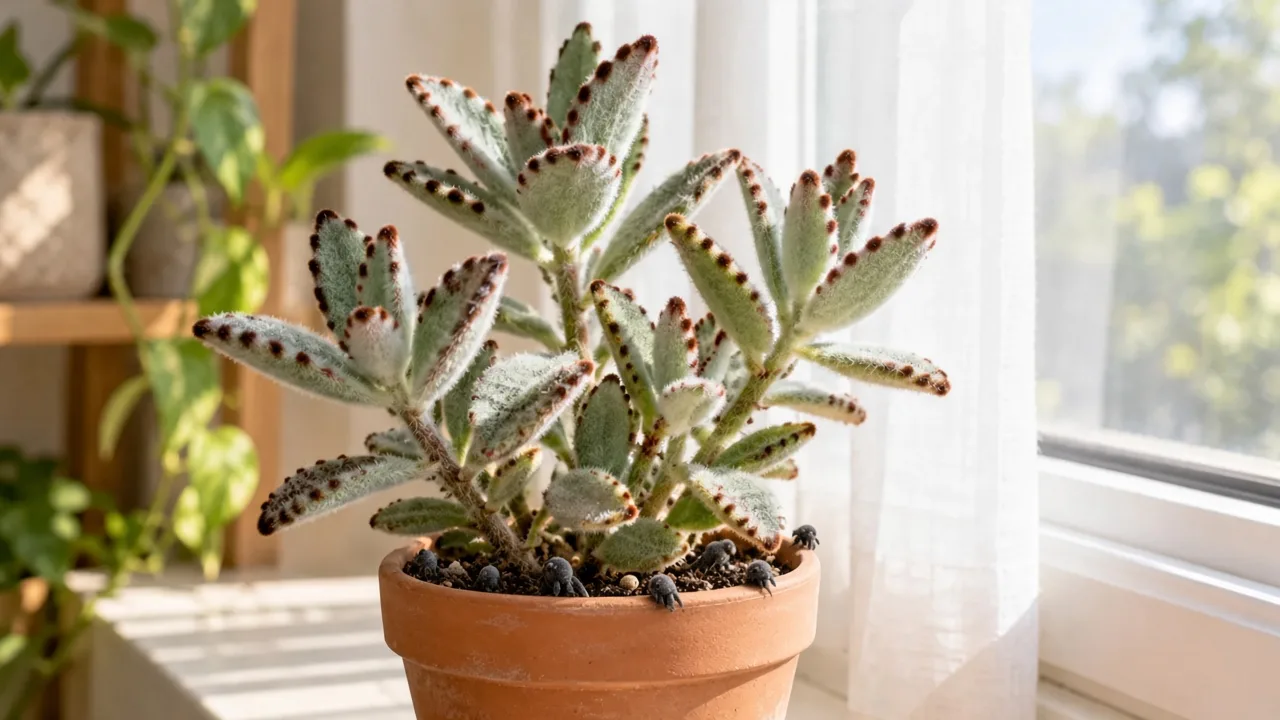
Fungus Gnats on Panda Plant: Causes, Larvae Elimination & Soil Drying
This guide covers fungus gnats on Panda Plant. See also the general Fungus Gnats guide, watering, and light pages for this plant.
Fungus Gnats on Panda Plant: Causes, Larvae Elimination & Soil Drying
Quick answer
Seeing tiny black gnats crawling across your Panda Plant’s (Kalanchoe tomentosa) potting mix is an immediate warning of an environmental mismatch. Fungus gnats (Sciaridae) require constantly moist, decomposing organic matter to complete their life cycle—conditions completely opposed to this Madagascan succulent’s natural granite-hill ecology. For universal insect biology and cross-species eradication protocols, visit our global fungus gnats guide.
Your first fix is simple and decisive: withhold all water immediately. Panda Plant possesses thick, velvety leaves engineered for extreme water conservation; it will comfortably withstand several weeks of bone-dry soil, whereas subterranean gnat eggs and larvae will rapidly dehydrate and die. Position yellow sticky cards directly above the soil to capture egg-laying adults, and apply Bacillus thuringiensis israelensis (BTI) the next time the container requires watering.
Why Panda Plant gets fungus gnats: the care breakdown
Under proper succulent care, fungus gnats cannot reproduce. Their presence highlights specific cultural breakdowns:
1. Peat-heavy commercial potting soils
Commercial nursery plants are frequently potted in dense blends of peat moss or coco coir designed for commercial overhead watering. As Clemson Cooperative Extension points out, peat holds water tightly and decomposes over time, creating an abundant supply of decaying organic cellulose and surface fungi that attract gravid female gnats.
2. Lack of complete root-zone dry-downs
Watering on a calendar schedule (such as every Saturday) keeps the bottom two-thirds of the container continually saturated. Even if the top half-inch seems dry, a perched water table near the pot base provides continuous moisture for larval development.
3. Non-porous containers and stagnant saucers
Panda plants kept in glazed ceramic or plastic pots with decorative cachepots frequently sit in discarded irrigation drainage. Trapped runoff wicks continuously back into the root zone, creating stagnant, anaerobic conditions.
What fungus gnats look like on Panda Plant
- Adults: Delicate, dark gray or black flies measuring 2 to 4 mm long with long legs, segmented antennae, and clear wings showing a characteristic Y-shaped vein pattern. They are weak, erratic fliers that hover low over the soil surface or run rapidly across the pot rim.
- Larvae: Translucent, legless maggots (up to 5 mm long) with shiny black head capsules, living in the top 2 to 3 inches of moist potting medium.
- Subterranean root damage: As larvae consume fine root hairs, the Panda Plant loses hydraulic uptake capacity. The succulent leaves may begin wilting or drooping despite damp soil, leading inexperienced growers to erroneously add more water and accelerate root rot.
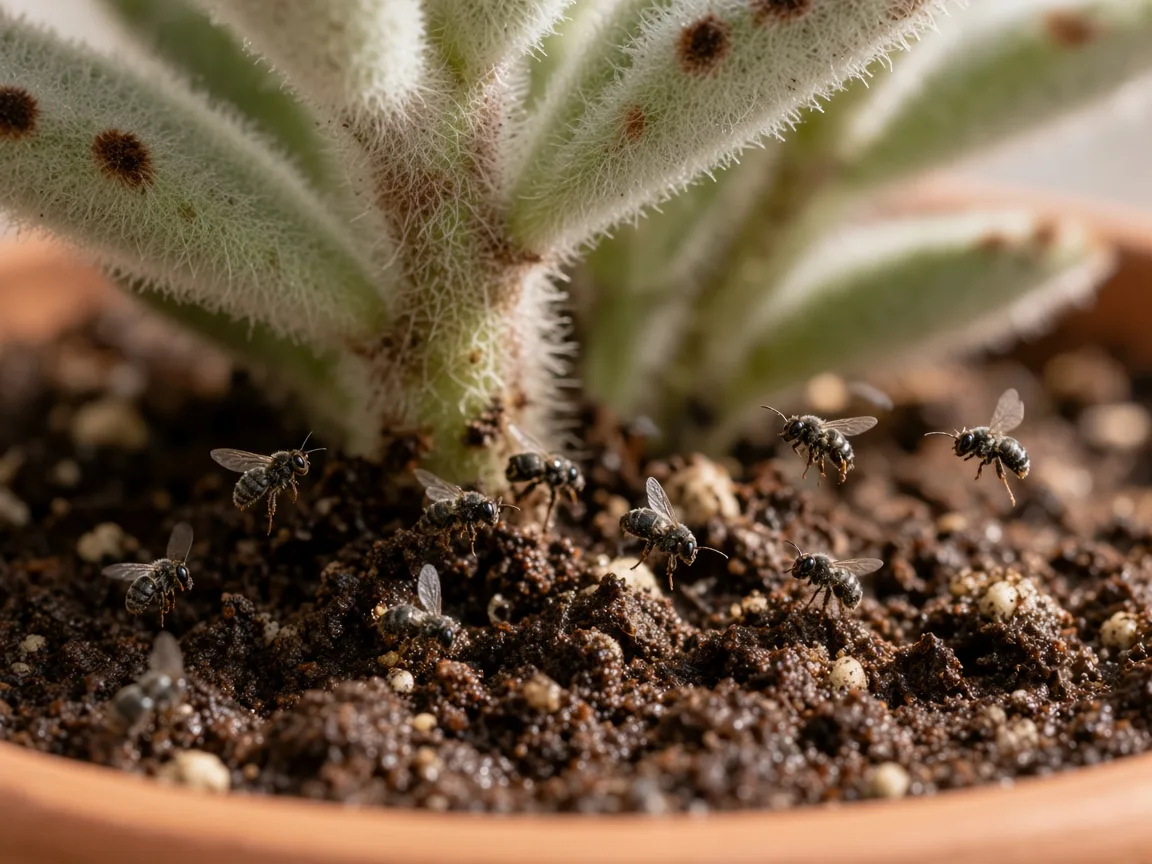
Adult fungus gnats on damp potting mix at the base of a Panda Plant — a sign the soil is staying wet too long.
Confirming fungus gnats vs. lookalikes
| Insect / Symptom | Appearance & Movement | Location on Plant | Damage Pattern |
|---|---|---|---|
| Fungus gnats (Bradysia) | Tiny black/gray slender flies; weak erratic flight; run on soil | Soil surface and pot rim | Larvae chew root hairs; secondary wilting |
| Fruit flies (Drosophila) | Tan or brown, rounded bodies, red eyes; fast fliers | Kitchens, organic fruit, compost | Do not breed in gritty soil or feed on roots |
| Shore flies (Scatella) | Darker, stouter flies with spotted wings; strong fliers | Standing algae on soil surface | Feed strictly on algae; do not chew plant roots |
| Winged aphid migrants | Pear-shaped bodies with dual rear cornicles | Terminal leaf buds and flower stems | Sap-feed on leaves, leaving sticky honeydew |
Step-by-step eradication protocol for Panda Plant
Eliminate fungus gnats safely without damaging Kalanchoe tomentosa’s sensitive root system:
Step 1: Enforce a full container dry-down
Allow the entire container to dry out 100% from top to bottom. Use a wooden skewer pushed to the base of the pot: if it emerges cool or damp, continue withholding water. University of Minnesota Extension emphasizes that dry soil breaks the gnat life cycle by dehydrating fragile eggs and starving newly hatched larvae.
Step 2: Trap adult breeding populations
Install bright yellow sticky cards cut into small rectangles and stake them right at the soil level. Adult gnats are drawn to the yellow wavelength and stick immediately, removing breeding females before they can deposit up to 200 eggs each into the substrate, per UC IPM pest management notes.
Step 3: Apply biological BTI larvicide
When the soil has thoroughly dried and your Panda Plant finally requires hydration:
- Soak Bacillus thuringiensis israelensis granules (Mosquito Bits) in room-temperature water for 30 minutes, then strain out the solids.
- Drench the dry potting mix thoroughly with the BTI-infused water until it flows freely from the drainage holes.
- BTI produces crystalline proteins that are completely non-toxic to plants, pets, and humans, but lethal to fungus gnat larvae when ingested. Apply BTI with every watering for three consecutive cycles to eliminate successive generations.
Step 4: Install an inorganic mineral top-dressing
Cover the soil surface with a 1/2-inch layer of coarse horticultural pumice, crushed poultry grit (granite), or lava rock. This inorganic stone barrier dries within minutes after watering, preventing female gnats from reaching the underlying soil to lay eggs and trapping emerging adults below.
Long-term prevention for Kalanchoe tomentosa
- Upgrade to unglazed terracotta: Clay pots allow lateral air exchange and water evaporation through the container walls, eliminating the stagnant moisture that gnats require.
- Formulate high-grit mineral soil: Blend standard cactus soil with 60% to 70% coarse inorganic amendments (pumice, perlite, granite grit), as detailed in our Panda Plant soil guide.
- Follow strict soak-and-dry irrigation: Always allow the container to dry down completely between drinks. Empty saucers within 15 minutes of watering.
- Provide intense sunlight: Grow your plant in bright indirect light or gentle direct morning sun. Strong light drives transpiration and accelerates soil dry-down, per our Panda Plant light guide.
Related tool
Use our Succulent Soil Mix Calculator to determine the exact proportions of pumice, perlite, and coarse sand needed to formulate a fast-draining, gnat-resistant substrate for your Panda Plant.
Related Panda Plant guides
- Panda Plant overview — comprehensive natural history and species care profile
- Watering guide — how to master soak-and-dry intervals safely
- Soil guide — custom high-porosity mineral substrate recipes
- Light guide — lighting thresholds for rapid dry-down and compact rosettes
- All Panda Plant problems — full diagnostic troubleshooting directory