Yellow Leaves on Plumeria: Causes, Checks & Fixes
Quick answer
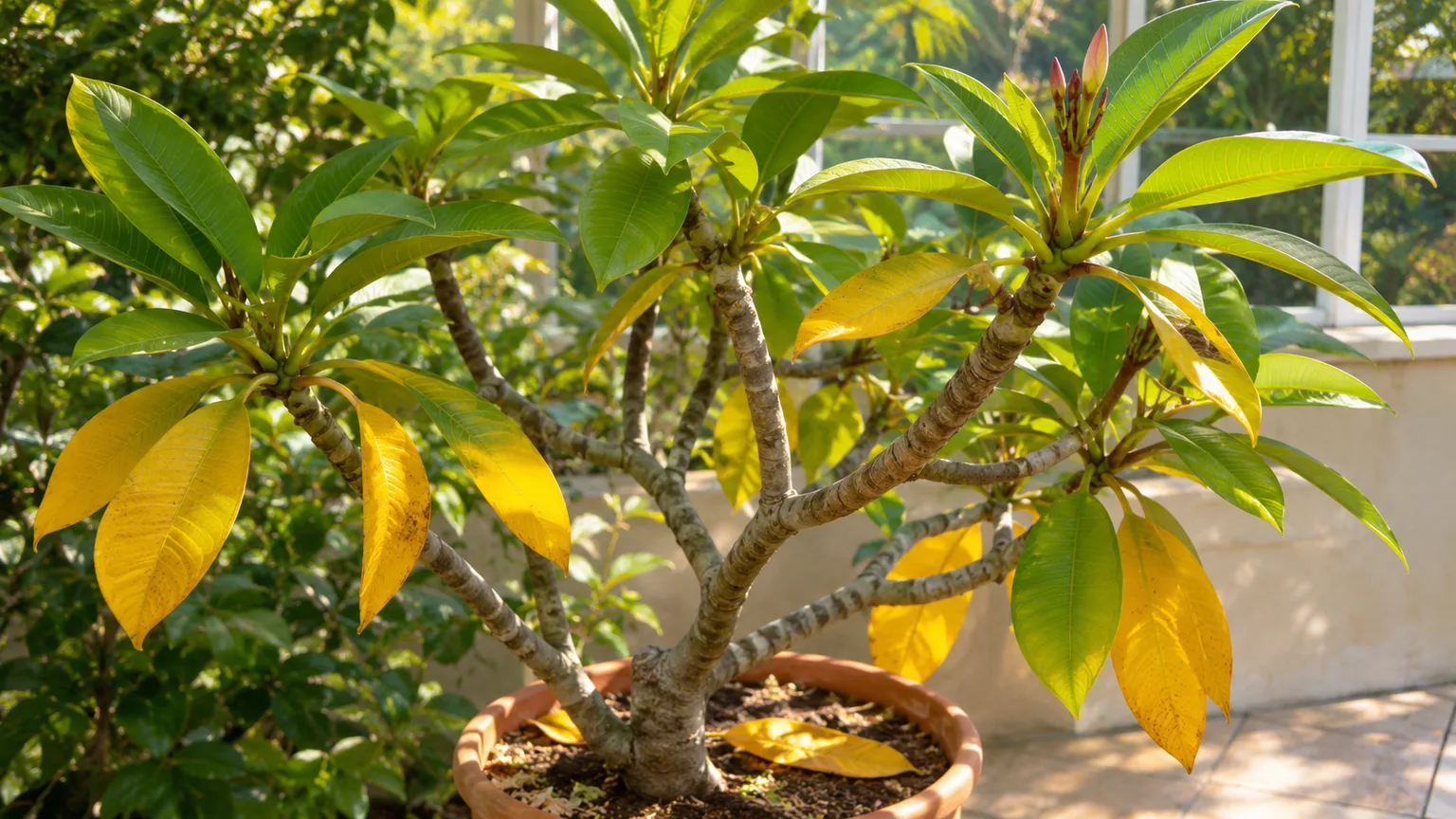
Yellow leaves on plumeria are most often normal autumn leaf drop before winter dormancy, with lower older leaves yellowing on firm stems. In spring and summer, the same symptom usually means too much water in cool weather, plumeria rust on the leaf undersides, a mobile nutrient shortage, mites, or cold exposure. First step: run the dormancy check below, then correct water and drainage before feeding or spraying anything.
Yellow Leaves on Plumeria: Causes, Checks & Fixes
This guide covers yellow leaves on Plumeria. See also the general Yellow Leaves guide, watering, and light pages for this plant.
Yellow Leaves on Plumeria: Causes, Checks & Fixes
Quick answer
Yellow leaves on plumeria are most often the normal autumn shutdown. Lower older leaves turn gold and drop over several weeks while branch tips stay firm and growth slows. That is a deciduous plumeria doing its yearly rhythm, not a dying plant.
For how yellow foliage works as a general stress signal, see our yellow leaves guide. On plumeria, read the calendar first: autumn yellowing from the bottom up on firm stems is dormancy, while spring or summer yellowing, yellowing new tip leaves, or yellow with spots, powder, or webbing means water, rust, nutrients, mites, or cold.
First step: run the 60-second dormancy check. Note the month, which leaves are yellow, and whether stem tips are firm. If the pattern matches autumn drop, taper water and let the leaves fall. If it does not match, let the top 2 to 3 inches of mix dry and confirm the pot drains freely before touching fertilizer or sprays.
When to use this page vs other Plumeria guides
| Pattern | Read next |
|---|---|
| Lower older leaves yellow in autumn, firm tips, slowing growth | Normal pre-dormancy (this page) |
| Yellow upper leaf surface with orange powdery spots beneath | Rust section (this page) |
| Summer yellowing after heavy rain with heavy wet mix | Water and drainage sections (this page), then the Plumeria problems hub |
| Uniform pale older leaves in summer on a hungry plant | Nutrient section (this page) |
| Stippled yellow with fine webbing in hot dry weather | Mite section (this page) |
| Sudden yellowing after a cold night below 50F | Cold section (this page) |
If several patterns overlap, work this page top to bottom once rather than treating everything the same day.
What yellow leaves look like on Plumeria
Plumeria carries big oblong leaves at the branch tips, so yellowing reads differently from a small-leafed houseplant. Normal autumn drop starts with the lowest, oldest leaves on each branch turning even gold, then dropping cleanly over weeks while the tip bud stays plump and firm.
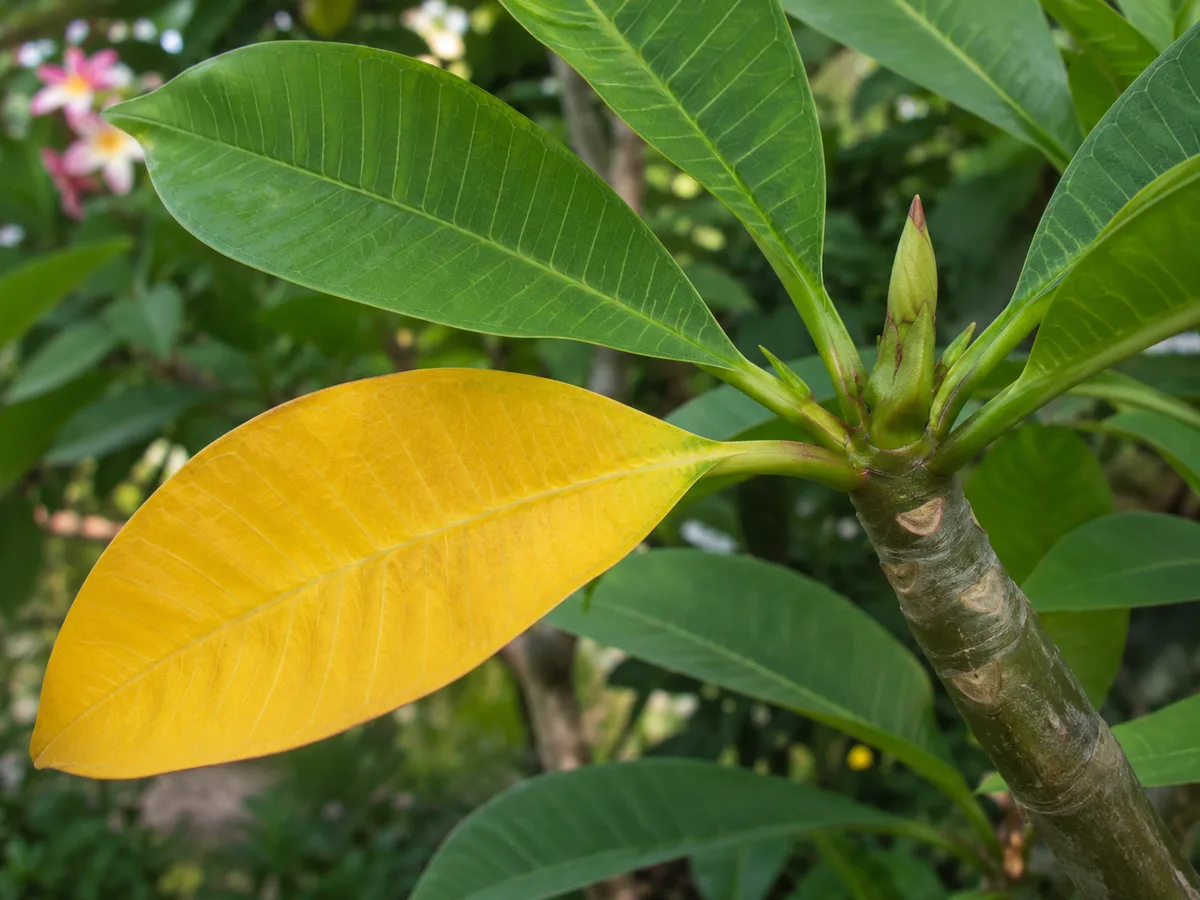
Normal autumn yellowing starts on older lower leaves while the branch tip stays firm and green.
Growing-season yellowing looks different. Watch for uniform pale wash on older leaves (mobile nutrient hunger), yellow new tip leaves with green veins (micronutrient lockout), yellow with orange-brown powder beneath (rust), fine stippled yellowing with webbing (mites), or sudden whole-branch yellowing after cold or soggy weather (environmental shock). Where the yellow starts and what rides along with it is the whole diagnosis.
Autumn pre-dormancy yellowing is usually normal
This is the section that saves most plumeria owners a panic repot. In Florida landscapes, most plumeria lose their leaves in the winter months, going dormant and leafless until spring. Potted plants everywhere else follow the same program once days shorten and nights cool: lower leaves yellow first, drop follows, and thick green stems carry the plant through the rest.
Specialist plumeria growers describe the same rhythm, with leaf yellowing and drop in late autumn marking a healthy plant entering its seasonal rest rather than a failure. Confirm the benign pattern with three checks: yellowing concentrated on the oldest lower leaves, firm branch tips with intact buds, and timing in autumn or early winter as growth stalls. No spots, no webbing, no mushy stem base.
When all three fit, the correct response is restraint. Taper watering as leaves fall, stop fertilizer entirely, and move toward a dry frost-free rest. Bare stems that stay firm all winter are succeeding, not dying.
Thick stems, gritty mix, and the watering fork
Plumeria behaves like a plant with a built-in canteen. Its thick fleshy stems and branches store water, so it wants a deep soak followed by a real dry-down in a gritty fast-draining mix, not a constantly moist root zone. UF/IFAS sums up the placement as full sun and well-drained soil, with established plants tolerating drought far better than soggy feet.
That storage explains the two watering failures behind summer yellow leaves. Overwatering in cool or cloudy weather suffocates roots, and older leaves yellow while the mix stays heavy and the stem base softens. Underwatering in peak heat crisps leaf edges first, then drops leaves to cut transpiration. Check the fork the plumeria way: push a finger 2 to 3 inches into the mix, lift the pot for weight, and confirm water exits the drainage holes fast. Review the rhythm against the Plumeria watering guide and the mix recipe in the Plumeria soil guide before changing anything else.
Cool-season caution matters most. A plumeria with few or no leaves barely drinks, so winter watering on a summer schedule rots the exact roots the plant needs for spring. When in doubt during short days, keep it drier.
Plumeria rust on the leaf undersides
If summer leaves yellow with dusty orange or rusty-brown spots underneath, think plumeria rust before blaming fertilizer. This foliar fungal disease shows orange pustules on the underside before the upper leaf surface yellows, sometimes heavily enough to defoliate branches.
Confirm it with a fingertip test: rust pustules smudge orange-brown powder, while nutrient yellowing has no powder and mite damage shows stippling plus webbing instead. Rust rarely kills a mature plumeria outright, but repeated defoliation weakens bloom and pushes extra yellow drop.
Cultural control carries the season. UF/IFAS advises growers to collect dead leaves and remove them from the site in autumn to cut next-year carryover. Add spacing for airflow, water the mix rather than the foliage, and clear fallen leaves promptly instead of letting them blanket the pot. Fungicides can suppress rust, but sanitation plus dry foliage does the repeatable work for home growers.
Nutrients: old-leaf hunger vs new-leaf lockout
A hungry plumeria yellows in a readable order because nutrients move differently inside the plant. Nitrogen and other mobile elements are shuttled from old leaves to new growth, so shortage shows as a uniform pale wash starting on the oldest lower leaves while tip leaves stay greener longer. RHS deficiency guidance notes that older leaves are affected first in exactly this pattern.
UF/IFAS nutrient references describe the underlying split between mobile and immobile elements: mobile shortages climb from the base, while immobile shortages such as iron deform or bleach the newest tip leaves first, often with green veins on yellow tissue. That split keeps growers from dosing iron for a nitrogen problem or vice versa.
Two plumeria-specific traps follow. First, never fertilize a dormant or leafless plant to green it up; without active leaves the salts sit in the mix and burn the roots you need in spring. Second, high-pH water and hard tap water can lock out micronutrients even when fertilizer is present, so new-tip interveinal yellowing after a season of alkaline watering is a lockout suspect, not a cue for heavier doses. Feed only during active growth per the Plumeria fertilizer guide, at label rates, after water and rust are ruled out.
Mites and other sap feeders in hot dry weather
Spider mites love plumeria exactly when plumeria loves the sun: hot, dry, dusty spells. Leaves turn stippled yellow-white with a sandpapery look, growth at the tips slows, and fine webbing appears where petioles meet stems. UMN Extension frames confirmation around the undersides of leaves, where mites and their stippling damage concentrate.
Check before spraying. Tap a suspect leaf over white paper and watch for moving specks, and scope the undersides with a phone macro lens. Whiteflies, scales, and mealybugs also visit plumeria and yellow leaves through sap loss, but they leave visible insects, honeydew, or cottony cover rather than dry stipple alone.
Mites punish the standard panic response. Blasting a stressed plumeria with fertilizer pushes soft growth the mites prefer, and daily overhead misting for humidity keeps foliage wet. Dislodge light mite pressure with a firm water rinse aimed at leaf undersides on a dry morning, repeat weekly, and reserve horticultural oil or insecticidal soap for confirmed infestations at label rates.
Cold nights and sudden whole-plant yellowing
Plumeria is a tropical plant with a short fuse for cold. UF/IFAS places it in Zones 10B to 11 and warns it is open to cold damage, with container culture and indoor shelter as the answer farther north. Specialist cause lists put cold stress alongside watering and nutrition for the same reason: one night in the 40s can yellow leaves across the whole canopy within days.
The signature is speed plus uniformity. Dormancy yellows gradually from the base over weeks, while cold shock yellows leaves of all ages at once, sometimes with water-soaked patches or blackened tip buds. If a forecast dips near 50F, move pots under cover or indoors before the night, not after the yellow appears. A plant that got nipped but keeps firm stems usually re-buds from secondary buds in spring; mushy blackened tips should be pruned back to clean white tissue only after growth resumes and the damage margin is obvious.
Light belongs in this section too. Plumeria blooms and holds leaves best in strong sun, and a plant shifted from full sun to dim shade drops yellow leaves it can no longer support. Keep the sun exposure steady and review placement with the Plumeria light guide when indoor wintering ends.
How to confirm the cause
Work this order and stop at the first clean match.
- Calendar and pace. Autumn plus slow lower-leaf drop on firm tips means dormancy. Summer plus fast spread means something active.
- Leaf position. Oldest lower leaves only favors dormancy or mobile nutrient hunger. New tip leaves only favors micronutrient lockout or tip cold damage. All ages at once favors cold shock or severe root stress.
- Leaf undersides. Orange powder means rust. Stippling plus webbing means mites. Clean yellow means water, nutrients, cold, or dormancy.
- Mix and stems. Heavy wet mix with a softening stem base means overwatering and root stress. Bone-dry mix with crispy margins in heat means underwatering. Firm stems throughout favor dormancy, nutrients, or pests instead.
- Recent changes. Repotting, a move indoors, a cold night, a fertilizer dose, or a rainy spell within the last two weeks usually names the trigger.
A useful decision rule from plumeria specialists is that yellow leaves are a symptom, not a diagnosis: the pattern above picks the cause, and the cause picks the single fix below.
The first fix to try
Make the dormancy call first, then act on it alone. If the calendar says autumn, the yellow is on the oldest lower leaves, and stem tips are firm, taper watering, stop fertilizer, and let the leaves fall into a dry rest. If any of those three fail, let the top 2 to 3 inches dry, confirm fast drainage, and hold fertilizer and sprays until the mix rebounds.
One correction at a time is the point. Water, feed, spray, and repot stacked on the same weekend hide which one worked and compound stress on an already thin canopy.
Step-by-step recovery
After the first fix, continue in this order during the growing season.
- Stabilize water. Return to deep soak plus full dry-down for the pot size and weather, and empty any saucer that holds the roots wet.
- Sanitize rust. Pick off the worst spotted leaves, clear fallen foliage from the pot and bench, and keep future watering at the mix level.
- Rinse confirmed mites. Wash leaf undersides on a dry morning, repeat weekly, and escalate to label-rate soap or oil only with mites still present.
- Feed last. Once new tip growth holds green for two weeks on a stable watering rhythm, resume growing-season feeding per the fertilizer guide rather than dosing a stressed plant.
- Shelter from cold. Keep autumn nights above 50F for potted plants and bring containers in before the first real cold snap.
For confirmed autumn dormancy, the steps compress to taper water, clear fallen leaves, store dry and frost-free, and wait for spring buds.
Recovery timeline
Growing-season water corrections usually stop new yellowing within two to four weeks, with the next flush of tip leaves opening full size and green. Rust sanitation slows spread within weeks, but spotted leaves stay spotted; judge progress by cleaner new foliage, not by old spots vanishing. Nutrient corrections take longest, often four to six weeks before new growth reads normal, since only new tissue shows the fix.
Dormancy runs its own clock: bare firm stems through winter, bud swell in spring, and full leaf-out once nights stay warm. A stem that stays firm and pushes buds on schedule recovered perfectly even though every yellow leaf fell.
Worsening signs during the wait include spreading soft stem tissue, black lesions climbing branches, whole-canopy wilt in summer, or zero spring bud activity weeks after warm weather returns.
Lookalike symptoms
Natural leaf aging picks single oldest leaves any time of year and drops them cleanly. Normal and ignorable.
Sunburn after a sudden move bleaches exposed leaf faces white-tan rather than even gold, with damage on the sun side only.
Transplant shock yellows some leaves within days of repotting or relocation, then stabilizes once roots re-establish. Hold fertilizer until new tip growth resumes.
Stem rot from winter wet mimics heavy leaf drop but adds a soft wrinkled stem base and sometimes odor. That is a drainage emergency, not dormancy.
Chemical spotting from sprays applied in hot sun burns irregular patches where droplets sat. Spray only in cool hours at label rates.
Mistakes to avoid
Do not fertilize a dormant or leafless plumeria to force green leaves. Do not water a bare winter stem on a summer schedule. Do not mist foliage daily in humid weather, since wet leaves invite rust. Do not spray miticides or oils without confirming pests on the leaf undersides. Do not repot at the first yellow leaf when the calendar and firm stems already say dormancy. And do not strip every yellowing leaf by hand; leaves partway through nutrient salvage still feed the stem until they drop on their own.
How to prevent it next time
- Sun first. Hold full sun through the growing season and re-acclimate gradually after indoor wintering using the light guide.
- Mix for drainage. Keep a gritty fast-draining blend in a pot with open holes, per the soil guide, and refresh compacted mix in spring rather than mid-crisis.
- Water to the season. Deep soak plus dry-down in summer heat, tapering as days shorten and leaves fall, per the watering guide.
- Feed in season only. Fertilize actively growing plants and stop as autumn drop begins, per the fertilizer guide.
- Sanitize every autumn. Clear fallen leaves from pots and benches to starve rust carryover into next year.
- Beat the cold. Track forecasts and shelter containers before nights near 50F.
Steady sun, sharp drainage, seasonal water, and a respected winter rest prevent most repeat yellow-leaf scares. When patterns look mixed across the plant, triage through the problems hub page linked below before stacking treatments.
When to worry
Get hands-on fast when the stem base softens, when black sunken lesions spread along branches, when summer wilt hits the whole canopy in days, or when rust defoliates most leaves during active growth. Those patterns can outrun a wait-and-see week.
A firm-stemmed plant with slow lower-leaf yellowing, a light mite stipple caught early, or clean autumn drop is a routine correction, not a rescue. Watch new tip growth; it tells the truth before old leaves do.
Conclusion
Yellow leaves on plumeria usually narrate the season: even gold on lower leaves in autumn means dormancy and calls for drier rest, while summer yellow with wet mix, orange undersides, stippling, or cold nights names water, rust, mites, nutrients, or chill. Check calendar, position, undersides, mix, and stems in that order, make one correction, and judge recovery by the next tip leaves. Give this sun-lover sharp drainage and a real winter rest and it pays back with clean spring foliage and heavy bloom.
Related Plumeria guides
- Plumeria watering — soak-and-dry rhythm for thick-stemmed plants in gritty mix.
- Plumeria light — full-sun placement and re-acclimation after indoor wintering.
- Plumeria soil — fast-draining blends that keep winter-wet roots breathing.
- Plumeria fertilizer — growing-season feeding that stops when autumn drop begins.
- Plumeria problems hub — triage when yellow leaves overlap with wilt, spots, or pests.
Related tool
Use the Yellow Leaves Diagnosis Tool to narrow causes for yellow leaves on this plant before changing multiple variables at once.