How to Grow and Care for Black Mondo Grass
Learn how to grow black mondo grass with the right light, soil, watering, division, winter care, containers, and practical fixes for slugs and root rot.
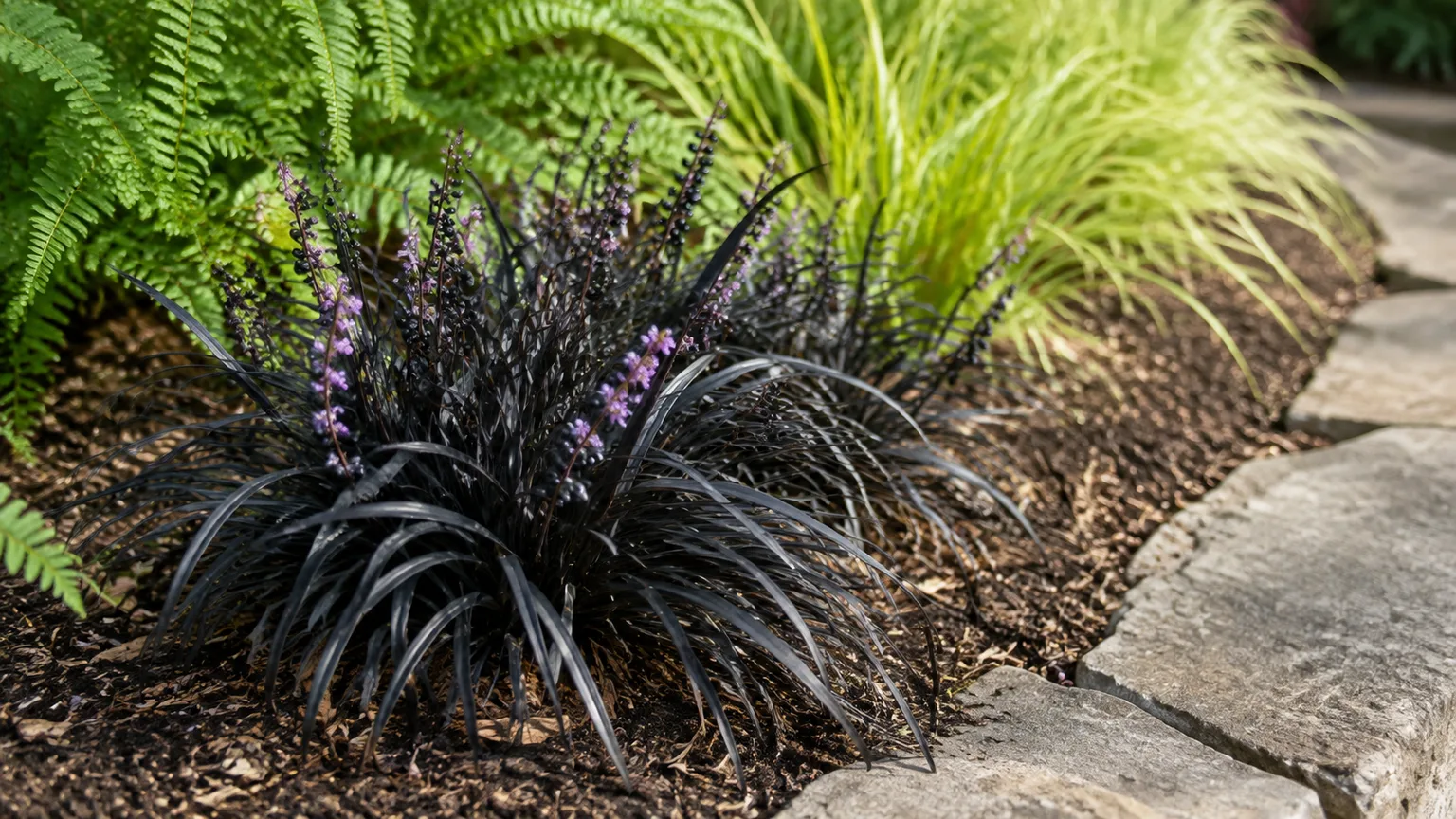
Black mondo grass is at its best when you stop expecting it to behave like lawn grass. Its narrow, arching leaves emerge from a basal crown in compact tufts, and the best plants look more like glossy black ribbons gathered into a low mound than a green carpet. That slow, deliberate growth is exactly why it makes such a strong edging plant—and why planting it in the wrong place can feel like a long wait for a disappointing result.
The plant sold as black mondo grass is usually Ophiopogon planiscapus ‘Nigrescens’, a grass-like perennial valued for near-black purple foliage, small summer flowers, and dark berries. It prefers moist but well-drained soil, tolerates full sun to partial shade, and usually needs patience more than complicated care. The guide below focuses on the decisions that matter: light versus heat, drainage versus moisture, clumping versus spreading, and maintenance that protects the crown instead of simply making the bed look tidy.
What Black Mondo Grass Is—and What It Is Not
Black mondo grass is not a true grass. It is a stemless, rhizomatous or stolon-forming perennial in the asparagus family, Asparagaceae, with narrow leaves that rise directly from the crown. The Missouri Botanical Garden describes the cultivar as forming slowly spreading clumps roughly 6 to 8 inches tall, with the species commonly reaching about 8 to 12 inches; mature width is commonly in the same general range. (Missouri Botanical Garden plant profile)
The color is not a flat ink black in every situation. Young leaves can emerge greener before deepening, and the foliage may read as blackish purple, aubergine, or deep charcoal depending on sun and background. In summer, small bell-shaped flowers in pink, pale violet, or white can hide among or just above the leaves. Dark purple to black berries may follow in fall and remain attractive into winter in mild climates. The Royal Horticultural Society lists ‘Nigrescens’ under several trade and synonym names, including ‘Black Dragon’ and ‘Kokuryu’, so compare the botanical name and cultivar on the tag rather than shopping by a common name alone. (RHS profile of Ophiopogon planiscapus ‘Nigrescens’)
The most important fact for a yard is growth rate. The University of Arkansas Extension notes that black mondo grass can take about three years before a clump shows obvious enlargement. It will eventually spread through short underground stolons, but it is not the plant to buy when you need a bare slope covered by the end of the season. Treat it as a permanent, low accent that gradually knits together, not as an instant mulch substitute. (University of Arkansas System Division of Agriculture: Black Mondo Grass)
Is Black Mondo Grass Right for Your Site?
Choose black mondo grass when you want a low border, a dark punctuation mark among bright foliage, a tidy container plant, or a slow-growing ground-cover texture in a bed you can reach easily. It works especially well at the front of a mixed border, along a path, in a rock garden, at the edge of a pond or stream, or beneath open-canopy shrubs where the soil stays evenly moist without becoming swampy.
The trade-off is speed. If your primary need is fast erosion control or quick coverage over a broad bank, a spreading lilyturf or another ground cover may perform that job sooner—but it may also cross boundaries and require more control. Black mondo grass is better when you are willing to wait and want the planting to stay visually composed. Before buying, ask whether you can keep the soil lightly moist during establishment and whether the area drains within a day after ordinary rain. If the answer to either is no, correct the site or choose a better-matched plant.
It is also worth checking the climate at the edge of the plant’s range. Missouri Botanical Garden lists the cultivar for USDA Zones 6 to 9 and warns that it is not reliably winter hardy in the colder parts of Zone 6. RHS rates the plant as H5 in its system, but hardiness labels are not guarantees against wet crowns, exposed wind, abrupt temperature swings, or a container freezing solid. A protected border can succeed where an exposed, waterlogged one fails in the same zone.
How Much Sun Does Black Mondo Grass Need?
Full sun generally develops the deepest foliage color. In a mild climate with evenly moist soil, six or more hours of direct light can give ‘Nigrescens’ its strongest near-black appearance and help the mound remain compact. Fine Gardening summarizes the practical baseline as full sun to part shade with moist, well-drained soil, and also highlights the plant’s value in containers and ground-cover plantings. (Fine Gardening plant guide)
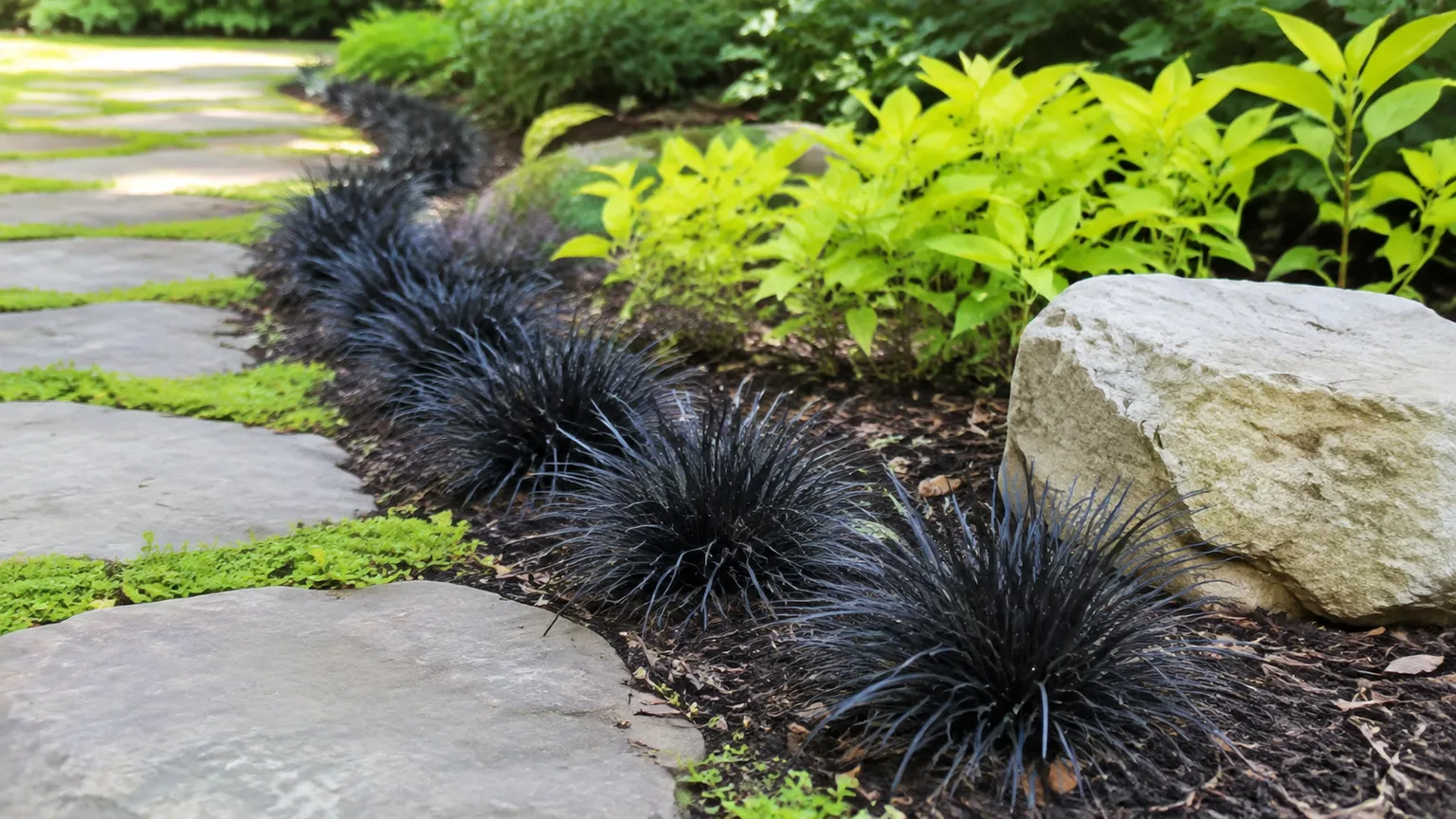
In a hot inland yard, however, the darkest possible spot is not automatically the healthiest spot. Intense afternoon light reflected from paving, a pale wall, or gravel can heat the narrow leaves and dry the root zone quickly. Give the plant morning sun and afternoon shade, or use dappled light beneath an open tree canopy, if the foliage scorches or the soil repeatedly dries before you can water deeply. A slightly less black plant that stays full is more successful than a sun-burned plant chosen for color alone.
Deep shade is the other extreme. The plant may survive, but the leaves can look less dramatic, growth can be slower, and flowers may be sparse. Use a simple test before planting: visit the proposed spot at midmorning, early afternoon, and late afternoon on a clear day. If there is bright filtered light for much of the day, the site may be excellent; if the soil is dark and cool but the canopy blocks nearly all sky light, choose a more shade-specialized companion or move the mondo grass toward the edge of the shade.
Prepare the Soil Before You Plant
The ideal is moist but well-drained soil that is moderately fertile, rich in organic matter, and slightly acidic to neutral. RHS lists clay, loam, and sand as possible soil types when drainage and moisture are right, while the Missouri Botanical Garden emphasizes rich, humusy, slightly acidic soil that does not dry out. You do not need a laboratory-perfect bed, but you do need a root zone that holds some water while allowing air back in after irrigation. If you are unsure what loam means in practice, use this quick explanation of how loam behaves in a garden bed. (RHS cultivation guidance)
Test the site before amending it. Dig a hole about 12 inches wide and deep, fill it with water, let it drain, then fill it again and watch. If water remains pooled for many hours after the second filling, black mondo grass is a poor candidate until you improve the grade, build a raised bed, redirect runoff, or choose a different plant. Mixing compost into compacted soil can improve structure over time, but a deep pocket of loose material inside heavy clay can also collect water around the roots. Organic matter is not a substitute for drainage.
Work compost or leaf mold into the upper root zone rather than creating a rich, isolated bowl. In sandy soil, the amendment helps slow moisture loss; in clay, it can help aggregation when mixed broadly instead of layered. Avoid burying the crown under soil or mulch while you work. The crown should sit at the same level as it did in the nursery container, with leaves emerging cleanly above the soil surface.
Plant Black Mondo Grass for Strong Establishment
Spring is a dependable planting window because it gives roots a long growing season before winter. Early fall can also work in regions with mild autumns, but in a cold climate or exposed site, leave enough time for roots to settle before the ground freezes. Water the nursery plant thoroughly before removing it from its pot so the root ball stays intact.
Plant in this order:
- Loosen the bed to the depth and width of the root ball, then mix in a modest amount of compost if the soil needs organic matter.
- Set the plant so the crown is level with the surrounding soil; never bury the center of the clump.
- Backfill with the native soil, firming gently to remove large air pockets without compacting the bed.
- Water slowly until the entire root ball and surrounding soil are wet.
- Add a thin organic mulch layer, keeping it a few inches away from the crown.
Spacing depends on the look you want and the exact cultivar. For a connected border, about 8 to 12 inches on center gives clumps room to expand while avoiding a large weed-filled gap. Four-inch spacing can create a faster-knit ground-cover grid, but it means more plants and more competition while the roots establish. The University of Arkansas Extension specifically points out that black mondo grass is unusually slow; spacing plants too far apart because they look small in pots can leave you staring at bare soil for years. Plant from crown center to crown center, and check the mature width on the nursery label.
Water by Soil Condition, Not by Calendar
Newly planted black mondo grass needs consistent moisture while roots move into the surrounding soil. For the first several weeks, check the soil with a finger or a narrow trowel near—but not directly against—the root ball. Water thoroughly when the upper inch or two begins to dry, then allow excess water to drain away. Frequent shallow sprinkles wet the surface but may leave the deeper root zone dry.
Once established, the plant can handle short dry periods better than a newly planted division or container-grown specimen. “Drought tolerant” does not mean “plant it and forget it”: the foliage stays fuller and the plant recovers better when the root zone is not repeatedly taken from moist to bone dry. A rain gauge helps you see whether a week has actually been wet enough, but soil texture, temperature, wind, shade, mulch, and root competition matter more than a universal weekly number.
Water at soil level in the morning when possible. Overhead irrigation is not automatically disastrous, but wet foliage that stays damp overnight and a dense, humid planting can increase the chance of foliar problems. More importantly, repeated overhead watering can hide the fact that runoff is leaving the bed while the crown remains dry. If the soil stays wet for days, do not respond by watering less often only; improve drainage and check that the plant is not sitting in a low pocket.
Fertilize Lightly and Prune at the Right Time
Black mondo grass is not a heavy feeder. A one- to two-inch layer of finished compost around the root zone in spring is usually enough for a plant growing in reasonably fertile soil. Keep compost and granular fertilizer away from the crown, and water after applying a product according to its label. Excess nitrogen can produce softer, greener growth without solving a light or drainage problem, and salt buildup is more likely in containers than in an open bed.
Pruning is mostly cleanup. Remove brown or damaged leaves individually when only a few are affected. If winter has left the whole clump ragged, use clean scissors to cut old foliage back in late winter or very early spring, before fresh shoots push through. Cut close to the base without scraping or slicing the crown. The RHS profile lists no routine pruning as necessary, so do not shear a healthy plant simply because the calendar says it is time; a light cleanup is safer than a ground-level haircut that damages emerging growth.
Seasonal Care From Spring Through Winter
Spring is the time to assess, not just tidy. Remove winter-damaged blades, pull weeds while the clumps are still open, top-dress with compost if needed, and check whether runoff or mulch has collected against the crowns. If a plant has been in the same container or a restricted bed for several years and the center is thinning, plan division after active growth resumes rather than forcing the roots apart during a heat wave.
Summer care is mostly moisture management. Check full-sun plantings more often than shaded ones, especially beside paving or under trees that intercept rainfall. Watch new divisions closely; their small root systems dry faster than established stolon networks. If the leaves pale or scorch only on the exposed side, first compare light and soil moisture before reaching for fertilizer.
Fall and Winter Protection
In mild winters, black mondo grass can remain evergreen. In colder locations, the foliage may look worn, flatten, or die back to the crown and return in spring. That response is not automatically a death sentence. Check the crown for firmness and new buds when the weather warms before digging up a plant that looks brown in January.
Protect plants in marginal climates with a light, breathable mulch after the soil cools, not a wet mound pressed over the crown. Compost or shredded leaves can buffer temperature changes, but several inches packed around the center can retain too much moisture. Containers need more attention: move them to a sheltered spot, group pots against a protected wall, or plant them into the ground temporarily if repeated freeze-thaw cycles threaten the root ball. Winter wet is often more damaging than cold alone.
Propagate Black Mondo Grass by Division
Division is the fastest and most predictable way to make more black mondo grass. Do it in spring as growth resumes, ideally after watering the plant the day before. A lightly moist root ball is easier to lift and separate than a dry, compacted one, and the new divisions have the growing season ahead of them.
- Dig around the clump with a spade or garden fork, working several inches away from the leaves so you lift the crown and roots together.
- Raise the root ball and brush away enough soil to see where offsets or natural sections connect.
- Pull apart small sections with your fingers. If the roots are tightly packed, use a clean, sharp knife to make deliberate cuts rather than shredding the crown.
- Keep several leaves and a healthy portion of roots attached to each division; tiny pieces may survive but take longer to recover.
- Replant divisions promptly at the original crown depth and water them thoroughly.
- Keep the new plantings evenly moist while they establish, then gradually use the same moisture checks as for an established clump.
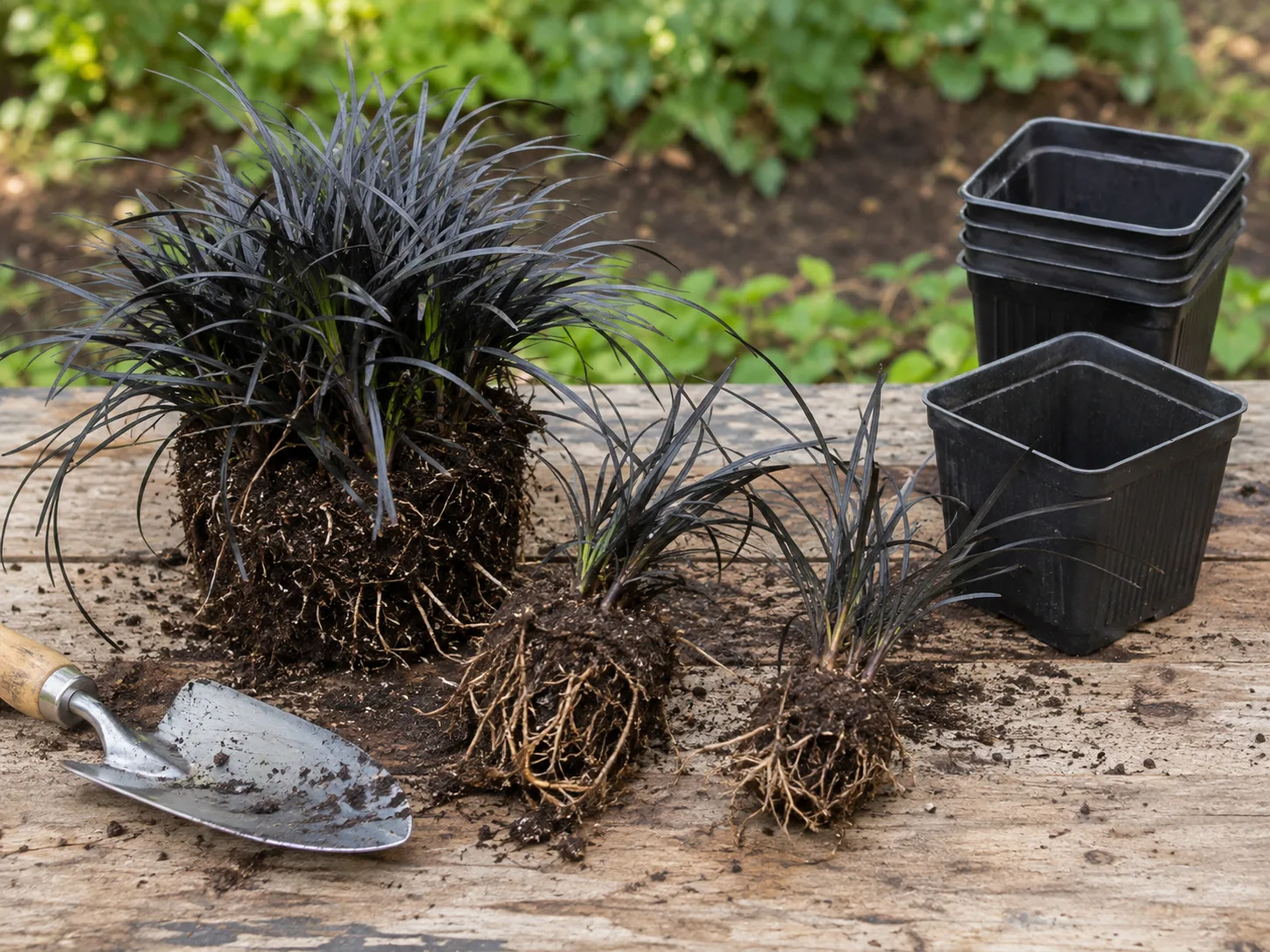
Do not divide merely because the plant is slow. A young clump needs time to build a stolon network, and dividing it too early gives you several stressed pieces instead of one strong plant. Division becomes useful when you want to create a border, the clump has outgrown its container, or the center has become crowded while the outer edges remain vigorous.
Can You Grow Black Mondo Grass From Seed?
Yes, but seed is a project, not the sensible shortcut. Mature berries contain seeds that can be cleaned, soaked, and sown in a sterile seed-starting medium. Germination can be slow and uneven, and seedlings take much longer to become landscape-sized clumps than divisions. The University of Arkansas Extension notes that the black-leaf characteristic can come true from seed, but variation in form is still possible.
If you want to experiment, harvest fully dark berries, remove the pulp, rinse the seeds, and sow them shallowly in a container with drainage. Keep the medium evenly moist, protect it from drying out, and give the tray a cool period if your seed source or regional guidance indicates one. Once seedlings emerge, provide bright light and good air movement, then harden them off before moving outdoors after frost risk has passed. Label the sowing date; a slow tray is not necessarily a failed tray.
For a specific named cultivar with predictable dark foliage, buy a healthy plant or divide a confirmed ‘Nigrescens’ clump. Seed is most rewarding when you enjoy raising plants and can wait several seasons, not when you need an immediate matching border.
Grow Black Mondo Grass in Containers
Containers make it easier to showcase the dark foliage, control soil quality, and move a plant away from harsh afternoon heat. Choose a pot with a drainage hole and only a little wider than the root ball. An oversized container holds wet mix around a small root system for too long, while a pot that is too tight dries quickly and may restrict the stolons. Avoid the common container-gardening mistakes that keep roots wet when you set up the pot.
Use a quality container mix that drains freely but holds moderate moisture. Do not place a layer of gravel in the bottom as a cure for a blocked or poorly designed pot; the drainage hole and the mix structure matter more. Set the crown at the same depth as in the nursery pot, water until it runs from the hole, and empty any saucer that holds water.
Place the container where it receives bright light but can be protected from the hottest reflected afternoon sun. Check moisture by lifting the pot or feeling the mix rather than watering on the same weekday every week. Container plants dry faster in wind and full sun, but they also become waterlogged faster when left in rain. Divide and refresh the pot when the root mass is crowded or the center declines, usually after several growing seasons rather than annually.
Use Black Mondo Grass in a High-Contrast Planting
Black mondo grass supplies color through foliage, so use it where the leaves can be seen against a lighter or brighter background. Chartreuse sedum, golden Japanese forest grass, silver foliage, pale gravel, white flowers, and light stone all make the dark clumps easier to read. Pink or lilac summer flowers echo the plant’s own small blooms without competing with them. For more ways to build a layered edge, compare these ornamental grasses for yard borders by light, height, and maintenance.
Repeat three or more clumps along a path or border instead of scattering a single plant in every empty spot. Repetition turns an unusual leaf color into a deliberate design rhythm. Keep companions from smothering the crown while the plant is young, and choose neighbors with similar moisture needs; a drought-loving succulent and a moisture-loving mondo grass may look good together in a nursery tray but need different irrigation in the ground.
Black mondo grass is a foreground plant, not a tall screen. Use it to draw a line along paving, anchor a container grouping, or create a low dark counterpoint beneath pale shrubs. For broad ground cover, calculate the cost and waiting time honestly. Its slow spread is a virtue for control, but a limitation when the design depends on quick closure.
Pests and Diseases to Watch For
Slugs and Snails in Wet, Shady Beds
Slugs and snails are the pests most likely to notice a lush, moist mondo planting, especially where mulch, dense shade, and frequent irrigation create hiding places. Look for irregular holes or ragged bites on fresh leaves, along with slime trails and daytime shelter beneath boards, pots, or thick mulch. Deer and rabbits are generally less interested, but browsing pressure varies by site and food availability.
Start with habitat and timing. Water in the morning, thin heavy mulch away from the crown, remove hiding debris, and inspect after dusk or after rain. Hand-pick when populations are small. Our slug and snail symptom guide can help you separate fresh feeding from old leaf damage. If you use a commercial bait, follow its label and keep it away from children, pets, and wildlife as directed; do not assume every “natural” bait is harmless. A saucer of beer may attract pests but can also attract non-target creatures and does not correct the wet site that helped the infestation.
Root Rot, Smut, and Persistently Wet Foliage
Root or crown rot is more serious than a few brown leaf tips. Suspect it when the soil stays saturated, the plant collapses from the center, leaves pull loose easily, or the crown is soft or foul-smelling. Remove the plant from the wet pocket, cut away only clearly rotted tissue, and replant a firm healthy section in corrected soil; if the crown is broadly mushy, discard it rather than spreading the problem through division.
Gardener’s Path also flags smut, a dark fungal growth that can appear when leaves stay wet overnight, and recommends morning watering and avoiding unnecessary overhead irrigation. (Gardener’s Path: Learn How to Grow Black Mondo Grass) The practical response is the same first step as for many foliar issues: improve air movement, water the soil instead of the foliage, remove badly affected leaves, and avoid treating a symptom you have not identified.
Common Problems and the First Fix to Try
Leaves are brown after winter. Check the crown before pruning or removing the plant. If the crown is firm, wait for spring growth, then trim damaged blades; protect marginal plants next winter from wind and wet rather than assuming they needed more fertilizer.
Leaves are brown at the tips in summer. Compare the affected side with the shaded side and test the soil several inches down. Drought, hot reflected light, salt buildup in a container, or root damage can all produce brown tips. Correct the site or irrigation pattern first, and flush container mix only when the pot drains freely.
The plant is green instead of black. Young leaves can emerge greener, and shade reduces the intensity of the dark color. Increase light gradually if the site is safe, but do not move a stressed plant straight from deep shade into hot afternoon sun. A healthy dark-purple plant in bright filtered light is a better goal than scorched foliage.
The clump is not spreading. That may be normal. Black mondo grass is a slow grower, and the University of Arkansas Extension notes that visible enlargement can take around three years. Check crown depth, weeds, moisture, and root competition before adding fertilizer. More nitrogen will not turn a naturally slow plant into a fast ground cover.
The center is thinning. First inspect for excess wetness, winter injury, and buried crowns. If the outer sections are firm and vigorous, divide in spring and replant the healthy offsets. If the center is soft or smells sour, treat it as a drainage or rot problem instead of propagating it.
Black Mondo Grass vs. Other “Monkey Grass”
“Monkey grass” is an unreliable common name used for several grass-like landscape plants. Black mondo grass is the dark-leaved Ophiopogon planiscapus selection. Dwarf mondo grass is usually Ophiopogon japonicus ‘Nana’, with green foliage and a compact habit. Liriope, often sold as lilyturf, is related but not identical; Liriope muscari is generally clumping, while Liriope spicata spreads more aggressively by rhizomes.
| Plant | Habit and color | Best use | Main trade-off |
|---|---|---|---|
| Black mondo grass | Slow clumps, near-black leaves | High-contrast edging, containers, small ground-cover drifts | Slow to fill; can suffer in wet or exposed winter sites |
| Dwarf mondo grass | Compact green clumps | Controlled edging and shade planting | Less dramatic color; still slow in many sites |
| Liriope muscari | Clumping green or variegated foliage, showier spikes | Borders, paths, and defined masses | Not the same black foliage effect |
| Liriope spicata | Creeping green mat | Broad banks where spread is acceptable | Can cross boundaries; check local guidance |
If you need a controlled black accent, choose black mondo grass and accept its pace. If you need fast coverage, research the exact species and local status before buying a spreading “monkey grass.” Read the botanical name on the label, decide how much spread your yard can tolerate, and match the plant to the job rather than treating the common name as a guarantee.
Conclusion: Give the Slow Grower the Right Start
Black mondo grass rewards a precise kind of patience. Give it moist but well-drained soil, enough light to develop strong color without exposing it to punishing reflected heat, and consistent water while the roots settle. Keep the crown at the correct depth, feed lightly, clean up in early spring when needed, and protect marginal plantings from winter wet and exposure.
The plant’s slow spread is not a flaw if you want a neat border that will not run through the garden overnight. It is a limitation if you need quick ground cover. Start with a site that suits the roots, buy the correctly labeled cultivar, and divide an established clump when you want more plants. Those choices do more for long-term success than any special fertilizer or rigid watering schedule.