15 Cauliflower Companion Plants to Grow Nearby
Find good plants to grow with cauliflower, what to avoid, and how to arrange companions without crowding roots, stealing light, or concentrating pests.
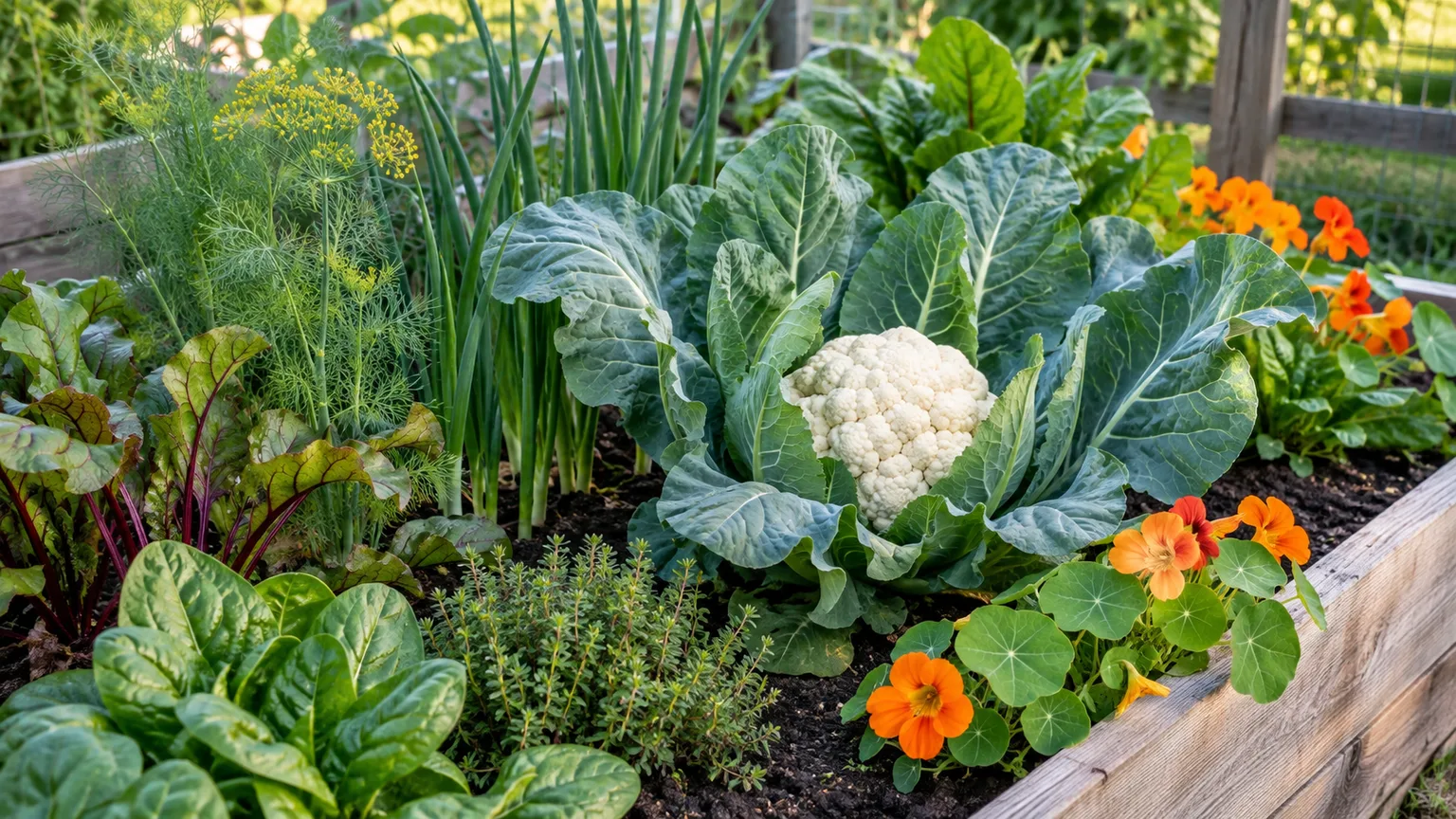
The best cauliflower companion plants are not magic shields. They are neighbors chosen for a specific job: filling a gap before the cauliflower gets large, adding flowers and insect habitat, creating a little more plant diversity, or producing another harvest in the same cool-season bed.
That practical definition is important. Cauliflower is a hungry, space-demanding crop with shallow roots and broad leaves. It needs full sun, fertile soil, even moisture, and enough room for air to move around the plant. A companion that crowds the crown, steals water, or hides caterpillars can do more harm than a companion chart can fix.
Use the 15 plants below as a menu rather than a recipe. Choose one or two that solve a real constraint in your garden, place them where they will not compete with the mature cauliflower, and judge the pairing by what you can observe: more usable space, easier scouting, a longer harvest window, or healthier-looking plants. The practical companion overview from Gardeners’ Path is a useful starting point, but the limits and layout matter more than the label “good companion.”
What companion planting can realistically do for cauliflower
Companion planting is planned proximity, not simply putting many species in the same bed. A second plant may share the cauliflower’s growing season, occupy a different layer of the bed, flower when beneficial insects are active, or serve as a monitored alternative host for a pest. Those are different functions, and they should not be promised as one universal “benefit.”
Choose the job before you choose the plant
Start with the problem you are trying to solve. If your bed is small, spinach or beets can turn open soil into an early harvest while young cauliflower is still establishing. If you want flowers near the vegetable patch, nasturtiums or marigolds can bring color and give you a visible place to watch insect activity. If you struggle with aphids or caterpillars, dill, sage, or flowering nasturtiums may make the bed more biologically active, but they still require inspection.
You can also choose a companion because its timing works. Green onions can be harvested while cauliflower is growing, and beans may fit a succession plan before a fall crop rather than as a dense neighbor in the same row. This timing-based approach is often more reliable than squeezing a permanent herb into every gap.
What the evidence says about pest control
There are plausible reasons mixed plantings can change pest pressure. A peer-reviewed review of companion plants for aphid management describes three broad mechanisms: a companion can attract the pest away from the main crop, interfere with the pest’s visual or chemical host-finding cues, or provide food and shelter for natural enemies. The review also stresses that results depend on the species, arrangement, density, and timing, and that companion plants work best alongside other control methods. See the peer-reviewed review in Insects for that useful distinction between a possible mechanism and a dependable garden result.
The strongest reason to stay modest is that practical trials do not always match the promise. In a SARE-supported Washington State project, researchers tested onion, dill, potato, and marigold with broccoli, a close relative of cauliflower, while also using mustard as a trap crop. The companions did not improve broccoli dry biomass or consistently change flea-beetle density on the broccoli. The report did find that more flea beetles in the mustard trap crop sometimes coincided with fewer on broccoli, but the effect did not translate into better plant weight and was not consistent across sampling.
That does not make companion planting useless. It means you should measure its success by the job you actually assigned it. A flowering edge that helps you notice pests earlier, a spinach crop harvested before the cauliflower canopy closes, or a row of onions that uses otherwise empty space can be a genuine win even if the cauliflower produces no larger head.
The 15 best cauliflower companion plants
The table below separates practical fit from pest folklore. “Best use” is the reason to try a pairing; “main caution” is the failure mode to watch. Start with the companions that match your bed’s water, light, and harvest schedule.
| Companion | Best use near cauliflower | Starting placement | Main caution |
|---|---|---|---|
| Beets | Cool-season gap crop | 8–12 in. from leaf edge | Thin crowded tops and harvest before shading |
| Swiss chard | Long harvest from a non-brassica green | 12–18 in. away | Mature leaves can crowd the cauliflower canopy |
| Spinach | Fast spring or fall harvest; living soil cover | 6–12 in. away | It bolts and declines when weather warms |
| Celery | Upright crop with similar moisture needs | 12–18 in. away | Needs steady moisture and a long season |
| Onions | Narrow edible border | 8–12 in. away | Bulbs need light and room to swell |
| Garlic | Fall-to-summer border crop | 8–12 in. away | Scent is not a guaranteed pest barrier |
| Leeks | Tall, narrow allium for efficient space use | 12 in. away | Do not let foliage fall across the crown |
| Dill | Flowers and habitat for beneficial insects | Bed edge, 12–18 in. away | Allow some to flower; remove unwanted seedlings |
| Sage | Aromatic, perennial bed-edge plant | 18–24 in. away | Drier needs and mature width make it a poor center-row crop |
| Rosemary | Perennial aromatic anchor in a separate spot | 24 in. or in a pot | It dislikes the wet root zone cauliflower prefers |
| Nasturtium | Flowering edge or monitored trap crop | Outside the row | Remove or prune it if aphids build up |
| Marigold | Flower diversity and possible nematode rotation role | 12–18 in. away | Do not expect a few plants to stop caterpillars |
| Beans | Succession crop or future soil-residue plan | Separate row, sunward side | Pole types can shade and overtake cauliflower |
| Arugula | Fast harvest or deliberate flea-beetle observation crop | Bed edge or gap | It can attract the same flea beetles as brassicas |
| Mustard greens | Deliberately monitored trap crop | Outside main cauliflower row | It can concentrate pests if ignored |
Compact cool-season vegetables: beets, Swiss chard, spinach, and celery
Beets, Swiss chard, spinach, and celery are useful when your first goal is to harvest more from the same piece of ground. They are not all equally compact, but each can fit beside cauliflower if you preserve light and do not turn the bed into a tangle. The close relationship between beets and chard is less important than their practical growth habits: both can be harvested for leaves, while beets also develop belowground.
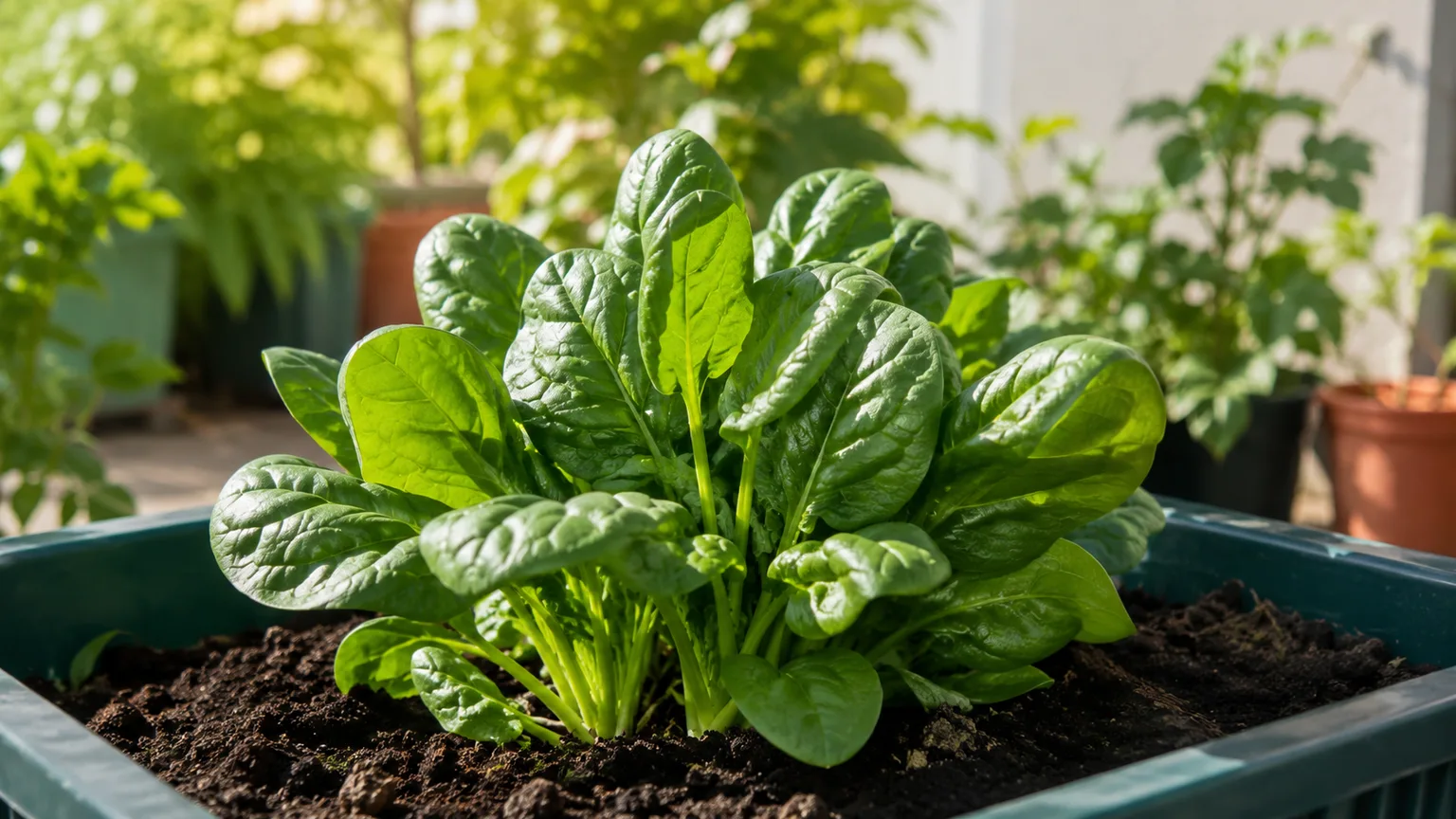
Spinach is the easiest space-sharing choice for a spring or fall bed. Direct-seed a short row outside the cauliflower’s planting hole, harvest the outer leaves repeatedly, and remove the plants when they bolt or when the cauliflower leaves begin to close over them. Think of spinach as a timed understory, not a permanent mulch. Its shallow roots still need water, so leave a narrow access strip for irrigation and weeding.
Beets can occupy the front edge, but thin them early. A dense beet row becomes a damp, shaded mat beneath cauliflower leaves, which makes scouting harder and increases competition. Swiss chard stays productive longer and can be a good choice when you want a second leafy crop, but its mature leaves are large; plant it outside the cauliflower’s widest leaf spread rather than directly underneath.
Celery is a different kind of neighbor. Its upright form uses vertical space, and it tolerates the regular moisture that cauliflower needs better than drought-loving herbs do. It is still a demanding crop, so do not add celery to a bed with poor irrigation and call the pairing efficient. Both plants need steady attention, and the benefit is mainly compatible care and shape—not a guaranteed flavor or pest effect.
Alliums: onions, garlic, and leeks
Onions, garlic, and leeks are among the most practical cauliflower companions because their leaves are narrow and their harvests can fit around the main crop. Plant them along the sunny edge or between larger plants only while the cauliflower is small. Their aromatic foliage may make host-finding more difficult for some insects, but the careful wording is “may.” A row of garlic will not stop aphids from landing when conditions favor them.
Onions work especially well in a spring cauliflower bed when you use sets or transplants. Leave enough room for the bulb to swell, and do not tuck the plants so close to the cauliflower that you must disturb its roots to harvest. Garlic planted the previous fall can be ready before a late cauliflower planting needs the whole bed, which makes it a good rotation and succession partner.
Leeks are slower and more upright, so they can share a bed when positioned at the outside edge. Keep their leaves from flopping across the cauliflower crown, and remember that all three alliums need reasonably well-drained soil even though cauliflower prefers consistent moisture. Avoid pairing alliums with beans in the same tiny bed when bean production is your priority; West Virginia University Extension’s companion-planting guidance gives the broader reminder that a plant can support one neighbor while competing with another.
Aromatic herbs: dill, sage, and rosemary
Dill is the most flexible herb on this list. Its fine foliage takes little ground space, and its small flowers can provide nectar and pollen for hoverflies, bees, and other insects. To get that flower benefit, let at least some plants bolt. Harvesting every dill stem before it blooms turns it into a kitchen herb but removes the floral resource you hoped to add.
Sage and rosemary are better treated as edge plants or nearby container plants than as moisture-loving filler between cauliflower. Both are woody Mediterranean herbs that prefer sharper drainage and less frequent watering. Place sage at the end of a row where it can receive sun without leaning into the cauliflower. Keep rosemary in its own pot or on the driest side of the bed, and do not run constant irrigation directly through its root zone.
Aromatic plants are often described as repellents. In reality, scent is only one possible part of a complex insect response, and a strong-smelling herb does not make the cauliflower invisible. Their most dependable benefits are edible harvest, flowers, and structural diversity. If a perennial herb becomes broad enough to shade the cauliflower, prune it or move it; do not preserve a “companion” at the expense of the crop.
Flowers for edges and pest observation: nasturtium and marigolds
Nasturtiums are useful when you have room outside the vegetable row. Their rounded leaves and flowers add a clear visual marker to the bed, and they can attract aphids, which is why some gardeners use them as a trap crop. That benefit is conditional: a trap crop must be inspected, and heavily infested nasturtiums should be pruned, treated according to the product label if you choose a treatment, or removed before pests spill into the cauliflower.
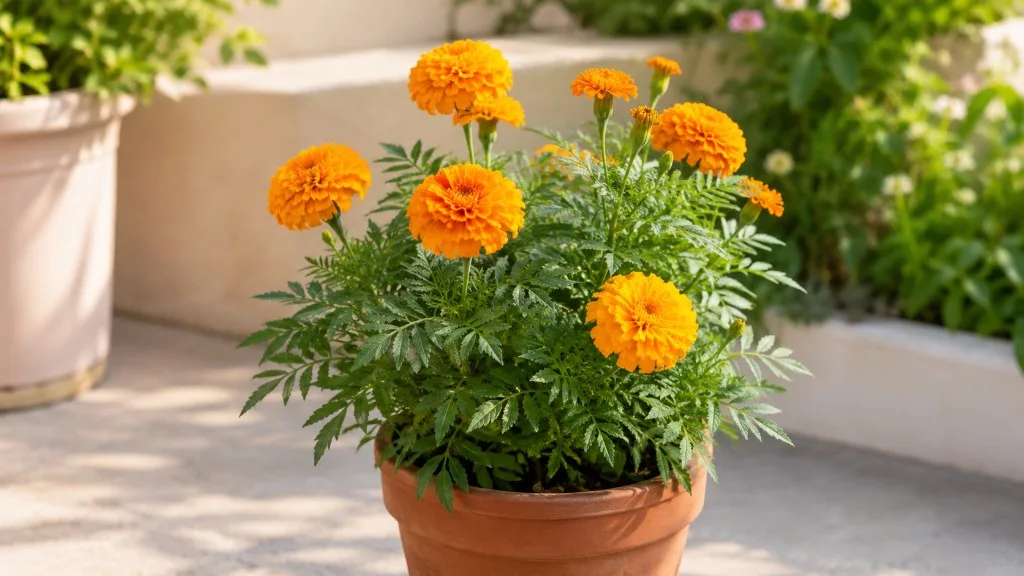
Marigolds add flowers and plant diversity, but their reputation often exceeds what a home planting can prove. Research and extension discussions have explored whether marigold residues or compounds can suppress some nematodes in particular rotations; that is different from claiming that a few flowering plants repel every cauliflower pest. Use marigolds where you want an easy-to-see edge and a possible rotation benefit, not as a substitute for row cover or scouting.
Place both flowers outside the mature cauliflower leaf zone. A plant that looks small at transplanting can become a dense, humid cushion by midsummer. You want the flowers visible and accessible, with enough open soil around the cauliflower to water, weed, and check leaf undersides.
Beans, arugula, and mustard greens: use with a plan
Beans can fit into a cauliflower succession plan, but the common nitrogen promise needs correcting. Living bean plants do not instantly donate their fixed nitrogen to a neighboring cauliflower. Nitrogen becomes more available through decomposing roots and residue after the legume has grown, and the effect depends on the plant, soil, harvest, and what you do with the residue.
For a current cauliflower crop, bush beans are safer than pole beans because they stay lower. Even then, keep the rows separate enough that you can water and harvest without stepping into the cauliflower. Pole beans need a trellis and can shade or physically overtake the crop. A better use may be to harvest an early cauliflower crop, clear the bed, and then grow beans before a later cauliflower succession if your local season allows.
Arugula and mustard greens are members of the same broad brassica group as cauliflower, so they do not provide the family diversity of spinach or onions. Their value is strategic: flea beetles may prefer some spicy brassica foliage, making these plants candidates for observation or a trap-crop experiment. Put them on the outside of the bed, not interwoven through every cauliflower plant, and remove them if they become a pest nursery.
The Washington State/SARE project tested mustard as a trap crop around broccoli and found that higher flea-beetle numbers in the trap crop sometimes coincided with lower numbers on broccoli, but the tested companion arrangements did not improve broccoli dry weight. That is a reason to monitor a trap crop closely, not a reason to plant a solid wall of mustard beside every cauliflower.
How to choose the right companion for your bed
Match sun, water, mature size, and root disturbance
Treat mature cauliflower as the anchor. It commonly needs roughly 18 to 24 inches of personal space, depending on variety and growing conditions, and its leaves can reach well beyond the planting hole. Put short, fast crops just outside the likely leaf spread, narrow alliums on the edge, and woody herbs farther away or in containers. The exact distance matters less than whether you can still see the soil and reach the plant.
Match water before scent. Spinach, beets, chard, celery, onions, and cauliflower can share a bed with regular irrigation. Rosemary and sage prefer a drier cycle, so placing them at the edge or in separate pots prevents you from compromising either plant. The Epic Gardening cauliflower companion overview is useful for seeing how many popular pairings are really about compatible shape or timing rather than proven pest control.
Protect the root zone when harvesting. Root crops such as beets can be lifted without a problem when they are still small and the soil is loose, but repeated digging beside an established cauliflower can tear fine roots. Harvest gap crops early and pull the entire row once it begins to compete. A companion that requires frequent digging is not a good choice directly beside a long-season head crop.
Use timing to share space without sharing problems
For spring cauliflower, sow spinach or a small beet row before or at transplanting, then harvest it as the cauliflower expands. Set onions or leeks at the edge at the same time. Add nasturtiums only when they will not smother young plants, and let a few dill plants flower if beneficial-insect habitat is part of your plan.
For fall cauliflower, use the cleared space left by spring garlic, onions, beans, or an early green. A companion can be “good” because it finishes first. This is especially helpful in short seasons, where a quick spinach or arugula harvest provides value before cool weather slows the cauliflower.
Keep notes for one season. Record the planting date, approximate spacing, first pest sighting, which plants shaded others, and whether a companion needed more water than expected. WVU Extension specifically emphasizes that companion planting is not an exact science and that gardeners should record successful and failed combinations. Your notes are more useful than a permanent chart that ignores your climate and soil.
A practical cauliflower companion-plant layout
A flexible 4-by-8-foot raised-bed pattern
For a 4-by-8-foot bed, begin with three cauliflower plants in a row rather than trying to maximize the number of heads. Place them 24 inches apart if that matches the variety and leave a clear access side. Along the sunny front edge, direct-seed a short strip of spinach or beets. At the two ends, tuck a few onions or leeks where they will remain visible and easy to harvest.
Put one or two dill plants near a corner, not in the middle of the cauliflower canopy. Place a marigold or nasturtium outside the bed edge where you can inspect it. If you want arugula or mustard as a trap crop, use a separate outside strip and decide in advance how you will remove it when flea beetles arrive. Rosemary or sage belongs at the dry end of the bed or in a pot nearby.
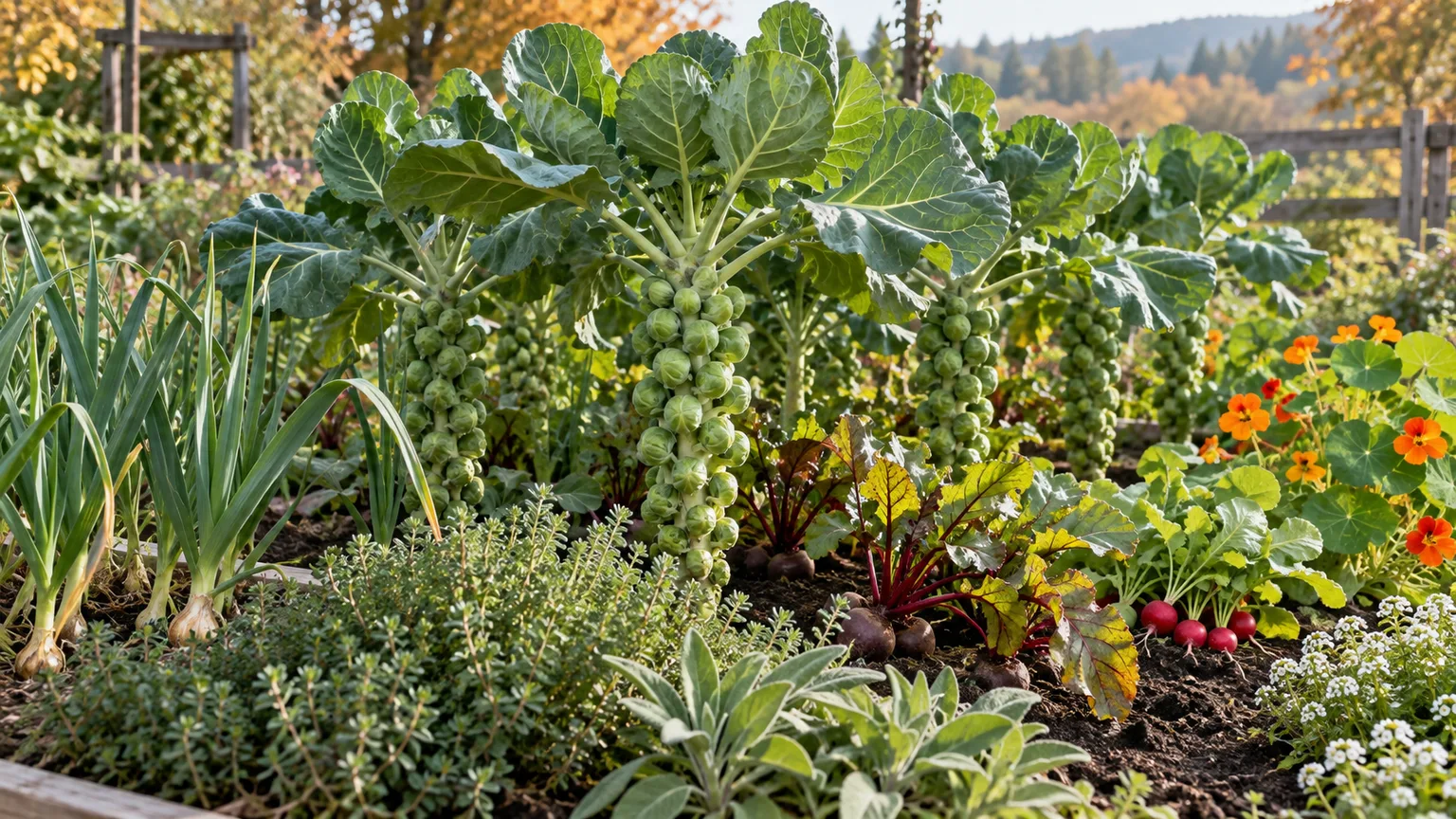
This pattern gives each plant a job and keeps the cauliflower central. It also leaves a bare or lightly mulched ring around each crown, which makes watering and weekly inspection much easier. The goal is not to make every inch green; it is to make the bed productive without hiding the crop.
Small beds, containers, and crowded rows
In a small bed, choose one compact edible companion and one flower or herb. Spinach plus onions is a low-risk starting combination. Nasturtium plus cauliflower can work when the nasturtium is planted outside the bed and trained away from the leaves. Dill can go in a pot at the corner if your soil is too crowded for another root system.
Containers require stricter limits. One cauliflower plant can fill a large container by itself, and a companion will compete for the same finite water and nutrients. Use one pot for cauliflower and a separate pot for rosemary, sage, or nasturtium if you want the visual or insect-habitat benefit. A tiny shared pot is an experiment, not a reliable way to produce a full head.
If your existing row is already crowded, do not add companions to fix it. Thin the weakest plant, harvest the gap crop, or move a perennial herb. Airflow, light, and access are more valuable than another label on the companion list. A clean row that you can inspect will usually outperform a dense row with theoretically helpful neighbors.
Why companions do not replace pest control
Cauliflower attracts pests because it is a brassica, regardless of how many flowers or herbs grow nearby. Common problems include flea beetles that pepper young leaves with small holes, cabbage worms and loopers that chew foliage, aphids clustered on tender growth, and slugs that hide in cool, damp cover. Companion plants may change the setting, but they do not remove the food source.
Scout first, then use barriers and targeted action
Inspect the top and underside of leaves at least once a week, and more often when seedlings are small. Look for shot holes, clusters of eggs, frass, curled leaves, and caterpillars tucked along the midrib. Check the companion plants too, especially nasturtiums, mustard, and arugula if you planted them as observation or trap crops.
Floating row cover is often the most dependable early-season tool for excluding flying pests from young cauliflower. Anchor the edges so insects cannot crawl underneath, and make sure the cover does not press heavily on growing leaves. Because cauliflower is grown for its head rather than a fruit that needs insect pollination, a cover can remain useful longer than it would on a crop that must be visited by bees; follow local crop and weather guidance and keep plants from overheating.
Remove visible eggs and caterpillars by hand when the planting is small enough to inspect. Keep weeds and old brassica debris from creating hidden habitat, water the soil rather than splashing the leaves, and rotate the main crop so cauliflower and its close relatives do not occupy the same bed year after year. If you use a pesticide, identify the pest first and follow the product label, including crop, timing, harvest interval, and protective requirements.
The most important trap-crop rule is simple: never plant one and then stop looking. If mustard or nasturtium carries more pests, that is information and a management responsibility. Remove or manage the trap before the population expands into the cauliflower, and do not assume that a damaged companion has protected the crop merely because it looks busy with insects.
Plants to avoid with cauliflower—and why
Avoid putting many other brassicas—broccoli, cabbage, kale, Brussels sprouts, arugula, and mustard greens—into one tight block if your main purpose is pest reduction. They share important pests and diseases, so the bed can become one large target. Arugula and mustard can be deliberate trap-crop experiments, but that is different from treating them as automatically protective companions.
Keep tomatoes, melons, and other vigorous warm-season crops away from the cauliflower’s root and leaf zone. Tomatoes compete heavily for nutrients and space, while melons can run through the bed and make watering, weeding, and scouting difficult. A trellised cucumber may appear to solve the space problem, but the resulting shade and shared moisture schedule are still a poor fit for many cauliflower plantings.
Strawberries are a poor neighbor in a dense cauliflower bed because their low foliage can create damp, sheltered habitat for slugs and block access to the soil. Grow them in a separate patch where you can manage their runners and inspect the fruit. Fennel is best kept separate as well. Claims about its allelopathic effects vary by source and situation, but its mature size, strong growth, and awkward fit with a small mixed vegetable bed are enough reason not to use it as a casual companion.
Finally, be cautious with mint. It is not on the recommended list because spreading stems and roots can take over the same access space you need for cauliflower. If you want mint nearby, keep it in a container with no contact between its stems and the vegetable bed. The right response to a poorly matched companion is not more fertilizer or closer spacing; it is removal, separation, or a different plant.
Conclusion
The best cauliflower companion plants are the ones that solve a defined problem while preserving the crop’s basic needs. Start with spinach, beets, Swiss chard, or celery when you want a second cool-season harvest; choose onions, garlic, or leeks for a narrow edible edge; and use dill, sage, rosemary, nasturtiums, or marigolds for flowers, structure, and insect observation. Beans, arugula, and mustard greens can be useful in a planned succession or trap-crop experiment, but each needs more careful timing and monitoring.
Keep the cauliflower row open enough to water, scout, and harvest. Companion planting can add diversity and make a small garden more productive, but row cover, crop rotation, good spacing, consistent moisture, and regular pest checks remain the dependable foundation. Choose one pairing, record what happens, and let the results in your own bed determine whether that companion has earned its space.