How to Grow and Care for Staghorn Ferns
Grow staghorn ferns on a mount with bright indirect light, soak-and-drip watering, steady humidity, and pup propagation—plus fixes for rot and brown shields.
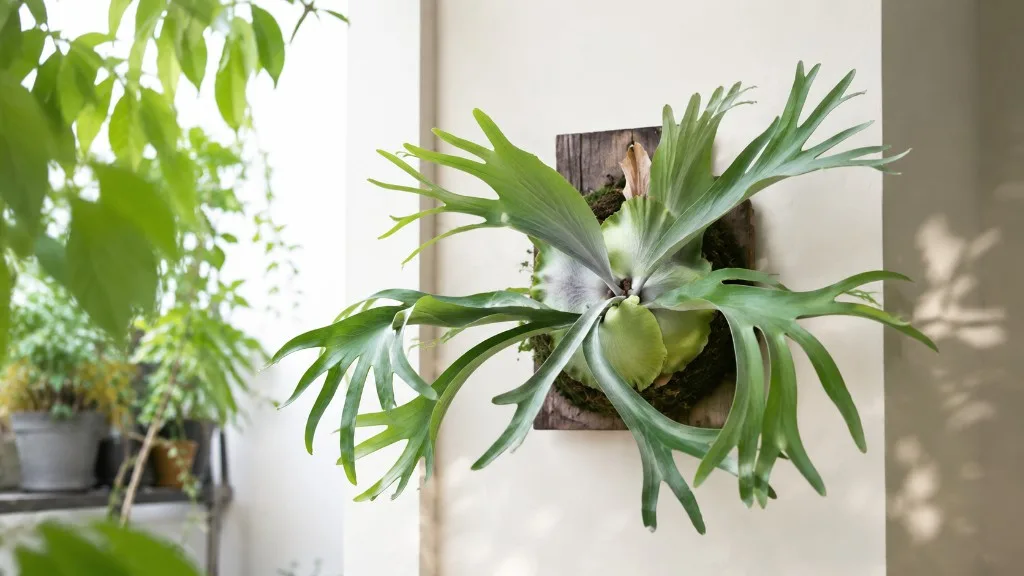
A staghorn fern looks like wall-mounted sculpture until the moss stays wet for two weeks, the antler tips crisp in February, or someone trims the brown “dead leaves” at the base and exposes the crown. Platycerium bifurcatum and its relatives are not difficult because they are delicate—they are difficult because most houseplant advice treats them like soil-rooted ferns in pots. In nature, staghorns are epiphytes: they cling to tree bark and rock, catch rain and debris in shield-shaped basal fronds, and send forked antler fronds upward for photosynthesis. Your job indoors is to copy that open, airy, soak-and-dry rhythm on a mount, not to park the plant in dense peat and water on a calendar.
This guide covers the full care loop for the common staghorn fern—anatomy, light and humidity, mounting and remounting, soak-and-drip watering, feeding, species differences, pup propagation, outdoor limits, pests, and a troubleshooting path when fronds tell you something is off. For topic-specific deep dives, the LeafyPixels cluster breaks out light, watering, soil and mount substrate, fertilizer, repotting and remounting, propagation, and pruning on their own pages.
Staghorn Fern Quick Reference
Use this table before you change anything. When a symptom shows up, match it to the fix column instead of guessing with more water.
| Factor | Indoor / mounted target | Watch for |
|---|---|---|
| Light | Bright indirect; east window or filtered west/south | Bleached or crispy antler tips = too much direct sun |
| Temperature | Above 55°F (13°C) day-to-day; avoid sustained below 50°F | Brief dips OK on mature plants; young plants less tolerant |
| Humidity | 50–70%+; bathrooms work if light is adequate | Crispy antler edges in heated winter air |
| Water | Soak mount when moss nears dryness—often weekly in warm months | Heavy wet moss for days = rot risk |
| Mount | Sphagnum moss on wood, bark slab, or wire basket | Dense potting soil in a closed pot = common failure |
| Fertilizer | Dilute balanced liquid monthly in spring–summer | Salt buildup browns antler tips |
| Mature size | 2–3 ft. wide on a board over years | Plan remount before hardware shows |
| Hardiness | USDA zones 9–12 outdoors | Elsewhere: summer shade only, frost-free nights |
| Pets | Non-toxic to cats and dogs (ASPCA) | Chewing mount line or moss still risky |
Wisconsin Horticulture Extension notes that Platycerium bifurcatum—the species most shops sell—is probably the easiest staghorn to grow, reaching about 3 feet across at maturity with antler fronds up to 18 inches long. (Wisconsin Extension) NC State Extension lists typical container spread around 60–90 cm (2–3 feet) with similar antler length. (NC State Extension) Indoors, growth is slow to moderate; a wall trophy builds over years, not weeks.
What Makes Staghorn Ferns Different From Other Houseplants
If you have kept a Boston fern or maidenhair in soil, reset your expectations. Staghorn ferns belong to Polypodiaceae, but epiphytic Platycerium species follow different rules than terrestrial pot ferns. They do not want a perched water table at the bottom of a cachepot. They want fast drainage, airflow around the root pad, and periodic full saturation followed by a real dry-down. Missouri Botanical Garden describes P. bifurcatum as an epiphyte suited to bright indirect light indoors and warns to avoid full sun. (Missouri Botanical Garden)
The other big difference is dual frond architecture. Every staghorn produces two frond types. Confusing them causes most beginner mistakes—including destructive “cleanup” pruning.
Shield Fronds vs Antler Fronds
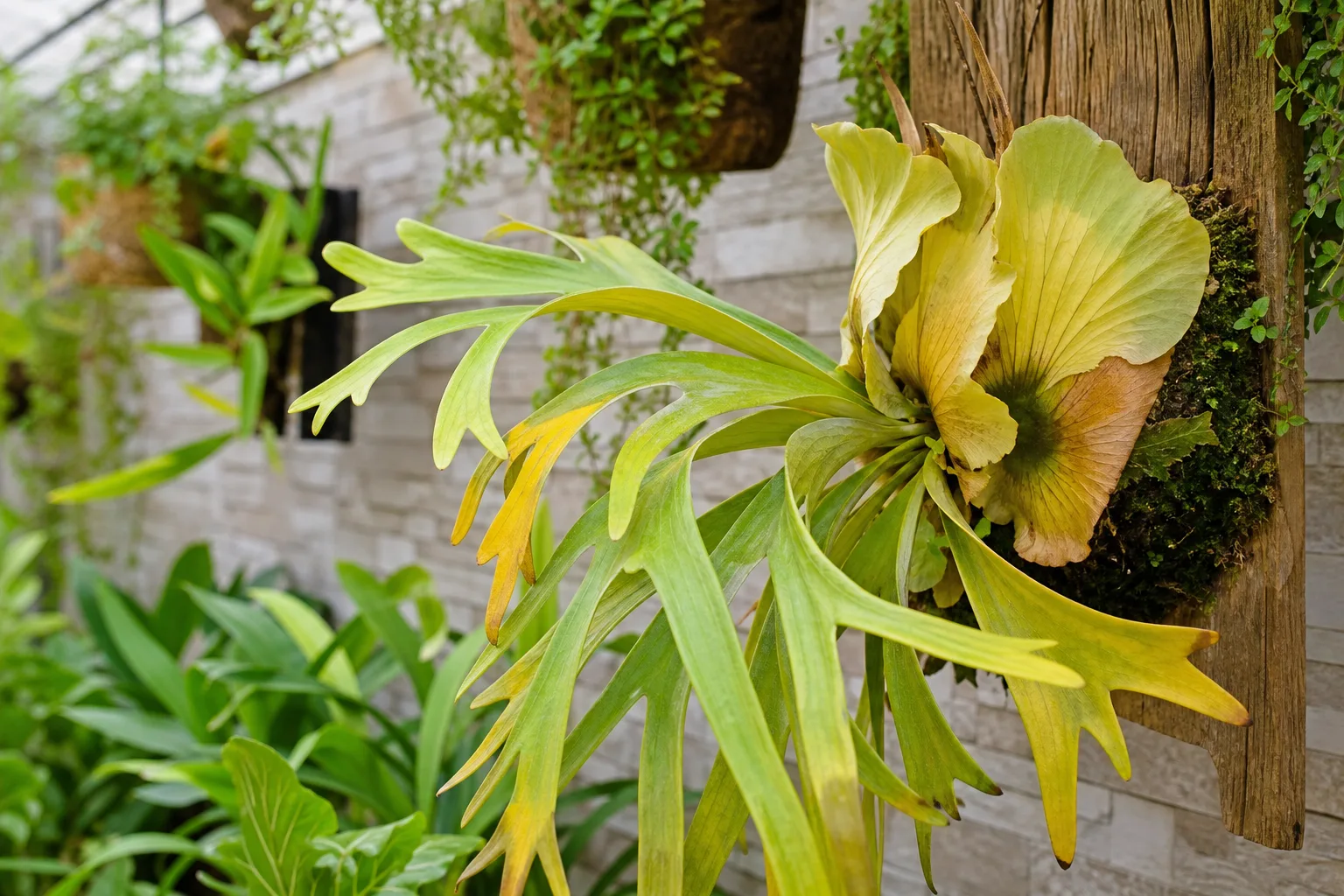
Shield fronds (basal or sterile fronds) are the rounded, kidney-shaped plates that press flat against the mount. They start dull green and succulent, then turn papery tan to cinnamon-brown with age. Their jobs: anchor the plant, protect the rhizome and roots, trap organic debris for nutrients, and shield the growing point from drought and harsh light. Wisconsin Extension is explicit: do not remove the brown shield-like basal fronds—they are normal, not dead weight to peel away. (Wisconsin Extension)
Antler fronds (foliar or fertile fronds) are the forked, strap-shaped “stag horns” that photosynthesize and reproduce. They branch into two or three segments along their length. On mature fronds, dark brown masses (sori) on the undersides hold spores—that velvety brown is normal sporangia, not disease. UF/IFAS Gardening Solutions reassures growers who mistake sporangia for a problem. (UF/IFAS)
First-action rule: Brown shields at the base are often aging architecture. Brown or black soft tissue at the crown where new growth emerges is a red flag—usually overwatering or rot. Yellowing or limp antler tips more often trace to underwatering, low humidity, or too much direct sun. Do not treat all brown the same.
Why Epiphytes Do Not Want Dense Potting Soil
Staghorn ferns are often sold in small pots for shipping convenience, but long-term pot culture is a compromise. In a standard mix, water lingers around the rhizome longer than on an exposed moss pad. Wisconsin Extension explains that small plants can grow in containers with rich, very well-drained medium, but indoor culture typically mounts them on boards or bark for essential drainage and display. (Wisconsin Extension)
NC State notes that in habitat these ferns attach to trees; houseplant culture mimics that with boards, wired baskets, or bark slabs plus sphagnum or peat moss for roots to grow into. (NC State Extension) Pot culture can work in very open orchid-style mixes in shallow slatted containers, but mount culture aligns better with soak-and-drip watering and prevents the silent rot that starts when moss at the core never dries.
Best Light and Where to Hang a Staghorn Fern
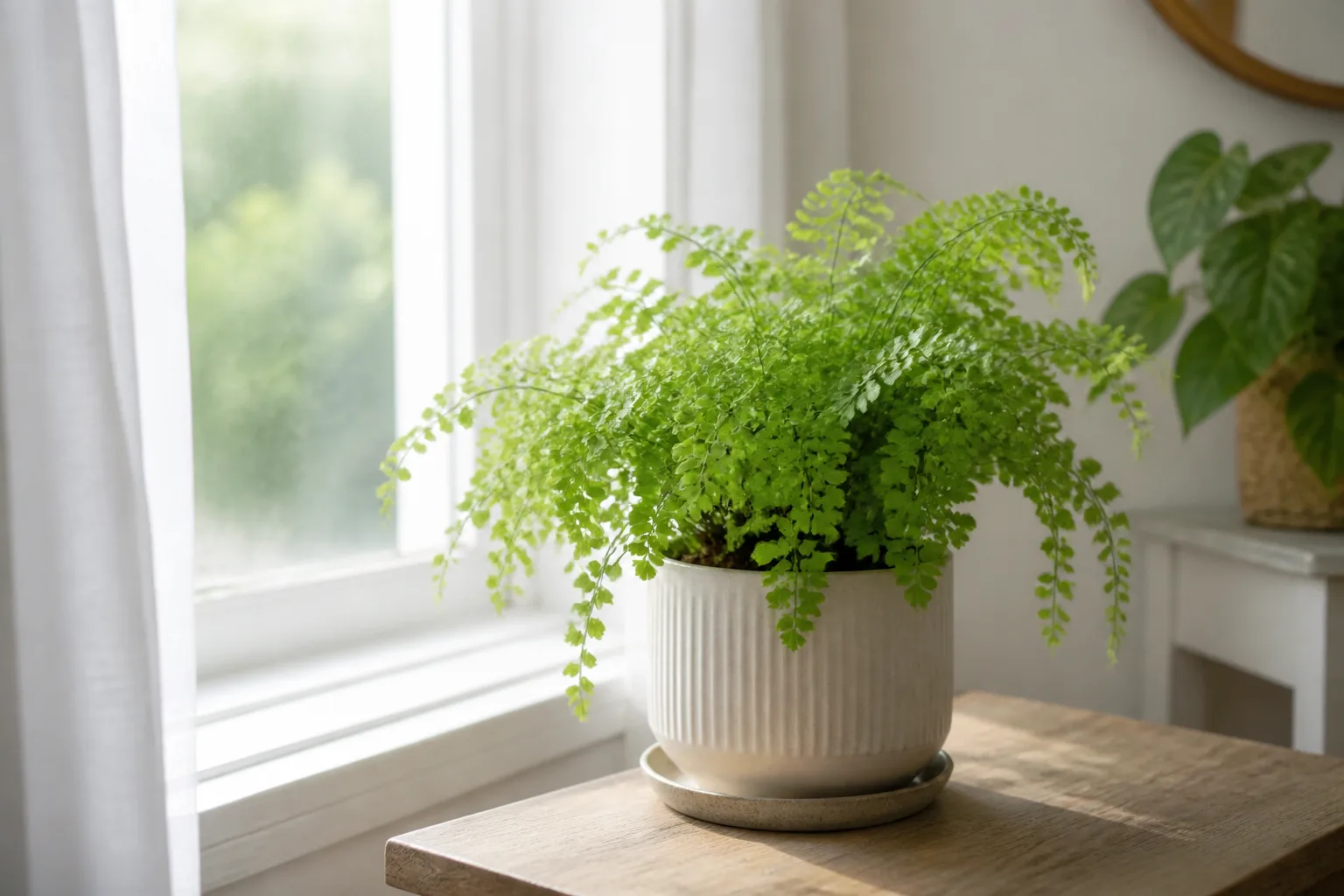
Staghorn ferns want bright, indirect light—the dappled canopy light they evolved under. Indoors, that usually means an east-facing window, a bright north room, or a spot several feet back from west- or south-facing glass where direct rays do not hit antler tissue. NC State recommends bright indirect light and partial shade tolerance. (NC State Extension)
They can handle more sun when humidity and temperatures are high—but direct midday sun on dry fronds scorches fast. Wisconsin Extension notes they tolerate more direct light in humid heat but need more water in those conditions. (Wisconsin Extension) If antler tips bleach white or tan on the window side, pull the mount back or add a sheer curtain. If new antlers stay thin and reach toward the glass, the plant wants more brightness, not fertilizer.
Best hang spots: a bright living room wall, a bathroom with usable window light, or a shaded porch in frost-free months. Avoid dark hallways—UF/IFAS warns that very low light encourages disease and pest problems. (UF/IFAS) For window-by-window nuance, see the dedicated Staghorn Fern light guide.
Temperature and Humidity Targets
Warm, stable room temperatures suit staghorn ferns: above 55°F (13°C) for routine indoor life, with Wisconsin Extension recommending household temps above 55ºF and caution below that. (Wisconsin Extension) Mature P. bifurcatum can survive brief freezes into the mid-20s °F outdoors, but repeated cold damages tissue—move mounts indoors before nights drop into the 40s °F in fall.
Humidity matters as much as temperature. Staghorns absorb moisture through fronds and roots. Aim for 50–70%+ relative humidity; heated winter air without supplementation produces crispy antler margins even when soaking looks “on schedule.” A humidifier is the reliable fix. Grouping plants helps at the margins. Misting raises humidity only briefly; treat it as a supplement, not a strategy.
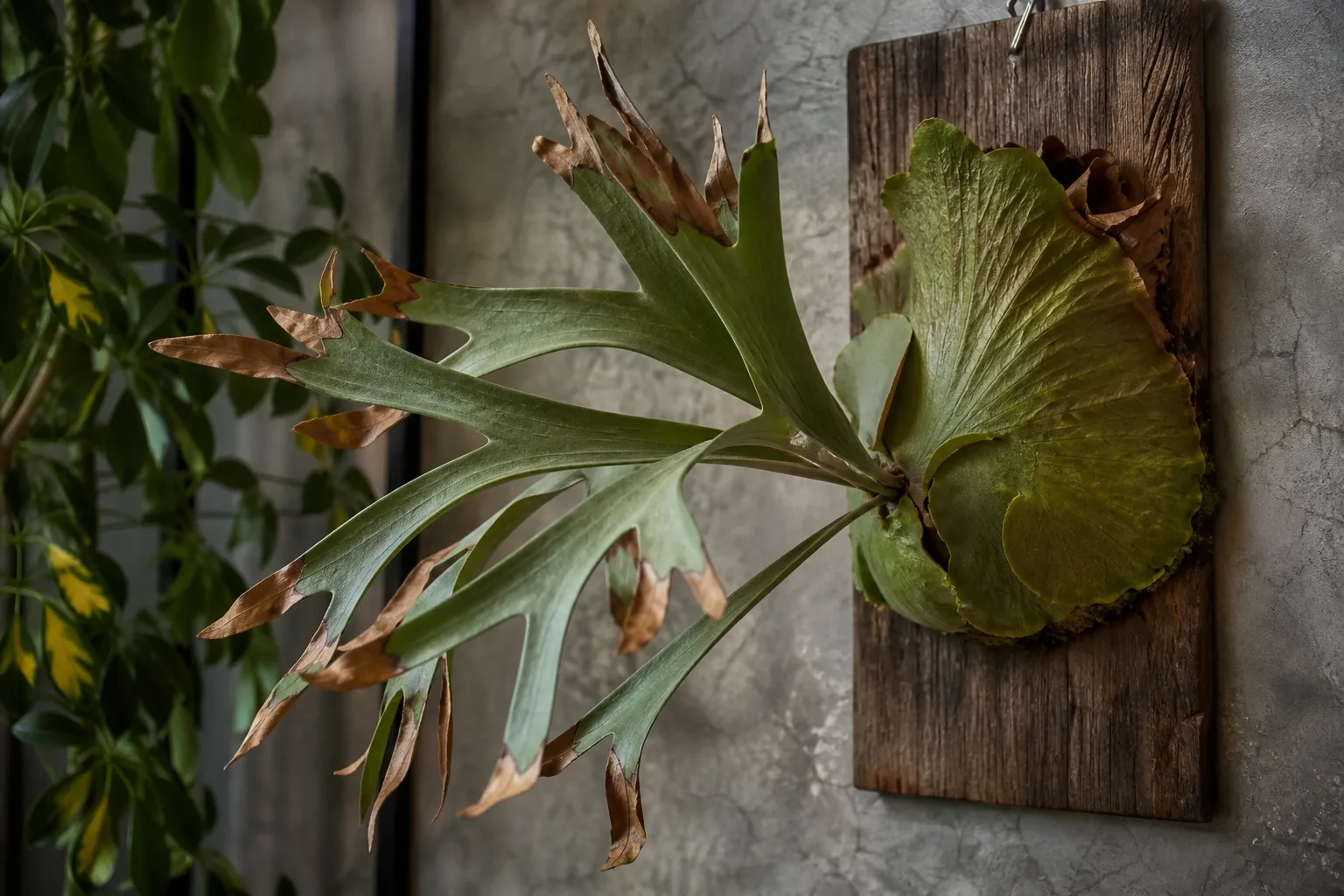
Bathrooms and kitchens work when they combine enough light with periodic humidity spikes from showers or cooking. A steamy but windowless bathroom still needs a grow light or the fern slowly declines. NC State suggests bathrooms or kitchens as high-humidity placements when light and airflow are adequate. (NC State Extension) Keep mounts away from radiator blasts and AC vents—rapid air swings stall growth.
How to Mount a Staghorn Fern
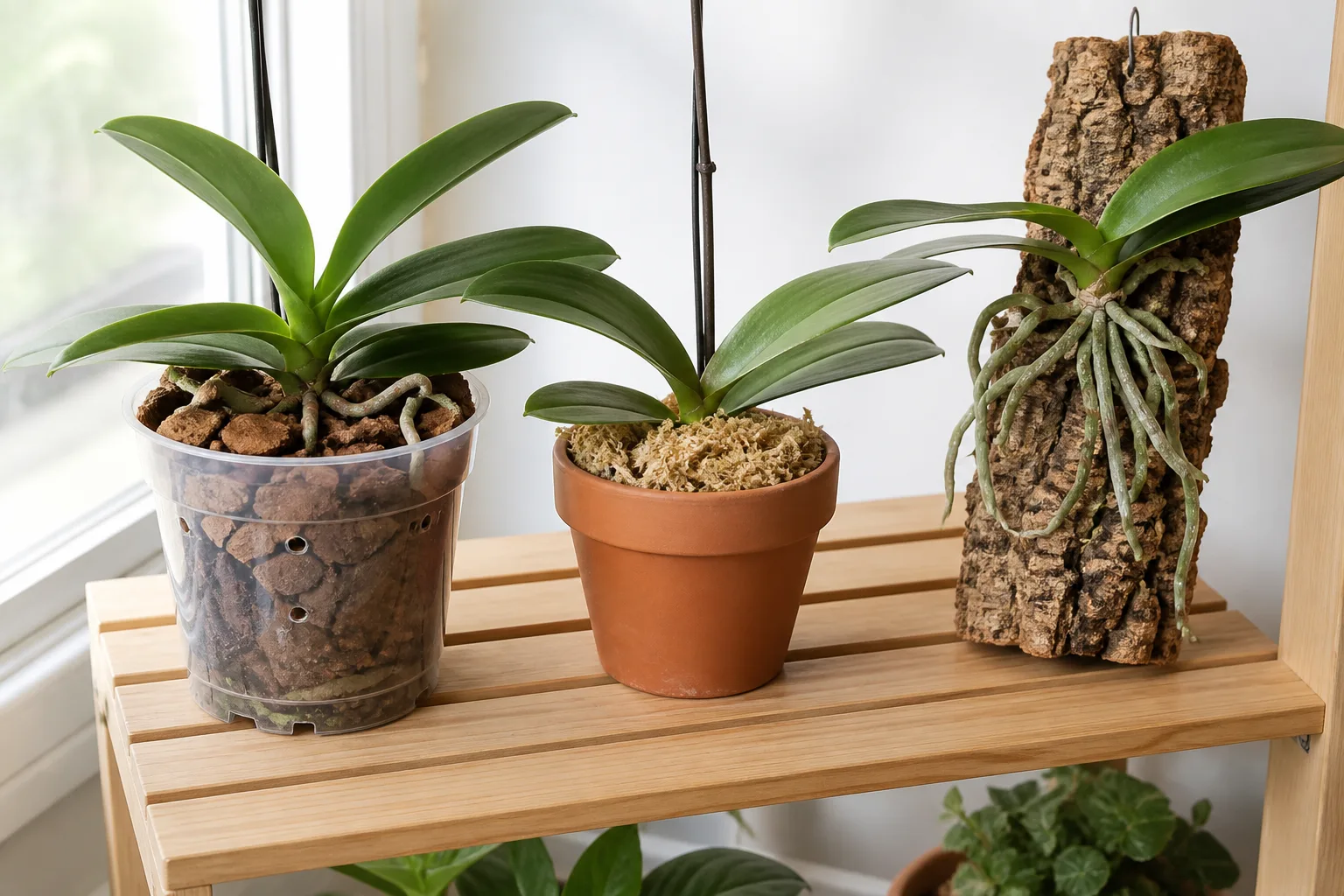
Mounting is not optional décor—it is the lowest-maintenance path for most homes. UF/IFAS describes the ideal spot as mounted on wood, tree fern fiber, or rock with basal fronds in contact with organic medium. (UF/IFAS)
Materials and Step-by-Step Mounting
You need: a cedar board, hardwood plaque, or bark slab; sphagnum moss (or a very open orchid mix for baskets); monofilament fishing line, nylon strips, or plastic mesh—not copper wire, which can damage roots; optional eye hooks and picture-hanging hardware for wall display.
Steps:
- Soak moss until fully saturated, then squeeze lightly so it is moist—not dripping.
- Form a fist-sized mound on the board where the fern will sit.
- Nestle the plant so living shield fronds contact the moss and the growing point faces outward. Wisconsin Extension warns: secure through dead brown shields, never over soft green tissue, or you will damage or kill fronds. (Wisconsin Extension)
- Wrap fishing line in a grid across old shields to hold the root pad against the moss. New green shields will eventually hide the hardware.
- Hang vertically in bright indirect light. Horizontal “table” mounting traps water in shield cups—avoid unless you are experienced.
Wire basket alternative: hang a basket sideways, pack with moss, and let pups eventually engulf the frame—UF/IFAS describes this method for specimens that spill from all sides. (UF/IFAS)
Young nursery plants in pots can stay temporary in loose orchid mix, but plan to mount within the first year if you want fewer rot scares.
When to Remount on a Larger Board
Remount when green shields reach past the board edges, the mount feels unbalanced or too heavy for the hardware, or dried moss no longer holds moisture evenly. UF/IFAS notes some giants become impractical to remount but tolerate crowded conditions—do not panic if antlers overlap; panic if the core stays soggy.
Remounting steps mirror initial mounting: soak the plant, gently detach old line from brown shields only, transfer the root pad to a larger plaque with fresh moss, and re-tie. Spring is the forgiving season. Full remount detail lives on the Staghorn Fern repotting guide.
Watering Staghorn Ferns the Right Way
Proper watering separates thriving wall trophies from rotting crowns. Staghorns need consistent moisture with a real dry-down between soaks—they rot easily if the moss stays saturated. Wisconsin Extension is blunt: allow growing medium to dry some between waterings; overwatering is the fast path to failure. (Wisconsin Extension)
The Soak-and-Drip Method
Do not sprinkle a wall-mounted fern with a watering can and walk away. Use full immersion:
- Unhook the mount and submerge it in a sink or tub of room-temperature water (rainwater or filtered water is ideal when available).
- Soak 10–20 minutes until moss and shield tissue are fully saturated and the mount feels heavy.
- Drip dry completely on a rack or over the sink—30 minutes to an hour is common.
- Rehang only when water stops streaming from the moss.
How often? In many bright, moderate homes: about weekly in warm active growth, every 10–14 days in cooler or dimmer winter months. UF/IFAS suggests weekly in warm dry weather and less in cool cloudy weather—but both extension sources emphasize checking moss dryness, not obeying a calendar. (UF/IFAS)
Weight check: Lift the mount before every decision. Feather-light and dusty moss means soak soon. Heavy and cold days after the last soak means wait. Press a finger into moss behind a shield: slightly cool and barely damp is the target between soaks.
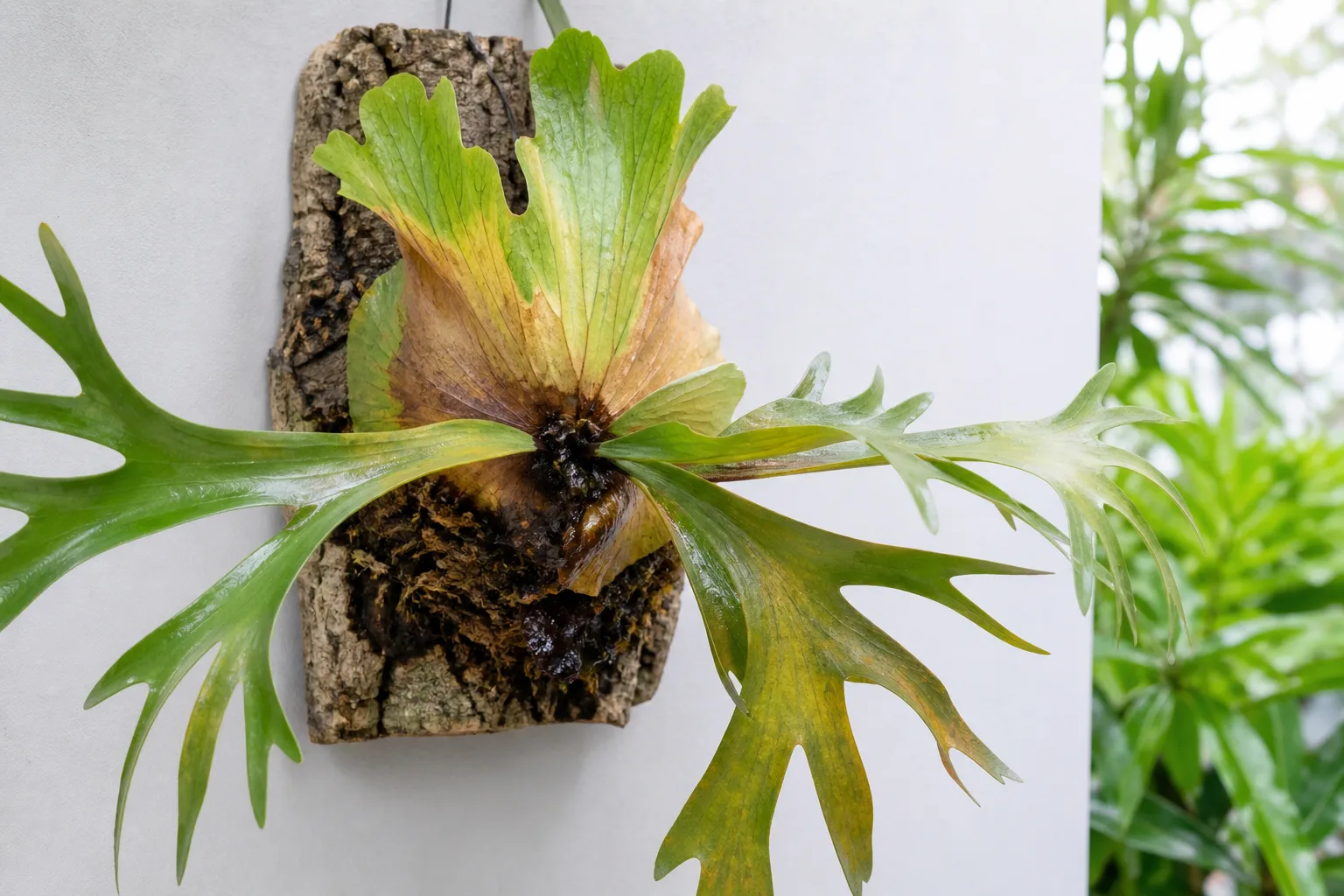
Established plants are fairly drought tolerant and can withstand longer dry spells better than chronic wet feet—Wisconsin Extension notes mature specimens endure drought better than rot. (Wisconsin Extension) If antler tips wilt but moss is dry, soak now. If antlers yellow while moss stays wet and smells sour, you are likely overdoing it—see overwatering on Staghorn Fern before the next soak.
Fertilizer and Feeding Schedule
Staghorn ferns are light feeders compared to fast-growing tropicals, but monthly dilute fertilizer during warm active growth supports antler size and pup production. Wisconsin Extension recommends balanced, diluted liquid fertilizer monthly in warmer months or slow-release pellets in the moss. (Wisconsin Extension) UF/IFAS suggests a 1:1:1 ratio for young plants monthly in warm months and every other month when growth slows; mature plants may thrive with once or twice yearly feeding. (UF/IFAS)
Rules that prevent damage:
- Use half-strength liquid feed unless the label specifies epiphytes or ferns.
- Apply to soaked moss after a normal watering cycle, never to bone-dry tissue.
- Pause or reduce feeding October through February in most homes.
- Salt buildup shows as brown antler tips even when watering seems correct—flush with plain water soaks for a few cycles.
More feeding nuance: Staghorn Fern fertilizer guide.
Staghorn Fern Species Worth Knowing
Roughly 18 Platycerium species exist, with hybrids and varieties beyond that. (UF/IFAS) Most collectors start with P. bifurcatum—forgiving, pup-forming, and widely sold. Wisconsin Extension awarded it the RHS Award of Garden Merit in 1993. (Wisconsin Extension)
| Species | Beginner fit | Distinctive traits |
|---|---|---|
| P. bifurcatum | Excellent | Classic forked antlers; produces pups; zones 9+ |
| P. veitchii | Good | Smaller, blue-green, more sun-tolerant |
| P. hillii | Good | Broad bright green fronds, 2–3 ft. |
| P. alcicorne | Moderate | Easy in Florida humidity; variable forms |
| P. andinum | Collector | Amazon native; narrow 5-ft. fronds; only New World species |
| P. superbum | Advanced | Huge nest-forming shields; no pups; cold-sensitive |
| P. coronarium | Collector | Long pendulous forked fronds for baskets |
| P. stemaria | Collector | Deep V-shaped layered horns |
| P. elephantotis | Collector | Wide ridged 4-ft. leaves |
UF/IFAS lists P. bifurcatum, P. veitchii, P. alcicorne, and P. hillii among easier species. (UF/IFAS) If your tag is missing, assume P. bifurcatum unless growth habit clearly suggests otherwise.
Propagating Staghorn Ferns by Division
Home propagation means pup division, not spores. Spore propagation is real—ferns alternate sporophyte and gametophyte life stages—but it is slow and finicky for most growers. Wisconsin Extension notes staghorns are generally propagated by division, cutting pups with sterile fronds and roots. (Wisconsin Extension)
When to divide: Spring, on a mature plant with offsets (pups) at least 10–15 cm across that show their own green shield and root tissue.
Steps:
- Soak the parent mount thoroughly so moss flexes.
- Identify a pup with a clear rhizome connection behind its shield.
- Slice once with a sterilized knife, taking shield, roots, and at least one antler if present.
- Mount the pup on a small board with fresh sphagnum moss—same technique as initial mounting.
- Keep warm, bright indirect, and evenly moist (not soggy) until new growth proves independence. Establishment can take weeks to months; do not discard slow pups too early.
UF/IFAS encourages sharing pups with friends once rooted—just be honest that solitary species like P. superbum will not give you offsets. Full protocol: Staghorn Fern propagation guide.
Growing Staghorn Ferns Outdoors
In USDA zones 9–12, staghorn ferns can live outdoors year-round in shaded or partially shaded spots with frost protection. Wisconsin Extension places P. bifurcatum in zones 9 and above for in-ground or outdoor culture. (Wisconsin Extension) NC State lists zones 9–11 (9b–11b) for outdoor use. (NC State Extension)
Cooler climates: move mounts outdoors after nights stay consistently in the 40s °F, acclimating gradually to brighter outdoor light. Bring inside before nights drop into the 40s in fall. Under a porch roof or tree canopy mimics habitat and reduces frost burn.
Invasive-plant caution: P. bifurcatum has naturalized in Florida and Hawaii, where Wisconsin Extension reports it is considered invasive on the islands. (Wisconsin Extension) UF/IFAS now advises Florida gardeners to plant with caution and manage growth to prevent escape, per the UF/IFAS non-native plant assessment. Do not discard mounts or pups into wooded areas in warm humid regions.
Pests and Diseases
Staghorn ferns are relatively pest-free when airflow and light are good, but scale, mealybugs, and spider mites appear—especially when humidity is low or neighboring plants are infested. NC State lists spider mites, aphids, and mealybugs as monitors. (NC State Extension)
Response protocol:
- Inspect shield bases and antler undersides at each soak.
- Isolate infested mounts from clean collections.
- For soft-bodied pests, insecticidal soap or horticultural oil on a test frond first—fern tissue is sensitive.
- Avoid heavy systemic chemicals on epiphytes you soak weekly.
Black spot can appear when humidity is too high with poor airflow—NC State flags black spot under excessive humidity. (NC State Extension) Improve circulation, widen soak spacing, and trim only clearly dead tissue with sterile tools. Fungal issues overlap with overwatering; fix moisture before spraying repeatedly.
Cluster links: spider mites, mealybugs, aphids.
Common Staghorn Fern Problems (and Fixes)
Match the symptom to tissue type before you trim, soak, or move the plant.
| Symptom | Likely cause | First action |
|---|---|---|
| Papery brown flat shields at base | Normal aging | Leave in place; do not peel |
| Black soft tissue at crown | Overwatering / rot | Stop soaking; improve airflow; see root rot |
| Wilting antler tips, light mount | Underwatering | Full soak-and-drip now |
| Yellow antler fronds, heavy moss | Chronic wet moss | Extend dry period; check overwatering |
| Bleached tan patches on sun side | Too much direct sun | Filter light or move mount |
| Brown velvety patches under antlers | Normal sporangia | No action needed |
| Crispy antler edges in winter | Low humidity | Humidifier; see low humidity |
| Stippling + fine webbing | Spider mites | Isolate; treat gently |
Black Spots, Rot, and Wilting Antlers
Blackening at the base of antler fronds often signals overwatering—the same pattern Spruce readers report, but the fix is operational: verify moss weight, lengthen the dry window, and ensure the mount drips fully after every soak. If green shields soften and smell sour, treat it as crown rot, not a watering tweak.
Wilting antler tips with dry moss mean underwater now. Wilting with wet moss means root damage—more water will worsen collapse.
Brown shield fronds stacked in layers are normal architecture on mature specimens. Problems start when you remove living green shields or let water sit stagnant inside a closed cup for days.
For yellow antler diagnostics step-by-step, see yellow leaves on Staghorn Fern. For droop without color change, see wilting.
Conclusion
Staghorn ferns reward growers who accept epiphyte logic: mount on moss, hang in bright indirect light, soak fully, drip dry completely, and read moss weight instead of a calendar. Understand shield fronds versus antler fronds, leave papery brown shields in place, and treat velvety sporangia as normal reproduction—not a cleanup job. Feed lightly in warm months, divide pups in spring when they are substantial, and remount before hardware fails under increasing mass.
Outside the tropics, enjoy them as seasonal patio sculptures; in zones 9–12, shade and frost protection still matter—and in Florida and Hawaii, manage plants responsibly so they stay garden ornaments, not escaped weeds. With that framework, a Staghorn Fern becomes one of the most distinctive living displays you can hang on a wall—and far less intimidating than its reputation suggests.