How to Grow and Care for Philodendron Paraiso Verde
Learn Philodendron Paraiso Verde care with clear advice on light, water, soil, humidity, support, propagation, and troubleshooting for healthy mottled leaves.
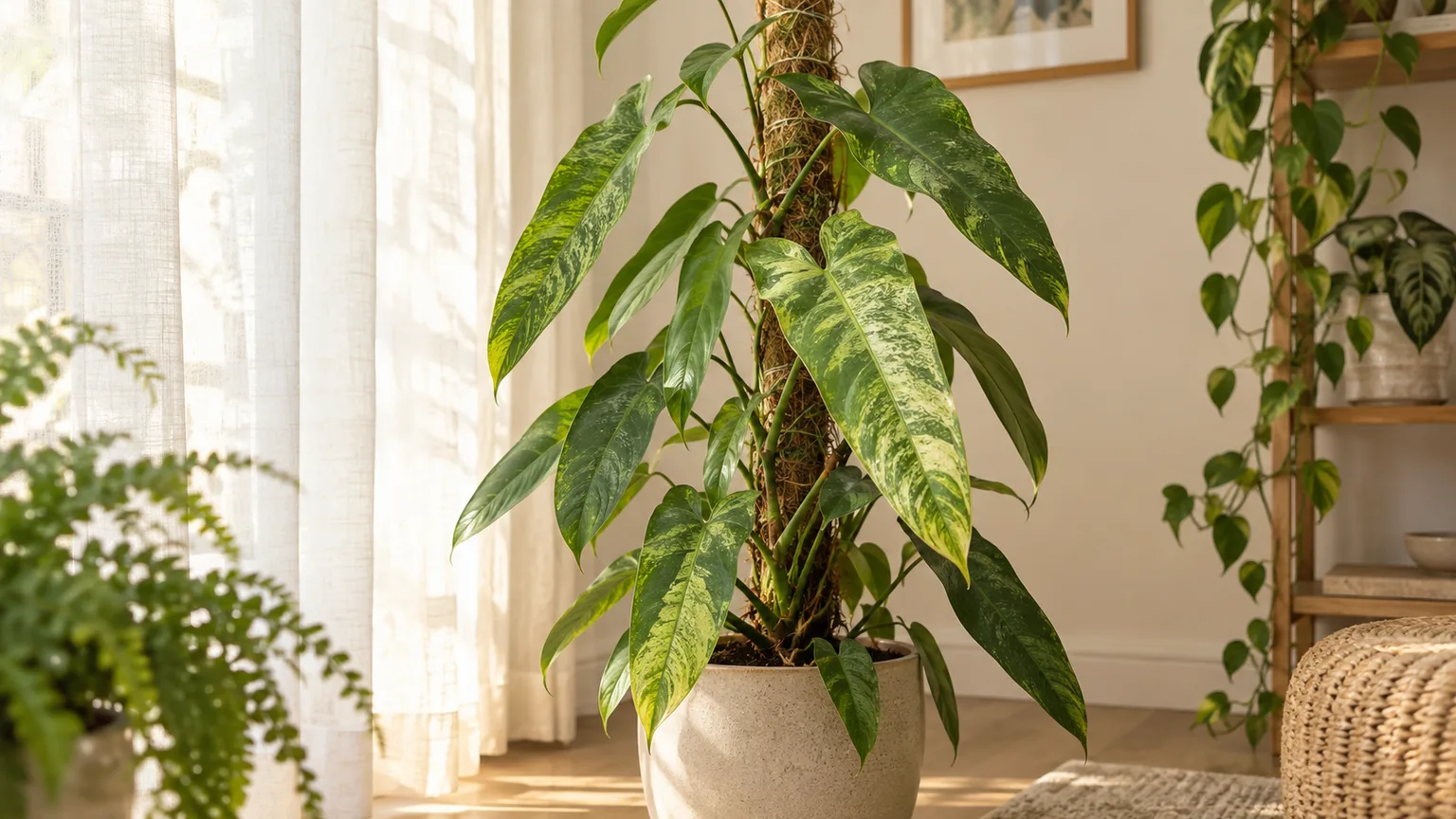
Philodendron Paraiso Verde is grown for long, climbing stems and leaves mottled in several shades of green. That foliage is naturally variable: two leaves on one plant may carry different amounts of lime or yellow-green marbling, and no care routine can make every leaf match a photograph. The reliable way to keep the plant healthy is to balance bright filtered light with a root zone that drains well, dries partway between waterings, and stays warm.
Use the advice below as a set of checks, not a fixed calendar. A plant near a sunny window in a small nursery pot may dry much faster than the same plant in a cool room and a large cachepot.
What Makes Paraiso Verde Different
Paraiso Verde is a climbing philodendron, not a self-heading rosette. As the stem lengthens, it produces leaves and aerial roots at nodes; in the right conditions those roots can grip a pole or another rough support. North Carolina State Extension describes climbing philodendrons as plants whose aerial roots attach to a pole or trellis, while its genus-level care guidance calls for bright indirect light, warmth, and moist but well-drained soil. Those are useful starting points, though the exact pattern and size of a named cultivar are not guaranteed.
The feature people call variegation is usually irregular green-on-green mottling, rather than stable blocks of white tissue. Light, warmth, plant maturity, and the particular stem can all affect what a new leaf looks like. Older leaves do not recolor after a move, so judge a change by the next one or two leaves rather than expecting an instant transformation.
Online plant labels are not always consistent, particularly for uncommon cultivars. When buying, look for a healthy active growing point, firm stem, and recent photos of several leaves; one unusually mottled leaf does not prove that every future leaf will match it. A climbing stem with distinct nodes is also more useful for propagation than a leaf-only cutting.
Quick-Care Profile
| Care factor | Good starting point | Adjust when |
|---|---|---|
| Light | Bright, indirect light for much of the day | Increase gradually if new growth is small, widely spaced, or consistently greener |
| Water | Let roughly the upper half of the mix dry, then water thoroughly | Wait longer in cool, dim conditions; shorten the interval as warmth and growth increase |
| Soil | Loose, chunky aroid mix in a pot with drainage holes | Use a finer mix only if your room and pot dry too quickly |
| Temperature | A stable warm room, ideally about 65–85°F (18–29°C) | Protect it from cold glass, drafts, and sudden temperature drops |
| Humidity | Average home humidity is usually workable; moderate humidity can help | Improve room humidity if new leaves repeatedly stick or edges crisp despite sound roots |
| Support | Moss pole, plank, or trellis as the stem climbs | Let it trail if you prefer; support is for form and leaf development, not survival |
| Feeding | Dilute balanced houseplant fertilizer during active growth | Skip feeding when the plant is not growing or the mix is dry |
These are ranges, not pass/fail thresholds. For example, the RHS growing guide recommends keeping philodendrons above 59°F (15°C) and notes that average household humidity is often sufficient; NC State Extension gives 65–85°F as an ideal genus-level temperature range. Together, they suggest warmth and protection from cold matter more than chasing a precise humidity reading.
Light: Preserve Mottling Without Scorching Leaves
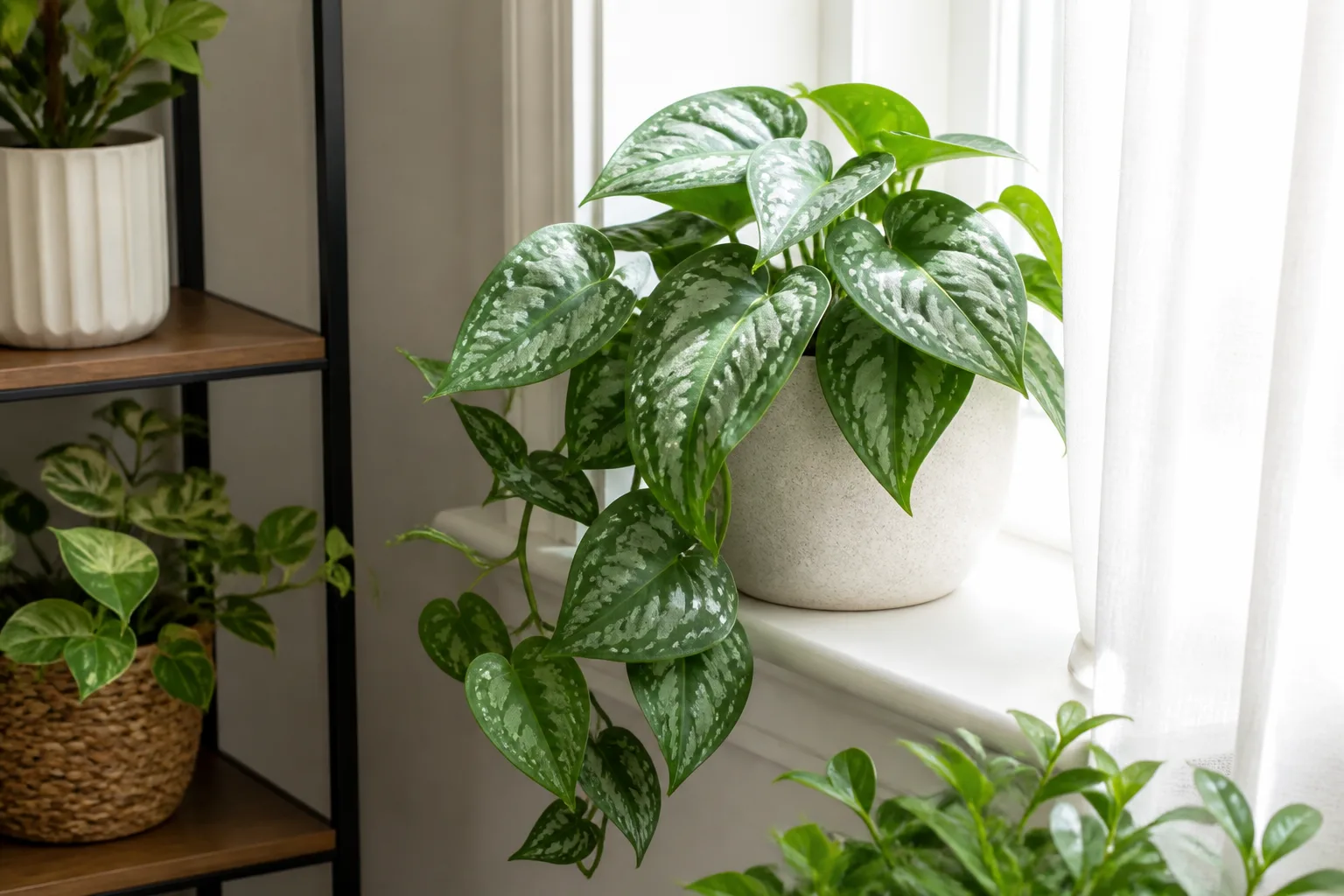
Give Paraiso Verde bright, indirect light. An east-facing window is often an easy starting point; near a brighter south- or west-facing window, filter the afternoon sun with a sheer curtain or place the plant several feet back. A few hours of gentle morning sun may be tolerated after gradual acclimation, but direct hot sun through glass can bleach or crisp the leaf surface. NC State Extension likewise recommends bright indirect sunlight for philodendrons and warns that direct exposure can scorch leaves.
Light is also one factor behind stronger or weaker mottling, but it is not a pattern-control switch. If a new leaf emerges mostly green and the plant is making long gaps between leaves, move it closer to a bright window in small steps over a week or two. If a leaf develops a pale, dry patch only on its window-facing side, reduce direct exposure instead of moving it into a darker corner.
Clean leaves help the plant use the light it receives. Dust broad leaves with a soft damp cloth and rotate the pot a quarter turn every week or two if the plant leans toward a window. Avoid trying to fix weak color with intense grow lights placed close to the foliage; start with a moderate distance and follow the fixture maker’s coverage guidance.
Water: Use Root-Zone Dry-Down, Not a Calendar
Water when the mix has dried partway, not when a date on the calendar arrives. Push a finger or wooden chopstick a couple of inches into the mix, then lift the pot: when the upper half is dry and the container feels lighter, water thoroughly until excess runs from the drainage holes. Empty the saucer or cachepot after the water has drained. This approach aligns with the RHS growing guide advice to let compost dry slightly and with Teak and Terracotta’s Paraiso Verde notes to check the upper half of the mix.
A dry surface alone can mislead you if the center of a dense root ball is still wet. Check more than one spot, especially after repotting or when the plant sits in a decorative pot that hides runoff. If the lower mix stays wet for many days, do not keep adding water because the leaves droop; inspect drainage, pot size, and root health first.
The interval changes with season and setup. In warm bright conditions with active growth, the plant may use water quickly; in winter, a cool room or low light can stretch the interval substantially. Water deeply when it is time, then allow air back into the mix. Constant small sips wet only the surface and make it harder to know whether the root ball is hydrated.
Soil and Pot: Keep the Roots Airy but Evenly Supplied
Paraiso Verde needs moisture that is available to the roots without leaving them in a saturated, airless pot. A practical starting mix is one part quality indoor potting mix or coco-based medium, one part fine orchid bark, and one part perlite or pumice. If your home is dry and the pot dries too quickly, use a little more base mix; if the center remains wet, increase the coarse bark and mineral component. The right mix is the one that drains freely while still holding enough moisture for the plant between checks.
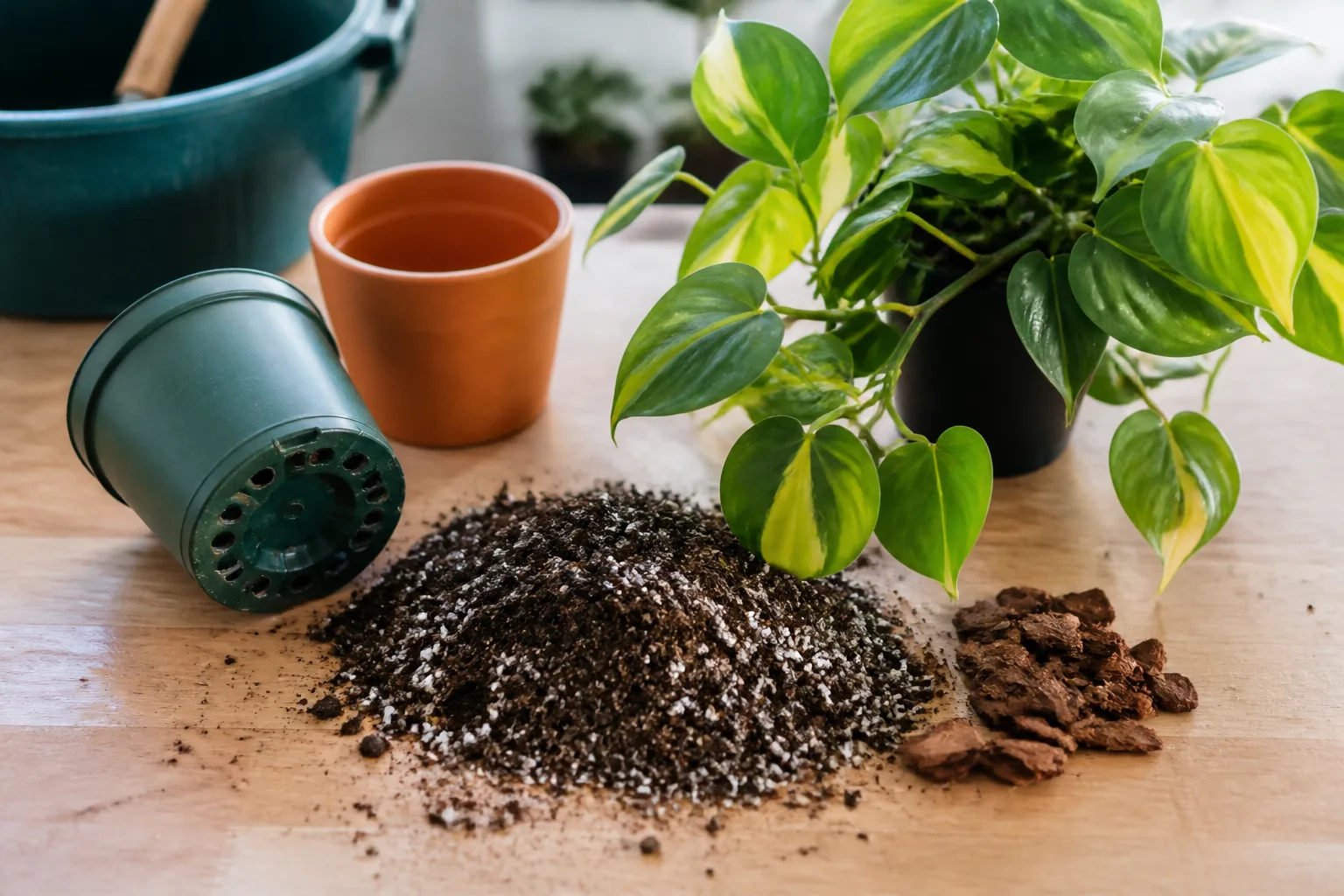
Choose a pot with open drainage holes and only a small amount of extra room around the root ball. A pot that is dramatically wider or deeper than the roots holds unused wet mix, which can stay cold and oxygen-poor. Plastic retains moisture longer than unglazed terracotta; neither material is automatically better, so match the pot to how quickly your mix dries and how often you can check it.
Do not add gravel to the bottom as a substitute for drainage. The important features are drainage holes, a loose mix, and a container that is not oversized. If you use a cachepot, lift out the nursery pot to empty collected water instead of letting it sit in runoff.
Temperature and Humidity: Prioritize Warmth and Airflow
Keep the plant in a stable warm room, roughly 65–85°F (18–29°C) as a practical target. Cold drafts from a frequently opened door, air conditioner, or winter window can stall growth, especially when the pot is wet. Move it away from heating vents too: a hot blast dries leaves and substrate unevenly even when the rest of the room feels comfortable.
Higher humidity can make tropical foliage look more comfortable and may help a new leaf unfurl, but it is not a reason to keep the roots wet. NC State Extension notes that philodendrons prefer humidity but can adapt to average household conditions; the RHS growing guide similarly says typical home humidity is usually adequate. If the room is very dry and new leaves repeatedly stick or develop crisp edges, a room humidifier is more predictable than misting. Leave space around the leaves for air to move, and do not crowd a wet plant into a closed cabinet.
Fertilizer: Feed Active Growth Lightly
Feed only when the plant is growing. A balanced liquid houseplant fertilizer diluted to half the label strength every four to six weeks in spring and summer is a cautious starting point; use the label for the product you own, because formulas differ. If the plant sits under a grow light and keeps making leaves through winter, a weaker and less frequent feed may be reasonable. If growth has stopped, the room is cool, or the mix is staying wet, fertilizer will not solve the underlying problem.
Water the plant first if the mix is very dry, then feed at the next normal watering rather than pouring concentrated fertilizer onto dry roots. Once in a while, flush the mix with plain water and let it drain to reduce accumulated salts. Brown tips alone do not prove fertilizer burn, but a white crust on the mix or pot rim, combined with recent heavy feeding, is a reason to pause and flush. RHS growing guide recommends feeding philodendrons during the growing season, while Gardening Know How gives similar seasonal guidance for a different philodendron; neither supports feeding a struggling plant on autopilot.
Support a Climbing Stem Before It Sprawls
A moss pole, plank, or sturdy trellis gives the climbing stem a direction and helps keep leaves from piling on the floor. Set the support close to the stem without forcing it through a dense root mass. If you are repotting, place the pole while the root ball is loose; otherwise, position it carefully and secure the base so it cannot wobble.
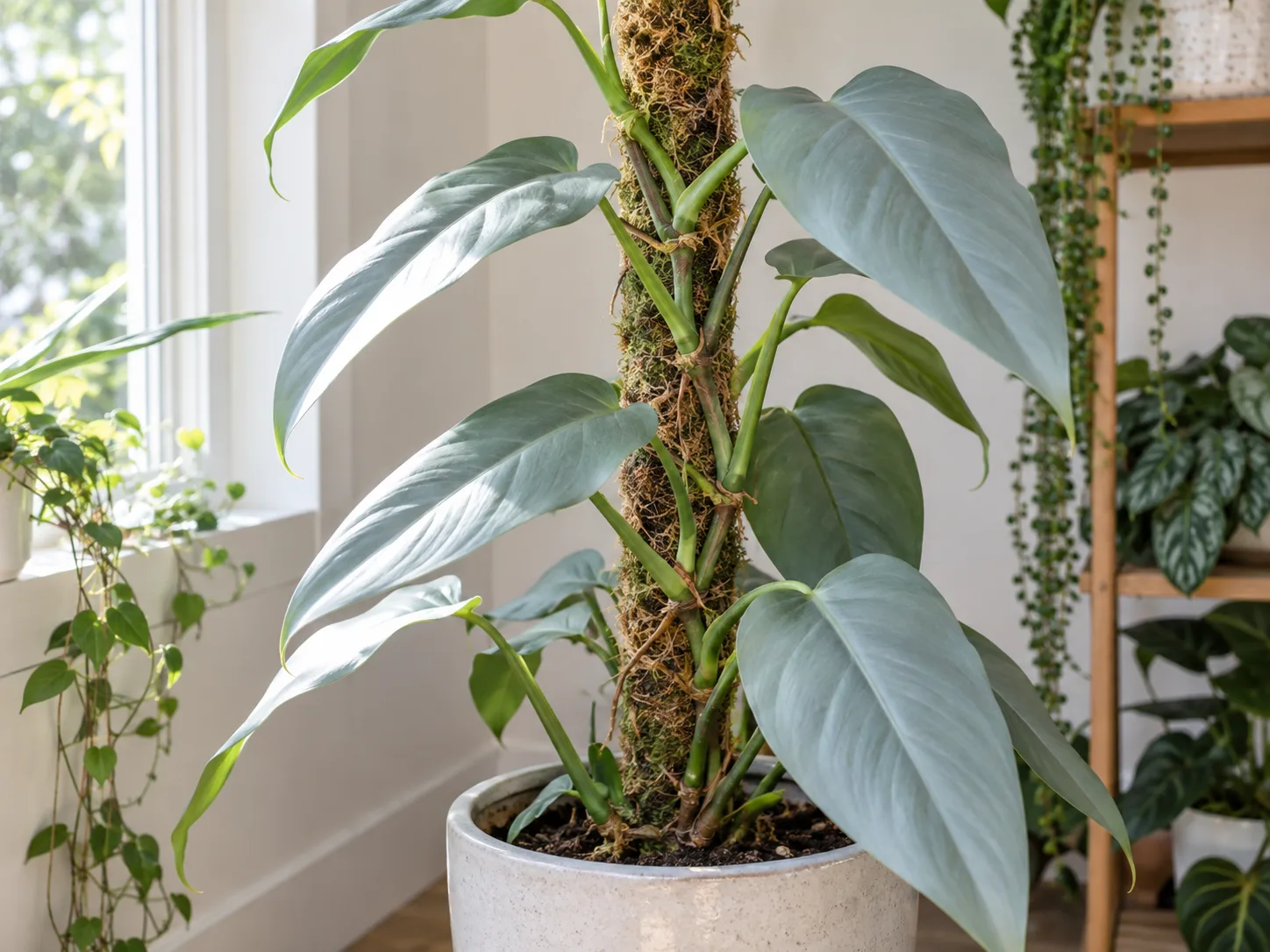
Attach the stem loosely at a few nodes with soft plant ties, leaving room for it to thicken. Do not tie petioles—the stalks that hold the leaves—or bend a mature stem sharply to make it touch the pole. Aerial roots can be guided toward a moist moss pole, but they do not need to be buried or cut off simply because they are visible.
Support is optional if you prefer a trailing plant, but the shape will be different. A climber may produce larger, more upright leaves as it matures against support; a trailing stem can still grow well if light and roots are healthy. The RHS growing guide explains that climbing philodendrons can be trained onto moss poles and root into them when the pole is kept moist. Keep the pole damp enough for attachment only if that is your goal, and avoid letting its moisture keep the potting mix wet.
Repot When the Roots Need More Room
Do not repot every year by default. Consider it when roots circle densely around the root ball, growth and water uptake have changed, or the mix has broken down and stays wet long after watering. A few roots emerging from a drainage hole are not an emergency on their own. Spring or early summer is convenient because active growth helps the plant settle, but a root problem should be addressed when it appears rather than waiting for a date.
Choose a pot just one size larger—usually about one or two inches wider than the current root ball. Ease the plant out, loosen only roots that are tightly circling, and remove soft, dark roots if rot is present. Replant at the same depth in fresh airy mix; burying the stem too deeply can keep the base damp. Water once to settle the mix, let it drain, then delay fertilizer until you see renewed growth.
If a healthy plant is merely large, repotting is not the only option. You can refresh the upper layer of mix, prune a few stems, or add a support without disturbing the roots. The RHS growing guide recommends repotting into a pot only slightly larger than the root ball, and NC State Extension recommends repotting when a philodendron becomes root-bound.
Prune and Shape Without Sacrificing Healthy Growth
Routine pruning is not necessary for a plant that fits its space. Remove yellow, damaged, or badly pest-marked leaves with clean shears, cutting the leaf stalk near the main stem without slicing into the stem itself. If the vine is too long, cut just above a node; that node is also the most useful part of the remaining stem for propagation.
Be cautious about cutting off every green leaf to chase more mottling. A green leaf still photosynthesizes and supports roots while the plant recovers. If a whole stem is producing only green leaves over several growth points, improve light first and wait for the next leaf or two; if you decide to prune, cut back to a node on a healthier portion of stem rather than removing most of the plant at once.
Wipe sap from tools and wash them after pruning, especially before moving to another plant. Keep fresh cuttings out of reach of pets and children. Gloves are sensible if your skin is sensitive, since NC State Extension notes that philodendron sap can irritate skin.
Propagate From a Viable Stem Node
Use a stem cutting with at least one healthy node, where a leaf joins the stem and a growth point or aerial root may be visible. A leaf blade with its petiole but no node cannot usually make a new climbing vine. Paraiso Verde nodes can be close together, so inspect the cutting before you make a second cut; losing the only node leaves you with foliage but no way to grow a new shoot.
Take a clean cutting just below a node, keeping one leaf attached if possible. Root the node in clean water, damp sphagnum, or a lightly moist airy propagation mix; keep the leaf above the medium and give the cutting warmth and bright indirect light. Water is easy to monitor, while moss or mix can reduce the transition from a soil-like environment later. Whichever method you use, keep it moist rather than submerged or waterlogged.
Change propagation water regularly and check the cutting for a firm stem rather than tugging on it every day. Once roots have several inches of length and begin branching, pot it into a small container with drainage and airy mix. Keep that first pot modest; a large pot around a tiny cutting dries slowly and invites rot. The first new leaf may be smaller or less mottled while the cutting establishes, so wait for a second leaf before deciding how well it has rooted. Teak and Terracotta’s first-hand Paraiso Verde growing notes also describe node cuttings and rooting in moist media; the same basic rule—include viable stem tissue—applies to philodendron propagation generally.
Troubleshoot Leaf Changes and Slow Growth
Start with the pattern and the pot before changing care. A single older leaf fading at the base is different from several new leaves yellowing while the mix stays wet. Likewise, one green leaf is not proof that light is wrong if the plant is otherwise growing strongly.
Green Leaves or Weaker Mottling
If new leaves repeatedly come in much greener and smaller, first check the plant’s light and spacing. Move it gradually to a brighter indirect spot, clear dust from the leaves, and make sure the support is stable enough for the stem to climb. Give the plant time to produce new growth; older leaves cannot regain mottling they never formed.
Do not respond by putting the plant in direct midday sun. Scorched patches can permanently mark a leaf while doing nothing to guarantee a better pattern on the next one. Mottling varies naturally, and specialist growers note that a single plant can show different patterns across leaves. If the plant is healthy and only one leaf differs, observe rather than prune.
Yellowing, Drooping, or Brown Edges
Yellow leaves are a clue, not a diagnosis. Several yellow leaves plus wet, heavy mix point toward overwatering, poor drainage, or root stress; yellowing while the pot is very light and the root ball is dry points toward underwatering. Check moisture below the surface and inspect roots only if multiple symptoms or a sour smell suggest a problem. One aging lower leaf can be normal and does not justify unpotting a healthy plant.
Drooping can come from either dry roots or roots damaged by excess water. If the mix is dry and the pot is light, water thoroughly and check whether the leaves firm up over the next day. If the mix is wet, do not water again; improve drainage and airflow, and inspect the roots if the plant continues declining. Brown, papery patches on the window side suggest sun or heat stress, while crisp tips can also follow erratic dry-down, low humidity, or salt buildup. Address the likely cause first and watch the next leaf rather than expecting damaged tissue to repair.
Pests and Damaged New Growth
Inspect leaf undersides, petiole joints, and the newest unfurling leaf for mealybugs, scale, aphids, thrips, or spider mites. Fine webbing and stippling often accompany spider mites; cottony clusters suggest mealybugs; silvery scarring and distorted growth can point to thrips. NC State Extension lists these pests among common philodendron problems, so check routinely rather than waiting for a large infestation.
Isolate an affected plant, rinse accessible pests from the foliage, and remove heavily infested leaves if needed. For a labeled insecticidal soap or horticultural oil, follow the product label and test a small leaf section first; variegated or stressed foliage may react differently. Repeat inspection because eggs and hidden insects can survive an initial wash. Avoid applying oils in hot direct sun or mixing products unless the label permits it.
Toxicity and Safer Placement
Keep Paraiso Verde away from pets and young children who may chew leaves or stems. NC State Extension classifies philodendrons as low-severity poisonous plants and identifies calcium oxalate crystals as the toxic principle; ingestion can irritate the mouth and throat, while sap may irritate skin. That is a reason for careful placement and handwashing, not a reason to handle the plant as though it were a highly dangerous chemical.
Wear gloves if you are prone to skin irritation, clean sap from tools and surfaces, and discard trimmings where animals cannot reach them. If a person or pet chews the plant, contact a clinician, veterinarian, or poison-control service for situation-specific advice, especially if swelling, repeated vomiting, or difficulty swallowing occurs. Do not try to induce vomiting or treat symptoms at home without professional instructions.
Conclusion
Good Philodendron Paraiso Verde care comes down to a few repeatable habits: provide bright filtered light, water only after the mix has dried partway, use an airy potting mix, protect the roots from cold and standing water, and support the stem as it climbs. Moderate feeding and occasional pruning help, but neither can compensate for a dim position or saturated soil.
Watch the newest leaf and the root zone together. If the plant is firm, actively growing, and producing healthy stems, a naturally greener leaf is not a crisis; if growth declines alongside wet soil, yellowing, or pests, diagnose that pattern before repotting or cutting. This approach keeps the plant vigorous while letting its mottled foliage remain its own rather than a result you try to force.