Philodendron Xanadu Care Guide: Complete Indoor Overview
Thaumatophyllum xanadu
Philodendron Xanadu needs medium to bright indirect light, watering every 7–10 days when top 3–5 cm is dry, and no moss pole. Toxic to pets.
Philodendron Xanadu Care Guide: Complete Indoor Overview
Start with wateringThe most common care mistake for Philodendron XanaduWatering guide →Philodendron Xanadu care essentials
Light
Water
Every 7–10 days in summer — allow top 3–5 cm to dry. Every 10–14 days in winter.
Soil
Standard potting mix + 20–25 % perlite. Well-draining. pH 5.5–6.5.
Humidity
moderate (50–60 %)
Temperature
18°C to 29°C (65–85°F)
Fertilizer
Feed lightly during active growth — monthly balanced liquid at half strength in spring and summer.
About Philodendron Xanadu
Philodendron Xanadu is native to southern Brazil & Paraguay, typically reaches 90–150 cm (3–5 ft) tall and wide outdoors; 60–90 cm typical indoors indoors, with medium growth. Philodendron Xanadu has a upright growth habit and part of the Araceae family. It is also known as Winterbourn Philodendron, Xanadu Philodendron, and Philodendron 'Xanadu'.
| Detail | Information |
|---|---|
| Also known as | Winterbourn Philodendron, Xanadu Philodendron, Philodendron 'Xanadu' |
| Native region | southern Brazil & Paraguay |
| Mature size | 90–150 cm (3–5 ft) tall and wide outdoors; 60–90 cm typical indoors |
| Growth rate | Medium |
| Growth habit | Upright |
| Scientific name | Thaumatophyllum xanadu |
| Family | Araceae |
Philodendron Xanadu Care Guide: Complete Indoor Overview
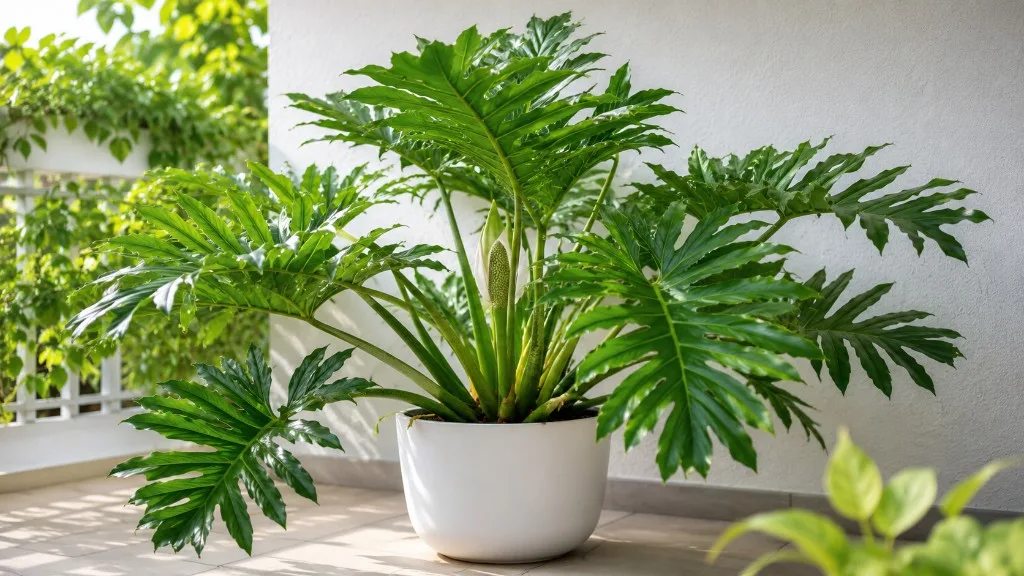
Philodendron Xanadu is the houseplant people buy when they want tropical lobed foliage without a vine taking over the room. It is not a heartleaf philodendron on a pole, and it is not a tree philodendron that eventually eats the ceiling. It is a self-heading bush — a dense rosette of glossy, deeply divided leaves that spreads from a central crown. That one habit difference changes almost everything about how you place it, water it, and propagate it.
This guide is the hub for Philodendron Xanadu care indoors. You will learn what the plant actually is (including its updated botanical name), how large it realistically grows in a pot, the light and watering rhythm that keeps lobes deep and spacing tight, when to divide rather than take stem cuttings, and the mistakes that turn an easy philodendron into a yellow-leaf rescue project. For step-by-step depth on any single topic, follow the linked cluster guides below.
What Philodendron Xanadu Actually Is
Philodendron Xanadu is a cultivated hybrid widely sold as a compact foliage plant. Retail tags usually read Philodendron x ‘Xanadu’ or Philodendron xanadu per the RHS; some botanical references also use Thaumatophyllum xanadu after recent aroid reclassification. Nurseries still label it philodendron, and that label is fine for shopping — the growth rules follow a bush, not a climber.
The RHS describes Philodendron xanadu as a clump-forming, upright perennial with glossy dark green deeply lobed leaves, occasionally producing red spathes on mature outdoor specimens. Native range is Brazil and Paraguay. Indoors you are growing a tropical evergreen shrub in a container, not a rainforest vine.
Thaumatophyllum xanadu and the Nursery Label
Do not let the name change confuse your care. Whether the tag says Philodendron x ‘Xanadu’, Thaumatophyllum xanadu, or simply “Xanadu philodendron,” the plant wants the same things: bright filtered light, moist but never sodden roots, and room for the crown to spread evenly. UF/IFAS lists the scientific name as Philodendron x ‘Xanadu’ and notes it is a perennial shrub suitable for indoor culture — the extension profile emphasizes coarse, lobed foliage and fast growth when conditions are warm and bright.
Self-Heading Growth Habit — Not a Climber
This is the detail most care guides bury, and it matters most. Self-heading means new leaves emerge from a central crown and the plant builds outward in a mound. It does not produce long vining stems that cling to bark, and it does not need a moss pole to “reach its potential.” Adding a pole does not create bigger split leaves on Xanadu the way it can on Monstera or climbing philodendrons — it just wastes floor space.
Each leaf is divided into roughly 15 to 20 lobes, with blades commonly 12 to 18 inches long on mature outdoor plants and somewhat smaller indoors. Leaves sit on long smooth petioles and give a coarse, architectural texture that reads well in living rooms and offices. If you wanted vertical drama, choose a climbing erubescens cultivar. If you wanted a wide tropical bush that stays manageable, Xanadu is the right tool.
How Big Philodendron Xanadu Gets Indoors
Outdoors in frost-free climates, UF/IFAS documents landscape size around 2 to 4 feet tall and 4 to 6 feet wide with a fast growth rate when planted in shade with rich, moisture-retentive soil. The RHS gives a broader outdoor potential of 1 to 1.5 metres tall and 1.5 to 2.5 metres spread over 10 to 20 years — numbers that assume subtropical ground planting, not a 25 cm indoor pot.
Mature Size, Spread, and Realistic Timelines
In a typical home pot, expect a rounded bush roughly 60–90 cm (2–3 ft) tall and 75–120 cm (2.5–4 ft) wide over several years if light is adequate and you resist the urge to overpot. Xanadu fills sideways more than it rockets upward. That is an advantage in apartments — until you park it in a walkway. Give the crown space to open evenly; crowding against a wall on one side produces lopsided growth and weaker back-side leaves.
Judge health by the newest leaves at the center, not by whether old outer leaves are smaller. A stable Xanadu pushes fresh lobed foliage through the warm season and slows in winter. If size stalls for months while light is dim and soil stays wet, suspect slow growth on Philodendron Xanadu from insufficient light or root stress before you chase fertilizer.
Quick Care Summary for Philodendron Xanadu
Light: Medium to bright indirect light; tolerates moderate indirect light. Water: Every 7–10 days in summer — allow top 3–5 cm to dry. Every 10–14 days in winter. Always check the pot, not the calendar. Soil: Standard potting mix + 20–25% perlite. Well-draining. pH 5.5–6.5. Humidity: Moderate (50–60%). Temperature: 18°C to 29°C (65–85°F). Fertilizer: Monthly balanced liquid at half strength in spring and summer; pause in winter or on stressed plants. Propagation: Division at repotting when multiple crowns are visible. Repotting: Every 1–2 years in spring when roots circle the pot. Support: None — no moss pole. Pets: Toxic — keep out of reach.
That summary is the daily rhythm. The sections below explain why each line matters for this species and when to open a dedicated guide for more detail.
Light for Deeply Lobed, Compact Foliage
Xanadu’s leaf quality is a light meter. In medium to bright indirect light, lobes stay deep, petioles relatively short, and the mound looks full. In very dim corners, leaves shrink, internodes stretch, and the plant looks pale and sparse — classic not enough light stress, even though the plant may technically survive.
The RHS cultivation advice for philodendron under glass calls for bright filtered light with shade from hot sun — a good indoor translation is an east window, or several feet back from filtered south or west glass. UF/IFAS notes landscape plants grow in shade; indoors, “shade-tolerant” still means bright indirect in most homes, not a dark hallway.
Harsh direct afternoon sun can scorch leaves. If you see bleached or crispy patches, diffuse the window or pull the pot back. Full placement workflow, grow lights, and recovery steps live in the Philodendron Xanadu light guide.
Watering Rhythm and Drainage
Philodendron Xanadu fails most often from overwatering in low light, not from drought. The self-heading crown sits low in the pot; chronic wet mix invites root rot on Philodendron Xanadu and yellow leaves on the oldest foliage first.
Water when the top 3–5 cm of mix feels dry — typically every 7–10 days in active summer growth and every 10–14 days in cooler winter for a standard indoor pot with drainage. That interval is a starting point. A bright warm room dries faster than a dark office; a dense bushy canopy shades the soil surface and can trick you if you only look at the top. Clemson HGIC recommends allowing the upper soil to dry between waterings for philodendron indoors.
When you water, soak until excess runs from drainage holes, then empty the saucer within 30 minutes. Never let the pot sit in stale water. If the pot stays heavy days after watering, fix drainage and light before the next pour. Step-by-step checks and seasonal nuance are in the Philodendron Xanadu watering guide.
Soil, Pots, and Drainage
Xanadu wants moisture-retentive but well-drained soil — the same tension UF/IFAS describes for landscape performance. Indoors that means standard peat-free or peat-based potting mix with 20–25% perlite, not straight garden soil and not a succulent mix that dries too fast for the fine roots.
Drainage holes are mandatory. The RHS lists moist but well-drained loam as ideal; translate that to a pot mix that holds structure without compacting into a wet brick. Target pH 5.5–6.5 — slightly acidic conditions philodendrons prefer. Cachepots are fine only if you lift the nursery pot to drain after every soak.
Oversized decorative pots are a common silent killer. The root ball does not fill the extra volume, so the outer mix stays wet while you think you are being generous. Repot one size up only when roots circle the current pot. Mix recipes, pH notes, and wrong-soil fixes are in the Philodendron Xanadu soil guide.
Fertilizer During Active Growth
Xanadu is not a heavy feeder, but it is a fast grower when warm and bright. Feed monthly in spring and summer with a balanced liquid fertilizer diluted to half strength on already-moist soil. Skip feeding in winter, immediately after repotting, during pest recovery, or whenever leaves yellow on wet mix — fertilizer does not fix cultural problems.
The RHS advises a balanced liquid feed monthly during active growth under glass. Indoors, half strength is safer because light is lower than a greenhouse. Salt buildup shows as brown tips on leaf margins; flush the pot and pause feeding if crust appears on the soil surface. Full schedule and mistake avoidance: Philodendron Xanadu fertilizer guide.
Propagation and Repotting Basics
Climbing philodendrons propagate easily from stem cuttings with nodes. Xanadu is different. The practical home method is division at repotting when you see multiple crowns or offset clumps with their own leaf clusters and roots. Slice through the root ball with a clean knife, pot each section separately, and keep humidity moderate while they settle.
UF/IFAS lists landscape spacing of 36 to 60 inches because each clump wants room to spread — the same logic applies on a smaller scale in pots. The RHS notes propagation by seed or layering outdoors; indoors, division is what works reliably for most owners.
Repot every 1–2 years in spring when roots circle the pot or water runs straight through dry channels. Move up one pot size, refresh mix, and avoid burying the crown deeper than it sat before. Do not repot on day one after purchase unless the mix is clearly failing or pests are visible — quarantine and learn dry-down speed first. Detailed workflows: Philodendron Xanadu propagation guide and repotting guide.
Pet Safety and Handling
Philodendron Xanadu is toxic to cats and dogs if chewed. Like other arums, it contains insoluble calcium oxalate crystals that cause oral irritation, drooling, pawing at the mouth, and difficulty swallowing. The ASPCA lists philodendron as toxic to cats and dogs. The RHS also flags harmful-if-eaten sap that can irritate skin and eyes — wear gloves if you are sensitive when pruning or dividing.
Keep floor-level pots out of reach in pet households, or choose a non-toxic alternative for spaces pets can access. This is an overview, not veterinary advice; contact your veterinarian or animal poison control if ingestion is suspected.
Common Philodendron Xanadu Mistakes
Adding a moss pole is the most common category error. Xanadu will not climb it meaningfully; you will still need floor space for the spreading crown.
Overwatering in low light pairs two stresses that compound. Wet mix plus weak photosynthesis equals yellow lower leaves, sour soil, and eventual crown decline. Fix light and drainage before you water again.
Buying a wet, yellowing plant from a dark shop corner is another trap. Xanadu shows root stress on the oldest leaves first. Choose specimens with firm upright petioles, several active leaf tips, and neutral-smelling soil.
Changing everything at once after purchase — repot, move to a new window, and fertilize in week one — creates drooping leaves you cannot diagnose. Quarantine, learn the dry-down rhythm, and change one variable at a time.
Ignoring pests in dry air — spider mites and scale can appear on stressed plants. Rinse foliage, improve airflow, and treat early rather than after webbing spreads.
Xanadu vs Selloum and Climbing Philodendrons
UF/IFAS explicitly compares Xanadu to Selloum (tree philodendron types): similar coarse lobed texture without the large size. Indoors, Selloum and Hope selections can outgrow a room; Xanadu was bred and selected to stay more compact and manageable while keeping the tropical look.
Compared with climbing heartleaf or erubescens types, Xanadu trades vertical vining for a mounded bush. You will not train it up a bookcase. You will not take single-node wet sticks and expect the same propagation success rate. You will get a wide architectural plant that works on the floor or a large table without stringing moss poles across the ceiling.
If you need a philodendron for a tall moss pole and variegated pink leaves, that is a different plant entirely. If you need a wide lobed floor plant that behaves, Xanadu is the match.
Seasonal Adjustments Indoors
Spring and summer bring faster dry-down, more new lobed leaves, and higher fertilizer appetite. Check the pot every few days even if your calendar says weekly — bright light and air conditioning both change evaporation in ways the calendar hides.
Autumn and winter slow growth. Extend the interval between soaks when the top 3–5 cm stays dry longer, and keep the plant away from cold window glass below about 15°C (59°F). Philodendron roots in chilled wet mix stop functioning; leaves droop while soil stays wet — a dangerous combination that looks like underwatering but is actually cold root stress.
When to Use This Page vs Other Philodendron Xanadu Guides
Use this overview when you are new to the plant, deciding whether it fits your space, or building a complete baseline routine across light, water, soil, and safety. Open a topic guide when one variable needs depth:
- Light — window placement, grow lights, scorch recovery
- Watering — finger-test workflow, saucer discipline, seasonal intervals
- Soil — mix recipes, drainage tests, wrong-soil fixes
- Fertilizer — strength, timing, salt flush
- Propagation — division steps, aftercare
- Repotting — pot sizing, root inspection, post-repot pause
- Pruning — thinning crowded crowns, removing yellow leaves
Use a problem page when symptoms are already present — yellow leaves, root rot, brown tips, or drooping leaves — rather than re-reading general care.
Related Philodendron Xanadu Guides
- Philodendron Xanadu light guide — keep lobes deep and spacing tight
- Philodendron Xanadu watering guide — check-first rhythm and drainage discipline
- Philodendron Xanadu soil guide — perlite mix and pot sizing
- Philodendron Xanadu propagation guide — division at repotting
- Philodendron Xanadu fertilizer guide — half-strength monthly feeding
- Philodendron Xanadu repotting guide — when and how to upsize
- Philodendron Xanadu pruning guide — thin crowded crowns safely
Conclusion
Philodendron Xanadu rewards boring care more than clever hacks. Treat it as a self-heading tropical bush: give medium to bright indirect light, water when the top 3–5 cm dries, use well-drained mix with perlite, and skip the moss pole. Divide when crowns multiply; repot when roots circle; feed lightly only in active growth. Respect pet toxicity, watch the newest crown leaves for early stress, and open the dedicated cluster guides when a single topic — not the whole plant — needs troubleshooting. Get those basics right and Xanadu becomes one of the most forgiving statement plants in a bright living room or office.
How to care for Philodendron Xanadu?
When should you water Philodendron Xanadu?
Every 7–10 days in summer — allow top 3–5 cm to dry. Every 10–14 days in winter.
- Finger or chopstick to 3–5 cm depth; lift pot to gauge weight - Every 7–10 days in summer — allow top 3–5 cm to dry.
- Drain excess water - Empty the saucer after watering so the roots are not sitting in standing water.
What soil works best for Philodendron Xanadu?
Standard potting mix + 20–25 % perlite. Well-draining. pH 5.5–6.5.
- Well-draining mix - Well-draining.
Grower notes for Philodendron Xanadu
Xanadu habit note
Xanadu is self-heading — it builds a mounded rosette of lobed leaves rather than climbing. Do not add a moss pole expecting larger split leaves; give space for the crown to spread evenly instead.
Xanadu light note
Medium to bright indirect light keeps lobes deep and the plant compact. Very dim corners produce smaller leaves and wider spacing between petioles.
What matters most with Philodendron Xanadu
Philodendron Xanadu is easiest to understand by its growth habit. No climbing support needed — grows as a compact self-heading bush. In practice: medium to bright indirect light; tolerates moderate indirect light. Pair with standard potting mix + 20–25 % perlite, and avoid changing water, pot size, and placement all at once.
Best placement in a real home
Xanadu suits bright living rooms and offices where you want philodendron texture without vertical vining. Keep it where medium to bright indirect light reaches most of the crown for even lobed growth. Humidity target: moderate (50–60 %). Temperature comfort zone: 18°C to 29°C (65–85°F).
Before you buy this plant
Choose a plant with firm upright petioles, several active leaf tips, and no sour-smelling soil. Xanadu fills out sideways — buy for crown health, not one oversized leaf. Also sold as Winterbourn Philodendron; verify the dense lobed bush habit, not a mislabeled Selloum cutting.
Safety note for Philodendron Xanadu
Philodendron Xanadu is not safe for pets or children who chew plants. Use elevated placement or choose a non-toxic alternative for floor pots.
Is it pet safe?
Philodendron Xanadu is toxic to cats and dogs.
Toxic - calcium oxalate crystals.
Watering Philodendron Xanadu
For Philodendron Xanadu, finger or chopstick to 3–5 cm depth; lift pot to gauge weight and water every 7–10 days in summer; every 10–14 days in winter. Reduce frequency in winter when growth slows and the pot dries more slowly.
| Detail | Information |
|---|---|
| How often | Every 7–10 days in summer; every 10–14 days in winter |
| How to check | Finger or chopstick to 3–5 cm depth; lift pot to gauge weight |
| Seasonal changes | Reduce frequency in winter when growth slows and the pot dries more slowly |
Soil & potting for Philodendron Xanadu
Fast-draining; roots must never sit in saturated soil. Target soil pH around 5.5–6.5. Repot every 1–2 years, ideally in spring.
| Detail | Information |
|---|---|
| Drainage | Fast-draining; roots must never sit in saturated soil |
| Soil pH | 5.5–6.5 |
| Repotting frequency | Every 1–2 years |
| Best season to repot | Spring |
Humidity & temperature for Philodendron Xanadu
Philodendron Xanadu prefers moderate (50–60 %), though normal home humidity is usually fine. Keep temperatures around 18°C to 29°C (65–85°F).
| Detail | Information |
|---|---|
| Humidity | moderate (50–60 %) - normal home humidity is fine. |
| Ideal temperature | 18°C to 29°C (65–85°F) |
Fertilizer & pruning for Philodendron Xanadu
Use feed lightly during active growth — monthly balanced liquid at half strength in spring and summer. for Philodendron Xanadu.
| Detail | Information |
|---|---|
| Fertilizer type | Feed lightly during active growth — monthly balanced liquid at half strength in spring and summer. |
Common problems on Philodendron Xanadu
Yellow Leaves
MediumLikely cause: Common on this plant type; confirm with recent watering, light, and root checks.
Quick fix: Inspect the plant and correct the most likely care stressor before stacking treatments.
Full fix guide →Brown Tips
MediumLikely cause: Common on this plant type; confirm with recent watering, light, and root checks.
Quick fix: Inspect the plant and correct the most likely care stressor before stacking treatments.
Full fix guide →Root Rot
MediumLikely cause: Common on this plant type; confirm with recent watering, light, and root checks.
Quick fix: Inspect the plant and correct the most likely care stressor before stacking treatments.
Full fix guide →Overwatering
MediumLikely cause: Common on this plant type; confirm with recent watering, light, and root checks.
Quick fix: Inspect the plant and correct the most likely care stressor before stacking treatments.
Full fix guide →Underwatering
MediumLikely cause: Common on this plant type; confirm with recent watering, light, and root checks.
Quick fix: Inspect the plant and correct the most likely care stressor before stacking treatments.
Full fix guide →Spider Mites
MediumLikely cause: Common on this plant type; confirm with recent watering, light, and root checks.
Quick fix: Inspect the plant and correct the most likely care stressor before stacking treatments.
Full fix guide →Mealybugs
MediumLikely cause: Common on this plant type; confirm with recent watering, light, and root checks.
Quick fix: Inspect the plant and correct the most likely care stressor before stacking treatments.
Full fix guide →Aphids
MediumLikely cause: Common on this plant type; confirm with recent watering, light, and root checks.
Quick fix: Inspect the plant and correct the most likely care stressor before stacking treatments.
Full fix guide →Leggy Growth
MediumLikely cause: Common on this plant type; confirm with recent watering, light, and root checks.
Quick fix: Inspect the plant and correct the most likely care stressor before stacking treatments.
Full fix guide →Slow Growth
MediumLikely cause: Common on this plant type; confirm with recent watering, light, and root checks.
Quick fix: Inspect the plant and correct the most likely care stressor before stacking treatments.
Full fix guide →Wilting
MediumLikely cause: Common on this plant type; confirm with recent watering, light, and root checks.
Quick fix: Inspect the plant and correct the most likely care stressor before stacking treatments.
Full fix guide →Drooping Leaves
MediumLikely cause: Common on this plant type; confirm with recent watering, light, and root checks.
Quick fix: Inspect the plant and correct the most likely care stressor before stacking treatments.
Full fix guide →Low Humidity
MediumLikely cause: Common on this plant type; confirm with recent watering, light, and root checks.
Quick fix: Inspect the plant and correct the most likely care stressor before stacking treatments.
Full fix guide →Not Enough Light
MediumLikely cause: Common on this plant type; confirm with recent watering, light, and root checks.
Quick fix: Inspect the plant and correct the most likely care stressor before stacking treatments.
Full fix guide →Fungus Gnats
MediumLikely cause: Common on this plant type; confirm with recent watering, light, and root checks.
Quick fix: Inspect the plant and correct the most likely care stressor before stacking treatments.
Full fix guide →Mold on Soil
MediumLikely cause: Common on this plant type; confirm with recent watering, light, and root checks.
Quick fix: Inspect the plant and correct the most likely care stressor before stacking treatments.
Full fix guide →