Should Houseplants Touch? A Practical Spacing Guide
Find the safest spacing for houseplants, how to group plants by light and water needs, and how to prevent crowded leaves from trapping moisture or pests.
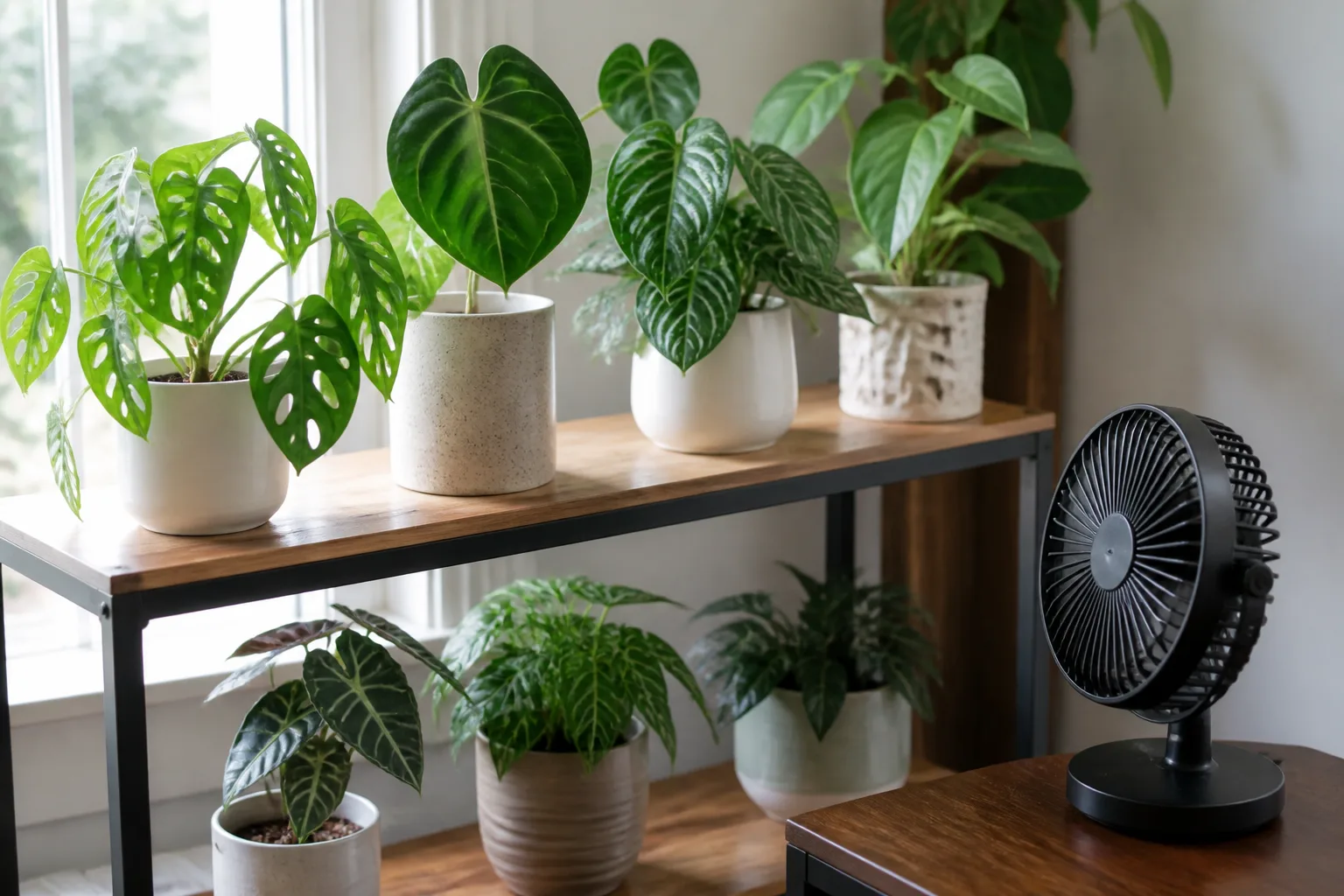
The practical answer: close is fine; constant contact is not
Yes, houseplants can touch occasionally. A leaf brushing a neighbor when you move a pot, or two flexible leaves resting together for part of the day, is not an emergency and does not mean you need to dismantle your display. The useful rule is more specific: keep foliage from constantly overlapping, rubbing, or forming a damp, inaccessible cluster.
That distinction matters because the risk is rarely the contact itself. It is the new environment contact can create around the leaves: less air movement, fewer drying surfaces, blocked light, hidden pests, and no room to water or inspect without knocking something over. A lush group can be healthy; a packed canopy can become a plant-care blind spot.
For small and medium houseplants, start with roughly 2 to 6 inches between the outer leaves and their neighbors. Treat that as a working range, not a botanical law. Broad-leaved plants, plants in still rooms, and plants that are difficult to inspect need more clearance. Fine-textured plants with open growth can often sit closer if the leaves stay dry and you can still reach every pot.
Is the problem the touch—or what touching creates?
When leaves touch, they can rub as air-conditioning, a ceiling fan, a person, or the plant itself moves them. That repeated friction may cause small tears or bruised patches, especially on thin leaves. A single mark is mostly cosmetic. Repeated rubbing at the same edge can become an entry point for decay or simply shorten the life of a leaf that was already stressed.
Overlap also changes the canopy, the layer of leaves where light and air are exchanged. One plant may shade the other’s lower leaves, while the overlapping surfaces stay damp longer after watering or cleaning. That does not guarantee fungal disease, but it removes the margin of safety that helps leaves dry. The University of Alaska Fairbanks Cooperative Extension Service explains that many fungal leaf spots need prolonged free water on a leaf and recommends avoiding splash, watering early enough for leaves to dry, and providing good air circulation. (University of Alaska Fairbanks Cooperative Extension Service)
Crowding also makes you less observant. A whitefly cloud under one leaf, a few thrips on new growth, or the first webbing from spider mites is much easier to notice on a plant you can turn and examine. In a dense group, the first affected leaf may be behind another pot, and foliage can act as a bridge between plants before you realize a problem has started.
What plant-touch research actually shows
Plants do respond to mechanical stimulation. Touch, wind, rain, brushing, and repeated movement can activate signaling pathways that alter growth and defense. This is known as thigmomorphogenesis, a term for touch-related changes in plant form and development. A recent peer-reviewed review describes the response as dependent on the species, the intensity and frequency of the stimulus, and the length of exposure; different plants can respond with changes in leaf area, stem growth, or architecture. (peer-reviewed review of plant responses to touch)
That science is useful, but it should not be turned into a scary rule that every touching houseplant will stop growing. Plants evolved with moving leaves, neighboring stems, rain, wind, and contact. Mechanical stimulation can be part of normal life, and a short period of contact in a living room is not equivalent to a controlled experiment with repeated stimulation.
The practical takeaway is modest: if leaves are constantly pressed against another plant, a wall, or a busy walkway, give them room to move. You are reducing abrasion and making the plant’s environment easier to manage. You do not need to treat every accidental touch as damage.
Why the 30% claim needs a caveat
The often-repeated percentage comes from a La Trobe University research report describing repeated touch responses in Arabidopsis thaliana, or thale cress. The university summary says that very light touch activated a large gene response and that repeated touching reduced growth in that experimental system. (La Trobe University research summary)
That finding explains why plants are not passive objects, but it does not tell you that a pothos, monstera, fern, or peace lily in your home will lose the same percentage of growth when one leaf touches another. The work used a model plant under research conditions, and the university itself noted that the consequences and applicability to crop species needed further study. The more defensible houseplant advice is to avoid repeated, forceful, or unavoidable contact, not to chase a precise growth penalty.
This distinction protects you from another common mistake: moving plants so far apart that they lose light or become impossible to care for, all in pursuit of a perfect no-touch bubble. Houseplant care is a balance. Adequate light, correct watering, healthy roots, and pest monitoring generally matter more than whether two leaves touch for an hour.
A workable spacing rule for houseplants
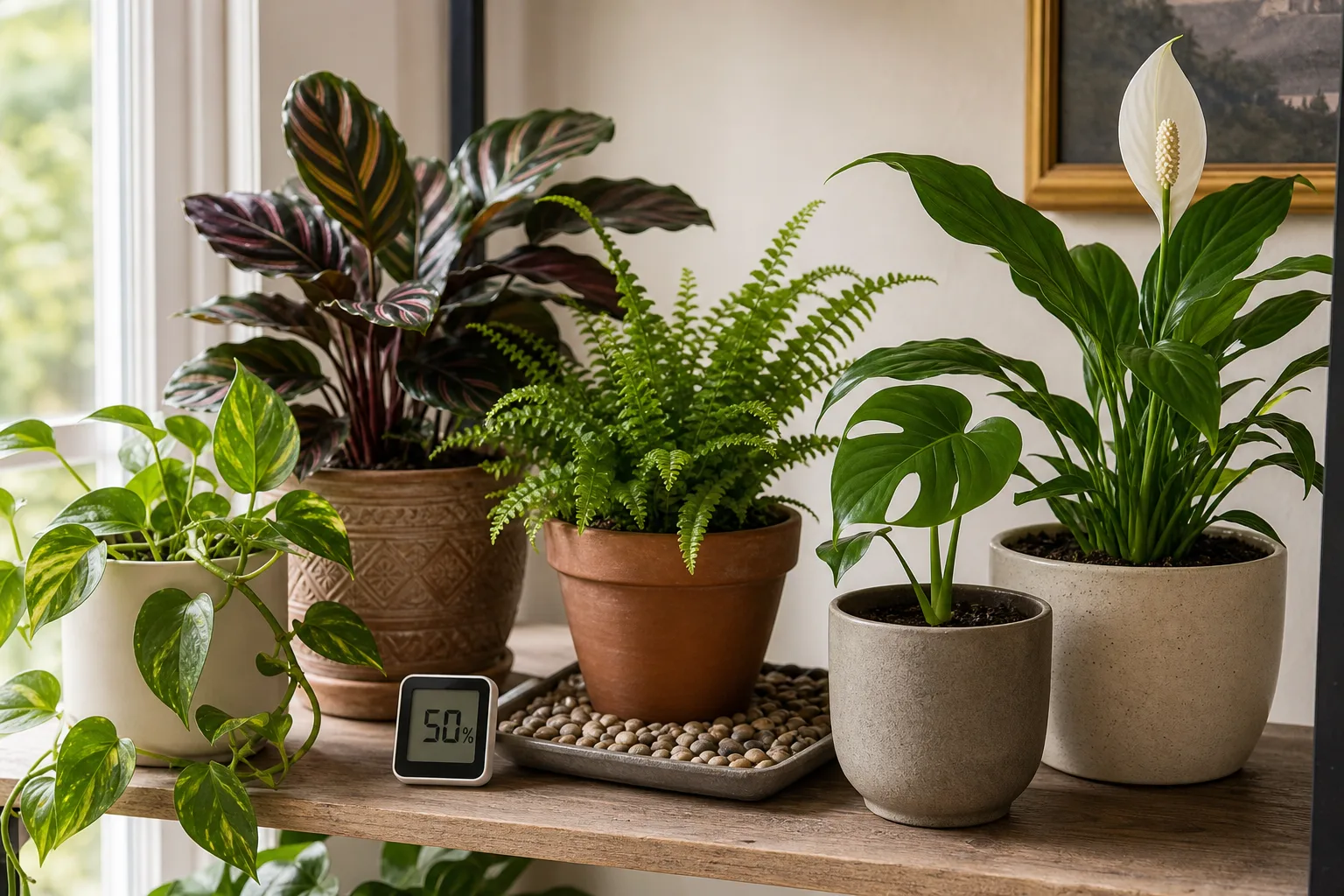
A healthy group leaves enough room to inspect leaves, reach the soil, and let air move between plants.
Use spacing as a small experiment. Start close enough to create a pleasing group, then watch what happens after watering, during the warmest part of the day, and as new leaves unfurl. If you can see the gap between plants, reach the soil, and inspect the undersides of the leaves, the arrangement is probably workable. If the plants become one continuous mass, it is time to open the group.
Use these starting ranges for the space between pot edges:
| Plant situation | Starting clearance | Why it needs that room |
|---|---|---|
| Small, upright plants with open foliage | 2–4 inches | Close enough to read as a group while keeping pots reachable |
| Medium plants with broad or layered leaves | 4–8 inches | Leaves need room to expand without forming a wet overlap |
| Large plants, climbers, or mature spreading plants | 8–18 inches or more | The future canopy is larger than the current pot and may shade neighbors |
| Plants under treatment or newly purchased | Separate room, not a display gap | Isolation must prevent leaf bridges and make inspection easy |
These are not minimum legal distances or guarantees against disease. They are a useful first layout. Increase the gap if the room has still air, if the foliage stays wet for hours, or if one plant’s leaves regularly rest on another’s. Decrease it only after checking that the leaves still move freely and the pots remain accessible.
Measure the canopy, not just the pot
Pot size is a poor proxy for the amount of space a plant needs. A 4-inch pot of pothos may send vines across a shelf, while a 6-inch snake plant may keep its leaves in a narrow column. A young monstera may look tidy for a month and then produce a new leaf that reaches into the neighboring pot.
Measure from the outermost leaf, stem, or vine to the nearest plant, wall, curtain, and frequently used surface. The space you are protecting is the active canopy, not the empty circle around the pot. If a plant leans toward a window, include the direction it is likely to grow after you rotate it.
Plan for the next season, too. Nebraska Extension’s guide to growing houseplants emphasizes that indoor conditions can limit development through low light, low humidity, poor watering, and other environmental mismatches. It also recommends rotating plants because light usually reaches them from one side. (University of Nebraska–Lincoln Extension guide to growing houseplants) A plant that is already reaching across a shelf is telling you that its current light and growth pattern need to be part of the spacing decision.
Leave room to lift a nursery pot out of its cover pot. If you cannot remove one plant without moving three others, the arrangement is too tight for routine care even if the leaves do not touch. Watering becomes less accurate, drainage goes unnoticed, and a sick plant cannot be removed quickly.
Use a leaf-clearance test before adding space
Try this simple test after arranging the pots:
- Turn each pot a quarter-turn and make sure no leaf is pinned against another plant.
- Slide a hand or a thin piece of cardboard between the closest canopies without bending leaves.
- Look at the undersides of several leaves and the soil line of each pot.
- Water one plant as you normally would and check whether the neighboring foliage blocks the spout or catches splash.
- Stand back and watch for ten minutes with a fan, HVAC vent, or open window operating as usual.
If foliage bumps repeatedly, dries slowly, or hides the soil and leaf undersides, open the gap. If the only contact is a soft leaf tip that shifts away when air moves, you may not need to change anything. The goal is clearance that preserves care, not a ruler-perfect display.
Group plants by care compatibility, not looks alone
Grouping is not automatically bad. A cluster can make a room look intentional, put plants where you remember to care for them, and create a slightly more humid pocket through transpiration and evaporation. Epic Gardening recommends grouping houseplants with similar humidity preferences, while also warning that moisture support must be balanced with airflow, light, and dry periods between watering. (Epic Gardening on humidity for houseplants in winter)
The wrong grouping is a collection arranged only by color or pot shape. A fern, a succulent, and a calathea may look beautiful together, but their soil moisture and light preferences do not line up. If one pot is kept damp for the fern while the succulent is waiting for a dry cycle, the visual group has made care harder rather than easier.
Light comes first
Put plants together only where all of them receive usable light. Humidity cannot compensate for a plant living in a dim corner, and moving a sun-loving plant beside a shade-tolerant one may leave one of them chronically stressed. The University of Nebraska–Lincoln guide notes that homes vary widely in light intensity and that plants often need rotation or supplemental light when illumination is limited.
Arrange a group by height without letting the tall plant become a light wall. Put the tallest pot toward the back or side, but keep its leaves from casting permanent shade over a smaller plant that needs brighter conditions. Use a plant stand, shelf riser, or hanging basket to change height while preserving each plant’s access to light.
Watch the window over a full day, not only at noon. A bright-looking room can still have weak light several feet from glass, while direct afternoon sun through a window can scorch thin foliage. If a plant begins stretching toward the window, rotate it and reassess the spacing rather than automatically adding fertilizer.
Watering and humidity must agree
Plants that share a display should have broadly compatible watering rhythms. That does not mean they need identical schedules, but you should be able to water each pot individually. Never water the whole group on one calendar day simply because the pots sit together; check each plant’s soil and container.
Grouping may help plants that like moderate to high humidity, especially in a small room or protected shelf. It is not a substitute for a humidifier when the air is extremely dry, and it should not be used to create a permanently damp canopy. Nebraska Extension describes 40–60 percent relative humidity as a preferred range for many houseplants, with succulents as an important exception; a small hygrometer can show whether the group is actually in a dry draft or a humid pocket. (Nebraska Extension houseplant humidity guidance)
Avoid placing a moisture-loving group directly in the path of a heater or air-conditioning vent. A draft can dry leaves even when the room’s average humidity looks acceptable. Conversely, a tightly enclosed corner with no air movement may hold moisture on leaves long enough to encourage spots. If the group only looks good when every surface is wet, the solution is better environmental control, not more crowding.
Arrange a lush display without a packed canopy
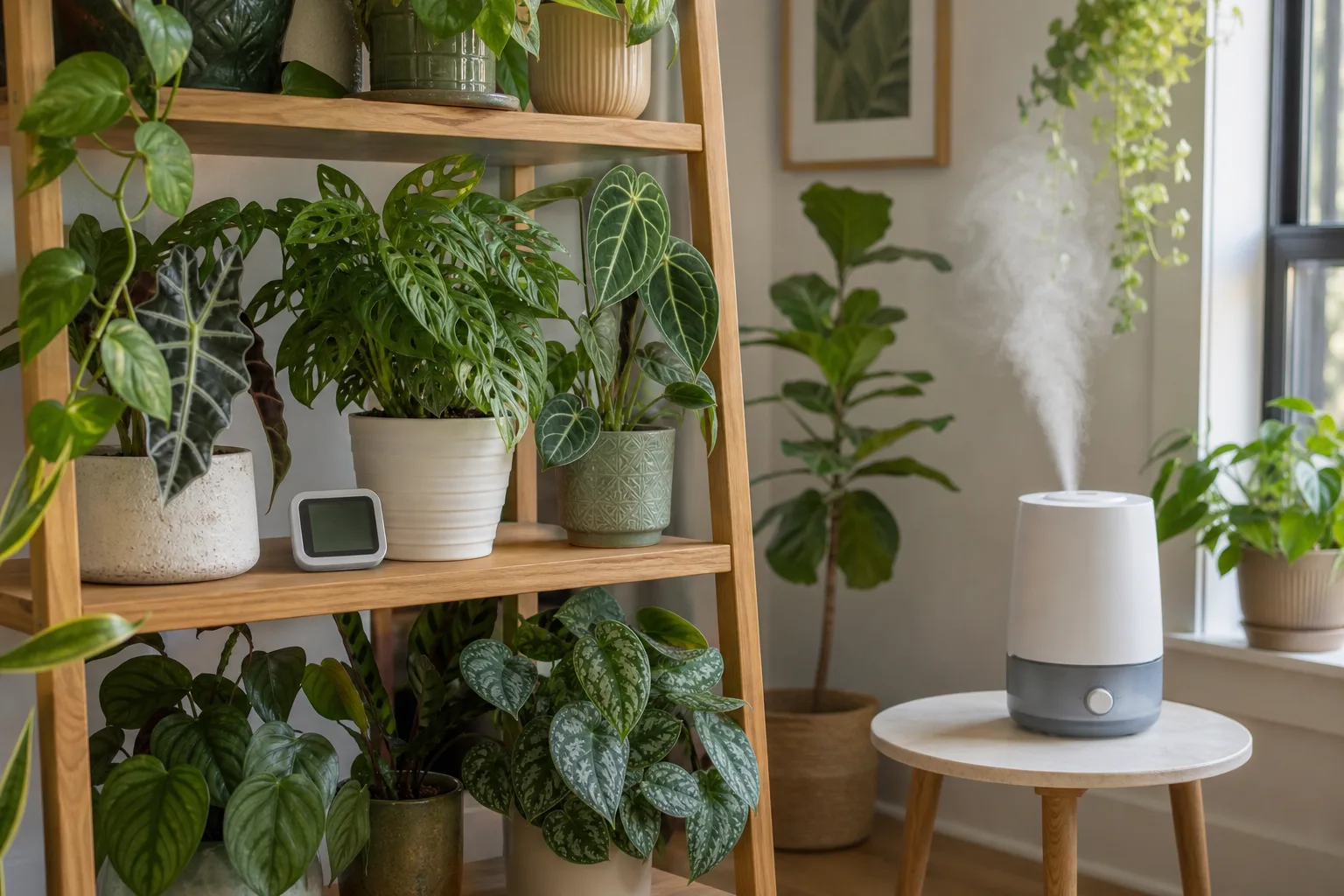
Varying heights creates a full display while preserving separate canopies and a clear light path.
You can create the layered, indoor-jungle effect with visual proximity rather than constant leaf contact. The eye reads plants as a group when they share a shelf, repeat a pot color, or overlap in height from the viewer’s angle. The roots and leaves do not need to occupy the same physical space.
Start with the largest plant and place it where its mature size will not block a doorway, window, or air path. Add a medium plant beside it, then a smaller one at a different height. Leave a narrow visual gap between the canopies and use the background wall or shelf to make the group feel connected.
If you want more styling ideas, the existing guide to arranging houseplants can help you think in terms of height, rhythm, and placement while this spacing guide keeps the health constraints visible.
Use height and direction to separate foliage
Vertical space is the easiest way to add plants without adding a crowded floor or tabletop. A stable plant stand can put a fern below a taller rubber plant, while a wall shelf can keep a trailing pothos above the canopy of a compact prayer plant. The separation should be large enough that leaves cannot reach the next level when the plant is watered, rotated, or moved by a draft.
Train climbers toward a trellis or support instead of allowing vines to crawl into neighboring pots. Prune a vine at a healthy node when it has crossed the arrangement, then use the cutting elsewhere. For large plants, remove only dead or badly damaged growth first; hard pruning is not a substitute for enough light or a suitable pot.
Use plant stands carefully. A loaded pot is heavy, and water makes soil and ceramic heavier. Put the largest container on the lowest, widest surface, keep shelves level, and leave enough clearance to catch drainage. A toppled plant can damage leaves, furniture, people, and pets in a way that leaf contact never will.
Keep vents, windows, walls, and traffic lanes clear
Leaves should not be pressed against a wall or curtain all day. The back of a plant often receives less light and becomes the least inspected surface in the room. A small gap lets you rotate the pot, wipe dust, spot pests, and keep wet foliage from resting against a surface that stays damp.
Do not place a leafy arrangement where people brush past it repeatedly. Passing contact can tear leaves, knock over pots, and carry pests on clothing or hands from one plant to another. Keep thorny, irritating, or toxic plants out of high-traffic and pet-accessible areas, and avoid making a beautiful display into a trip hazard.
Vents deserve special attention. You want gentle room movement, not a direct blast across one plant. If a vent is unavoidable, move the group slightly to the side, raise it above the direct stream, or use a deflector. Check the plant itself: curling, crisp edges, one-sided drying, or leaves that flap constantly are signals that the airflow is too harsh.
Airflow: gentle movement, not a wind tunnel
Airflow is the quiet reason spacing helps. Moving air carries heat and water vapor away from leaf surfaces and helps a freshly watered group dry at a reasonable pace. It does not sterilize a plant, kill a pest, or guarantee that fungal disease will stay away.
A small fan can help in a dense room, especially in winter when windows stay closed, but aim it across the room or toward a wall, not directly at the leaves. Use the lowest setting that creates mild movement. If leaves are constantly fluttering, the fan is doing more than you need.
Airflow and humidity are linked but not opposites. Dry, forceful air can stress tropical foliage and encourage spider mites, while still, humid air can keep leaf surfaces wet and make disease management harder. The right setup is a measured middle: adequate humidity for the plants, dry leaves after watering, and enough circulation that you can feel a faint movement when you hold a hand near the group.
Do not mist as a default response to crowded leaves. Gardening Know How notes that misting can provide a short-lived humidity increase, but its practical value depends on the plant and the room. If leaves stay wet or the cluster never dries, misting can add the exact moisture problem that spacing is meant to reduce. (Gardening Know How beginner’s guide to houseplants)
New plants need a quarantine lane
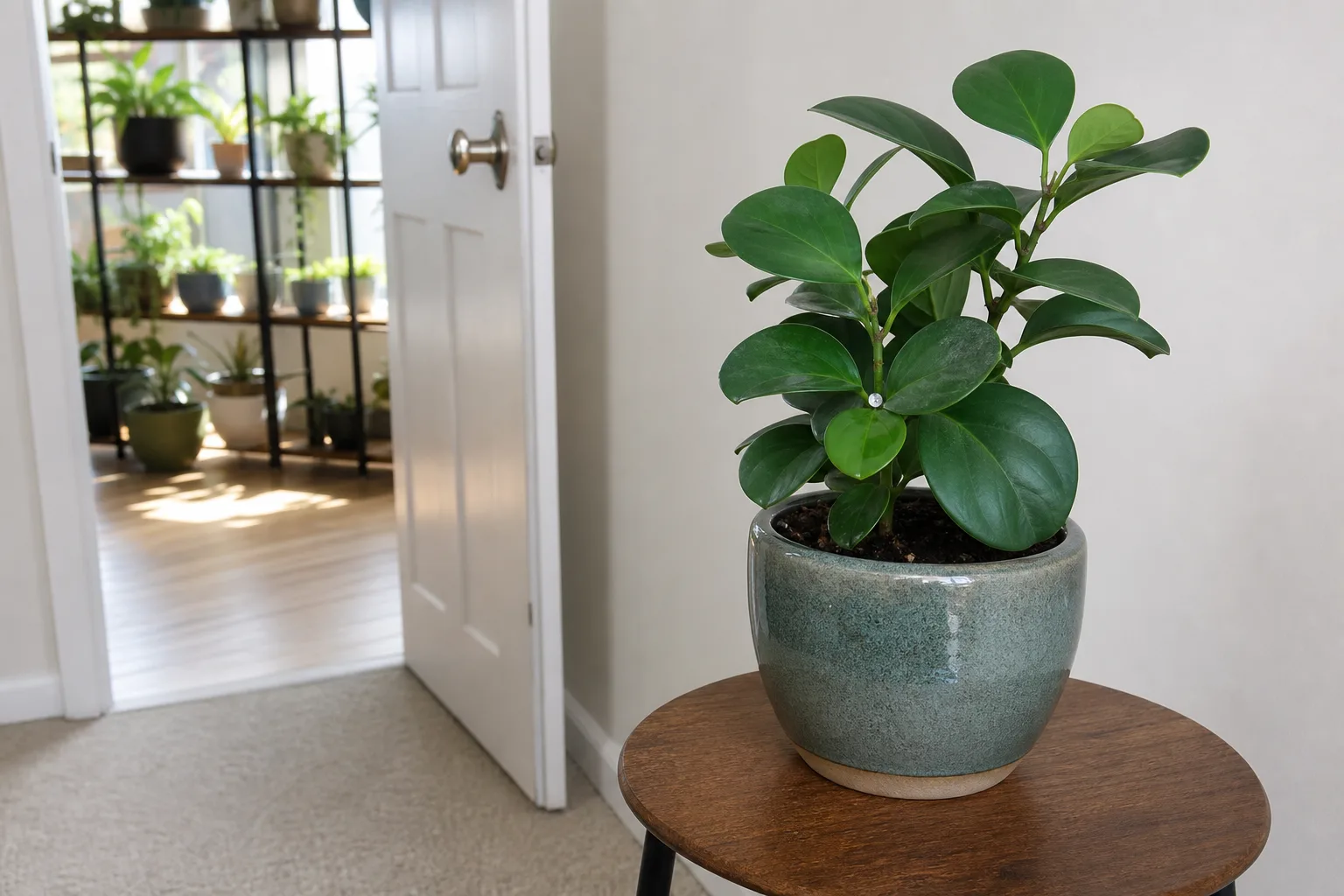
A quarantine spot should be easy to inspect and physically separate from the main collection.
Spacing protects a collection only after you have checked what is coming into it. A new plant can look healthy from across the room while carrying scale under a leaf, mealybugs in a leaf axil, thrips in new growth, or fungus gnat larvae in moist soil. If you place it directly into a dense display, the group becomes an efficient route for a problem to spread.
Colorado State University Extension recommends inspecting plants before purchase and keeping new plants in a separate area for at least three weeks, followed by another careful inspection. (Colorado State University Extension on managing houseplant pests) Use that as a sensible quarantine window, not as proof that every pest will reveal itself on a precise day.
During quarantine, keep the newcomer far enough from the collection that leaves cannot touch and that a watering can, tray, or pruning tool does not move directly from one plant to the next. Look under leaves, along stems, around the crown, at drainage holes, and across the soil surface. A magnifying glass helps with mites and immature pests that are easy to miss.
If you see webbing, cottony clusters, sticky residue, flying insects, distorted new growth, or repeated leaf stippling, keep the plant isolated. Do not solve the problem by simply moving the pot to the back of the display. Treat or discard according to the pest, the plant’s tolerance, and the product label if you use a pesticide. Minor pests may be manageable; a severely infested plant can be a continuing source of trouble for the whole collection.
If leaves are already touching: a reset plan
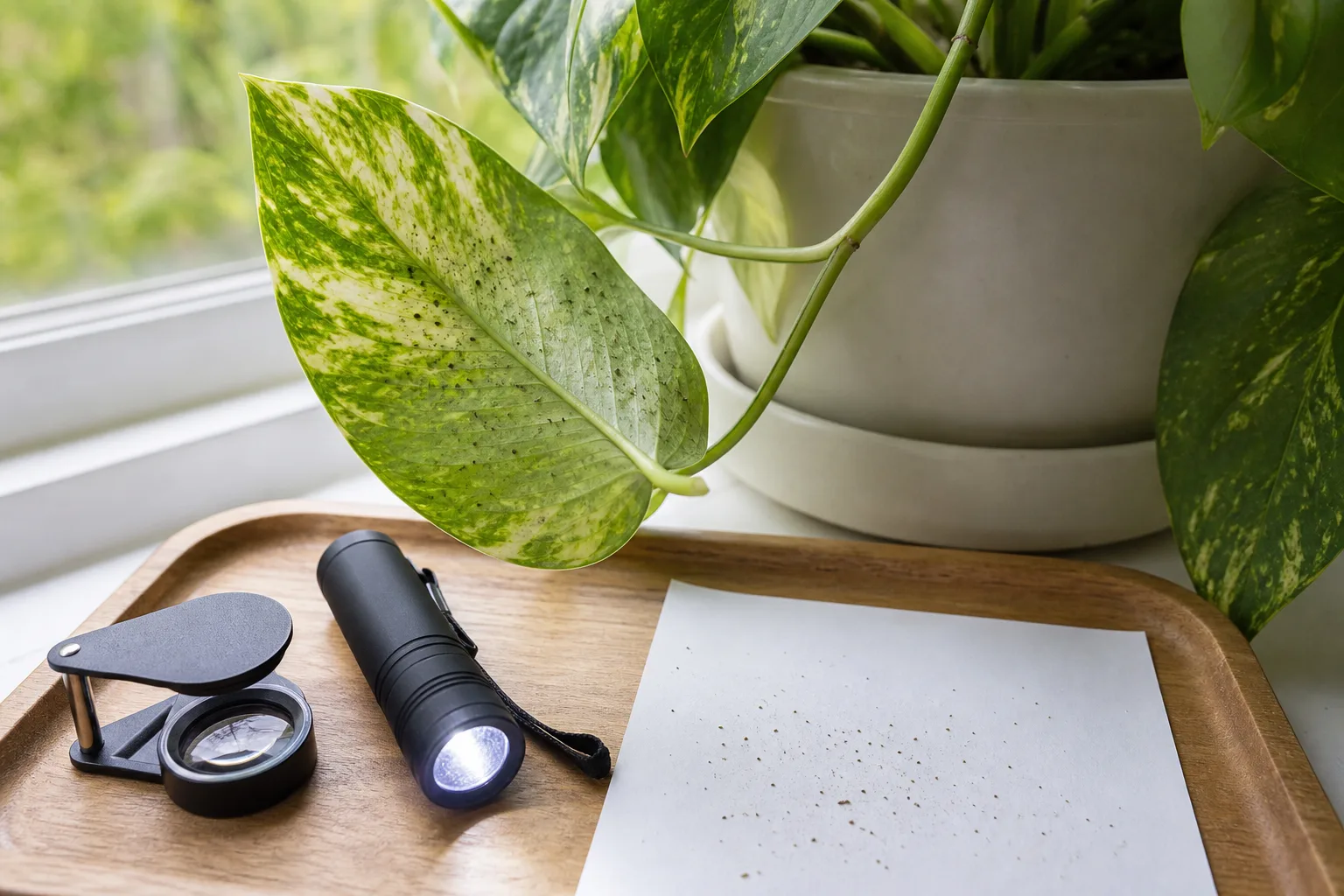
Inspect the whole plant, including leaf undersides and the soil line, before deciding what to cut or spray.
Do not begin by cutting every leaf that crosses another. First decide whether the contact is cosmetic, structural, environmental, or part of a pest problem. A crowded plant can look unhappy because it is shaded, dry, overwatered, root-bound, or infested, and the correct first action depends on the pattern.
Use this order:
- Separate the most crowded pots. Make a temporary gap before you diagnose. If one plant has pests or disease, move it farther away immediately.
- Inspect the whole plant. Check the leaf undersides, new growth, stem joints, soil surface, pot rim, drainage hole, and the side facing the wall.
- Correct the room first. Move the group out of direct drafts, open a light path, and provide gentle circulation. Do not compensate for a dark location with tighter grouping.
- Clean and prune selectively. Remove dead, yellow, mushy, or clearly diseased material with clean tools. Do not remove healthy leaves solely because they touched.
- Rearrange by mature size and care rhythm. Put plants where you can water, lift, rotate, and observe them without moving the entire collection.
- Watch new growth. A plant that produces clean leaves after the reset was probably reacting to its environment. A plant with new stippling, sticky residue, webbing, or spreading spots needs a more specific diagnosis.
Diagnose spread vs stress before treating
Several houseplant symptoms overlap. Yellow leaves may follow low light, root problems, aging, overwatering, or sap-feeding pests. Brown edges may reflect dry air, salt buildup, underwatering, heat, or direct contact. Leaf spots may be fungal, bacterial, chemical, or mechanical. The University of Alaska Fairbanks Cooperative Extension Service recommends considering the whole situation—environment, cultural practices, and how the pest may have entered—rather than diagnosing from one symptom alone.
Look for patterns that raise the urgency:
- Pests are more likely when you find moving insects, webbing, cottony clusters, scale-like bumps, honeydew, or repeated damage on new growth.
- A leaf-surface disease is more likely when spots expand, several leaves develop similar water-soaked or bordered lesions, or wet foliage and poor circulation are part of the history.
- Environmental stress is more likely when damage is limited to the draft-facing side, follows a light change, appears after a watering mistake, or stops after placement improves.
- Mechanical damage is more likely when one edge is torn or bruised exactly where it rubs a shelf, wall, stake, or neighboring leaf.
When in doubt, isolate the suspect plant while you observe it. Isolation is reversible; letting an active pest move through a collection is expensive in time and plant health. Avoid applying multiple sprays to an unidentified problem just because the leaves are crowded. A stressed plant can be injured by unnecessary treatment, and a spray cannot repair blocked light or saturated roots.
Once the group is stable, inspect it weekly. Lift leaves, check the soil, rotate pots, empty standing water, and make sure each plant still has the clearance it had when you arranged it. Houseplants grow into their spacing plan. The display that was perfect in spring may need a stand, a trellis, a prune, or a second shelf by late summer.
Conclusion
Houseplant leaves do not need to live in separate rooms. Occasional contact is usually harmless, and grouping can make a collection more attractive and easier to care for when the plants share compatible light, water, and humidity needs. The line to avoid is persistent overlap that blocks light, keeps leaves wet, hides pests, or makes every care task awkward.
Start with 2 to 6 inches between small and medium canopies, then adjust for leaf size, mature growth, room airflow, and your ability to inspect each plant. Keep large plants farther apart, use height to create visual density, keep vents and traffic lanes clear, and quarantine newcomers before they join the display. If leaves are already touching, separate first, diagnose second, and prune only what the plant no longer needs. That gives you the jungle look without turning the jungle into a maintenance problem.



