Capsicum Soil Guide for Beds, Pots and Monsoon
Capsicum Soil Guide for Beds, Pots and Monsoon
Capsicum Soil Guide for Beds, Pots and Monsoon
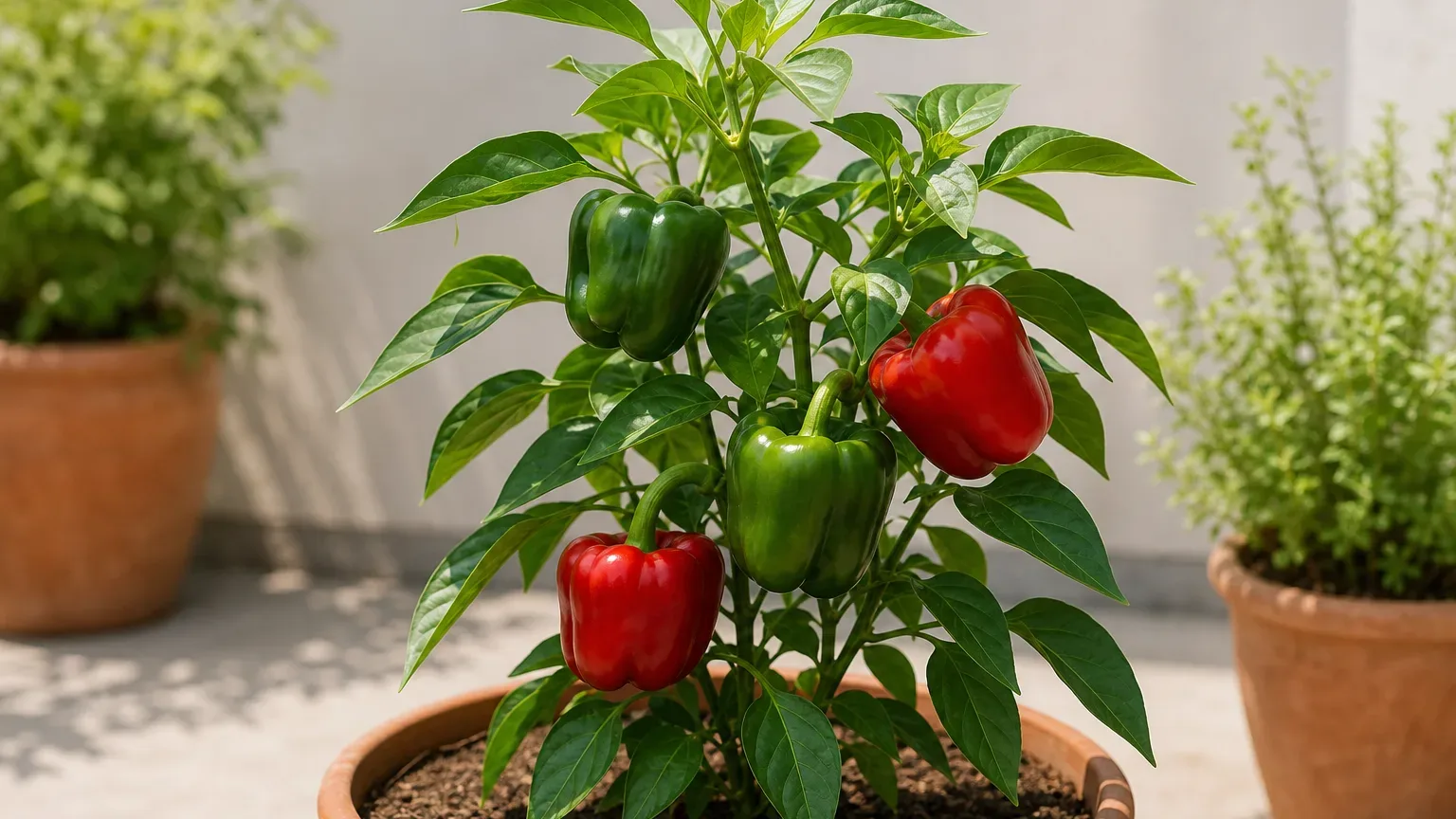
Capsicum here means sweet bell pepper or Shimla Mirch, a non-pungent form of Capsicum annuum, not a generic hot green chilli. Its ideal root zone is fertile and moisture-retentive but freely drained: water should spread through the soil, then excess should leave while small air spaces remain around the roots. Soil that is merely “rich” is not enough if it puddles after rain or collapses into a dense pot.
That balance matters in both beds and containers, but the way you create it differs. A garden bed relies on its existing mineral soil, structure, elevation, and long-term organic matter. A pot needs a manufactured mix that stays open after repeated watering. During an Indian monsoon, drainage and rain protection become more important than adding another handful of compost.
Quick answer: the soil capsicum needs
For an in-ground capsicum, aim for well-drained loam or sandy loam enriched with mature compost, with a slightly acidic pH around 5.8–6.8. NC State Extension describes sweet bell peppers as preferring moist, well-drained loamy or sandy soil in a pH range of 5.5–6.8, while Penn State gives a narrower commercial target of pH 5.8–6.6. Those ranges overlap enough to make 5.8–6.8 a useful home-garden target, not a reason to chase an exact decimal.
For a container, use potting mix rather than excavated garden soil. A workable starting blend by volume is about 50% quality potting mix or screened loam-based container compost, 30% mature compost, and 20% aeration material such as perlite, pumice, or coarse horticultural sand. Adjust the blend after a drainage test: add more aeration material in humid, rainy weather, but retain enough fine material that a fruiting plant does not dry out within hours.
Why capsicum roots need both moisture and air
Bell peppers are not drought succulents, so an extremely gritty cactus mix is a poor answer. They need steady root-zone moisture through flowering and fruit expansion, yet wet, poorly aerated soil creates conditions in which root and crown diseases become more likely. The useful target is not “fastest possible drainage”; it is good infiltration plus useful water-holding capacity, the combination Penn State specifies for pepper production.
This is why a mix can fail in opposite ways. Dense clay or decomposed potting mix can remain saturated after rain, leaving roots short of oxygen. Very coarse sand or an over-amended pot can drain immediately but hold too little water for a plant carrying several thick-walled fruits. Match Capsicum watering to the soil you actually have: check below the surface and water deeply when the upper layer begins to dry rather than keeping the root zone constantly wet.
Preparing a garden bed for capsicum
Start with a sunny position where rainwater moves away instead of collecting. Tamil Nadu Agricultural University recommends well-drained loamy soil rich in organic matter for capsicum and uses ridges, furrows, or raised beds in its field layouts. At home, the same principle can be scaled down: a modestly raised bed, open drainage path, and compost worked through the upper root zone are more valuable than a deep planting hole filled with soft material inside hard clay.
Spread mature compost across the bed and blend it with the existing soil rather than creating isolated “pots” in the ground. If the bed has supported vegetables for years and already contains abundant organic matter, add less and use a soil test to decide what nutrients are missing. The goal is a crumbly root zone that holds together lightly when squeezed but breaks apart when touched.
Test texture and drainage before planting
After wetting a test patch thoroughly, watch what happens. Water that remains on the surface for a long period, a hole that refills from surrounding soil, or a sticky mass that stays glossy and airless the next day points to poor drainage. Water vanishing immediately from pale, loose soil, followed by deep dryness soon afterward, points to insufficient water retention.
Also inspect the site during actual rain. A dry-season drainage test cannot reveal runoff arriving from a roof, terrace, or higher bed. If water routinely crosses the planting zone, redirect it before transplanting; do not expect perlite in one planting hole to solve landscape-scale water movement.
Improve heavy clay or fast-drying sand
In heavy clay, improve a broad bed, not just the planting hole. Incorporate mature compost over the whole area, avoid working clay while it is wet, and raise the crown zone above the surrounding grade. If water still stands after ordinary rain, grow capsicum in a raised bed or container rather than repeatedly adding sand; small additions of fine sand to clay can leave an even denser mix.
In very sandy soil, compost improves both nutrient retention and water-holding capacity. Use organic mulch after the soil has warmed, leaving a small gap around the stem. The RHS likewise recommends well-drained, fertile, moisture-retentive ground and advises adding compost or well-rotted manure where soil is poor or heavy. This is a structural amendment, not permission to bury roots in unfinished manure.
Choosing soil for container capsicum
Container capsicum needs a stable mix and enough volume for roots, moisture, and a top-heavy crop. The RHS recommends a final container at least 30 cm wide with one sweet pepper planted in multi-purpose potting compost. A larger pot is often easier to keep evenly moist on a hot Indian balcony, provided it has effective drainage and is not left exposed to continuous rain.
Do not fill a pot with dense garden clay. In a confined container it compacts, drains unpredictably, and leaves little air around the roots. Do not fill the bottom with a thick rubble or gravel “drainage layer” either; drainage depends on an open mix and unobstructed holes throughout the base, not on hiding a reservoir below dense soil.
A practical capsicum potting mix
Use the 50:30:20 blend as a starting point, then adapt it. Quality potting mix supplies a consistent base, mature compost contributes slow nutrient release and water retention, and perlite, pumice, or coarse horticultural sand preserves larger pores. In a humid monsoon climate, shift slightly toward aeration; on a hot, windy terrace, retain more of the moisture-holding base and use surface mulch.
Screen homemade compost before using it in a pot and avoid material that is hot, sour-smelling, or still visibly decomposing. If coco coir is the main base, remember that it provides structure and moisture retention rather than complete fertility. Plan feeding separately through the Capsicum fertilizer guide instead of loading the initial mix with strong fertilizer.
Pot drainage matters as much as mix
Use several clear holes at the lowest point of the container and keep them off a flat floor where silt can seal them. Water a newly filled pot before planting: the surface should accept water without prolonged ponding, and runoff should emerge freely. Empty saucers after watering and move decorative outer pots under cover during persistent rain.
A potting mix that drained well when new can collapse over a season as fine organic particles settle. If water begins to run around the root ball rather than through it, gently loosen the surface and check whether roots have filled the pot. The next decision may be a container change, covered in Capsicum repotting, rather than more frequent watering.
Capsicum soil pH and when to test
For most home growers, pH 5.8–6.8 is a sensible target. Sam Houston State University similarly lists fertile, organic-matter-rich soil and an ideal bell-pepper pH of 6.0–6.8. Within this slightly acidic band, the main nutrients peppers use are generally available without aggressive correction.
Test before adding lime, sulphur, wood ash, or repeated “pH adjusters.” University of Georgia Extension advises testing two to three months before planting and gives pH 6.0–6.5 as its target. Container growers should use a reliable fresh mix and test only when persistent symptoms, unusual irrigation water, or repeated reuse suggests drift; inexpensive probe readings alone are not a sound basis for large corrections.
Fertility without making soil excessively rich
Capsicum is a fruiting crop, but more nitrogen does not automatically mean more peppers. Clemson Extension warns that abundant foliage with few flowers or fruits can indicate nitrogen over-fertilization. Begin with mature compost and a soil-test-led basal feed, then adjust nutrition as plants establish and begin flowering.
Do not use this soil page as a universal fertilizer schedule. Native soil fertility, compost analysis, container volume, irrigation, cultivar, and fertilizer formulation all change the dose. Separate structure from feeding: build an aerated root zone first, then follow the Capsicum fertilizer guide and the product label instead of mixing concentrated fertilizer against young roots.
Managing capsicum soil through the Indian monsoon
Monsoon management begins before the first long rain. Keep beds raised above surrounding paths, clear outlets, and avoid planting in roof-drip lines or low pockets. TNAU’s protected nursery guidance uses sloped areas, raised beds, and polythene protection during rainy months; for a balcony or small garden, a bright rain shelter with open sides follows the same drainage-first logic without trapping humid air.
During a wet spell, stop calendar watering and inspect the root zone. Remove standing saucers, lift pots on feet, pull saturated containers under cover, and pause liquid feed until normal drainage and active growth return. Keep mulch a little away from the stem base and thin any thick, soggy layer. Do not repot merely because rain is forecast, but act if the mix smells sour, the stem base darkens, or the pot remains heavy long after the rain stops.
Crop rotation and whether to reuse soil
Capsicum belongs to the Solanaceae family with tomato, brinjal, and potato. Rotating among those crops is not a meaningful break because they share several soil-borne disease and pest risks. Clemson advises not planting pepper, tomato, eggplant, or potato in the same spot more often than once every three years; where space permits, use unrelated crops during the break and remove infected debris.
Healthy container mix can be reused only after old roots are removed and structure is restored with fresh potting mix and aeration material. Do not reuse soil from a plant that had unexplained wilt, crown rot, severe root decay, or nematode damage. Bell pepper fields can host root-knot nematodes, including Meloidogyne species documented in pepper roots and soil, so discarding suspect container soil is safer than transferring it into another nightshade pot.
Signs the soil setup is wrong
Poor drainage often shows as a pot that stays heavy, a sour smell, algae or persistent surface mould, lower-leaf yellowing, stalled growth, or wilt while the root zone is wet. Fast-drying soil behaves differently: it pulls from pot edges, sheds water through cracks, becomes light soon after watering, and leaves the plant repeatedly wilted during fruit expansion. Neither symptom pattern should be diagnosed from leaves alone.
Nutrient problems can mimic drainage stress. Pale growth may come from low fertility, unsuitable pH, damaged roots, or prolonged saturation that prevents normal uptake. Check moisture, drainage, root condition, and recent feeding together. If the plant is wilting, use the Capsicum overview to confirm its broader growing conditions before changing several variables at once.
How to correct soil around an existing plant
For a bed that drains slowly but is not flooded, stop irrigation, open shallow channels away from the crown, and improve the path for surface runoff. Add compost as a surface amendment after conditions become workable; do not dig aggressively through active roots. If the site remains waterlogged after ordinary rain, lifting and moving the plant to a raised bed or container may be less damaging than waiting for root decline.
For a container, first clear the holes and remove standing water. If the mix is structurally collapsed or sour, move the plant into fresh, open potting mix at the same depth, trimming only clearly dead roots. Keep it bright but protected from harsh stress while roots recover, and resume feeding only after new growth shows that uptake has restarted.
When to use this page vs other Capsicum guides
- Use the Capsicum overview to confirm that you are growing sweet bell pepper or Shimla Mirch and to review the whole care system.
- Use Capsicum watering when the mix is suitable but you need to decide when and how deeply to irrigate.
- Use Capsicum fertilizer for product type, timing, and deficiency versus excess; soil structure comes first.
- Use Capsicum repotting when roots have filled the container or the old mix has collapsed.
- Use Capsicum propagation for seed-starting media and transplant-stage care rather than mature-plant soil.
Related Capsicum guides
- Capsicum care overview — identity, climate, and whole-plant priorities.
- Capsicum light guide — sun exposure and heat management.
- Capsicum watering guide — moisture checks for beds and pots.
- Capsicum fertilizer guide — feeding through growth, flowering, and fruiting.
- Capsicum repotting guide — final-pot timing and root assessment.
- Capsicum propagation guide — seed sowing and seedling establishment.
- Capsicum pruning guide — when trimming helps and when it delays the crop.
Conclusion
The best capsicum soil does two jobs at once: it keeps enough moisture available for a fruiting Capsicum annuum while allowing excess water to leave and air to return around the roots. In beds, build that balance with broad organic-matter improvement, a tested pH near 5.8–6.8, good site drainage, and rotation away from other nightshades. In containers, use a real potting mix with durable aeration, effective base holes, and no standing saucer water.
For Indian monsoon conditions, treat elevation, outlets, and rain cover as part of the soil system. Do not try to fix a saturated root zone with fertilizer, and do not assume more compost will cure poor drainage. Test how water actually moves, correct the limiting factor, and let healthy new growth confirm that the root zone is working.