Aphids on Lemon Tree: Causes, Checks & Fixes
Quick answer
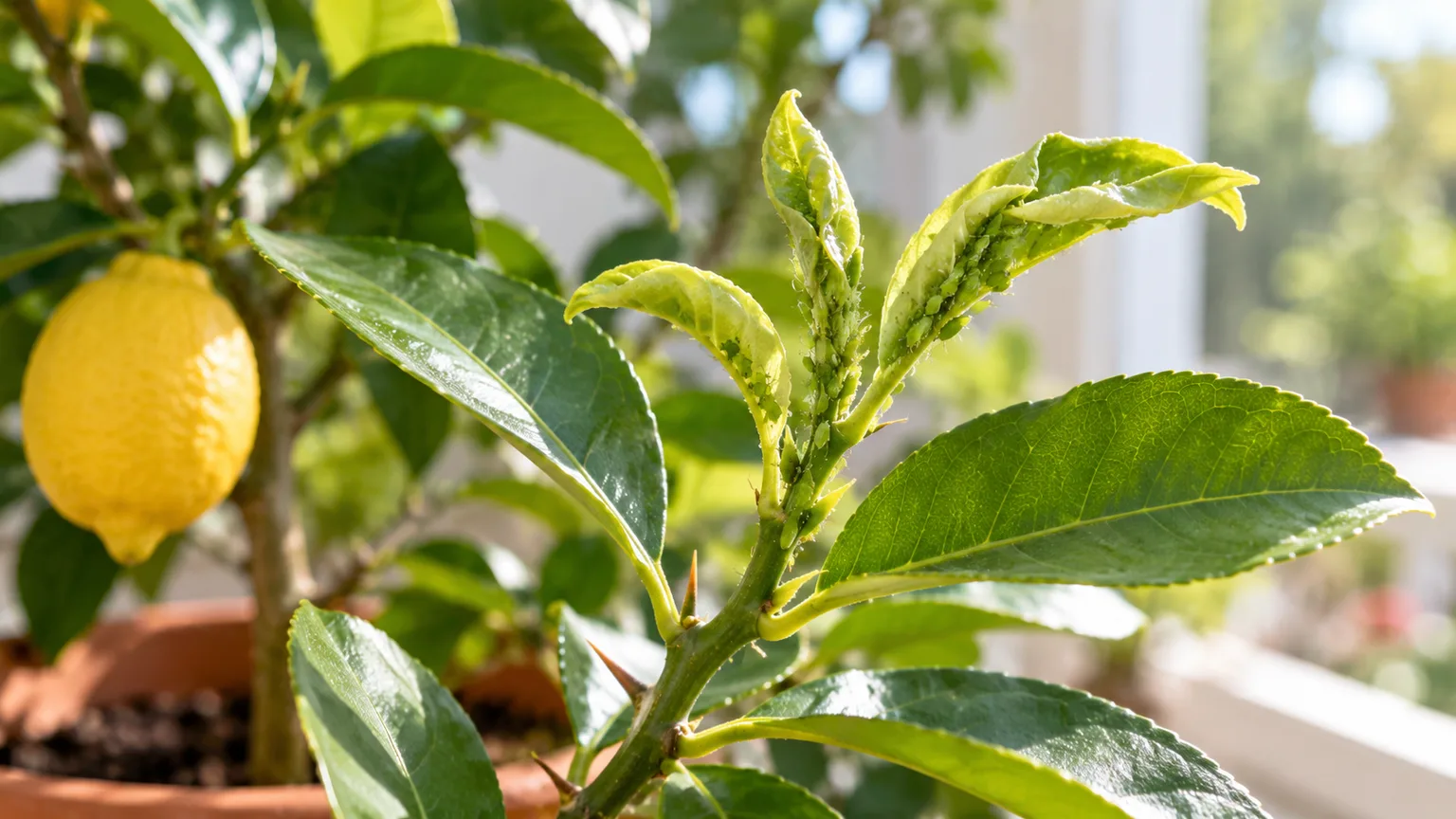
Aphids on a lemon tree cluster on soft new flush growth, flower buds, and leaf undersides, causing curling leaves and sticky honeydew. First step: isolate the tree and blast colonies off the new growth with a firm stream of water, then recheck in two to three days.
Aphids on Lemon Tree: Causes, Checks & Fixes
This guide covers aphids on Lemon Tree. See also the general Aphids guide, watering, and light pages for this plant.
Aphids on Lemon Tree: Causes, Checks & Fixes
Quick answer
If the newest shoots on your lemon tree are sticky, curling, and dotted with tiny soft insects while older leaves still look fine, aphids are the likely cause — not a watering mistake. Aphids feed on young citrus buds and the undersides of soft new leaves, which is exactly where a healthy lemon pushes growth after each flush.
First step: isolate the tree and blast the colonies off the new growth with a firm stream of water, aiming at leaf undersides, unrolling tips, and flower buds. For how aphids behave on plants in general, see our aphids guide — on a lemon tree, the pattern almost always starts on the softest flush. Recheck in two to three days; one rinse rarely finishes the job because nymphs keep hatching.
What aphids look like on a lemon tree
On citrus, the usual culprits are the spirea aphid, the black citrus aphid, and the cotton (melon) aphid — spirea aphids are always bright green, black citrus aphids are shiny black, and cotton aphids range from yellow to green to dull black. Expect dense clusters rather than single wanderers: aphids reproduce so quickly in warm weather that a clean flush can look coated within a week.
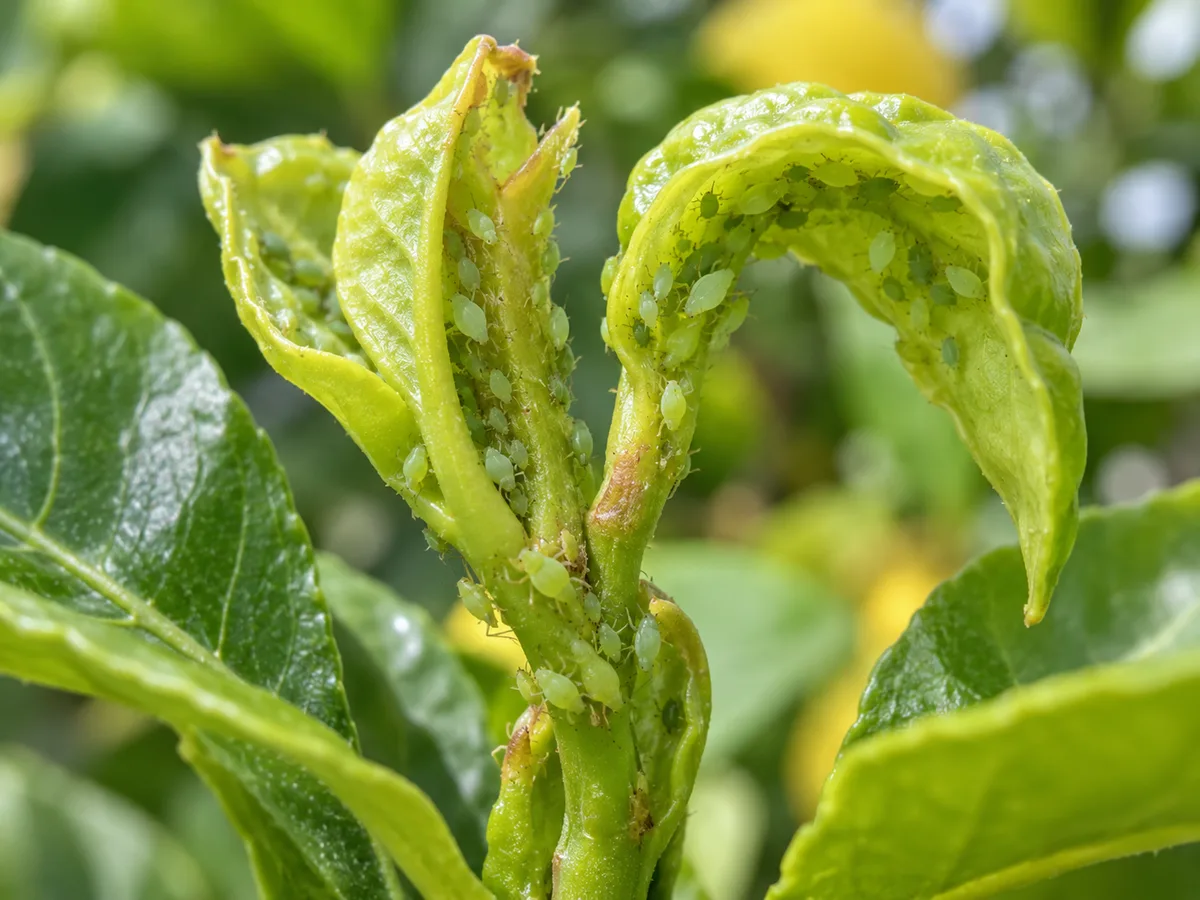
Macro view: pear-shaped aphids packed on a soft lemon flush tip with curling young leaves — compare with firm, flat hardened leaves lower on the same branch.
Typical lemon-tree signs, in the order they usually appear:
- Clusters of small pear-shaped insects on unrolling leaf tips, flower buds, and the undersides of soft new leaves
- Young leaves causing leaves to curl toward the stem instead of expanding flat
- Clear sticky honeydew on glossy leaves, fruit rind, or patio surfaces below the canopy
- Ants traveling up branches to tend the colonies
- Black sooty mold growing on honeydew left unwiped
- Bud drop or stunted new shoots when feeding is heavy during bloom
Honeydew is easy to confirm on a lemon’s glossy evergreen leaves: wipe a fingertip along a young leaf. Tackiness that returns within a day means sap feeders are still active above that spot.
Why lemon trees get aphids on flush growth
Lemons flush repeatedly, and every flush is an invitation. A vigorous lemon tree in full sun pushes several waves of soft feather-stage growth from spring through early autumn. Aphids target exactly that tissue, so a tree can look clean on hardened summer leaves and still get hit on each fresh flush. Container trees on sunny patios and young newly planted trees are the most frequent victims; UC IPM notes aphids are generally a problem only on young trees or continually flushing varieties.
Soft, over-fed shoots attract faster outbreaks. Lemons need regular citrus feeding through active growth, but a heavy nitrogen push produces the succulent tips aphids colonize first. Match doses to the lemon tree fertilizer guide rather than doubling up when growth looks pale — pale new leaves with no insects point to nutrition or pH, not pests.
Entry routes are ordinary. Winged aphids drift in on air currents through open windows, arrive on new nursery stock, or spread from nearby roses, hibiscus, or weeds. Trees brought indoors for frost protection deserve a full flush inspection first: a mild indoor winter lets a small colony build with no predators around. Keep watering rhythm steady through the move, since drought-stressed flushes are colonized faster.
Ants make small colonies permanent. Ants harvest honeydew and defend aphids from lady beetles and parasitoid wasps. If ants stream up the trunk, expect the colony to persist until the ants are blocked — a sticky trunk barrier plus rinsing works better than spraying alone.
How to confirm aphids before treating
Work in this order so you do not spray pests while missing a different problem:
- Flush-tip scan — Start at the newest growth and any swelling flower buds, not the older canopy.
- Underside check — Turn soft young leaves over; colonies hide where sprays and eyes miss them.
- Honeydew wipe — Tacky residue that returns within a day confirms active sap feeding.
- Ant trail follow — Ants on the trunk usually lead upward to aphids, not downward to root trouble.
- Hardened-leaf comparison — Damage confined to new growth with firm flat older leaves fits aphids. Widespread yellowing of older leaves with wet mix points toward overwatering on lemon tree instead.
Symptom lookalike comparison
| What you see | Likely cause | Key check |
|---|---|---|
| Soft pear-shaped insects clustered on flush tips | Aphids | Colonies scatter when disturbed; honeydew present |
| White cottony masses in leaf axils and stem joints | Mealybugs on lemon tree | Stationary waxy tufts, slower spread |
| Fine stippling and webbing on older leaves | Spider mites on lemon tree | Hot dry air; damage on hardened leaves, not buds |
| Uniform yellowing of older leaves, wet mix | Yellow leaves from watering stress | No insects; check 5–8 cm soil moisture first |
| Black coating that wipes off sticky leaves | Sooty mold on honeydew | Mold is secondary — find the sap feeders above |
One honest limit: aphids can transmit citrus tristeza virus, but home sprays cannot prevent transmission — research shows area-wide programs are the only effective approach. Rinse and manage the colony; do not escalate to harsh chemistry out of virus fear.
First fix: isolate and rinse the flush
Move the tree away from other plants until you see no new aphids for at least two weeks after treatment. Then take a hose or a firm shower setting to every colony: new shoot tips, both sides of young leaves, buds, and twig crotches. Water pressure alone can knock these insects off of leaves with zero residue on fruit — the lowest-risk first move on an edible tree.
Rinse in the early morning so foliage dries before intense midday sun, and repeat every two to three days for at least two cycles to catch newly hatched nymphs. Wear gloves and eye protection around the canopy: lemon twigs commonly carry sharp thorns.
Follow-up steps if rinsing is not enough
If colonies persist after two or three rinses, step up in this order:
- Apply insecticidal soap or horticultural oil labeled for citrus or edible ornamentals, coating tops and undersides of infested flush until wet. Contact sprays only kill insects they touch, so thorough coverage matters more than dose strength.
- Repeat on a tight cycle — every 5 to 14 days until no live aphids remain, matching the product label.
- Never spray open blossoms or foraging bees, and avoid oil or soap in peak heat; treat in cool morning hours and keep the tree hydrated per its normal watering needs.
- Wipe honeydew off leaves and developing fruit with a damp cloth so sooty mold cannot establish.
- Block the ants with a trunk barrier and remove ant nests near containers; without ant guards, predators cannot finish the job.
- Invite predators — lady beetles, lacewings, syrphid larvae, and parasitoid wasps control aphids within 6 weeks on outdoor trees. Flowering companions near the patio help them stay.
Skip fertilizer boosts and repotting while treating: extra nitrogen pushes the soft growth aphids want, and a disturbed root ball on a fast-draining citrus mix masks whether pests or care stress caused the setback.
What not to do
- Do not drench the pot because curled leaves look thirsty — check moisture 5–8 cm deep first; soggy roots plus aphids is a worse combination.
- Do not apply oils or soaps at midday on a sun-baked patio tree; leaf burn follows heat plus wet spray.
- Do not reach for broad systemic insecticides on a fruiting home lemon as a first resort. Insecticide use is rarely warranted for citrus aphids, systemics threaten the pollinators lemon blossoms depend on, and label restrictions on edibles are strict — always read the label and prefer contact options.
- Do not prune off every infested shoot at once. Light tip-trimming of the worst clusters is fine; hard pruning during active growth removes the flowering wood next season needs.
- Do not ignore a soft trunk base, sour mix, or circling roots — that is root rot on lemon tree, a different emergency that rinsing will not fix.
Recovery timeline
Live colonies should thin within days of consistent rinsing and clear within one to two weeks. Expect the next clean flush within three to five weeks in warm active growth — judge success by that new growth, not by old damage. Curled hardened leaves stay curled, dropped buds will not reopen, and wiped sooty mold may leave faint staining until those leaves age out.
Call it worsening if fresh flushes keep emerging coated after three full treatment cycles, if sooty mold spreads across most of the canopy, or if new growth stalls entirely. At that point a local extension office can confirm the pest in person before any stronger product is considered.
How to prevent aphids next time
Quarantine every new plant for two weeks and inspect each lemon flush weekly from spring through early autumn — catching the first dozen aphids beats rescuing a coated shoot. A quick foliage rinse during routine watering knocks off winged arrivals before they settle.
Keep the underlying care aphid-unfriendly: 6–8 hours of direct sun, free-draining slightly acidic citrus mix, deep watering with partial dry-down, and measured citrus feeding through the season. Trees that hold firm, sun-hardened growth between flushes shake off light aphid pressure with predator help — which is why mature outdoor lemons often carry a few aphids with no harm done.
When to use this page vs other lemon tree guides
- Lemon tree watering guide — Use for routine moisture checks before assuming insects are the main issue.
- Lemon tree problems hub — Browse all common lemon tree issues when symptoms do not fit aphids.
- Yellow leaves on lemon tree — Follow when older foliage yellows without visible insects or honeydew.
- Mealybugs on lemon tree — Switch when the white insects are stationary, cottony, and slow-spreading rather than soft clustered aphids.
- Spider mites on lemon tree — Switch when damage is stippled older leaves with fine webbing in hot dry air.
Related Lemon Tree guides
- Lemon tree overview
- Lemon tree watering
- Lemon tree light
- Lemon tree soil
- Lemon tree fertilizer
- Lemon tree pruning
- Yellow leaves on lemon tree
- Mealybugs on lemon tree
- Spider mites on lemon tree
- Lemon tree problems
Keep cats, dogs, and horses from chewing leaves, peel, or fallen fruit during treatment: lemon plant material is toxic to cats, dogs, and horses. Move containers out of reach while rinsing and spraying.
Related tool
Use the Pest Identifier Tool to narrow causes for aphids on this plant before changing multiple variables at once.