Lemon Tree Yellow Leaves: Citrus Chlorosis Diagnosis & Fixes
Quick answer
Yellow leaves on a lemon tree are usually a citrus nutrition, watering, light, or cold signal—not a random leaf disease. First step: push a finger 5–8 cm into the mix, lift the pot for weight, and read the newest flush against the oldest leaves before watering, feeding, or moving the tree.
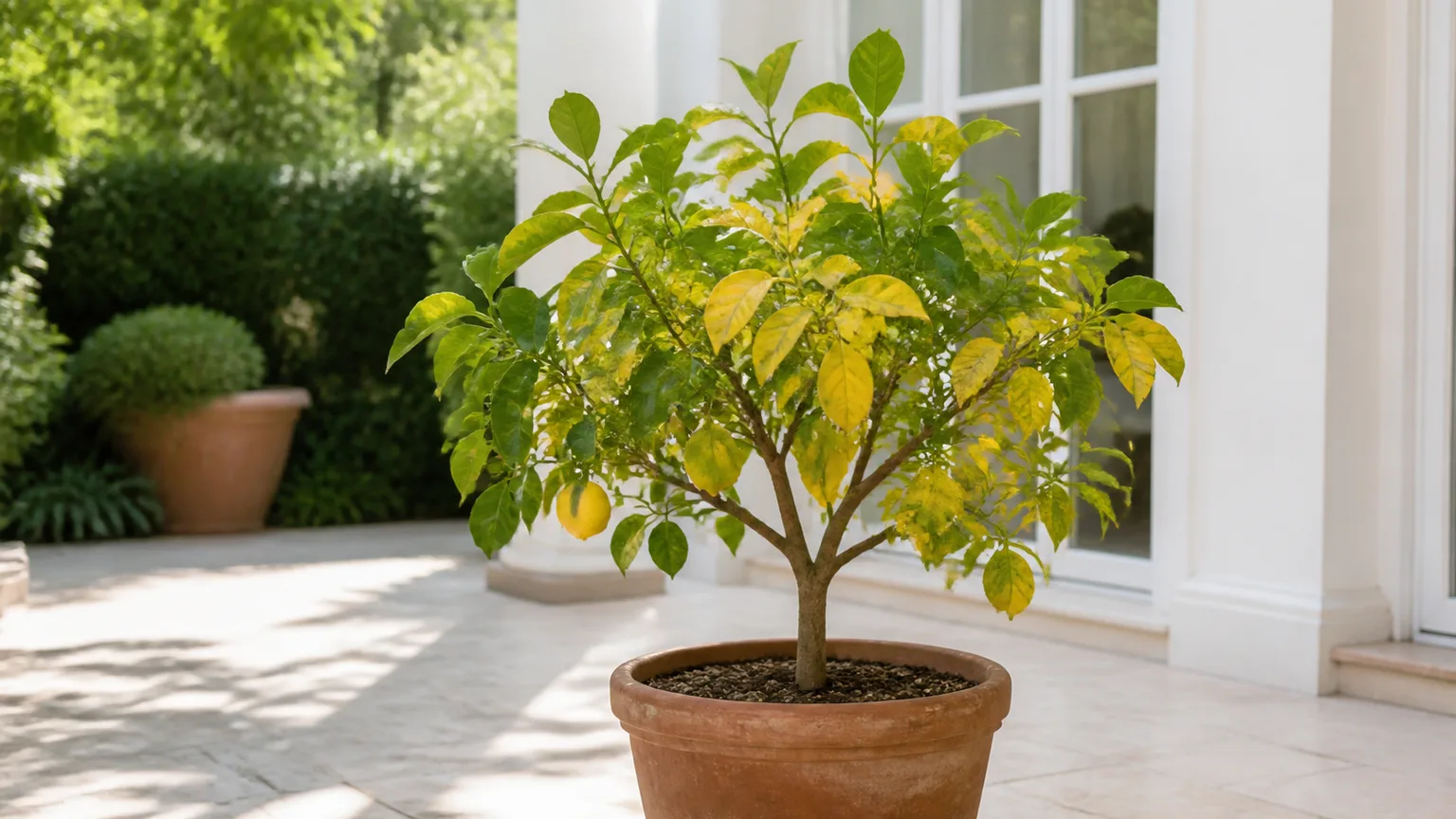
Yellow Leaves on Lemon Tree: Causes, Checks & Fixes
This guide covers yellow leaves on Lemon Tree. See also the general Yellow Leaves guide, watering, and light pages for this plant.
Yellow Leaves on Lemon Tree: Causes, Checks & Fixes
Quick answer
Yellow leaves on a lemon tree (Citrus limon) are almost always a citrus chlorosis signal — the tree telling you, in a very legible code, whether it is short of nitrogen, iron, magnesium, or zinc, or whether its roots are too wet, its light too weak, or a cold snap just bit it. Lemon trees are heavy-feeding, sun-hungry subtropical evergreens, so yellowing here behaves differently than on a low-light houseplant: the pattern across old versus new leaves is the diagnosis.
For the general biology behind chlorosis, see our yellow leaves hub. On lemon trees, the decisive clues are an even yellow wash over the oldest leaves, yellow new flush with green veins, a green inverted V left on the midrib, small blotchy stunted leaves, or yellowing that arrived days after soggy soil, a move indoors, or a cold night — not one or two old leaves dropping on an otherwise deep-green canopy.
First step: push a finger 5–8 cm into the mix, lift the pot for weight, and read the newest flush against the oldest leaves. Make that one check before watering, fertilizing, spraying, repotting, or moving the tree.
What yellow leaves look like on a lemon tree
On a healthy lemon tree the canopy is a deep, glossy green with new flushes emerging a lighter green that darkens as leaves harden. Trouble starts as a pale, washed-out cast that deepens to yellow — and where it starts matters more than how bright it is. Uniform yellowing that begins on the oldest, lowest leaves and creeps upward is the classic nitrogen signature. Yellowing confined to the newest growth at the branch tips, with veins staying green while the tissue between them pales, points toward iron. A yellow blotch spreading from the leaf base that leaves a green inverted V along the midrib is magnesium’s calling card.
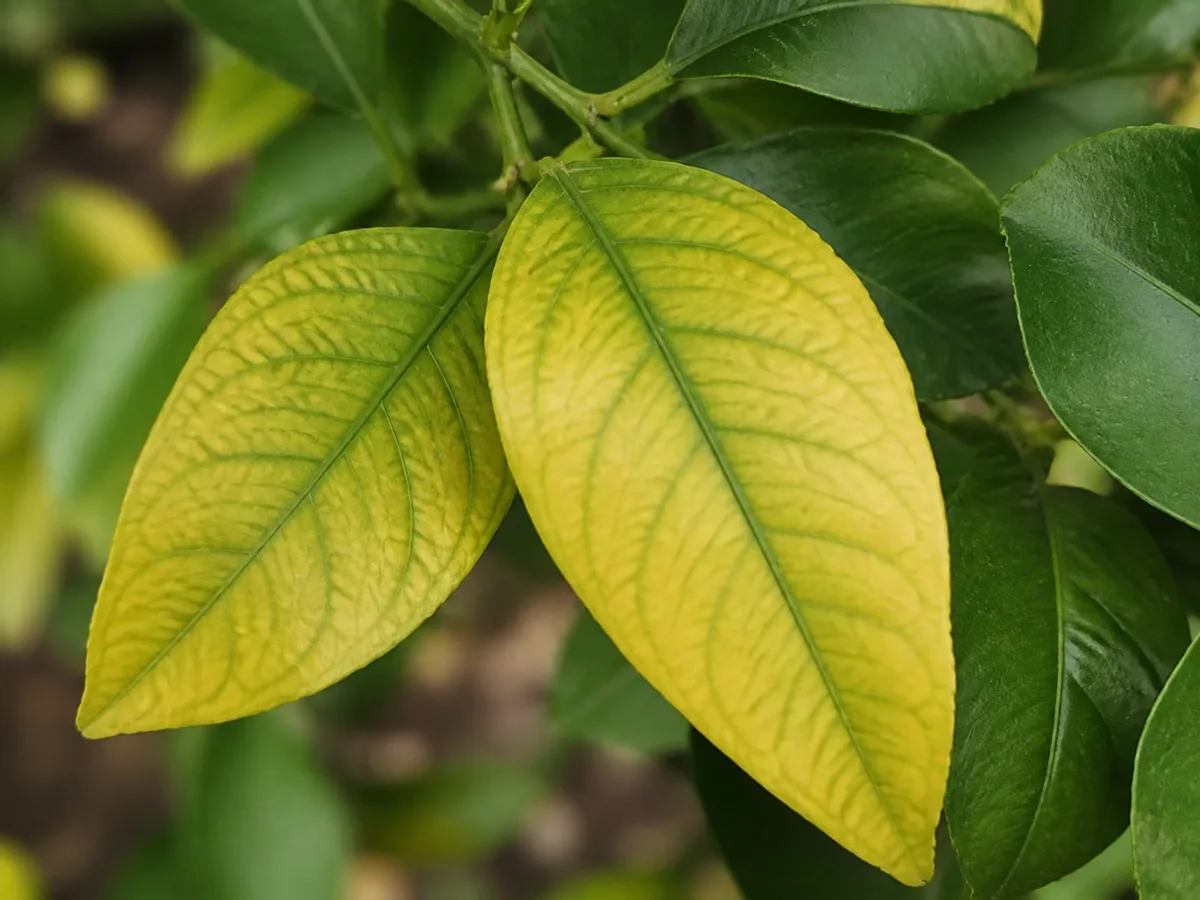
Close-up: note whether veins stay green while tissue between them yellows (iron, zinc, manganese), or the whole blade fades evenly from the oldest leaves upward (nitrogen).
Container trees often show the earliest yellowing on the side facing away from the window, and indoor-overwintered trees may drop a flush of yellow leaves within a week or two of coming inside. A few older yellow leaves with clean green new growth is usually normal turnover on this evergreen — intervene when yellowing spreads across many leaves, reaches new growth, or arrives with soft stems, leaf drop on wet soil, or stunted shoots.
Why lemon trees turn yellow: the citrus-pattern key
Lemon trees are among the hungriest common fruit trees, and each missing nutrient paints a different pattern. Learning these five signatures replaces guesswork with a confident read:
- Nitrogen — whole-tree pale wash, oldest leaves first. A nitrogen shortage shows as light-green to yellow foliage over the entire tree with no distinctive leaf pattern, progressing as conditions intensify. New growth emerges pale and darkens slowly, and older leaves may bronze before dropping. This is the most common nutritional yellowing on container lemons that have not been fed on schedule.
- Iron — newest leaves yellow, veins stay green. An iron shortage appears first on new foliage, with veins darker green than the yellowing tissue between them, turning nearly ivory in severe cases. On lemons this is frequently a pH problem rather than absent iron: alkaline mix locks iron out of reach, so container trees in old or lime-heavy soil yellow despite fertilizer sitting in the pot.
- Magnesium — yellow blotch with a green inverted V. The yellow area spreads from near the leaf base until only a green V remains at the tip and base of the midrib; acute cases turn fully yellow-bronze and drop. Dolomite corrects mild cases in low-to-neutral pH soils, while calcareous soils may need foliar feeding.
- Zinc — small yellow blotches between green veins, stunted tips. Early zinc shortage shows as small yellow blotches between green veins, and severe cases produce small leaves with narrow pointed tips on terminal growth. Foliar fertilizer applications are usually recommended for correction.
- Manganese — mottled dark-green veins on pale new leaves. Deficiency appears as dark green bands along the midrib and main veins surrounded by pale interveinal areas; both manganese and zinc shortages are worse on calcareous soils and highly pH-sensitive rootstocks. Mild manganese symptoms sometimes fade as the season progresses, so watch leaves across several weeks before treating.
Beyond nutrients, four environmental causes dominate on this species. Overwatering causes root rot that blocks nutrient and air uptake, so plant in loose well-drained mix and never let water pool around the roots. Underwatering yellows and dries foliage from dehydration — lemons are thirstier than many citrus. Too little sun yellows and drops leaves, since lemons need around eight hours of direct sun daily. And cold snaps yellow and drop leaves on this frost-tender subtropical tree; container trees should come indoors during cold spells and in-ground trees deserve frost cloth on cold nights.
How to confirm the cause at home
Work through these checks in order — each one rules a cause in or out before you touch fertilizer or the watering can:
- Read old versus new leaves. Oldest leaves yellow first with an even wash: suspect nitrogen or natural aging. Newest flush yellow with green veins: suspect iron, zinc, or manganese. One pattern, one suspect — write down which you see.
- Check the root zone at citrus depth. Push a finger 5–8 cm (2–3 in) into the mix, the depth in the lemon tree watering guide. Damp and heavy days after watering points to overwatering and possible root rot; powder-dry and feather-light points to underwatering. Also confirm the pot drains freely and the tree is in a coarse citrus mix, per the lemon tree soil guide.
- Test light honestly. Is the tree getting close to full sun, or has it just moved from outdoors to a dim room? A south- or southwest-facing window is the minimum for overwintering indoors — see the lemon tree light guide. Yellowing plus leggy pale shoots after a move indoors is light transition stress; compare with the not enough light guide.
- Check pH before feeding. Lemon trees want slightly acidic mix around pH 5.5–6.5. If new growth yellows with green veins in old container mix, an at-home pH test beats another round of fertilizer — alkaline mix locks out iron, zinc, and manganese no matter how much you feed.
- Inspect for pests and cold. Look under leaves and along stems for sap-sucking spider mites, scale, or mealybugs, which yellow leaves in clusters. Ask whether a cold night, heater blast, or frost exposure preceded the yellowing by a few days.
If the mix is soggy, roots smell sour, or stems soften near the soil line, treat it as a waterlogged root emergency first — nutrients can wait. Full mechanics of wet-soil damage are covered in the overwatering guide; waterlogged mix deprives roots of oxygen so they cannot take up water or nutrients.
The first fix to try
First, correct the water–drainage situation and confirm dry-down rhythm — one action, nothing else yet. If the mix is wet below the top few centimeters, let it dry to the 5–8 cm check depth before watering again, empty any cachepot saucer, and make sure the pot has drainage holes with citrus mix. If it is powder-dry, give one slow deep watering until excess drains, wait, and repeat so the root ball actually rewets. Do not fertilize, repot, spray, or move the tree on the same day — you need to see which correction the tree responds to.
Only after moisture is behaving normally for a week should you act on the pattern you recorded: an even old-leaf wash on a well-drained tree earns a citrus fertilizer feeding per the lemon tree fertilizer guide; green-vein new-leaf yellowing earns a pH test and, if alkaline, repotting into fresh citrus mix rather than more iron tonic poured into locked-up soil. Citrus fertilizer is typically applied three times a year, with roughly twice as much nitrogen as phosphorus and potassium — container trees may need smaller, steadier doses through the growing season.
Step-by-step recovery
Once the first fix is in place, follow the tree’s response rather than a calendar:
- Stabilize water for one to two weeks. Water deeply, then wait for the 5–8 cm dry-down each time. New yellow leaves should stop appearing; continued yellowing on wet mix means drainage is still failing — unpot and inspect roots following the root rot guide.
- Restore light gradually. Move container trees toward full sun over 7–10 days rather than all at once, since abrupt indoor-to-sun moves scorch leaves. If the tree must stay inside, give it the brightest south- or southwest-facing window available.
- Feed only on healthy roots in active growth. Resume citrus fertilizer in spring and summer once new growth looks green and the mix drains properly. Container trees respond well to small consistent doses through the year rather than one heavy application.
- Fix pH-driven lockout at the soil level. Soil pH above 7.0 can be lowered with a commercial acidifier, while pH below 5.0 rises with lime or dolomite — but for container lemons, repotting into fresh citrus-formulated mix is usually the cleaner reset.
- Treat pests only after confirming them. If you found mites, scale, or mealybugs, treat with insecticidal soap and recheck weekly; see the aphids guide for the related sap-feeder routine. Do not spray a drought- or cold-stressed tree on day one.
Yellowed blades themselves will not re-green — recovery is judged by new growth, not by old damaged tissue. Expect the tree to hold its remaining green leaves, stop dropping, and push a clean green flush within a few weeks in warm bright conditions. Slow growth persisting after yellowing stops usually means feeding or light still needs tuning.
When to use this page vs other lemon tree guides
This page is the yellow-foliage entry: use it when leaves are paling or yellowing and you need to separate nutrient chlorosis from water, light, cold, or pest causes. Go to overwatering when soil stays wet and leaves drop on damp mix; underwatering when the mix is powder-dry with crisping edges; root rot when stems soften or roots smell sour; not enough light when indoor yellowing comes with stretching; spider mites or mealybugs when stippling, webbing, or cottony clusters are visible; and the lemon tree problems hub when you are not sure which symptom page fits.
Cold snaps, indoor moves, and normal shedding
Two lemon-specific situations cause yellowing that looks alarming but follows a benign script. First, a few yellow leaves with healthy green growth is often natural shedding of older foliage — evergreens still retire old leaves. Second, moving a potted tree between indoors and outdoors in spring or autumn commonly triggers yellowing and leaf drop from the light change; consistent water and feeding while it adapts is the whole treatment.
Genuine cold damage is different: it follows frost or near-freezing nights within days, may blacken tissue, and hits container and young trees hardest. Mature trees tolerate brief freezes, but extended cold damages leaves — protect with indoor shelter or frost cloth before the forecast, not after the yellow appears. Brown tips arriving alongside yellow after a cold or dry spell usually share the same trigger.
Mistakes to avoid
- Feeding a stressed, waterlogged tree. Fertilizer cannot enter suffocated roots and excess salts worsen the damage. Confirm drainage and dry-down first.
- Chasing iron with tonics in alkaline mix. If pH is above 7, iron is locked out regardless of dose — fix the mix, not the bottle.
- Stacking repot, prune, spray, and feed in one day. Each is a separate stress; a shocked tree cannot tell you which intervention helped.
- Moving a yellowing tree between extremes. Hauling a stressed tree from a dim room straight into harsh sun (or vice versa) adds transition shock to the original problem.
- Ignoring the thorn and pet factor during handling. Lemon foliage, peel, and oils are listed as toxic to cats, dogs, and horses, so keep fallen leaves, peel, and concentrated citrus oil products away from pets while you work on the tree.
How to prevent it next time
Keep the tree in coarse, slightly acidic citrus mix (pH 5.5–6.5) that drains freely, water by the 5–8 cm check rather than the calendar, and hold the tree in the sunniest spot available — details live in the lemon tree overview and the watering, light, soil, and fertilizer care guides. Feed on a regular citrus schedule during active growth, test container-mix pH yearly, and plan the autumn move indoors before cold nights arrive so the tree transitions in still-mild weather. A quick weekly glance at the newest flush catches the next deficiency while it is still a pale hint rather than a yellow canopy.
Related lemon tree guides
- Lemon Tree overview — full care profile: sun, water, soil, and feeding baselines this page assumes.
- Lemon Tree problems hub — start here when yellowing comes with unfamiliar symptoms.
- Watering — the 5–8 cm dry-down method that rules out water causes.
- Light — hitting the 6–8 hour direct-sun target indoors and out.
- Soil — citrus mix recipe and pH 5.5–6.5 maintenance.
- Fertilizer — citrus feeding schedule once roots and pH check out.
- Overwatering — when to use it: yellow plus wet mix and leaf drop.
- Root rot — when to use it: soft stems, sour mix, or dark roots.
- Underwatering — when to use it: dry crisping leaves on powder-dry mix.
- Not enough light — when to use it: indoor yellowing with stretching.
- Spider mites — when to use it: stippled yellowing with webbing or stipple marks.
Related tool
Use the Yellow Leaves Diagnosis Tool to narrow causes for yellow leaves on this plant before changing multiple variables at once.