Not Enough Light on Lemon Tree: Causes, Checks & Fixes
Quick answer
Low light on a lemon tree shows as leggy pale shoots, small leaves, leaf drop, and no flowers or fruit. Move the tree toward 6–8 hours of direct sun with a 7–14 day hardening-off, then judge recovery by firm new growth.
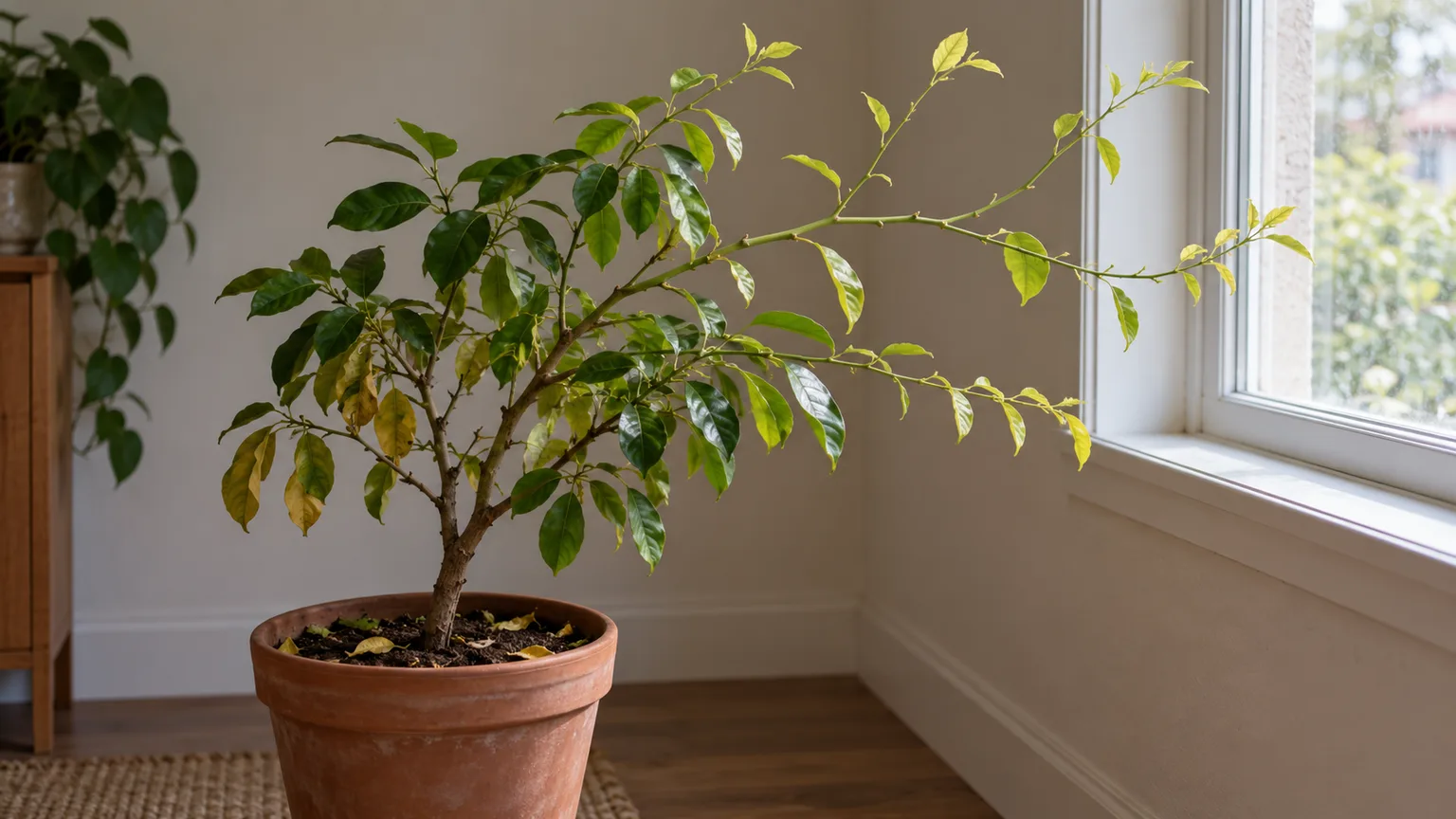
Not Enough Light on Lemon Tree: Causes, Checks & Fixes
This guide covers not enough light on Lemon Tree. See also the general Not Enough Light guide, watering, and light pages for this plant.
Not Enough Light on Lemon Tree: Causes, Checks & Fixes
Quick answer
A lemon tree short of light grows leggy shoots with wide gaps between leaves, pushes small pale-green leaves, drops older leaves and buds, and refuses to flower or size fruit. First fix: start hardening the tree toward 6–8 hours of direct sun over 7–14 days rather than dragging it straight onto a blazing terrace. For how dim conditions weaken plants in general, see our not-enough-light guide. On a lemon tree, the pattern usually shows up as a sparse canopy with soft elongated shoots while the potting mix stays wet far longer than the watering rhythm expects.
What not enough light looks like on a lemon tree
New shoots stretch long and thin with pale bark, and the internodes — the stem spans between leaves — run noticeably longer than on sun-grown wood. Fresh leaves emerge smaller than mature ones, feel soft instead of leathery, and hold a yellowish-green cast rather than the deep gloss of a sun-fed canopy. Older interior leaves yellow and fall, and any flower buds or marble-sized fruitlets abort, because the tree cannot fund them on a light deficit.
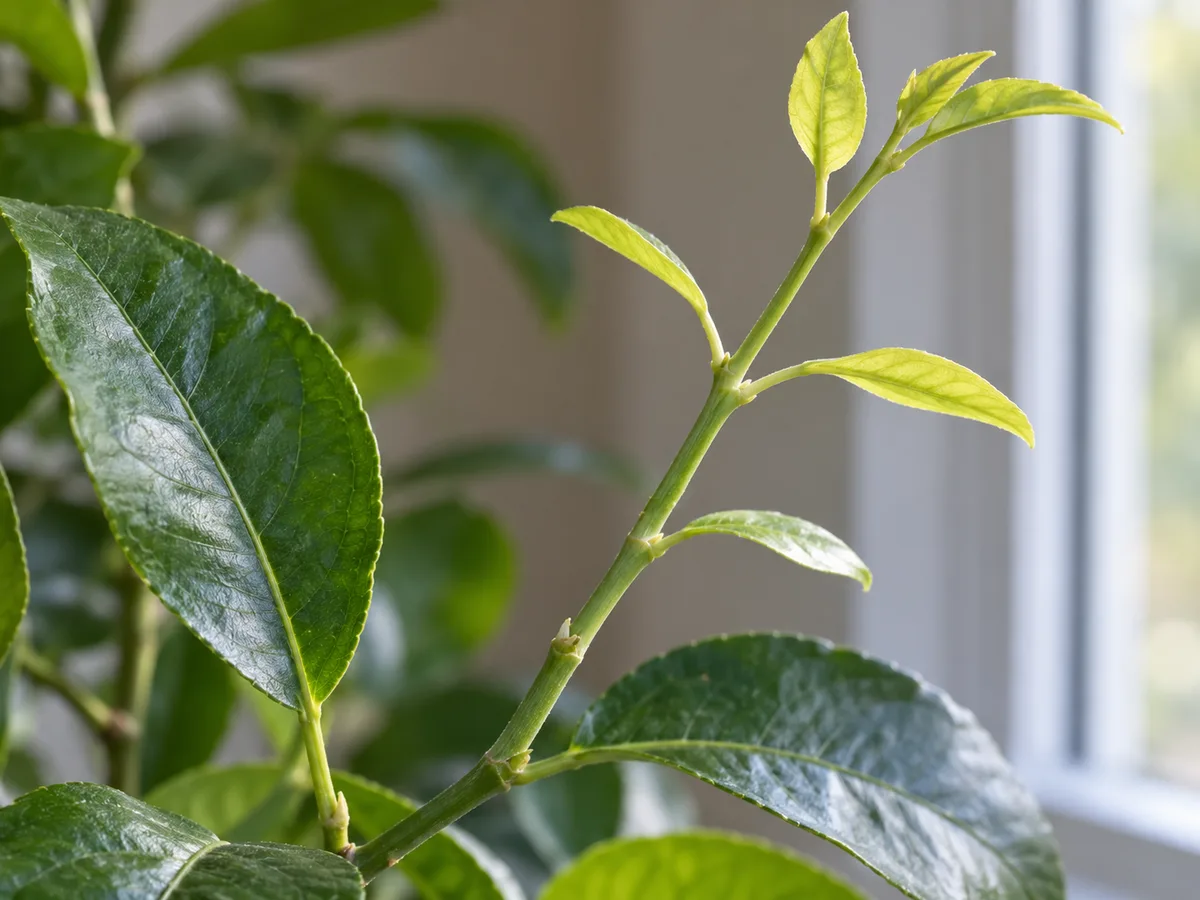
Pale stretched shoots with small soft leaves and widening gaps between nodes signal low light on Citrus limon.
Indoors the whole tree often leans toward the glass, with one-sided growth and a thin crown that lets you see through to the trunk. Growth stalls even in warm weather, which separates light hunger from seasonal rest. If your tree matches the leggy-growth pattern plus bud loss, light is the prime suspect.
Why a sun-demanding citrus shows it first in flowers and fruit
Citrus limon evolved as an open-grown subtropical evergreen, and Missouri Botanical Garden lists it with Sun: full sun in a sunny position. UC IPM advises a site with full sun most of the day, and UF/IFAS planting guidance directs growers to plant citrus in full sun for best growth and fruit production. Translate that into a home target of at least 6–8 hours of direct sun on the canopy, a figure container lemon guidance echoes with at least eight hours for potted trees.
Flowering fails first because buds form on well-lit productive wood. A shaded lemon keeps its older leaves alive for months on stored reserves, so the owner sees a green tree and assumes patience is needed — while every new flush arrives weaker and every blossom drops. UF/IFAS citrus culture notes citrus tolerate light shade but stay more productive in full sunlight, which is exactly the gap between a surviving ornamental and a fruiting tree.
Extra fertilizer cannot close that gap. Nitrogen pushed into a dim canopy forces even softer elongated shoots, which is why shade plus feeding often looks worse than shade alone. Check the fertilizer schedule only after light is corrected.
Terrace, balcony, and overwintering-room light traps
Three placements fool lemon growers repeatedly. A covered balcony that feels bright to human eyes may deliver only one or two hours of direct sun, with the wall behind the pot lit instead of the leaves. A tree tucked against a north-facing wall or under a larger tree gets open sky but no direct beam, which reads as shade to the canopy. And the classic winter trap is a warm dim living room: the RHS citrus guide favors a cool bright winter position over a hot dark one, because heat plus darkness accelerates leaf drop while roots sit wet.
Distance from glass matters as much as direction. Light intensity falls steeply within the first meter from a window, so a lemon parked three meters inside a sunny room is effectively in shade. Sheers, tinted glazing, grimy panes, and neighboring buildings each shave off more. Indoor citrus guidance treats only the brightest window positions as viable long term, with supplemental lamps as backup rather than a full replacement for sun.
How to confirm low light before you move anything
Work through this order so you do not mistake wet roots or pests for shade:
- Measure sun hours on the leaves. Watch the canopy (not the wall) for one fair-weather day and count hours of unfiltered direct beam. Under 4 hours with the symptoms above confirms the diagnosis; 6–8 hours points elsewhere.
- Read the new wood. Long internodes, small soft leaves, and one-sided lean toward the glass are light signatures. Compare against photos in the light needs guide.
- Check the soil clock. Dim canopies transpire slowly, so mix that used to dry in three days now stays damp for a week. Lift the pot and probe 5–8 cm deep before each watering.
- Scan buds and fruitlets. Buds yellowing and dropping on otherwise green wood, with no honeydew or webbing, fits light hunger better than pests. Sticky residue points toward aphids or mealybugs instead.
- Rule out root trouble. If leaves yellow while soil smells sour and roots look dark, read overwatering and root rot first — a drowning root zone mimics shade from above.
First fix: harden the tree toward real sun
Move the pot to the sunniest frost-free position available, but build exposure over 7–14 days. Start with morning sun plus bright open shade at midday, then add roughly an hour of midday beam every two to three days. Glass-grown leaves scorch in sudden terrace sun, and bleached patches never recover, so gradual acclimation is the single action that matters most this week.
Place the canopy — not just the pot — in the beam, rotate a quarter turn every few days to even the crown, and keep the root ball evenly moist (never soggy) as transpiration rises. Do not prune, repot, or spray on moving day; one variable at a time lets you read the response.
Step-by-step recovery after the move
Once the tree sits in its brighter position, sequence the rest:
- Recalibrate watering. Brighter canopies drink faster. Return to the deep-watering rhythm — soak until drainage flows, then let the upper 5–8 cm approach dryness — instead of the cautious sips the dim corner needed.
- Bridge dark winters only. Where outdoor sun is unavailable, run full-spectrum LEDs 30–45 cm above the canopy for 12–16 hours daily as a holding measure, per the light needs guide. Treat lamps as a bridge to spring sun, not a fruiting setup.
- Correct feeding last. Resume small regular citrus doses only when new flushes emerge firm and deep green. Feeding a still-stalled tree forces soft growth that shades itself.
- Tidy selectively. Once compact new shoots appear, shorten only the weakest etiolated stems back to a healthy outward node, following the pruning guide. Never strip a recovering canopy bare — it needs every working leaf.
Recovery timeline
Expect leaf drop to slow within two to three weeks of correct exposure. The first compact flush usually appears within four to eight weeks in warm weather; winter-held trees wait until spring. Flowering resumes on the new well-lit wood one flush later, and fruit sizing normalizes the season after that. Judge progress by shorter internodes and leathery deep-green leaves, not by old pale foliage greening up — it will not.
Lookalike symptoms on a lemon tree
| What you see | More likely | How to separate |
|---|---|---|
| Long bare stems, tiny pale leaves, no blooms | Low light (this page) | Sun hours under 4; one-sided lean; wet-slow soil |
| Same stretch plus sparse crown after winter indoors | Leggy growth | Companion pattern — treat light first, then shape |
| Uniform yellow older leaves, wet sour mix | Overwatering or root rot | Pot heavy, mix sour, roots dark; light may be adequate |
| Yellow leaves with green veins on new flush | Nutrient or pH issue — see fertilizer and soil | Veinal pattern on young leaves; sun hours normal |
| Sudden wilt with dry light mix | Underwatering or wilting | Leaves crisp and perk after deep soak; soil powdery |
| Sticky leaves, sooty film, visible insects | Aphids, mealybugs, or spider mites | Honeydew, webbing, or cottony clusters present |
| Overall stall, tiny leaves, adequate sun | Slow growth | Sun hours check out; inspect roots, pot size, and feeding |
| Lower leaves soft and hanging in dim room | Drooping leaves | Confirms stress — use sun-hour count to pick the cause |
Mistakes to avoid
Do not drag a glass-grown lemon straight into all-day terrace sun; bleached patches are permanent. Do not answer shade with fertilizer — it stretches shoots further. Do not keep the dim-corner watering schedule after the move; brighter trees that stay soggy slide toward mold on soil and fungus gnats. And do not seal the tree in a warm dark room for winter while watering on a summer schedule; cool, bright, and drier-kept beats hot, dim, and wet.
How to prevent it next time
Keep the lemon in the sunniest frost-free position all year: open terrace or south-to-west exposure outdoors, the largest unobstructed window plus outdoor summers for cold climates. Log sun hours when seasons change — a position perfect in May can fall below four hours by December behind the same building. Clean the glass, prune only for airflow per the pruning guide, and repot on schedule through the repotting guide so roots can use the light they get. Low humidity rooms and brown tips often ride along with winter indoor holding; fix light first, then tune those.
When to use this page vs other lemon tree guides
Use this page when shoots stretch, leaves stay small and pale, buds drop, and sun hours measure low. Switch to leggy growth once light is corrected and the job is reshaping. Reach for yellow leaves when veinal chlorosis or sudden uniform yellowing dominates despite good sun. Browse the full set from the lemon tree problems hub or the lemon tree overview when several symptoms overlap.
Related lemon tree guides
- Lemon tree light needs — sun-hour targets, placement, and grow-lamp bridging; read alongside this fix.
- Lemon tree watering — deep soak and dry-down rhythm that shifts with brighter positions.
- Lemon tree soil — fast-draining citrus mix that keeps newly sunlit roots aerated.
- Lemon tree fertilizer — small regular citrus doses to resume after compact regrowth.
- Leggy growth on lemon tree — shaping stretched stems once light is restored.
- Slow growth on lemon tree — when adequate sun still yields no momentum.
- Lemon tree problems hub — scope check when causes overlap.
Related tool
Use the Plant Problem Diagnosis Tool to confirm not enough light against wet roots, pests, and nutrient issues before moving the tree or changing the feeding schedule.