Spider Mites on Lemon Tree: Causes, Checks & Fixes
Quick answer
Pale stippling plus fine webbing on a lemon tree usually means spider mites feeding on the leaf undersides. First, isolate the tree and blast the undersides of every leaf with a strong jet of water, then recheck in 3 days before reaching for any spray.
Spider Mites on Lemon Tree: Causes, Checks & Fixes
This guide covers spider mites on Lemon Tree. See also the general Spider Mites guide, watering, and light pages for this plant.
Spider Mites on Lemon Tree: Causes, Checks & Fixes
Quick answer
Pale stippling plus fine webbing on a lemon tree usually means spider mites feeding on the leaf undersides. First, isolate the tree and blast the undersides of every leaf with a strong jet of water, then recheck in 3 days before reaching for any spray. Stippled leaves will not re-green, so judge success by clean new flush growth and no fresh damage.
What spider mites look like on a lemon tree
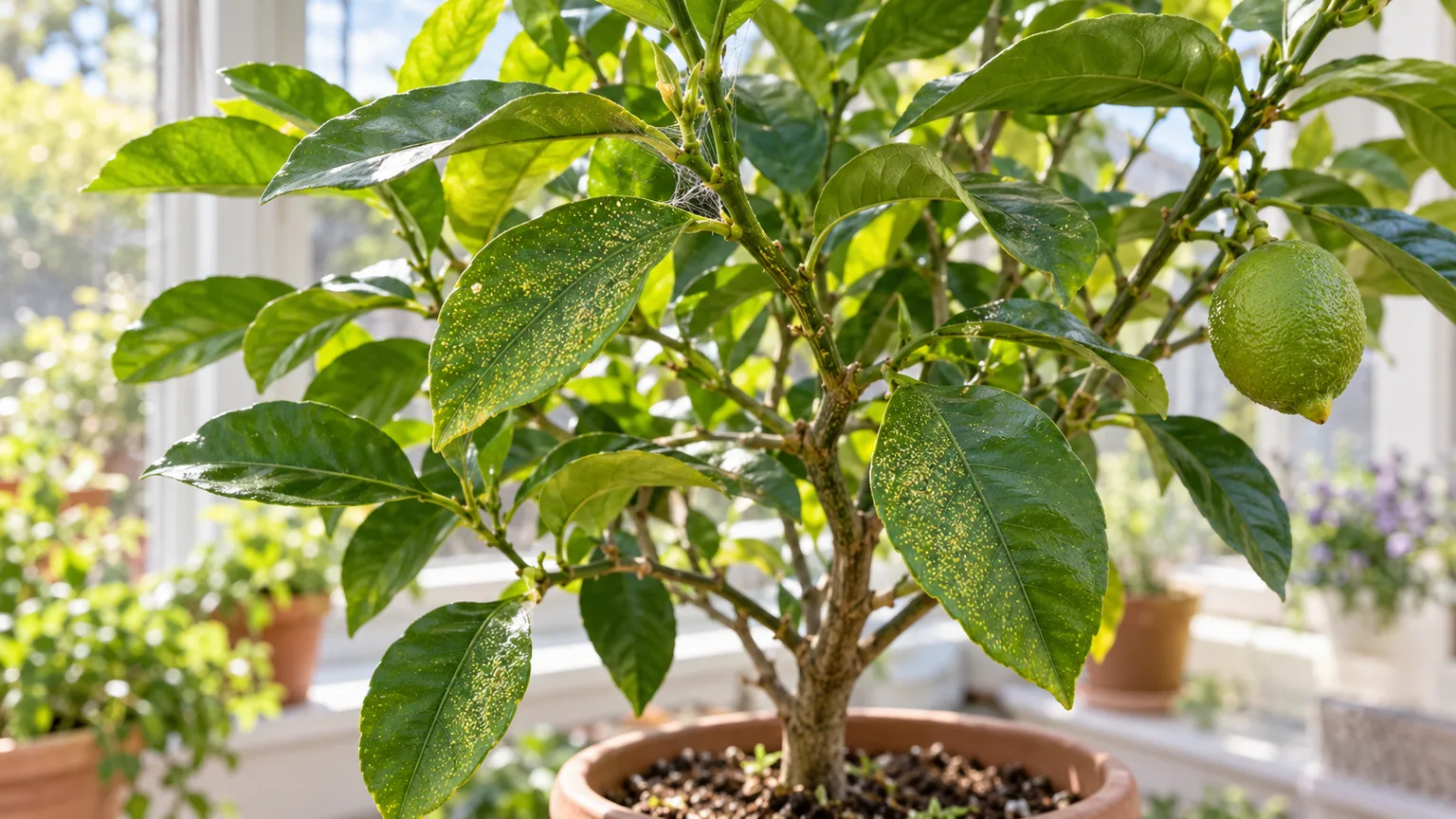
On a lemon tree’s glossy, evergreen leaves, mite feeding shows up as thousands of tiny pale dots — stippling — where mites have sucked out individual cell contents. Light attacks look like a faint yellow dusting between the veins on otherwise green leaves. Heavy attacks turn patches bronze or gray, dry out leaf edges, and can push leaves to drop early, which matters more on a fruiting evergreen than on a fast-regrowing leafy houseplant because every lost mature leaf is lost photosynthesis for the current fruit crop.
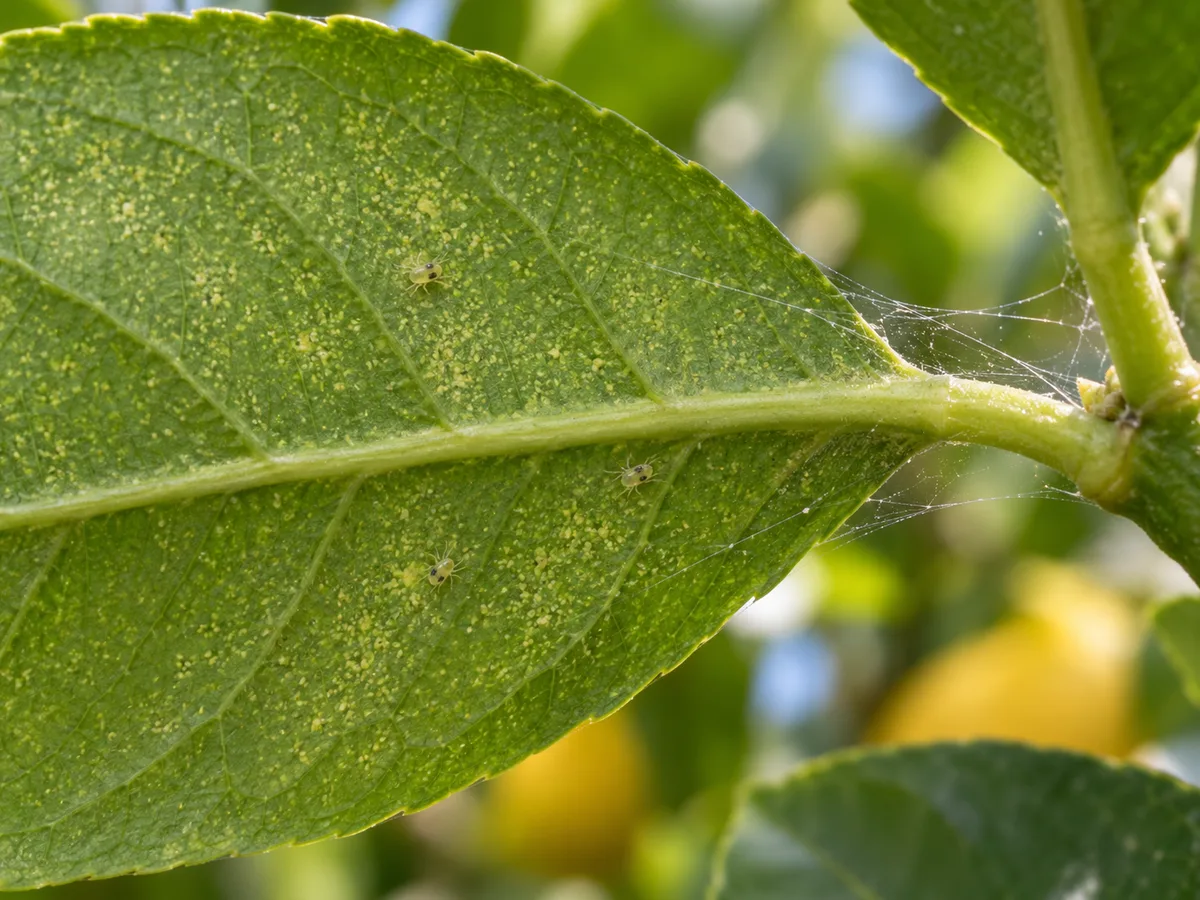
Close-up: pale stippling between the veins with fine silk on the leaf underside — the signature of webspinning mites on citrus.
Two different mites cause most of this damage, and telling them apart changes what you do next. The twospotted spider mite is pale green with two dark spots and covers leaves and fruit with conspicuous webbing. The citrus red mite is red to purplish, about 0.5 mm long, and produces little or no webbing — which is exactly what distinguishes it from the webspinning species on citrus. At least seven spider mite species can be pests on citrus in California, but citrus red mite is the most common, so stippling with almost no silk still deserves a mite diagnosis, not a shrug.
For how mites feed and spread on plants in general, see our spider mites hub. On lemon trees specifically, the pattern usually starts on the undersides of older interior leaves and the soft new flush, then climbs outward as numbers build through spring and late summer.
Why lemon trees get spider mites
A lemon tree is a subtropical evergreen in the Rue family that pushes repeated flushes of soft young growth — and mites prefer exactly that tissue, feeding on young leaves first before spreading to mature foliage. Container trees that overwinter indoors sit in warm, dry, still air beside heating vents, which is close to ideal mite weather while the tree’s growth has slowed and its defenses are down. Dusty leaves make it worse: dust shelters mites and suppresses the predatory insects that would otherwise eat them.
Water stress is the biggest amplifier. Mite damage potential on citrus tracks water stress and heat from year to year, and adequate irrigation measurably reduces feeding damage. A lemon kept too dry between waterings — easy to do when its watering rhythm slips in hot weather — suffers more leaf drop from the same mite population than a well-watered tree. Broad-spectrum insecticides sprayed for other pests can also trigger outbreaks by wiping out predatory mites, which is why a tree recently treated for aphids or mealybugs sometimes breaks out in mites a few weeks later.
How to confirm the cause
Work the leaf undersides first, because that is where spider mites live. Hold white paper under a suspect leaf and tap the leaf sharply: crawling specks the size of dust grains confirm live mites, and a hand lens shows the eight-legged arachnid body. Fine silk strung between leaves or across the leaf surface points to twospotted-type mites; stippling with essentially no silk points toward citrus red mite.
Next, confirm the pattern fits mites rather than care problems. Mite stippling is evenly scattered pinpricks across the leaf, often worst on interior and lower leaves and on the current flush. Compare that against yellow leaves from overwatering, which yellow whole leaves while the soil stays wet, and against underwatering, which curls and crisps leaf edges rather than dotting the surface. If new flush leaves emerge twisted with silvery trails inside the leaf, suspect citrus leafminer instead — a different pest with different treatment. Check your recent history too: a dry spell, a move into hot sun, or a recent insecticide spray all raise the odds that stippling is mite-driven.
The first fix to try
Isolate the tree and wash it — one strong, thorough water treatment, nothing else on day one. Take the tree outside or into a shower and blast the undersides of every leaf, the twig crotches, and any fruit with a firm jet of water. This physically removes most mites, eggs, and webbing without chemicals, and UC guidance specifically recommends periodically hosing off small citrus trees to cut dust and help biological control. Recheck with the white-paper test after 3 days; repeat the wash weekly for two to three weeks if live mites persist.
Hold every other intervention until the wash has had a chance to work. Do not fertilize, repot, prune, or spray oil on the same day — a stressed lemon tree cannot show you what helped if you change five variables at once, and oil sprayed during hot weather can injure citrus foliage.
Step-by-step recovery
- Wash, then wait. Complete the water blast described above and mark the worst leaves with a twist tie so you can tell old damage from new.
- Fix the water. Return to deep watering with the upper 5–8 cm of mix allowed to approach dryness between waterings, and correct any chronic overwatering or dry spells, since even irrigation is itself a mite control.
- Escalate only if mites persist. If live mites survive three weekly washes, apply insecticidal soap or horticultural oil strictly to the leaf undersides in cool, overcast conditions. Soap and refined horticultural oils smother mites while sparing most beneficial insects — but never spray oil in heat, and note the serious phytotoxicity hazard oil poses to green lemons.
- Protect the predators. Skip broad-spectrum insecticides entirely; preserve predatory mites and helpers like lady beetles and lacewings, and keep miticides as an absolute last resort since they select for resistant mites.
- Feed only on recovery. Resume the normal citrus fertilizer schedule once new flush emerges clean — never feed a defoliating, mite-stressed tree to “push” it back.
Recovery timeline
Expect visible progress in 2–4 weeks: fewer live mites on the paper test, no new stippling, and fresh flush leaves emerging glossy and unmarked. Old stippling never fills back in — the emptied cells stay pale permanently — so prune badly bronzed leaves only after the tree has replacement growth. A tree that lost significant foliage may skip or shed its current fruit set; that is triage, not failure. If defoliation continues past a month of correct treatment, or twigs begin dying back, the tree likely has a compounding problem such as root stress or frost damage rather than mites alone.
Lookalike symptoms
| What you see | More likely | How to tell |
|---|---|---|
| Even pinprick stippling + silk on undersides | Spider mites (this page) | Paper-tap shows moving specks |
| Stippling, no silk, red dots along midrib | Citrus red mite (this page) | Stalked red eggs on the midrib vein |
| Twisted new leaves with silvery internal trails | Citrus leafminer | Damage is inside the leaf, not surface dots |
| Sticky honeydew + clustered insects on new shoots | Aphids | Visible soft-bodied insects; see aphids |
| White cottony masses in leaf axils | Mealybugs | Waxy clumps, not dots; see mealybugs |
| Whole-leaf yellowing with wet soil | Overwatering / root stress | Soil stays wet; see overwatering |
| Crisp brown edges in dry air | Low humidity / underwatering | Edge burn, not dots; see low humidity |
When to use this page vs other Lemon Tree guides
Use this page when the damage is pinprick stippling confirmed by the paper-tap test. Switch to the yellow leaves guide when whole leaves yellow uniformly, to the brown tips guide when only margins scorch, and to the overview or the problems hub when you are not sure which symptom matches. Keep the light and watering basics correct throughout — they determine whether the tree outgrows the damage.
Lemon Tree care cross-check
Mite recovery depends on the tree growing vigorously enough to replace damaged leaves, so verify the fundamentals from the overview: 6–8 hours of direct sun, a fast-draining citrus mix kept evenly hydrated but never waterlogged, and regular citrus feed during active growth. Indoor winter trees need the brightest window available plus distance from heat vents — dim, hot, dry rooms stall new growth while mites keep feeding. Remember the handling cautions too: lemon foliage contains oils that are toxic to cats, dogs, and horses, and twig thorns demand gloves, so wash and spray with pets out of reach and wear eye protection when working inside a thorny canopy.
How to prevent it next time
Keep irrigation even through heat waves, since drought-stressed citrus suffers the worst mite damage. Hose dust off small trees periodically and favor strong light and airflow over misting, which does little against mites on a waxy citrus leaf. Quarantine every new plant for two weeks and paper-test it before it joins the collection — indoor citrus groupings share mites fast. Finally, treat beneficial insects as livestock: avoid broad-spectrum sprays for every minor pest, because the predatory mites already patrolling your tree are the cheapest mite control available.
Mistakes to avoid
Do not spray rubbing alcohol, dish soap, or undiluted neem on lemon foliage — citrus leaves burn readily, and phytotoxicity adds defoliation to the mite damage. Do not apply horticultural oil in hot sun or to trees carrying green fruit without reading the label’s citrus cautions. Do not prune off every stippled leaf at once; a stressed evergreen needs its remaining canopy to fund regrowth. And do not “rescue” the tree with extra fertilizer or a repot while mites are active — feeding and root disturbance on a defoliating tree slow recovery instead of speeding it.
Related Lemon Tree guides
- Lemon Tree overview — full care baseline: sun, soil, watering rhythm, and frost protection.
- Lemon Tree problems hub — start here when the symptom does not clearly match mites.
- Watering — use when stippling follows a dry spell or erratic watering.
- Yellow leaves — use when whole leaves yellow rather than showing pinprick dots.
- Aphids — use when new shoots carry clustered insects plus sticky honeydew.
- Mealybugs — use when white waxy masses sit in leaf axils and crotches.
- Low humidity — use when indoor winter air crisps edges alongside any stippling.
Related tool
Use the Pest Identifier Tool to narrow causes for spider mites on this plant before changing multiple variables at once.