Slow Growth on Orange Tree: Flush Cycles & Care Fixes
Quick answer
Slow growth on an orange tree (Citrus sinensis) is often normal: citrus trees do not grow continuously, but in distinct episodic flushes separated by weeks of resting. However, if your tree skips a seasonal flush during warm weather, growth is usually halted by soil pH lockout (pH > 7.5 binding iron and zinc), container root-binding, chronic nitrogen deficit, insufficient sunlight (<8 hours direct sun), or vigorous rootstock suckers stealing resources below the graft union. First step: check the calendar and ambient temperature. If temperatures are between 65°F and 90°F (18°C–32°C) during spring or summer and no new flush appears, test your soil pH and inspect the root ball for circling roots before applying heavy fertilizers.
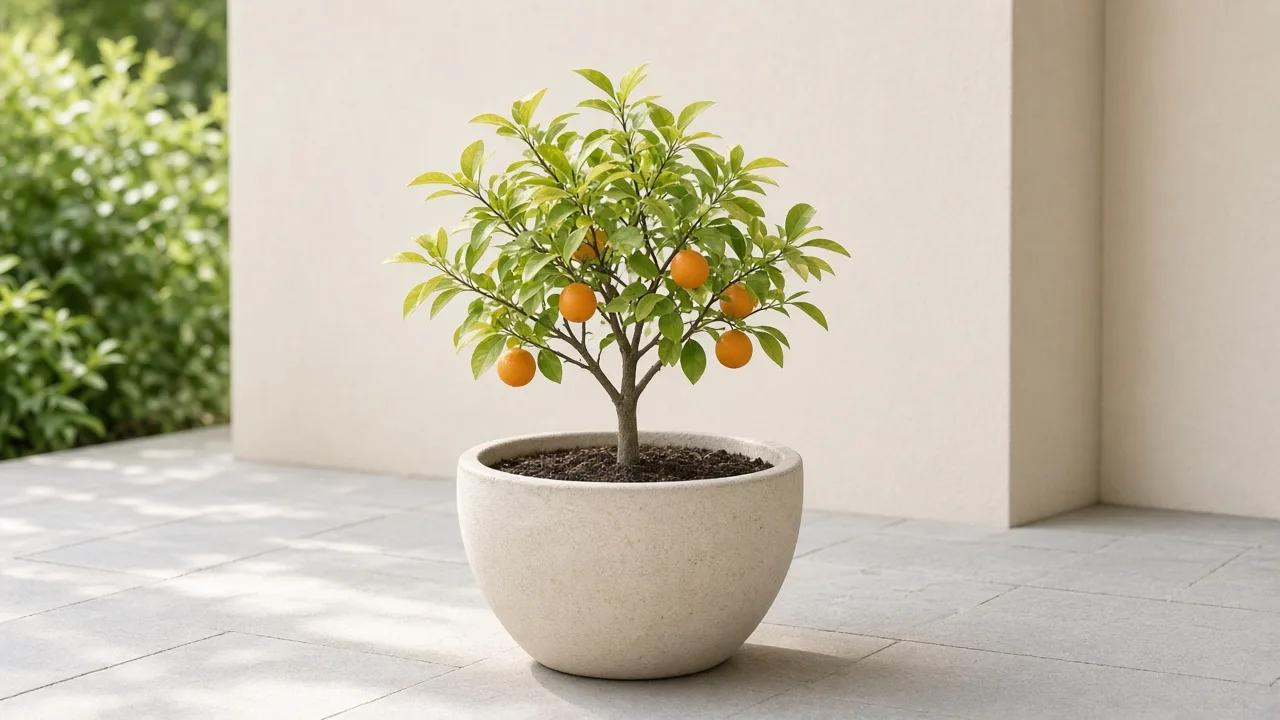
Slow Growth on Orange Tree: Causes, Checks & Fixes
This guide covers slow growth on Orange Tree. See also the general Slow Growth guide, watering, and light pages for this plant.
Slow Growth on Orange Tree: Causes, Checks & Fixes
Quick answer
When an orange tree (Citrus sinensis) stops putting out new leaves, gardeners often assume the tree is failing. In reality, citrus trees do not grow continuously like tropical vines or leafy houseplants. Sweet oranges grow in rhythmic, episodic seasonal flushes—typically producing a strong surge in spring, followed by smaller flushes in early and late summer. In between these cycles, the canopy rests while the tree channels carbohydrates into root expansion, wood lignification, and fruit maturation. For the general physiological mechanics of stalled plant development, read our slow growth guide. On an orange tree, however, a stall is only abnormal if your tree skips a flush during warm, favorable weather.
First step: check the season, temperature, and recent growth timeline. If temperatures are between 65°F and 90°F (18°C and 32°C) and your tree has produced no new growth for an entire spring or summer cycle, check the lower trunk for rootstock suckers, measure soil pH with a calibrated probe (citrus locks out nutrients above pH 7.5), and check whether root circling has trapped the tree. Do not dump high-nitrogen fertilizer onto a dormant or root-bound tree until you confirm the root zone is functional.
When to use this page vs other Orange Tree guides
Citrus issues often overlap. Stalled vegetative growth may occur alongside yellowing foliage, twig dieback, or root complications. Use this diagnostic routing table to ensure you are treating the correct underlying problem:
| What you observe on your tree | Primary underlying cause | Urgency | Action path |
|---|---|---|---|
| Inactive buds during warm weather; leaves remain green and firm | Normal inter-flush resting phase or low sunlight (<8 hrs) | Low to Moderate | Verify flush calendar; move to full sun |
| Pale, stunted leaves with dark green veins; zero new flush | Soil pH lockout (pH > 7.5 binding iron & zinc) | High | Acidify soil to 6.0–6.8; see soil guide |
| Stalled canopy while wild, thorny shoot rockets from lower trunk | Rootstock sucker diverting energy below graft | Immediate | Prune flush to collar; see leggy growth |
| Tree stops growing; water pools on surface or runs down pot edge | Pot-bound circling roots choking root ball | High | Inspect root ball; root prune and step up pot |
| Growth stalled accompanied by yellowing, dropping lower leaves | Waterlogged potting mix suffocating feeder roots | Critical | See watering guide and root rot |
| Stunted, sparse canopy with small, dull, yellow-green leaves | Chronic nitrogen starvation or low fertility | Moderate | Apply citrus feed; see fertilizer guide |
For general tree care and overall cultivation rules, consult the Orange Tree overview and review our comprehensive Orange Tree problems hub.
What slow growth looks like on Orange Tree
Recognizing abnormal stunting on Citrus sinensis requires examining the branch tips and the graft union. A resting tree in good health retains rich, dark green, glossy leaves and plump, green terminal buds that wait for the next temperature trigger. A stressed, stalled tree shows distinct physical warning signs.
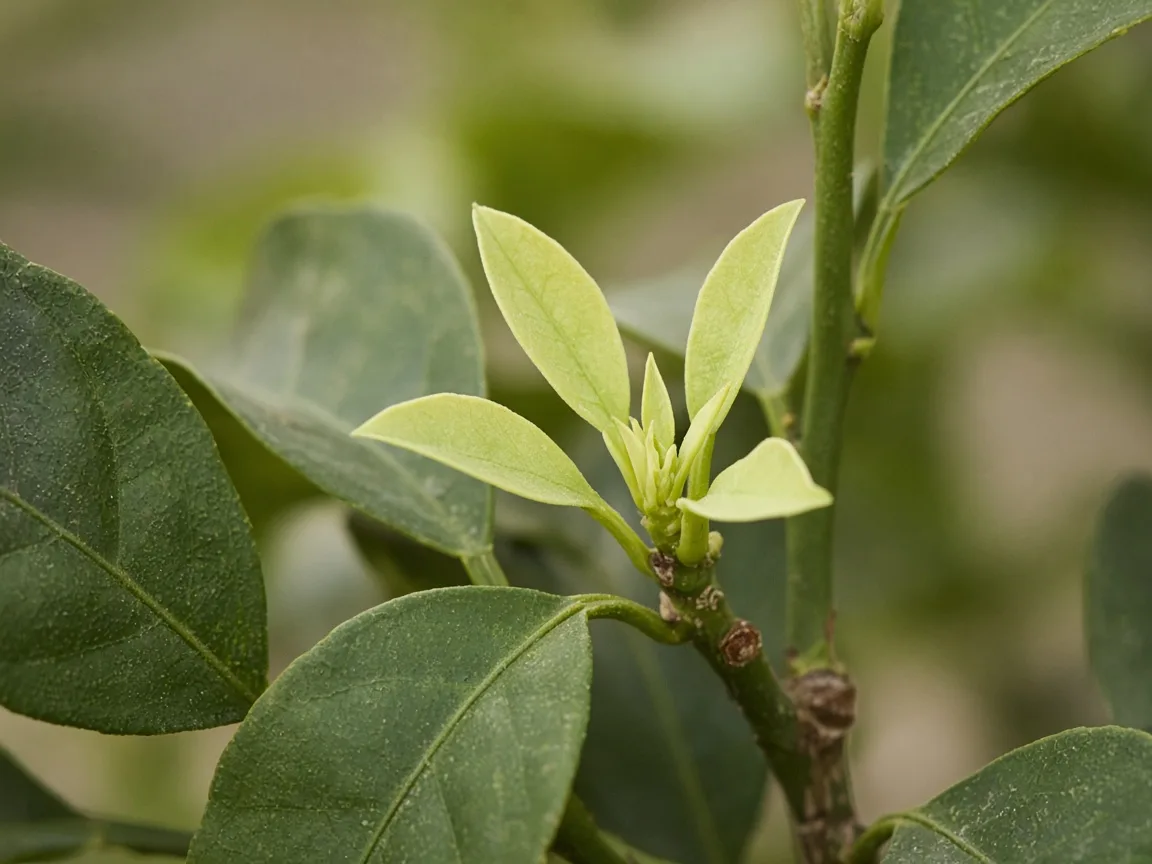
Close-up of a stalled Citrus sinensis terminal branch tip, highlighting tightly compressed nodes, lignified stems, and absence of tender feather flush.
Signs of an unhealthy growth stall:
- Aborted “feather growth”: Emerging flush tips (soft, pale green miniature leaves) turn brown, blacken, or dry up and drop before expanding.
- Interveinal chlorosis on young foliage: If new leaves do manage to emerge, they remain tiny and pale yellow with contrasting dark green veins—a classic indicator of micronutrient lockout.
- Shortened internodal rosetting: Stem internodes become exceedingly short (less than 0.25 inches), causing foliage to bunch into tight, stunted rosettes rather than extending into vigorous lateral branches.
- Premature fruit shedding (“June drop” escalation): While citrus naturally thins excess fruitlets, a stressed tree will abort almost 100% of its pea-sized oranges to conserve energy.
- Lack of stem lignification: Twigs remain thin, brittle, and dull gray-green rather than hardening into sturdy, green-barked structural wood.
The citrus flush cycle: why orange trees pause naturally
Unlike an indoor vine that unfurls a new leaf every few days, sweet orange trees operate on episodic growth flushes governed by internal hormonal cycles and external weather cues. Understanding this botanical rhythm prevents gardeners from misdiagnosing a healthy resting tree as diseased:
[ Early Spring Flush ] ───> [ Quiescent Rest ] ───> [ Early Summer Flush ] ───> [ Quiescent Rest ] ───> [ Late Summer Flush ] ───> [ Winter Semi-Dormancy ]
(Heavy bloom + leaves) (Root expansion) (Shoot elongation) (Fruit sizing) (Hardening wood) (Bud induction <55°F)- Spring flush (major cycle): Triggered by warming soil and increasing day length, this is the most vigorous vegetative flush of the year, accompanied by fragrant blossom clusters.
- Early summer flush (secondary cycle): Typically occurs after the initial fruit set. Shoots expand rapidly over 3 to 4 weeks, hardening before midsummer heat sets in.
- Late summer flush (tertiary cycle): Occurs in late July or August in warm subtropical climates. Foliage from this flush must mature before cool autumn weather arrives.
- Inter-flush resting periods: Between each flush, terminal buds enter temporary dormancy. Meristematic cell division pauses while the tree routes photosynthates down into the root system to build up carbohydrate reserves.
Temperature thresholds that arrest citrus growth
Citrus physiology is strictly bound to ambient root and canopy temperatures. Temperature thresholds for citrus root and shoot activity dictate whether cell division can occur:
- Below 55°F (13°C): Root uptake of water and nutrients drops drastically. The tree enters a protective semi-dormancy where vegetative growth stops entirely. This cool period is beneficial for mature trees, as it induces floral buds for spring.
- Optimum range: 65°F to 90°F (18°C to 32°C): Metabolic activity, transpiration, photosynthesis, and vegetative extension proceed at peak efficiency.
- Above 95°F (35°C): Heat stress forces the tree to close its stomata to prevent catastrophic moisture loss. Photosynthesis halts, cellular respiration consumes stored sugars, and vegetative flush ceases in a state of heat-induced quiescence.
Five primary growth inhibitors on Citrus sinensis
If the season is warm and your orange tree has skipped multiple growth flushes, one of five underlying cultivation bottlenecks is holding the tree back:
1. Soil pH lockout (the invisible nutrient blocker)
Sweet orange trees demand an optimum soil pH range between 6.0 and 6.8. When soil pH climbs above 7.2—which frequently happens in container culture when plants are irrigated with hard tap water rich in calcium carbonates—a chemical catastrophe occurs in the root zone.
Alkaline pH binds essential micronutrients, particularly iron (Fe), zinc (Zn), and manganese (Mn), into insoluble oxidized compounds. Even if your potting soil is packed with fertilizer, the tree’s root hairs cannot absorb these locked-out elements. Without iron to synthesize chlorophyll and zinc to regulate cell elongation hormones (auxins), the apical meristems stall completely.
2. Container root-bound circling
Sweet orange trees develop extensive, vigorous root systems. When grown in containers for more than two years without root management, heavy woody roots hit the impervious container walls and circle tightly around the perimeter. Over time:
- The circling roots form a dense, impenetrable wooden mat that chokes inner fibrous feeder roots.
- Water applied to the surface bypasses the compacted root ball, channeling straight down the sides of the pot.
- Soil volume is consumed by old woody roots, leaving zero pore space for fresh, nutrient-absorbing root tips. Growth in the canopy stalls because the root-to-shoot ratio reaches a hard mechanical ceiling.
3. Insufficient sunlight (<8 hours direct sun)
Citrus sinensis evolved under intense subtropical sun. NC State Extension emphasizes that sweet orange requires a minimum of 8 to 12 hours of direct sun daily to produce the tremendous carbohydrate energy needed for growth flushes and citrus production.
Keeping an orange tree on a covered porch, behind shaded window glass, or under standard household lighting starves the tree of photosynthetic photons. The plant enters survival mode: internodes stretch slightly, leaves darken to capture scarce light, but cell division at terminal buds grinds to an absolute halt.
4. Nitrogen and macronutrient deficiency
Citrus trees have a notoriously high nitrogen demand during active growth. Nitrogen is the foundational building block for amino acids, proteins, and chlorophyll. If your potting mix has been leached by frequent watering or you are using generic houseplant food with low nitrogen and zero trace minerals, the tree simply runs out of raw materials. Old leaves may slowly fade to an even, pale yellowish-green as the tree scavenges mobile nitrogen from older foliage, while terminal buds remain completely dormant.
5. Rootstock suckers diverting energy away from the scion
Almost all cultivated orange trees are grafted onto a wild, vigorous rootstock (such as Poncirus trifoliata, ‘Carrizo’ citrange, or sour orange). If a sucker sprouts from below the graft union on the lower trunk, its wild vigor will dominate the tree. Because the sucker originates directly from the rootstock below the graft union, it intercepts sap, nutrients, and water first. The upper sweet orange canopy is starved of vital carbohydrates, resulting in stunted scion growth while the thorny rootstock sucker thrives.
The graft union diagnostic: scion vs rootstock suckers
If your orange tree has stopped growing at the top but you notice aggressive growth shooting up from the bottom, perform this critical check:
- Locate the graft union: Inspect the lower trunk roughly 3 to 6 inches above the soil line. You will see an angled scar, bulge, or texture change in the bark.
- Examine shoot origin: Any shoot emerging below this line is rootstock tissue.
- Inspect leaf structure: True sweet orange leaves are single (unifoliate) oval blades. If the vigorous shoot has three leaflets (trifoliate leaves) and wicked 1- to 2-inch thorns, it is Poncirus trifoliata rootstock.
- Action: The Royal Horticultural Society instructs gardeners to prune away rootstock suckers flush to the trunk with sharp, sterile bypass pruners immediately. Never leave a stub, as latent buds will sprout again. Removing suckers restores hydraulic pressure and nutrients to the sweet orange scion.
How to confirm what is stalling your Orange Tree
Follow this structured, home diagnostic sequence before changing your care routine or adding amendments:
[ Step 1: Check Temperature & Season ]
    │
    ├── Temp <55°F or >95°F ───> Natural temperature dormancy (Take no action; maintain modest moisture)
    │
    └── Temp 65°F–90°F (Warm) ───> Proceed to Step 2
            │
[ Step 2: Inspect Lower Trunk for Suckers ]
    │
    ├── Shoot emerging below graft ───> Prune flush to collar immediately
    │
    └── Trunk clean ───> Proceed to Step 3
            │
[ Step 3: Measure Sunlight Exposure ]
    │
    ├── Under 8 hours direct sun ───> Relocate to full sun or add 300+ µmol grow lights
    │
    └── Full sun confirmed (8–12 hrs) ───> Proceed to Step 4
            │
[ Step 4: Test Soil pH ]
    │
    ├── pH > 7.2 (Alkaline) ───> Micronutrient lockout (Acidify soil + chelated Fe/Zn)
    │
    └── pH 6.0–6.8 (Optimal) ───> Proceed to Step 5
            │
[ Step 5: Unpot & Inspect Root Ball ]
    │
    ├── Dense root-bound circling ───> Root prune and pot up into 2–4" larger container
    │
└── Roots loose, healthy, uncircled ───> Primary nutrient deficit (Apply dedicated citrus feed)- Step 1: Check temperature context. If the weather is cold (late autumn/winter) or scorching hot (midsummer heatwave above 95°F), the pause is physiological. Protect the roots, water moderately, and do not attempt to force growth.
- Step 2: Inspect the trunk. Search for water sprouts below the graft union. Prune any rootstock suckers immediately to redirect sap to the main canopy.
- Step 3: Measure actual direct sunlight. Log how many hours of unfiltered, direct sunlight strike the foliage. If the tree gets only bright indirect light, it lacks the photon flux required to power a flush.
- Step 4: Test root zone pH. Insert a calibrated digital soil pH meter into the root zone at several points after watering, or perform a 1:2 soil-to-distilled-water slurry test. If pH reads above 7.0, you have confirmed nutrient lockout.
- Step 5: Lift the plant and check roots. If soil pH and light are optimal, slide the root ball out of the container. If the exterior is a solid wall of spiraling woody roots with no visible soil, the tree is mechanically pot-bound.
The first fix for a stalled Orange Tree
Make one targeted environmental correction first: If your tree is receiving less than 8 hours of direct sunlight, transition the tree into full, unobstructed direct sun over 5 to 7 days.
Full sun is the primary engine of citrus metabolism. Moving your tree to maximum sunlight increases photosynthetic rate, elevates root-zone warmth into the active 70°F–85°F (21°C–29°C) zone, and stimulates apical auxin production.
Do not begin by applying heavy chemical fertilizers or repotting a stressed tree on day one. Move the plant into proper lighting first, monitor water consumption for 7 to 10 days, and use that baseline to execute the recovery steps below.
Step-by-step recovery protocol
Once the immediate lighting and trunk checks are complete, address root-zone inhibitors systematically:
1. Acidify alkaline soil and unlock micronutrients
If your soil pH tests above 7.0, micronutrient deficiencies in high-pH soils will block growth until corrected:
- Drench with acidified water: Dissolve 1 to 2 tablespoons of distilled white vinegar or agricultural citric acid per gallon of irrigation water to temporarily knock down root-zone alkalinity during watering.
- Top-dress with elemental sulfur: Apply finely ground elemental sulfur to the potting mix surface (typically 1 to 2 teaspoons for a 10-gallon pot) to provide slow, lasting acidification as soil microbes oxidize the sulfur into sulfuric acid.
- Apply chelated micronutrients: Use a foliar spray or soil drench containing EDDHA-chelated iron alongside zinc and manganese sulfate. EDDHA iron remains bioavailable even in high-pH substrates above 7.5, allowing the foliage to green up while the sulfur works on the soil.
2. Supply dedicated citrus nutrition with trace elements
Once soil pH is within the 6.0 to 6.8 window, replenish depleted nitrogen and mineral reserves:
- Select an organic or synthetic fertilizer specifically formulated for citrus, possessing an NPK ratio close to 2-1-1 or 3-1-2 (for example, 12-6-6 or 8-4-8) with guaranteed analyses of iron, zinc, manganese, magnesium, and calcium.
- For container trees, apply at half the label rate every 3 to 4 weeks during active warm weather. Avoid single massive doses, which spike electrical conductivity (EC) and damage delicate root hairs.
- If you are unsure of exact container dosages, use our Fertilizer Calculator to determine precise nutrient rates based on container volume and tree maturity.
3. Root prune and pot upsize for circling roots
If your inspection revealed severe root binding, repotting is non-negotiable:
- Citrus is intolerant of soggy, compacted substrates. Choose a container only 2 to 4 inches wider than the current root ball, outfitted with multiple bottom drainage holes.
- Using a sterilized root hook or clean shears, shave off the outer 0.5 to 1 inch of dense root felt and slice vertically through any heavy circling roots in three or four places around the perimeter. This stimulates the emergence of fresh, branching feeder roots.
- Backfill with an open, aerated citrus mix composed of 60% loam-based potting mix, 20% fine pine bark, and 20% coarse perlite or pumice as detailed in our orange tree soil guide.
- Water thoroughly until runoff flows freely, and keep the tree in bright, filtered light for 7 days before returning it to full direct sun.
Recovery timeline: what to expect
Resetting an orange tree’s growth requires patience, as meristems must pass through hormonal resets:
- Weeks 1 to 2: The root zone stabilizes. Soil acidification begins lowering pH, and foliar-applied chelated minerals restore active photosynthesis in existing pale leaves. No visible shoot elongation is expected during this stage.
- Weeks 3 to 4: Terminal buds swell visibly at branch tips, transitioning from dry brown scales to plump, bright emerald-green points (“bud break”).
- Weeks 5 to 8: A vigorous new vegetative flush explodes across the canopy. Tender feather shoots elongate several inches, unfurling glossy, dark green leaves with proper winged petioles.
- Months 3 to 6: The new flush fully expands and lignifies into rigid woody branches, establishing the structural framework for future blossoms and fruit production.
Mistakes to avoid when dealing with slow Orange Tree growth
Avoid these widespread errors that compound citrus stress:
- Do not apply bloom booster fertilizers: Phosphorus-heavy bloom boosters lack the critical nitrogen and trace minerals needed to trigger vegetative flushes, and excess phosphorus can further inhibit zinc uptake.
- Do not overwater to “wake up” the tree: When a tree is not actively flushing, its water consumption drops by 40% to 60%. Keeping the soil soggy suffocates roots and breeds Phytophthora water mold; see our orange tree watering guide for proper moisture cycles.
- Do not prune the upper canopy of a stalled tree: Chopping off dormant branches removes stored carbohydrate reserves. Only prune rootstock suckers, dead twigs, or crossing branches.
- Do not use unbuffered garden soil in containers: Heavy garden clay packs down, suffocates citrus feeder roots, and traps alkaline minerals. Always use a dedicated, well-aerated container blend.
Related Orange Tree guides
Strengthen your care routine and cross-check symptoms with our dedicated Citrus sinensis resources:
- Orange Tree Care Overview: Master complete indoor and patio cultivation basics from planting to harvest.
- Orange Tree Soil Guide: Learn how to build an aerated, free-draining citrus mix and maintain optimal pH between 6.0 and 6.8.
- Orange Tree Fertilizer Guide: Determine the right NPK ratios, micro-mineral schedules, and organic feeding methods for potted trees.
- Orange Tree Watering Guide: Master the soak-and-dry irrigation routine to protect sensitive citrus roots.
- Leggy Growth on Orange Tree: Identify the difference between light-starved etiolation and aggressive rootstock suckers.
- Orange Tree Problems Hub: Browse all documented pests, environmental disorders, and diseases affecting sweet oranges.
Related tool
To ensure you provide the exact amount of nitrogen, potassium, and trace minerals without risking fertilizer burn or soil salt accumulation, use our Plant Fertilizer Calculator customized for potted and in-ground sweet orange trees.