Wilting on Orange Tree: Causes, Checks & Fixes
Quick answer
Wilting on an orange tree (Citrus sinensis) stems from four distinct physiological failures: hydraulic underwatering (dry soil causing inward leaf curling), anoxic root rot (soggy soil causing root asphyxiation that halts water uptake), midday vapor pressure deficit (VPD) and heat stress where transpiration outpaces root delivery, or vascular and graft union damage. First step: perform a soil probe check 10 to 15 centimeters deep and inspect pot weight before adding water—soaking an already waterlogged, oxygen-starved root system accelerates root collapse.
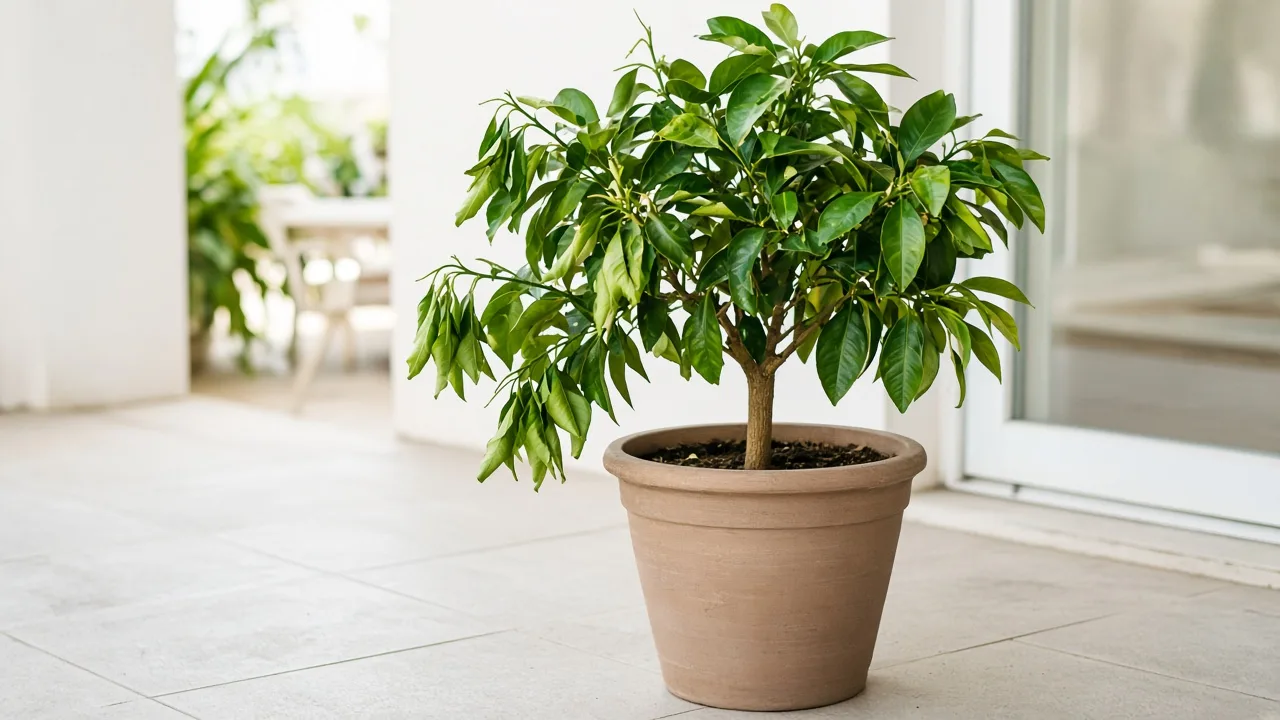
Wilting on Orange Tree: Causes, Checks & Fixes
This guide covers wilting on Orange Tree. See also the general Wilting guide, watering, and light pages for this plant.
Wilting on Orange Tree: Causes, Checks & Fixes
Quick answer
Wilting on an orange tree (Citrus sinensis) indicates that leaf cells have lost internal hydrostatic turgor pressure. This occurs when transpirational water loss from the canopy outpaces the root system’s ability to supply moisture to the xylem vessels. In citrus culture, wilting is not a single diagnosis—it is a shared distress symptom produced by four completely different mechanisms:
- Hydraulic underwatering: The root ball is bone-dry, causing leaves to curl inward lengthwise and lose turgor.
- Anoxic root rot and overwatering: Saturated, anaerobic soil suffocates fine feeder roots, causing decay that stops water transport even though the pot is soaking wet.
- High vapor pressure deficit (VPD) and heat stress: Blistering heat, intense direct sunlight, or dry winds cause leaves to lose moisture faster than even healthy, well-watered roots can draw it up. The canopy wilts during peak afternoon heat and recovers overnight.
- Vascular injury or graft union damage: Fungal crown rots (Phytophthora, Fusarium), mechanical trunk damage, or rootstock incompatibility choke off vascular flow at the stem base.
Consult our global wilting guide for baseline plant hydration principles. On an orange tree, never add water automatically when you see drooping foliage. Always confirm root-zone moisture with a 10 to 15 cm soil probe first. Pouring water onto an already waterlogged citrus tree finishes off suffocating roots.
What wilting looks like on Orange Tree
Unlike soft herbaceous houseplants that droop uniformly into limp green heaps, woody citrus branches react through distinctive morphological stages:
- Loss of Leaf Luster: Healthy orange tree leaves display a glossy, rich deep green cuticle. When cellular turgor drops, the foliage dulls, taking on a matte, grayish-green appearance.
- Inward Longitudinal Curling: As Gardening Know How notes on citrus leaf curling, citrus foliage responds to drought stress by rolling the leaf margins upward and inward toward the central midrib. This physiological reflex shields the stomata on the abaxial (lower) leaf surface from dry air and direct solar radiation, drastically cutting transpirational water loss.
- Limp Apical Shoots: The soft, actively expanding vegetative flush at branch terminals wilts first. New succulent shoots hook downward like a shepherd’s crook, while mature, heavily lignified leaves remain rigid but curled.
- Premature Blossom and Fruitlet Drop: Citrus trees actively shed reproductive sinks to conserve moisture. If an orange tree wilts during spring bloom or early fruit set, it will drop blossoms and pea-sized developing oranges within 48 to 72 hours.
- Desiccated Leaf Retention vs. Defoliation: If drought is sudden and severe, leaves dry out while still attached to twigs. Under chronic root rot or waterlogging, the tree forms an abscission layer at the petiole base, dropping green or chlorotic leaves cleanly onto the ground.
Differential diagnosis: the 4 causes of citrus wilting
Understanding the exact physical or biological bottleneck determines whether your tree needs a deep soaking, an emergency repotting, afternoon shade, or trunk surgery.
| Primary Cause | Soil Moisture (10–15 cm) | Leaf Shape & Texture | Time of Day Sensation | Trunk / Crown Signs | First Corrective Action |
|---|---|---|---|---|---|
| 1. Hydraulic Underwatering | Powder-dry, cracked, lightweight pot | Curled inward, crisp, matte pale green | Constant wilt, day and night | Normal, dry, sound bark | Slow, deep basin soak until runoff drains |
| 2. Anoxic Root Rot / Overwatering | Saturated, muddy, foul or sour odor | Limp, dull yellow-green, soft drops | Constant wilt, worsens after watering | Darkened soil-line bark, mushy feeder roots | Withhold water, aerate soil, prune decayed roots |
| 3. High VPD & Heat Stress | Evenly moist to slightly damp | Soft cupping, temporary midday droop | Strong wilt 1:00–4:00 PM; perky by 7:00 AM | Sound, healthy trunk | Provide 30% shade cloth, windbreak barrier |
| 4. Vascular / Graft Union Failure | Variable (often moist) | Sudden collapse of single branches or whole top | Constant wilt, sudden irreversible dry-up | Oozing gum, cracked graft union, brown wood | Inspect crown flare, excise lesions, apply fungicidal wash |
1. Hydraulic underwatering (drought stress)
Orange trees possess dense root systems, with over 70% of their functional feeder roots concentrated in the upper 30 to 45 cm of the soil profile. According to UC IPM citrus watering guidelines, this shallow root zone makes container and landscape citrus particularly sensitive to surface dry-out.
When soil water potential drops below the plant’s internal water potential, roots can no longer extract capillary moisture. The tree closes its stomata to conserve water, halting photosynthesis. If irrigation is not provided, the leaves roll inward along the midrib and become brittle. If prolonged past the permanent wilting point, the tree sheds foliage to preserve its woody scaffold branches.
2. Anoxic root rot & overwatering (root asphyxiation)
A paradox of citrus cultivation is that too much water produces the exact same top-growth wilt as severe drought. Citrus roots require continuous soil oxygen for cellular respiration, which produces the ATP energy necessary to power active water and nutrient uptake.
As detailed by UF/IFAS Extension on citrus root health, waterlogged and compacted soils displace vital air pores. Within 24 to 48 hours of saturated conditions, roots suffer from hypoxia (oxygen starvation). Without oxygen, root cells collapse and die, effectively cutting off the tree’s water intake straw.
Furthermore, oxygen-depleted soils create the perfect environment for destructive Oomycete water molds. UC IPM research on Phytophthora root rot demonstrates that Phytophthora nicotianae and P. citrophthora release motile swimming zoospores in standing water. These zoospores chemically home in on citrus root tips, penetrating and rotting away the cortex. The outer root tissue sloughs off easily between your fingertips, leaving behind only the stringy internal stele. Because feeder roots have rotted away, the canopy wilts from physiological drought despite sitting in a mud puddle.
3. High vapor pressure deficit (VPD) & heat stress
Vapor pressure deficit (VPD) is the difference between the moisture pressure inside the saturated air spaces of the leaf and the dry ambient atmosphere. When temperatures exceed 90°F (32°C) accompanied by low relative humidity (<30%) or hot winds, VPD spikes dramatically.
Under elevated VPD, the rate of water vapor escaping through open stomata into the arid air accelerates beyond the physical transport rate of the tree’s xylem vessels, even if the root ball is damp. As noted in Royal Horticultural Society advice on citrus cultivation, dry air and atmospheric stress frequently trigger sudden foliage droop. The tree wilts temporarily as an emergency defense, closing its stomata during midday heat. Once the sun sinks and temperatures cool in the evening, transpiration subsides, root pressure catches up, and the foliage re-inflates with full turgidity by dawn.
4. Vascular injury, trunk girdling & graft union failure
Commercially grown sweet orange trees (Citrus sinensis) are composite plants, created by budding the desired scion cultivar onto a specialized rootstock (such as Poncirus trifoliata, Swingle citrumelo, or Carrizo citrange). The junction where scion and rootstock fuse is the graft union, located 10 to 20 cm above the soil line.
If the graft union or lower trunk is compromised, water drawn up by healthy roots cannot pass into the canopy:
- Phytophthora Gummosis: Phytophthora attacks the cambium bark above or at the graft union, causing lesions that exude thick amber gum. As the lesion girdles the circumference of the trunk, the canopy above wilts and dies.
- Citrus Dry Root Rot (Fusarium solani): As documented by UC IPM guidelines on dry root rot, Fusarium solani infects crown and tap roots previously stressed or injured by flooding, causing wood underneath the dead bark to turn hard, dry, and stained grayish-purple. This can cause a mature orange tree canopy to suddenly collapse and dry up in midsummer heat.
- Mechanical Girdling: Weed trimmers, tight nursery stakes, rootstock suckers, or rodent chewing can strip bark around the trunk base, severing both phloem and xylem flow.
- Incompatible Bud Union: Occasionally, a delayed viral reaction or physiological incompatibility between scion and rootstock creates a weak, constricted graft junction that snaps or clogs during heavy fruit loads.
Step-by-step diagnostic confirmation
Follow this reliable clinical sequence to pinpoint the cause before taking action.
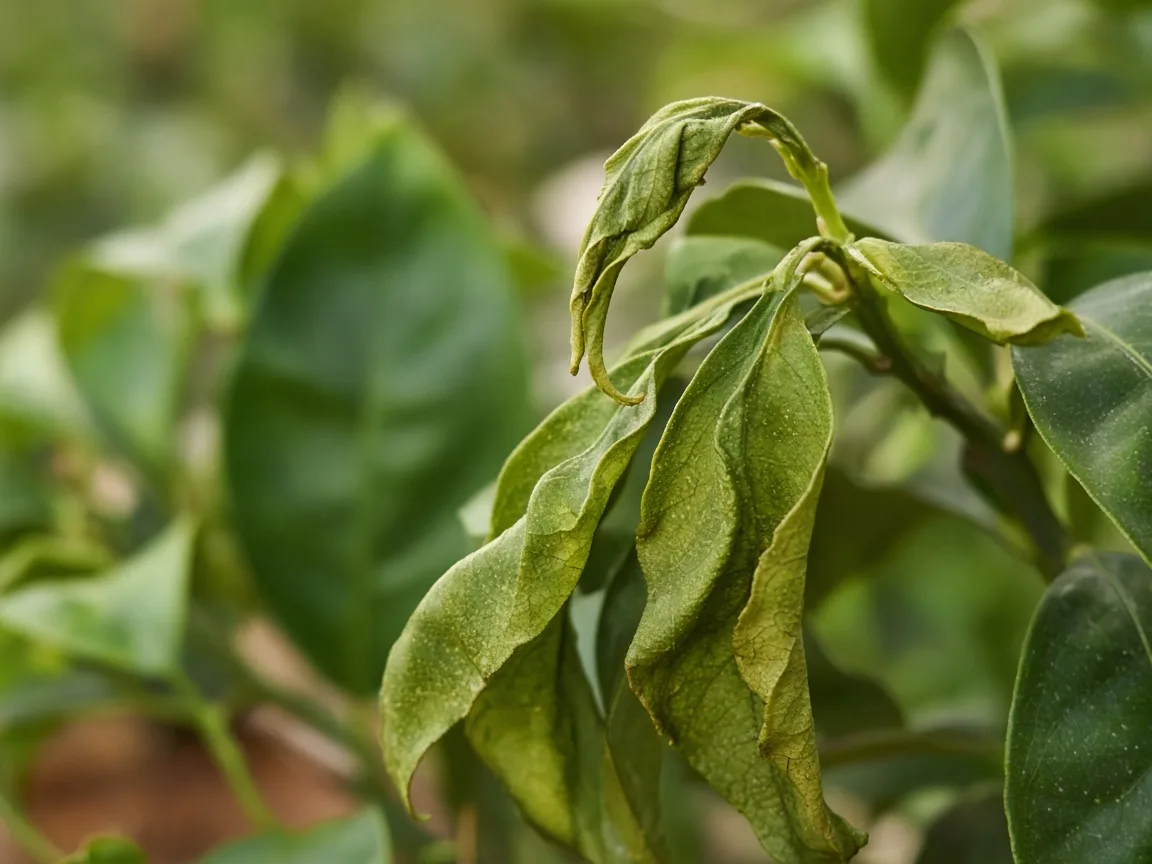
Close-up of Citrus sinensis foliage under water stress: leaves curl inward along the midrib to reduce surface area and limit transpiration.
Step 1: The deep soil probe & pot lift test
Never judge moisture by touching the top 2 cm of soil—peat and bark mulches dry rapidly under air circulation while the root ball below remains waterlogged.
- The Dowel Check: Insert a clean, unfinished 30 cm wooden dowel, bamboo skewer, or soil probe down to the bottom third of the container or root ball (10 to 15 cm deep). Leave it in place for 60 seconds, then withdraw it.
- If the wood emerges pale, bone-dry, and dusty, the root ball is experiencing hydraulic underwatering.
- If the wood emerges dark, cool, and damp with clinging soil particles, the root zone contains moisture.
- If the wood emerges wet, glistening, or smells sour like swamp water, the tree is suffering from anoxic waterlogging.
- The Pot Heft Test (Container Citrus): Tip or lift the container slightly. A dry container feels surprisingly light and top-heavy; an overwatered container feels dense, heavy, and anchor-like.
Step 2: Calibrating and reading a moisture meter
Dial-style electrical conductivity moisture meters are convenient, but they can mislead gardeners if improperly used:
- Clean the Probe: Polish the metal tip with a coarse kitchen pad or fine steel wool before testing. Mineral oxidation on the metal probe produces falsely dry readings.
- Take Multiple Depth Readings: Probe near the edge of the pot, midway in, and directly beneath the main trunk flare. In container citrus, hydrophobic dry pockets often form in the center of the root ball while irrigation water runs down the inner pot walls.
- Interpret with Salt Context: Moisture meters measure electrical conductivity. If you have heavily fertilized your orange tree, salt accumulation will drive the needle toward “Wet” even if the soil is physically dry. Always correlate your meter reading with the physical wooden dowel check.
Step 3: Timing the diurnal cycle
Observe the tree across a 24-hour cycle:
- If leaves droop severely at 2:00 PM when ambient temperatures hit 95°F (35°C), but stand erect and firm at 7:00 AM, the issue is VPD heat stress, not an empty root reservoir. Do not soak an already moist pot.
- If leaves remain stubbornly curled and wilted at dawn, the problem is hydraulic failure within the soil or vascular system.
Step 4: Feeder root and trunk collar inspection
If the soil is moist but the tree remains permanently wilted:
- Gently Unpot or Excavate: Slide the root ball slightly out of its container or scrape away 5 cm of soil near the drip line of an in-ground tree.
- Inspect the Feeder Roots: Healthy citrus feeder roots are plump, fibrous, light cream to pale tan, and resist gentle pulling. Roots compromised by Phytophthora root rot appear dark brown to charcoal black, feel slimy, and the outer cortex easily slips away from the inner thread when pulled.
- Examine the Trunk Flare and Graft: Clear away mulch and topsoil from the trunk base. The graft union should be clean, dry, and well above the soil line. Look for cracked bark, dark water-soaked stains, or amber gum beads oozing from the collar.
The first fix: triage before treatment
Make one targeted physical correction based on your diagnosis. Do not stack multiple treatments simultaneously.
- If Hydraulic Underwatering is Confirmed: Do not splash a single cup of water on top. Dry potting soils high in peat moss or pine bark shrink and become hydrophobic, causing water to channel down the sides of the pot and escape without wetting the root core. Submerge container trees in a deep bucket or basin of lukewarm water for 30 to 45 minutes until air bubbles stop rising, then let drain completely. For landscape trees, build a temporary 10 cm earthen berm at the drip line and run a slow soaker hose for 2 hours.
- If Anoxic Root Rot is Confirmed: Immediately halt all irrigation. Remove the pot from any decorative cachepot or standing saucer of water. Prop the container onto pot feet or wooden blocks so air circulates beneath the drainage holes. If soil is foul and muddy, carefully slide the tree out, slice off black, mushy root sections with sterilized shears, and repot into fresh, aerated citrus mix.
- If Midday VPD Stress is Confirmed: Erect a 30% to 40% agricultural shade cloth over the canopy during peak afternoon hours (12:00 PM to 5:00 PM) and set up a windbreak to deflect dry gusts.
- If Trunk Girdling / Gummosis is Confirmed: Uncover the root flare, gently scrape away dead surface bark from gummosis lesions down to clean green wood, and allow the collar area to dry in open air.
Targeted recovery procedures
Re-establishing hydrophobic citrus soil
When an orange tree dries out completely, organic potting substrates shrink away from the pot container walls. The next time you water, liquid follows the path of least resistance down this gap and flows straight out the drainage holes, leaving the inner root ball dry.
- Top-Dress Penetration: Loosen the hardened top 2 cm of soil with a small hand fork, taking care not to shred surface roots.
- Bottom-Up Immersion: Place the pot into a tub filled with water reaching halfway up the pot. Allow capillary action to draw water upward for 30 to 45 minutes.
- Drainage Purge: Lift the pot, allow all gravity water to empty from the drain holes, and empty the collection saucer 20 minutes later.
Rescuing a waterlogged, root-rotted tree
As emphasized in Missouri Botanical Garden cultural profiles for Citrus sinensis, sweet oranges cannot endure “wet feet.” If roots have begun to rot:
- Extract and Wash: Slide the tree from its pot. Gently wash away the sour, oxygen-starved potting mix with a gentle stream of tepid water to expose the root architecture.
- Surgical Root Pruning: Using sharp pruning shears sanitized in 70% isopropyl alcohol, prune off all brown, black, hollow, or decaying root tissue back to firm, healthy, cream-colored wood.
- Downsize the Container: Do not replant into an oversized pot. Place the tree into a clean container only 2 to 3 cm larger than the remaining healthy root ball. An oversized container holds excess wet soil that rots recovering roots.
- Plant in Porous Medium: Use a specialty citrus mix containing 40% coarse perlite, pumice, or bark chips to ensure rapid gravitational drainage and aeration. Consult our detailed orange tree soil guide.
- Tent and Shade: Keep the repotted tree in bright, indirect light (out of intense sun) for 2 to 3 weeks. Enclosing the canopy in a clear plastic tent can help support high humidity, lowering VPD and transpirational stress while roots regenerate.
Recovery timeline: what to expect
Setting realistic biological expectations prevents gardeners from making panicked, counterproductive interventions:
- 12 to 24 Hours (Drought Rebound): If wilting was caused solely by simple hydraulic underwatering, leaves will uncurl, firm up, and regain their glossy sheen within 12 to 24 hours after a thorough soaking.
- 1 to 2 Weeks (Shedding Damaged Leaves): Leaves that crossed the permanent wilting threshold will not recover. They will turn yellow or pale tan, curl into dry tubes, and drop cleanly. Do not panic—as long as branch twigs remain green and pliable beneath the bark when scratched, the woody framework is alive.
- 3 to 6 Weeks (Root System Regrowth): In trees recovering from overwatering or root rot, the above-ground canopy will appear static for several weeks. The tree prioritizes allocating stored carbohydrates to rebuilding fine feeder roots before it invests energy into new leaves.
- 6 to 10 Weeks (New Vegetative Flush): Once the regenerated root system can support transpiration, apical buds will swell and push a fresh flush of pale green, vigorous leaves.
What not to do: common mistakes to avoid
- Do Not Fertilize a Wilted Tree: Applying chemical fertilizer salts to a water-stressed or root-damaged orange tree is fatal. Mineral salts draw water out of dehydrated roots via osmosis and scorch delicate new root hairs. Withhold all fertilizers until the tree produces a vigorous flush of mature new growth.
- Do Not Leave Pots Standing in Full Saucers: Allowing container citrus to stand in runoff water turns the bottom 5 cm of the pot into a stagnant, anaerobic graveyard for roots. Empty drainage saucers within 20 minutes of watering.
- Do Not Prune Living Canopy During Drought: Cutting off branches while a tree is wilted creates open wound sites and stimulates hormonal attempts to push new shoots, draining the tree’s remaining carbohydrate reserves. Remove dead, brittle twigs only after the tree stabilizes.
- Do Not Repot in the Heat of the Day: If emergency repotting is required for root rot, carry out the procedure in early morning or late evening in a shaded, protected workspace to prevent transpirational shock.
- Do Not Spray Horticultural Oils on Water-Stressed Leaves: Applying neem oil, insecticidal soap, or dormant oils to wilted citrus foliage disrupts stomatal regulation and burns leaf tissues under sunlight.
Orange Tree care cross-check
When an orange tree wilts repeatedly, cross-reference its overall environmental regime against species requirements:
- Watering Rhythms: Allow the top 5 to 7 cm of potting mix to dry before watering deeply. Review our comprehensive orange tree watering guide for seasonal dry-down schedules.
- Soil Porosity: Citrus requires an acidic to neutral pH (6.0 to 6.8) and an open, fast-draining potting substrate with high macroporosity. Read our orange tree soil guide.
- Light Requirements: Orange trees need at least 6 to 8 hours of direct sunlight daily for robust root energy. However, recently repotted or root-damaged trees should be sheltered in bright indirect light until roots recover. See our orange tree light guide.
- Pest Check: Inspect the undersides of curled leaves for sap-sucking pests like aphids, spider mites, and citrus leaf miners that drain leaf moisture and cause secondary leaf cupping. Browse our diagnostic directory of orange tree problems.
- Species Overview: Learn more about container fruit production, temperature tolerances, and seasonal growth habits in our complete orange tree guide.
How to prevent wilting next time
- Adopt the “Soak and Dry” Irrigation Cycle: Never give citrus shallow, daily sips of water. Water deeply until liquid flows freely from the bottom drainage holes, then wait until the upper third of the root ball dries before watering again.
- Elevate Containers: Keep container orange trees on pot feet to prevent drainage holes from being blocked by patio slabs or standing water.
- Mulch Correctly: Apply a 5 cm layer of coarse organic mulch (pine bark or wood chips) over the soil surface to conserve root-zone moisture and moderate soil temperature spikes. Keep mulch pulled back at least 10 cm from the trunk flare and graft union to prevent crown rot.
- Buffer Against Extreme Weather: Move container citrus to a wind-sheltered patio nook during scorching heatwaves or dry continental winds.
- Seasonal Repotting: Repot container-grown orange trees every 2 to 3 years in early spring to refresh decomposed, compacted soil before roots exhaust available aeration pores.
Related Orange Tree guides
- Orange Tree Overview — Botanical biology, seasonal cycles, and fruiting conditions
- Watering Orange Trees — Dry-down depths, winter watering, and container drainage techniques
- Orange Tree Soil & Potting — Porous citrus soil formulations, pH targets, and repotting steps
- Orange Tree Light Requirements — Full sun parameters, indoor grow lights, and heat protection
- All Orange Tree Problems — Diagnostic index for citrus pests, nutritional chlorosis, and leaf drop
Related tool
Use the Watering Can Calculator to calculate the precise irrigation volume required for your orange tree based on container dimensions, soil texture, and current seasonal temperatures before altering your routine.