Mold on Soil on Panda Plant: Causes, Checks & Fixes
Quick answer
White fuzz on Panda Plant (Kalanchoe tomentosa) potting mix is almost always harmless saprophytic mold decomposing wet organic peat, rather than an infection attacking the succulent. However, it indicates a dangerous cultural breakdown: stagnant air, heavy water-retentive soil, and prolonged wetness. Scrape off the surface mold, stop watering until the container dries completely, and increase airflow.
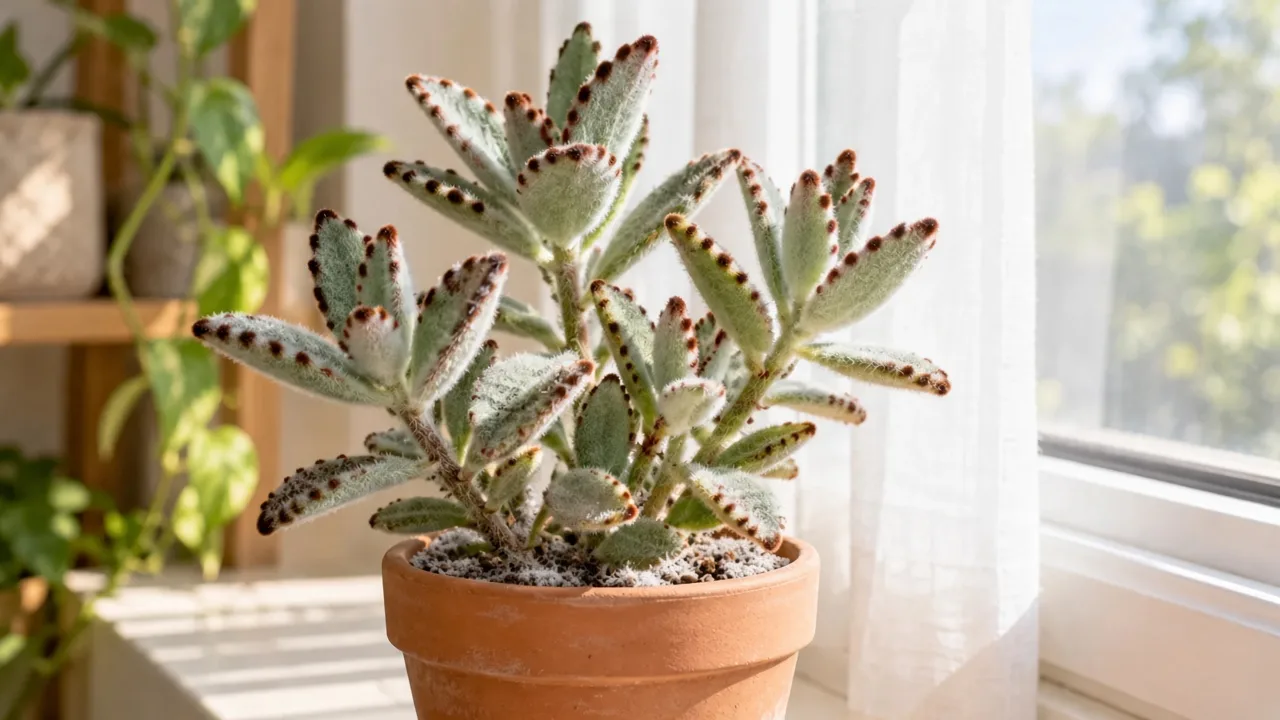
Mold on Soil on Panda Plant: Causes, Checks & Fixes
This guide covers mold on soil on Panda Plant. See also the general Mold on Soil guide, watering, and light pages for this plant.
Mold on Soil on Panda Plant: Causes, Checks & Fixes
Quick answer
A powdery, cottony, or threadlike white film spreading across your Panda Plant’s potting soil is almost always a harmless saprophytic fungus decomposing damp organic matter. While the fungus itself does not infect the succulent’s velvety foliage, its presence is a severe cultural warning. Panda Plant (Kalanchoe tomentosa) is an arid succulent native to the rocky granite hills of Madagascar; persistent moisture at the soil surface directly contradicts its evolutionary biology. For broader fungal mechanics across houseplant containers, consult our global mold on soil guide.
Your first fix is straightforward: stop watering immediately and scrape away the top crust of moldy mix. Dispose of the scraped material in the trash, set the container in a bright spot with active air circulation, and allow the potting medium to dry completely down to the bottom drainage holes before irrigating again. If the stem base remains rigid and the leaves stay plump, you are correcting an environmental imbalance rather than mourning a dying plant.
Is this harmless surface mold or lethal succulent stem rot?
Before applying any treatments, spraying remedies, or unpotting the plant, you must confirm whether you are seeing benign surface saprophytes or the early stages of lethal vascular decay. Use this diagnostic table to determine the exact state of your plant:
| What you see | Underlying condition | Urgency level | Immediate action |
|---|---|---|---|
| White or pale gray fuzz on soil only; main stem rigid and woody; leaves plump | Harmless saprophytic surface fungus feeding on wet organic peat | Low | Stop watering → scrape surface crust → full-pot dry-down |
| White fuzz on soil accompanied by tiny black flies hovering around the pot | Surface mold co-occurring with fungus gnats in damp substrate | Medium | Cease watering → allow topsoil to bake dry → install sticky traps |
| White mold reappearing within 48–72 hours after being scraped clean | Chronic water retention from dense peat mix or cold, stagnant air | Medium | Top-dress with coarse pumice → increase ventilation → plan mix overhaul |
| Black, water-soaked stem collar at the soil line; squishy leaves dropping | Lethal stem rot or black leg caused by Pythium or Fusarium | Critical (same day) | Unpot immediately → excise diseased tissue → follow the root rot guide |
| Chalky, brittle white crust that crumbles into dry powder without fuzz | Mineral salt and carbonate accumulation from hard water or excess fertilizer | Low | Flush substrate with distilled water at next scheduled watering cycle |
The primary difference between cosmetic mold and terminal decay lies in tissue firmness. University of Maryland Extension explains that saprophytic molds are harmless decomposers that colonize moist organic matter on the media surface without invading healthy plant cells. In contrast, opportunistic water molds and pathogenic fungi such as Pythium and Fusarium aggressively attack oxygen-starved root systems, migrating upward into the stem collar to produce fatal basal rot (commonly referred to as “black leg”). If the main stem yields to gentle pressure or shows dark water-soaked discoloration at the soil level, the problem has advanced well beyond surface mold.
When to use this page vs other Panda Plant guides
This diagnostic guide specifically addresses white fungal and mold colonies appearing on the potting mix of an indoor Panda Plant (Kalanchoe tomentosa). Use this scope routing to find the exact protocol needed for your plant’s condition:
- Panda Plant overview — review natural habitat conditions, growth habit, and baseline requirements for Kalanchoe tomentosa.
- Watering guide — learn the correct soak-and-dry irrigation routine, seasonal moisture reductions, and container depth checks.
- Soil guide — discover custom high-porosity mineral substrate recipes (50%–70% inorganic grit) that permanently prevent waterlogging.
- Light guide — evaluate light intensity requirements (bright indirect to direct morning sun) to accelerate soil evaporation.
- Overwatering guide — resolve water-logged conditions, translucent leaf drop, and edema before fungal pathogens invade roots.
- Root rot guide — step-by-step surgical excision, stem beheading, and callous propagation for plants suffering from black stem collapse.
- Fungus gnats guide — eradicate larval populations feeding on soil fungi and delicate succulent root hairs.
- All Panda Plant problems — browse our complete diagnostic index to evaluate multiple overlapping symptoms.
What mold on soil looks like on Panda Plant
In an ideal indoor environment, the top layer of potting mix in a Panda Plant pot remains visibly dry, coarse, and dusty between waterings. When mold colonizes the container, it alters the soil surface:
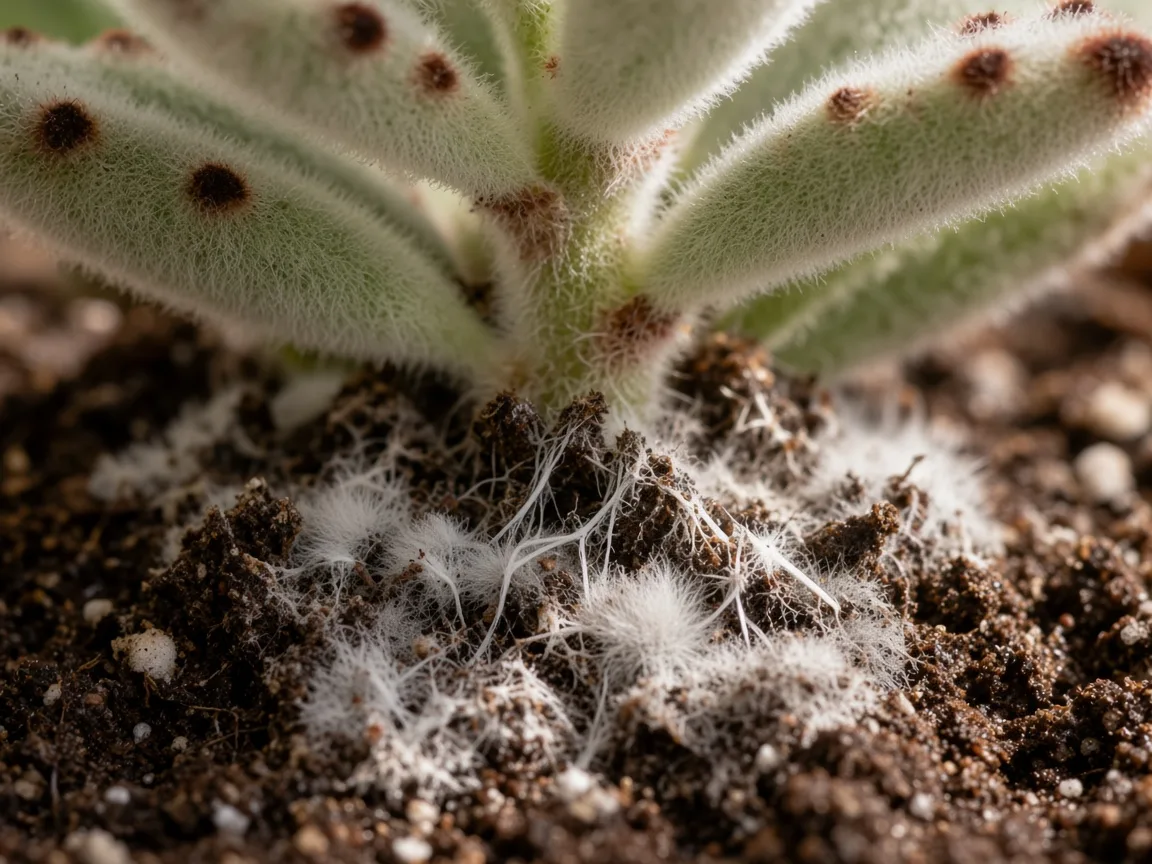
White saprophytic mold on damp potting soil indicates excess moisture and stagnant air beneath a Panda Plant’s velvety foliage.
Panda Plant possesses unique morphological adaptations that influence how moisture interacts with its environment. According to the NC State Extension Gardener Plant Toolbox, Kalanchoe tomentosa is distinguished by fleshy, oblong leaves covered in dense silvery-white trichomes (felt-like hairs) tipped with distinctive chocolate-brown teeth along the margins. These trichomes trap a microclimate of boundary air around the leaf to reduce transpiration in arid conditions. However, when an indoor pot sits in stagnant, humid air, those same low-growing velvety leaves trap moisture against the soil surface, creating an incubator for fungal spores.
Typical benign surface mold features:
- A fine, web-like mycelial network or fuzzy, cottony white-to-gray patches spreading across peat bits, perlite, and bark fragments.
- Growth concentrated in sheltered depressions, beneath low-hanging lower leaves, or along the inner rim of plastic containers.
- The soil beneath feels cool, clumpy, and damp to the touch days after the last watering.
- The plant’s central stem remains firm, woody, and pale gray-green, while the velvety leaves retain their stiff, upward-angled posture.
Warning signs that the environment is compromising the succulent:
- The white fuzz rapidly creeps up onto the lower foliage or attaches to the stem collar.
- The potting mix emits a sour, stagnant, or swampy odor rather than a clean, earthy scent.
- Lower leaves turn pale yellow, take on a translucent jelly-like appearance, and detach at the slightest brush of a finger.
- Probing the stem at the soil line reveals soft, spongy, or collapsing tissue.
Why Panda Plant gets mold on soil: the cultural breakdown
White mold spores (Aspergillus, Penicillium, and related saprophytic fungi) exist naturally in virtually all indoor air and commercial potting substrates. Under normal succulent culture, these spores cannot germinate because the soil surface dries out within hours of irrigation. When mold appears, it serves as a direct indicator of improper succulent culture:
1. Heavy organic peat and lack of mineral porosity
Commercial nursery plants are frequently sold in dense, peat-dominated substrates or coir blends designed for rapid commercial greenhouse turnover. As the Missouri Botanical Garden notes for Kalanchoe tomentosa, this species demands sharp drainage and porous growing media to avoid moisture-related root decline. Peat holds onto moisture tightly and decomposes over time, providing an abundant supply of wet cellulose and carbon for saprophytes while depriving succulent roots of critical gas exchange.
2. Stagnant ambient air and boundary-layer trapping
In closed indoor rooms during fall and winter, air movement often drops to zero. Without a gentle cross-breeze or ambient circulation, humidity settles directly over the soil surface. Panda Plant’s dense, velvety leaf rosettes create an umbrella effect that shields the soil below from moving air, slowing surface evaporation and enabling spore germination.
3. Cool temperatures and slowed succulent metabolism
Panda Plant utilizes Crassulacean Acid Metabolism (CAM) to conserve water, opening its stomata primarily at night. When household temperatures drop below 65°F (18°C) or during short winter days, the plant’s metabolic activity and transpiration drop significantly. Continuing to water on a summer schedule leaves the soil soaked for weeks in cool temperatures, creating the exact conditions that favor fungal proliferation.
4. Calendar-driven watering and trapped saucer runoff
Succulents should never be watered on a fixed weekly schedule. Pouring water into the pot while the core of the root ball is still moist maintains constant capillary saturation. Furthermore, keeping the nursery container inside a decorative, non-draining cachepot allows discarded runoff to pool at the bottom, wicking moisture continuously back up into the root zone. Clemson Cooperative Extension emphasizes that chronic overwatering displaces pore-space oxygen in container media, stressing root hairs and setting the stage for opportunistic pathogens.
How to confirm the cause
Perform these four diagnostic checks before making any drastic care alterations:
- Wooden skewer depth inspection: Insert an unvarnished wooden skewer or chopstick deep into the potting mix near the center of the root ball, leaving it for five minutes. If the skewer emerges cool, dark, and damp, the lower two-thirds of the container are waterlogged, confirming that the surface mold is driven by deep soil saturation.
- Basal collar firmness test: Use two clean fingertips to gently squeeze the base of the Panda Plant’s stem right at the soil line. A healthy Kalanchoe tomentosa stem feels dense, woody, and completely solid. If the stem gives way, feels squishy, or slips under the skin, water mold has invaded the vascular bundles, requiring immediate stem excision.
- Foliage turgidity check: Gently touch the middle and lower leaves. Healthy leaves should feel firm, thick, and velvety. If the leaves feel soft, deflated, and wrinkled while the soil is damp, the roots have begun to rot and can no longer absorb water. If the leaves are soft and translucent, overwatering is actively lysing plant cells.
- Olfactory inspection: Bring your nose near the base of the container. Healthy soil has a neutral, forest-floor aroma. A sour, sulfurous, or septic smell confirms anaerobic bacterial activity caused by chronic oxygen starvation.
First fix for Panda Plant: immediate surface triage
Immediately stop watering and use a clean metal spoon or small garden trowel to gently scrape off the superficial mold crust and top half-inch of contaminated mix.
University of Maryland Extension recommends removing and discarding the upper crust of soil when fungal mats develop on indoor plant media. Scoop up the white threads, loose organic debris, and affected peat particles, deposit them directly into a sealable plastic bag, and dispose of them in the outdoor trash. Do not discard the moldy soil into household compost, where fungal spores can spread to other indoor plantings.
After scraping, leave the soil exposed and do not add water. Avoid the urge to spray vinegar, hydrogen peroxide, or household disinfectants onto the mix; chemical drenches disrupt beneficial soil microbes, alter soil pH, and can chemically burn delicate root hairs near the surface. The single most potent fungicide for an arid succulent is absolute dryness.
Step-by-step remediation: rebuilding succulent growing conditions
Once the visible surface crust has been removed, follow this structured remediation protocol to restore environmental balance:
1. Enforce a complete root-zone dry-down
Leave the plant undisturbed in its current pot until the root ball dries completely. Move the container to a bright, warm location receiving plenty of bright indirect light or gentle morning sun. Position a small oscillating fan across the room to create gentle, indirect air circulation around the pot’s exterior; active airflow accelerates surface evaporation without chilling the plant.
2. Apply an inorganic mineral top-dressing
Once the top inch of mix has thoroughly dried, spread a 1/4-inch to 1/2-inch layer of coarse, inorganic horticultural grit across the soil surface. Excellent materials include:
- Coarse horticultural pumice (1/8-inch to 1/4-inch grade)
- Crushed granite poultry grit (insoluble, grower-grade)
- Coarse black volcanic scoria
An inorganic mineral top-dressing serves a crucial physical function: water passes instantly through coarse stones without clinging to the surface, breaking capillary moisture retention at the air-soil boundary. Because the top-dressing contains zero organic carbon, fungal spores cannot germinate. Furthermore, it keeps the Panda Plant’s low-hanging, velvety leaves elevated away from damp substrate, preventing foliar contact rot.
3. Transition to the soak-and-dry irrigation method
When you finally water again—only after a skewer inserted to the pot base emerges 100% dry—apply water thoroughly around the perimeter of the pot until it pours freely from the drainage holes. Never let the pot sit in collected water; empty the saucer or decorative cachepot completely within 15 minutes of watering. For comprehensive seasonal irrigation advice, follow our Panda Plant watering guide.
4. Overhaul the substrate into high-porosity mineral succulent soil
If the Panda Plant is still potted in dense commercial nursery peat, surface scraping provides only temporary relief. Once the plant stabilizes, repot it into an unglazed terracotta pot with ample drainage holes, using a high-porosity mineral substrate containing 50% to 70% coarse inorganic grit and 30% to 50% organic matter. You can formulate this custom blend using our soil guide or the interactive tool linked below.
Remediation vignette: desktop Panda Plant in florist peat
An indoor grower kept a 4-inch Panda Plant on a shaded office desk in its original plastic nursery container. After four weeks of weekly top-watering, a thick layer of white cottony fuzz covered the dark potting mix, accompanied by a faint sour odor. The main stem probed completely firm, and the velvety leaves remained rigid. The grower scraped away the top half-inch of moldy peat into a bag, moved the plant to an east-facing window sill with a small desktop fan nearby, and withheld all water for 24 days until a wooden skewer emerged completely dry.
After verifying complete dry-down, the grower repotted the plant into an unglazed 4.5-inch terracotta pot filled with a mix of 60% coarse pumice and perlite with 40% succulent soil, topped with a thin layer of crushed granite grit. Within three weeks of adopting the soak-and-dry method, new compact rosettes with crisp chocolate margins emerged from the crown with zero recurring mold.
Lookalike symptoms and what to rule out
Before treating the soil, verify that the white residue is truly fungal mold and not one of these common succulent lookalikes:
| Symptom | Diagnostic appearance | How to distinguish from soil mold |
|---|---|---|
| Mineral salt efflorescence | Hard, crusty, crystalline white or yellowish rings on soil or terracotta rims | Hard and gritty to the touch; does not dissolve or feel fuzzy when touched with a damp finger; caused by tap water minerals or fertilizer salts |
| Powdery mildew (Podosphaera) | Circular powdery white talc-like patches on leaves and stems | Affects the living foliage directly rather than the potting mix; wipes off to reveal chlorotic or damaged leaf tissue beneath |
| Mealybug ovisacs (Pseudococcidae) | Sticky, dense, cottony white clusters tucked into stem joints or leaf axils | Dense wax-like webs containing tiny pinkish oval insects; leaves sticky with honeydew; located on plant tissue rather than soil |
| Soil algae | Slick, velvety green or dark olive-black film on the surface | Green photosynthetic film indicating standing surface water and bright light; requires identical drying protocol |
| Beneficial mycorrhizal hyphae | Fine, fibrous white webbing woven tightly through the root ball underground | Revealed only when unpotting; concentrated around root hairs deep in the mix rather than blanketing the surface soil |
Mistakes to avoid
- Misting the plant’s leaves: Never mist a Panda Plant. Its dense trichomes trap water droplets against the cuticle, which promotes fungal leaf spotting, powdery mildew, and foliar rot while increasing humidity over the potting mix.
- Drenching the soil with chemical fungicides or household remedies: Pouring cinnamon, neem oil, or diluted bleach solutions into the soil will not cure chronic drainage issues and frequently scorches sensitive succulent feeder roots.
- Repotting a soaking wet, moldy plant on day one: Unpotting a plant with saturated roots tears the fragile, water-softened root hairs, opening wounds that allow soil-borne pathogens to enter. Always let the potting mix dry down substantially before attempting a repot.
- Watering directly into the center of the rosette: Always apply water to the surrounding soil perimeter. Pouring water directly into the crown traps moisture between the tightly clustered velvety leaves, initiating crown rot.
- Using decorative moss or organic mulches: Layering preserved sheet moss, sphagnum, or wood chips over succulent soil traps evaporating water and provides an endless carbon food source for mold.
- Leaving spent organic debris on the soil: Fallen leaves, spent stems, and dust provide fuel for saprophytic fungi. Inspect the surface weekly and pick out all debris using tweezers.
- Leaving scraped debris where domestic pets can access it: ASPCA Animal Poison Control warns that Kalanchoe species are toxic to cats and dogs due to bufadienolide cardiac glycosides. Ingestion can cause vomiting, diarrhea, lethargy, and abnormal heart rhythms. Always seal and trash scraped soil and pruned plant parts safely out of reach of household animals.
Recovery timeline and realistic expectations
Recovery from surface mold occurs in distinct phases as the cultural environment stabilizes:
- Days 1 to 5 (Surface stabilization): After scraping and withholding water, existing mycelial growth collapses as surface moisture evaporates. The top layer transitions from dark, wet brown to light, dusty gray.
- Weeks 2 to 3 (Root-zone aeration): Deep pore spaces drain, allowing oxygen to re-enter the root zone. Fragile feeder roots resume normal gas exchange. The stem collar remains firm and woody.
- Weeks 4 to 6 (Substrate overhaul & new growth): Once repotted into high-porosity mineral substrate or top-dressed with pumice, the plant resumes active growth. New pairs of velvety leaves emerge from the terminal buds, sporting vibrant silvery-white trichomes and crisp dark chocolate margins.
Tissue reality note: Any lower leaves that turned yellow, water-soaked, or translucent from prolonged moisture cannot revert to green. Remove them cleanly at the stem. Evaluate recovery by the firmness of the central stem and the vigorous, compact growth of new apical rosettes.
How to prevent mold on Panda Plant soil long term
To ensure white mold never reappears on your Panda Plant’s soil, establish a care routine tailored to its succulent physiology:
- Choose breathable unglazed terracotta: Unglazed clay pots allow moisture to evaporate laterally through the porous pot walls, preventing the persistent soil-surface dampness typical of glazed ceramic or plastic pots.
- Maintain a 50% to 70% mineral substrate: Blend standard cactus mix with generous portions of coarse horticultural pumice, perlite, and crushed granite grit to ensure instant gravitational drainage.
- Follow a rigorous soak-and-dry schedule: Always verify complete root-ball dryness using a wooden skewer or container weight before watering. During active summer growth, this may mean watering every 2 to 3 weeks; during cool winter dormancy, reduce frequency to once every 4 to 6 weeks.
- Maximize bright sunlight: Provide at least 6 hours of bright, filtered sunlight or direct morning sun daily. Brighter light drives transpiration and accelerates soil dry-down, per our Panda Plant light guide.
- Promote constant air circulation: Avoid confining your Panda Plant to dark, stagnant corners or crowded plant groupings. Ensure ample space around the container so room air can circulate freely across the soil line.
- Top-dress with inorganic mineral grit: Maintain a permanent 1/4-inch barrier of horticultural pumice or poultry grit over the soil surface to break capillary action and starve airborne spores of organic matter.
- Manage fungus gnats through complete dry-downs: If gnats accompanied the mold, University of Minnesota Extension advises allowing the soil to dry thoroughly between waterings to dehydrate gnat larvae and break their reproductive cycle.
When to worry: knowing when to escalate
Assess the urgency of your Panda Plant’s situation using these guidelines:
Low urgency (Manage at home): White fuzz is strictly confined to the soil particles; the stem base is hard and woody; the leaves are thick, velvety, and firm; and the mix has only recently stayed damp. Scraping, withholding water, and increasing air circulation will resolve the issue completely.
Medium urgency (Intervene promptly): White mold reappears repeatedly within days of scraping; the pot remains heavy more than 10 days after watering; or small fungus gnats swarm the container. Escalate by withholding water completely, moving to brighter light, top-dressing with coarse pumice, and scheduling a substrate overhaul into gritty succulent mix.
Critical emergency (Execute surgical rescue): The stem collar at the soil line turns brown, black, or squishy; the plant wobbles loosely in the container; lower leaves turn translucent and drop en masse; or the pot smells distinctly sour or rotten. The plant is suffering from lethal stem or root rot. Immediately unpot the plant, cut away all diseased, discolored stem tissue above the rot line using a sterile blade until only clean green tissue remains, allow the cutting to callous in a dry, shaded room for 4 to 7 days, and root it in dry pumice per the root rot guide.
FAQs
Can I continue watering my Panda Plant if only the soil surface has white mold?
No. White mold is visible proof that the potting medium is staying damp far too long for a drought-adapted succulent. Withhold all water immediately and wait until a wooden skewer inserted to the bottom of the container emerges completely dry before even considering another drink.
How do I tell harmless soil mold apart from lethal stem rot on a Panda Plant?
Harmless saprophytic mold forms a superficial white threadlike web across the potting mix while the main stem remains rigid, woody, and gray-green. Lethal stem rot causes the base of the plant to turn black, water-soaked, and squishy right at the soil line, often causing lower velvety leaves to drop prematurely.
Is white mold on Panda Plant potting mix toxic to the plant?
The saprophytic fungi that create white topsoil fuzz do not attack healthy succulent tissue directly; they decompose dead peat and organic matter. However, the wet, oxygen-deprived environment that allows mold to thrive will rapidly suffocate roots and invite lethal fungal and oomycete pathogens.
Should I repot my Panda Plant immediately after finding mold on the soil?
If the plant is potted in dense, moisture-retentive commercial peat or a container without drainage holes, a full repot into a gritty mineral mix containing 50% to 70% pumice or perlite is essential once the soil dries. If the mix is already gritty and the stem is firm, simply scraping off the surface crust and withholding water will usually suffice.
How can I permanently prevent mold from returning to my Panda Plant’s container?
Prevent recurring mold by potting in porous unglazed terracotta, using a high-drainage substrate rich in coarse grit and pumice, providing bright filtered sunlight with gentle air movement, and top-dressing the soil with a thin layer of inorganic gravel or pumice.
Related Panda Plant guides
- Panda Plant overview — botanical characteristics and native habitat care
- Watering guide — seasonal soak-and-dry intervals and moisture testing
- Soil guide — custom mineral succulent recipes and grit amendments
- Light guide — optimal sun exposure for compact growth and dry-down
- Overwatering guide — diagnosing edema and waterlogged substrate early
- Root rot guide — surgical stem excision and propagation for rotting stems
- Fungus gnats guide — eliminating gnat larvae in damp potting media
- All Panda Plant problems — comprehensive species diagnostic index
Related tool
Use our Succulent Soil Mix Calculator to determine the exact proportions of pumice, perlite, and grit needed to create a high-porosity, mold-resistant potting substrate for your Panda Plant.