Aphids on Plumeria: Causes, Checks & Fixes
Quick answer
Aphids on plumeria cluster on the soft new leaves at branch tips and around flower buds, usually during the spring flush. First fix: blast them off with a strong jet of water aimed at leaf undersides and growing tips, then recheck in two to three days before reaching for any spray.
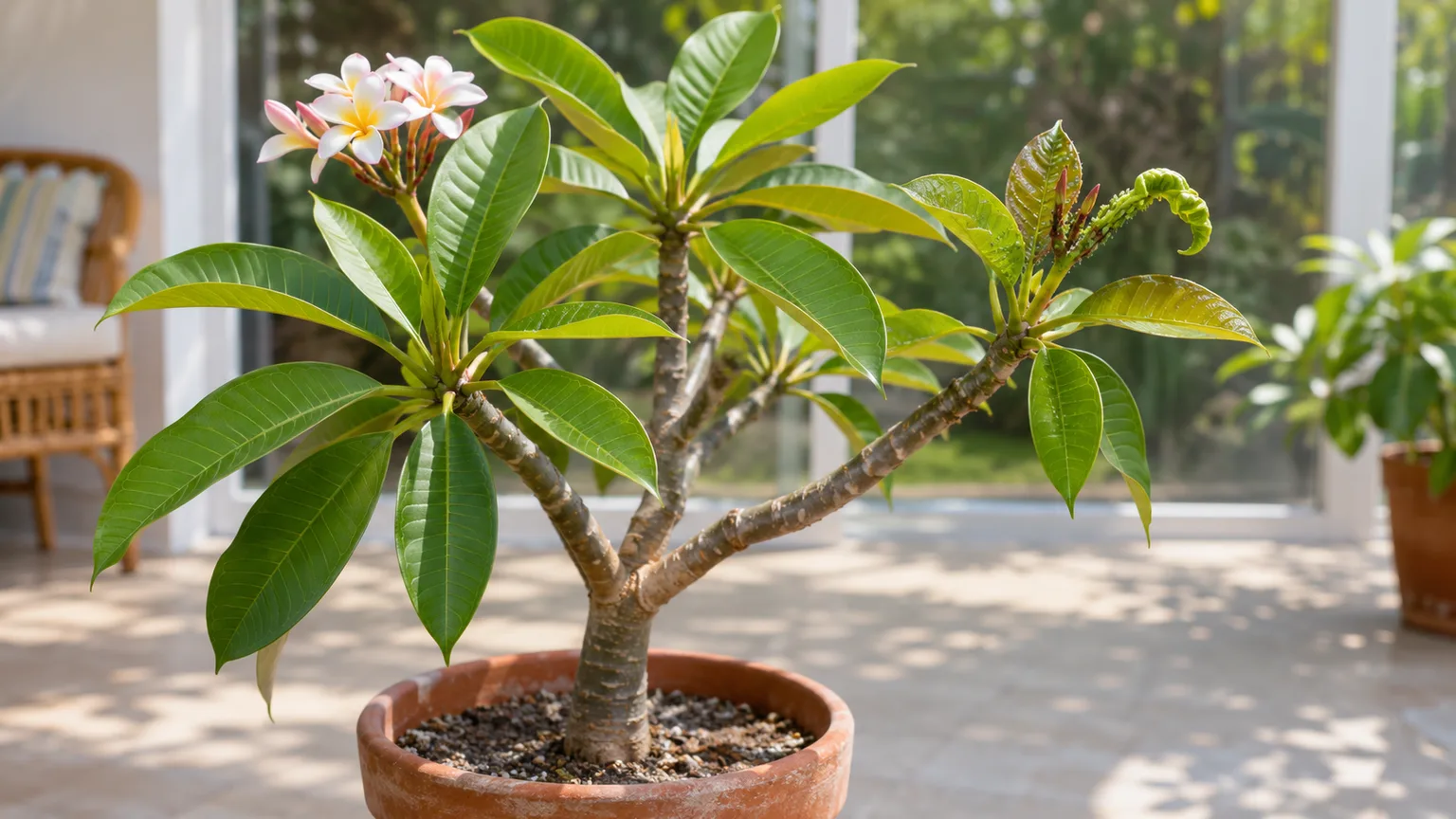
Aphids on Plumeria: Causes, Checks & Fixes
This guide covers aphids on Plumeria. See also the general Aphids guide, watering, and light pages for this plant.
Aphids on Plumeria: Causes, Checks & Fixes
Quick answer
Aphids on plumeria gather on the softest tissue the tree makes: unfurling leaves at the branch tips, the undersides of young leaves, and developing flower buds. Expect them during the spring growth flush, when the tree races from bare stems to full canopy. First fix: take the plant outside in the morning and blast every colony off with a strong jet of water, aiming up into the leaf undersides and branch-tip crevices. Recheck in two to three days and repeat before you consider any soap or oil spray.
For general aphid biology and lifecycle background, see our aphid guide. On plumeria, the pattern usually shows up as stunted branch tips and sticky young leaves rather than whole-tree decline.
What aphids look like on plumeria
Aphids are small, soft-bodied, pear-shaped insects that feed by piercing young tissue and sucking sap. On plumeria they appear as dense clusters in green, yellow, or black, packed onto the spots a casual glance misses: the underside of a half-open leaf, the groove where a new leaf meets the branch tip, and the surface of swelling flower buds.
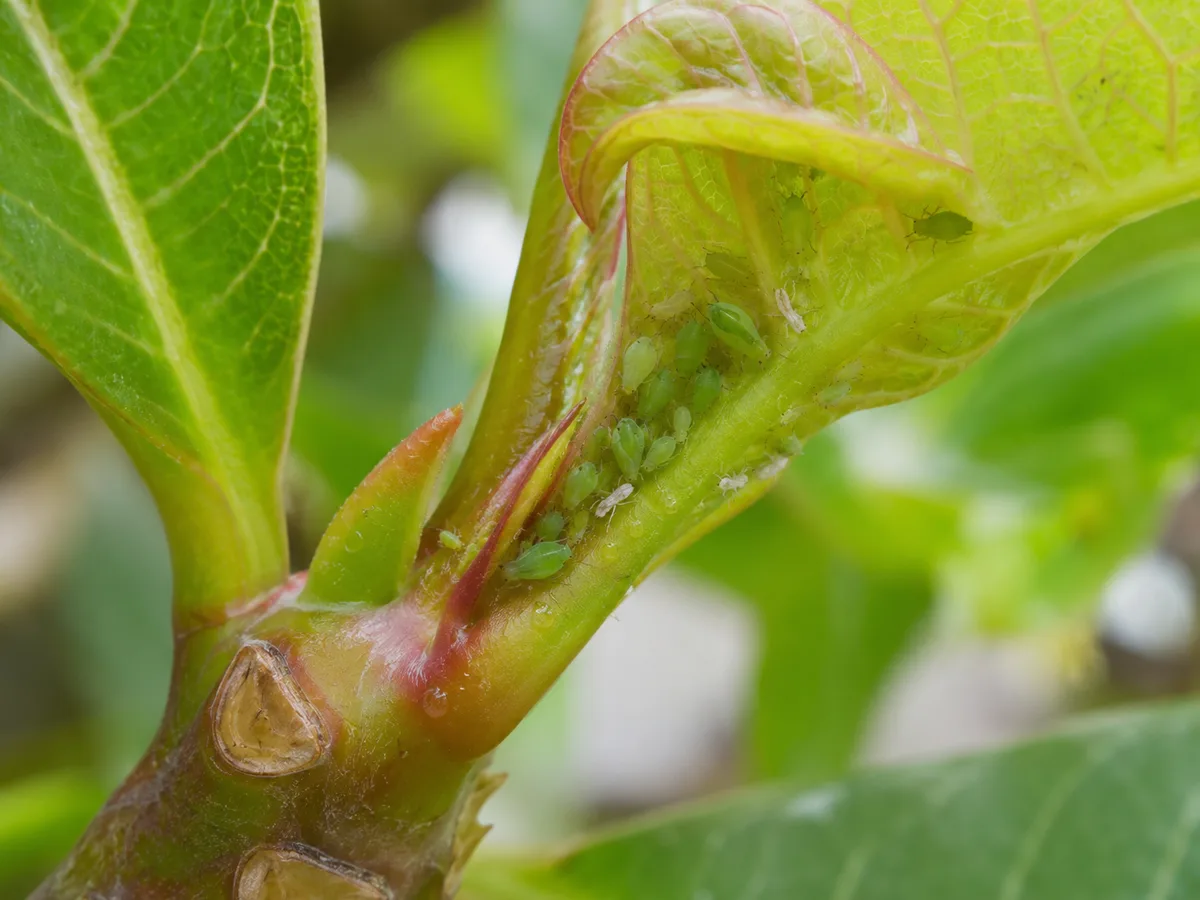
Aphids gather on soft new leaves and branch tips during the plumeria growth flush.
The tree tells on them quickly. New leaves curl inward, pucker, or emerge undersized. Buds that should swell into fragrant flower clusters stall, distort, or drop. Leaves and nearby stems develop a clear sticky coating, which is sticky honeydew excreted by the feeding colony, and that coating often grows a black powdery layer of sooty mold. A line of ants marching up the trunk toward the branch tips is another classic sign, since ants farm aphids for their honeydew.
Why the spring flush invites aphids
Plumeria spends winter as bare, leafless stems, then pushes an entire canopy of soft growth in a matter of weeks once warmth returns. That flush is exactly what aphids want: tender, nitrogen-rich tissue with thin cell walls that mouthparts penetrate easily. A tree coming out of dormancy has no hardened foliage yet, so a colony that lands on the first emerging tips can multiply across every growing point before the leaves even finish expanding.
Feeding habits decide how bad it gets. Plumeria owners naturally want fast growth and heavy bloom, so the temptation is a big dose of high-nitrogen fertilizer at leaf-out. Aphids multiply more rapidly with high nitrogen levels, and the resulting soft, succulent shoots are their ideal nursery. This is why the same tree can be clean one spring and coated the next: the difference is often how the feeding schedule lined up with bud break. Keep routine nutrition on a steady, bloom-oriented fertilizer schedule rather than forcing growth with extra nitrogen.
Container placement matters too. Plumeria needs the full sun covered in the plumeria light guide, but a tree crammed against a wall or crowded by neighbors gets poor airflow around its branch tips, giving colonies sheltered, undisturbed feeding sites. Trees that overwinter indoors face a related risk: aphids can ride inside on stems in autumn and breed unchecked in a warm room with no predators, so inspect every branch tip before the plant goes back out in spring.
How to confirm the diagnosis
Work from the tips inward, in this order:
- Examine each branch tip. Pull the newest unfurling leaf gently aside and look into the crevice. Aphid colonies pack into exactly this shelter.
- Flip the youngest open leaves. Check the undersides along the midrib for clusters, shed white skins, or sticky residue.
- Inspect flower buds. Buds that stall or brown at the tip deserve a close look with a magnifier, since thrips and bud blast look similar from a distance.
- Touch-test for honeydew. If young leaves and stems feel tacky and black mold is spreading, sap-feeding insects are confirmed; aphid clusters identify which ones.
- Watch the ants. Ants commuting up the stems to the tips and ignoring everything else point strongly at aphids or close relatives.
Confirm live insects before spraying anything. Honeydew and curling alone only prove that sap-feeders visited, and plumeria has several of them.
First fix: blast them off with water
In the morning, spray every colony off with a strong jet of water from a hose nozzle.
This is the recommended opening move for plumeria pests generally: a strong jet of water dislodges sap-feeders and drowns many outright, and the blast physically breaks the delicate mouthparts aphids feed with. Aim upward into the leaf undersides and directly into the branch-tip crevices where clusters hide. Morning timing lets the broad leaves dry before evening, which matters for a tree already dealing with sticky honeydew.
Do this first and alone. One thorough blast followed by a recheck in two to three days resolves light infestations completely, and it shows you whether the problem is a small local colony or something that needs escalation.
If they persist: soap, then oil, in sequence
When a second water blast still leaves live clusters behind, step up one level at a time:
- Prune the worst tip only if it is heavily coated. Snipping a single badly infested leaf or tip and disposing of it (not composting) removes the densest colony at once. Do not strip the tree; plumeria needs its new canopy for the season’s energy.
- Apply insecticidal soap. Use a commercial insecticidal soap formulation, coating the colonies directly including leaf undersides, since aphids must be hit by the spray for it to work. Repeat applications are usually needed. Do not substitute dish soap, which can damage foliage.
- Consider neem or horticultural oil for stubborn cases. These smother and disrupt feeding and are a standard follow-up when soap alone fails. Spray every 7 to 10 days until colonies subside, treat at dusk to avoid leaf burn in strong sun, and test one leaf first since some plumeria varieties react sensitively.
- Recruit predators. Lady beetles and lacewings eat aphids in large numbers, and a plumeria grown outdoors in season will attract them on its own if broad-spectrum sprays are withheld. Releasing ladybugs near the tree in the evening can speed the process.
Never combine pruning, soap, and oil on the same day. Each step stresses young tissue slightly, and stacking them makes it impossible to tell which action worked.
Dormancy changes everything
Plumeria’s deciduous rhythm gives you a structural advantage most houseplant owners never get: for part of the year, there is simply no foliage for aphids to eat. Use it.
Do not spray bare winter stems preventively. With no leaves present there is nothing to protect, and oil residues on dormant branch tips serve no purpose. Instead, make bud break your inspection trigger. The week the first leaf spikes emerge from the branch tips, check every tip twice weekly. Colonies caught at this stage consist of a few dozen insects on soft tissue a water blast removes in seconds; the same colony ignored for three weeks becomes thousands spread across buds and young leaves.
For trees overwintered indoors, quarantine logic applies in both directions. Inspect before bringing the tree in, because a small autumn colony breeds all winter in a heated room, and inspect again before spring move-out. Standard plumeria watering discipline keeps the dormant root zone nearly dry through this period, so any sticky residue or curling you see indoors cannot be blamed on watering and should be treated as a pest signal.
Lookalikes on plumeria
Several plumeria problems mimic aphid damage at a glance:
- Plumeria rust shows as orange-yellow powdery pustules on leaf undersides, often with yellow spots above. Unlike aphid honeydew, rust dust is dry and powdery, and leaves drop from the lower canopy first. Browse the plumeria problems hub if rust-like spots dominate.
- Mealybugs form white, cottony, stationary clumps tucked into branch forks and stem joints rather than mobile clusters on young leaf undersides. They need alcohol-dab treatment, not a water blast.
- Spider mites cause fine stippling and pale speckles, worst in hot, dusty conditions, with delicate webbing between leaf ribs on close inspection. Mites hate the water blast too, but they do not produce honeydew.
- Whiteflies fly up in a small cloud when stems are shaken. Aphids never fly unless winged forms develop, and they stay clustered instead of scattering.
- Normal autumn leaf drop yellows older leaves evenly as the tree heads for dormancy. Aphid yellowing is patchy, sticky, and concentrated on new growth during the growing season, not a whole-canopy event in fall.
When symptoms overlap, the touch test decides: sticky means sap-feeders, dry and powdery means rust, fine webbing means mites.
Mistakes to avoid
- Dosing extra fertilizer to push past the damage. More nitrogen grows exactly the soft tissue aphids want, and a stressed tree cannot use the feed well anyway.
- Spraying at midday in full sun. Wet leaves plus oil or soap films scorch easily on a sun-loving tree. Treat at dusk or early morning.
- Reaching for systemic insecticides first. Plumeria flowers feed pollinators, and broad-spectrum products kill the ladybugs and lacewings doing free control work. Reserve systemics for cases that survive water, soap, and oil.
- Ignoring the ants. As long as ants guard the colony, predator insects struggle and reinfestation follows cleanup. A sticky barrier on the pot rim or trunk wrap breaks the partnership.
- Treating autumn leaf yellowing as a pest emergency. Check the calendar first: a plumeria dropping leaves as nights cool is going dormant, not dying.
Recovery timeline
Plumeria recovers from aphids faster than from most of its problems, because the damage is confined to soft tissue the tree replaces continuously in season.
- Days 1 to 3: colonies gone after the blast, honeydew rinsed away. Some curling remains on leaves that fed on.
- Weeks 1 to 2: new leaves at the branch tips open flat and clean. Sooty mold dries and flakes off instead of spreading.
- Weeks 3 to 4: flower buds resume swelling if they were only lightly affected. Buds that browned fully will not reopen; the tree sets new ones on healthy tips.
Judge recovery from the newest growth at each branch tip, not by whether curled leaves flatten. They will not. If every fresh round of leaves still emerges distorted, live colonies remain hidden in a tip crevice or bud, and the soap step is due.
How to prevent it next season
Prevention is mostly timing plus moderation. Start tip inspections at leaf-out and continue weekly through early summer while growth is softest. Feed on the measured schedule in the plumeria fertilizer guide and keep the fast-draining structure from the plumeria soil guide so the tree grows steadily rather than in nitrogen-driven surges. Prune lightly for open airflow between branches following the plumeria pruning guide, which removes the crowded, shaded tip clusters where colonies establish first.
Keep the tree’s overall vigor up with the sun and drainage it demands. Healthy plumeria outgrows minor aphid visits, and a tree checked weekly never hosts a colony long enough for honeydew to mold.
When to use this page vs other plumeria guides
- Plumeria hub — start here for the whole care picture: sun, dormancy, and seasonal rhythm.
- Plumeria watering — check when leaves yellow or wilt without any sticky residue or visible insects.
- Plumeria light — check when growth is leggy or bloom fails in the absence of pests.
Related Plumeria guides
Related tool
Use the Pest Identifier Tool to narrow causes for aphids on this plant before changing multiple variables at once.