Fertilizer Numbers: What They Mean and What to Look For
Fertilizer numbers show nitrogen, phosphorus, and potassium percentages by weight. Learn how to read N-P-K labels, compare bags, and pick the right ratio.
Walk down any garden aisle and every bag or bottle advertises the same kind of code: 10-10-10, 24-8-16, 3-5-3, or 32-0-5. Those fertilizer numbers are not a quality score, a maturity rating, or a secret cultivar code. They are the guaranteed analysis — the percentage of nitrogen (N), phosphorus (P), and potassium (K) in the product, always in that order, always expressed by weight.
Once you read N-P-K as a label rather than a lottery ticket, shopping gets simpler. You can compare two bags fairly, follow a soil-test recommendation that lists pounds of actual nitrogen, and stop buying bloom booster for a lawn that only wanted green leaves. For feeding schedules and product picks after you understand the numbers, see our how to fertilize indoor plants hub, complete indoor fertilizing guide, and best fertilizers for indoor plants roundup.
What the Three Numbers on a Fertilizer Label Actually Mean
A label reading 20-5-10 means the product contains 20% nitrogen, 5% phosphorus, and 10% potassium by weight. The dashes are shorthand; some labels spell out N-P-K explicitly. If you see 10-0-0, the middle and last numbers are zero — that product delivers nitrogen only. A 0-20-0 is phosphorus only. Zeros are useful data, not missing information.
N-P-K Order Never Changes
N always comes first, P second, K third — worldwide, on every legal fertilizer label. Phosphorus is reported as P₂O₅ (phosphate) and potassium as K₂O (potash) on U.S. labels, but gardeners still call the middle and last slots phosphorus and potassium. Do not rearrange the numbers when comparing products or matching a soil-test printout.
Percentages by Weight, Not Volume
The percentages refer to weight, not scoop volume. A dense granular and a fluffy organic blend can look similar in a cup but deliver very different nutrient loads. That is why a 5-pound bag of 10-10-10 and a 10-pound bag of 5-10-5 can supply the same total nitrogen, phosphorus, and potassium if you apply them according to label rates — the concentration differs, not necessarily the outcome.
Quick bag math: multiply bag weight by the percentage (as a decimal). A 40-pound bag of 10-10-10 contains about 4 pounds of nitrogen, 4 pounds of phosphorus, and 4 pounds of potassium. A 33-pound bag of 32-0-5 contains about 10.6 pounds of nitrogen and 1.7 pounds of potassium, with no phosphorus — useful when a soil test says “apply 1 pound of actual nitrogen per 1,000 square feet” and you need to know how much product that requires (Pennington).
How to Read NPK Like a Shopping Label
Think of the front N-P-K as the headline and the ingredient panel as the footnotes. The headline tells you the three macronutrients. The footnotes list micronutrients (iron, manganese, boron, zinc, and others), secondary nutrients like calcium and magnesium, carriers, and fillers.
Complete, Incomplete, and Balanced Fertilizers
A complete fertilizer contains all three macronutrients — any ratio where N, P, and K are all above zero, such as 10-10-10 or 4-5-4. A balanced fertilizer is a complete formula with roughly equal numbers, like 10-10-10 or 20-20-20. Balanced does not mean “right for every plant.” It means the three nutrients are present in similar proportions.
An incomplete fertilizer omits one or two macronutrients — 32-0-5 lawn food, 0-20-0 superphosphate, or 15-0-0 lawn nitrogen. Incomplete is not inferior. It is targeted. Many lawns already have enough phosphorus in soil; repeated phosphorus applications can contribute to runoff, which is why some regions restrict phosphorus on turf unless a test proves a deficiency (Gardening Know How).
Higher Numbers Are Not Automatically Better
A 20-20-20 product is more concentrated than a 10-10-10, not automatically “twice as good.” You apply less of the stronger formula to deliver the same nutrient load. Conversely, chasing the highest numbers on the shelf is a common path to fertilizer burn — soluble salts pulling water from roots — especially on containers, new transplants, or plants in low light (University of Georgia Extension).
The right question is not “What is the biggest number?” but “What ratio does this plant need, in what concentration, at this growth stage, in this soil?”
What Nitrogen, Phosphorus, and Potassium Do in Real Gardens
The three macronutrients are called macro because plants use them in the largest quantities. Each drives a different part of growth.
Nitrogen for Leaves and Green Color
Nitrogen fuels chlorophyll production and leaf expansion. Lawn grasses, leafy greens, corn, and foliage houseplants respond strongly to nitrogen. Too little nitrogen shows up as pale or yellowing older leaves and slow growth. Too much nitrogen on flowering or fruiting plants pushes lush leaves at the expense of blooms and fruit — the classic “all vine, no tomato” problem (Pennington).
High-first-number blends such as 24-8-16, 20-10-10, or 32-0-5 target green, vegetative growth. That is what you want on an actively growing lawn in spring — not necessarily on a tomato already loaded with foliage.
Phosphorus for Roots, Flowers, and Fruit
Phosphorus supports root development, flowering, fruit set, and efficient use of other nutrients. Bulbs, roses, tomatoes, and young transplants often benefit from a higher middle number during establishment or bloom — think 10-30-20 blossom boosters or 4-6-3 flower formulas.
Phosphorus moves slowly in soil and is easy to over-apply. If your soil test already shows adequate phosphorus, adding more will not force extra blooms; it may simply waste money and add environmental risk on sandy or runoff-prone sites.
Potassium for Strength, Stress, and Overall Balance
Potassium helps regulate water movement, disease resistance, drought tolerance, and overall plant balance. It does not get the marketing spotlight nitrogen does, but the third number matters for fruit quality, winter hardiness, and stress recovery. Formulas like 10-10-20 or 4-5-8 tilt toward potassium when root systems and cell strength need support.
If symptoms look like a deficiency but N-P-K seems fine, read the back label or test for micronutrients — iron chlorosis and magnesium issues mimic N-P-K problems (Gardening Know How).
What the Other 70 Percent of the Bag Contains
A 10-10-10 product is only 30% N-P-K by weight. The rest is carrier material, fillers (sand or limestone in some granular blends), coatings on slow-release prills, moisture, and sometimes micronutrients or organic matter. None of that is wasted weight — it affects spreadability, release speed, and soil biology.
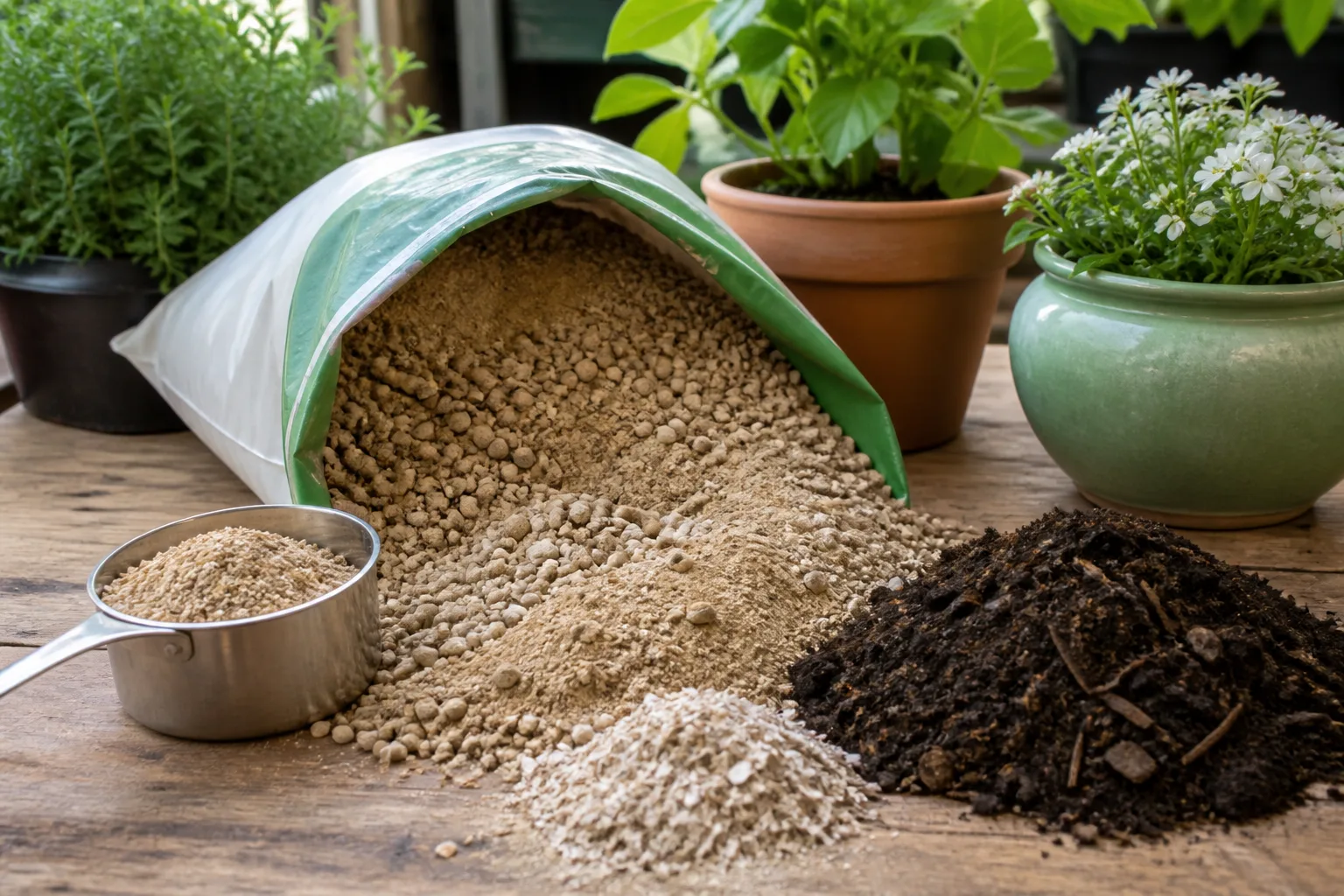
Organic blends often list lower N-P-K because nutrients are bound in compost, feather meal, bone meal, or fish emulsion that break down gradually. A 2-3-1 fish emulsion and a 24-8-16 water-soluble powder are not in the same league on the label — but after dilution and application rate, both can feed a plant appropriately. The label numbers describe concentration, not kindness to roots.
Always read the secondary and micronutrient panel. Calcium helps prevent blossom end rot in tomatoes when soil calcium is low — a problem phosphorus alone will not fix. Iron, manganese, zinc, boron, and copper appear in specialty formulas for acid-loving plants, citrus, and beds with long-term nutrient depletion. Magnesium supports chlorophyll; sulfur appears in some blends as a fourth number on certain labels. The front N-P-K will not tell you any of that, which is why two bags with identical 10-10-10 headlines can behave very differently in your garden.
If a plant shows interveinal chlorosis (yellow between green veins) on new growth, suspect iron or manganese before you reach for more nitrogen. If older leaves yellow while veins stay green, magnesium may be low. Micronutrient problems are common in alkaline soil, container mixes leached by frequent watering, and peat-heavy indoor blends. A complete N-P-K feed can mask the issue briefly without solving it.
Common NPK Ratios and When Each Makes Sense
Use this table as a starting point, then let your soil test and plant goals override it.
| Label example | Common name | Best when |
|---|---|---|
| 10-10-10 or 20-20-20 | Balanced complete | General garden maintenance, new beds with unknown fertility, mixed plantings |
| 32-0-5 or 24-0-8 | High-nitrogen lawn | Actively growing turf that needs green-up; skip extra phosphorus unless tested low |
| 10-30-20 or 4-6-3 | Bloom / fruit tilt | Tomatoes, roses, containers pushing flowers; not for nitrogen-starved lawns |
| 5-10-5 or 3-5-3 | Root / transplant | Bulbs, new shrubs, seedlings establishing roots |
| 2-2-2 or 4-4-4 | Mild organic complete | Containers, herbs, houseplants at dilute rates; slow, gentle feeding |
| 15-0-0 or 46-0-0 | Nitrogen only | Correcting confirmed nitrogen deficiency without adding P or K |
Season matters too. Spring often favors moderate nitrogen for leafy growth. Summer vegetables may shift toward phosphorus and potassium as fruit forms. Fall lawn feeding in cool-season grass regions sometimes uses lower nitrogen formulas so tender growth does not get hit by frost (Gardening Know How). Houseplants in low winter light usually need little or no fertilizer until growth resumes (UNH Extension).
Soil Testing Beats Label Guessing
The most expensive fertilizer mistake is buying the wrong ratio for soil that already has plenty of one nutrient. A soil test through your local cooperative extension or certified lab reports pH, phosphorus, potassium, and often micronutrients — in units you can match to bag math.
Without a test, you are guessing. Pale lawn grass might need nitrogen — or it might need iron at a high pH. Tomatoes with blossom end rot might need calcium, not more phosphorus. A soil test separates those paths.
Why pH Changes What Your Plants Can Use
Soil pH controls how available nutrients are to roots, even when they are present in soil. Most vegetables and ornamentals perform best near slightly acidic to neutral pH (roughly 6.0–7.0). Below or above that range, phosphorus and micronutrients can become tied up in forms roots cannot absorb (Penn State Extension).
Dumping more fertilizer on a pH problem is like shouting louder in a language the plant does not speak. Fix pH with lime or sulfur when the test recommends it, then fertilize to the reported deficiencies.
How to Pick Fertilizer Numbers by Plant and Season
Use this decision flow at the store:
Step 1 — Match the plant’s job. Lawns want leaf color (high N). Flowering containers want bloom support (higher middle number). Root crops and new trees want establishment (moderate P, balanced K). Foliage houseplants want mild, balanced formulas at low rates.
Step 2 — Check the test. If phosphorus is already high, choose a low-P or 0-P lawn or bed formula. If potassium is low, favor a higher third number.
Step 3 — Match growth stage. Seedlings and transplants: gentle balanced or root-leaning ratios. Active vegetative growth: more nitrogen. Bud and fruit set: raise phosphorus and potassium modestly without abandoning nitrogen entirely.
Step 4 — Adjust for indoors. Container houseplants need far less fertilizer than outdoor beds. UConn recommends dilute, frequent liquid feeding or slow-release at label rates for light-active plants. UGA Extension suggests starting around one-quarter of the label rate monthly indoors, increasing only when new growth is pale and light is adequate.
Step 5 — Read the back label for calcium, magnesium, iron, and coating type — especially for tomatoes, azaleas, and citrus.
Outdoor examples that put numbers in context:
- Cool-season lawn in spring: A high-N, low-P formula such as 32-0-5 or 24-0-8 matches turf’s leaf-first appetite when phosphorus is already adequate in soil. Apply by soil-test rate, not by “more is greener.”
- Tomato bed at transplant: A balanced to root-leaning ratio like 5-10-10 or 4-6-3 supports establishment without forcing excessive early vine growth. Shift toward bloom-leaning ratios only when the plant is sized and flowering.
- Leafy greens and corn: Nitrogen-forward blends (20-10-10, 21-0-0 with caution) suit crops harvested for foliage. Watch runoff and follow local nitrogen guidelines near waterways.
- Houseplants in bright summer windows: A mild balanced liquid such as 2-2-2 or 7-9-5 at quarter to half label strength every two to four weeks beats a monthly full-strength dose of 20-20-20 (UConn).
- Winter rest indoors: When growth stalls under short days, hold fertilizer regardless of what the bag ratio promises. Nutrient demand tracks light and temperature, not the calendar alone (UNH Extension).
Organic vs Synthetic: Why Numbers Look Smaller
Synthetic fertilizers (water-soluble crystals, urea, ammonium salts) usually show higher N-P-K because nutrients are in immediately available forms. They work fast, which also means they can burn if over-applied or applied to dry soil.
Organic fertilizers (compost, fish emulsion, bone meal, feather meal) typically show single-digit N-P-K because nutrients release as microbes break down material. They feed slower and often improve soil structure and biology. Lower numbers do not mean weaker nutrition — they mean lower concentration per pound, so application rates are higher and feeding is gentler (Gardening Know How).
Many gardeners use organic matter (compost) for baseline soil health and a targeted synthetic or organic blend when a test shows a specific gap. The label numbers tell you which gap you are filling.
Liquid, Granular, and Slow-Release on the Same Label
The N-P-K ratio is the same whether the product is liquid, powder, granular, or coated slow-release. What changes is delivery speed and application method — not the meaning of the numbers.
- Liquid / water-soluble: Fast availability; easy to dilute for houseplants; best when you want control.
- Granular broadcast: Even field or lawn coverage; risk of burn if over-applied to dry soil.
- Slow-release coated prills or spikes: Lower initial salt spike; harder to “turn off” if you over-applied.
For a full comparison of liquid versus slow-release indoors, see liquid vs slow-release fertilizer for houseplants. If salts have already built up, jump to fertilizer burn on houseplants before buying a stronger formula.
Common NPK Mistakes That Waste Money or Burn Plants
Shopping by the highest numbers. Concentration is not care. Indoor plants often need dilute food, not the strongest bag on the shelf.
Using bloom booster on everything. High phosphorus does not create flowers on a nitrogen-starved, shaded plant.
Ignoring zeros. A 46-0-0 lawn product is a deliberate nitrogen tool, not a complete diet for a vegetable garden.
Skipping the soil test and repeating the same 10-10-10 every year. You may be stacking phosphorus or potassium your soil already had.
Feeding dormant plants because the calendar says spring. Low light and cool soil mean low nutrient demand — especially indoors (UNH Extension).
Forgetting micronutrients. Yellow leaves between veins may be iron or magnesium, not nitrogen. More 20-20-20 will not fix that.
Applying to dry soil or double-stacking liquid on top of fresh slow-release prills. That is a reliable burn recipe (UGA Extension).
Conclusion
Fertilizer numbers are a simple code once you treat them as percentages by weight in N-P-K order. They tell you what is inside the bag — not which bag is “best.” Match ratios to plant goals, growth stage, and soil-test results, use bag math to apply the right pounds of actual nutrient, and read the back label for micronutrients and release type.
Start with a soil test when you can. Choose complete, incomplete, or balanced formulas on purpose, not by habit. Keep indoor rates dilute, respect zeros on the label, and treat higher numbers as concentration, not a score. When you are ready to feed, our fertilize indoor plants guide and best indoor fertilizers picks turn label literacy into a practical schedule.



