Forsythia Care & Growing Guide
Grow forsythia shrubs with confidence: planting timing, pruning on old wood, cold-hardy cultivars, propagation, and fixes when yellow spring blooms fail.
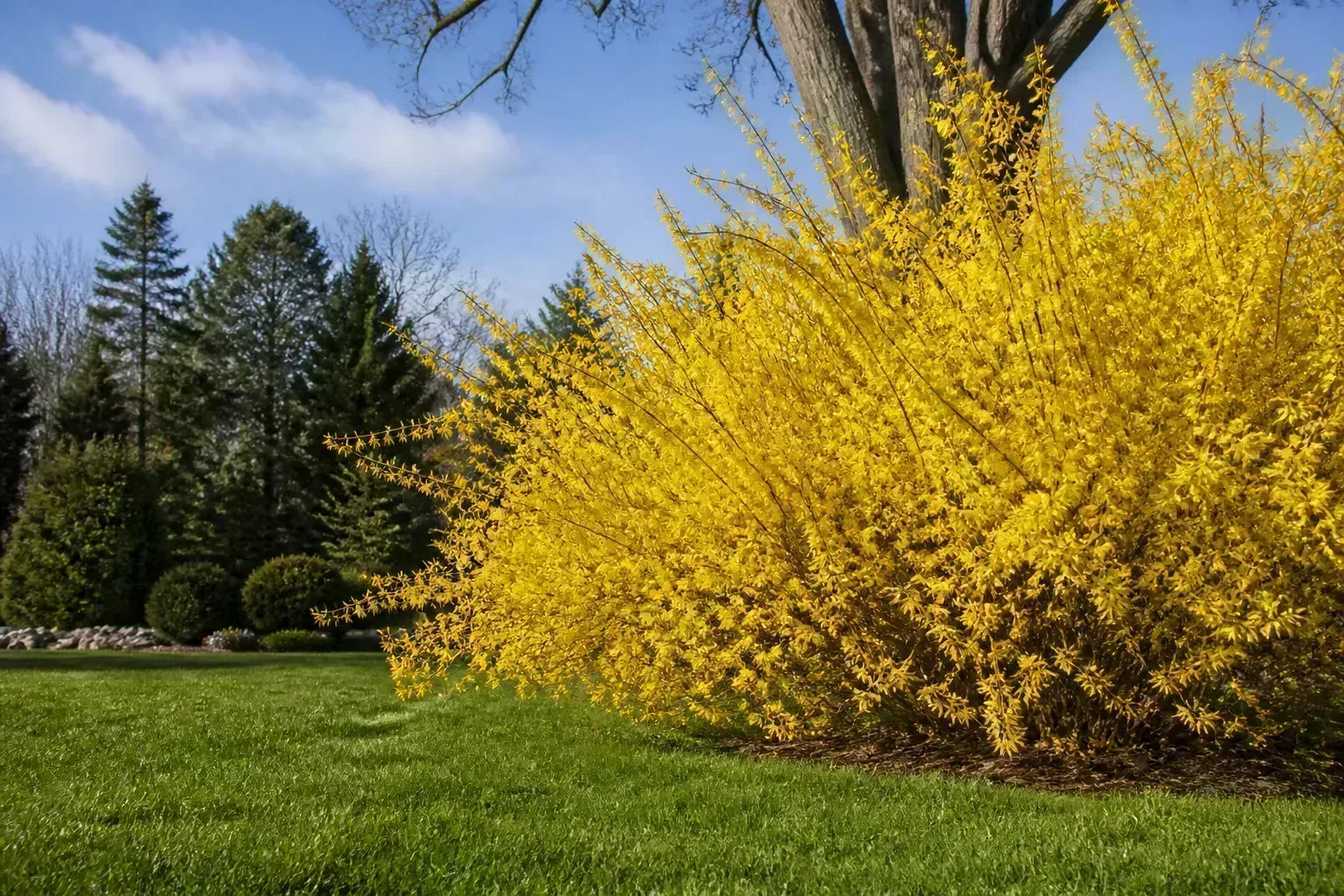
Forsythia (Forsythia spp.) is the shrub that turns bare late-winter branches into a wall of yellow before most perennials wake up. Gardeners plant it for that single dramatic week in early spring — and then spend the rest of the year managing its arching habit, deciding whether to shear it into a hedge, and wondering why last year’s freeze left the top half flowerless. The good news: forsythia is forgiving. The catch: almost every mistake that matters traces back to when you prune, how much sun the site gets, and which cultivar you matched to your winter.
This guide covers site selection through propagation, with emphasis on the decisions that actually control bloom — not generic “water when dry” filler.
What Forsythia Is and Why Gardeners Grow It
Forsythia is a genus of deciduous flowering shrubs in the olive family (Oleaceae). NC State Extension recognizes 11 accepted species native to China, Japan, and southeastern Europe. The genus honors William Forsyth (1737–1804), superintendent of the Royal Gardens at Kensington Palace. Most landscape plants are hybrids — especially Forsythia × intermedia, a cross between weeping forsythia (F. suspensa) and greenstem forsythia (F. viridissima).
Mature size ranges from compact 3- to 4-foot dwarfs to 10-foot arching specimens depending on species and cultivar. Flowers are deeply four-lobed, bright gold to lemon yellow, and appear on bare wood from late February through April in most climates — often before leaves emerge. Stems cut and brought indoors are a traditional signal that winter is ending. Forsythia is deer-resistant, pollution-tolerant, and adaptable to average garden soils once established, which explains its decades-long presence in suburban hedgerows.
| Feature | Details |
|---|---|
| Common names | Forsythia, golden bells, Easter tree |
| Botanical name | Forsythia spp. |
| Family | Oleaceae |
| Plant type | Deciduous flowering shrub |
| Mature size | 3–10 ft. tall, 4–10 ft. wide (cultivar-dependent) |
| Sun | Full sun to partial shade |
| Soil | Moist, well-drained; tolerates clay |
| Soil pH | Acidic to alkaline |
| Bloom time | Late winter to mid-spring |
| Flower color | Yellow |
| Hardiness | USDA zones 5–8 (cultivar-dependent) |
| Native range | Asia; widely naturalized in temperate regions |
Flowers are heterostylous — long-style and short-style morphs cross-pollinate — and largely self-sterile. That botanical detail matters if you wonder why a lone shrub sets few seed capsules. Only the flowers are listed as edible on NC State’s plant profile; leaves and stems are not food crops.
Is Forsythia Right for Your Yard?
Forsythia is not a year-round star. After the yellow show, you get medium green foliage and an informal fountain shape until leaf drop. If you need evergreen screening, look at top evergreens for privacy hedges instead. If you want a low-input spring beacon on a sunny bank or along a driveway, forsythia earns its space.
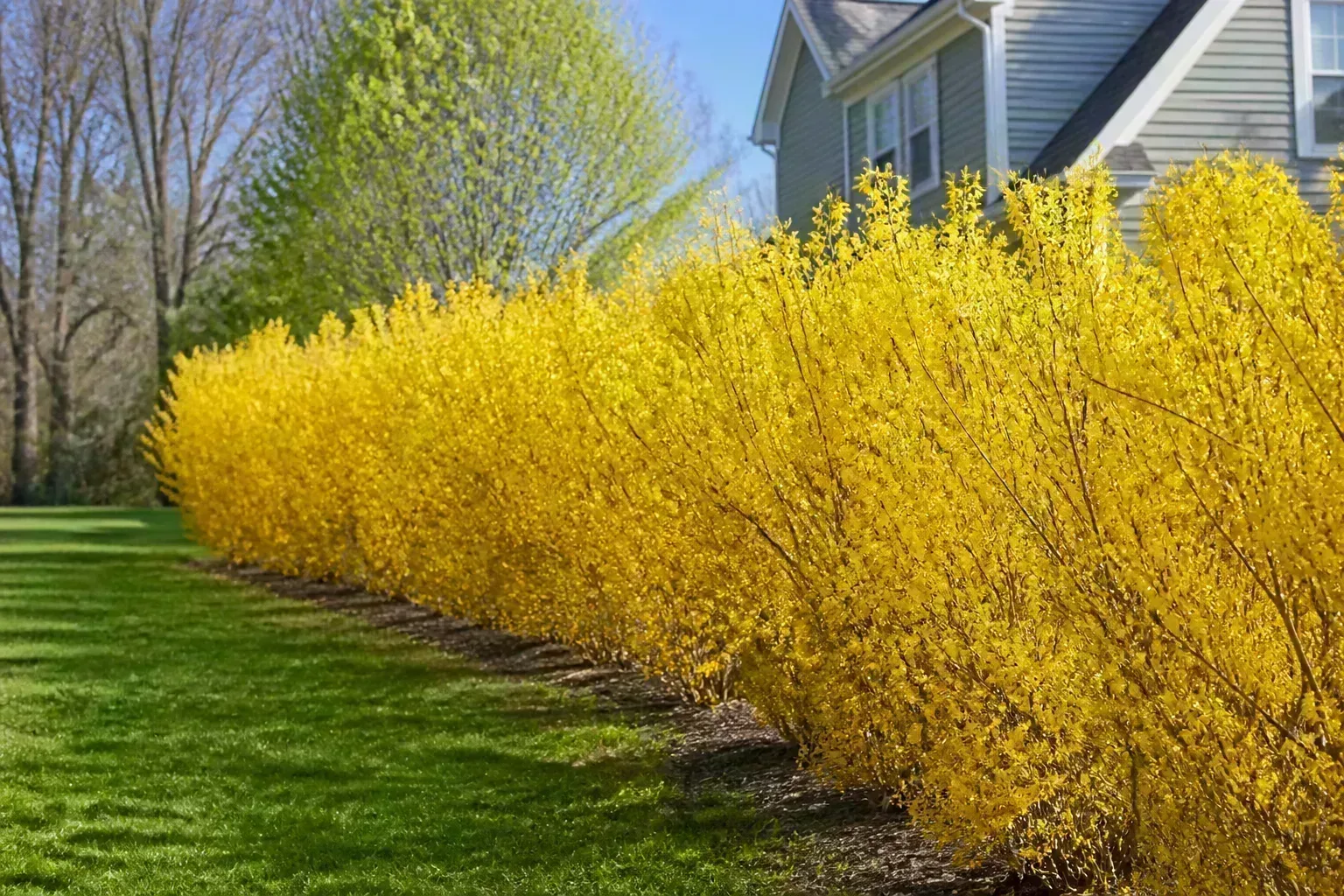
Choose forsythia when you have full sun or at least six hours of direct light, well-drained soil (even clay is workable with amendment), room for arching branches, and tolerance for a shrub that can sucker and layer where stems touch soil. It fits cottage gardens, cutting gardens, children’s gardens, and informal privacy plantings where a loose yellow hedge beats a formal boxwood wall.
Skip or reconsider when the site is deeply shaded, chronically wet, or too narrow for a 6-foot-wide spreader. Forsythia also disappoints gardeners who want months of color — the ornamental peak lasts roughly one to three weeks. Formal foundation hedges sheared into boxes lose most of their flower power because shearing removes the old wood that carries buds.
Best Landscape Uses
Informal hedge or screen: Plant medium cultivars 4 to 6 feet apart on center for a connected row within three to five years. Allow the natural arching habit rather than boxing plants into cubes — you’ll get more flowers and fewer bare ankles.
Slope and erosion control: Root systems stabilize banks where turf fails. Pair with spring bulbs at the base for a layered early-season display.
Specimen or border anchor: One well-placed mature forsythia becomes a focal point when everything behind it is still dormant. Underplant with shade perennials that emerge after forsythia leafs out.
Cut-flower forcing: Branches cut in late winter can be brought indoors and forced into bloom in water — a useful trick when snow still covers the garden.
When and How to Plant Forsythia
Plant forsythia in fall while the shrub is dormant, or in early spring before bud break. Fall planting gives roots months to establish before summer heat. Spring planting works if you water consistently through the first growing season. Avoid planting in midsummer unless you have no choice and can irrigate daily for six weeks.
Confirm your USDA hardiness zone before choosing a cultivar. Most F. × intermedia selections suit zones 5 through 8. Northern gardeners should prioritize bud-hardy types — a late January thaw followed by a hard freeze is the classic bloom killer in zone 5.
Spacing rules: Space compact cultivars 4 to 6 feet apart for hedges. Large arching types like ‘Lynwood Variety’ or ‘Meadowlark’ need 8 to 10 feet between plants if you want each specimen to develop its full fountain form without crowding.
Step-by-Step Planting
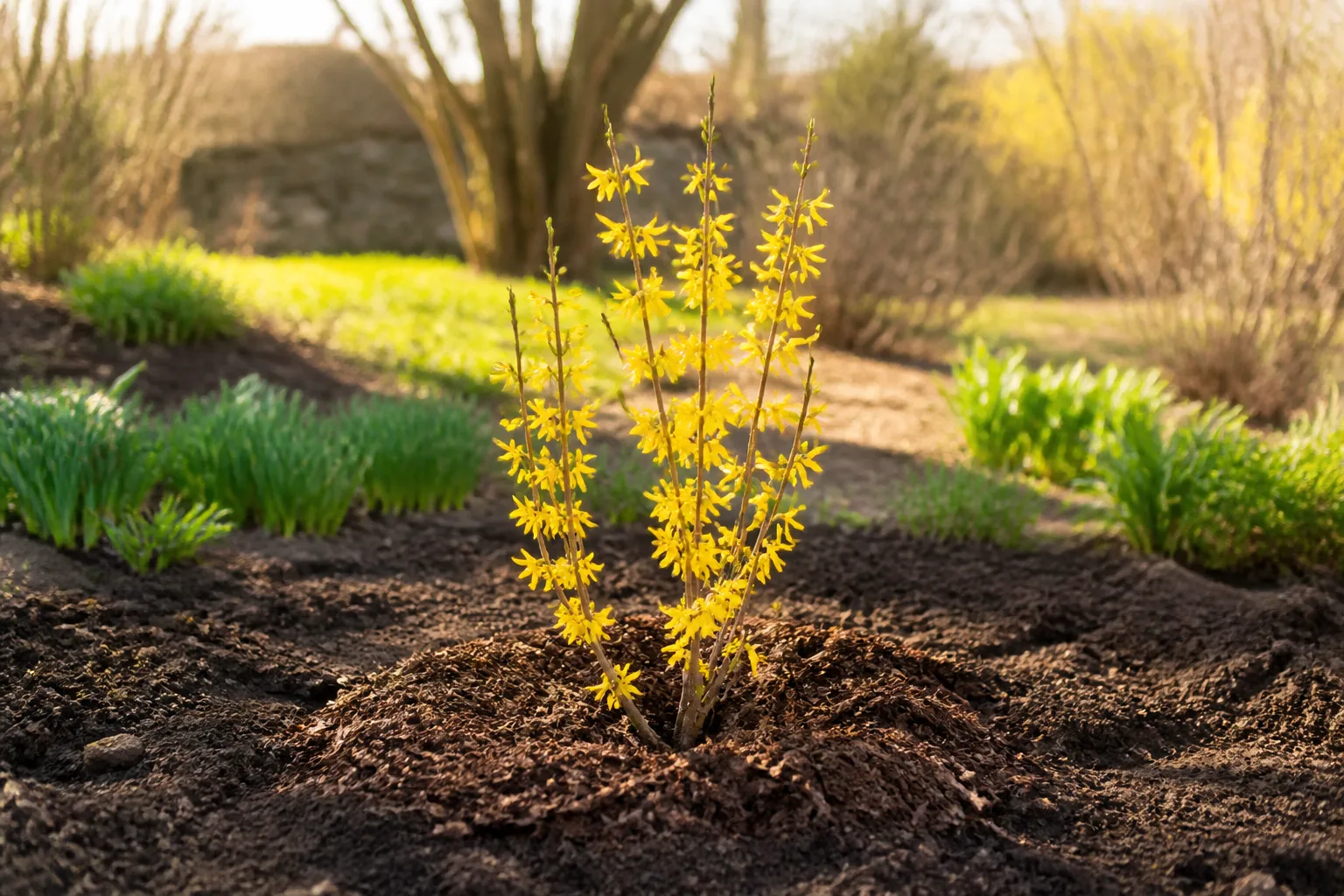
Dig a hole twice as wide as the root ball and no deeper than the root ball height. Forsythia tolerates planting at the same depth it grew in the nursery container — burying the crown invites rot. Mix compost into backfill if soil is heavy clay, but do not over-enrich a hole in dense soil; that creates a “bathtub” that holds water.
Set the plant so the top of the root ball sits level with or slightly above grade. Backfill, firm soil gently to remove air pockets, and water deeply. Apply 2 to 3 inches of shredded bark mulch in a ring, keeping mulch off the crown. Stake only if the site is windy and the plant is top-heavy; most established forsythias need no staking.
Water new plants weekly through the first growing season — roughly 1 to 2 inches of water per week including rainfall. Reduce frequency once you see vigorous new shoot growth the following spring.
Light, Soil, and Water Requirements
Light
Forsythia produces the heaviest flower set in full sun — six or more hours of direct light daily. NC State Extension notes that plants in full sun flower earlier and more profusely than those in partial shade. Partial shade (two to six hours of direct sun) keeps the shrub alive but thins blooms toward the top and outer edges. Deep shade produces leggy growth and near-zero flowering.
If an existing shrub blooms only at the base, walk the site at noon in summer and note shadow patterns from trees or structures. Thinning overhanging branches often restores bloom faster than fertilizer ever will.
Soil and Drainage
Forsythia prefers loose, well-drained loam with moderate organic matter. It tolerates clay, compacted urban soils, and moderate drought once roots are established — traits that make it useful in tough roadside plantings. What it will not tolerate long-term is standing water. Amend compacted clay with compost and plant on a slight mound if drainage is questionable.
Soil pH is flexible. Forsythia grows in acidic and alkaline soils alike. Do not let pH concerns delay planting on an otherwise sunny, well-drained site.
Watering
Keep soil evenly moist during establishment — the first full year after planting. Mature forsythia is moderately drought-tolerant and rarely needs supplemental irrigation except during extended heat waves or when grown in containers. Overwatering is a more common killer than underwatering: soggy soil promotes root rot and crown diseases that show up as sudden wilting in summer.
A 2- to 3-inch mulch layer conserves moisture and moderates soil temperature. Pull mulch back 2 inches from the stem base to discourage bark rot.
Fertilizing Forsythia
Established forsythia rarely needs fertilizer. Overfeeding produces leafy growth at the expense of flowers and can soften tissue, making plants more susceptible to winter injury. If a shrub looks pale and growth is stunted after two years in the ground, apply a slow-release granular fertilizer formulated for trees and shrubs in late winter or early spring before bud break — not repeatedly through summer.
Proven Winners recommends a thin compost mulch at the base as the primary nutritional input for landscape shrubs. That approach matches how forsythia behaves in the wild: lean soil, strong bloom on old wood. If you fertilize lawns near forsythia hedges, runoff nitrogen may already be feeding the roots — another reason to skip heavy supplemental feeding.
Best Forsythia Varieties for Your Climate
Most garden centers stock Forsythia × intermedia hybrids. Heights and bud hardiness vary enormously, so read the tag rather than assuming all forsythias behave the same.
‘Lynwood Variety’ — Classic 8- to 10-foot arching form with large yellow flowers and purple-tinged fall foliage. Reliable in zones 5 through 8. Good for informal screens.
‘Meadowlark’ — Reaches 7 to 10 feet with strong cold tolerance and few pest issues. A top pick for northern hedges where flower bud survival matters.
‘Sunrise’ — Compact 4- to 6-foot shrub with bud hardiness superior to many older cultivars. Fits smaller yards and foundation plantings.
‘Kolgold’ — 4 to 5 feet tall with unusually large flowers — nearly 1 inch across. Useful where you want maximum color per square foot.
‘Show Off’ and ‘Show Off Starlet’ — Prolific bloomers along the entire stem length; Starlet stays dwarf. Minimal pruning needed if you match the mature size to the space.
Forsythia suspensa (weeping forsythia) — Pendulous branches to 10 feet; train against a wall or trellis for a cascading effect.
Forsythia koreana — Blooms earlier than most hybrids; useful for the earliest yellow in the neighborhood.
Cold-Climate Cultivars
Northern gardeners should treat bud hardiness as the primary selection criterion — not maximum height. Temperatures below -5°F can damage flower buds even when the shrub survives (NC State Extension). Prioritize:
- ‘Meadowlark’ — Bred for cold regions; consistent bloom in zone 5.
- ‘Northern Gold’ (F. ovata hybrid) — Reliable yellow in short-season climates.
- ‘New Hampshire Gold’ — Compact 5-foot form for smaller northern yards.
- Forsythia ovata (Korean forsythia) — Among the earliest and hardiest species; Harvest to Table recommends it when standard hybrids fail after harsh winters.
If your shrub blooms only on lower branches after a brutal winter, the top buds froze while snow insulated the base — a pattern that confirms you need a hardier cultivar, not more fertilizer.
Pruning Forsythia Without Losing Next Year’s Blooms
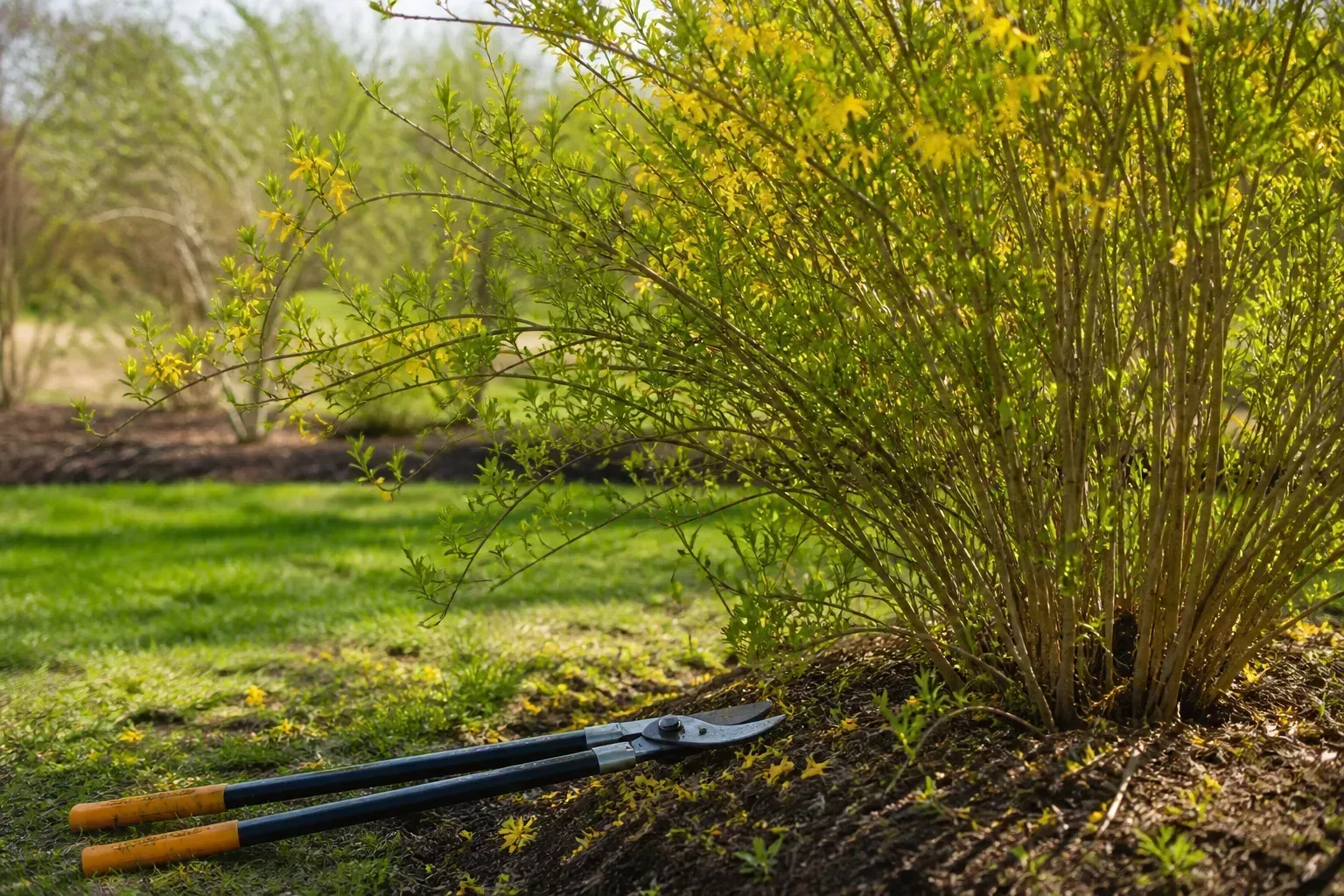
Forsythia flowers on old wood — buds form on stems grown the previous summer. Prune immediately after flowering finishes in spring. That window typically closes by late June; NC State Extension warns that pruning after mid-July removes next year’s flower buds.
Annual maintenance: Remove dead, damaged, or crossing branches first. Then cut up to one-third of the oldest canes to the ground to encourage vigorous new shoots. Shape the outer canopy lightly if needed, but avoid shearing the entire shrub into a ball — formal hedging removes most flowering wood.
Rule of thumb: If you are unsure whether a stem will bloom, wait until flowering ends, then cut. Never “tidy up” forsythia in fall or winter unless you accept zero flowers next spring.
Rejuvenation Pruning
Older forsythias that bloom sparsely — all leggy stems, hollow center, flowers only at the tips — need rejuvenation pruning. Cut one-third to one-half of the oldest canes to the ground right after spring bloom. Repeat over two or three springs until the shrub resets with young wood. Hard cutback to 6 inches above ground works on healthy plants but sacrifices bloom for one full year while new shoots mature.
Rejuvenation is preferable to abandoning a 15-year-old specimen. Forsythia responds vigorously to hard pruning when done at the correct time. Compare timing principles with our rose pruning guide — different species, same old-wood logic.
Propagating Forsythia from Cuttings and Layering
Forsythia is among the easiest shrubs to propagate. NC State Extension lists stem cuttings and layering as the recommended strategies. Seed propagation is slow and unreliable because hybrid cultivars do not breed true.
Softwood cuttings (early to mid-summer): Take 4- to 6-inch cuttings from new growth after spring flowering ends. Strip lower leaves, dip cut ends in rooting hormone, and insert into a mix of perlite and peat. Keep humidity high and medium moist. Roots form in four to eight weeks. Overwinter rooted cuttings in a protected cold frame before planting out.
Hardwood cuttings (late fall): Take dormant 8- to 10-inch sections, bury two-thirds in sand outdoors, and let them root over winter in mild climates or in a cold frame in zone 5.
Ground layering (anytime stems are flexible): Bend a low arching branch to the soil, wound the underside at a node, pin it down, and cover the contact point with soil. Check for roots the following spring, then sever and transplant the new plant.
Layering is the lowest-effort method for homeowners who want one or two extra shrubs without rooting trays. Forsythia’s natural habit of rooting where branches touch soil makes this almost automatic if you leave arching stems alone.
Growing Forsythia in Pots
Forsythia can grow in containers, which also limits aggressive spread in small yards. Choose a dwarf cultivar like ‘Show Off Starlet’ or ‘Gold Tide’ rather than forcing a 10-foot hybrid into a pot. Use a container at least 18 to 24 inches wide with drainage holes. Fill with half quality potting mix and half compost.
Place the pot in full sun. Water when the top inch of soil dries — containers dry faster than ground beds. Repot every two to three years or root-prune and refresh soil when growth slows. Fertilize lightly in spring with a slow-release product. Overwinter pots in an unheated garage or against a sheltered wall in zone 5; roots in above-ground containers freeze harder than in-ground roots.
Pests, Diseases, and Deer Resistance
Forsythia has few serious insect pests. Aphids and spider mites may appear during hot, dry summers but rarely require treatment beyond a strong hose spray. Deer generally avoid forsythia — NC State Extension lists deer resistance among its landscape virtues.
Twig blight causes brown or black dieback on branch tips, often after wet springs. Prune affected wood 6 to 8 inches below visible damage and improve air circulation by thinning crowded canes. Avoid overhead irrigation.
Crown gall (Agrobacterium tumefaciens) produces rough, warty swellings at the crown or on stems. There is no cure — remove and destroy infected plants and do not replant susceptible species in the same hole for two years.
Leaf spot causes cosmetic speckling on foliage. Rake fallen leaves and thin the shrub if spots recur annually. Fungicide is rarely necessary for established landscape plants.
Forsythia tolerates black walnut juglone, compaction, and urban pollution better than many flowering shrubs — useful when planting near driveways or city sidewalks.
Why Your Forsythia Won’t Bloom
When forsythia fails to flower, work through causes in this order:
1. Pruning at the wrong time. Any pruning between mid-summer and spring bud break removes flower buds. This is the most common cause by far. Solution: stop pruning until after the next bloom cycle completes.
2. Insufficient light. Less than six hours of direct sun thins blooms dramatically. Solution: thin competing trees or relocate the shrub in fall.
3. Winter bud kill. Late freezes or temperatures below -5°F damage exposed buds while lower branches under snow still bloom. Solution: plant bud-hardy cultivars; avoid southern exposures that trigger early bud swell.
4. Age and neglect. Very old shrubs bloom only on young wood at the tips. Solution: rejuvenation pruning over two to three springs.
5. Fall bloom on spring-blooming wood. Forsythia occasionally flowers in autumn when cool nights follow a warm spell. Those buds open early and will not reflower in spring — expect reduced bloom the following year. Do not panic; normal flowering usually returns the year after.
6. Overfertilization. Excess nitrogen pushes leaves over flowers. Solution: skip fertilizer for one season and rely on compost mulch only.
If only the bottom third bloomed after a hard winter, you are seeing freeze damage, not disease. Top-dress with compost, prune after spring bloom, and consider replacing with ‘Meadowlark’ or F. ovata if the pattern repeats three years running.
Troubleshooting Drooping and Discolored Leaves
Wilting or drooping leaves in summer usually mean too much or too little water. Check soil moisture 4 inches down before watering. Soggy soil with wilting leaves points to root rot — reduce irrigation and improve drainage. New transplants wilt in heat until roots catch up; shade cloth for one week after planting helps.
Curling leaves often trace to aphids, spider mites, or heat stress. Inspect leaf undersides for insects. Hose off pests in early morning; horticultural oil treats persistent mite outbreaks during cool weather.
Brown leaf tips suggest drought, salt buildup in containers, or wind desiccation. Deep watering beats frequent shallow sprinkles. Container plants need leaching if fertilizer salts accumulate.
Yellowing leaves in late summer may simply be early senescence before fall drop — not every yellow leaf signals a crisis on a deciduous shrub.
Conclusion
Forsythia rewards gardeners who respect three rules: match the cultivar to your winter, plant it in sun with drainage, and prune only in the weeks right after spring flowers fade. Get those right and you inherit one of the toughest, deer-resistant flowering shrubs for USDA zones 5 through 8 — a plant that asks little after establishment yet delivers the year’s first serious color.
Treat forsythia as a spring event shrub, not a year-round formal hedge, and it will outperform expectations for decades. When bloom disappoints, look at pruning dates and bud hardiness before reaching for fertilizer or fungicide. That diagnostic discipline saves more forsythias than any product on a shelf.