Early Spring Leaf Drop on Houseplants: When to Worry (and When Not To)
Early spring leaf drop on houseplants is often harmless. This guide separates normal shedding from overwatering, sunburn, fertilizer burn, and move shock.
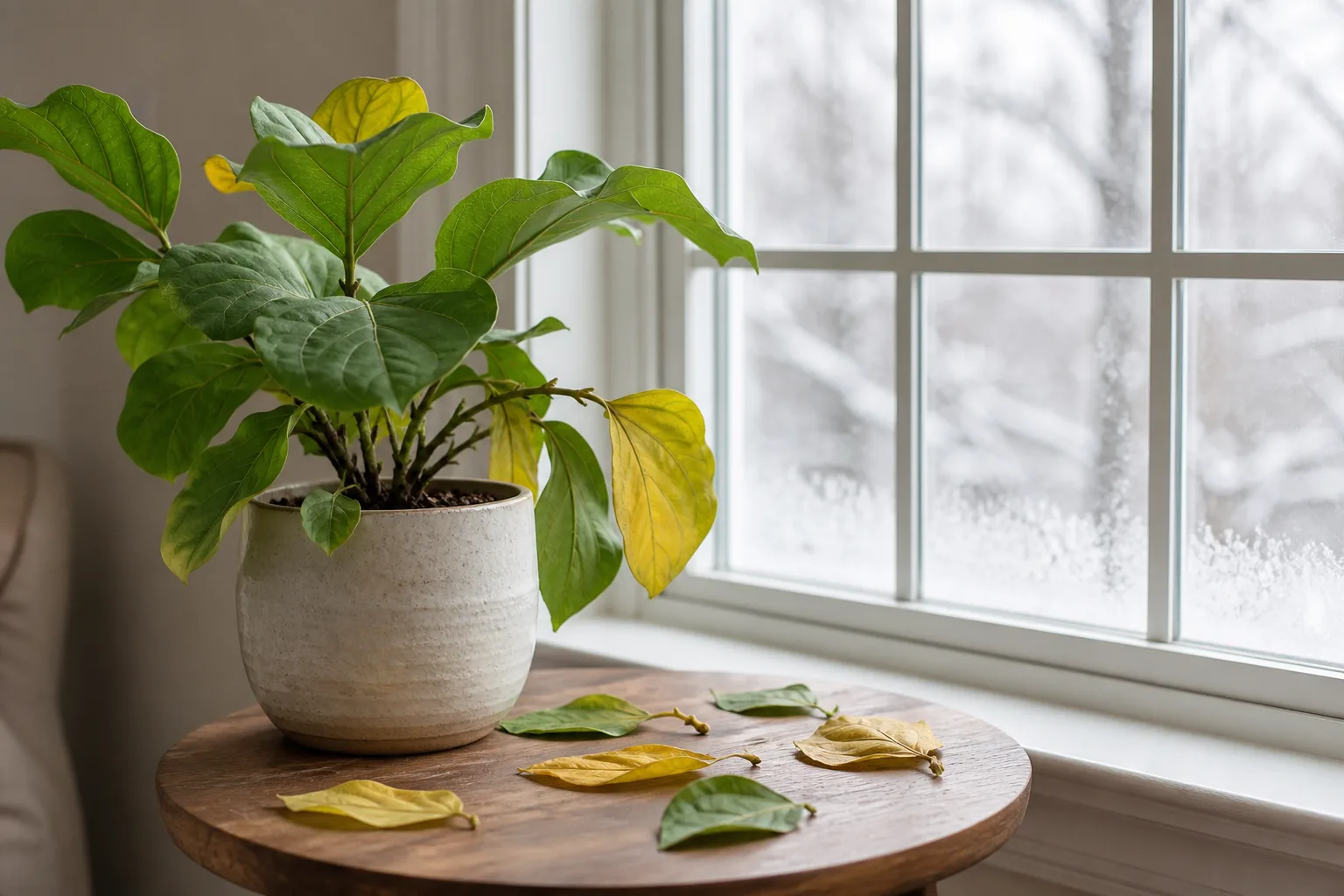
You watered faithfully all winter. The days are finally longer. Instagram says this is growing season — and yet your pothos, fiddle-leaf fig, or peace lily is shedding leaves onto the windowsill like it is still November. That mismatch between expectation and reality is exactly why early spring leaf drop sends so many plant owners into a spiral of extra water, random fertilizer, and ill-timed repotting.
The short answer: a few lower leaves falling in March or April is often normal housekeeping as the plant reallocates energy toward new spring growth. Widespread yellowing, soft stems, green leaves dropping in clusters, or a steady trickle of more than a handful of leaves per week usually means something in your care routine has not caught up to the season — or has overshot it.
This guide walks through the five most common early-spring causes, how to tell harmless shedding from a real problem, and what to fix first without making things worse.
What This Guide Covers (and What It Does Not)
This guide covers: why houseplants drop leaves specifically in early spring (roughly late February through April in the Northern Hemisphere), how to score whether your drop rate is normal, and targeted fixes for light shifts, watering transitions, fertilizer timing, move shock, and natural aging.
This guide does not cover: year-round leaf-drop diagnostics (see the houseplant leaf drop guide), winter-specific patterns (plants dropping leaves in winter), or summer heat and AC stress (plants dropping leaves in summer). For root damage that surfaces after winter overwatering, see root rot in houseplants.
If you are unsure whether your drop is sudden shock or slow chronic decline, start with the leaf drop symptom hub for the 60-second triage order, then return here for spring-specific context.
Why Early Spring Changes the Rules for Leaf Drop
Winter and spring are not opposite problems — they are different mismatches between what the plant needs and what the room provides. In winter, growth slows under short days and most houseplants use less water. In early spring, daylight lengthens, sun angle rises, indoor temperatures climb, and roots wake up — but your watering, light placement, and feeding habits may still be stuck in February mode.
Clemson Cooperative Extension HGIC notes that leaf drop can follow either over- or under-watering, pots that are too small, chilling, pests, or a significant change in environment — and that environment-linked drop should typically last about three weeks if the new conditions are stable. Early spring piles several of those changes on at once, which is why March leaf drop is so common and so misunderstood.
The four variables that shift in March and April
| Variable | Winter baseline | Early spring shift | Leaf-drop risk if you ignore it |
|---|---|---|---|
| Day length | Short; weak sun angle | Longer days; stronger direct sun | Sunburn on leaves adapted to dim winter light |
| Water use | Slow; soil stays wet longer | Faster transpiration as growth resumes | Overwatering if you ramp too fast — or underwatering if you wait too long |
| Temperature | Cooler rooms; cold window glass | Warmer days; heating may cycle less | Drafts at night still cold against glass; daytime heat spikes |
| Feeding | Most plants need little or none | Owners eager to “wake up” plants | Salt burn and root damage from early heavy fertilizer |
RHS guidance on leaf damage lists yellowing in large numbers as a response to too much or too little water, overpotting, shade, cold, sudden temperature drops, and draughts — and separately notes that leaves can remain green but still fall, which often points to abrupt environmental shock rather than slow nutrient fade. That green-drop pattern shows up constantly in early spring when someone moves a plant closer to a sunny window or starts feeding before roots are ready.
Normal vs. Warning: How Many Leaves Is Too Many?
Not all leaf drop is a crisis. Plants shed older leaves as part of senescence — the controlled shutdown of foliage the plant no longer wants to maintain. When spring growth kicks in, the plant may drop a few bottom leaves to fund new shoots at the top. RHS considers the odd lower yellow leaf on a mature plant normal; alarm bells ring when most of the foliage changes color or falls.
Use this drop-rate framework before you change anything:
| What you are seeing | Likely category | First action |
|---|---|---|
| 1–2 lower leaves per month, plant otherwise full and pushing new tips | Normal aging / spring turnover | Watch; keep stable care |
| 3–5 leaves in one week, mostly older and yellow | Mild stress — usually water or light transition | Check soil moisture and window exposure; adjust one variable |
| Green leaves falling in clusters within days of a move or care change | Shock drop | Stabilize placement; no repot or fertilizer for ~3 weeks |
| Steady weekly loss for a month+, thinning canopy, weak new growth | Chronic mismatch | Full diagnostic via leaf drop guide |
| Yellow leaves + soft stems + wet soil smell | Root stress / rot | Stop watering; inspect roots; see root rot guide |
Count fresh fallen leaves from the last 48 hours and compare again next week. Improvement means the weekly count drops by roughly half or more once you fix the trigger — a method borrowed from the drop-rate scoring in our general leaf drop diagnostic.
Quick Diagnosis: Read the Pattern Before You Panic
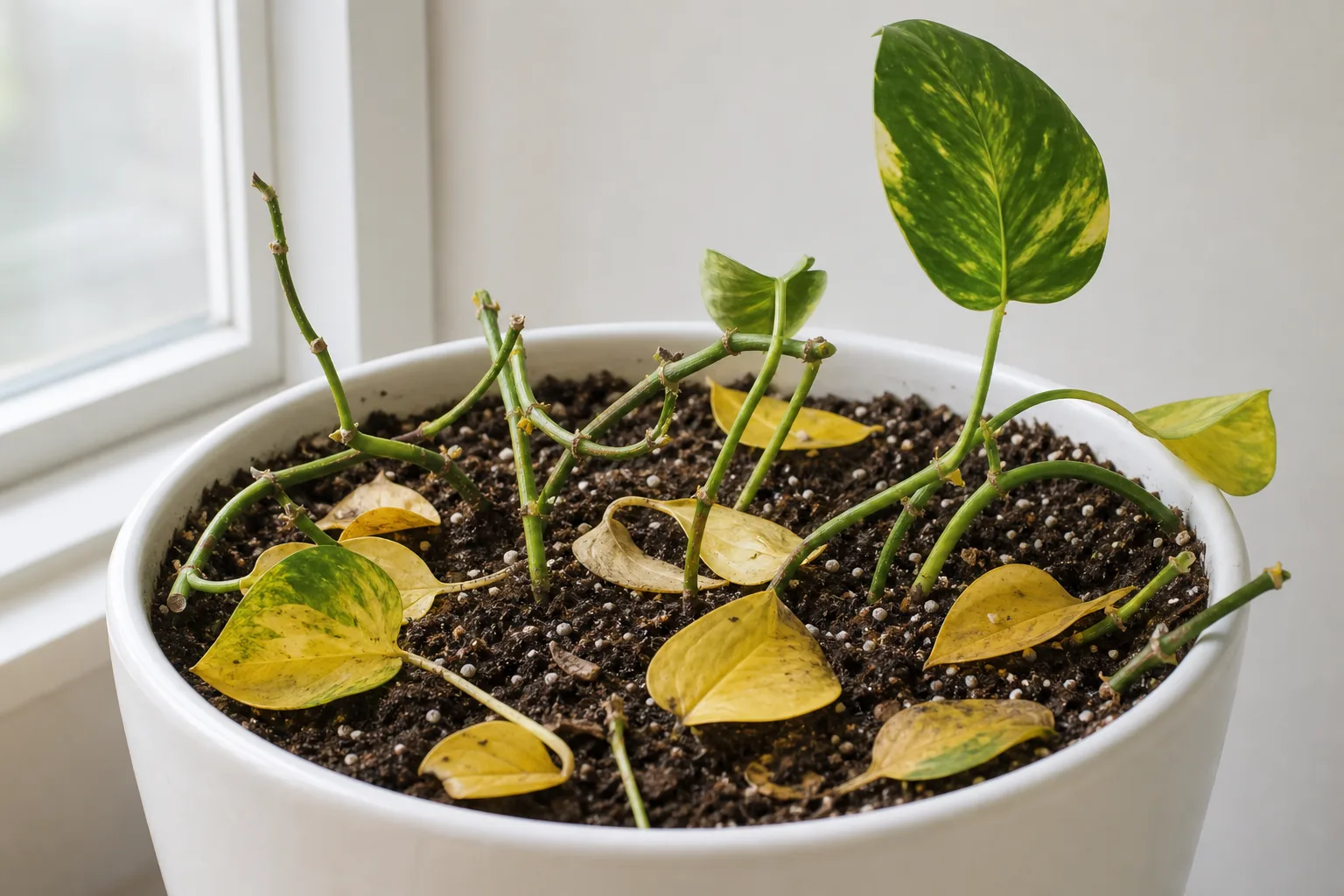
Leaf color and where leaves fall tell you more than the calendar does. Before you water, fertilize, or repot, run this 90-second scan:
- Timeline: Did drop start within two weeks of a move, window swap, repot, or first spring fertilizer?
- Soil: Finger-test 5 cm (2 in) deep — wet, evenly moist, or dry?
- Pot weight: Heavy and soggy vs. light and dusty?
- Leaf position: Only lowest/oldest leaves, or new growth too?
- Leaf look: Green and intact, yellow and soft, or brown and crispy?
Green leaves falling vs. yellow leaves falling
| Pattern | What it usually means in early spring | What to do first |
|---|---|---|
| Green leaves, sudden burst | Move shock, draft, abrupt light jump, cold night against glass | Hold position steady ~3 weeks; no fertilizer |
| Yellow lower leaves, soft, wet soil | Overwatering — often winter schedule still running in warmer spring | Let top 2–5 cm dry; check drainage |
| Yellow/brown crispy edges, dry soil | Underwatering — plant outpaced your winter frequency | Deep soak; shorten dry interval slightly |
| Pale patches then yellow, sun-facing side | Spring sunburn on winter-acclimated leaves | Filter light or pull back from south/west glass |
| Stippling, webbing, sticky residue | Pests waking as humidity and warmth rise | Isolate; inspect undersides; treat before feeding |
Green drop after you dragged a ficus three feet toward a brighter window is annoying but often reversible. Yellow drop with mushy stems and sour soil is a different emergency — and spring is when winter root damage finally shows up above ground.
Reason 1 — More Daylight (Sometimes Too Much)
Longer days are the reason spring is supposed to be good for houseplants. More photons mean more photosynthesis, which means the plant can finally afford new leaves after a dim winter. The catch: leaves that spent four months in weak winter light are not sunscreened for a sudden blast of March sun through a south- or west-facing window.
Symptoms of too much spring light usually appear on the sun-facing side first: pale bleached patches, brown crispy spots, orange-tinted scorch, then yellowing and drop. This is not the plant “not liking spring” — it is tissue damage from a light jump faster than the plant can adapt.
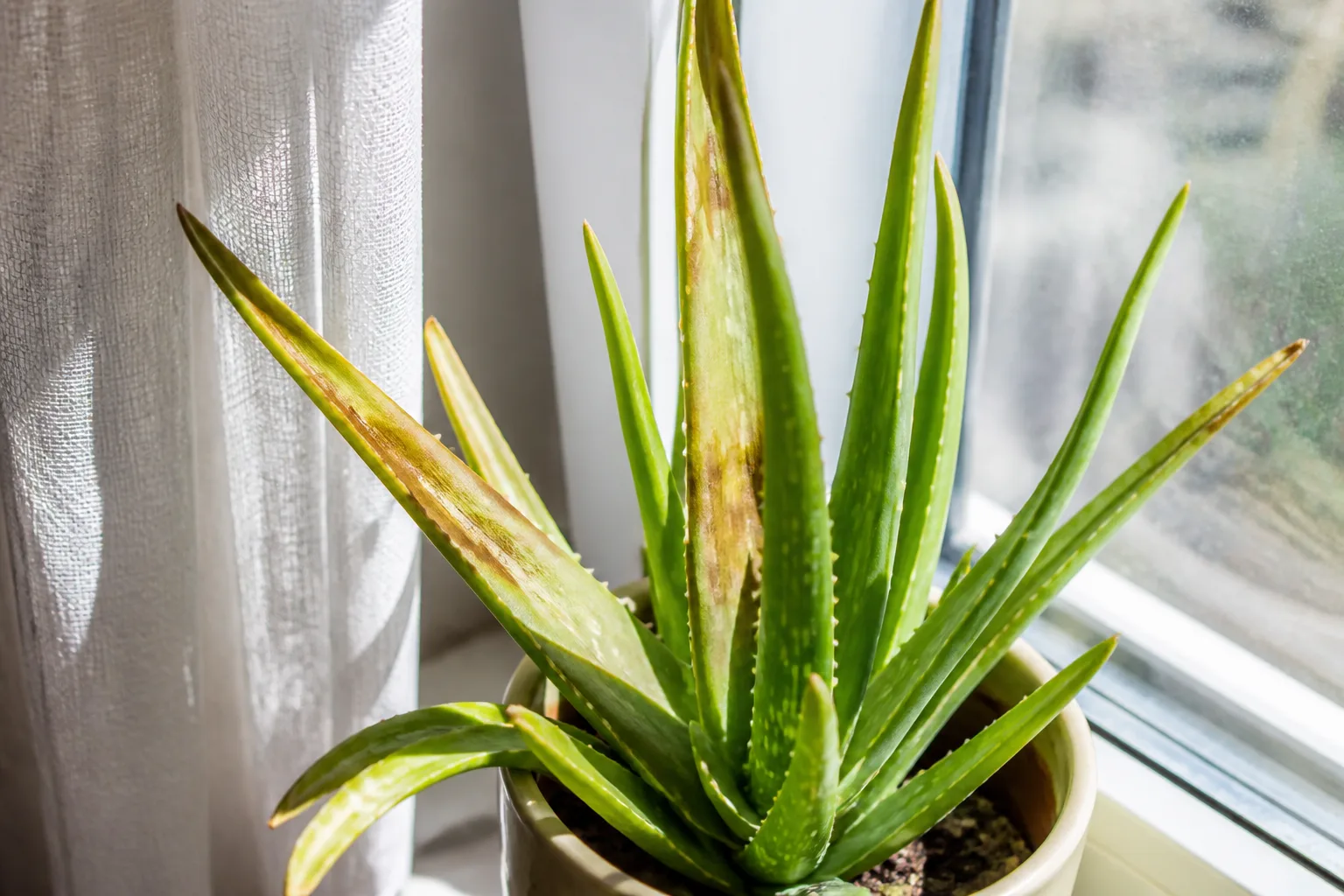
Fixes that work:
- Ease the transition: Move the plant back 30–60 cm (1–2 ft) from intense glass, or hang a sheer curtain to filter midday rays while still increasing total daily light.
- Prefer morning sun: An east-facing window delivers gentler light that builds tolerance before summer intensity.
- Rotate weekly once conditions are stable so new growth develops evenly.
- Do not chop every scorched leaf immediately — if the petiole is firm and only the tip burned, the leaf may still photosynthesize while replacements grow.
If you moved plants closer to windows for winter light and never moved them back before the equinox, sunburn is a prime suspect. The opposite problem — a plant still in a dim corner while days lengthen — causes slow yellowing and etiolation rather than scorch, but that is a chronic light deficit, not the “spring wake-up” drop this guide focuses on.
When stronger spring sun burns leaves before they drop
Burn often precedes drop by several days. You will see stiff, papery patches on otherwise firm leaves. Once abscission completes, the leaf falls cleanly. Removing the plant from direct rays stops new damage; existing burned leaves will not green up again, but new foliage should emerge paler green and healthy if light is corrected.
Reason 2 — The Watering Transition Trap
Spring is the season of the watering whiplash. More light and warmth mean roots and leaves transpire faster — so the plant legitimately needs more water than it did in January. But owners who increase frequency too aggressively turn winter’s “barely moist” habit into soggy soil just as roots wake up and demand oxygen.
Clemson HGIC is blunt: overwatering decreases root oxygen and favors root diseases; chronic underwatering causes wilting, curling, and death. Either extreme drops leaves. In spring, both mistakes spike because people guess instead of checking.
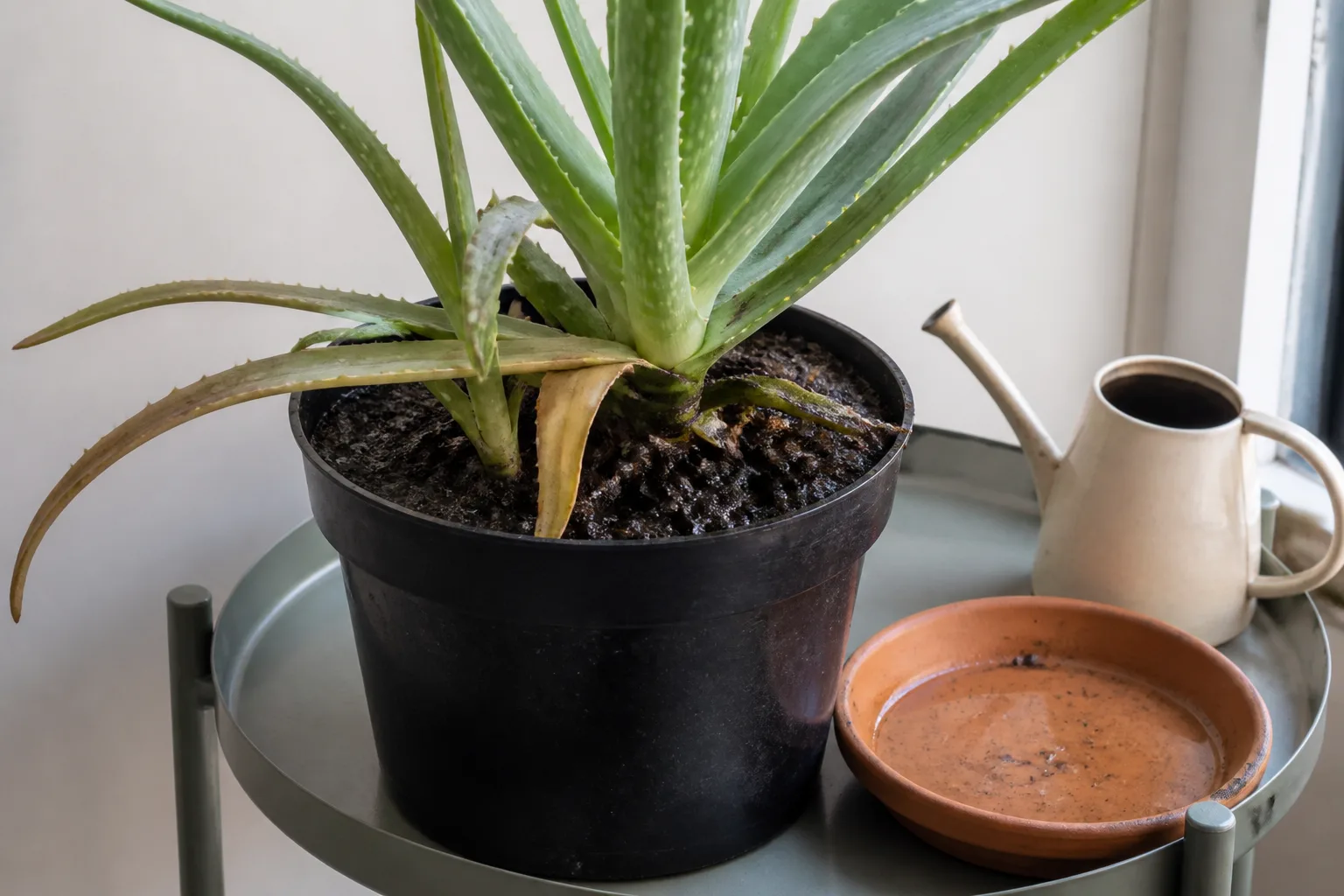
Overwatering signals in early spring:
- Yellow leaves, often starting low but spreading
- Soft, mushy stems near soil line
- Soil wet days after watering; white mold on surface
- Leaves drop while still partially green
- Pot feels heavy; gnats may appear
Underwatering signals:
- Oldest leaves brown at edges first, then yellow and fall
- Soil pulls away from pot sides; pot feels light
- Wilting that recovers after a soak but returns quickly
- New leaves smaller or slower than last year
The spring ramp rule: do not switch to a summer schedule overnight. When you see the first consistent new growth — a fresh leaf unfurling, not just a bud — increase watering one step: if you watered every 14 days in winter, try every 10–12 days, then check soil before the next drink. Always verify moisture at depth, not just the surface crust that dries first in warmer rooms.
You may also need to refresh drainage: if winter compaction left the mix dense, spring growth plus retained water is a root-rot setup. A handful of perlite worked into the top inch or a full repot — only after drop slows — can help. See winter houseplant care for why soil stayed wet all winter in the first place.
Signs your spring watering schedule is off
If you are toggling between bone-dry and swampy week to week, the plant experiences repeated drought-rewet stress — another leaf-drop trigger. Aim for even moisture in the active root zone: dry the top 2–5 cm for most tropical foliage plants, then water until a little drains out, empty the saucer, and do not water again until the probe or finger test says so. Consistency beats volume.
Reason 3 — Fertilizer You Started Too Soon or Too Strong
March enthusiasm kills more roots than March neglect. The first sunny weekend sends half of plant Twitter back to full-strength fertilizer — and two weeks later, leaf margins brown, growth stalls, and leaves fall.
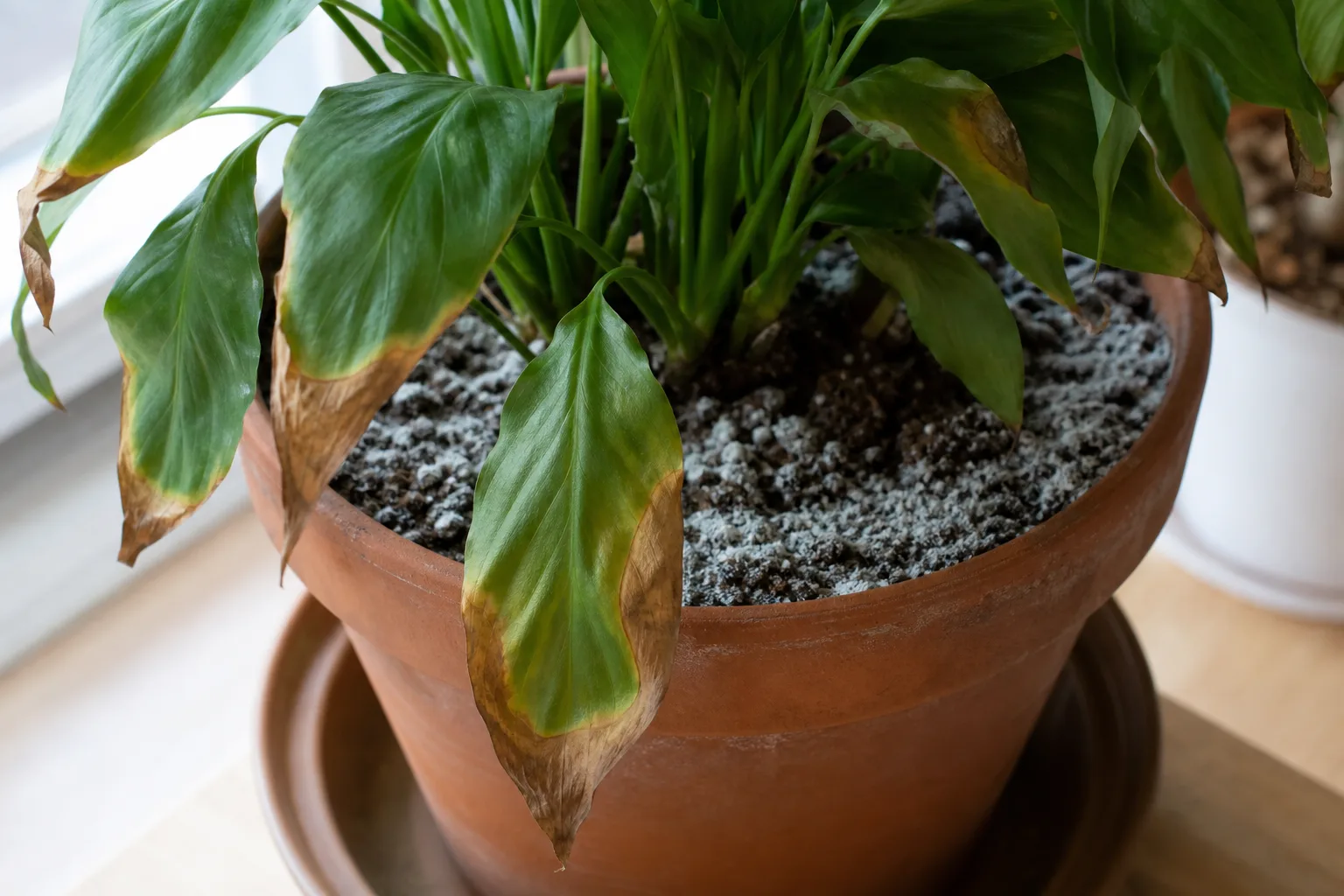
Safe spring feeding rules:
- Wait for visible new growth — an unfurling leaf, not just “it is March.”
- Start at half strength of label rate for liquid feeds; monthly is enough for most foliage plants.
- Never fertilize a plant actively dropping leaves — salts stress roots that are already struggling.
- Flush salts if you overfed last fall and crust rings the pot — see how to fertilize indoor plants.
Over-fertilizing damages roots the same way drought does: the plant cannot take up water properly, leaves scorch at edges, then abscise. If you fed in early March and drop followed within 10 days, stop feeding, leach the pot with plain water until drain runs clear, and wait for recovery signs before resuming at quarter strength.
Spring is when to resume feeding, not when to make up for winter. Plants that were correctly rested without fertilizer do not need a March feast — they need light and water aligned first.
Reason 4 — Move Shock After Winter Relocation
Early spring is move season indoors: closer to windows for light, away from heating vents as they shut off, out of the guest room and back to the living room, or — for the ambitious — the first trip to a sheltered patio on a warm afternoon. Every move changes light angle, airflow, humidity, and temperature microclimates. Sensitive species respond by dropping leaves while they are still green.
Ficus benjamina is the textbook case: relocate it and it may shed a third of its canopy within a week. Fiddle-leaf figs, crotons, and some calatheas follow the same script. This is hormonal shock, not necessarily root death — and Clemson notes environment-linked drop should ease within about three weeks if conditions stay stable.
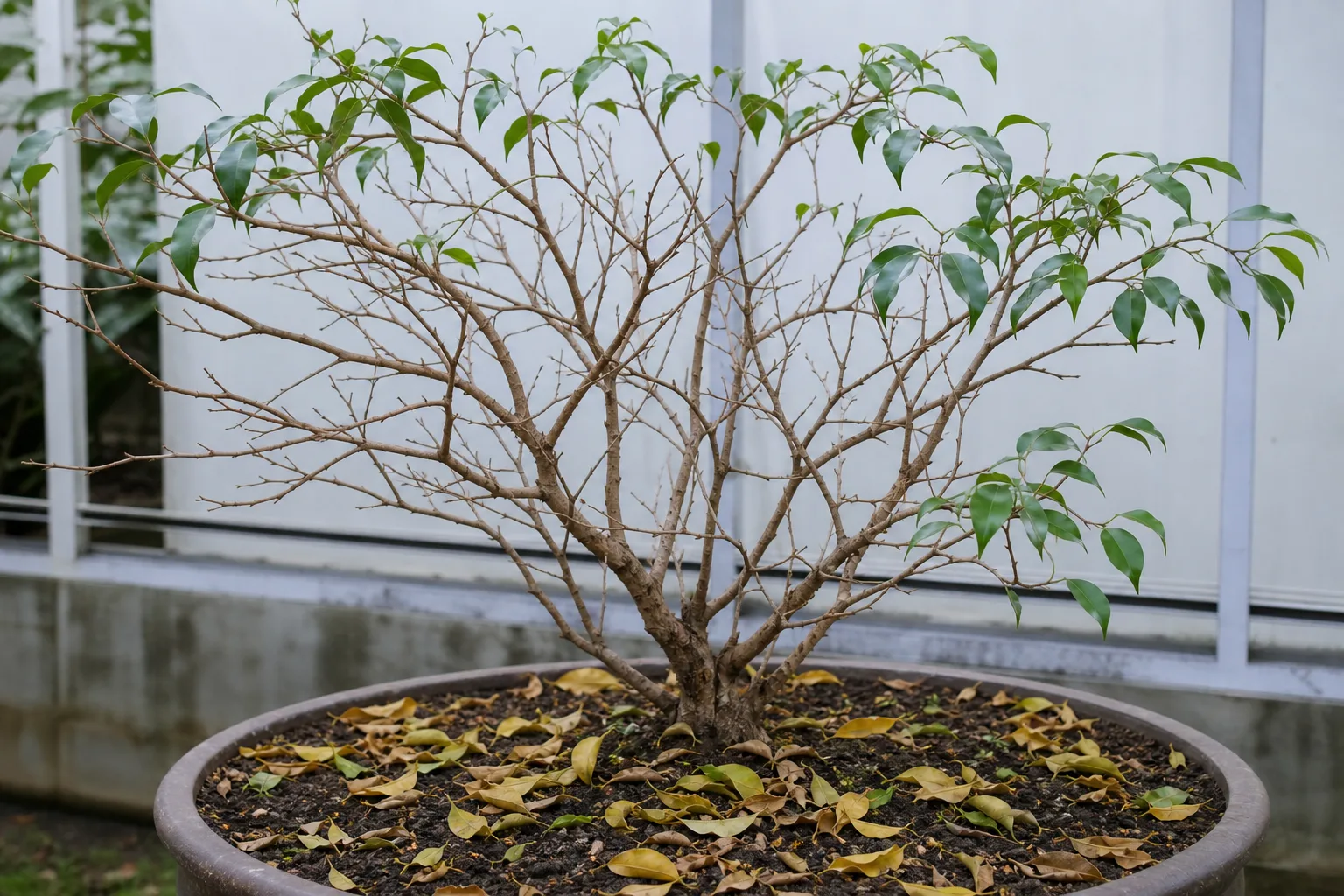
What helps:
- Pick the final spot and leave the plant there — no weekly shuffling.
- Match light gradually — intermediate position for a week before the brightest target.
- Hold fertilizer and repotting until drop slows and new buds swell.
- Keep watering conservative — shock plus overwater is a common double hit.
A fiddle that looks like a stick with knobs can still push new buds if stems are firm and roots are white or tan, not black mush. Patience beats panic pruning.
Ficus, croton, and other plants that hate change
| Plant | Typical shock trigger in spring | Recovery signal |
|---|---|---|
| Weeping fig (Ficus benjamina) | Any move >1 m; draft from open window | Tiny green dots along stems |
| Fiddle-leaf fig | Light jump; repot + move same week | New leaf from top bud |
| Croton | Temperature swing; outdoor preview on cool night | Brighter new leaves at tips |
| Rubber plant | Sudden full sun after dim winter | Firm stems; one leaf at a time drop only |
If green drop continues past three weeks with stable care, move from shock diagnosis to moisture, pests, and roots using the full leaf drop workflow.
Reason 5 — Natural Leaf Aging as Growth Resumes
Sometimes spring leaf drop is simply the plant retiring old hardware. Lower leaves that have been on the plant for a year or more may yellow slowly, then fall, while fresh growth emerges above. That is senescence — efficient, not alarming.
Normal aging checklist:
- Only one or two leaves at a time
- Always the oldest, lowest leaves
- Yellowing is gradual, not overnight
- New growth is firm, green, and proportionate
- Soil moisture and light are otherwise stable
RHS treats isolated lower yellow leaves on mature plants as no cause for concern. When the rest of the canopy looks full and the plant is pushing spring shoots, let the old leaves go. Snip only if they are more than half brown and unsightly — the plant may still be reclaiming mobile nutrients from yellowing tissue.
Natural aging should not thin the canopy week after week. If you are losing more leaves than you are gaining through April, one of the stressors above is layered on top — usually water or light.
When Early Spring Leaf Drop Means Something Serious
Not every March leaf belongs in the “don’t worry” bucket. Escalate when you see:
Root rot surfacing after winter. Soil stayed wet all winter while growth was slow; roots died quietly. Spring warmth revives fungi, stems soften, and leaves yellow in batches. Sour smell, black roots, and a heavy wet pot are confirmations. Stop watering and read root rot in houseplants before repotting.
Pests waking with warmer air. Spider mites, thrips, and scale often explode as indoor humidity drops and heating cycles end. Colorado State University Extension links mite stippling, bronzing, webbing, and premature leaf drop on common hosts. Inspect leaf undersides with a phone flashlight before assuming “spring adjustment.”
Cold damage on warm afternoons. A plant pressed against glass can cook by day and chill at night. RHS flags sudden temperature drops and draughts as mass-yellowing triggers. Pull pots back from the pane or add insulation at night during late frosts.
Disease spots spreading. Water-soaked lesions with yellow halos, uniform brown patches, or sticky ooze are not seasonal senescence — isolate the plant and remove affected leaves.
If stems are mushy, smell is foul, or more than half the canopy is gone in two weeks, normal spring patience is the wrong tool.
Your Early Spring Recovery Checklist
Use this sequence when drop rate is above “a few old lowers” but stems are still firm:
- Count and log fallen leaves for one week — baseline drop rate.
- Freeze changes: no repot, no fertilizer, no moving unless sunburn is active.
- Fix light first if scorch or sudden window move — filter or step back.
- Fix water second — soil test at depth; adjust one step, not a flood.
- Wait ~3 weeks for shock-type green drop after placement is stable (Clemson acclimation window).
- Resume fertilizer only when new growth is consistent — half strength (fertilize indoor plants).
- Re-count weekly — improvement = roughly half fewer fresh falls.
- Escalate to pests, roots, or the leaf drop diagnostic if counts stay flat or rise.
Do not do this while leaves are actively falling:
- Repot “to freshen soil”
- Double fertilizer to “encourage growth”
- Move the plant every few days hunting for the perfect spot
- Cut the entire canopy back to sticks without diagnosing roots
Spring recovery is boring on purpose: stable light, corrected water, time.
Conclusion
Early spring leaf drop sits in an awkward middle ground — the plant is waking up, your habits are shifting, and a few fallen leaves can be completely normal senescence or the first sign that light, water, or fertilizer jumped ahead of the roots. The difference comes down to rate, color, and timing: one or two yellow lowers with healthy new tips is housekeeping; green clusters after a move need three weeks of stability; yellow mush with wet soil needs watering stopped today.
Score your drop rate, read the leaf pattern, adjust one variable at a time, and use the seasonal companions for winter and summer when the calendar — not the symptom — is your main clue. Most houseplants that drop leaves in March are not dying; they are negotiating new conditions. Give them consistent care, resist the March fertilizer impulse, and let new growth be the signal that spring has actually arrived for the roots — not just for you.