Seedlings Falling Over: Damping Off vs Weak Stems
Seedlings falling over? Tell damping-off from weak etiolated stems, discard infected cells, then fix sterile media, light, and airflow.
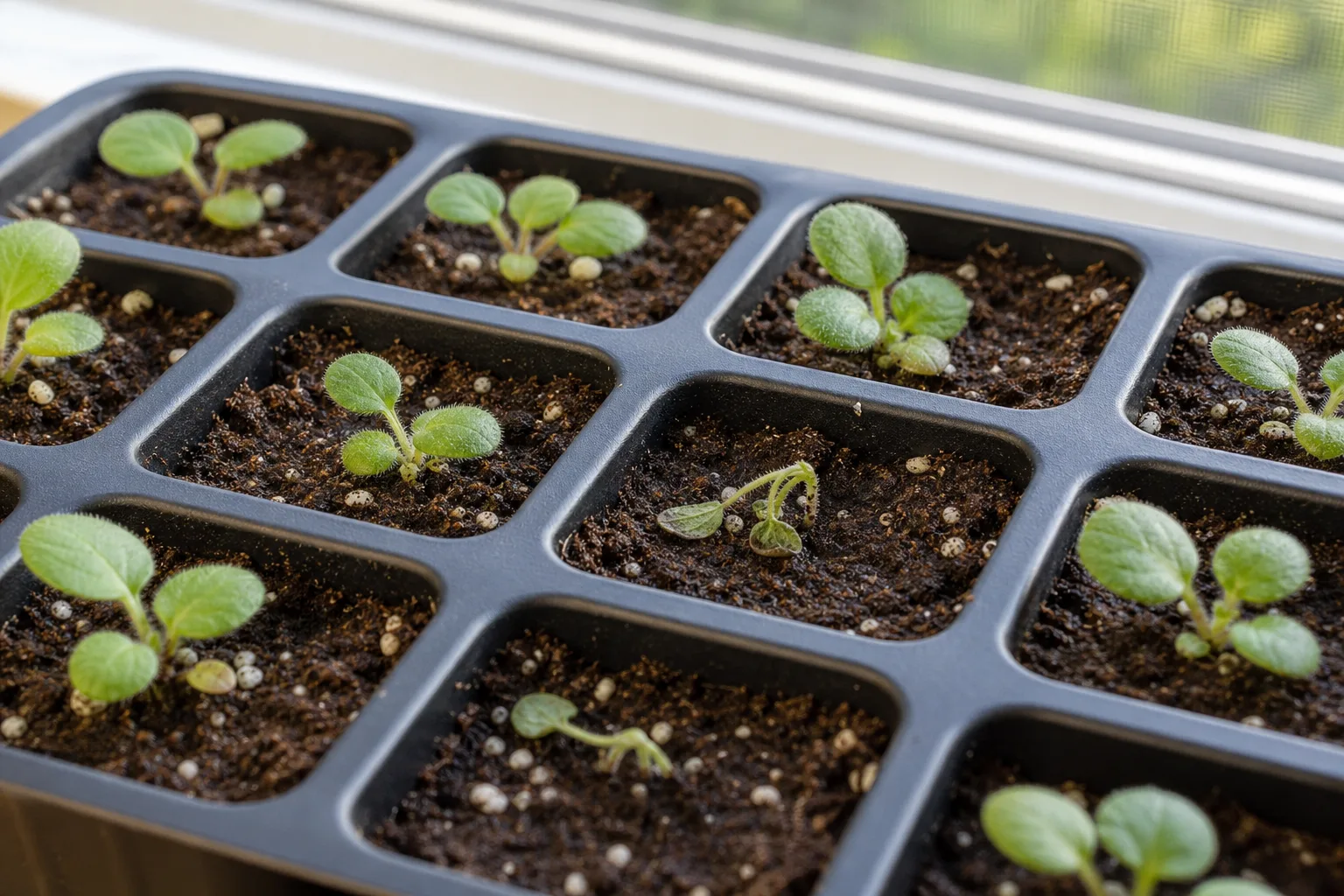
Your tray looked fine yesterday. Today a cluster of seedlings is leaning, pinching at the soil line, or flopping sideways like tiny straws. Seedlings falling over is almost never “bad luck.” It is usually one of two problems — or both at once: damping-off (a pathogen attack in wet media) or etiolation (weak, stretched stems from low light). Sorting those apart changes what you do next.
This guide is for indoor seed starting and houseplant propagation trays — plastic flats, peat pellets, and nursery pots on a windowsill or under a light rack. You will learn how to diagnose collapse versus stretch, why sterile media and airflow matter, and how to rebuild a setup that stops the next tray from failing the same way.
Tray note (overcrowded basil under a far LED, March 2026): In one 72-cell flat of basil sown thick for “insurance,” lights hung about 12 inches (30 cm) above the canopy and a clear humidity dome stayed on for five days after emergence. By day 6, stems were pale and leaning; by day 8 a wet circular patch of soft soil-line collapse had opened in the densest corner. A matching thinned flat of the same seed lot under the same fixture at about 3 inches (8 cm), dome cracked from day 1 of sprouts, and a low fan across the shelf kept firm upright stems with no patch. That overcrowded-plus-dim stack is the failure mode this page is built to prevent.
If you are raising cuttings of pothos or Monstera beside seed trays, keep those clean setups separate from any tray that already shows soil-line collapse. For a short symptom overview across species, see the seedlings falling over symptom hub. Written by Sai Ananth; horticulture review by Dr. Priya Menon (botanist and indoor plant specialist).
Why Seedlings Fall Over
Young seedlings have almost no woody tissue. The stem just above and below the soil line is thin, soft, and easy to infect or to stretch beyond what it can support. When conditions stay wet, cool, crowded, or dim, that weak zone fails first. Extension pathologists treat damping-off as a disease complex of several soil organisms, not a single fungus with one spray fix. Light-stretch problems are physiological, not infectious — but a spindly seedling in a wet flat is also a soft target for pathogens.
Houseplant seed (ornamental peppers, coleus, African violet pellets, herb trays kept indoors) and edible seedlings share the same pathogen cast. Germination temperature targets differ by crop — warm-season tomatoes and basil want warmer media than cool-season lettuce — but the soil-line collapse pattern and sanitation rules do not change.
Damping-Off: Soft Collapse at the Soil Line
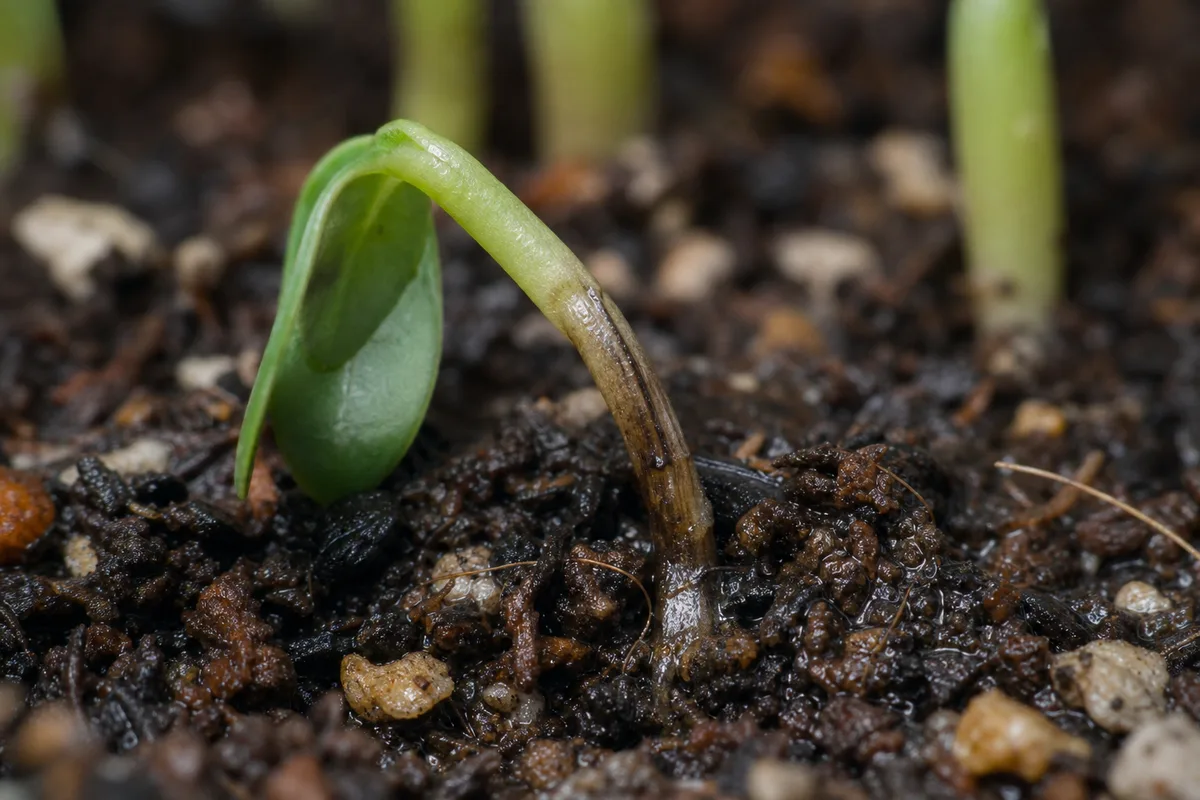
Damping-off is the rotting of seeds in the media and the destruction of newly emerged seedlings by fungi and fungus-like organisms. Penn State Extension describes it as seed decay before germination or seedling rot just below the soil line. Wisconsin Horticulture notes that seedlings often look healthy at first, then collapse at or just below the surface and die soon after.
There are two timing patterns:
- Pre-emergence damping-off: seeds germinate poorly or not at all because the radicle and hypocotyl rot before the shoot breaks the surface. You get empty cells and patchy stands.
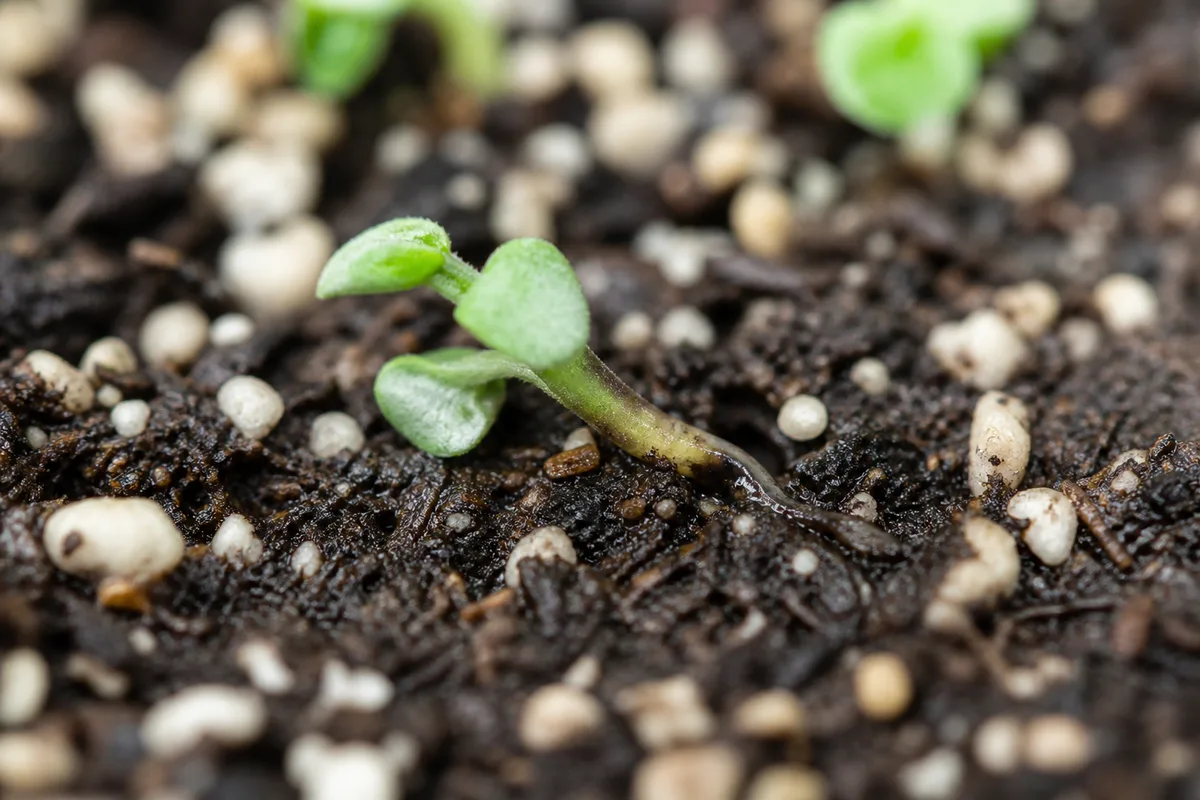
- Post-emergence damping-off: seedlings emerge, then wilt, pinch, discolor, and fall over. The classic sign is a water-soaked, sunken, or dark lesion at the soil line.
UConn Extension adds that infected flats often show a circular patch of death spreading from a starting point, while plug trays can look more random because splash and irrigation move pathogens cell to cell. Under moist conditions you may see whitish cottony growth on collapsing stems — RHS and Penn State both note this as a common (but not required) sign.
Once a seedling shows true damping-off collapse, it will not recover. Wisconsin Horticulture is blunt: infected seedlings die and cannot be saved. Prevention is the control strategy.
Etiolation: Tall, Pale, Weak Stems
Etiolation is stretch growth under inadequate light. Stems elongate, internodes lengthen, tissue stays thin, and foliage often looks pale or undersized. The seedling is not rotting at the soil line — it is reaching for photons it never finds. Wisconsin’s seed-starting guidance is clear that bright window light alone is often not enough; seedlings need really bright light to build thick stems, which is why fluorescent or LED lights hung a few inches above the canopy are standard practice.
Etiolated seedlings tip over because the stem is too long and too soft for the leaf weight and any slight breeze. The base may still be firm and pale green rather than brown and mushy. That distinction matters: more light and a fan can help surviving stretchy seedlings; fungicide and “drying harder” will not fix a light deficit. For the same stretch pattern on mature foliage plants, see why plants get leggy and not enough light for houseplants.
How to Tell Damping-Off from Etiolation
Use the stem, the pattern, and the media moisture as your three checks. Guessing wrong wastes a week and can recontaminate the next sowing.
| Check | Damping-off | Etiolation (weak stems) |
|---|---|---|
| Soil-line stem | Soft, pinched, water-soaked, brown/black, sometimes thread-thin | Thin but usually still intact; may lean without a necrotic pinch |
| Height pattern | Often short; collapses while still young | Tall, spindly, long gaps between leaves |
| Leaf color | Wilting; may stay green then collapse | Pale, small, searching toward light |
| Tray pattern | Patches or random cells after splash; neighbors fail over days | Whole tray stretches toward window or light gap |
| Media feel | Persistently wet, cool, compacted, poor drainage | Can be any moisture; light is the driver |
| Rescue odds | Near zero for symptomatic plants | Fair for survivors if light and airflow improve fast |
NC State Extension warns that true damping-off can be confused with fertilizer burn, drowning, drought, heat, cold, or chemical injury. Those abiotic hits often damage leaves and upper stems first and tend to hit the tray more evenly. Damping-off is more patchy, with roots and the soil-line stem failing first. Soft collapse can also look like wilting or plant drooping until you check the soil line up close.
When Both Problems Stack
Dim rooms, plastic humidity domes left on too long, and thick sowing create the worst stack: seedlings stretch under the dome, then stay wet and crowded at the surface. Tall, soft hypocotyls lodge easily, and any Pythium or Rhizoctonia already in reused mix or dirty trays finds easy entry. RHS notes damping-off is especially damaging in spring when light and temperatures are low and seedlings grow slowly — exactly when home growers start tomatoes, herbs, and ornamental houseplant seed on cool windowsills.
If your tray shows both tall pale stems and soft pinching at the soil line, treat it as a sanitation and moisture emergency first (discard diseased cells, dry and ventilate the rest), then fix light distance so survivors stop stretching.
What Causes Damping-Off
Damping-off is a disease of opportunity. The pathogens are common; the outbreak happens when seedlings stay vulnerable and the environment favors the organism.
Pathogens and Wet, Cool Media
Several organisms cause the same symptom cluster. Across UConn, Penn State, NC State, Wisconsin, and RHS sources, the usual cast includes:
- Pythium and Phytophthora (water molds / oomycetes) — favored by cool, wet, poorly drained media; often attack below the soil line and root tips
- Rhizoctonia — can cause soil-line killing and later “wirestem” (dark, woody, constricted stems) on survivors
- Fusarium, and sometimes Botrytis, Sclerotinia, and others depending on crop and conditions
NC State notes Pythium-group problems lean cool and wet, while Rhizoctonia and Fusarium can also strike under warmer and relatively drier surface conditions — so “it was warm in my room” does not rule damping-off out.
Favorable conditions repeatedly listed by extension sources:
- Media that stays wet too long; excessive overhead misting; condensation drip
- Low media temperatures before germination (Penn State and UConn cite below about 68°F / 20°C as risky)
- Overcrowded flats that trap humidity and reduce light at the stem base
- Slow emergence from deep sowing or cold media, which lengthens the vulnerable window
UConn also reminds growers that later in the cycle the same pathogens can produce wirestem: off-color, twisted, constricted stems that look “alive” but transplant poorly.
Contaminated Pots, Tools, and Garden Soil
These organisms live in soil and move on anything that carries soil. UConn lists contaminated tools, hose ends, water splash, and hands as common bridges from dirty areas into clean media. Penn State’s grower-facing guidance adds infected seed or transplants, irrigation water, stakes, and even shoes. Wisconsin specifically warns against garden soil in seed trays because it often carries damping-off pathogens.
Reused plug trays are a special risk. UConn notes they are hard to clean thoroughly once organic matter lodges in tiny cells, and that you should not keep “healthy-looking” seedlings from an infected flat — they can carry contaminated media and develop wirestem or root rot later. RHS advises never reusing pots and trays from a damping-off outbreak when possible.
Sterile Media and Clean Starting Setup
If you only change one habit after a collapse, change cleanliness. Fungicides are a poor substitute for a clean start, and many home gardeners have few labeled options anyway (RHS states no fungicides are available to UK gardeners for damping-off control; U.S. home products vary and young seedlings are easy to burn).
Choosing a Seed-Starting Mix
Use a commercial soilless seed-starting or germination mix that drains well and is sold as pasteurized or pathogen-suppressive for starting seeds. UConn and Penn State both push commercially available soilless media that are free of damping-off fungi. Wisconsin says use a well-drained, pasteurized potting mixture and do not use garden soil. For how houseplant mixes differ from fine germination media later in the plant’s life, see best potting mix for indoor plants.
Practical mix rules for houseplant and edible seedlings:
- Prefer a fine germination mix for small seed — Wisconsin notes it gives better seed-to-soil contact and stays lighter than chunky houseplant soil
- Pre-moisten media before filling trays so you are not flooding dry peat later
- Fill trays lightly; UConn warns against compacting media by stacking filled trays
- Skip heavy compost-heavy “garden blends” for the first weeks unless you know the compost is finished and tested — unfinished organics can stay wet and harbor problems
- After an outbreak, discard the infected media. Do not sift “the good parts” back into a new tray
Penn State notes potting soil can be pasteurized by heating to about 180°F (82°C) for 30 minutes if you must treat your own mix. Most bagged soilless seed mixes do not need home pasteurization if they stay uncontaminated.
Disinfecting Trays and Tools
Clean is a process, not a rinse.
- Discard flats with active damping-off rather than nursing them beside new sowings.
- Wash pots and trays with soapy water to remove old media crumbs.
- Wisconsin recommends soaking pots at least 20 minutes in 10% bleach, then rinsing thoroughly; tools and benches can be treated at least 30 seconds with 10% bleach or (preferably, less corrosive) 70% alcohol.
- Dry completely before storage.
- After disinfection, keep clean gear off dirty floors and benches — UConn emphasizes recontamination as a common failure point.
- Prefer new trays after repeated outbreaks; plastic plug trays that held diseased plants are the hardest to trust.
RHS also recommends mains water when possible for pot and tray irrigation, and covering rain barrels so leaf debris does not inoculate stored water. That detail matters for balcony growers who water seedlings from open butts.
Light, Heat, and Airflow That Build Strong Stems
Sanitation stops pathogens. Light, heat, and air stop the weak architecture that makes seedlings fall even when they are not infected.
Grow Lights, Bottom Heat, and Airflow
The shorter the time a seedling spends as a soft hypocotyl in cool wet media, the smaller the damping-off window. UConn and Penn State both recommend bottom heat so media sits roughly 70–75°F (22–24°C) for many warm-season crops during germination. Rapid emergence is a cultural fungicide. Cool-season crops still need clean media and airflow; they simply do not need the same heat-mat target — follow the seed packet rather than forcing every tray onto a mat.
Do not plant deeper than the seed packet recommends. Deep sowing delays emergence and stresses seedlings. Once most seeds are up, Wisconsin advises turning off constant heat mats for many crops so day/night temperatures can fluctuate; chronically hot, wet media after germination can create other problems even if it helped sprouting.
A bright-looking room is not the same as seedling-level light. UF/IFAS Gardening Solutions explains that human eyes adapt so well we misjudge intensity — a desk by a window can be many times brighter than a nearby shelf that still “looks fine.” Their indoor ranges put many interior spots in the 25–100 foot-candle “low” band, while unshaded east/west window zones may reach hundreds of foot-candles. Seedlings need the high end of indoor intensity, not the decorative-shelf end.
Wisconsin’s seed-starting advice: hang fluorescent or LED lights a few inches above developing seedlings and raise the lights as plants grow. If stems race toward a distant window and flop, the light is too weak or too far — that is etiolation, and moving the lamp closer is the fix. For deeper placement and fixture choices, see our grow lights guide for indoor plants and the broader leggy plant / etiolation guide.
Air movement does two jobs. It dries the film of moisture that pathogens love at the soil line, and it mechanically stimulates thicker stems. Wisconsin Horticulture recommends a fan on seedlings both to reduce damping-off risk and to trigger structural proteins that thicken cell walls. Gentle daily brushing of seedling tops (a commercial nursery trick) can supplement that.
Spacing matters as much as the fan. UConn, Penn State, NC State, and RHS all warn against thick sowing: crowded seedlings raise humidity, shade stems, and slow drying. Sow thinly, thin early, and crack or remove humidity domes as soon as germination is underway — domes are for sprouting, not for raising seedlings for weeks. Peat pellets under a sealed dome are especially easy to over-wet at the collar; vent early and stop sitting pellets in a flooded tray.
Watering discipline closes the loop. Keep moisture even, not swampy. Bottom-water when you can so the surface stays less constantly wet. Avoid leaving trays in standing saucer water. If your watering habits are the weak link across houseplants too, pair this article with indoor plant watering basics and the overwatered plant guide.
First-Hand Notes From Indoor Trays
These are single-setup LeafyPixels tray notes from early 2026 — observational, not controlled trials. Use them as pattern recognition, not as universal recipes.
Overcrowded vs thinned basil (March 2026): Same seed lot, same soilless germination mix, same 14-hour LED photoperiod. Thick sowing under a sealed dome with lights ~12 inches up produced stretch by day 6 and a soft soil-line patch by day 8. The thinned sibling tray at ~3 inches, dome vented from first sprouts, plus a low fan kept upright stems with no collapse through potting-on at true-leaf stage.
Tomato restart after sanitize (February 2026): A windowsill tomato flat collapsed in a circular wet patch after reused plug trays and leftover houseplant mix. We discarded the whole flat (including “healthy-looking” edge cells), bleach-soaked trays 20+ minutes, rinsed hard, and restarted in fresh seed mix under the same LED rack at a few inches. No second outbreak through transplant. Leaving edge survivors in the dirty media is how we had lost the prior attempt.
Dome-on stretch then pinch (April 2026, coleus): Ornamental coleus seed under a closed dome on a cool north sill stretched pale for four days, then developed soft pinches where condensation dripped. Venting the dome, adding a fan, and moving the tray under LEDs stopped new pinches within 48 hours; already-pinched seedlings were removed with their media. Stacked etiolation + moisture is faster than either problem alone.
What to Do When Seedlings Are Already Falling
Act by diagnosis, not by panic shopping for a miracle spray.
If it looks like damping-off (soft pinch, patch death, wet media):
- Remove and discard symptomatic seedlings and the media in those cells. Do not compost indoors where splash can recirculate spores and debris.
- Isolate the tray from other clean sowings and cuttings — including pothos propagation jars or soil trays nearby.
- Improve drying: increase air movement, reduce watering frequency, raise temperature slightly if the media is cold, and improve light so survivors grow faster.
- Do not transplant “the ones that still look okay” from a heavily infected flat into clean mix without accepting risk — UConn warns asymptomatic neighbors can still carry contaminated media.
- Sanitize tools and wash hands before touching a new tray.
- Chemical fungicide drenches are mainly a commercial tool with crop-specific labels; NC State notes many products can stunt or yellow young seedlings and should wait as long as possible. Home growers should prioritize culture and sanitation over improvising greenhouse chemistry.
If it looks like etiolation (tall, pale, firm soil line):
- Lower lights to a few inches above the canopy or move trays into stronger light immediately.
- Add gentle airflow.
- Stop nitrogen-heavy feeding until growth is compact again.
- For survivors that are merely stretched, pot on carefully once true leaves and roots are ready; do not bury a rotting stem hoping soil will brace it.
- Accept that already-stretched internodes will not shorten — future growth can be sturdy if light stays adequate.
If you cannot tell yet: treat sanitation and drying first (cheap, reversible), then correct light the same day. Waiting “to see” usually means watching the patch widen.
Fungus gnats often show up in the same chronically wet trays. They are a separate pest, but wet media is the shared cause — see fungus gnats on houseplants if adults are lifting off every time you water.
Myths That Do Not Cure Damping-Off
Social feeds love cinnamon dust, hydrogen peroxide drenches, and “just mist less” as miracle cures. Extension and RHS control guidance does not treat those as primary damping-off cures — and for good biological reasons.
- Once the soil-line stem is soft and pinched, the seedling is already dying. Wisconsin’s guidance is that infected seedlings cannot be saved. A spice dust or peroxide rinse cannot rebuild collapsed vascular tissue.
- Pathogens live in wet media and move on dirty tools, splash, and reused trays. Penn State, UConn, Wisconsin, and RHS put sterile media, sanitation, thin sowing, ventilation, and warm enough germination ahead of any home remedy. Skipping bleach-and-rinse while sprinkling cinnamon on a swampy flat leaves the real drivers untouched.
- UK gardeners have no labeled fungicides for damping-off per RHS; U.S. commercial options exist but NC State warns young seedlings are easy to injure with fungicides. Improvised household chemistry is not a safer substitute for that gap.
- “Mist less” alone is incomplete. Overhead misting and condensation drip do promote outbreaks, but dry air on overcrowded, cold, dirty media still fails. Fix media cleanliness, spacing, light, and airflow together.
If a tray is already collapsing, discard diseased cells, sanitize, and restart clean. Save the cinnamon for baking.
Prevention Checklist for the Next Tray
Use this as a reset after a loss:
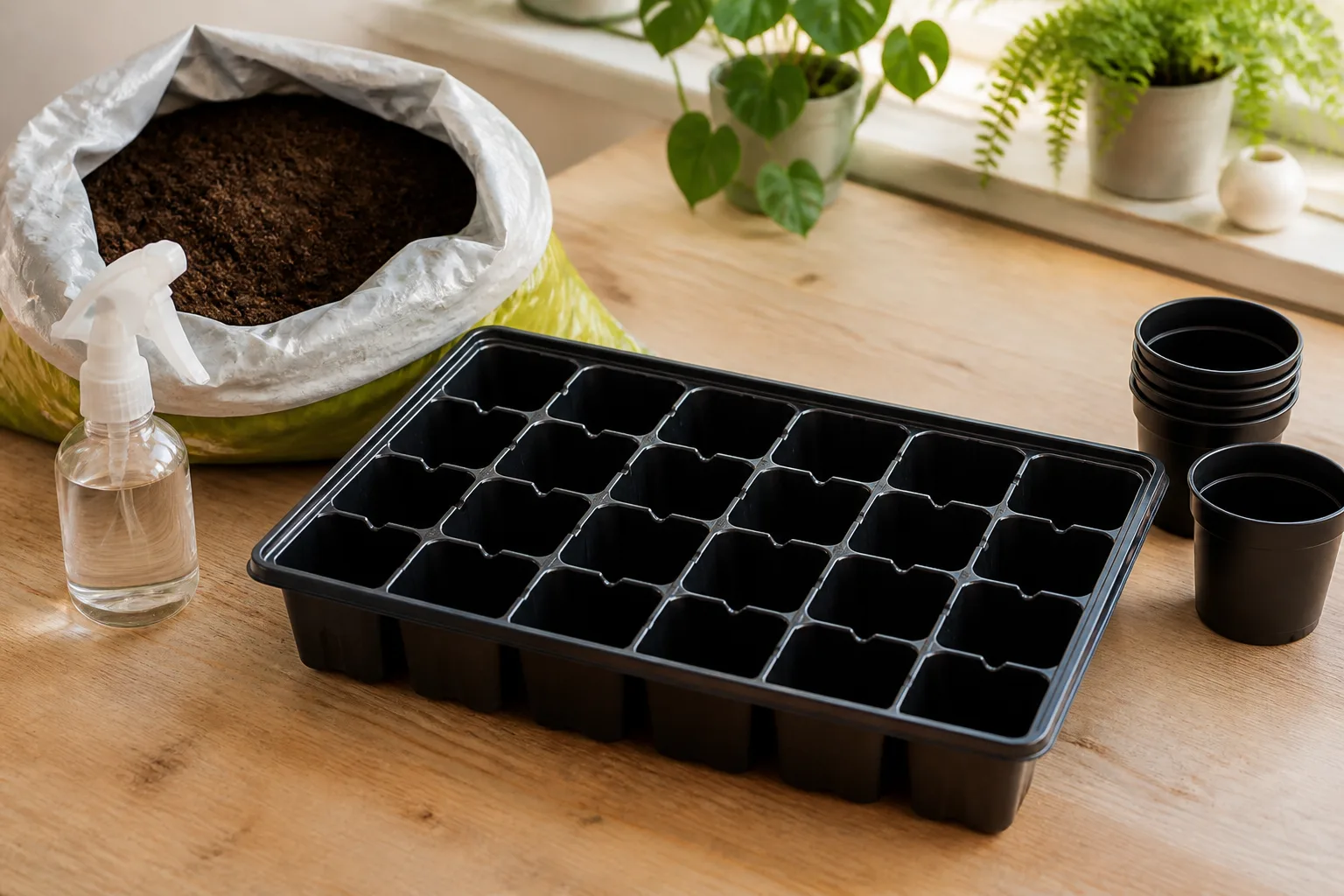
- New or fully sanitized trays — wash, bleach-soak or alcohol-treat, rinse, dry; retire problem plug trays.
- Fresh soilless seed mix — never garden soil; discard outbreak media.
- Clean bench — disinfect the surface before the new tray lands there.
- Thin sowing — space for air and light at the stem base.
- Correct depth and temperature — packet depth; bottom heat ~70–75°F for warm-season germination when appropriate.
- Strong light from day one of emergence — lights a few inches above seedlings, raised as they grow.
- Fan on low — continuous gentle air, not a leaf-shredding blast.
- Humidity dome discipline — vent early; remove once most seeds are up.
- Even moisture, no puddles — water to moisten, then let the surface approach damp-dry between drinks.
- Cull fast — one soft, pinched seedling out immediately, media and all.
- Hands and tools — wash between a sick tray and a clean one.
- Water source awareness — prefer clean tap water for trays; keep rain barrels covered if you use them.
That list is boring on purpose. Damping-off prevention is sanitation and environment, not a secret product.
Related Guides
- Why Is My Plant Leggy? — stretch diagnosis when the plant is past the seedling stage
- Grow Lights for Indoor Plants — fixture distance and photoperiod after you lower the lamp
- Not Enough Light for Houseplants — room-level intensity checks when windowsills fail
- Indoor Plant Watering Basics — moisture habits that keep trays swampy
- Fungus Gnats on Houseplants — wet-media pests that ride the same conditions
- Best Potting Mix for Indoor Plants — media structure after you leave germination mix
Conclusion
Seedlings fall over for reasons you can diagnose with a close look at the soil line and the light above the tray. Soft, pinched, patchy collapse in wet media is damping-off — discard the casualties, sanitize hard, and change moisture and airflow. Tall, pale, firm-based flopping is etiolation — move lights closer, thin the stand, and toughen stems with air movement. When both show up together, clean and dry first, then rebuild light.
Do these 5 before the next sow
- Sanitize or replace trays; rinse bleach residue thoroughly.
- Fill with fresh soilless seed mix — never garden soil or outbreak leftovers.
- Hang lights a few inches above emerging seedlings; raise as they grow.
- Thin early, vent the dome, and run a gentle fan.
- Cull the first soft pinch immediately — media and all — before the patch spreads.