35 Types of Snake Plants Worth Growing
Compare 35 snake plant types by leaf shape, size, variegation, and light needs. ID charts, pet safety, dwarf vs tall picks, and links to species care.
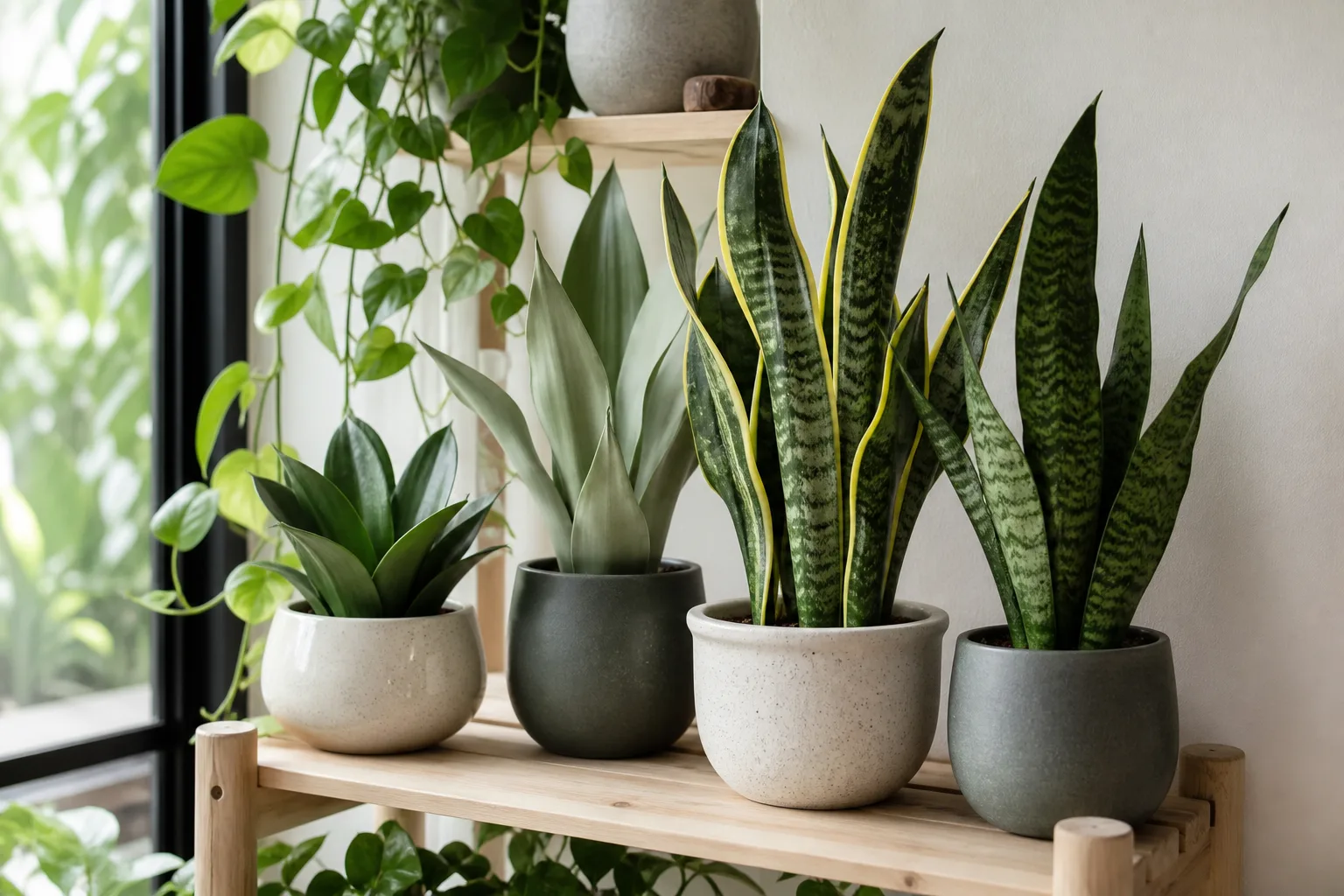
Snake plants are the houseplant world’s answer to “I forget to water.” Botanists now classify them as Dracaena, after DNA work folded the old Sansevieria genus into it—but the nickname stuck because the upright, sword-like leaves look nothing like cane-form corn plants or dragon trees sold under the same genus name. More than 70 species exist in the wild, from desert succulents to humidity-loving tropical forms, and nurseries push dozens of named cultivars on top of that.
This guide covers 35 snake plant types worth growing indoors: the classics you will see at every garden center, the dwarfs that fit on a shelf, the cylindrical oddballs collectors chase, and a handful of rare species that reward patient growers. For watering rhythms, soil mixes, and troubleshooting yellow leaves across the group, start with our snake plant care guide; the snake plant hub links light, watering, soil, propagation, and problem-fix pages when you want to go deeper on one plant. If you are comparing snake plants to other Dracaena houseplants, see our types of dracaena guide for cane types like Janet Craig and lucky bamboo.
What Counts as a Snake Plant Today
A snake plant is any Dracaena species or cultivar in the former Sansevieria group: thick, succulent leaves rising from underground rhizomes, no woody cane, and a tolerance for dry soil that cane dracaenas do not share. The most common species is Dracaena trifasciata (formerly Sansevieria trifasciata), native to West Africa and naturalized in subtropical regions worldwide. NC State Extension lists it as a stemless evergreen with stiff upright leaves, slow growth, and low maintenance indoors. (NC State Extension)
Taxonomy shifted after molecular studies showed Sansevieria nested inside Dracaena. NCBI Taxonomy now lists species like D. trifasciata, D. angolensis, and D. masoniana under Dracaena. Retail tags still print “Sansevieria” on half the pots—both names point to the same plant. What matters for you: shop and care by leaf shape and growth habit, not by whether the sticker updated.
Royal Botanic Gardens, Kew notes that snake plants use CAM photosynthesis, opening stomata at night to reduce water loss—part of why they survive irregular watering better than thin-leaved tropicals. (Royal Botanic Gardens, Kew) They are not immortal in dark closets, but they forgive more mistakes than most foliage houseplants when drainage is right.
How to Identify Your Snake Plant Type Before You Buy
Nursery labels lie. Wholesale growers reuse generic “snake plant” tags, and the same cultivar arrives under three Latin names. Identification starts with what you can see in the pot, not what the sticker claims.
Flat Sword Leaves vs Cylindrical vs Bird’s Nest Rosettes
Run through this order every time:
- Flat, sword-shaped leaves in an upright fan → Dracaena trifasciata cultivars (Laurentii, Moonshine, Black Gold, Whitney, and most variegated types on this list).
- Short rosette, leaves clustered like a nest → bird’s nest types (D. trifasciata ‘Hahnii’, ‘Twisted Sister’, ‘Black Jack’, ‘Jade Pagoda’, ‘Futura Superba’).
- Round or cylindrical leaves, stiff and tube-like → D. angolensis, D. bacularis, D. canaliculata, D. ballyi, D. francisii, ‘Starfish’, ‘Fernwood’.
- One or few extremely wide paddle leaves → whale fin (D. masoniana).
- Leaves spreading sideways or drooping with age → D. patens, D. pethera, D. pinguicula (walking sansevieria).
Variegation pattern narrows cultivars within the flat-leaf group: yellow leaf margins (Laurentii, Black Gold, Black Limon), silvery-gray overall (Moonshine, Silver Queen), white vertical stripes (Bantel’s Sensation), horizontal banding (Zeylanica, standard green), or metallic gray lines (‘Metallica’).
Why Tags Still Say Sansevieria
You will still see Sansevieria trifasciata, S. cylindrica, or S. masoniana on pots and online listings. Those are synonyms, not different plants. ITIS and other taxonomic databases track the name change to Dracaena, but horticulture moves slower than botany. When comparing two pots, match leaf width, edge color, and height habit—not the genus printed in smaller type on the tag.
If a seller lists “Sansevieria” only, ask for a photo of the leaf cross-section: flat vs round eliminates half the confusion before you pay shipping on the wrong type.
Shared Care Rules for Every Snake Plant Type
Every type on this list shares a succulent-style baseline. Do not water snake plants on the same schedule as cane Dracaena fragrans or marginata—that mismatch is the top reason collections fail.
| Factor | Snake plants (all types below) | Notes |
|---|---|---|
| Light | Bright indirect ideal; many tolerate moderate low light | Variegated and silver cultivars need more light to hold color |
| Water | Only when soil is fully dry | Overwatering causes root rot faster than underwatering causes harm |
| Soil | Fast-draining succulent or cactus mix | Heavy peat retains moisture too long |
| Pot | Drainage hole required | Terra cotta helps dry rhizomes between drinks |
| Temperature | 60–85°F (16–29°C) | Below 50°F (10°C) damages leaves |
| Humidity | Average room OK | High humidity rarely hurts; low humidity is fine |
| Fertilizer | Dilute feed spring–summer; skip winter | Overfeeding burns leaf tips |
| Repotting | Every 2–4 years when root-bound | Spring preferred; do not upsize aggressively |
The RHS groups sansevierias among low-maintenance foliage plants that prefer bright light but tolerate shade, with watering reduced in winter. (RHS) First action when any snake plant looks unhappy: stick a finger or moisture meter deep into the pot. Soft yellow leaves at the base almost always mean wet soil, not “needs more water.”
Variegated cultivars (Laurentii, Moonshine, Bantel’s Sensation) lose contrast in dim rooms within weeks—move them closer to a window before assuming the cultivar was mislabeled.
Pet Safety: Are Snake Plants Toxic?
Yes. ASPCA lists snake plant (Sansevieria spp., now Dracaena trifasciata and related species) as toxic to dogs and cats. Saponins in the leaves can cause nausea, vomiting, and diarrhea if chewed. (ASPCA) There is no pet-safe snake plant cultivar—only placement on stands, shelves, or rooms pets cannot access.
Our snake plant toxicity guide covers symptoms, vet decision points, and safer alternatives if you share space with curious chewers. Call ASPCA Poison Control at (888) 426-4435 or your veterinarian if a pet ingests leaf tissue.
Classic Dracaena trifasciata Cultivars (Flat Sword Types)
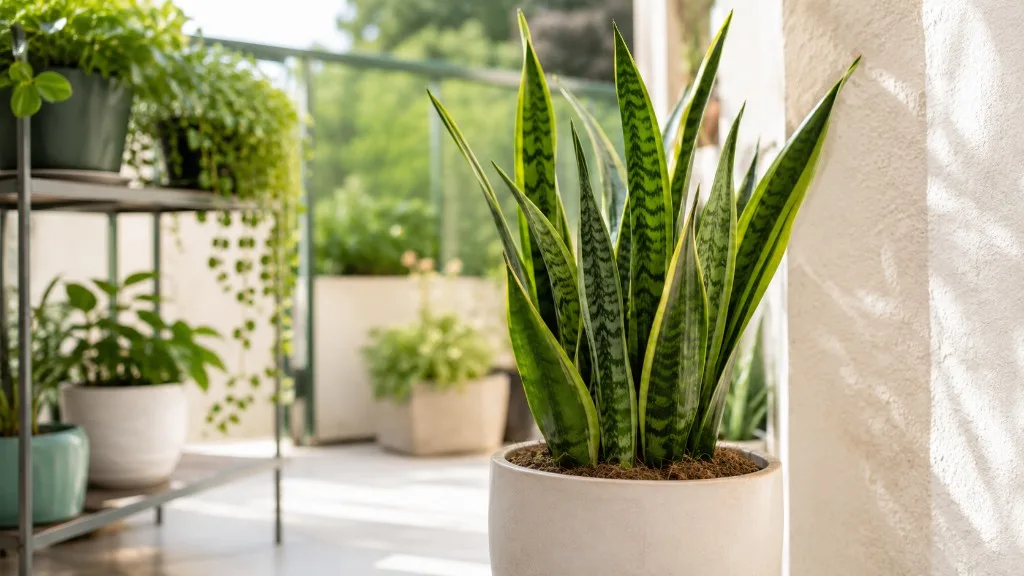
Most of the 35 types on this list are Dracaena trifasciata cultivars or close look-alikes with flat, upright leaves. These are the varieties you will find at big-box stores, grocery floral sections, and online plant shops without hunting specialty sellers.
Laurentii, Zeylanica, and Bantel’s Sensation
Laurentii (D. trifasciata ‘Laurentii’) — The default snake plant in most minds: dark green leaves with horizontal gray-green bands and bright yellow margins, sword-shaped, to about 4 ft indoors. Also sold as variegated snake plant or striped mother-in-law’s tongue. Tolerates lower light than silver cultivars but yellow edges narrow in very dim spots.
Zeylanica (D. zeylanica) — Nearly identical banding to the species type but without yellow margins—olive-green leaves with twisty horizontal stripes, to 3 ft. Often confused with plain D. trifasciata; check for the absence of gold edging.
Bantel’s Sensation (D. trifasciata ‘Bantel’s Sensation’) — Slender, tall leaves with bold white vertical stripes on dark green—sometimes called white snake plant. Award-winning cultivar that needs bright indirect light to keep stripe contrast. Height ~3 ft.
Futura Robusta — Semi-compact matte dark green leaves with silvery-green blotches; inverted-triangle leaf shape; ~2 ft.
Black Robusta — Very dark green with mottled silver stripes; slower than ‘Black Jack’; typically 3–5 leaves per rosette; ~16 in.
Futura Superba — Wide leaves, substantial yellow margin, upright rosette of 3–5 leaves; ~15 in.
Whitney — Dark green centers with irregular pale margins on wide leaves; 4–5 leaves per plant; ~16 in.
Moonshine, Silver Queen, and Metallica
Moonshine (D. trifasciata ‘Moonshine’) — Silvery-gray, almost white new leaves that darken with age; wide inverted-triangle shape; ~2 ft. Needs bright light—in shade, leaves revert to darker green within weeks. One of the most photogenic cultivars and one of the easiest to mis-buy for a dim room.
Silver Queen — Medium height with silver-green banding and horizontal stripes; ~3 ft; less extreme than Moonshine but still a high-light cultivar.
Metallica — Rare, slow-growing; metallic silver-gray vertical lines over green with horizontal banding; ~3 ft. Specialist nurseries more than big-box stock.
Golden Flame — Gray-green leaves with yellow-gold streaking like sparks; darkens with age; compact ~18 in.
Black Gold, Black Limon, and Compact Gold-Edge Cultivars
Black Gold — Dark green foliage with sharp chartreuse-yellow margins; ~3 ft; margin color needs good light—direct midday sun scorches leaves, but deep shade bleaches the gold.
Black Limon — Similar gold edge on dark green; ~3 ft; marketed for drought tolerance—still needs dry soil between waterings, not neglect forever.
Black Jack — Compact rosette, 7–10 leaves, bright yellow-green margins on dark green; ~15 in.; faster than Black Robusta.
Jade Pagoda — Dwarf with wavy yellow margins on deep green; ~10 in.; big visual impact in a small pot.
When not to buy: Any silver or heavily variegated flat cultivar (Moonshine, Bantel’s Sensation, Metallica) for a north-facing room far from glass. Choose Zeylanica, Laurentii, or a bird’s nest dwarf instead—or add a grow light.
Bird’s Nest and Dwarf Snake Plants for Small Spaces
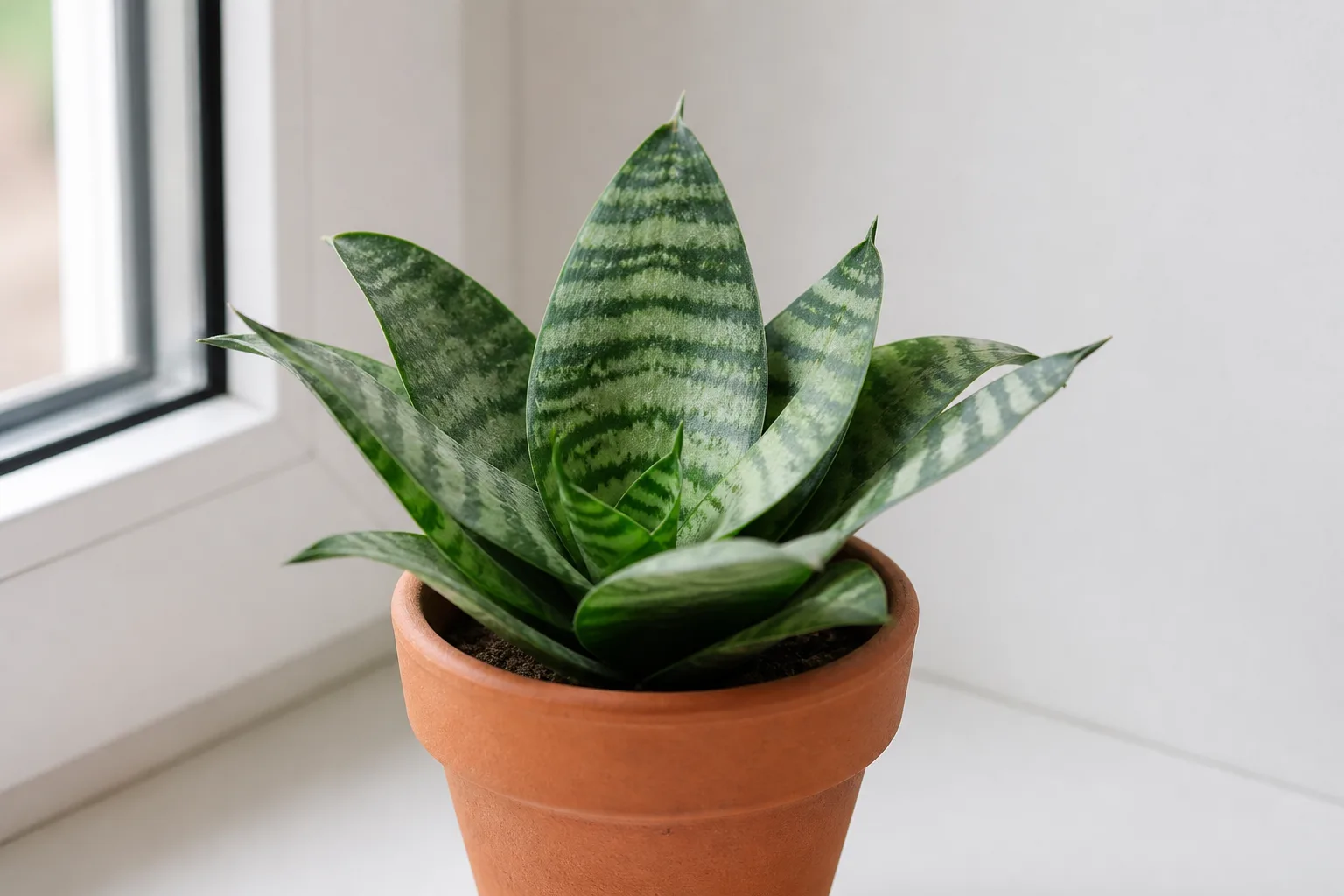
Bird’s nest types are stemless rosettes: leaves cluster low like a nest rather than rising in a tall fan. They fit desks, bathroom shelves, and kitchen windowsills where a 4-foot Laurentii would be absurd.
Hahnii (D. trifasciata ‘Hahnii’) — The original bird’s nest snake plant; dark green with creamy horizontal stripes; ~18 in. wide rosette; fast offsetter.
Twisted Sister — Gold-green variegation with curved, twisting leaves; ~15 in.; excellent shelf plant.
Black Jack, Whitney, Futura Superba, Black Robusta, Golden Flame, and Jade Pagoda (detailed above) also stay under 20 in. and belong in this shopping category even when sold as “compact trifasciata” rather than Hahnii sports.
For propagation and repotting dwarfs without rotting rhizomes, see our snake plant propagation guide.
Cylindrical and Round-Leaf Snake Plants
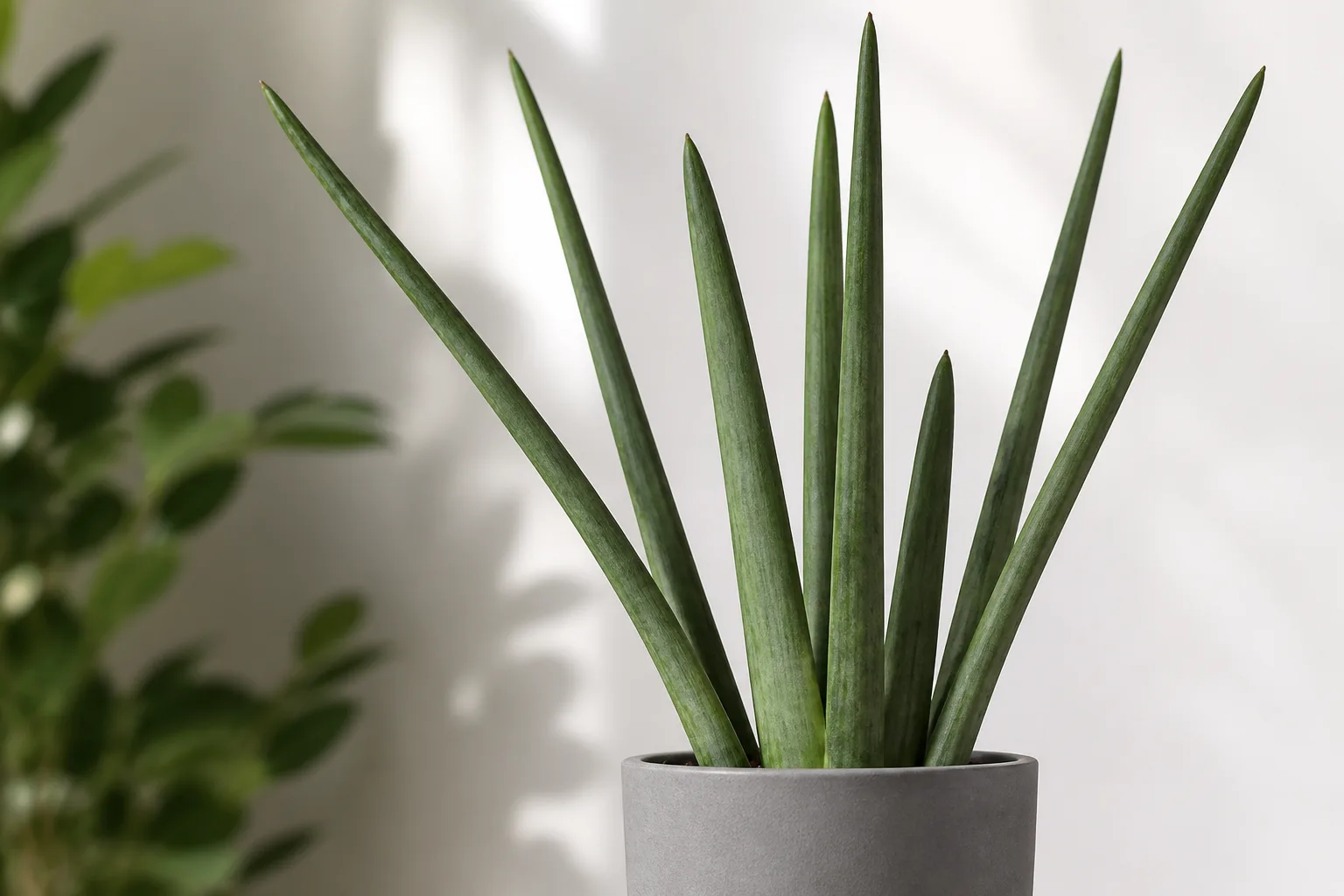
Cylindrical types look like green fingers or spears rising from the pot. They read as a different plant entirely until you flip the tag and see Dracaena again.
African Spear, Starfish, and Bacularis
African spear (D. angolensis, formerly S. cylindrica) — Round, stiff, gray-green leaves arching from a central crown; ~6 ft at maturity indoors; slow. Braided forms sold in shops are one plant, not multiple stems—unbraid carefully if repotting.
Starfish (D. angolensis ‘Starfish’) — Stubby cylindrical leaves spreading in a fan like a starfish; ~1 ft; collectible dwarf form of the spear group.
Bacularis (D. bacularis) — Often confused with D. angolensis but leaves are thinner tubes with gray-green banding; ~6 ft; upright habit.
Canaliculata (D. canaliculata) — Cylindrical leaves with surface grooves, growing individually rather than in tight rosettes; ~3 ft; rare in retail.
Ballyi (D. ballyi) — Dwarf snake plant with thin rough cylindrical leaves curving inward; ~6 in.; reddish-brown leaf tips; ‘Minnie’ cultivar even smaller.
Fernwood (D. ‘Fernwood’) — Hybrid of D. parva × D. suffruticosa; grooved cylindrical leaves, dense arching clump; ~3 ft; often mislabeled as D. angolensis—look for vertical grooves.
Francisii (D. francisii) — Short stiff tubes in stacked rows with gray banding; ~2 ft; specialist plant.
Suffruticosa (D. suffruticosa) — Bowstring hemp; thick leaves with a central groove becoming cylindrical toward the tip; ~3 ft; slightly arching.
Stuckyi (D. stuckyi) — Floor specimen potential; young plants banded and flat-ish, mature leaves long, pale green, cylindrical with vertical channels—transformation takes years; ~6 ft.
Rare and Unusual Snake Plant Species
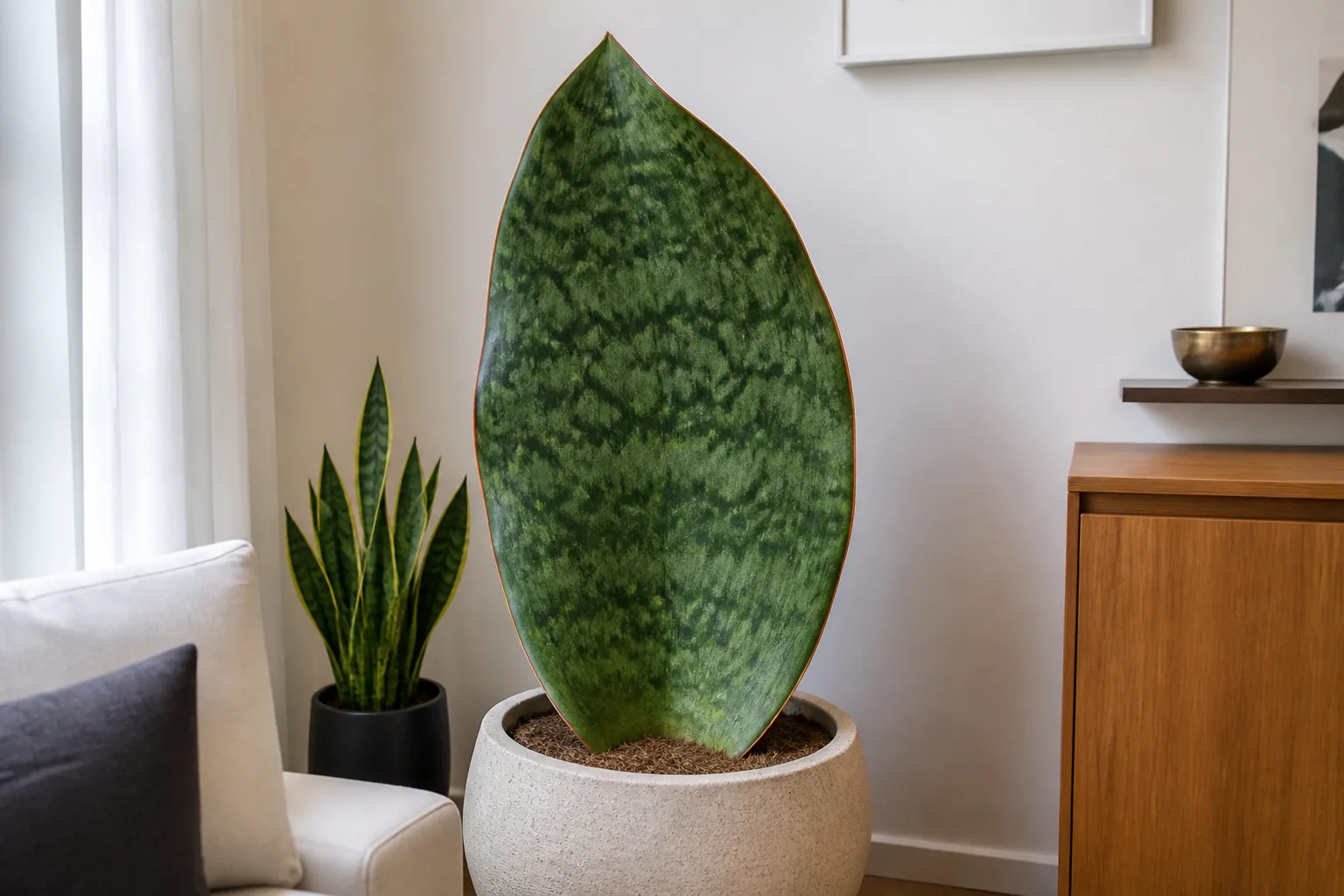
These types reward collectors who accept slow growth, specialist sourcing, and prices far above a $15 Laurentii.
Whale Fin, Walking Sansevieria, and Spreading Forms
Whale fin (D. masoniana) — Massive paddle-shaped leaves, mottled green with reddish margins; ~4 ft leaf length possible; slow; the statement plant of the genus. Full care on the whale fin snake plant hub.
Walking sansevieria (D. pinguicula) — Stubby blue-green leaves with reddish margins and sharp tips; “walking” refers to how offsets emerge on stolons above soil; ~1 ft; resembles agave more than a classic snake plant.
Star sansevieria (D. pethera, often sold as D. kirkii) — Heavy sword leaves that droop with age unlike upright trifasciata; wavy reddish margins; ~3 ft; very slow.
Patens (D. patens) — Thick leaves fanning in random directions with deep grooves; bright green banding; informal, sculptural habit; ~3 ft.
Hanningtonii (D. hanningtonii, syn. D. ehrenbergii) — Sword sansevieria or blue sansevieria; wide bluish leaves with reddish margins; ~5 ft but takes years indoors.
Pearsonii (D. pearsonii) — Rhinograss; vertical ribbed leaves, dark green; hard to find; ~4 ft.
Parva (D. parva) — Kenya hyacinth; narrow lance leaves; fragrant flowers when conditions align—rare indoors; ~18 in.; variegated form exists with yellow-white stripes.
Concinna (D. concinna) — Rare species; leaves can develop spoon shape in bright light; ~18 in.
Aubrytiana (D. aubrytiana) — Father-in-law’s tongue; glossy marbled white splotches on dark green; ~2 ft; related to D. pethera.
When not to buy rare types as your first snake plant: If you tend to overwater, start with Zeylanica or Hahnii, not whale fin or pinguicula. Rare species cost more and forgive less while roots establish.
Quick Pick Chart: Best Snake Plant for Your Room
| Your situation | Best types | Why |
|---|---|---|
| First houseplant / chronic overwaterer | Zeylanica, Hahnii, Black Jack | Forgiving banding; compact size slows rot risk |
| Low light hallway | Laurentii, Zeylanica, standard green trifasciata | Hold color better than silver cultivars in shade |
| Bright south or west window | Moonshine, Bantel’s Sensation, Black Gold | Variegation and silver tones need luminance |
| Desk or shelf under 12 in. | Jade Pagoda, ballyi, Twisted Sister | True dwarfs stay off the floor |
| Statement floor plant | Laurentii, stuckyi (mature), African spear | Vertical height without cane-dracaena watering |
| Pet-free collector | Whale fin, pinguicula, francisii | Visual payoff; not for chewers |
| Pets in the home | None without elevation | All types toxic; use stands or choose non-toxic plants |
| Cylindrical aesthetic | Starfish, bacularis, Fernwood | Distinct from flat mother-in-law’s tongue look |
| Blooms (honest expectations) | Parva, hanningtonii | Most snake plants rarely flower indoors; see our snake plant bloom guide |
Shopping tip: Buy the leaf shape you want, not the trendiest cultivar name. A healthy Zeylanica beats a stressed Moonshine shipped cross-country and parked in a dark corner.
Conclusion
Snake plants earned their popularity by surviving real apartments—irregular watering, dry air, and moderate light—not by being unkillable sculptures. The 35 types here span flat classics, bird’s nest dwarfs, cylindrical spears, and rare paddles, all united by dry soil between waterings, fast drainage, and honest light for variegation.
Start with an ID pass: flat vs round vs nest rosette, then margin color, then mature size. Link out to our snake plant care guide when you are ready to repot, propagate, or fix yellow leaves—and keep pots away from pets regardless of cultivar. Once you know which silhouette you want, the “right” snake plant is the one whose leaf shape you will still like when it is 3 years older and twice as wide.