Should You Water Orchids With Ice Cubes? The Evidence
Can you water orchids with ice cubes? Learn what a Phalaenopsis study tested, when the method may suit a bark-grown orchid, and when tepid water is better.
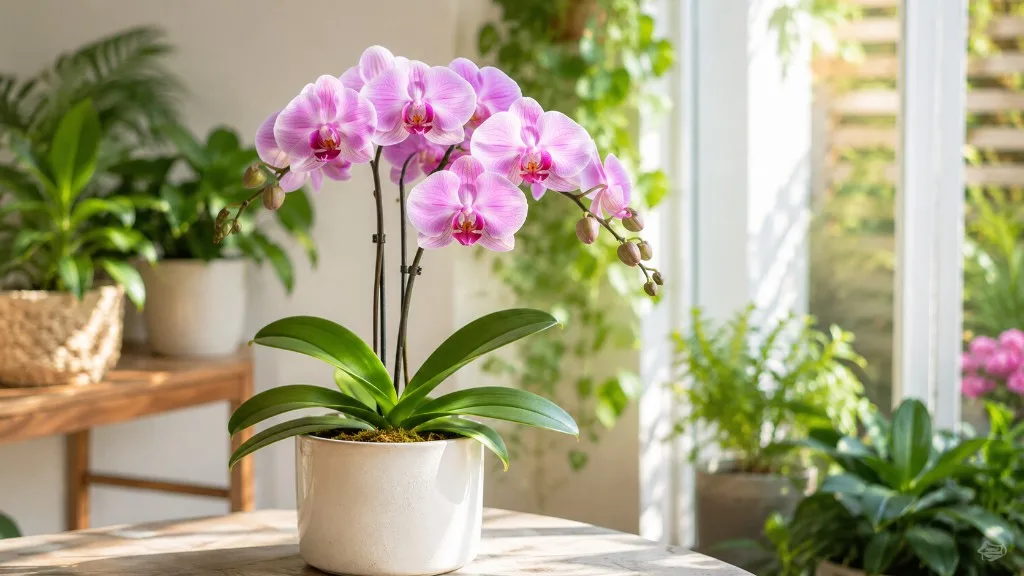
You can water some common moth orchids with ice cubes without harming them, but the answer is narrower than “three cubes every week works for orchids.” A peer-reviewed study found no reduction in display life or measured plant quality when four cultivars of potted Phalaenopsis in bark received weekly ice cubes instead of the same volume of room-temperature water. That result supports the method for a specific plant-and-pot setup; it does not show that ice is better, that every orchid should be watered on a weekly schedule, or that every growing medium needs the same dose.
For a typical grocery-store Phalaenopsis in a well-drained bark mix, ice can be a convenient way to deliver a small, repeatable amount of water. Still, the more flexible routine is to check the medium and roots, water thoroughly with tepid water when the plant is nearly dry, and let excess drain away. That approach adjusts to a cool room, a warm windowsill, a moss-filled pot, and an orchid that is using water quickly.
The Short Answer: It Depends on the Orchid and the Setup
If you have a mature Phalaenopsis planted in chunky bark, the available trial supports using ice as a measured irrigation option. The important conditions are the orchid type, the medium, the pot’s drainage, and the fact that the plant is ready for water. The research does not establish a universal watering rule for all Orchidaceae, which includes plants with very different roots and moisture needs.
For a different orchid genus, a plant mounted on cork, a basket with exposed roots, or a Phalaenopsis packed in moisture-retentive sphagnum moss, do not copy a fixed cube count just because it is convenient. First decide whether the plant is nearly dry. Then choose a method that wets the whole root zone without leaving it waterlogged. The American Orchid Society emphasizes that watering frequency depends on the growing area, humidity, airflow, medium, and light; there is no reliable number of days that fits every pot (American Orchid Society).
What the Ice-Cube Study Actually Tested
In 2017, researchers published a HortScience study comparing ice-cube irrigation with room-temperature water for potted Phalaenopsis orchids grown in bark. The experiment evaluated four cultivars and used three ice cubes once a week, compared with the equivalent volume of tap water. The researchers measured individual flower longevity, overall display life, and aspects of plant quality. They found that the ice treatment did not decrease display life or the measured quality of the orchids (South et al., HortScience).
That is useful evidence because it tests the concern that a slowly melting frozen cube must injure a tropical orchid. Under those trial conditions, that injury did not show up in the measured outcomes. A controlled comparison also gives a clearer answer than a grower’s anecdote: the tested orchids received a measured water volume in two different forms, ice or liquid water.
The result does not mean ice cubes are a special orchid food or a treatment that improves flowering. The room-temperature-water plants were the comparison group, not a failing group. The study supports “this dose did not harm these bark-grown Phalaenopsis during the trial,” not “ice cubes are the ideal way to water all orchids.”
What the Study Does Not Prove
The trial focused on four Phalaenopsis cultivars in bark. It cannot establish the same result for every orchid genus, an orchid mounted on a slab, a plant with roots exposed to the room, or a pot packed with dense sphagnum. It also does not establish that a set number of cubes matches every pot size, cube size, home temperature, humidity level, or stage of growth.
The study’s measurements also answer a limited question. Display life and measured plant quality are meaningful outcomes for a flowering houseplant, but they are not a guarantee that every long-term watering routine will keep every orchid healthy for years. A small dose could leave a larger or quickly drying pot thirsty; a dose delivered to a small moss-filled pot could leave its center wet longer than expected. These are differences in volume and dry-down, not proof that ice itself is toxic.
That distinction matters because advice about orchids often turns one study into an all-purpose rule. The best reading is more practical: ice was not shown to harm the tested Phalaenopsis setup, while orchid growers still need to match water to species, potting mix, and conditions.
Why the Method Can Be Convenient—and Where It Falls Short
Ice cubes are pre-measured water. As they melt, they release moisture gradually instead of sending a large pour through the pot immediately. For someone who tends to soak an orchid and leave it sitting in a full cachepot, the measured-dose aspect can make the routine easier to control. The study found that the cold water did not reduce display life for the tested plants, so there is no need to treat every use of ice on a bark-grown Phalaenopsis as an automatic emergency.
But the method’s convenience comes from limiting the amount of water. It does not tell you when the plant needs water, guarantee that the dose wets all roots evenly, or flush fertilizer salts from bark. If the medium is still damp, adding ice because it is “orchid day” is still watering too soon. If the bark is bone dry and water runs around the rootball, a few small cubes may not rehydrate the whole pot. In that case, a slow thorough soak and complete drainage are more useful.
Ice also does not replace inspection. Roots that are chronically wet can lose the ability to absorb water, so the leaves may wrinkle even though the plant is surrounded by moisture. Adding more cubes in response to limp leaves without checking roots can intensify the underlying problem. The same diagnostic rule applies whether water comes from a frozen cube, a cup, or a watering can: look at the medium and root condition before increasing the amount.
Identify the Orchid Before Borrowing a Routine
The ice-cube research centers on Phalaenopsis, often called moth orchids. They are the familiar flowering orchids sold in grocery stores and garden centers, and they are often grown in a clear inner pot filled with bark or a bark-based mix. If that describes your plant, the trial is relevant—but still only if its container and medium resemble the tested setup.
Other orchids can have a different balance between moisture and drying. The American Orchid Society advises that Cattleyas and Oncidiums with pseudobulbs can generally dry fully between waterings, while Phalaenopsis and Vandas without water-storage organs should be watered just before they become completely dry. Some mounted orchids need very frequent watering because their roots dry quickly. A Phragmipedium or Paphiopedilum may have preferences that differ from the common moth orchid.
If you do not know the name, start with the plant tag, purchase page, or a reliable orchid identification resource. Do not assume that “orchid” is a single care category. The broad family includes plants that live in bark-like air spaces, plants that prefer more consistent moisture, and species with thick storage organs. A fixed ice-cube schedule that works for one grocery-store Phalaenopsis can be a poor fit for another orchid in your collection.
Let the Potting Medium Set the Watering Interval
The type and condition of the medium affect how much water stays near the roots after irrigation. A clear plastic pot makes the medium and roots easier to inspect, but even then the visible surface may dry before the center. If your orchid’s medium is new, old, tightly packed, or recently changed, its watering pattern may differ from the one you observed last month.
Bark dries differently from moss
Chunky bark drains quickly and holds air pockets around orchid roots. It can dry at different rates across the pot; the bark near the surface may become pale while the lower portion stays damp. If the pot feels heavy or a wooden skewer inserted near the center comes out cool and damp, wait even if the top pieces look dry. Gardeners’ Path likewise notes that bark generally drains faster than sphagnum moss, while the moss can retain moisture much longer (Gardener’s Path).
Bark also changes as it ages. Fresh coarse bark can dry quickly, but old bark that has broken down into finer particles can hold water and reduce airflow. If it takes unusually long to drain or remains wet for many days, adjust the medium or plan to repot rather than adding a small amount of water more often. The roots need both moisture and air; frequent sips are not automatically safer than a thorough watering followed by a healthy dry-down.
Moss, mounted plants, and baskets need separate checks
Sphagnum moss can hold moisture in the middle of a pot even when the surface looks dry. A few cubes placed on top may melt in one area while the rootball remains unevenly wet. For a moss-grown Phalaenopsis, check deeper in the pot and lift it to judge its weight; do not treat the bark-based study as a tested prescription for moss.
Mounted orchids, slatted baskets, and bare-root Vandas lose water more quickly because airflow reaches more of the root surface. A small cube perched on one part of the mount may not wet all roots. These plants often need a full root-zone rinse or soak and more frequent checks, especially in a warm, dry, or breezy room. If you have a mixed collection, give each type its own routine rather than watering every pot on the same day.
If You Choose Ice, Use It as a Measured Dose
For a bark-grown Phalaenopsis that is ready for water, a small number of cubes can be used as a measured option. Keep the ice on the medium and away from the crown, leaves, flowers, and exposed aerial roots. Use a pot with drainage holes, and take the inner pot out of any decorative cachepot first so you can see whether water collects underneath.
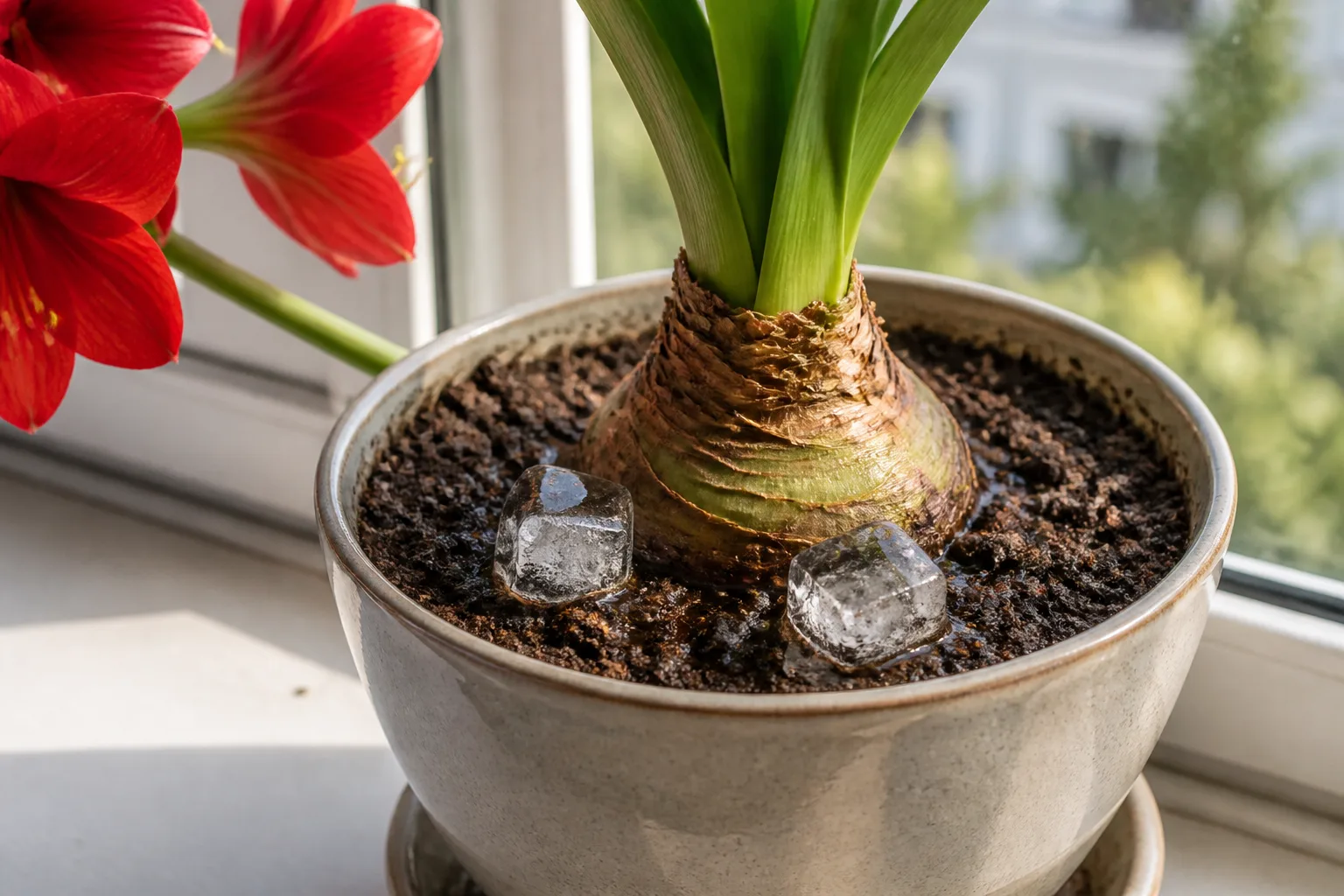
This image shows a different potted plant and illustrates only the measured-meltwater concept; the cited orchid trial tested Phalaenopsis grown in bark.
This is not a reason to add cubes on a fixed weekday regardless of moisture. The plant still needs a dry-down appropriate to its medium, and any meltwater in the outer pot must be poured away. If the pot is very large, the room is hot, or the roots remain dry after the cubes melt, switch to a thorough soak rather than stacking cubes until the dose seems right.
Match the dose to the test, not an arbitrary calendar rule
The study’s protocol used three ice cubes weekly for its potted Phalaenopsis plants. That is the tested starting point, not a universal measure for every orchid sold in every container. “Three cubes” can mean different volumes depending on the ice tray, while plant size, bark amount, light, temperature, humidity, and airflow change how quickly water is used.
If you try the method, use it only when the orchid is approaching dryness and then observe what happens. After the cubes melt, check that the center of the medium is not still soggy and that the pot has drained rather than holding standing water. If roots stay silver and leaves begin to soften despite regular doses, the plant may need more water or its roots may be damaged; inspect the medium before simply adding another cube.
Some retail care instructions and gardening articles repeat the three-cube weekly shortcut because it is easy to remember. Treat that number as a repeatable experimental dose for a similar bark-grown moth orchid, not a timer. The amount should change if the container and conditions are different, and the plant’s actual moisture cues take priority over a printed calendar.
A More Flexible Routine: Water Thoroughly and Let It Drain
For most home-grown potted orchids, a tepid pour gives you a more adjustable routine. Remove the grow pot from its decorative cover, take it to a sink, and slowly wet the whole medium until water exits the drainage holes. If the bark is very dry and water races through without soaking it, pause briefly and repeat the pour from another direction.
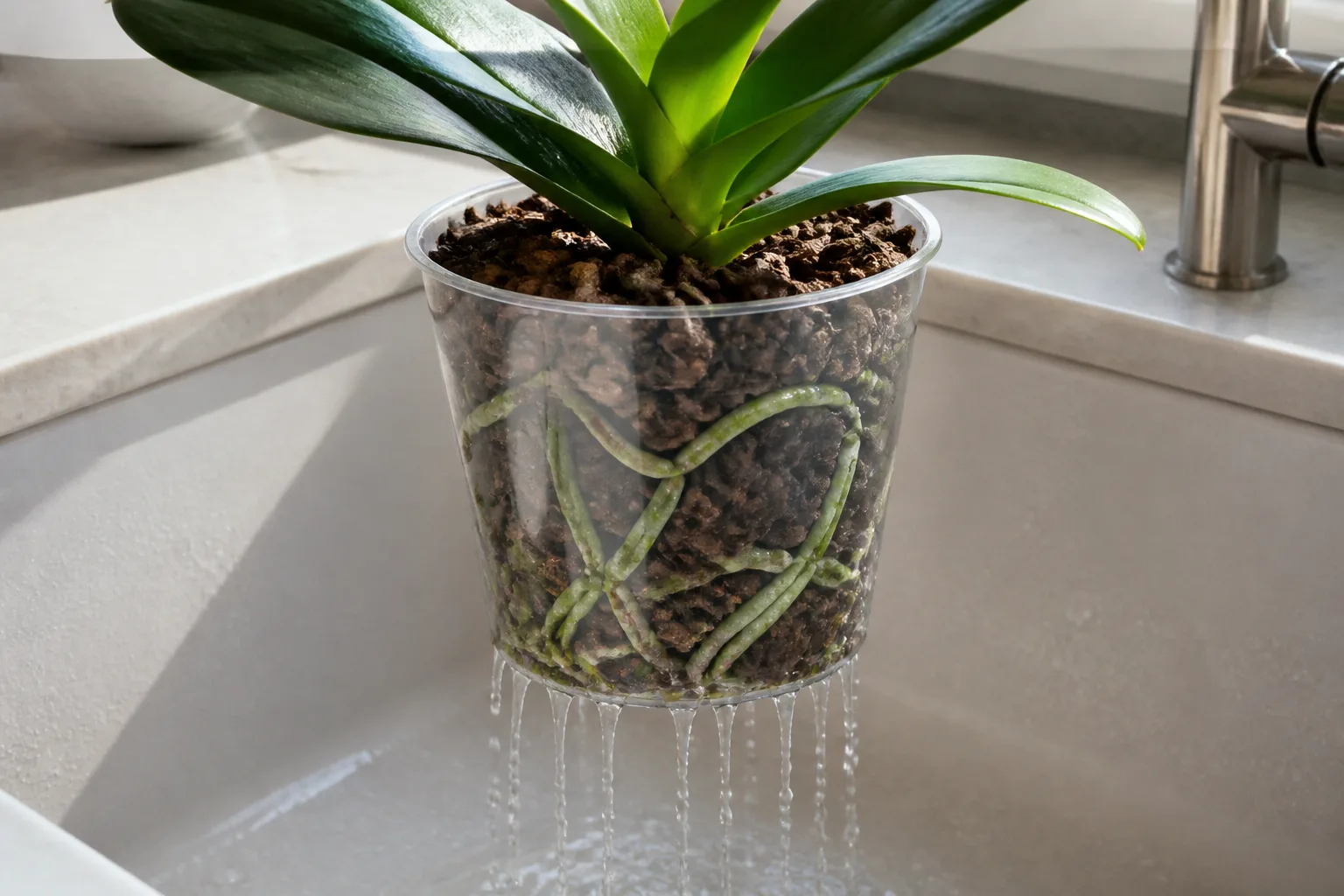
Water at the root zone rather than pouring into the crown, where water can sit between the leaves. When the medium is thoroughly wetted, let the pot drain fully before you return it to a shelf or cachepot. This method gives the bark a complete soak and makes it easy to see whether drainage is clear.
Flush the medium and empty the outer pot
A thorough flush has a second benefit: it carries away some dissolved fertilizer and mineral salts that can accumulate in the medium. The American Orchid Society recommends watering copiously until water runs freely through the drainage holes and notes that flushing helps remove salts; it also advises watering plants thoroughly at least periodically, even when another routine is used (American Orchid Society).
After watering, wait until dripping stops and empty the saucer or decorative pot. A cachepot without drainage can hide several tablespoons of runoff, leaving roots to sit in water while the surface of the bark appears dry. Do not use a communal dunk bucket for a group of orchids; sharing standing water can spread disease from one plant to another. A personal sink or separate clean vessel is easier to manage.
Read Roots and Medium Before You Water
In a clear grow pot, firm roots that look green after watering and silver, white, or pale gray as they dry give you a useful cue. Color alone is not enough: some roots are hidden by bark, older roots may be stained, and different orchid species have their own patterns. Combine root appearance with pot weight and a deeper look or feel of the medium.
Lift the pot shortly after watering so you learn its heavier, wet weight. Lift again as it approaches dryness; the difference is often easier to notice than judging the bark by sight. You can also slide a wooden skewer down the inside edge of the pot for a few minutes. If it comes out cool and damp, wait; if it is nearly dry and the pot is light, it is probably closer to watering time.
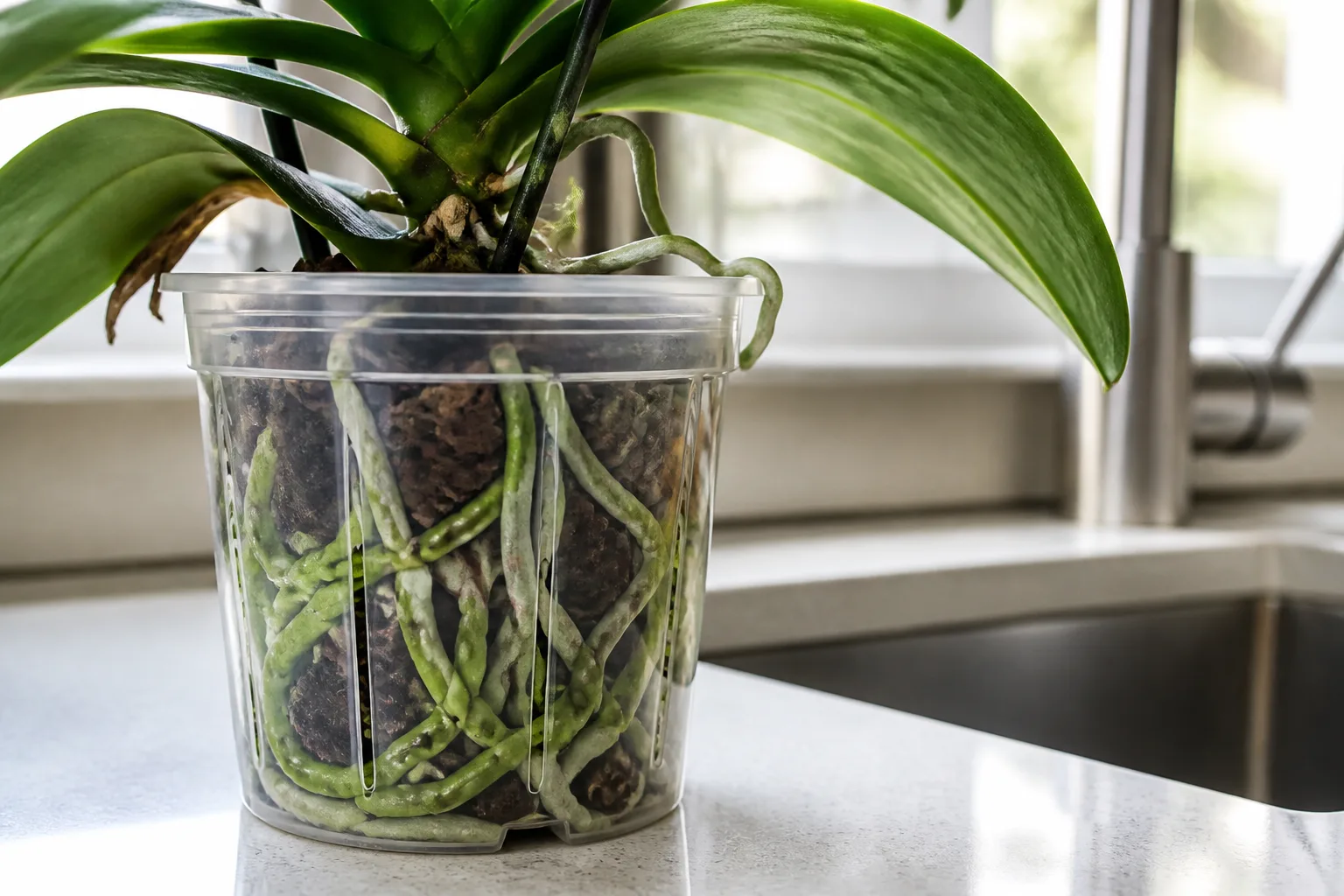
The American Orchid Society describes dry roots as white or gray and hydrated roots as greener, while brown, mushy roots indicate decay. A root that is silver but firm is not automatically dead and should not be trimmed. Look instead for roots that are soft, hollow, blackened, or whose outer layer slips away easily; those are stronger evidence of damage than a color change on its own.
Adjust for Light, Temperature, Season, and Repotting
Bright light, warm air, low humidity, and moving air usually dry a pot faster. Cool temperatures, short winter days, a large container, and dense moss tend to slow dry-down. Do not “water less in winter” by turning off the plant’s supply for a set number of weeks; check the plant more slowly and wait for the medium to approach its own dry point.
Repotting also resets the routine. Fresh bark can dry differently from decomposed bark; new sphagnum can hold water longer than the old mix; a pot that is larger than the root system may stay wet in its center. After repotting, use the same root, weight, and medium checks rather than copying the old schedule. A plant in active root or leaf growth may use water differently from one that is cool and growing slowly.
For a Phalaenopsis, the goal is generally not to leave it bone dry for long stretches, but also not to keep the root zone saturated. The American Orchid Society’s rule of watering just before complete dryness is more useful than an exact weekly count because the same plant can dry in four days in one room and take much longer in another. If a routine changes, observe it for a few cycles before increasing or cutting the dose.
Mistakes That Cause More Trouble Than Ice Temperature
The most common error is watering by a weekly reminder instead of checking whether the pot needs it. A damp moss center, decomposed bark, a low-light room, or a cool season can make the same dose too frequent. Conversely, a hot windowsill, fresh bark, a small pot, or an exposed mount can leave a plant dry well before a week has passed.
Another problem is focusing on the cold cube while ignoring drainage. A pot without drainage can trap meltwater; a blocked drain hole can keep roots wet; and water left in the decorative pot can cause the same oxygen-starved conditions as any other watering method. The cause of root rot is persistent wetness and poor airflow, not the fact that the water began as ice.
Do not mistake misting for watering. A spray can briefly wet leaves or aerial roots, but it will not thoroughly rehydrate the bark around roots in the center of a pot. Likewise, do not leave water in the Phalaenopsis crown. If a little collects there, blot it with a clean tissue, especially before a cool night.
Troubleshoot Wrinkled Leaves and Damaged Roots
An orchid’s leaves can look thirsty even when its pot is wet. If leaves wrinkle, check whether roots are alive before adding more water. A functioning root system should be firm; if most roots are mushy or hollow, the plant may not be able to absorb moisture from the pot regardless of whether you use cubes or a full pour.
Dry roots and a light pot point toward dehydration
If most visible roots are silver, the pot feels light, and the bark or moss is nearly dry deeper down, the plant likely needs water. Use tepid water to wet the entire root zone and let it drain. Then resume checks based on how quickly the medium dries. If a couple of small cubes were not enough to rehydrate a large or very dry pot, switch to a slow thorough watering instead of repeating the same short dose.
Brown, mushy roots call for inspection, not another dose
When the medium is still wet and roots are soft, brown, or hollow, more water is not the fix. Remove the pot cover, make sure all drainage holes are open, and inspect the inner pot. If the medium has broken down or smells sour, repotting into a fresh airy orchid mix may be needed; trim only dead roots with a clean tool and keep the plant in a stable, bright location while it recovers.
Wrinkled leaves paired with a wet pot can point to root loss rather than a watering shortage. That is the moment to stop guessing, look inside the pot, and correct the drainage or medium problem. If roots remain firm and the pot dries normally but leaves continue to wrinkle, review the orchid’s specific care needs and the amount of light, temperature, and airflow in its location.
Conclusion
Watering orchids with ice cubes is supported by a limited but useful study: four bark-grown Phalaenopsis cultivars showed no drop in display life or measured quality when they received three cubes weekly instead of an equal volume of room-temperature water. That makes the method a possible measured dose for a similar moth orchid, not a universal prescription for the entire orchid family.
Before adding ice, check that your orchid is nearly dry, identify its type and medium, and make sure its pot drains. If you want a routine that adapts more easily, use tepid water to wet the roots and medium thoroughly, let the pot drain, and empty the cachepot. Roots, pot weight, and the medium tell you more about the next watering date than a calendar does.