5 Weeds You Should Never Ignore in Your Yard (And Why)
Identify five toxic or invasive yard weeds, know which to remove first, and what to do after contact. Safety-first guide with sources.
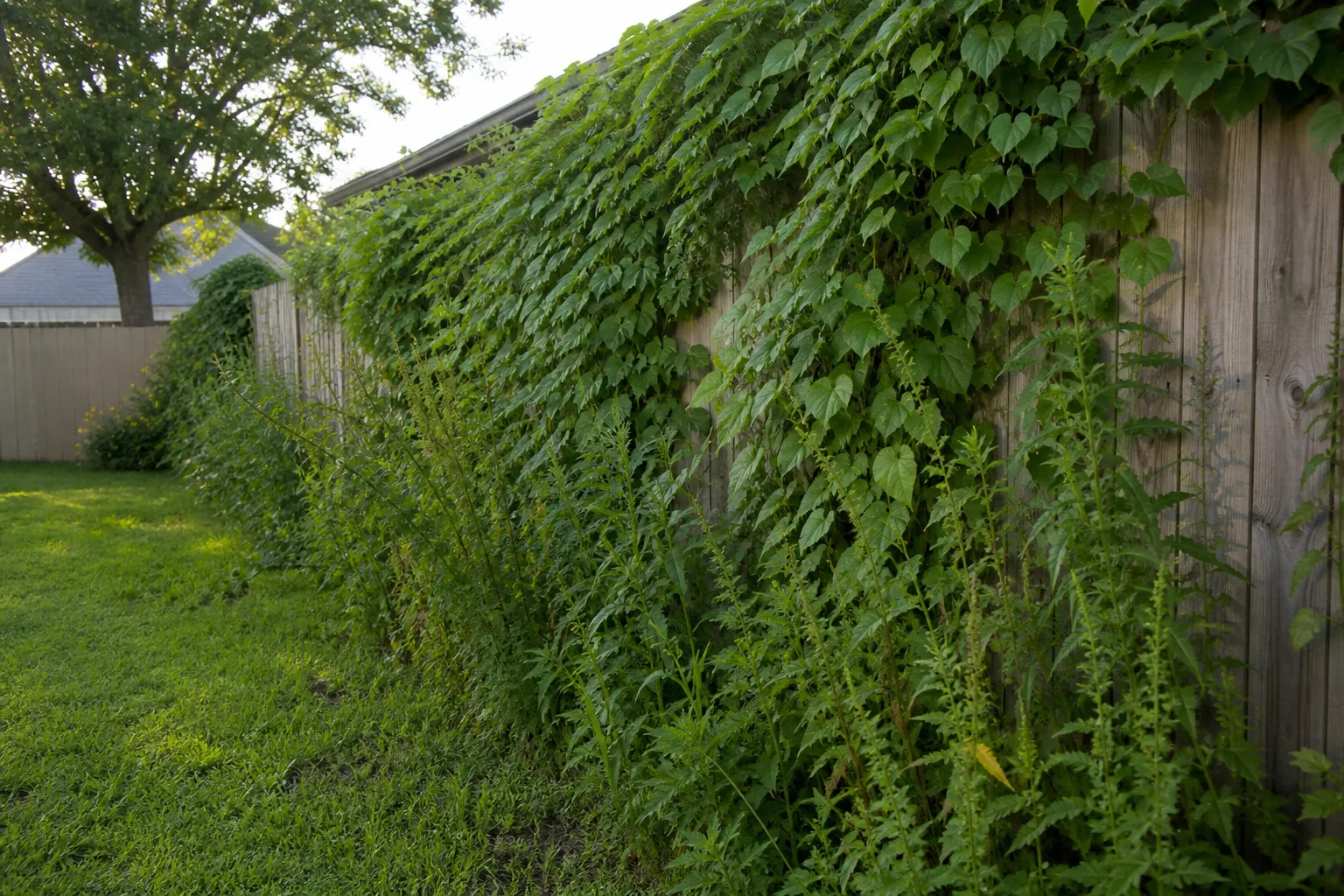
Most weeds in a home landscape are annoying, not dangerous. Dandelions in the lawn, chickweed in the vegetable row, and henbit along the driveway are worth pulling—but they will not poison your toddler, collapse a retaining wall, or send you to urgent care with a blistering rash. A smaller group of noxious yard weeds crosses that line. They are toxic, aggressively invasive, or both, and every week you let them stay makes removal harder.
This guide covers five weeds that belong on your do-not-ignore list: bittersweet nightshade, oriental bittersweet, Japanese knotweed, common ragweed, and poison ivy. For each one you will learn how to recognize it, why it is dangerous, and what control method actually works—plus the safety gear and timing rules that keep a cleanup job from becoming a medical bill. I have removed all five from a half-acre yard in the Mid-Atlantic over two growing seasons, and the notes below reflect what worked, what regrew, and what I would do differently.
Why Some Weeds Demand Immediate Action
A tolerant attitude toward weeds is fine for low-stakes species. The five on this list are different because the cost of waiting compounds fast. Bittersweet nightshade can tempt a curious child with shiny red berries. Oriental bittersweet can girdle a mature tree in a few seasons. Japanese knotweed spreads underground through rhizome fragments that survive in moved soil. Common ragweed releases pollen that triggers fall hay fever. Poison ivy carries urushiol, an oil that causes allergic contact dermatitis in most adults and stays active on tools and clothing for years.
Toxicity, Invasiveness, and Allergens—Three Red Flags
Use three filters when you spot an unfamiliar plant. Toxicity means any part can harm people, pets, or livestock if touched or eaten—bittersweet nightshade and poison ivy qualify. Invasiveness means the plant spreads beyond where you planted it, outcompetes natives, and resists casual pulling—oriental bittersweet and Japanese knotweed are textbook examples. Allergenicity means the plant releases pollen or sap that triggers immune reactions in sensitive people—common ragweed is the classic fall offender.
If a weed hits one of these red flags, treat it as a priority project, not background clutter. Hitting two or three at once—like oriental bittersweet, which is both invasive and can hide poison ivy in the same thicket—raises the urgency further.
How to Spot and Prioritize Noxious Weeds
Walk your property edges at least twice a year: once in late spring when young shoots are easiest to identify, and again in late summer when flowering weeds reveal themselves. Pay extra attention to fence lines, wood piles, unmowed corners, and anywhere birds perch—those are seed-dispersal highways.
Photograph suspicious plants before you touch them. A phone snapshot buys you time to compare leaf shape, berry color, and growth habit against extension ID guides without risking skin contact.
What “Noxious” Means in Your Backyard
State agriculture departments maintain official noxious weed lists—plants so damaging that landowners may be required to control them. Japanese knotweed and oriental bittersweet appear on eradicate-or-control lists in many northern and mid-Atlantic states; see your state department of agriculture’s noxious weed list for the legal status where you live. Even if a weed is not legally listed where you live, the practical definition still applies: a plant that causes injury, property damage, or ecological harm faster than you can manage it with normal weekend weeding.
Prioritize in this order when you are short on time: anything toxic where children or pets play, anything climbing living trees, anything flowering that you are allergic to, and anything with visible rhizome mats or bamboo-like stems.
Emergency Steps If You Suspect Exposure or Ingestion
This is the box to read before you need it. Poison Control (U.S.): 1-800-222-1222, free, confidential, 24/7; the online tool is at webpoisoncontrol.org. Call 911 for trouble breathing, collapse, seizures, or unconsciousness.
- Child or pet ate nightshade berries: do not induce vomiting. Call Poison Control or your veterinarian immediately. Bring a photo or sample of the plant. Expect nausea, vomiting, diarrhea, and possible drowsiness; severe cases can affect heart rhythm and breathing.
- Skin contact with poison ivy: wash with soap and cool water within 30 minutes; the FDA notes urushiol binds quickly and prompt washing reduces severity. Wash clothes separately in hot water with detergent. Clean tools with rubbing alcohol or soap and water while wearing disposable gloves.
- Eye or lung exposure (burning poison ivy, or smoke): seek emergency care; smoke can carry urushiol into the lungs.
- Large or unknown ingestion, or any symptom in a child under 6: call Poison Control first, then follow their instruction.
Bittersweet Nightshade (Solanum dulcamara)
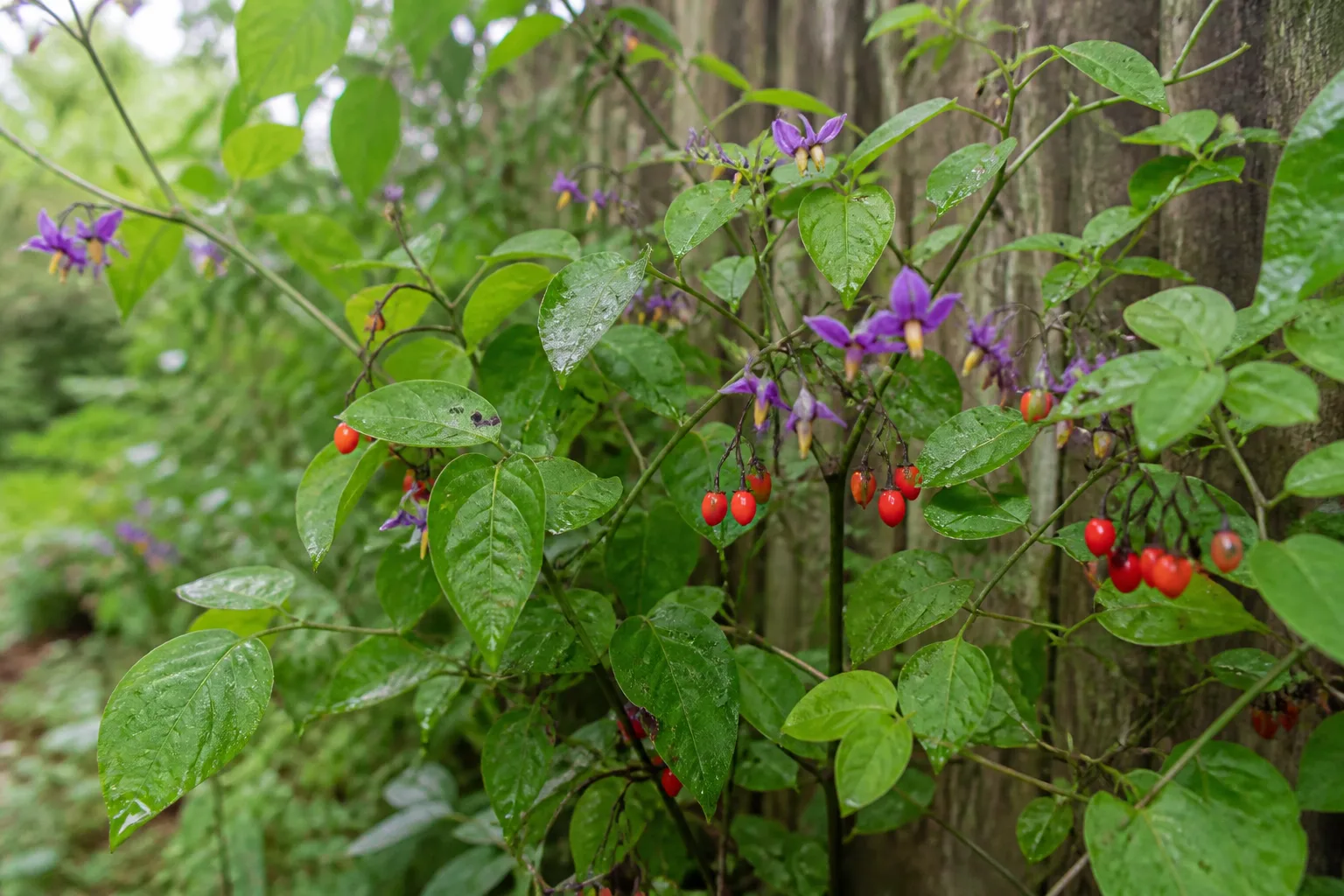
Bittersweet nightshade is a scrambling woody vine or semi-woody perennial with purple flowers and glossy red berries that look like tiny cherry tomatoes. It is not the same plant as oriental bittersweet—the names sound similar, but they belong to different families and demand different control tactics.
NC State Extension lists bittersweet nightshade as an introduced species now reported invasive in parts of the Northeast and Midwest [1]. It favors moist, disturbed edges: stream banks, fence lines, and the shady side of sheds.
Why the Berries Are a Child-Safety Emergency
All parts of bittersweet nightshade are toxic to humans, pets, and livestock, but the ripe berries pose the highest risk because they are colorful and easy for children to pick. NC State Extension notes that ingestion can cause nausea, vomiting, diarrhea, low blood pressure, and—in severe cases—life-threatening heart and respiratory depression [1]. Contact with sap or foliage can also irritate skin.
This is not a wait-until-fall project. If bittersweet nightshade grows along a play area, dog run, or vegetable garden path, remove it before berries ripen.
Removing Bittersweet Nightshade Safely
Small infestations respond well to manual removal. Water the soil the day before, then dig out the plant with a fork, aiming to lift the root crown and as much root mass as possible. Wear long sleeves, pants, and gloves—preferably waterproof—because sap contact can cause dermatitis. Bag the plant material for trash pickup rather than composting; nightshade toxins do not break down reliably in home compost piles.
Monitor the site every two weeks through the growing season. Bittersweet nightshade spreads by rhizomes and bird-dispersed seed, so one session rarely finishes the job. Spot-spraying regrowth with a directed glyphosate application on a calm day can help on large patches, but keep spray off desirable plants and follow label rates.
Oriental Bittersweet (Celastrus orbiculatus)
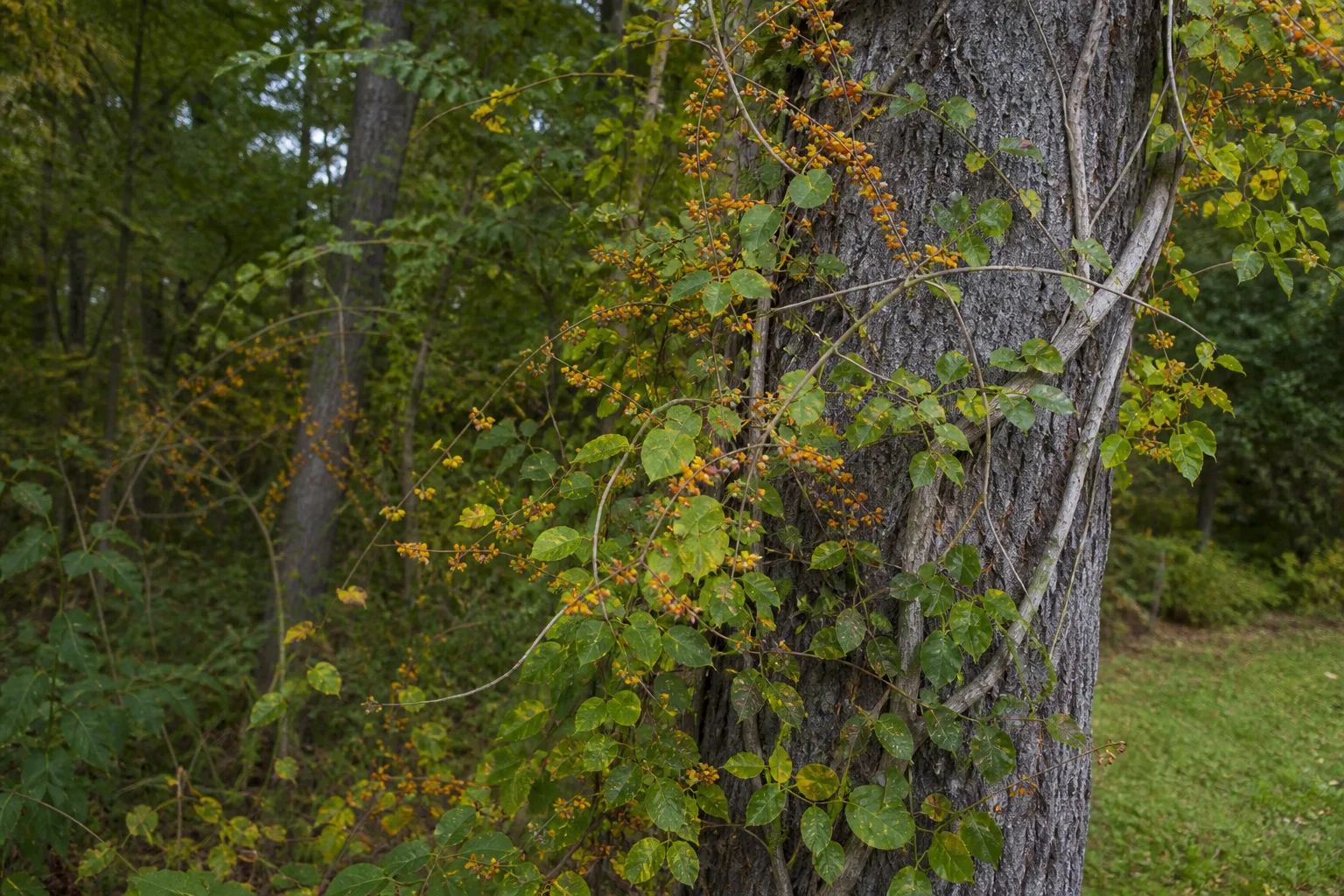
Oriental bittersweet is a woody climbing vine that can reach the tops of tall trees. It is one of the most destructive invasive vines in eastern North America. Left alone, it forms dense mats, shades out tree canopies, and wraps trunks with stems that tighten as they thicken—a process called girdling that can kill young and mid-size trees.
Do not confuse it with American bittersweet (Celastrus scandens), a native vine that is also vigorous but far less aggressive. American bittersweet carries fruit clusters at stem tips; oriental bittersweet bears yellow-orange capsules along the entire vine length, often in the leaf axils. Oriental leaves are also more rounded, while American leaves taper to a point.
How This Vine Kills Trees and Spreads
Oriental bittersweet grows fast in full sun or partial shade. Birds eat the berries and deposit seeds along woodland edges and in ornamental beds—wreaths and fall decorations made from oriental bittersweet berries have historically spread infestations into new neighborhoods. Once established, a single vine can produce thousands of seeds per year while also sending up new shoots from the root crown.
The weight of mature vines adds physical stress to branches. Combined with girdling, that is why foresters treat this species as a tree-health emergency rather than a cosmetic weed.
Control Methods That Work on Oriental Bittersweet
Control strategy depends on growth form. For vines climbing trees, cut each stem at the base near soil level—do not yank living vines off bark, which can strip the tree. Immediately treat the cut stump and any ground-level regrowth with a triclopyr or glyphosate product labeled for woody brush, applied with a sponge or paintbrush to limit drift. The aerial portion of the vine will die and decay over two to three years; that is normal.
For low patches without tree hosts, repeated cutting is required. Penn State Extension notes that mowing has been shown to encourage root sprouting and may not control the plant even when repeated periodically [2]. A more reliable sequence: cut all stems at the base in early summer, let regrowth reach about one foot tall, then spray foliage with triclopyr or glyphosate on a calm, dry day. Inspect monthly and dig or treat any suckers.
Never compost oriental bittersweet stems with mature berries. Bag and landfill per local guidance. For a deeper species-specific walkthrough, see our guide on oriental bittersweet vines.
Japanese Knotweed (Fallopia japonica)
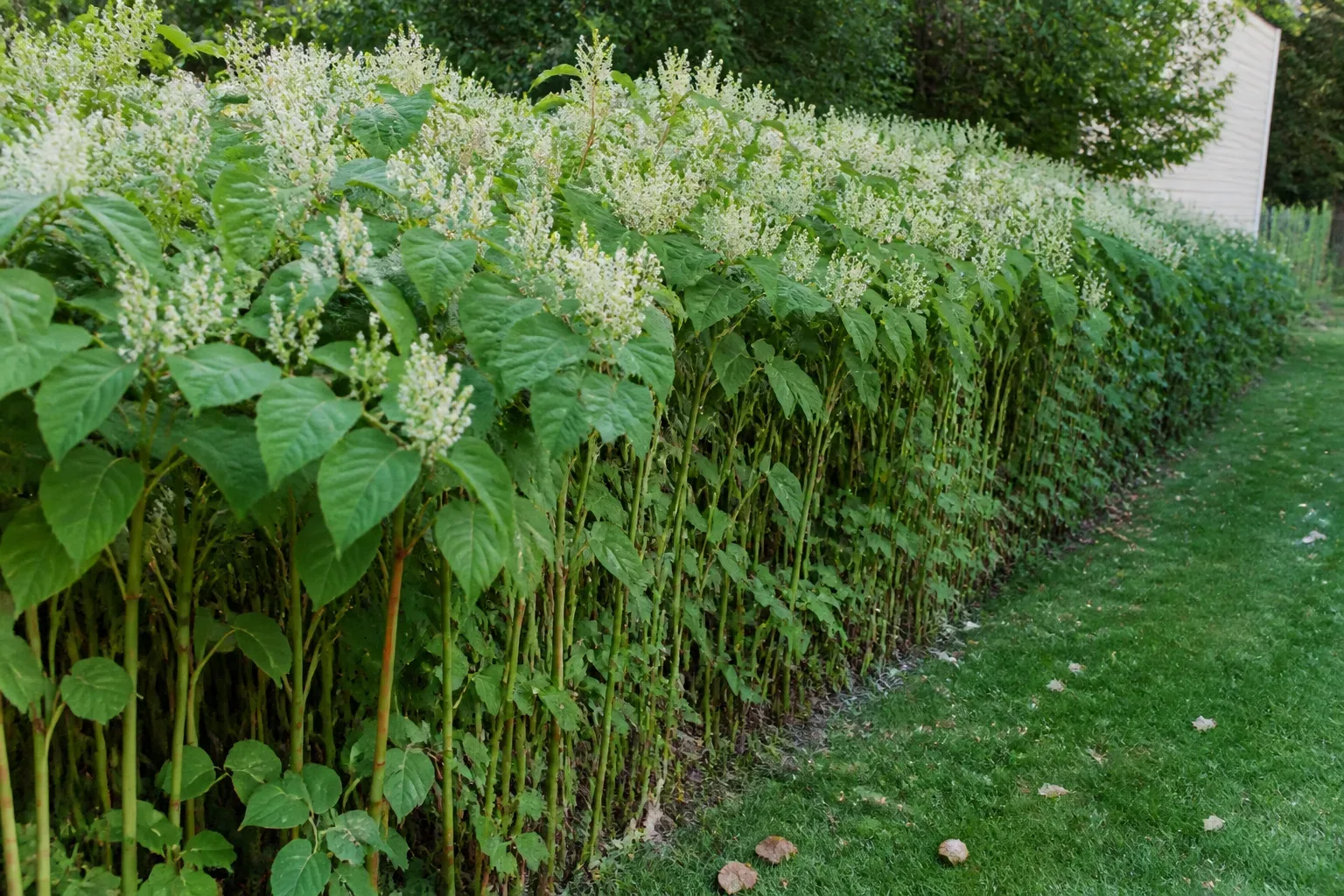
Japanese knotweed looks like bamboo’s unruly cousin: hollow, jointed green stems with reddish nodes, heart-shaped leaves, and frothy white flower plumes in late summer. It was introduced as an ornamental and erosion-control plant in the late 1800s and has since become one of the hardest invasive weeds to eliminate in temperate climates.
Pennsylvania State University Extension describes stands that grow up to 11 feet tall and spread horizontally through an extensive rhizome network—underground stems that send up new shoots along their length [3].
Why Knotweed Rhizomes Make Digging a Losing Game
The reason knotweed laughs at a shovel is vegetative spread. Rhizomes fragment easily when soil is disturbed, and each fragment can regenerate a full plant. Stems cut and left on moist ground can also root. PSU Extension warns that infestations persist even after multiple removal attempts if rhizomes remain [3].
Knotweed also damages hardscape. Rhizomes exploit cracks in asphalt, retaining walls, and foundation joints—reason enough to act while the patch is still small. Along streams, knotweed monocultures replace native vegetation and provide poor erosion control compared to the plants they displace.
Knotweed Herbicide Timing and Multi-Year Plans
PSU Extension recommends a two-phase approach: initial control over at least two seasons, then maintenance monitoring for regrowth [3].
Cutting alone does not work, but cutting followed by herbicide can. Cut stems in June, then wait at least eight weeks before spraying regrowth that reaches two to five feet tall. That waiting period matters: if you spray too soon, glyphosate kills top growth without reaching rhizomes. Late-summer applications are especially effective because the plant translocates sugars—and systemic herbicide—into roots and rhizomes during flowering.
Glyphosate is the most common choice; use aquatic-labeled formulations near water. Triclopyr injures foliage but has limited rhizome effect on its own. Expect to repeat treatment the following year on dense patches. Mark your calendar when you start—knotweed control is measured in seasons, not weekends. For a full eradication protocol, see our eradication of Japanese knotweed plants guide.
Knotweed and Property Transfers
Some municipalities and lenders now require knotweed management plans before construction or property transfer. In the UK, a seller must state whether Japanese knotweed is present on the TA6 property information form, and mortgage lenders often require an eradication plan backed by a transferable guarantee before releasing funds [4]. Check local rules if you are buying or selling, and get a written management plan from a licensed applicator.
Common Ragweed (Ambrosia artemisiifolia)
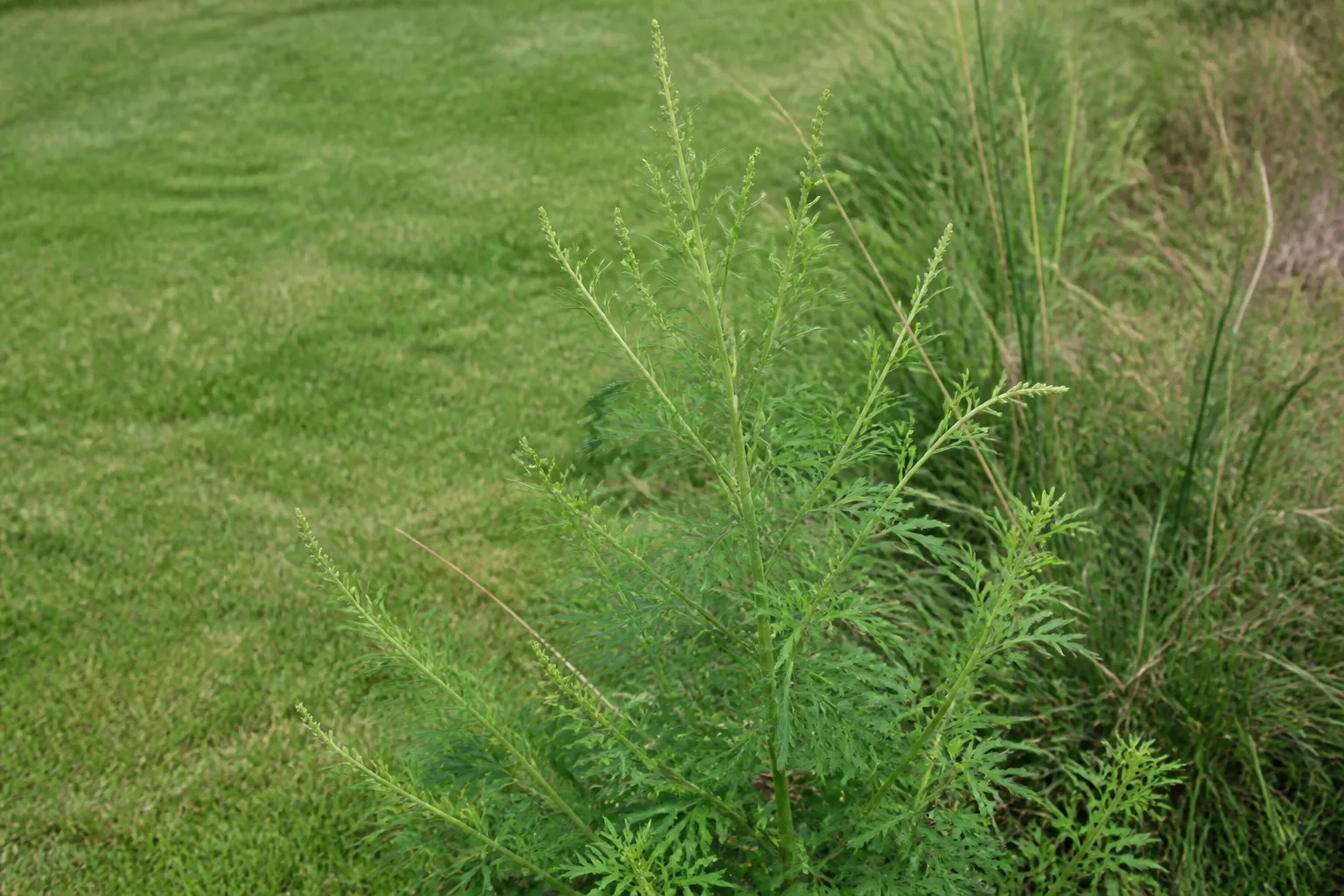
Common ragweed is an upright annual with deeply lobed, fern-like leaves and inconspicuous green flower spikes. It is easy to overlook because it does not scream “weed” the way thistle or burdock does—until August and September, when it releases pollen that triggers hay fever in millions of people.
Giant ragweed (Ambrosia trifida) causes similar allergies but grows much taller with coarser, three-lobed leaves. Most suburban yards harbor common ragweed, not giant ragweed. NC State Extension describes common ragweed as a summer annual noxious weed in the daisy family [5].
Pulling Ragweed Before It Pollinates
The good news: common ragweed is an annual with a shallow, fibrous root system—not a rhizome monster—so hand-pulling works when you catch plants before they set seed. Extension references confirm the shallow, fibrous root system, correcting the common “taproot” mistake [5]. Wear gloves and long sleeves—ragweed sap can also cause contact dermatitis in sensitive individuals.
Timing is everything. Remove plants by mid-summer if possible, before green flower spikes mature into pollen-releasing staminate heads. One mature ragweed plant can produce thousands of seeds that survive in soil for years, so letting it go to seed guarantees a bigger problem next August.
For large infestations in unused areas, mowing repeatedly before flowering reduces pollen load even if it does not eliminate the seed bank immediately. In vegetable gardens, shallow cultivation and mulch layers help suppress germination—our mulch weed-control guide explains depth rules that block light to ragweed seedlings. For identification photos, see our pictures of ragweed guide.
Poison Ivy (Toxicodendron radicans)
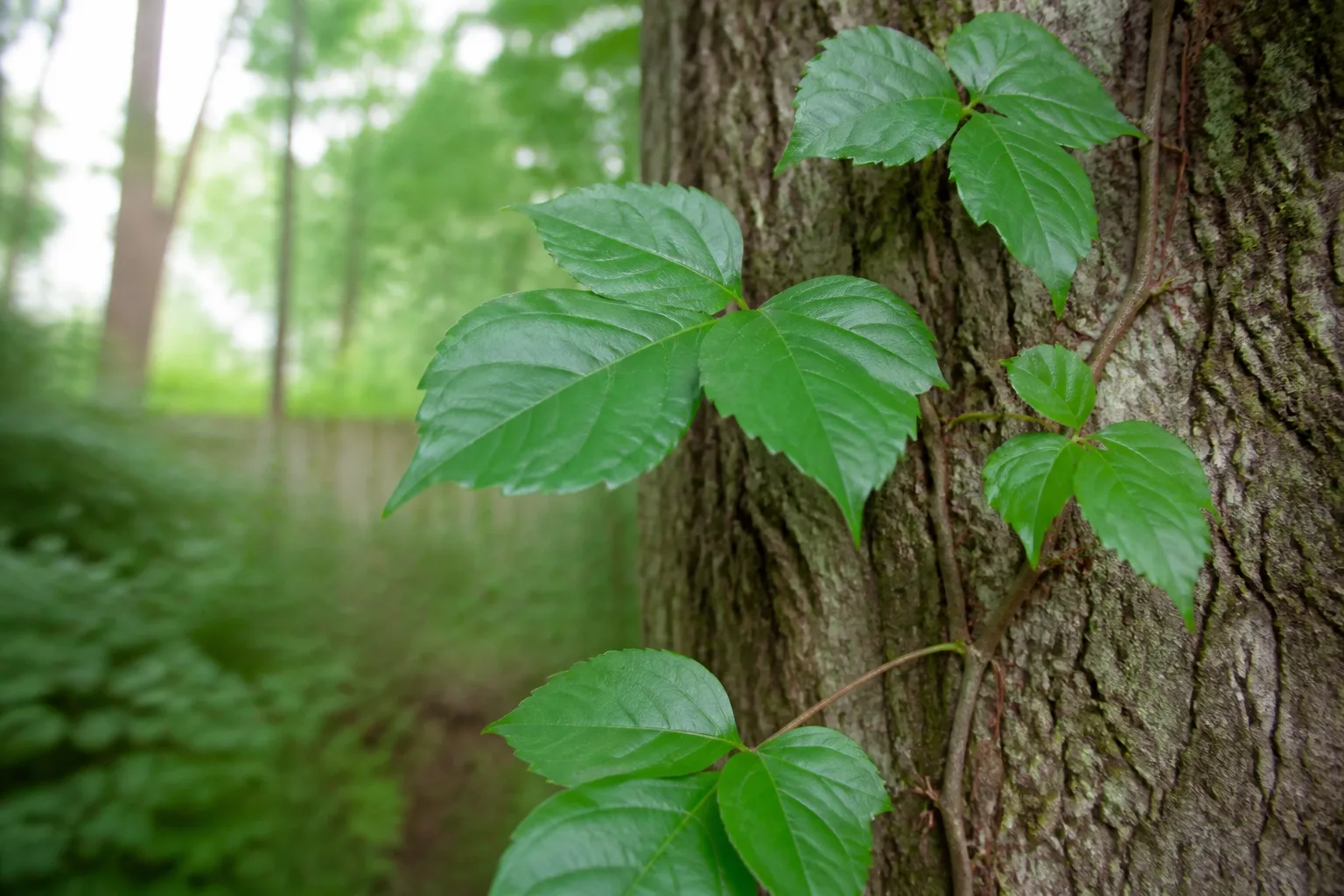
Poison ivy is the weed most homeowners already fear—and still underestimate. Eastern poison ivy typically grows as a hairy, ropelike three-leaf vine on trees and fences, but it also appears as a low shrub, especially in western forms. Every part of the plant—leaves, stems, roots, flowers, and berries—contains urushiol, the sap oil responsible for the blistering rash.
CDC NIOSH reports that exposure to less than a grain of salt worth of urushiol causes rash in 80 to 90 percent of adults [6]. Urushiol can remain active on clothing, tools, and pet fur for up to five years if not cleaned off [6].
Identifying and Removing Poison Ivy Safely
“Leaves of three, let it be” is a useful start but not complete. Poison ivy leaflets are often asymmetrical, with the center leaflet on a longer stalk. Spring foliage may be reddish; fall color runs orange to red. The vine form shows aerial rootlets that make the stem look hairy or fuzzy against bark.
Poison ivy has no thorns. Virginia creeper, a harmless look-alike, has five leaflets—not three. Young box elder seedlings also confuse people, but box elder leaves are opposite on the stem, while poison ivy leaves are alternate.
You can react in any season. Digging in early spring before leaves fully emerge still exposes roots packed with urushiol. Burning poison ivy is never safe: smoke carries urushiol particles that can cause severe lung irritation.
Choose your removal method based on location and your sensitivity. Manual removal works for small patches: wear disposable gloves over work gloves, long sleeves, pants, and closed shoes. Loosen soil and pull roots when the ground is moist. Expect regrowth from root fragments; repeat as needed.
Cut-and-treat suits vines on trees: sever the vine at chest height and at ground level, then treat the stump with glyphosate or triclopyr per label directions. Do not pull dead vines off bark. For natural-method options, see our kill poison ivy naturally guide, and for PPE and technique details our tips for removing poison ivy safely guide.
Foliar spray with glyphosate is effective on full green growth in summer, but drift will damage any ornamental the spray touches. Apply on calm mornings. Wash skin with soap and cool water within 30 minutes of suspected contact—the FDA notes that urushiol binds quickly and that aggressive washing reduces severity [7].
Urushiol on Tools, Clothes, and Pets
After any method, decontaminate gear. CDC NIOSH recommends washing clothes separately in hot water with detergent and cleaning tools with rubbing alcohol or soap and water while wearing disposable gloves [6]. A pet that brushed through poison ivy can carry urushiol on its fur for days; bathe the pet with pet shampoo and wear gloves, then wash your own clothes. See our guide on how to wash poison ivy exposed clothes for a step-by-step decontamination routine.
Gear, Disposal, and Decontamination Rules
Toxic and invasive weeds share one rule: what you wear and how you dispose of material matters as much as the removal technique.
Minimum kit for poison ivy and bittersweet nightshade: waterproof gloves, long sleeves, eye protection, closed shoes, and dedicated clothing you wash immediately afterward. For knotweed and oriental bittersweet, add safety glasses when cutting woody stems and keep a sharp pruning saw or loppers rated for half-inch wood.
Bag berry-bearing vines and seed heads for municipal trash when local rules allow. Do not burn unknown vines. Do not compost mature invasive weeds unless your pile reliably reaches temperatures that extension services recommend for weed seed destruction—most home piles do not.
Store herbicides in original containers, away from children and pets. A DIY vinegar spray may kill tender annuals, but it will not touch knotweed rhizomes; our three-ingredient weed killer guide covers what household mixes can and cannot do so you do not waste a season on the wrong tool.
When to Hire a Professional
Call a licensed applicator or invasive-species contractor when any of these apply: the infestation covers more than a few hundred square feet, knotweed or oriental bittersweet sits against your home foundation or under pavement, poison ivy intertwines with plants you cannot sacrifice to herbicide drift, or anyone in the household has severe urushiol sensitivity or respiratory conditions.
Professional help is also smart before major earth-moving projects if knotweed has ever been on the site. Moving soil spreads rhizome fragments. Some municipalities and lenders now require knotweed management plans before construction or property transfer—check local rules if you are buying or selling.
For patio and path weeds that are annoying but not noxious, start with prevention: natural patio weed solutions address the cracks and joints where annual weeds germinate without the PPE drama poison ivy demands.
Conclusion
Not every weed in your yard is an emergency. These five are: bittersweet nightshade for child and pet toxicity, oriental bittersweet for tree damage and explosive spread, Japanese knotweed for rhizome persistence and hardscape risk, common ragweed for fall allergies and seed banking, and poison ivy for year-round urushiol exposure.
Identify first, prioritize by risk, then match the control method to the biology—manual pull for small nightshade and ragweed patches, cut-and-treat for vines on trees, and timed glyphosate sequences for knotweed rhizomes. Gear up, never burn unknown vines, and plan on follow-up visits because every species on this list is built to come back. Handle them early and you protect your family, your trees, and years of future weekends.
References: [1]: https://plants.ces.ncsu.edu/plants/solanum-dulcamara/ (NC State Extension, bittersweet nightshade) [2]: https://extension.psu.edu/oriental-bittersweet (Penn State Extension, mowing encourages root sprouting) [3]: https://extension.psu.edu/japanese-knotweed (Penn State Extension, knotweed rhizomes and control) [4]: https://www.rhs.org.uk/weeds/japanese-knotweed (RHS, buying and selling property) [5]: https://plants.ces.ncsu.edu/plants/ambrosia-artemisiifolia/ (NC State Extension, common ragweed) [6]: https://www.cdc.gov/niosh/ (CDC NIOSH, urushiol exposure) [7]: https://www.fda.gov/ (FDA, washing after urushiol contact)



