What Is NPK Fertilizer? A Clear Guide to the Numbers
Learn what NPK fertilizer numbers mean, how nitrogen, phosphorus, and potassium differ, and how to choose a formula from a soil test without overfeeding.
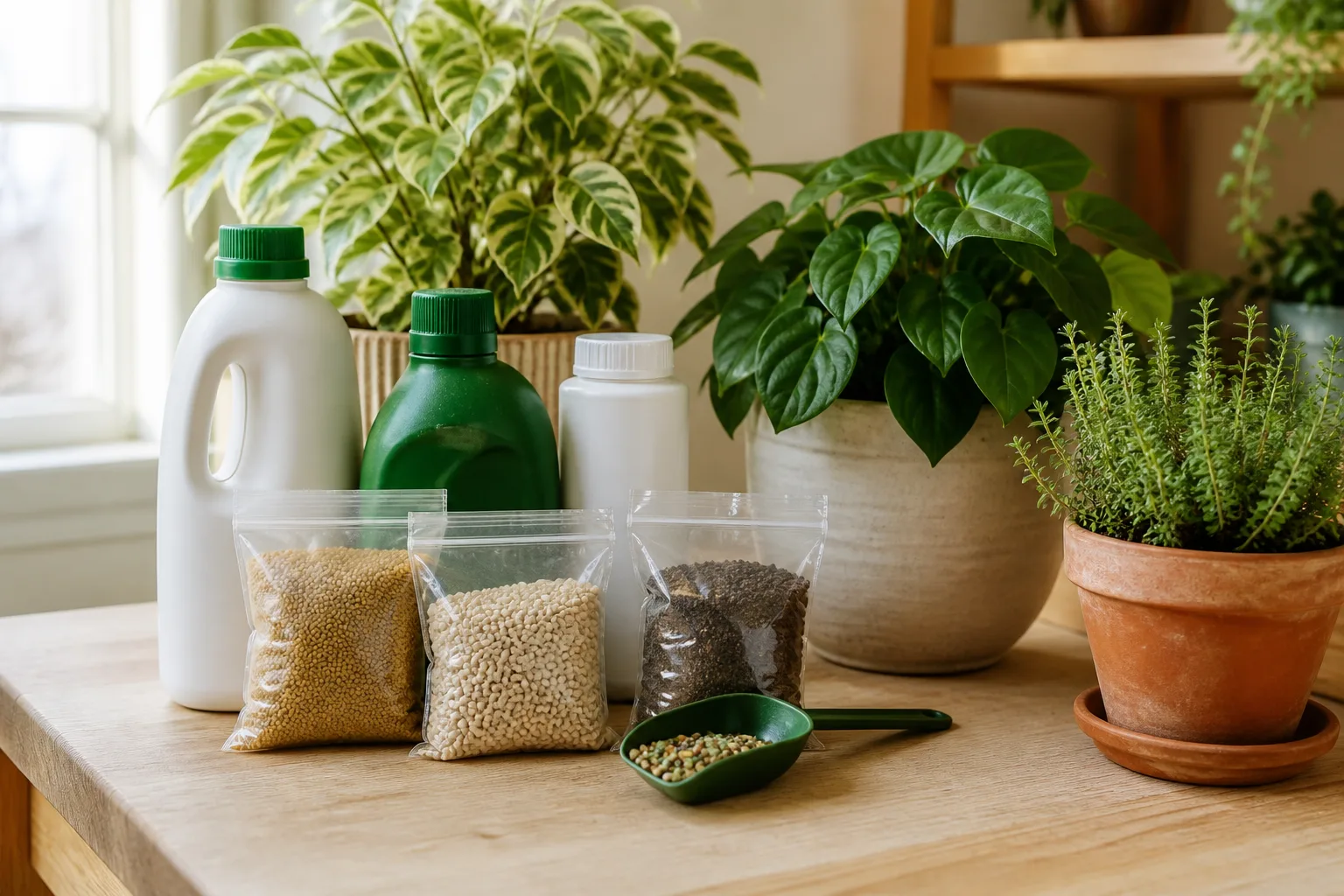
A fertilizer label marked 10-10-10, 24-8-16, or 4-6-3 is giving you an analysis of three primary plant nutrients: nitrogen (N), phosphorus (P), and potassium (K), in that order. In the United States, those figures are percentages by weight; the second and third numbers are conventionally reported as phosphate (P₂O₅) and potash (K₂O), not as elemental phosphorus and potassium. The label tells you how concentrated the product is in those nutrients, but it does not tell you whether your soil or plant needs them.
That distinction turns fertilizer shopping from guesswork into a practical comparison. First identify the plant and growing medium, then check whether a nutrient is actually needed, choose a product whose analysis fits that need, and follow the rate on its full label. A larger number is not a better score, and adding more fertilizer cannot solve every yellow leaf, slow-growing plant, or lack of flowers.
The short answer: what NPK means
NPK stands for nitrogen, phosphorus, and potassium, the three primary macronutrients plants use in relatively large amounts. They support different, overlapping jobs: nitrogen is part of chlorophyll and proteins; phosphorus is involved in energy transfer and genetic material; and potassium helps regulate water balance and many enzyme processes. The chemical symbol for potassium is K, from kalium, which is why its label letter differs from its English name.
NPK usually appears as three numbers separated by dashes on a fertilizer container. A 10-10-10 product has a 1:1:1 N-P-K relationship and a 10 percent label analysis for each position; 20-20-20 has that same relationship but twice the nutrient concentration per pound of product. That is why a gardener should ask both “What is the ratio?” and “How much nutrient does each pound deliver?” before comparing bags. The University of Minnesota Extension’s fertilizer guide explains how those analyses are used when matching a product to crop and soil needs.
How to read the numbers on a fertilizer label
Read the sequence from left to right: first nitrogen, second phosphorus, third potassium. For a U.S. product labeled 8-2-4, the guaranteed analysis reports 8 percent nitrogen, 2 percent available phosphate expressed as P₂O₅, and 4 percent soluble potash expressed as K₂O. A 0 means the product does not guarantee that nutrient in that position; a 10-0-10 contains nitrogen and potash but no listed phosphate.
The front-panel figures are only the quick summary. Turn the bag around to read the guaranteed analysis, ingredient or source statements, secondary nutrients, micronutrients, directions, application limits, and any warnings about the product’s use. A lawn “weed and feed,” for example, may combine fertilizer with herbicide; the NPK line alone will not tell you that it is unsuitable for a vegetable bed or a particular grass species.
Percentages, not just a ratio
Gardeners often call the three numbers an NPK ratio, and that shorthand is useful for comparing proportions. Strictly speaking, though, each number on a U.S. label is a nutrient analysis by weight, not merely a relative ratio. A 20-10-10 and a 10-5-5 both reduce to a 2:1:1 relationship, while each pound of the 20-10-10 product supplies twice as much of each listed nutrient as each pound of the 10-5-5 product.
For example, 10 pounds of 10-10-10 delivers 1 pound of nitrogen, 1 pound of phosphate (as P₂O₅), and 1 pound of potash (as K₂O). Ten pounds of 5-5-5 delivers half those amounts; you would need 20 pounds of 5-5-5 to match the first product’s N, P₂O₅, and K₂O quantities. The numbers refer to weight, so comparing scoops by volume can be misleading when two products have different particle sizes or densities.
What U.S. labels report for P and K
The U.S. convention is easy to misread because P₂O₅ and K₂O are oxide-equivalent reporting forms. Fertilizer directions and soil-test recommendations often use these conventions so products can be compared consistently; the label is not claiming that plants take up phosphorus pentoxide or potassium oxide molecules as such. UMN Extension describes an 8-2-4 label as 8% N, 2% P₂O₅, and 4% K₂O, and notes that growers commonly refer to those oxide figures as P and K for simplicity.
Other countries may show both oxide values and elemental nutrient values, or follow a different labeling convention. The Royal Horticultural Society’s fertiliser-label guide explains that labels may present oxide content alongside the amount of the element. When a soil-test report and a fertilizer label seem to use different units, check the lab’s explanatory notes or ask the local Extension service before converting; do not assume the digits on both documents are directly interchangeable.
What nitrogen, phosphorus, and potassium do
Plants need more than three nutrients. NPK is a useful front-of-bag summary, not a complete inventory of everything a plant requires or everything in a fertilizer. The RHS overview of fertilizer labels notes that plants also need nutrients such as magnesium, calcium, and sulfur, while carbon, oxygen, and hydrogen come largely from air and water; the amounts needed vary with plant and growth stage.
The three NPK nutrients work together, so simple memory tricks can overpromise. Nitrogen is not only “for leaves,” phosphorus does not guarantee flowers, and potassium does not immunize a plant against disease. Each nutrient supports plant processes; whether a plant responds to extra fertilizer depends on whether that nutrient is limiting and whether the roots can access it.
Nitrogen supports leafy growth
Nitrogen (N) is part of chlorophyll, amino acids, proteins, and nucleic acids. Adequate nitrogen supports new shoots and leaves, which is why nitrogen is often a major part of lawn fertilizers and feeds for leafy crops such as lettuce or kale. A nitrogen-deficient plant may grow slowly or develop pale older leaves, but that appearance is not proof that soil nitrogen is the problem.
An excess can push leafy growth at the expense of flowering or fruiting in some crops, delay maturity, or produce soft growth that is more vulnerable to stress. Nitrogen can also move through soil more readily than phosphorus, and some forms can be lost through leaching or runoff. If a plant looks pale, first check watering, drainage, light, root health, and recent fertilizer history before reaching for a high-first-number product.
Phosphorus supports energy transfer and roots
Phosphorus (P) is part of ATP, the molecule cells use to transfer energy, as well as DNA, RNA, and cell membranes. It supports root development, seed formation, and early plant growth, but that does not mean that adding a high-middle-number fertilizer automatically creates more blooms or fruit. A plant that already has adequate phosphorus may show little or no benefit from extra P.
Phosphorus is relatively immobile in soil, so root growth and soil conditions matter for uptake. Cold, wet soil can slow root activity, and compaction or root injury can restrict access even when soil contains phosphorus. A purple tinge on leaves can have several explanations, including temperature stress; it should not be treated as a diagnosis that calls for bone meal or a “bloom booster.” For these reasons, many Extension recommendations advise using a soil test before adding phosphorus, especially in established lawns and beds.
Potassium helps regulate water and metabolism
Potassium (K) activates enzymes and helps regulate water movement, stomatal opening, and the transport of sugars and other compounds through the plant. Adequate potassium supports normal root growth, turgor, and tolerance of drought, cold, and other stresses. It is important to ordinary growth, not a special “fruiting switch” that makes a crop taste sweeter or ripen on schedule.
Potassium availability depends on the soil’s minerals, moisture, temperature, and root activity. Some soils contain abundant total potassium but comparatively little in plant-available forms; a soil test is more useful than guessing from the soil’s appearance. Leaf-edge scorch or weak growth can occur with potassium deficiency, but similar symptoms can follow salt injury, drought, root damage, or other nutrient problems, so confirm the cause before applying a K-heavy product. UMN Extension’s potassium guidance describes potassium’s roles in water and nutrient movement, enzyme activation, and plant stress response.
Complete, balanced, and incomplete fertilizer
A complete fertilizer supplies all three primary nutrients, meaning the N, P, and K values are each above zero. An incomplete fertilizer omits one or more of them; examples include 20-0-10, which supplies no phosphate, and 0-10-10, which supplies no nitrogen. “Incomplete” describes the analysis, not the quality of the product: a nitrogen-only fertilizer can be a better fit when a test indicates that phosphorus and potassium are already sufficient.
A balanced fertilizer usually means the three label numbers are equal or close to equal, such as 10-10-10. Balanced and complete are not synonyms: 10-10-10 is both, while 20-10-10 is complete but not balanced. Even a complete, equal-number formula can be a poor match if the soil already has high phosphorus or if the plant needs a different nutrient balance.
Do not choose a balanced formula just because it sounds universally safe. Repeated applications add nutrients whether or not plants use them, and phosphorus can accumulate in soil. A fertilizer with a zero in the “wrong” place for a marketing slogan may be exactly what a soil report calls for.
What NPK does not tell you
NPK does not show the full secondary nutrient and micronutrient profile. Depending on the product, the rest of the label may list calcium, magnesium, sulfur, iron, manganese, zinc, boron, copper, molybdenum, or other components. Plants require these in different amounts, and a deficiency of one cannot necessarily be corrected by increasing N, P, or K.
The NPK figures also do not tell you whether a product is quick-acting, slow-release, granular, water-soluble, or intended for foliage, lawns, crops, or a particular application method. A high-number water-soluble product can deliver a concentrated dose quickly, while a controlled-release product is designed to release nutrients over time; both still need to be used at the rate printed on their own labels. Granules are not automatically slow-release, and “organic” does not automatically mean the product has a gentle or predictable dose.
Finally, no fertilizer label measures soil pH, compaction, drainage, light, irrigation, root disease, or pest pressure. A plant can be surrounded by nutrients and still be unable to take them up if pH is out of range, roots are damaged, or the medium stays waterlogged. If growth stalls, treat NPK as one clue in a wider diagnosis rather than as the first and only fix.
Choose a formula by soil and plant needs
The useful question is not “Which NPK is best?” but “Which nutrient, if any, is missing for this plant in this growing medium?” The answer changes between a lawn, a vegetable bed, a flowering annual, a newly planted shrub, and a houseplant in potting mix. It can also change as a crop develops, but stage-of-growth advice should be specific to the crop and region rather than a universal switch from one number to another.
Start with the plant’s growing conditions and history. A healthy plant in fertile soil may need no fertilizer; a container plant may rely on nutrients already incorporated into the potting mix; and a vegetable bed may benefit from a lab recommendation. University Extension guidance and trusted horticultural references such as Fine Gardening’s introduction to NPK can help with the basic vocabulary, but use local test results and product directions to decide on a rate.
Start with a soil test
For lawns and in-ground garden beds, a lab soil test is the most reliable way to choose a fertilizer analysis. It can report pH, organic matter, and levels of nutrients such as phosphorus and potassium, then give a crop- or site-specific recommendation. Test the area before adding fertilizer, follow the lab’s sampling directions, and keep separate beds or lawn areas separate if they have different histories or uses.
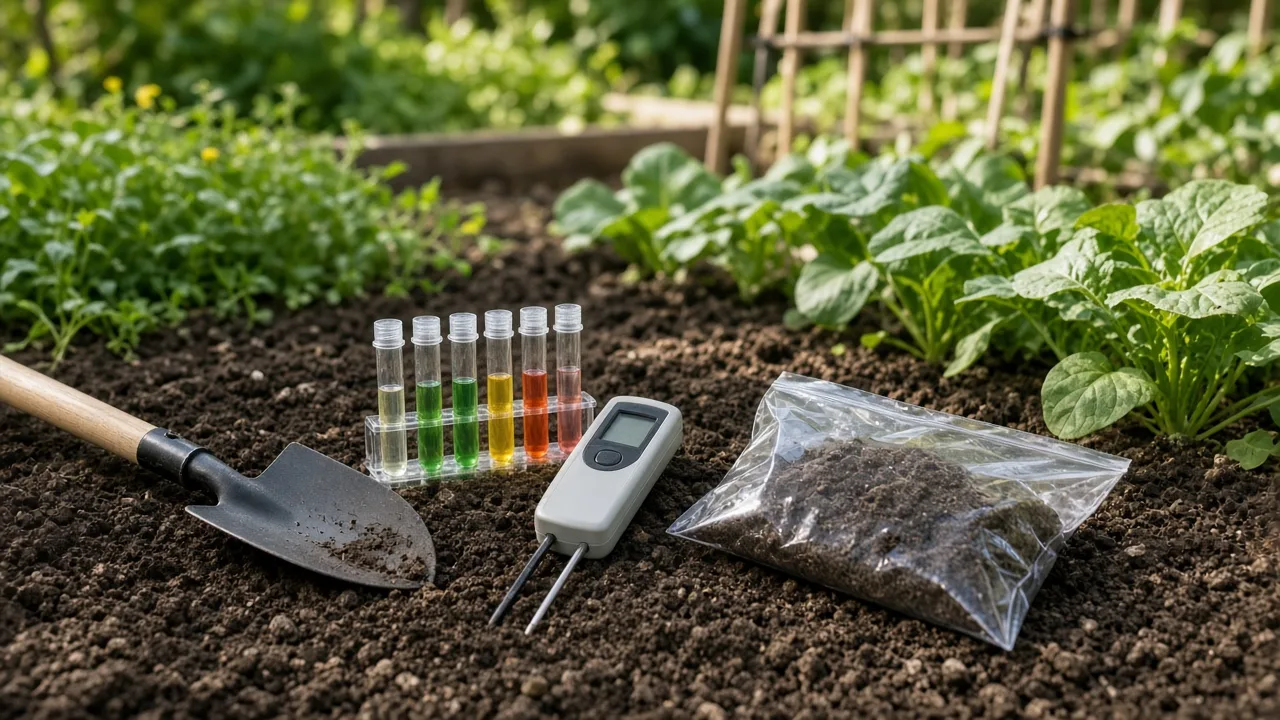
A basic soil test may not provide a simple “nitrogen level” because nitrogen changes quickly in soil and recommendations often depend on the crop, season, organic matter, and previous amendments. For example, Illinois Extension explains that nitrogen can vary and may not be included in a basic fertility test, while the report often includes pH and other nutrient results. A soil-test recommendation matters more than a generic label suggesting that every plant needs a balanced feed.
Testing frequency varies with local practice and how intensively the site is managed. UMN Extension recommends testing lawns and gardens periodically and when making a major change; its soil-testing guide explains what a standard test covers and why excessive phosphorus can harm water quality. Use your local lab’s schedule rather than treating one region’s interval as universal.
Translate a recommendation into a product
Match the product to the nutrients the test says to add, not the other way around. If the report calls for nitrogen but no phosphorus, a high-phosphorus “all-purpose” blend may add an unnecessary nutrient; look for a product with little or no P, or ask a local Extension office how to supply the recommended nutrient without overshooting the others. If the recommendation names amounts per area rather than an N-P-K formula, read the label percentages and calculate the product rate carefully.
A practical selection sequence is:
- Check whether the plant, crop, or lawn actually needs fertilizer now.
- Read the soil-test recommendation and note which nutrients it calls for.
- Compare the guaranteed analyses on products; avoid adding nutrients the test says are already high or not needed.
- Confirm that the product is meant for the plant and site, then follow its application directions and restrictions.
- Keep the label and record what you applied so the next test has useful history.
If no soil test is available, do not improvise a heavy dose from a leaf symptom. For an established in-ground bed, a soil test is a better next purchase than a stronger fertilizer; for a container, check whether the potting mix contains starter nutrients and use plant-specific care guidance. Some municipalities or states restrict phosphorus fertilizer on lawns except under specified conditions, so check local rules before applying it near water or to turf.
NPK examples: same ratio, different strength
These labels are easier to understand when you distinguish relationship from concentration:
| Label | N-P-K relationship | What it tells you |
|---|---|---|
| 10-10-10 | 1:1:1 | Equal label percentages; complete and commonly called balanced. |
| 20-20-20 | 1:1:1 | Same relationship as 10-10-10, with twice the listed concentration per pound. |
| 24-8-16 | 3:1:2 | More nitrogen relative to the other two; one pound supplies more N than one pound of 10-10-10. |
| 10-0-10 | No P listed | Supplies N and K without adding a guaranteed phosphate percentage. |
| 0-10-10 | No N listed | Supplies phosphate and potash without a guaranteed nitrogen percentage. |
The numbers do not prescribe a crop on their own. A high first number may suit a nitrogen-demanding lawn if the soil and timing support it, while a leafy vegetable may need more N than a plant grown for fruit; neither fact proves that a high-N blend is right for every lawn or vegetable. A fruiting crop still needs healthy leaves and roots, and its overall nutrient plan depends on soil, cultivar, season, and growing method.
Likewise, a high middle number does not guarantee extra flowers. If phosphorus is adequate, adding more may waste money and build up in soil; if a test identifies a deficiency, a phosphorus-containing product may be appropriate. Ratios make products comparable, but the soil test, label directions, and plant’s actual need decide whether the product belongs in your garden.
Organic, synthetic, and slow-release fertilizers
The source of a fertilizer and its NPK analysis are separate pieces of information. Organic-source fertilizers are generally derived from plant or animal materials, while synthetic or conventional products are manufactured from processed materials; a naturally mined mineral is not automatically an organic fertilizer. If you need a product allowed in certified organic production, check its certification and ingredients rather than relying on the word “natural.” Either source can supply nutrients plants use, and an NPK figure does not by itself tell you the speed of release, salt level, or suitability for a particular growing system.
Many organic materials have lower nutrient concentrations and release nutrients as soil organisms break them down, so their availability can depend on temperature, moisture, and microbial activity. They can also contribute organic matter or other nutrients, but nutrient content varies by material and product; compost and manure are not automatically a complete or balanced NPK feed. Conventional soluble fertilizers can make nutrients available quickly and are often easier to measure precisely, but concentrated salts can injure roots when a product is over-applied.
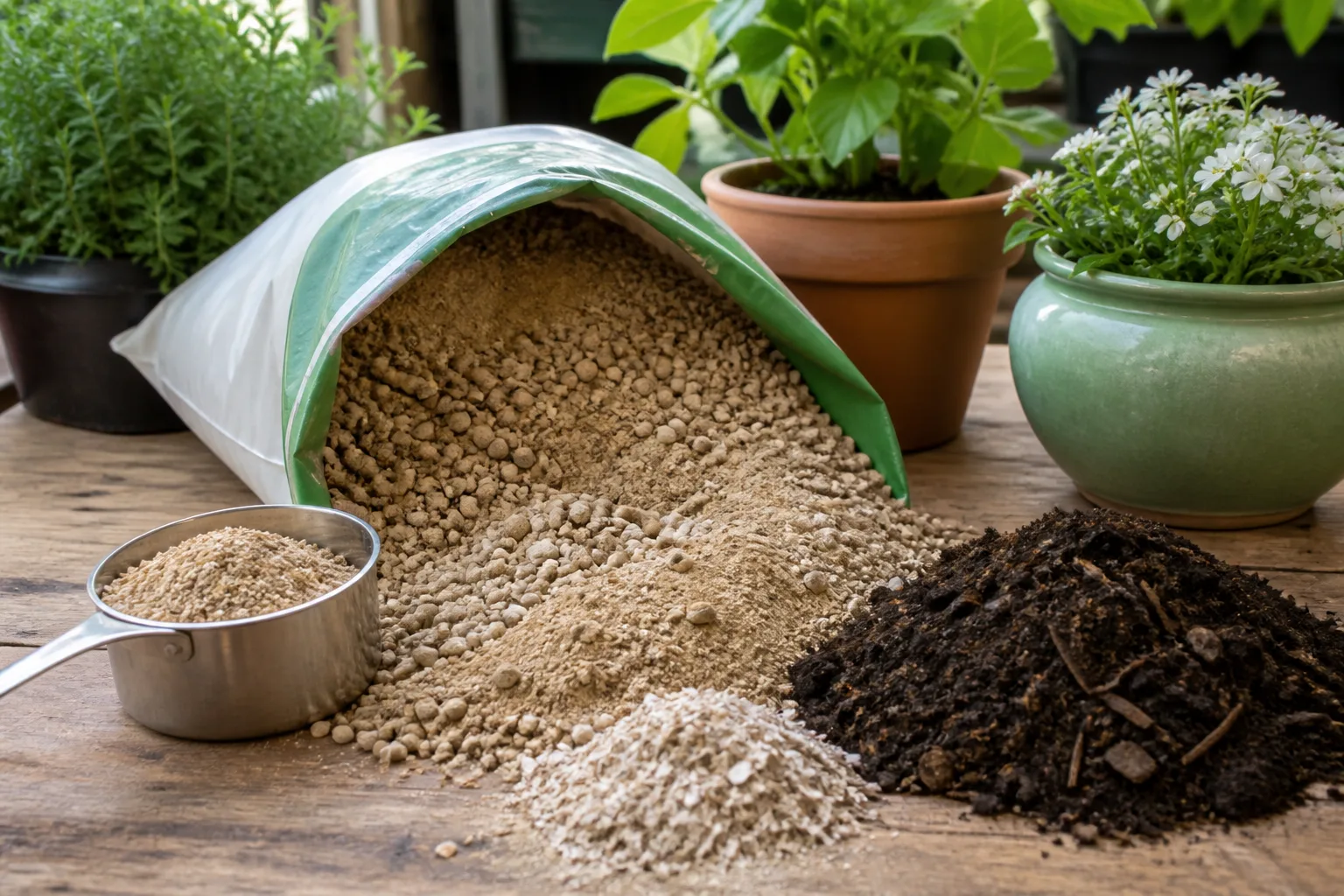
“Slow-release” describes how quickly the product releases nutrients, not whether it is organic. Some synthetic products are coated or formulated for controlled release, and some organic ingredients release slowly because they must decompose. Oregon State University Extension’s guide to choosing fertilizer discusses these differences: organic products often have lower concentrations and rely on microbial activity, while readily available conventional nutrients can be useful when a plant needs them quickly.
When comparing two products, check the analysis, nutrient sources, release claims, application directions, and compatibility with the crop. For a pot or raised bed that is watered often, soluble nutrients may be lost more quickly; for a cool spring bed, organic nutrients may not mineralize as fast as they will in warm soil. Neither style is inherently better for every plant, climate, or gardener.
Calculate how much fertilizer to use
The simple calculation is amount of product = amount of a nutrient needed ÷ nutrient fraction in the product. Convert the label percentage to a decimal first: 20 percent becomes 0.20, 5 percent becomes 0.05. Use this only with a real recommendation for the nutrient and area; the formula does not decide how much a plant needs.
Suppose a soil-test recommendation calls for 1 pound of nitrogen per 1,000 square feet, and a suitable product is labeled 20-4-8. Divide 1 pound by 0.20: you need 5 pounds of product to deliver 1 pound of label nitrogen to that area. That 5 pounds also delivers 0.2 pound of phosphate (5 × 0.04) and 0.4 pound of potash (5 × 0.08), so confirm those additions fit the recommendation too.
For a smaller area, scale the product amount proportionally. If your bed is 250 square feet, it is one quarter of 1,000 square feet, so the example rate scales to 1.25 pounds of product, provided that the lab recommendation and product label use those same units and area. Measure by weight when possible, spread evenly, and use a calibrated spreader for lawns rather than estimating handfuls across the yard.
Do not apply a calculated amount if it exceeds the fertilizer label’s maximum rate or conflicts with local restrictions. Product instructions may set a rate based on the product’s release type, grass species, crop, season, or application interval; those restrictions still apply. When a soil-test recommendation and bag directions appear to conflict, contact the test lab or local Extension office before choosing which number to follow.
Common NPK mistakes to avoid
The first common error is treating the largest three numbers as the most complete or effective formula. A 30-10-10 is more concentrated than a 10-10-10 in each pound, but it is not inherently “stronger” in a beneficial sense; the extra product can over-supply a nutrient, and a smaller amount of a high-analysis product may deliver the same nutrient quantity as more of a low-analysis one. Compare the nutrient amount applied, not just the front-panel digits.
Another mistake is buying a “bloom booster” because the middle number is high. Flowering depends on light, maturity, water, temperature, pruning, and species as well as nutrition. Excess nitrogen can make some plants produce abundant foliage at the expense of flowers or fruit, but adding phosphorus when none is deficient is not a shortcut to bloom; use the plant’s care requirements and test results.
Do not assume the same formula works for every plant in a mixed garden. A lawn, leafy crop, tomato, ornamental shrub, and indoor fern differ in nutrient demand, root environment, and watering; one broadcast dose can be too much for some and too little for others. The same product may be useful in one zone and wasteful in the next, especially when one area has received manure or compost for years.
Avoid diagnosing a deficiency from one symptom. Yellow leaves can reflect aging, overwatering, underwatering, poor light, damaged roots, pH-related nutrient lockout, pests, or a nutrient shortage; purple leaves can appear in cold weather even when phosphorus is present. Check the full pattern and conditions, review fertilizer history, and test soil before adding a nutrient that is difficult to remove.
Finally, do not confuse the fertilizer’s delivery form with its nutrient balance. Liquid does not always mean fast-release, granular does not always mean slow-release, and organic does not mean the analysis is unknown or impossible to overuse. The full label—not just the three front numbers—tells you how to apply a particular product safely.
Apply fertilizer with less runoff
Fertilizer that does not stay in the root zone can wash off a driveway, sidewalk, or compacted soil and enter storm drains. Nitrogen and phosphorus can contribute to nutrient pollution in nearby waterways; excess phosphorus can encourage unwanted aquatic plant growth, while excess nitrogen can move through water as well. The U.S. Environmental Protection Agency’s yard guidance recommends applying fertilizer only when needed and at the recommended amount, avoiding windy or rainy conditions, keeping products away from waterways, and preventing overwatering.
For lawn or garden applications, measure the area and product before you spread. Sweep any granules from pavement back onto the lawn or bed if the product label allows, keep fertilizer out of gutters and storm drains, and do not fertilize soil that is frozen, saturated, or about to receive heavy rain. If runoff is likely, delay the application and follow local rules, especially near lakes, streams, drainage channels, or wells.
Store the product in its original, closed container in a dry place inaccessible to children and pets. Follow the label for protective equipment, watering-in, re-entry, and disposal; added herbicides or other ingredients can change the precautions. Responsible use protects the plant’s roots, reduces wasted fertilizer, and limits the nutrients that leave the garden.
Conclusion
NPK is the short label for nitrogen, phosphorus, and potassium, and the three numbers show their guaranteed percentages in a fixed order. In U.S. products, remember the oxide convention for phosphate and potash, then distinguish the product’s concentration from the relative N-P-K relationship. That small bit of label literacy helps you compare products accurately instead of assuming one ratio fits every plant.
Before you fertilize, check whether the plant needs feeding and whether its soil or potting mix already supplies nutrients. Use a soil test for garden beds and lawns, match the product to the recommendation, calculate the rate from the label, and apply only as directed. If you do not know what is missing, test or diagnose first; adding a stronger NPK blend is not a reliable substitute for that information.



