Aphids on Neem: Causes, Checks & Fixes
Quick answer
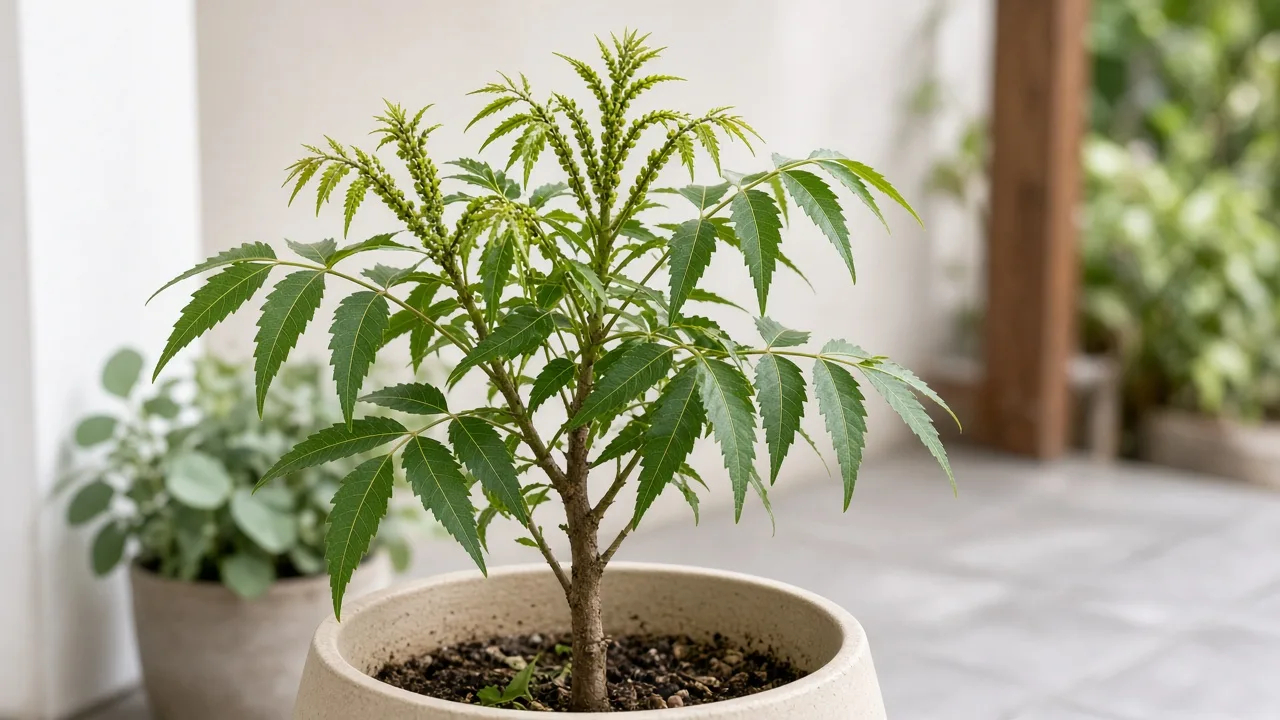
Aphids on Neem (Azadirachta indica) target succulent new flushes and terminal branch tips where natural azadirachtin levels are low, piercing tender pinnate leaflets to feed on sap. They excrete sticky honeydew that fosters black sooty mold. First step: isolate container trees and blast the colonies off terminal shoots and leaflet undersides with a firm stream of water before applying potassium salts of fatty acids.
Aphids on Neem: Causes, Checks & Fixes
This guide covers aphids on Neem. See also the general Aphids guide, watering, and light pages for this plant.
Aphids on Neem: Causes, Checks & Fixes
Quick answer
Discovering an aphid infestation smothering a Neem tree (Azadirachta indica) comes as an ironic shock to many home growers and patio gardeners. Neem oil is globally recognized as one of the most effective botanical insecticides in organic horticulture, leading many to assume that the living tree is naturally immune to insect pests. Yet aphids—most commonly the cotton or melon aphid (Aphis gossypii) and the green peach aphid (Myzus persicae)—frequently establish dense, damaging colonies on neem trees, especially on container-grown specimens and young saplings.
The explanation is fundamentally botanical: secondary defensive metabolites, notably the bitter limonoid azadirachtin, are concentrated in the tree’s seeds, mature woody bark, and toughened leaves. Rapidly unfurling vegetative branch tips and tender pinnate leaflets lack high concentrations of these compounds, leaving their soft, sugar-rich phloem sap directly exposed to piercing-sucking pests.
First step: isolate the plant immediately and dislodge the aphid colonies with a focused, forceful stream of lukewarm water. Direct the spray across terminal branch tips, into leaf axils, and along the undersides of the compound leaflets to wash away insects and honeydew without chemical stress. For an overview of aphid lifecycles, reproduction, and anatomy across garden plants, explore our global aphids guide. To review baseline lighting, potting, and irrigation requirements for this species, consult our Neem tree overview.
What aphids look like on Neem
Aphids are small, soft-bodied insects belonging to the superfamily Aphidoidea. They possess specialized piercing-sucking mouthparts called stylets, which they thread between plant cells into the phloem sieve tubes. Rather than chewing holes in foliage, aphids siphon liquid nutrients directly from the tree’s vascular network under natural hydrostatic pressure.
On Neem, aphids present in two primary forms depending on colony density and seasonal triggers:
- Wingless females (Apterae): These form the bulk of the colony. Measuring 1 to 3 mm in length, they have plump, pear-shaped bodies ranging in color from pale yellow-green and lime green to dusty olive, dark brown, or slate gray. Two distinctive tubelike exhaust structures, known as cornicles, protrude from the rear of the abdomen.
- Winged dispersers (Alates): When a colony becomes crowded or the quality of a vegetative flush declines, aphids produce winged offspring. These darker, slender adults possess transparent wings folded rooflike over their backs, allowing them to fly and colonize neighboring branches or nearby plants.
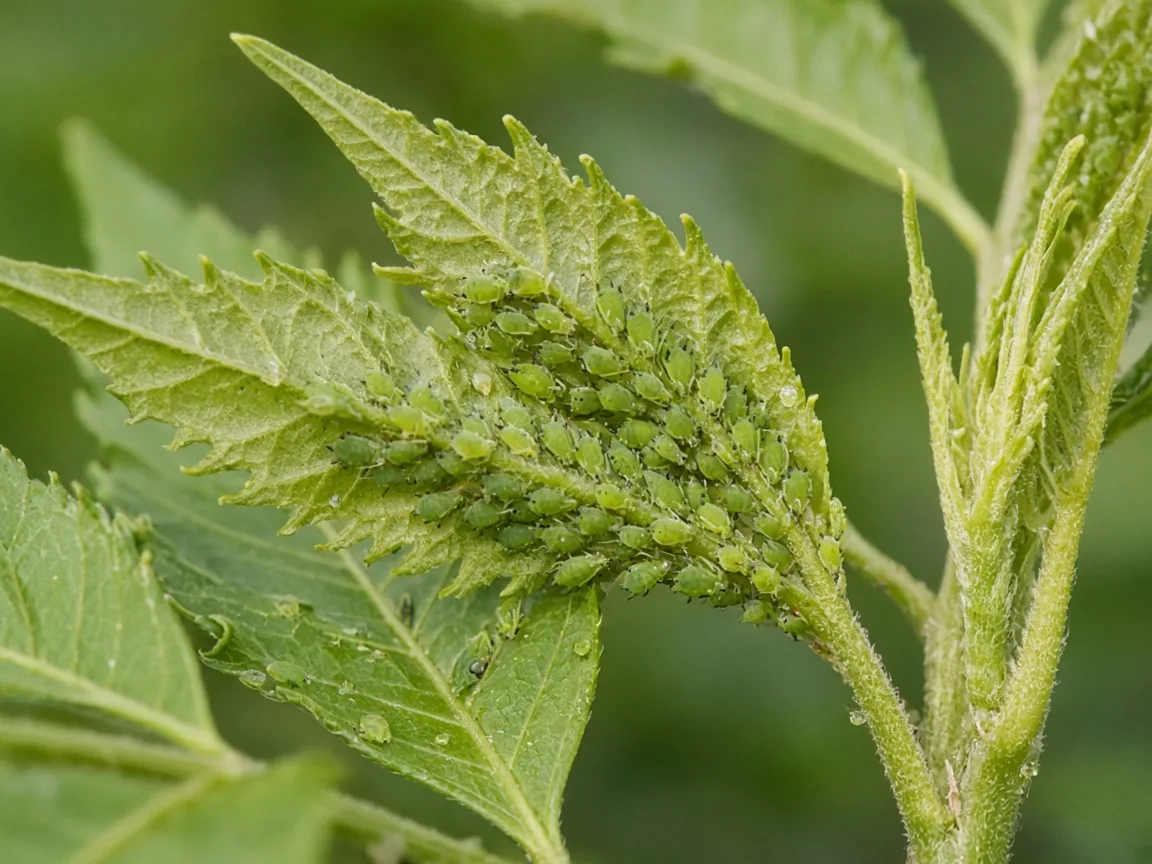
Dense aphid clusters colonizing the rachis and undersides of newly expanding Neem leaflets. Note the curling leaflet margins and glistening sticky honeydew deposits.
Because aphids extract copious volumes of phloem sap to harvest trace amino acids, they excrete vast quantities of excess water and liquid sugars. As UC IPM notes, this sugary waste, termed honeydew, creates the most visible diagnostic hallmarks of an infestation on Neem:
- Curled, crinkled leaflets: As aphids feed on expanding tissue, their saliva disrupts cellular growth, causing tender leaflets to curl downward, twist into tight spirals, or develop a puckered, crinkled texture.
- Sticky foliage and stems: Honeydew drips downward from upper terminals onto lower compound leaves, coating the dark green serrated leaflets in a clear, tacky sheen that traps airborne dust.
- Powdery black sooty mold: Saprophytic fungal spores land on the honeydew deposits, quickly establishing sheets of dark sooty mold. While the fungus does not infect plant tissue directly, it blocks sunlight from reaching the chlorophyll beneath, hampering photosynthesis.
- White cast skins: As nymphs molt through four developmental stages (instars), they shed their white exoskeletons, leaving visible white flecks adhered to sticky leaf surfaces.
- Ant mutualism: Worker ants often march in steady lines up the neem trunk to tend the aphids, stroking them to harvest honeydew while defending the colony against predatory insects.
The Neem paradox: why aphids attack a natural insecticide tree
Why would an insect choose to feed on Azadirachta indica, a tree known for repelling hundreds of insect species? Understanding this paradox helps growers diagnose and prevent recurring attacks on Missouri Botanical Garden classified Azadirachta indica:
- Compartmentalized chemical defenses. Commercial neem oil is extracted primarily by pressing seeds and kernels, which contain the highest density of azadirachtin, nimbin, and salannin. In contrast, the vegetative flush of a living tree exhibits a steep chemical gradient: mature, tough, fibrous leaves and woody bark hold moderate chemical deterrents, but freshly emerging branch tips and expanding leaflets have minimal concentrations.
- Specialized phloem feeding. Azadirachtin works predominantly as an antifeedant and growth regulator when ingested by chewing insects (such as caterpillars or beetles) that masticate cellular walls. Aphids bypass the leaf exterior entirely by sliding ultra-fine stylets between epidermal cells into vascular bundles, feeding purely on sap where defense limonoids are not concentrated in lethal amounts.
- Exploiting growth flushes. In warm climates or during seasonal spring and monsoon surges, neem trees push rapid flushes of soft pinnate growth. These tissues are rich in easily accessible nitrogen and free amino acids. Aphids reproduce exponentially via parthenogenesis (females giving birth to live female clones without mating), allowing populations to explode before the tree can lignify and harden the new tissue.
- Container root stress. Neem is a large, taproot-forming tropical tree native to semi-arid regions. In containers, root confinement, poor drainage, or erratic watering compromises tree vigor. Stressed trees produce lower systemic defense compounds and higher stress-induced free amino acids, making them significantly more attractive to opportunistic pests.
Where aphids hide on Neem
The foliage of Azadirachta indica consists of alternate, once-pinnate compound leaves measuring 20 to 40 cm long, typically bearing 8 to 18 curved, lanceolate, serrated leaflets arranged along a central rachis. Aphids do not scatter randomly across this canopy; they congregate in specific structural microhabitats:
- Apical meristems and branch terminals: The growing tip of each branch is the prime colonization site. Look for tight clusters encircling the soft, green succulent stem just below emerging buds.
- Abaxial leaflet surfaces along the rachis: Aphids settle on the undersides of newly expanded leaflets, clustering along the midvein and in the tight angles where individual leaflet petiolules join the central rachis.
- Emerging flower panicles: In spring, mature neem trees produce drooping panicles of fragrant white blossoms. The soft, nectar-rich stems and delicate flower buds are highly favored by aphids before petals open.
- Juvenile bark and leaf axils: The junction where a compound leaf petiole attaches to the young stem creates a sheltered crevice that protects colonies from drying winds, strong rains, and casual observation.
How to confirm aphids before treating
Accurate diagnosis prevents mistreating your tree. Run through these sequential checks:
- Magnification inspection: Use a 10x jeweler’s loupe or hand lens to inspect the curled tips of new growth. Confirm the presence of sedentary, pear-shaped insects with visible cornicles. Unlike thrips, aphids do not scurry rapidly across the leaf surface when disturbed.
- Honeydew touch test: Touch glistening patches on lower leaves. True aphid honeydew is tacky, sticky to the touch, and dissolves readily in water, unlike natural plant oils, dry scorch marks, or chemical burns.
- Symptom pattern analysis: Colorado State University Extension emphasizes that aphid feeding characteristically induces leaf curling and distortion restricted to expanding leaves. If older leaves exhibit uniform curling without sticky residue, examine soil moisture and temperature rather than pests.
- Observe ant movement: If ants are moving up and down the main trunk in an organized trail, follow them to their destination; they almost invariably lead directly to an aphid colony.
Lookalike symptoms on Neem
| Observed Symptom | Primary Cause | Distinguishing Diagnostic Feature |
|---|---|---|
| Clustered pear-shaped insects, sticky honeydew, curled new leaflets | Aphids | Stationary soft-bodied colonies on terminals; honeydew present; see this guide |
| Fine stippled yellow dots, dusty appearance, fine webbing across leaflets | Spider Mites | Microscopic mites under webbing; dry environment; no stickiness; see Neem spider mites |
| White cottony cushions in leaf axils and petiole joints, sticky honeydew | Mealybugs | Segmented oval insects covered in waxy white fluff; see Neem mealybugs |
| Lower leaves yellowing and dropping, soggy pot, sour soil smell | Overwatering | Wet, waterlogged potting mix, no pests; consult our Neem watering guide |
| Crispy leaflet edges, dry soil, dull wilting canopy | Underwatering / Drought | Pot feels exceptionally light; foliage brittle; see Neem underwatering guide |
| Elongated stems, pale foliage, wide spacing between leaflets | Not Enough Light | Slow, stretched growth; weak stems; see Neem light guide |
For broader diagnostic questions across all leaf, stem, and root conditions, browse our comprehensive guide to all Neem problems.
The first fix for Neem: step-by-step removal
When dealing with an active aphid outbreak on Neem, avoid reaching immediately for harsh synthetic pesticides. These chemicals can damage tender foliage and eradicate beneficial garden predators. Instead, execute this progressive, low-impact treatment protocol:
Step 1: Forceful water dislodgement (Immediate response)
Move container-grown trees to an outdoor wash station, patio, or shower. Using a garden hose with a multi-pattern nozzle set to a firm, medium-pressure spray, systematically wash down the entire tree. Focus the stream directly onto branch tips, terminal flushes, and the undersides of compound leaves.
As Colorado State University Extension notes in its guidance on managing indoor and houseplant pests, a forceful jet of water is remarkably effective against aphids. Because aphids are fragile, soft-bodied insects with weak ambulatory limbs, dislodged individuals are unable to climb back onto the tree and die on the ground. The water also rinses away sticky honeydew deposits, preventing sooty mold from gaining a foothold. Support slender branches with your hand to prevent snapping delicate green stems.
Step 2: Targeted spray with potassium salts of fatty acids (Days 2 to 4)
If aphids persist in tightly curled leaflets where physical water sprays cannot penetrate, apply an insecticidal soap based on potassium salts of fatty acids. Colorado State Extension explains that these specialized soap molecules dissolve the insect’s protective waxy cuticle and disrupt cellular membranes, causing rapid dehydration and death within hours.
- Mixing and application: Use a certified commercial insecticidal soap diluted according to label rates (typically 1 to 2% solution, or roughly 15 to 20 mL per liter of water). Ensure thorough coverage, saturating shoot tips and young leaf undersides until the spray drips freely. Contact is strictly required; soaps have zero residual toxicity once dry.
- Application precautions: Spray early in the morning or near dusk when the tree is cool. Never spray in direct midday sun or when temperatures exceed 32°C (90°F), as wet soaps under intense solar radiation can induce severe phytotoxic leaf scorch on neem.
Step 3: Support natural biological control (Ongoing)
On outdoor patios, balconies, and garden terraces, natural insect predators provide durable suppression. UC IPM points out that ladybird beetles (Hippodamia convergens and related species), in both adult and alligator-like larval stages, feed voraciously on aphids. Green lacewing larvae, hoverfly (syrphid) larvae, and tiny parasitic wasps (Aphidius spp.) also attack colonies. Preserving these allies requires avoiding broad-spectrum synthetic sprays.
Neem care cross-check
Cultural conditions directly influence how susceptible a neem tree is to sap-sucking pests. Review your management practices against our master Neem care guide:
- Watering rhythm: Neem is adapted to semi-arid tropical forests and cannot tolerate waterlogged, anaerobic soil. Allow the top 3 to 5 cm of potting mix to dry thoroughly before soaking deeply. In warm summer months, watering may be needed every 4 to 7 days, whereas in cooler seasons, intervals extend to 10 to 14 days. Learn proper moisture testing methods in our Neem watering guide.
- Soil texture and drainage: Potted neem trees must have sharp drainage. Use a gritty, sandy loam mix consisting of roughly 50% sandy topsoil, 25% coarse perlite or pumice, and 25% compost. Heavy potting soils retain stagnant water, suffocating roots and altering sap pressure. Learn how to formulate optimal substrate in our Neem soil guide.
- Sunlight exposure: Azadirachta indica is an obligate sun-lover that demands 6 or more hours of direct, unfiltered sunlight daily. Weak indoor light causes thin, stretched growth with soft cell walls that aphids easily penetrate.
- Fertilizer moderation: Resist the urge to fertilize an aphid-infested tree. Heavy applications of quick-release nitrogen force soft, succulent growth that acts as an aphid magnet. Feed sparingly only during active warm-season growth (spring through early autumn) with balanced organic plant food.
Recovery timeline and expectations
Neem trees are vigorous, resilient growers during warm weather. When the pest burden is lifted, the plant recovers predictably:
- Days 1 to 3: Dislodged aphids perish; sticky honeydew begins drying and washing away with mistings.
- Week 1 to 2: Minor survivor pockets may appear as unhatched nymphs emerge. Perform a second spot application of insecticidal soap around day 5 to 7 to interrupt the lifecycle.
- Weeks 3 to 4: With feeding halted, apical buds reactivate. New pinnate leaves emerge straight, smooth, and vibrant green without curling or puckering.
Setting realistic expectations: Leaflets that developed under aphid attack and curled will remain permanently warped; plant cell walls cannot un-curl once formed. As long as the tissue remains green, leave these leaflets intact to continue generating energy. Once fresh flushes fully expand, cosmetically distorted leaves can be pruned away during routine shaping.
Mistakes to avoid
- Spraying broad-spectrum chemical insecticides: Applying synthetic pyrethroids or organophosphates kills ladybird beetles and lacewings while selecting for pesticide-resistant aphid strains, often triggering severe rebound infestations.
- Spraying under high heat or direct sunlight: Treating foliage with soaps or horticultural oils when temperatures exceed 32°C (90°F) or under bright sun can burn neem leaflets and cause immediate defoliation.
- Overwatering a distressed plant: Stressed neem trees often shed a few leaflets. Misinterpreting this as drought and saturating the soil leads directly to root rot.
- Repotting during an infestation: Repotting a tree while it is actively battling pests adds severe root transplant shock on top of foliage stress. Eliminate the aphids first; postpone repotting to early spring.
- Allowing pets access to chemical spray run-off: Although ASPCA Animal Poison Control confirms that Azadirachta indica is not classified as toxic to dogs or cats, commercial insecticidal soap concentrates or runoff puddles should always be kept away from curious pets until dry.
How to prevent aphids next time
Maintain these preventive barriers to keep aphids from regaining a foothold on your tree:
- Enforce quarantine protocols: Quarantine any new houseplant, patio addition, or outdoor arrival in an isolated room for at least three weeks before introducing it to your collection.
- Weekly terminal scouting: Make a habit of checking apical shoots and leaflet undersides once a week during warm spring and summer flushes. Crushing a small starter colony of five aphids with your fingers prevents an infestation of thousands.
- Periodic canopy rinses: Giving your neem tree a weekly overhead water spray on warm mornings washes off accumulated dust, deters winged aphids from landing, and cleanses the leaf surface.
- Manage ant colonies: If ants are present, wrap the lower trunk with horticultural barrier tape coated in insect barrier glue to prevent ants from protecting aphid colonies.
When to use this page vs other Neem guides
- Use this guide when you observe soft-bodied bugs, honeydew droplets, leaf curling, or black sooty mold on new growth.
- Use our Neem spider mites guide if you find fine webbing, dusty foliage, and chlorotic stippling in hot, dry conditions.
- Use our Neem mealybugs guide if you discover white cottony masses tucked into leaf axils and petiole joints.
- Use our Neem watering guide if whole compound leaves turn yellow and drop without signs of insects.
- Browse our all Neem problems hub when symptoms appear across multiple plant zones simultaneously.
Related Neem guides
- Neem tree overview - Botanical history, native dry forest ecology, and container cultivation fundamentals.
- Neem watering guide - Soil drying depths, seasonal hydration schedules, and avoiding root hypoxia.
- Neem care guide - Complete care guidelines for light, temperature, humidity, and nutrition.
- Neem soil guide - Blending free-draining sandy loam substrates for optimal container aeration.
- All Neem problems - Diagnostic guide to identifying pests, leaf spot pathogens, and cultural disorders.
Related tool
Use the Plant Problem Diagnosis Tool to confirm whether curled leaflets and sticky residue on your Neem indicate aphids or another pest before applying treatments.