Aphids on Orange Tree: Causes, Checks & Fixes
Quick answer
Aphids on orange trees congregate on tender new flush leaves, sucking sap and causing severe leaf curling, stunting, and sticky honeydew coated in black sooty mold. First step: inspect the newest branch tips and blast colonies with a strong, focused jet of water to dislodge nymphs while preserving beneficial parasitoid wasps.
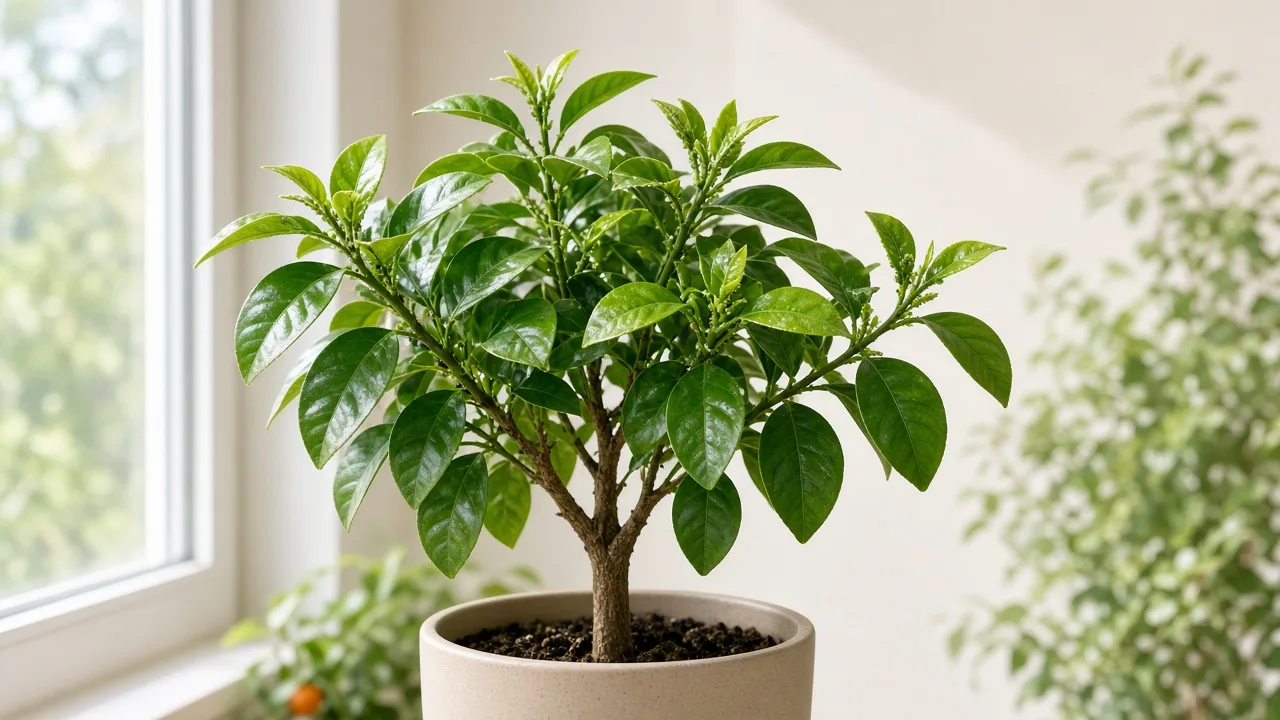
Aphids on Orange Tree: Causes, Checks & Fixes
This guide covers aphids on Orange Tree. See also the general Aphids guide, watering, and light pages for this plant.
Aphids on Orange Tree: Causes, Checks & Fixes
Quick answer
Aphids target the succulent new spring and summer leaf flushes of sweet orange (Citrus sinensis), congregating along the undersides of young leaves to pierce and suck cell sap. This feeding causes tender leaves to cup, curl tightly backward toward the twigs, and stunt before hardening. As aphids feed, they excrete copius sugary liquid that coats leaves and ripening fruit in sticky honeydew, quickly colonized by dark black sooty mold (Capnodium spp.).
For a broad biological overview of aphid reproduction and species across all plants, read our aphids guide. On citrus trees, infestations are uniquely driven by seasonal vegetative growth cycles and carry severe agricultural consequences, including vectoring the devastating Citrus tristeza virus (CTV).
First fix: isolate containerized trees or move to an open area, then blast the undersides of infested new flushes with a strong, focused jet of water to knock off colonies while keeping parasitoid wasps alive.
When to use this page vs other orange tree guides
| Foliage symptom | Primary cause | Diagnostic difference | Next step |
|---|---|---|---|
| Backward curled, cupped new leaves with clusters of soft pear-shaped bugs and sticky honeydew | Citrus aphids | Visible insects on tender flush; honeydew and sooty mold | This page |
| Curled, rolled leaves with silvery serpentine mine trails and folded leaf margins | Citrus leafminer (Phyllocnistis citrella) | Larval tunnels inside leaf cuticle; no soft sucking colonies | Check leaf interiors |
| Fine yellow stippling, bronzed foliage, and delicate webbing between petioles | Citrus red mites or two-spotted mites | Microscopic mites; dust-like specks on paper; see spider mites on Orange Tree | Wash undersides; mist canopy |
| Fluffy white cotton-like waxy deposits in stem axils and leaf joints | Citrus mealybugs | Flat segmented bodies under waxy filaments; see mealybugs on Orange Tree | Target axils with alcohol or soap |
| Generalized yellowing of older mature leaves while soil remains soggy | Overwatering / root asphyxiation | Roots brown and waterlogged; no pests or honeydew; see overwatering on Orange Tree | Adjust drainage and frequency |
| Upward leaf curling, brittle margins, and wilting in dry container mix | Moisture deficit / heat stress | Whole canopy wilts uniformly; soil pulls away from pot edges | See Orange Tree watering |
What aphids look like on Orange Tree
Citrus aphids are tiny (1.5 to 2.5 mm long), pear-shaped insects that congregate in dense colonies exclusively on tender, soft vegetative shoots. Multiple species feed on orange trees, and recognizing them helps evaluate disease risks:
- Spirea aphid / Green citrus aphid (Aphis spiraecola): Bright apple-green to yellowish-green with dark cornicles (tailpipes). It is the predominant species during spring flush in California and Mediterranean climates.
- Cotton or melon aphid (Aphis gossypii): Highly variable in coloration within the same colony, ranging from pale yellow to mottled olive-green and dull blackish-green.
- Brown citrus aphid (Toxoptera citricida): Shiny reddish-brown to jet-black with distinctive dark antennae banded in white. It is the most efficient insect vector of severe citrus viral diseases worldwide.
- Black citrus aphid (Toxoptera aurantii): Shiny dark reddish-brown to black, producing an audible scraping sound (stridulation) when disturbed in large colonies on tender shoots.
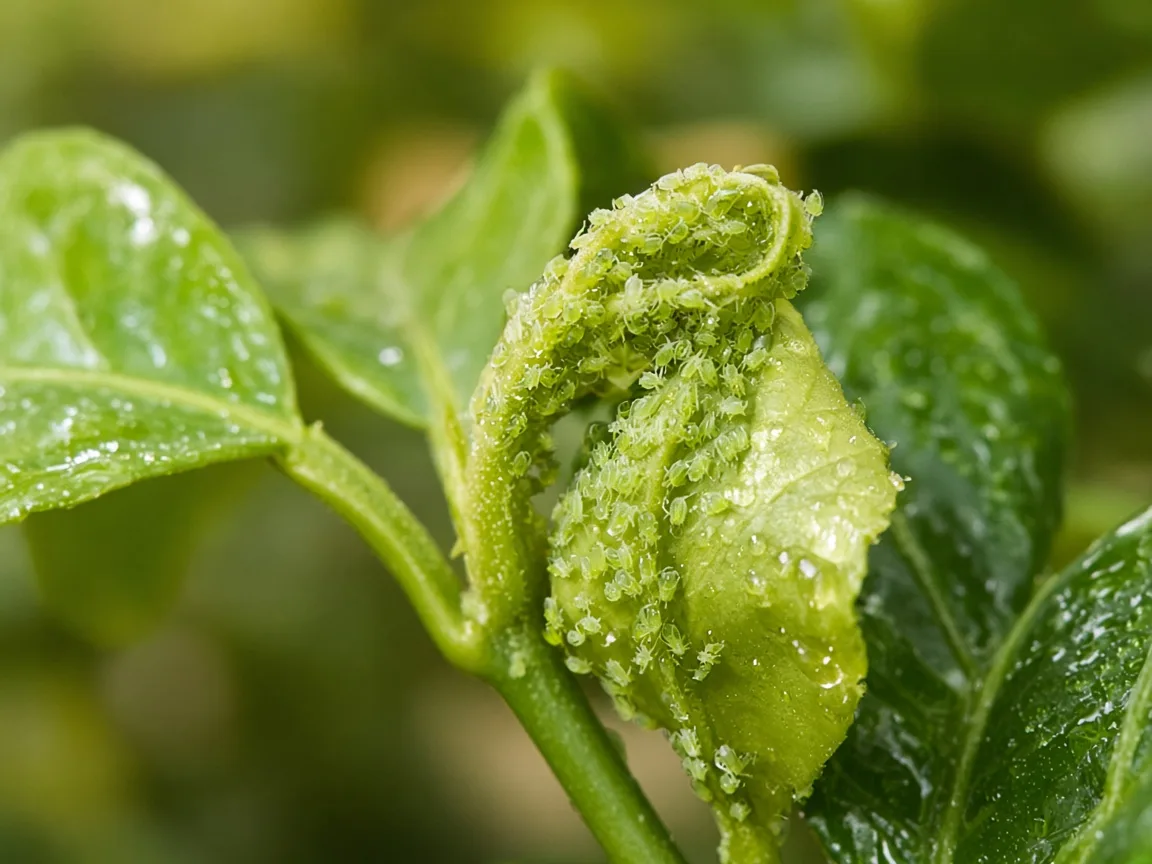
Dense colony of citrus aphids crowded along the curled underside of an orange tree’s spring flush leaf, accompanied by sticky honeydew.
Key visual clues on an orange tree include:
- Severe leaf distortion: Aphid feeding on developing leaf tissue prevents cell elongation on the underside, which causes leaves to curl tightly backward and cup downward toward the twig.
- Honeydew accumulation: Foliage below the colonies turns glossy, slick, and sticky to the touch from sugary excreta.
- Sooty mold crusts: Superficial black fungal mats develop across honeydew-coated leaves and fruit rinds, blocking sunlight from photosynthetic tissue.
- Ant trails: Lines of Argentine ants (Linepithema humile) or carpenter ants marching briskly up the trunk and main scaffold branches to protect aphids from natural predators.
- Cast white skins: Paper-thin, whitish nymph molts shed as aphids mature, often mistaken for whiteflies or dandruff among the colonies.
Why Orange Tree gets aphids
Sweet orange trees produce distinct, synchronous growth spurts called “flushes.” In subtropical climates or protected conservatory settings, flush events occur in early spring, mid-summer, and early autumn. Aphids do not attack mature, leather-like citrus leaves because their mouthparts cannot easily penetrate the thick waxy cuticle. Instead, winged adults (alatae) ride thermal wind currents and smell the volatile terpenes released by tender expanding flush tissue.
Over-fertilization with synthetic high-nitrogen feeds is the leading cultural trigger for explosive aphid outbreaks. Nitrogen stimulates excessive, succulent vegetative flush that remains soft for an extended window, allowing aphid populations to double every few days under warm temperatures (65°F to 80°F / 18°C to 27°C).
Additionally, indoor or patio orange trees frequently lack the diverse ecosystem of predators present in balanced orchards. When predatory hoverflies, lacewings, and ladybugs are absent—or when ants actively kill them—a small colony quickly blossoms into thousands of sap-sucking nymphs.
The vulnerability of citrus flush: Feather growth vs. hardened leaves
Citrus foliage undergoes a rapid physiological transformation. When new buds break, the nascent shoot is known as “feather growth”—tissue that is delicate, pale lime-green, flexible, and rich in amino acids and pressurized sap. Aphids cluster tightly along the stem of this feather growth and along the midrib on the lower leaf surface.
When aphids extract sap during this rapid expansion phase, uneven cellular growth causes irreversible mechanical deformation. The leaves become puckered, stunted, and permanently curled into tight rosettes. Once the flush matures, turns dark green, and develops its robust waxy epidermal layer, it becomes completely unpalatable to aphids.
Consequently, aphid feeding damage on sweet orange is self-limiting in timing: colonies peak on tender flushes and naturally collapse as the foliage hardens off. However, the legacy of that short feeding window is permanent aesthetic disfigurement of that season’s branch extension and a thick coating of sooty mold that reduces photosynthetic efficiency for the life of those leaves.
Citrus Tristeza Virus (CTV) vectoring and rootstock risk
Beyond direct leaf distortion and honeydew production, aphids pose a grave threat to orange trees because they vector Citrus tristeza virus (CTV), one of the most destructive citrus plant pathogens in history. CTV is transmitted in a semi-persistent manner: aphids acquire the virions in as little as 30 to 60 minutes of feeding on an infected host and transmit them to clean trees within minutes of probing fresh flush.
While sweet orange trees are vulnerable to several aphid species, the brown citrus aphid (Toxoptera citricida) transmits CTV with six to twenty-five times greater efficiency than the cotton aphid (Aphis gossypii) or spirea aphid (Aphis spiraecola).
The danger of CTV depends fundamentally on the tree’s rootstock. Sweet orange (Citrus sinensis) scions grafted onto sour orange rootstock (Citrus aurantium) suffer from “quick decline.” The virus induces phloem necrosis directly below the graft union, starving the root system of photosynthetic carbohydrates. Affected trees exhibit yellowing foliage with clear veins, premature leaf drop, dieback of branch tips, root rot, and eventual tree death within weeks or months. Modern trees grafted onto trifoliate hybrid rootstocks (such as ‘Carrizo’ or ‘Swingle’ citrumelo) tolerate mild CTV strains, but preventing aphid vector feeding remains vital for tree longevity.
Ant mutualism and preserving parasitoid wasps (Lysiphlebus testaceipes)
In almost every citrus aphid outbreak, a mutualistic symbiosis exists with ants. Argentine ants and field ants farm aphids like cattle. They stroke aphids with their antennae to stimulate honeydew secretion and greedily harvest the sugary carbohydrate source. In exchange, aggressive worker ants actively protect aphid colonies, driving off or killing predatory lady beetle larvae, green lacewings, and delicate parasitoid wasps.
The primary biological control agent regulating citrus aphids is Lysiphlebus testaceipes, a minute solitary braconid wasp. The female wasp inserts an egg inside a live aphid nymph. The developing wasp larva consumes the aphid from the inside, eventually pupating and causing the aphid’s outer cuticle to swell, harden, and turn into a characteristic tan or golden-brown leathery shell known as an aphid mummy. When adult development is complete, the tiny wasp cuts a neat circular exit hole in the mummy’s abdomen and emerges to hunt more aphids.
When inspecting curled orange leaves, look closely for these swollen, bronzed aphid mummies. If you observe that 20% to 50% of the aphids in a colony are bloated, papery mummies, natural biological control is already underway. Applying broad-spectrum synthetic pyrethroids or organophosphates in this scenario is counterproductive: it obliterates the wasp population while surviving aphids reproduce rapidly without biological checks.
How to confirm the infestation
Follow this systematic diagnostic order before applying treatments:
- Inspect newest shoot flushes: Examine branch tips pushing pale green feather growth. Look beneath the leaf blades and around the soft terminal bud.
- Examine curled leaf interiors: Unfurl curled leaves gently. True aphids appear as plump, soft, slow-moving insects clustered tightly along veins.
- Check for sticky honeydew and sooty mold: Touch leaves directly beneath suspect branches. Sticky residue confirms active phloem-sap feeders.
- Follow ant activity: Check the trunk base and main scaffold branches. A steady two-way highway of ants indicates an established colony that is being protected from natural enemies.
- Scan for aphid mummies: Use a 10× hand lens to check for inflated brown, tan, or charcoal-colored shells with circular exit holes, confirming Lysiphlebus testaceipes activity.
- Rule out leafminers: Confirm whether leaf curling is caused by aphids or by citrus leafminer larvae. Leafminers create distinct silvery serpentine translucent blisters inside the leaf laminate; aphids feed externally on surface sap.
- Cross-check tree health and root zone: Confirm that leaf curl is localized to fresh shoots rather than widespread canopy wilting from dry potting mix or root decay from saturated soil. Refer to orange tree problems if non-pest symptoms appear across mature foliage.
First fix: focused water jet blast
For a home or patio orange tree with an active aphid colony, immediately blast the undersides of the infested new flushes with a firm, focused jet of lukewarm water.
A sharp stream of water knocks soft-bodied aphids off the foliage, breaking their delicate mouthparts (stylets) and dislodging them onto the ground where soil predators consume them or they perish from dehydration. University extensions and the Royal Horticultural Society endorse dislodging soft-bodied pests with water as an effective initial cultural intervention.
Keep the following parameters in mind:
- Direct the spray upward to reach the curved undersides of curled leaves.
- Support the tender flush twig with your free hand so the water pressure does not snap delicate young growth or axillary spines.
- Rinse the foliage thoroughly to wash away accumulated sticky honeydew, which arrests the spread of black sooty mold fungus.
- Let the canopy dry completely under bright morning light.
Step-by-step control and ant barriers
If water blasting alone leaves persistent colonies on valuable spring flushes, follow this structured integrated pest management (IPM) sequence:
- Establish an ant barrier: Without ant control, aphid treatments frequently fail. Wrap a 3-inch band of protective tape or paper tree wrap around the lower trunk (never apply sticky resin directly to young citrus bark), then coat the wrap with a polybutene pest barrier (such as Tanglefoot). Trim low-hanging skirt branches that touch the ground or nearby walls, cutting off alternative ant bridges.
- Apply insecticidal soap or horticultural oil: For dense lingering clusters, spray an OMRI-listed potassium salts of fatty acids (insecticidal soap) at a 1% to 2% dilution, or a refined narrow-range horticultural oil (0.5% to 1% summer rate). Insecticidal soaps act on contact by disrupting the insect’s protective lipid membrane and dissolving cellular structure.
- Ensure thorough target coverage: Aphids shelter inside leaf curls. Direct your spray nozzle upward from below the canopy into every crevice and curled margin. Contact sprays have zero residual action once dry; unsprayed nymphs will survive.
- Respect temperature precautions: Never apply horticultural oils or soaps when ambient temperatures exceed 90°F (32°C) or in direct, blazing midday sun. Citrus leaves coated in oil under high heat suffer severe phytotoxic leaf burn and premature defoliation.
- Protect beneficial insects: If you observe substantial numbers of lady beetle larvae, lacewing eggs on slender stalks, or bronzed aphid mummies, hold off on chemical sprays. Allow beneficial predators two to three weeks to decimate the remaining nymphs.
- Pet safety awareness: While sweet orange fruit flesh is a refreshing human treat, ASPCA notes that Citrus sinensis stems, leaves, and peel are toxic to dogs and cats due to concentrated essential oils (limonene, linalool) and phototoxic psoralens. Wear gloves when handling thorny branches and keep pets away from pruned shoots and treatment areas.
What recovery looks like on Citrus sinensis
Understanding citrus growth physiology is crucial for realistic recovery expectations:
- Existing curled leaves never uncurl: Leaves that expanded while colonized by aphids suffer permanent cellular distortion. Their curled, cupped shape is locked into the hardened leaf structure. Do not prune off every imperfect leaf; as long as they are green, they produce carbohydrates for the tree.
- Sooty mold flakes off: Once honeydew production ceases, black sooty mold dries into a flaky crust that gradually weathers away with rain, overhead washing, or natural leaf shedding.
- The next flush confirms recovery: The true sign of success is the emergence of the next seasonal flush cycle (e.g., summer or early autumn flush). When newly emerged feather shoots grow straight, flat, vigorous, and unblemished, your aphid management has succeeded.
Recovery timeline
| Timeframe | Expected canopy status | Action to take |
|---|---|---|
| Day 1–3 | Active colonies dislodged by water jets or contact soap; honeydew rinsed away | Monitor trunk ant barriers; confirm no ants cross sticky bands |
| Week 1–2 | Remaining nymphs targeted by surviving ladybugs and Lysiphlebus wasps; aphid mummies turn golden-brown | Inspect new feather shoots every 3 days; spot-treat localized rebounds |
| Week 3–4 | Current flush hardens off; foliage darkens and becomes immune to aphid feeding | Wash lingering sooty mold off upper leaf surfaces with clear water |
| Week 6–8 | Next vegetative flush cycle breaks at terminal buds | Inspect tender expanding tips early; maintain balanced irrigation and nutrition |
Lookalike symptom check
| Visual symptom | Suspected pest or issue | Key diagnostic difference | Reference guide |
|---|---|---|---|
| Backward curled flush with pear-shaped sap-feeders and sticky film | Citrus aphids (Aphis spp., Toxoptera spp.) | Visible soft colonies on undersides; sticky honeydew; ant attendance | This page |
| Curled, rolled young leaves with silvery reflective serpentine mines | Citrus leafminer (Phyllocnistis citrella) | Larval feeding inside leaf epidermis; leaves roll upward; no honeydew | Monitor new flushes |
| Fine yellow speckling, pale stippled leaves, delicate webbing | Spider mites / Citrus red mites | Minute eight-legged mites; no leaf curling; rough bronzed leaf texture | Spider mites on Orange Tree |
| White waxy cottony tufts in branch forks and leaf axils | Citrus mealybugs (Planococcus citri) | Segmented bugs hiding under white wax; slower moving | Mealybugs on Orange Tree |
| Lower leaves yellowing and dropping, soggy sour container mix | Overwatering / poor root aeration | Damage starts on older foliage; roots soft and brown; no honeydew | Overwatering on Orange Tree |
| Crispy leaf tips, pale margins, slow growth in heavy soil | Soil compaction / salt buildup | Leaf tips burn; poor drainage; roots bound in container | Orange Tree soil |
Orange Tree care cross-check
Pest outbreaks are rarely isolated events; they are frequently magnified by environmental stressors and nutritional imbalances:
- Prune synthetic nitrogen: Discontinue high-nitrogen fast-release fertilizers during active aphid season. Instead, use a balanced, slow-release citrus formulation with micronutrients (zinc, iron, manganese, magnesium) to promote steady, robust tissue maturation rather than watery, succulent growth surges.
- Maintain consistent root moisture: Do not let containerized orange trees undergo alternating cycles of bone-dry drought and swampy saturation. Water deeply when the top 2 inches (5 cm) of mix dry out, as outlined in our Orange Tree watering guide. Stressed trees produce concentrated phloem sugars that attract sap-feeding insects.
- Provide maximum full sun: Citrus sinensis requires 6 to 8 hours of direct, unfiltered sunlight daily. Trees kept in dim or shaded positions produce weak, leggy growth with thin cuticles that remain susceptible to pests for weeks. See our Orange Tree light guide for indoor overwintering and outdoor exposure requirements.
- Ensure free-draining, slightly acidic soil: Plant orange trees in an open, aerated citrus mix (pH 5.5 to 6.5) containing coarse perlite, bark, and loam. Compacted or alkaline soil inhibits micronutrient uptake, weakening natural plant defenses. Check our Orange Tree soil guide for recommended container potting recipes.
How to prevent aphids on Orange Tree
- Monitor flush development weekly: Check expanding branch tips every 3 to 4 days during spring and summer flush periods. Catching an initial cluster of 10 aphids prevents a 1,000-bug infestation.
- Maintain sticky trunk barriers: Keep sticky barriers around the lower trunk active from early spring through autumn to exclude honeydew-farming ants.
- Preserve beneficial insect habitats: Plant flowering companion herbs (such as dill, fennel, alyssum, and cilantro) near your citrus trees to provide nectar and pollen for adult hoverflies, lacewings, and parasitoid wasps.
- Quarantine new citrus trees: Keep newly purchased nursery stock separated from your existing collection for at least 3 weeks to inspect for hitchhiking aphids, scales, and leafminers.
- Prune for canopy airflow: Lightly prune crowded, crossing interior water sprouts in late winter to encourage air circulation and light penetration, facilitating thorough spray coverage when needed.
When to worry
In mature, established landscape sweet orange trees, aphids are rarely life-threatening. A healthy tree easily tolerates 10% to 20% flush distortion without any noticeable decline in fruit yield.
However, escalate intervention when:
- Young or newly planted trees are heavily infested: A small 1-to-2-year-old container tree can experience stalled root development and severe stunting if every single emerging shoot is deformed.
- CTV quick decline symptoms emerge: If your orange tree is on sour orange rootstock and exhibits sudden canopy chlorosis, wilting during hot weather despite moist soil, or honeycombing beneath the bark at the bud union, suspect Citrus tristeza virus infection.
- Sooty mold smothers more than a third of the canopy: Extensive sooty mold drastically impairs photosynthesis, triggering premature leaf drop and reducing next season’s flower bud initiation.
Related tool
To ensure your indoor or patio orange tree maintains optimal transpiration without suffering from dry-air stress that exacerbates pest vulnerability, evaluate your environment with our Humidity Calculator.
Related Orange Tree guides
- Orange Tree care overview - Comprehensive guide to cultivar selection, container culture, and climate requirements.
- Orange Tree watering guide - Proper dry-down intervals and seasonal moisture management to prevent root rot.
- Orange Tree light guide - Optimizing sunlight exposure for vigorous flowering, fruiting, and compact growth.
- Orange Tree soil guide - Formulating slightly acidic, free-draining citrus potting mixes.
- Orange Tree problems hub - Diagnostic triage for nutrient deficiencies, physiological disorders, and pest infestations.