Fungus Gnats on Orange Tree: Indoor Root Checks & Fixes
Quick answer
Fungus gnats on potted orange trees indicate chronically damp, organic potting mix—most commonly occurring when dwarf citrus is moved indoors for winter and watered on an outdoor summer schedule. While adult gnats are harmless fliers, larvae feed on delicate citrus feeder roots and transmit fungal pathogens like Phytophthora. First step: apply a targeted Bacillus thuringiensis subsp. israelensis (Bti) soil drench, let the top 2–3 inches of mix dry out, and install yellow sticky cards at the pot rim.
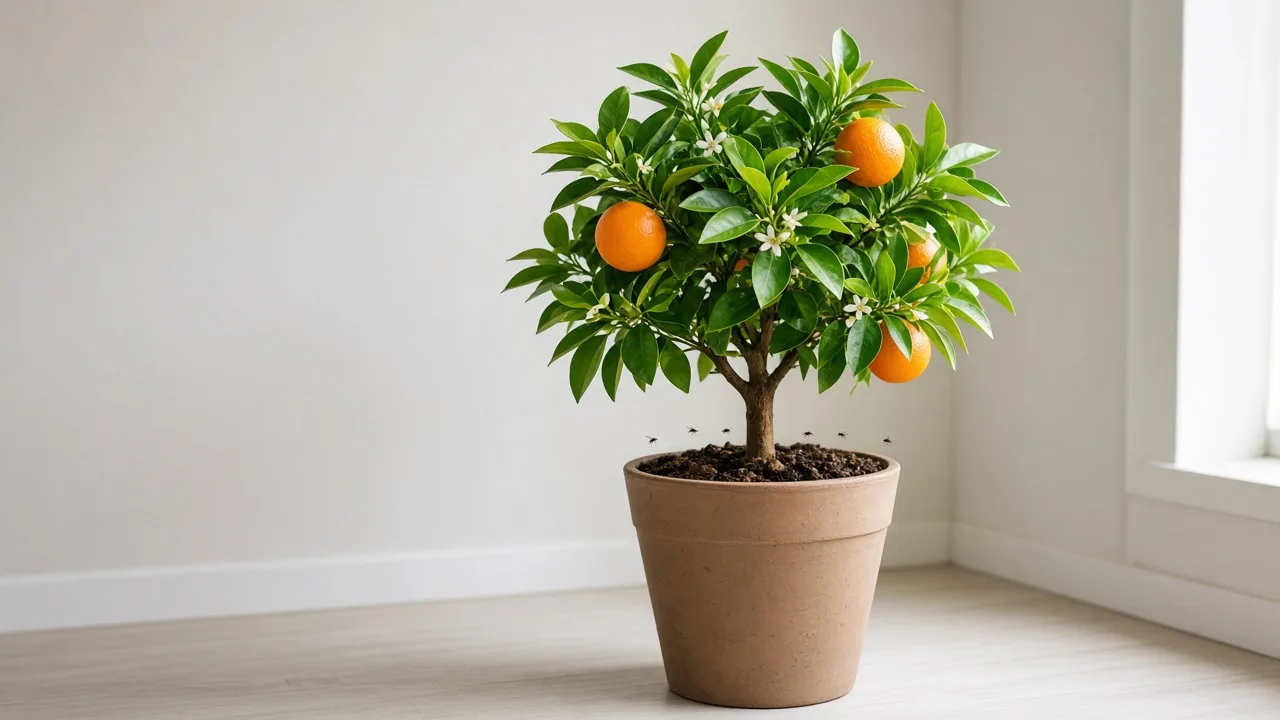
Fungus Gnats on Orange Tree: Causes, Checks & Fixes
This guide covers fungus gnats on Orange Tree. See also the general Fungus Gnats guide, watering, and light pages for this plant.
Fungus Gnats on Orange Tree: Causes, Checks & Fixes
Quick answer
Fungus gnats (Bradysia species) around a potted orange tree (Citrus sinensis) signal a potting soil moisture and aeration imbalance, not an airborne leaf pest. When container dwarf citrus trees are brought indoors for overwintering, their transpiration rate drops dramatically while dense organic potting soil stays wet for weeks. Adult females deposit hundreds of eggs into this warm, damp surface substrate, where translucent larvae hatch to feed on fungi, organic matter, and the tree’s delicate feeder roots.
For how fungus gnats reproduce and behave in moist potting media across all houseplant varieties, see our universal fungus gnats hub. On potted orange trees, the critical risk is below the surface: citrus trees concentrate their nutrient-absorbing feeder roots in the top few inches of the container, where active gnat larvae strip root hairs and create open wound pathways for lethal fungal root pathogens.
First step: Apply a targeted biological drench using Bacillus thuringiensis subsp. israelensis (Bti) in your next irrigation, allow the top 2 to 3 inches of potting mix to dry out completely, and place yellow sticky traps horizontally at the pot rim. Do not repot or spray the canopy with broad-spectrum insecticides on day one.
When to use this page vs other Orange Tree guides
Tiny insects hovering around your citrus container can come from several cultural issues. Distinguish fungus gnats from related indoor citrus disorders before applying treatments.
| Observed symptom pattern | Primary diagnosis | Actionable guide |
|---|---|---|
| Tiny dark flies flitting across damp soil; slender larvae in top mix | Fungus gnats | This guide |
| White fuzzy mold crust on the potting soil without swarming insects | Surface soil mold | Mold on soil |
| Yellowing lower leaves, foul sour pot odor, dark mushy root tips | Fungal root decay | Root rot |
| Uniform yellowing and leaf drop while soil is heavy and wet | Waterlogged roots | Overwatering |
| Pale foliage with green veins in dry soil; slow flush | Chlorosis / drought | Yellow leaves |
| Stagnant, water-retentive peat mix that fails to dry indoors | Substrate compaction | Soil guide |
| Calibrating indoor soak-and-dry irrigation intervals | Winter watering schedule | Watering guide |
What fungus gnats look like on Orange Tree
Detecting fungus gnats early requires inspecting the container rim and soil line rather than searching the glossy citrus leaves.
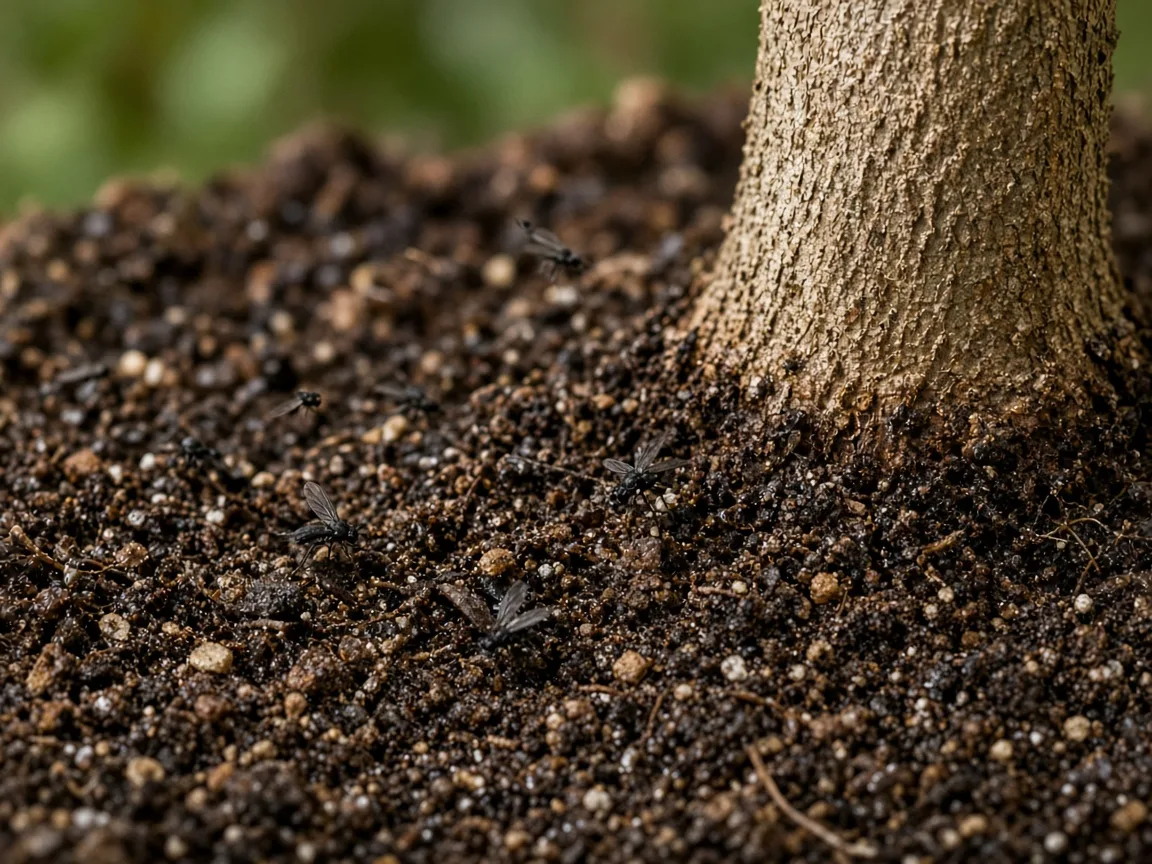
Translucent fungus gnat larvae in moist citrus potting mix feed on delicate feeder roots and fungal mycelium, while tiny dark adults emerge from the surface layer.
Adult signs on and around the container:
- Minute, delicate, mosquito-like flies measuring 1/16 to 1/8 inch (1.5 to 3 mm) in length with dark charcoal or black bodies.
- Distinctive long, slender antennae and Y-shaped wing veins that separate true dark-winged fungus gnats (Sciaridae) from other indoor flies.
- Weak, jerky, erratic fliers that spend most of their time walking across the damp potting mix, resting on the pot’s exterior, or fluttering just above the soil line when disturbed.
- Adults gathering on nearby sunny windowpanes or reflective surfaces in the room rather than feeding on citrus foliage.
Larval signs within the substrate:
- Slender, worm-like, translucent to milky-white legless maggots (about 1/4 inch long when mature) possessing shiny, jet-black head capsules.
- Larvae concentrated in the upper 1 to 3 inches of potting soil, actively wriggling through moist peat, bark particles, and citrus root clusters.
- Faint silvery slime trails resembling miniature snail tracks across the damp soil crust when larval populations reach extreme densities.
Citrus canopy clues:
- A mild gnat presence rarely shows immediate leaf symptoms. However, as populations multiply, you will observe sudden stagnation of new leaf flushes, premature dropping of delicate blossoms or marble-sized fruitlets, and mild interveinal chlorosis as fine feeder roots lose their uptake capacity.
Why Orange Tree gets fungus gnats: the indoor overwintering trap
Dwarf orange trees (such as Washington Navel, Calamondin, or Robertson Navel grafted onto dwarfing rootstocks like Poncirus trifoliata ‘Flying Dragon’) are naturally adapted to high-light outdoor environments. The primary trigger for fungus gnat outbreaks is the environmental shock of moving container citrus indoors for winter protection.
The indoor transpiration crash
During warm summer months on an outdoor patio, a potted citrus tree absorbs and transpires gallons of water each week under bright sunlight and natural wind movement. When brought indoors ahead of autumn frosts, the tree encounters lower light intensity (often under 500 foot-candles unless supplemental grow lights are provided per our light guide), stagnant indoor air, and cooler ambient temperatures. Under these conditions, citrus water uptake plummets during cool indoor overwintering. If you maintain an outdoor watering frequency, the potting volume remains waterlogged for weeks on end.
Organic peat and compost breakdown
Standard commercial potting soils formulated with high ratios of fine sphagnum peat moss, unaged compost, or fine coconut coir begin decomposing rapidly in stagnant, warm indoor conditions. Fungi, bacteria, and saprophytic molds proliferate throughout the damp top layer. This decaying organic matter is the primary natural food source for adult gnat oviposition and early larval nourishment.
Overpotting and perched water tables
Container citrus placed in pots that are disproportionately large for their root system suffer from large volumes of “dead soil” where active roots do not penetrate. Gravity pulls moisture downward, forming a perched water table in the lower half while the dense surface remains damp enough to sustain continuous gnat breeding cycles.
How citrus feeder roots suffer: larvae, chlorosis, and root fungal pathogens
Many gardeners assume fungus gnats are merely a visual nuisance in indoor spaces. For container citrus, however, unchecked larval infestations pose a direct physiological threat to the tree’s health.
Unlike taprooted landscape trees, container-grown Citrus sinensis relies on a dense, fibrous mat of fine feeder roots located primarily in the top 4 to 6 inches of the potting mix. These gossamer-thin feeder roots are covered with delicate epidermal root hairs responsible for absorbing water and critical micronutrients such as iron, zinc, and manganese.
When soil fungi and decaying organic matter become depleted, larvae actively chew fine root hairs and tender feeder roots. On a young dwarf orange tree, this root shearing leads to:
- Nutrient deficiency symptoms: The tree develops patchy interveinal chlorosis on newer growth because stripped root hairs can no longer absorb iron and magnesium from the soil solution.
- Moisture stress: The root system loses hydraulic conductivity, causing daytime leaf curl even though the potting mix feels damp to the touch.
- Pathogen transmission: Crucially, the microscopic chew wounds left along the root cortex breach the tree’s protective outer barriers. These open wounds left by feeding larvae provide entry pathways for Phytophthora (Phytophthora nicotianae and Phytophthora citrophthora) and Pythium species. Gnat larvae also ingest fungal resting spores from decaying mix and physically disperse viable oospores throughout the root ball as they migrate through the container profile.
How to confirm fungus gnats on your Orange Tree
Before initiating treatment, verify that the flying insects are indeed fungus gnats and assess the severity of larval activity in the root zone.
The raw potato slice test
The potato disk assay is the most reliable home diagnostic method for confirming active larvae in citrus potting soil:
- Cut a fresh, raw potato into wedges or round disks roughly 1/2-inch thick.
- Clear away any loose dry mulch and press the flat cut side firmly into the top inch of potting mix near the tree’s trunk.
- Leave the potato undisturbed for 48 hours.
- Lift the slice and examine both the underside of the potato and the soil surface directly beneath it with a magnifying lens or bright light.
- Translucent larvae with dark head capsules migrate to feed on the potato starch. Finding 5 to 10 larvae under a single slice confirms a moderate to severe infestation requiring immediate biological treatment.
The rim disturbance check
Gently tap the rim of the citrus container or blow lightly across the soil surface. Fungus gnat adults will instantly flush upward in short, erratic flights before landing back within inches of the pot rim.
Ruling out fly lookalikes
Do not confuse fungus gnats with other common indoor flies:
- Shore flies (Ephydridae): Stockier than fungus gnats, shore flies have short, bristle-like antennae and five distinct pale spots on dark wings. They feed strictly on algae growing on permanently saturated drainage saucers or constantly damp clay pots; their larvae do not damage citrus feeder roots.
- Fruit flies (Drosophila): Plumper, tan-to-brown flies with red eyes that hover around ripening citrus fruit, dropped fruit on the soil surface, or kitchen counters, rather than emerging from the substrate itself.
- Citrus whiteflies (Dialeurodes citri): Tiny, pure-white, moth-like insects that flutter from the undersides of citrus leaves when the branches are shaken, leaving sticky honeydew deposits on foliage; they do not live in the soil.
The first fix: targeted Bti soil drench
The most effective, plant-safe first response for fungus gnats on potted orange trees is an immediate biological larvicide drench using Bacillus thuringiensis subsp. israelensis (Bti).
Do not begin by repotting the orange tree or spraying aerosol insecticides across the room. Repotting an indoor citrus tree during winter shocks already stressed feeder roots, while adult contact sprays fail to eliminate the hundreds of eggs and larvae developing underground.
Why Bti is ideal for Citrus sinensis
Bti is a naturally occurring soil bacterium that produces specialized crystal delta-endotoxins. When ingested by dipteran larvae (fungus gnats and mosquitoes), these proteins bind specifically to alkaline receptors in the insect’s midgut epithelium, rupturing the cell walls and paralyzing the larva within 24 to 48 hours.
Crucially, Bti has zero toxicity toward citrus tissue, beneficial mycorrhizal fungi, earthworms, pets, or humans. It leaves no chemical residues that could compromise future edible fruit.
Step-by-step Bti drench protocol
- Source the biological control: Use dedicated Bti liquid concentrates (such as Gnatrol) or EPA-registered biological mosquito control granules (Mosquito Bits).
- Brew the drench: If using granules, soak 4 tablespoons of granules in one gallon of room-temperature, dechlorinated water for 30 minutes. Stir thoroughly, then strain the water through a fine mesh colander to remove the spent corn-cob carrier (leaving the corn grit on the soil can attract surface saprophytic mold).
- Apply as regular irrigation: Wait until the upper layer of soil has slightly dried, then drench the citrus root ball thoroughly until liquid drains freely from the pot’s bottom weep holes. Ensure the entire soil volume is saturated so the Bti suspension reaches deep larval feeding zones.
- Repeat on a strict schedule: Bti kills only the larval feeding stage; it does not affect pupae or unhatched eggs. To successfully break the insect’s life cycle, apply the Bti drench every 5 to 7 days for three consecutive waterings. This ensures that as dormant eggs hatch into first-instar larvae, they ingest the lethal endotoxin before damaging citrus feeder roots.
Secondary controls: sand top-dressing and yellow sticky cards
While the Bti drench eradicates subterranean larvae, you must simultaneously suppress flying adults and block future oviposition sites.
Coarse sand or pumice physical barrier
One of the most powerful non-chemical cultural controls is applying a half-inch to one-inch layer of coarse sand or horticultural pumice across the entire surface of the potting mix.
- How it works: Female gnats require damp organic material to deposit eggs. Sharp, sterile coarse sand (such as builder’s sand or horticultural grit #2) contains zero organic matter and drains instantly. The top half-inch remains bone-dry within minutes of watering.
- The mechanical trap: Adult females cannot penetrate the gritty sand barrier to access moist peat below, and newly emerging adults that pupate deep in the root zone become trapped and desiccate as they try to claw their way through the sharp mineral layer.
- Application tip: Maintain at least a 3/4-inch uniform layer right up to the trunk base, ensuring no gaps of exposed potting soil remain. Do not use fine sandbox play sand, which packs down into a cement-like crust that blocks vital root aeration.
Yellow sticky card monitoring and mass trapping
Deploy yellow sticky cards positioned horizontally at the container rim to capture flying adults.
- Cut standard yellow sticky cards into 2-by-3-inch rectangles and mount them on small wooden craft sticks placed 1 inch above the soil surface, or lay them face-up directly across the pot rim.
- Female gnats are visually attracted to the specific yellow wavelength and land immediately upon emerging from the substrate, removing them before they can mate and deposit their clutch of 100 to 200 eggs.
- Count trapped adults weekly to monitor population decline and gauge the success of your Bti drench schedule.
Saucer and drainage hygiene
Always empty the runoff saucer beneath the orange tree within 20 minutes of watering. Standing water in the collection tray keeps the bottom soil profile saturated through capillary action, creating an anaerobic refuge where fungus gnat larvae thrive and root-rotting water molds multiply.
Soil moisture management: the 2-3 inch dry-down rule
Biological controls and physical barriers succeed only when paired with sound watering discipline. Research demonstrates that allowing the surface substrate to dry thoroughly suppresses egg hatch and quickly starves newly emerged first-instar larvae, which have delicate cuticles that dehydrate rapidly in dry media.
The citrus root-zone dry-down protocol
While small succulent plants can be left completely dry for weeks, an evergreen Citrus sinensis carrying foliage and ripening fruit cannot tolerate prolonged, severe drought stress without dropping leaves or aborting crops. The key is allowing the surface profile to dry while maintaining adequate moisture around deeper roots:
- Verify depth before watering: Never water an indoor orange tree on a calendar interval. Insert a clean, unfinished wooden skewer or chopstick 3 to 4 inches into the mix near the mid-point between the trunk and container wall. Leave it for 5 minutes, then pull it out.
- Read the skewer: If the top 2 to 3 inches of the stick emerge completely dry, free of clinging soil particles, and light in color, the tree is ready for irrigation. If the skewer is cool and damp in the top 2 inches, withhold water for another 3 to 5 days.
- Use container heft: Lift or tilt the container slightly. A waterlogged citrus pot feels heavy and dense; when the top third has dried out, the pot feels distinctly lighter.
- Water deeply and drain: When moisture checks confirm it is time to irrigate, water deeply with room-temperature water until 10–20% runs out the drainage holes, flushing accumulated fertilizer salts and distributing Bti evenly.
Recovery timeline: what to expect on dwarf citrus
Eradicating fungus gnats and restoring damaged citrus feeder roots requires consistent execution over a 4-week window.
| Timeframe | Treatment action | Observable plant & insect response |
|---|---|---|
| Days 1–3 | Apply 1st Bti drench; place sticky cards at pot rim | Flying adults stick to cards; larvae ingest Bti and stop feeding within 24 hours. |
| Days 4–7 | Allow top 2–3 inches to dry; monitor potato slice | Adult emergence slows noticeably; potato test shows dead, shriveled, or absent larvae. |
| Days 8–12 | Apply 2nd Bti drench; install coarse sand top-dressing | Newly hatching instars from older egg clutches are eradicated; oviposition barrier blocks new flies. |
| Days 14–18 | Apply 3rd Bti drench; replace sticky cards | Trap counts drop to zero or single digits; soil surface remains completely free of flying pests. |
| Weeks 3–5 | Maintain 2–3 inch dry-down rhythm; provide bright light | Fine citrus feeder roots regenerate white tips; canopy halts leaf drop; healthy new vegetative buds emerge. |
Mistakes to avoid when treating Citrus sinensis
Avoid these common missteps that can injure sensitive container citrus:
- Do not spray synthetic pyrethroids or aerosol pesticides indoors: Spraying adult gnats in living spaces offers zero residual control of underground larvae and exposes indoor occupants to unnecessary chemical aerosols.
- Do not drench the potting mix with pure neem oil or essential oil concoctions: While dilute horticultural oils are useful for foliar scale, concentrated oil drenches coat citrus root hairs in an impenetrable film, suffocating delicate feeder roots and triggering rapid leaf defoliation.
- Do not allow the citrus root ball to desiccate into bone-dry dust: Forcing an orange tree into severe drought stress to kill gnats will kill the tree’s feeder roots faster than the larvae would, leading to massive fruit drop and branch dieback.
- Do not apply rich organic compost, manure, or fish fertilizer indoors: High-nitrogen organic amendments applied to the soil surface during winter provide an instant feast for fungi and accelerate gnat reproduction. Stick to gentle mineral citrus fertilizers applied sparingly in early spring per our Citrus sinensis overview.
- Do not repot an infested tree during winter dormancy: Stripping soil and washing root balls in the middle of winter shocks the citrus root system and can kill a dwarf tree. Treat the infestation in place with Bti and sand.
How to prevent fungus gnats next season
Prevent future outbreaks by adjusting your seasonal culture before bringing your orange tree indoors next autumn:
- Repot into a gritty, porous citrus substrate: Repot every 2 to 3 years in late spring using an airy mix containing 60% peat-free potting loam, 20% composted fine bark, and 20% coarse perlite or pumice as detailed in our soil guide. Fast-draining gritty mixes dry quickly at the surface, deterring gnat colonizers.
- Perform an autumn quarantine and preventive drench: Two weeks before the first expected autumn frost, treat your outdoor citrus with a preventive Bti drench and clean the exterior of the container before bringing it inside.
- Maximize winter light and air movement: Position your tree in the sunniest south-facing window available, supplement with full-spectrum LED grow lights for 8 to 12 hours daily, and run a small oscillating fan on low to promote transpiration and keep the soil surface dry.
- Water by weight, not habit: Check soil moisture with a probe or dowel and adhere strictly to the 2 to 3 inch dry-down rule throughout the indoor overwintering period.
Related Orange Tree guides
Strengthen your container citrus care routine with these dedicated species guides:
- Orange Tree Overview — Comprehensive cultivation requirements, cold-hardiness thresholds, and fruit-bearing care for Citrus sinensis.
- Orange Tree Watering — Master seasonal soak-and-dry irrigation to protect sensitive root systems from saturation and drought stress.
- Orange Tree Light — Essential foot-candle requirements and grow light positioning for indoor overwintering.
- Orange Tree Soil — Formulate free-draining, slightly acidic container potting mixes that resist compaction and pest habitat.
- Orange Tree Problems — Diagnostic index covering citrus leaf curl, scale insects, spider mites, and physiological fruit drop.
Conclusion
Fungus gnats on a potted orange tree are a clear signal of excess moisture and slowed transpiration during indoor overwintering. While adult flies are harmless to foliage, their underground larvae actively prune delicate citrus feeder roots and open pathways for dangerous pathogens like Phytophthora root rot.
By applying a targeted biological Bti drench every 5 to 7 days, installing a coarse sand or pumice top-dressing, and adhering strictly to the 2 to 3 inch soil dry-down rule, you can completely eradicate the infestation within two to three weeks while preserving the vital root system your dwarf orange tree needs for spring blossoming and sweet fruit production.
Related tool
Use our interactive Watering Calculator to determine optimal seasonal hydration intervals for your potted orange tree based on container size, potting substrate, and ambient indoor humidity.