Leggy Growth on Orange Tree: Etiolation vs Sucker Fixes
Quick answer
Leggy growth on an orange tree (Citrus sinensis) stems from two completely distinct botanical conditions: weak, etiolated shoots caused by insufficient sunlight (<8 hours direct sun indoors), or vigorous, upright suckers erupting from below the graft union on rootstock. First step: locate the graft union on the lower trunk. If shoots emerge below the graft line or bear three-lobed (trifoliate) leaves, prune them flush to the trunk collar immediately. If upper canopy branches are pale, floppy, and stretched, prune them back by one-third and provide at least 8 to 12 hours of direct sun or full-spectrum LED grow lights.
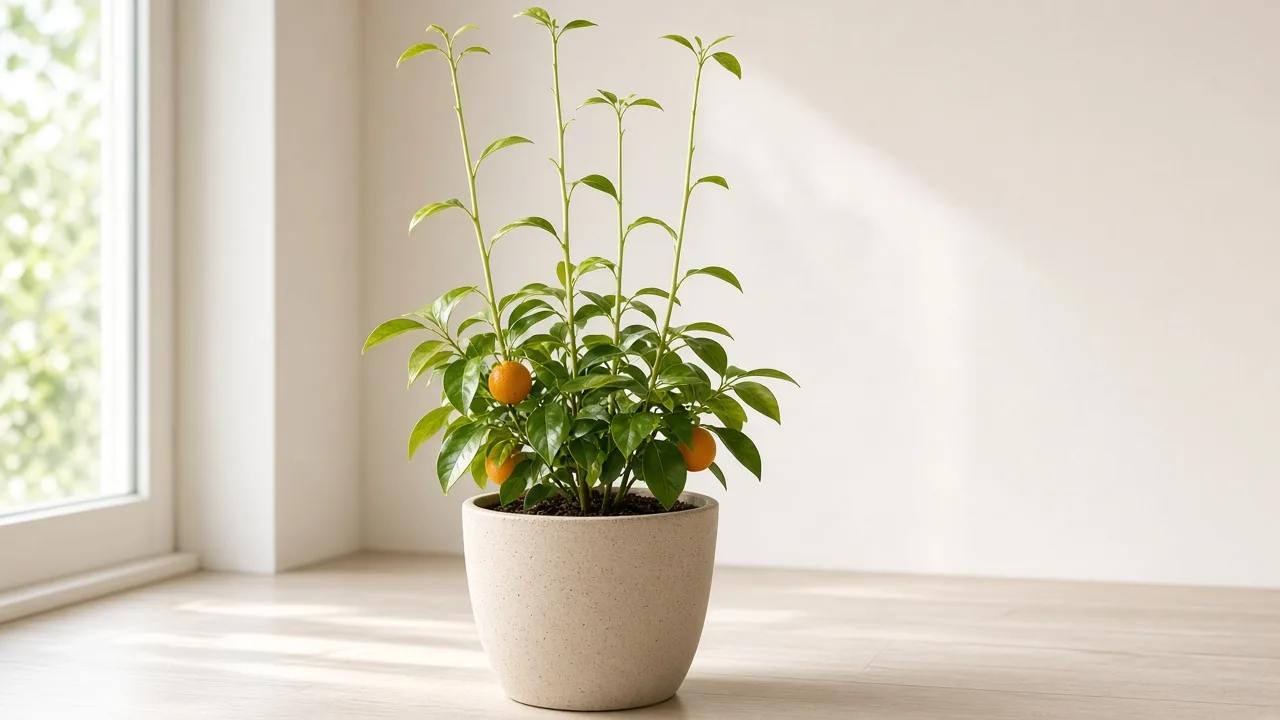
Leggy Growth on Orange Tree: Causes, Checks & Fixes
This guide covers leggy growth on Orange Tree. See also the general Leggy Growth guide, watering, and light pages for this plant.
Leggy Growth on Orange Tree: Causes, Checks & Fixes
Quick answer
When an orange tree (Citrus sinensis) develops leggy, elongated stems, you are almost always dealing with one of two distinct botanical issues: etiolation from inadequate light in the canopy, or rampant suckers (water sprouts) exploding from the rootstock below the graft union. For how light starvation drives internodal elongation across houseplants generally, see our leggy growth guide. On Citrus sinensis, however, stretching is only half the story, and treating all leggy stems the same way can destroy your tree’s fruiting capacity.
First step: inspect the lower trunk to locate the graft union and classify the shoot. If the elongated shoot originates from below the graft scar or displays three-lobed (trifoliate) leaves, grab bypass pruners and cut it flush to the trunk collar immediately. If the stretching consists of pale, floppy stems with widely spaced leaves in the upper canopy, your tree is light-starved: prune the spindly growth back by one-third and move the pot into at least 8 to 12 hours of direct sun or position a dedicated full-spectrum grow light overhead.
When to use this page vs other Orange Tree guides
Citrus trees express environmental stress through shoot elongation, leaf shedding, and twig dieback. Use this guide when stems are abnormally stretched, weak, or shooting aggressively from the base.
| What you see | Primary cause | Urgency | Action path |
|---|---|---|---|
| Pale, floppy stems with wide internodes in upper canopy | Inadequate light (<8 hrs direct sun) | Moderate | Prune back 1/3; add grow light or move to sun |
| Vigorous vertical shoot arising below graft union | Rootstock sucker (Poncirus / sour orange) | High | Prune flush to trunk collar immediately |
| Sparse foliage, pale leaves, overall stalled growth | Chronic low light across entire canopy | Moderate | See not enough light guide |
| Stretched shoots combined with yellowing lower leaves | Wet soil suffocating roots under low light | High | See watering guide and root rot |
| Wild vertical shoot sprouting from upper canopy scaffold | Water sprout from over-fertilization | Moderate | Thin out or head back to branch collar |
For overall container care and soil requirements, reference the Orange Tree overview, the orange tree soil guide, and the orange tree light guide.
What leggy growth looks like on Orange Tree
Because sweet orange trees have naturally compact, woody branch architectures when grown outdoors in full subtropical sun, abnormal elongation is easy to spot once you know the signs:
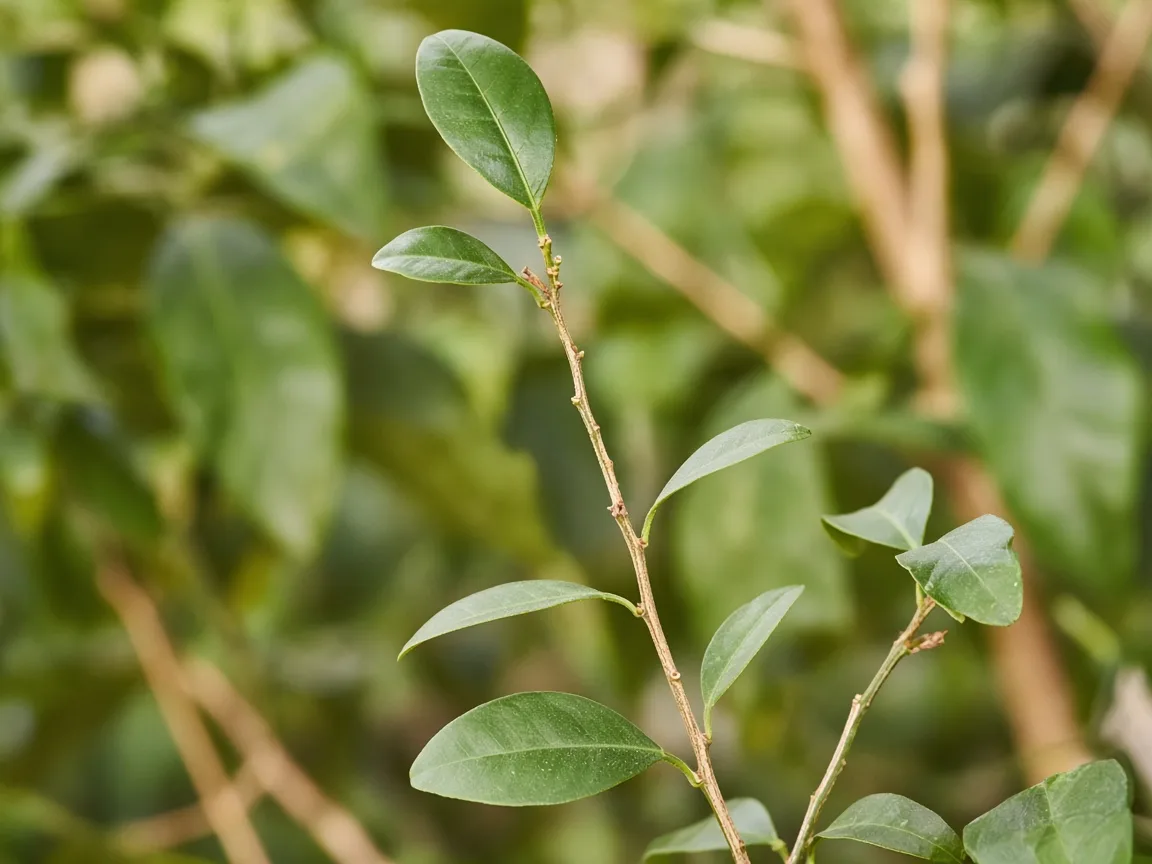
Close-up comparison of thin, elongated citrus internodes and vigorous vertical water sprouts on Citrus sinensis.
Signs of light-starved etiolation (upper canopy):
- Extended internodal spacing: Instead of leaves clustered every 0.5 to 1.5 inches along the stem, nodes are spaced 3 to 5 inches apart.
- Weak, weeping stems: Young branches lack lignin and lignified wood density, causing them to bend downward or flop under the weight of even a few leaves.
- Undersized, pale leaves: Foliage on stretched shoots is noticeably thinner, paler green, and lacks the glossy cuticle of healthy citrus leaves.
- Absence of flowering: Stretched stems rarely initiate blossom buds, as Citrus sinensis demands full sun to generate the carbohydrate reserves needed for floral induction.
Signs of rootstock suckers (lower trunk and base):
- Thick, hyper-vigorous vertical growth: Shoots grow straight up with remarkable speed, outstripping the rest of the canopy in weeks.
- Pronounced thorns: Stems often feature large, vicious spines at every node, measuring up to 1 to 2 inches long.
- Trifoliate foliage: Leaves on the shoot consist of three distinct leaflets rather than the single, ovate leaf with a narrowly winged petiole typical of sweet orange.
The graft union diagnostic: scion vs rootstock suckers
Virtually every cultivated sweet orange tree sold for home gardens or container growing is a grafted specimen. A desirable scion cultivar (such as ‘Washington’ Navel, ‘Valencia’, or ‘Moro’ blood orange) is budded onto a hardy, disease-resistant rootstock—commonly trifoliate orange (Poncirus trifoliata), ‘Carrizo’ citrange, or sour orange (Citrus aurantium).
          [ Cultivar Canopy: Citrus sinensis ]
          (Single ovate leaves, winged petiole)
                           \   /
                            \ /
        =============================================
         DIAGNOSTIC LINE: GRAFT UNION (Swelling / Scar)
        =============================================
                            |
                   [ Rootstock Trunk ]
               (Erect suckers, vicious thorns,
                  trifoliate 3-lobed leaves)
                            |
[ Soil Line ]- Locate the graft union: Look at the bottom 4 to 8 inches of the trunk above the soil. You will see a distinct diagonal scar, knot, or visible change in bark texture and trunk diameter. Everything above this line is the sweet orange scion; everything below it is the rootstock.
- Trace the shoot’s origin: Follow the leggy or vigorous shoot down to its exact point of attachment.
- Evaluate the risk: If the shoot originates below the graft union, vigorous rootstock shoots can quickly overwhelm the cultivar. Rootstock tissue has intense apical dominance. Left unchecked, it channels water, nitrogen, and hormones into its own vegetative growth, eventually causing the sweet orange scion above the graft to decline and die.
- Action: The Royal Horticultural Society emphasizes that growers must prune any shoots emerging below the graft union promptly to preserve the fruiting variety.
Leaf morphology clues: trifoliate rootstock foliage vs sweet orange leaves
If the origin point on the trunk is obscured by soil or low branching, the leaves will give you an immediate, definitive botanical answer:
- True sweet orange (Citrus sinensis): Bears unifoliate (single-bladed) leaves that are dark green, leathery, and oval with acute tips. The petiole (leaf stem) has narrow wings on either side, resembling small green ridges.
- Trifoliate rootstock (Poncirus trifoliata or citrange hybrids): Produces compound leaves made up of three distinct leaflets originating from a central petiole point. The central leaflet is slightly larger than the two lateral leaflets. The stems are intensely thorny and frequently remain bright green and angular even as they thicken.
- Sour orange (Citrus aurantium) rootstock: While unifoliate, sour orange leaves feature broadly winged, heart-shaped petioles and emit a pungent, bitter aroma when crushed, contrasting with the sweet citrus fragrance of crushed sweet orange foliage.
If you observe three-part leaves on your orange tree, you are cultivating rootstock, not fruit-bearing orange wood.
Why Orange Tree gets leggy growth
Sweet oranges evolved in high-irradiance subtropical environments. Their physiological processes—from photosynthetic carbon assimilation to gibberellin hormone distribution—require intense direct solar radiation. When grown indoors, on shaded balconies, or in high-nitrogen conditions, their growth patterns degrade quickly.
1. Light starvation and indoor etiolation
Citrus trees are obligate full-sun perennials. Outdoors, they receive upwards of 50 to 100 mol/m²/day of Photosynthetically Active Radiation (PAR). Indoors behind standard window glass, light levels drop by 70% to 90%. When a sweet orange receives fewer than 8 hours of unfiltered direct sun, phytochrome photoreceptors trigger a shade-avoidance response: internodes elongate rapidly, stems remain thin and soft, and cell walls fail to deposit lignin. The Missouri Botanical Garden notes that citrus requires the brightest possible indoor conditions to maintain compact growth.
2. High room temperatures combined with dim winter light
In winter, placing an orange tree in a heated 72°F (22°C) living room next to a modest window accelerates plant metabolism while providing almost no energy via photosynthesis. The plant consumes its stored carbohydrates to push weak, spindly winter shoots that snap easily under light touch.
3. Rootstock sucker emergence
Rootstock varieties like Poncirus trifoliata are selected for cold hardiness and aggressive nutrient foraging. Stress events—such as repotting, mechanical damage to the lower trunk, heavy canopy pruning, or seasonal light shock—signal the rootstock to produce juvenile water sprouts. These shoots bypass the scion entirely.
4. Excess nitrogen fertilizer
Feeding an orange tree with a high-nitrogen houseplant fertilizer while light levels are suboptimal produces rapid vegetative cell elongation without accompanying structural strength. Citrus fertilizers must supply balanced N-P-K alongside vital micronutrients (iron, zinc, manganese, magnesium) rather than pure vegetative nitrogen.
How to confirm the cause
Perform these four checks before making cuts or altering your plant’s environment:
- Origin check: Trace every fast-growing stem to its base. Is it emerging from the root system, the root crown, or the lower trunk below the graft union? If yes, it is a rootstock sucker.
- Leaf leaflet count: Examine the leaves on the stretched shoot. Are they single leaves with narrow winged petioles, or three-part compound leaves? Three leaflets confirm trifoliate rootstock.
- Internode measurement: On upper canopy branches, measure the distance between successive leaves. Internodes longer than 2.5 to 3 inches with pale, drooping stems indicate light etiolation.
- Light measurement: Test the light intensity at the canopy using a foot-candle meter or PPFD sensor. Sweet orange requires a minimum of 2,500 to 4,000 foot-candles (roughly 300 to 500 µmol/m²/s PPFD) during active growth. Readings below 800 foot-candles will inevitably cause leggy growth.
The first fix to try
First fix: cut any rootstock suckers flush to the trunk collar immediately, and do not prune the upper canopy until you have increased lighting.
- For rootstock suckers: Disinfect your bypass pruning shears with 70% isopropyl alcohol. Cut the sucker completely flush with the trunk collar. Do not leave a 1-inch stub; stubs contain dormant basal buds that will sprout into three new suckers within weeks.
- For etiolated canopy branches: Do not hack back the weak upper branches on the same day if the tree is still sitting in low light. Pruning without improving light forces the tree to spend its dwindling carbohydrate reserves pushing yet another set of weak, leggy shoots. First move the tree into stronger light or install a grow light; allow the plant 10 to 14 days to adapt, then prune back the stretched stems by one-third to an outward-facing bud.
The University of California Statewide Integrated Pest Management Program notes that pruning out vigorous water sprouts and rootstock suckers as soon as they appear directs vital energy into the productive canopy and preserves tree health.
Flush pruning surgery: eliminating rootstock suckers properly
Removing rootstock suckers requires proper technique to prevent recurring growth:
- Clear the base: Gently remove any loose mulch or topsoil around the root crown to expose the exact origin point of the sucker.
- Position the shears: Place the bypass blade tight against the trunk, right at the outer edge of the branch collar.
- Execute a clean, flush cut: Slice cleanly through the shoot base. Never tear, rip, or twist the sucker off with your hands, as tearing leaves ragged wounds that invite fungal pathogens like Phytophthora.
- Inspect for subterranean shoots: If a sucker originates directly from a lateral root beneath the soil line, dig carefully around the root, prune the sucker flush against the parent root, and recover with soil.
- Leave the wound unsealed: Do not apply pruning paints, sealants, or wound balm. Citrus calluses and heals naturally through suberization when exposed to circulating air.
Correcting canopy etiolation: lighting and pruning protocol
Once suckers are eliminated, rehabilitate light-starved upper branches through an integrated lighting and pruning plan:
1. High-output grow light positioning
If growing indoors or overwintering Citrus sinensis, natural window light is rarely adequate:
- Fixture type: Choose a full-spectrum LED horticultural light (3000K to 5000K daylight spectrum).
- Target irradiance: Provide 300 to 500 µmol/m²/s PPFD at the top of the canopy, maintaining at least 150 to 200 µmol/m²/s at the lower leaves.
- Distance: Hang LED panels 12 to 18 inches above the highest leaf tips to avoid heat burn while maximizing photon delivery.
- Photoperiod: Run the lighting on an automatic timer for 12 to 14 hours daily.
2. Heading back etiolated stems
After two weeks under adequate light:
- Identify each spindly, drooping branch.
- Locate a healthy, outward-facing bud along the firmer, lower section of the stem.
- Cut at a 45-degree angle approximately 1/4 inch above the selected bud.
- Remove no more than 25% to 30% of the total canopy foliage in a single pruning session to prevent metabolic shock.
- New growth emerging from the node beneath the cut will develop shorter internodes, thicker stems, and deeper green pigmentation.
Recovery timeline
Recovery unfolds across distinct stages as the orange tree rebalances its energy reserves:
- Weeks 1 to 2: Sucker wounds callus over. Following lighting correction, existing leaves darken slightly and internodal elongation halts on active shoot tips.
- Weeks 3 to 5: Dormant lateral buds along pruned stems swell and break into fresh growth flushes. These new leaves will be closely spaced, thicker, and distinctly glossy.
- Weeks 6 to 12: New shoots lignify into rigid, woody twigs capable of supporting future fruit weight. Tree canopy develops a denser, compact dome.
- Months 3 to 6: In appropriate seasons (late winter/early spring), hardened canopy branches initiate flowering trusses with fragrant white blooms.
Note on existing etiolated stems: The individual stretched internodes will never shrink or contract. Recovery means stopping the spread of weak growth and replacing it with sturdy structural wood.
Mistakes to avoid
- Leaving stubs when pruning suckers: Leaving even a half-inch stub preserves latent adventitious buds that generate clusters of vigorous new rootstock shoots.
- Fertilizing heavily to “fix” weak growth: Applying high-nitrogen fertilizers to an etiolated tree accelerates stretching, producing extremely fragile, watery growth that attracts sap-sucking pests.
- Placing the tree outdoors in sudden full sun: Moving a soft, etiolated indoor orange tree straight into intense outdoor solar radiation scorches tender leaves. Acclimate the plant gradually over 7 to 10 days in dappled shade before exposing to full sun.
- Pruning the entire tree back severely at once: Removing too many leaves simultaneously eliminates the plant’s photosynthetic engine, leading to root decline and severe shock.
- Ignoring suckers until they flower: Rootstock varieties like trifoliate orange produce inedible, bitter fruit packed with seeds while choking out sweet orange branches above. Remove them the day you see them.
How to prevent leggy growth next time
Preventing leggy growth requires coordinating sunlight, seasonal temperature management, and routine trunk inspections:
- Provide continuous direct sun: Keep your orange tree in a south- or southwest-facing exposure receiving a minimum of 8 hours of unfiltered sunlight, or supplement year-round indoors with quality LED grow lights. Check our orange tree light guide for detailed lux and foot-candle targets.
- Inspect the graft union monthly: Run your fingers along the lower trunk during routine watering. Snip off any bud swellings or sprouts below the graft line before they draw significant energy.
- Align watering with growth rate: Water deeply only when the top 2 to 3 inches of potting mix feel dry, as detailed in the orange tree watering guide. Stagnant, waterlogged soil damages fine feeder roots, compounding light stress.
- Use a gritty, free-draining citrus mix: Plant in a loam-based mix amended with 20% coarse perlite or pumice to maintain root aeration, outlined in the orange tree soil guide.
- Cool overwintering temperatures: If overwintering indoors with limited supplemental light, keep ambient temperatures between 55°F and 65°F (13°C to 18°C). Cooler temperatures slow vegetative metabolism, keeping the plant semi-dormant and preventing spindly winter shoots.
- Balanced feeding: Use a dedicated citrus formula with a 2-1-1 or 3-1-2 N-P-K ratio containing chelated iron and zinc, applying only during active spring and summer growth.
Regular practice of monitoring citrus canopy structure ensures that developing problems are caught early, keeping container and garden trees productive for decades.
Related Orange Tree guides
- Orange Tree overview — Core botanical requirements, temperature tolerance, and growing fundamentals
- Orange Tree watering guide — Proper container soak-and-dry schedules and overwatering prevention
- Orange Tree light guide — Foot-candle thresholds, south-window placement, and seasonal transition protocols
- Orange Tree soil guide — Gritty citrus soil recipes and drainage optimization
- Orange Tree not enough light — Diagnosing chronic shade stress, leaf thinning, and winter drop
- All Orange Tree problems — Complete index of pests, deficiencies, and physiological disorders
Related tool
Use the Light Meter Calculator to test your growing area’s foot-candles, calculate daily light integral (DLI), and ensure your sweet orange receives the photon density necessary for compact, productive growth.