Low Humidity on Orange Tree: Causes, Checks & Fixes
Quick answer
Low humidity causes indoor orange trees (Citrus sinensis) to curl their leaves, drop flowers and young fruitlets, and shed green foliage in winter when dry indoor air outpaces root water uptake. First step: move the container at least 4 to 6 feet away from forced-air heating vents or radiators, then install a cool-mist room humidifier to restore relative humidity to 40–60%.
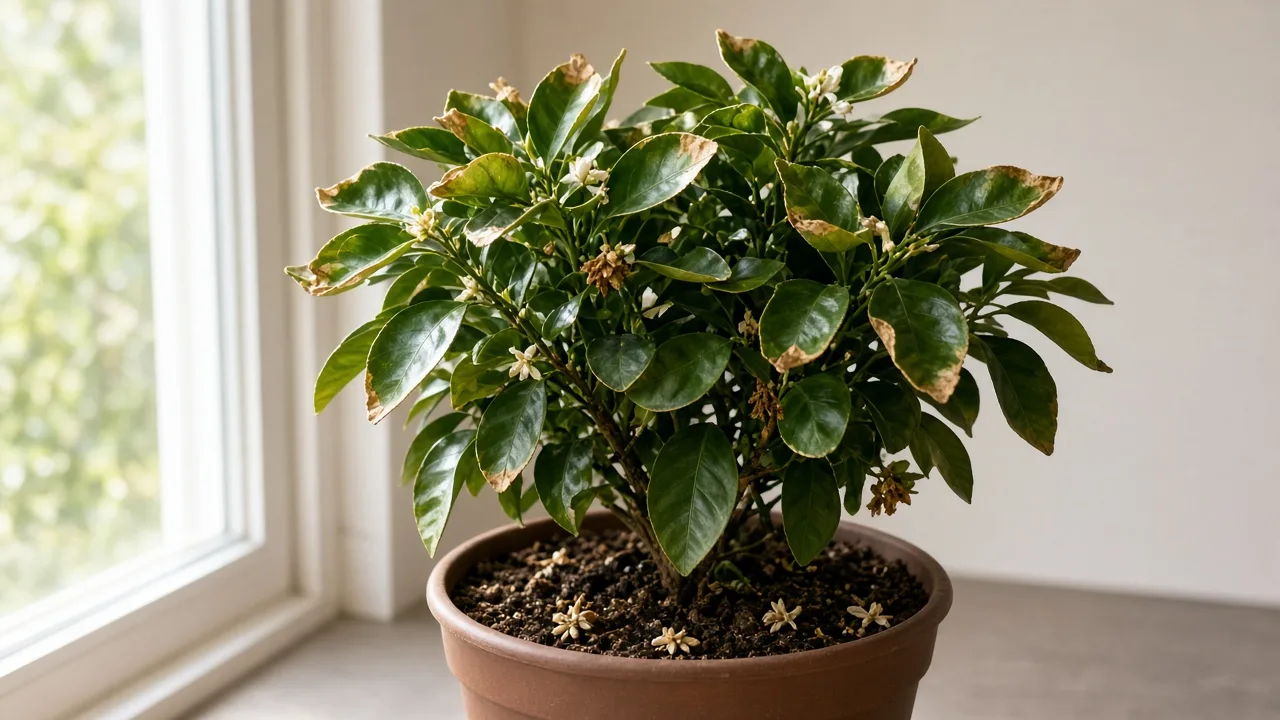
Low Humidity on Orange Tree: Causes, Checks & Fixes
This guide covers low humidity on Orange Tree. See also the general Low Humidity guide, watering, and light pages for this plant.
Low Humidity on Orange Tree: Causes, Checks & Fixes
Quick answer
Low humidity causes an indoor Orange Tree (Citrus sinensis) to suffer rapid transpirational moisture loss, resulting in inward-curling foliage, crispy brown leaf tips, aborted blossom buds, and the sudden shedding of green leaves known as winter leaf drop. Sweet orange is a subtropical evergreen that thrives in relative humidity between 40% and 60%. When brought indoors for winter protection, typical heated room air frequently plummets below 20% to 30% relative humidity, creating an extreme atmospheric moisture deficit that the plant cannot sustain.
For universal environmental moisture mechanics and how vapor deficit affects plants in general, see our low humidity guide. On Orange Tree, dry air is especially punishing because high transpirational demand at the canopy often collides with cold, sluggish roots in a container, forcing the tree to drop foliage and shed fruitlets to prevent complete desiccation.
First step: immediately shift the tree at least 4 to 6 feet away from any forced-air heating vent, baseboard heater, or radiator, and set up a dedicated cool-mist room humidifier to bring the microclimate up to 45–55% relative humidity. Do not respond by flooding the root ball with water, and do not waste effort on spray misting bottles. Stabilizing ambient air moisture while insulating cold roots is the single most effective intervention you can make.
What low humidity looks like on Orange Tree
An orange tree adapted to comfortable humidity displays broad, glossy, deep-green leaves with an open, slightly arched posture, fragrant white flowers that set fruit cleanly, and plump developing fruitlets. When relative humidity drops into dry winter levels, the foliage and reproductive structures show distinct physical distress patterns.
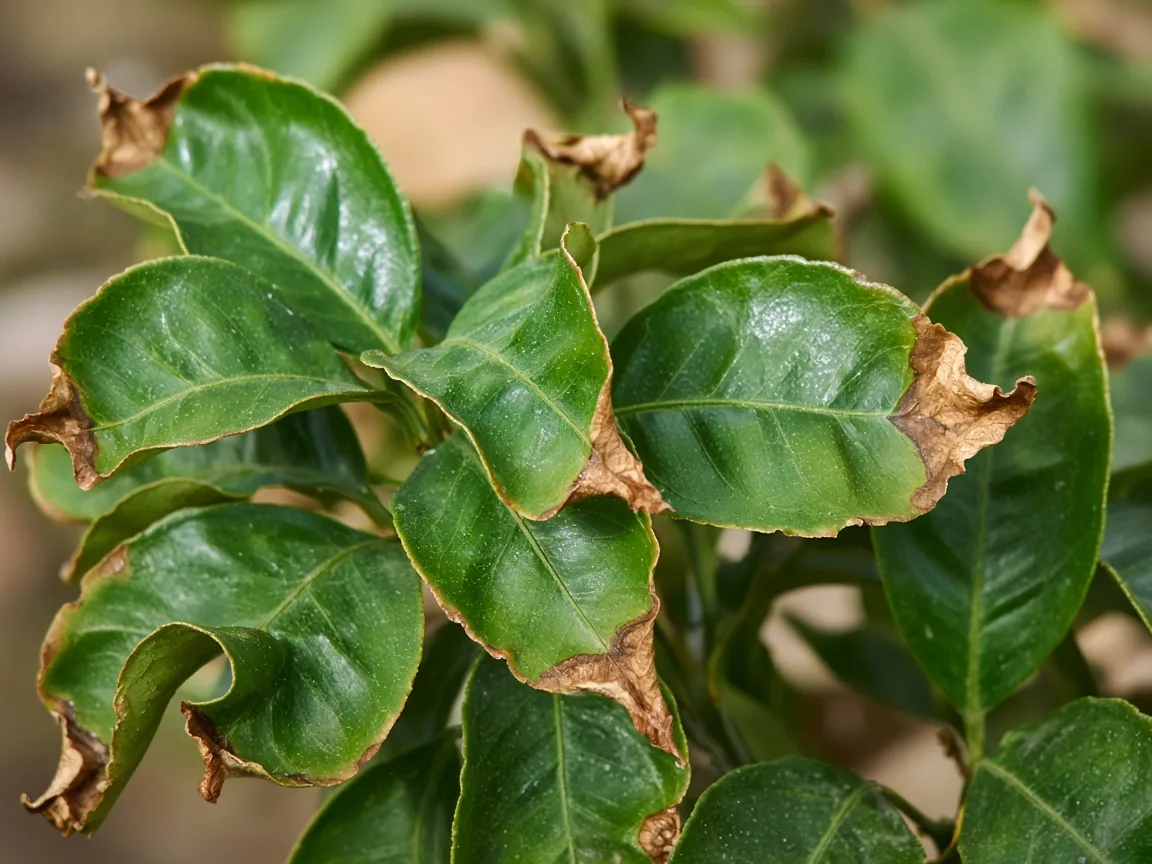
Inward curling leaf margins and desiccated bloom buds on Citrus sinensis caused by dry heated air and elevated vapor pressure deficit.
The diagnostic symptoms of low-humidity stress on Citrus sinensis develop in a predictable sequence:
- Inward leaf rolling and canoe-cupping: Leaf margins curl upward and inward toward the central midrib, reducing the exposed surface area of the leaf to conserve internal water.
- Crispy, brittle leaf margins and tips: The extreme edges and tips of mature leaves turn tan or light brown and feel brittle to the touch, while the central leaf blade remains green.
- Sudden winter leaf drop (green leaf abscission): The tree sheds intact, green, seemingly healthy leaves in large numbers without prior yellowing, often leaving bare branch scaffolds within a few days.
- Blossom blast and bud drop: Emerging white flower buds shrivel, brown at the petals, and drop before opening, or petals drop prematurely without setting fruit.
- Premature fruitlet abortion: Pea-sized or marble-sized young green oranges turn pale or yellowish-green and abscise at the fruit stalk.
- Secondary spider mite webbing: Dry, heated indoor microclimates create ideal breeding conditions for two-spotted spider mites, leaving fine dusty webbing and stippling on leaf undersides.
Unlike overwatering on Orange Tree or root rot, which cause leaves to turn limp, water-soaked, and dull yellow alongside soggy, foul-smelling soil, low-humidity stress leaves the root ball healthy and firm while foliage dries and curls from atmospheric thirst. Similarly, low-humidity leaf drop differs from underwatering on Orange Tree because leaves may drop even when the root ball is adequately moist, driven purely by the atmospheric moisture pull.
Why Orange Tree suffers in low humidity
Understanding why Citrus sinensis reacts so violently to dry indoor air requires looking at the plant’s native subtropical physiology and how container culture changes root dynamics.
Subtropical citrus humidity adaptations
The sweet orange (Citrus sinensis) is a broadleaf evergreen fruit tree native to subtropical and tropical regions of Asia, where ambient atmospheric humidity consistently hovers between 50% and 80%. As UC IPM notes, citrus is adapted to warmer subtropical climates where atmospheric moisture buffers the tree against intense solar radiation. The glossy, waxy cuticle on citrus leaves is built to manage regular transpiration in warm, humid air, but the stomata on the undersides of the leaves are sensitive to atmospheric dryness.
The winter heating vent trap and vapor pressure deficit (VPD)
When home heating systems kick on during autumn and winter, indoor air is repeatedly warmed without added moisture. Relative humidity indoors commonly drops to 15% to 25%—drier than many arid deserts. This low relative humidity creates a severe Vapor Pressure Deficit (VPD): the difference between the moisture pressure inside the saturated interior of the citrus leaf and the dry room air outside.
High VPD acts like an invisible vacuum, pulling water vapor through the leaf stomata at an unsustainable speed. As the Royal Horticultural Society points out, citrus trees kept indoors in centrally-heated homes suffer because the air is too dry, causing plants to transpire quickly into dry air and lose water faster than roots can replace it. Placing an orange tree near a floor register, radiator, or forced-air duct exposes the canopy to direct convective currents of hot, bone-dry air that accelerate this desiccation.
The cold root vs. warm canopy crisis (winter leaf drop)
The most destructive consequence of low humidity on indoor orange trees is the physiological mismatch between the canopy and the root system. When an orange tree sits near a sunny winter window or in a heated room, its leaves warm up to 68°F to 74°F (20°C to 23°C), stimulating active stomatal opening and intense transpirational demand.
However, container roots sitting on a cold hardwood floor, tile, or stone windowsill often hover between 50°F and 58°F (10°C and 14°C). Citrus root hydraulic conductivity plummets in cold soil: water viscosity increases, root cell membranes become less permeable, and metabolic water uptake slows dramatically. The warm canopy transpires vast amounts of water into the dry room air, but the chilled root system physically cannot pump water fast enough to satisfy the deficit.
Faced with acute internal desiccation, the citrus tree initiates emergency survival measures. It synthesizes abscisic acid and ethylene, forming an abscission zone at the base of each leaf petiole. The tree jettisons its leaves—often completely green and unblemished—to eliminate the transpirational surface area and save its woody branches from drying out.
Reproductive sensitivity: flower bud blast and fruitlet drop
Citrus flowers and juvenile fruitlets contain delicate vascular tissues with very high water requirements. When indoor air is dry and VPD spikes, the stigmas dry out before pollination can occur, and developing fruitlets lose moisture through their thin skins. As UF/IFAS extension literature explains, environmental stress triggers heavy fruit drop on citrus. In dry indoor air, the tree selectively aborts flowers and sheds pea-sized fruitlets to divert all available water toward preserving woody stems.
How to confirm the cause
Before initiating fixes, confirm that low humidity is the primary driver rather than root rot, under-fertilization, or pests. Work through these diagnostic steps:
- Check relative humidity with a digital hygrometer: Place a digital hygrometer directly at canopy level, not across the room. If the reading is below 40% RH (and especially if it sits below 30% RH), humidity stress is active.
- Inspect distance from convective heat sources: Measure the distance between your orange tree and the nearest heating vent, radiator, wood stove, or baseboard heater. Any tree within 6 feet of an active forced-air discharge is experiencing extreme localized VPD spikes.
- Check root-zone soil temperature: Insert a soil thermometer 3 to 4 inches deep into the container. If the root ball reads below 58°F (14°C) while the room air reads 70°F (21°C) or higher, cold-root winter leaf drop is almost certainly occurring.
- Assess soil moisture and pot weight: Lift or tilt the pot and probe 2 inches deep. If the soil is evenly moist and the pot feels heavy, but the tree is shedding green leaves and rolling its margins, rule out underwatering. The problem is atmospheric moisture deficit, not dry soil.
- Inspect leaf undersides for spider mites: Low humidity and warm temperatures encourage two-spotted spider mites. Oklahoma State University Extension cautions that spider mites thrive in dry heated indoor air. Check leaf undersides with a 10x hand lens for tiny amber or red specks and fine silk webbing around the petiole joints.
- Rule out root rot: Gently slide the root ball slightly out of the pot if practical, or check drainage holes. Healthy citrus roots are firm, pale cream to light tan, and smell earthy. Dark brown, mushy, or sour-smelling roots indicate root rot from overwatering, requiring a different recovery protocol.
First fix for Orange Tree
Move the container at least 4 to 6 feet away from all forced-air heating registers, radiators, and drafty windows, and elevate the pot onto an insulated plant stand.
Convective air blasts from heating vents deliver hot, dry air that strips moisture from citrus leaves faster than any remedial humidity tray can replace it. Relocating the plant out of direct airflow immediately lowers the evaporative demand on the canopy.
At the same time, lift the pot off cold tile, concrete, or hardwood floors using a wheeled wooden caddy, cork mat, or insulated plant riser. Raising the container allows room-temperature air to circulate around the pot walls, warming the soil mix toward 65°F (18°C) so root hydraulic uptake can recover and catch up with leaf transpiration.
Make this physical relocation your single first response. Do not soak the soil if it is already moist, do not fertilize, and do not prune bare branches.
Why foliar misting fails (and what to do instead)
Foliar misting from a handheld spray bottle is one of the most persistent myths in indoor citrus care. While it feels intuitive, misting provides virtually zero meaningful relief for an orange tree in dry air, and it introduces distinct horticultural risks.
Why misting is ineffective
- Fleeting duration: Water droplets sprayed onto citrus leaves evaporate within 5 to 10 minutes in typical dry indoor air. A 10-minute bump in humidity leaves the plant exposed to damaging high VPD for the remaining 23 hours and 50 minutes of the day.
- Hard-water mineral scaling: Most tap water contains dissolved calcium, magnesium, and carbonates. As mist evaporates repeatedly, it leaves unsightly white chalky deposits that clog leaf pores (stomata) and reduce photosynthetic efficiency on glossy citrus foliage.
- Fungal pathogen risks: Repeatedly wetting citrus foliage in stagnant indoor rooms without outdoor solar UV and breeze creates an ideal microclimate for foliar fungal pathogens and leaf spots, while failing to solve the atmospheric drought.
What actually works
To raise relative humidity effectively for an indoor orange tree, implement sustained ambient moisture solutions:
- Cool-mist ultrasonic or evaporative room humidifier: A dedicated humidifier running continuously 3 to 5 feet from the tree is the gold standard. Set the humidistat to maintain 45% to 55% relative humidity. This raises the moisture content of the entire air mass surrounding the canopy 24 hours a day.
- Wide pebble humidity trays: Set the container on a wide, shallow tray filled with gravel or river pebbles and water, following Oklahoma State University Extension’s guideline to keep the water level below the tops of the pebbles so the pot does not sit in standing water. As water evaporates upward around the tree, it creates a localized humidity pocket.
- Microclimate clustering: Group your potted orange tree with other leafy container plants. Collective plant transpiration creates a shared humid microclimate, moderating rapid moisture fluctuations.
- Water warming during winter irrigation: In winter, never water an indoor orange tree with icy tap water. Use lukewarm or room-temperature water (around 68°F to 72°F / 20°C to 22°C) to avoid shocking root metabolic activity.
Step-by-step recovery plan
Once you have relocated the tree and established humidity equipment, follow this staged recovery timeline:
- Day 0 (Relocate & Insulate): Move the tree away from forced air. Place an insulated pad beneath the container. Install a digital hygrometer at mid-canopy height.
- Day 1 (Activate Humidifier): Turn on a cool-mist humidifier adjusted to maintain 45% to 55% RH. If using a pebble tray, fill it with gravel and water, confirming the pot base sits completely dry atop the stones.
- Days 2–7 (Stabilize Soil and Monitor Drop): Check soil moisture 2 inches deep. Water only when the top 2 inches dry out; do not let the pot sit in runoff. Green leaf drop should slow down and cease by the end of the first week as VPD normalizes.
- Weeks 2–3 (Maintain Steady Environment): Keep temperatures between 65°F and 72°F (18°C to 22°C) during the day and no lower than 58°F (14°C) at night. Maintain 6 to 8 hours of bright, direct sunlight or supplement with a full-spectrum LED grow light positioned 12 to 18 inches above the canopy.
- Weeks 4–6 (New Flush Emergence): As root uptake balances with atmospheric humidity, dormant axillary buds along bare green stems will swell and push new purple-tinged or pale green leaf flushes. Resume light citrus feeding only after new flushes have expanded.
Recovery timeline
Patience is essential when rehabilitating an orange tree from dry-air damage:
- Dropped leaves, flowers, and fruitlets will never reattach: Once tissue abscises, it is gone permanently. Do not expect bare stems to re-grow foliage from the same petiole scars immediately.
- Leaf drop stabilizes within 5 to 10 days: Once relative humidity rises above 45% and the root ball warms to room temperature, green leaf drop should stop completely.
- New vegetative flushes emerge in 3 to 6 weeks: Citrus trees grow in seasonal pulses or flushes. Provided woody twigs remain pliable and green beneath the outer bark, new shoots will break from nodal buds along the branches within a month.
- Full canopy restoration takes 2 to 4 months: Rebuilding a full, dense head of foliage requires one or two complete flush cycles under steady light, proper watering, and stable 45–55% humidity.
- Flowering returns in the next regular cycle: While lost blossoms will not return immediately, a healthy Citrus sinensis that recovers its canopy over winter will produce a robust spring bloom once daylight and warmth increase.
What not to do
Avoiding common grower missteps is critical during the vulnerable recovery phase:
- Do not overwater a defoliated tree: When an orange tree sheds 30% to 70% of its leaves, its transpiration capacity drops proportionally. The pot will dry out much slower than before. Continue to let the upper 2 inches dry before watering; keeping the soil waterlogged will rot the roots and kill the tree. Review the Orange Tree watering guide for seasonal moisture management.
- Do not apply fertilizer while the tree is stressed: Feeding a tree that has dropped leaves from humidity stress burns sensitive root hairs and exacerbates osmotic stress. Hold all citrus fertilizers until active, healthy new growth is clearly expanding.
- Do not mist leaves with a spray bottle: Misting wastes effort, leaves mineral crusts on waxy leaves, and fails to fix low ambient humidity. Rely on humidifiers and pebble trays.
- Do not prune bare green branches prematurely: Leafless citrus branches often look dead, but if the bark is green or shows green cambium when lightly scratched with a fingernail, the wood is alive and packed with stored carbohydrates. Pruning live wood removes the dormant buds needed for canopy recovery.
- Do not let the pot sit on cold floors in sunny windows: Keep the root zone insulated from cold drafts and cold flooring so root temperature stays aligned with canopy temperature.
- Do not overlook pet safety during treatments: The ASPCA lists Citrus sinensis as toxic to dogs and cats due to essential oils (limonene, linalool) and phototoxic psoralens found in foliage, stems, and peels. Keep dropped leaves and pruned stems swept up and out of reach of household pets.
Lookalike symptoms on Orange Tree
Because citrus foliage reacts similarly to several distinct environmental stresses, use this comparison table to differentiate low-humidity stress from common lookalikes:
| Symptom Pattern | Primary Cause | Key Differentiating Checks | Diagnostic Guide |
|---|---|---|---|
| Inward curled margins, papery tips, green leaf drop; soil moist | Low humidity / High VPD | Hygrometer reads <35% RH; tree is near heating vent; roots cold; soil is moist | Low Humidity |
| All leaves curl inward, droop limply; pot is light; dry soil throughout | Underwatering | Soil is bone dry 3+ inches deep; entire canopy wilts together; rapid turgor recovery after a deep soak | Underwatering guide |
| Leaves turn pale yellow, drop with petiole attached; soil wet/sour | Overwatering / Root rot | Soil remains saturated for weeks; root tips are brown and mushy; lower leaves yellow first | Overwatering guide |
| Fine yellow stippling, dusty film, delicate webbing on leaf undersides | Spider mites | Fine webbing at leaf axils; magnified undersides show crawling mites; common in dry air | Spider mites guide |
| Crispy dark brown margins on older leaves; white salt crust on pot rim | Fertilizer burn / Salt accumulation | Heavy fertilizer history; white mineral crust on terracotta or soil surface; leaves do not roll inward | Orange Tree soil guide |
| Uniform yellowing of older leaves, veins remain pale; no leaf drop | Nitrogen deficiency | General chlorosis on mature leaves while humidity and watering are normal; corrected by citrus feed | Orange Tree overview |
Orange Tree care cross-check
When managing an orange tree indoors, cross-check these fundamental cultural factors to build environmental resilience:
- Light: Citrus sinensis demands high light intensity. Provide at least 6 to 8 hours of direct outdoor sun in summer, and the brightest south-facing window in winter, supplemented with full-spectrum horticultural LED grow lights if indoor light levels drop below 1,000 foot-candles. Consult the Orange Tree light guide to optimize lighting.
- Watering: Water thoroughly until moisture drains freely from the base holes, then allow the top 1.5 to 2 inches of potting mix to dry before watering again. Never let the pot stand in stagnant drainage saucer water.
- Soil and Potting Medium: Plant in an open, gritty, slightly acidic citrus mix (pH 5.8 to 6.5) containing coarse perlite, pine bark fines, and sandy loam. Heavy, peat-dense potting soils retain too much water in winter and suffocate roots when humidity adjustments are made. Review the Orange Tree soil guide for ideal soil recipes.
- Seasonal Microclimate Transition: When transitioning container citrus indoors before autumn frost, acclimate the tree gradually over 10 to 14 days in partial shade to reduce lighting shock, and prepare the indoor space with active humidification before heating systems begin drying the air.
How to prevent low-humidity stress next time
Preventing dry-air injury is far easier than rebuilding a defoliated canopy. Incorporate these proactive measures each autumn:
- Pre-season humidifier installation: Set up and test your cool-mist humidifier in the indoor growing room before turning on residential heating systems. Establish a 45% to 55% baseline RH from day one.
- Heating register baffles: Install magnetic deflector shields on floor and wall heating vents near your plant area to direct hot air currents away from foliage.
- Thermal pot elevation: Always place container citrus on rolling wooden stands, rubber plant trivets, or cork mats rather than bare winter floors. Keeping the root ball at 65°F (18°C) or higher prevents cold-root transpirational lockup.
- Routine hygrometer monitoring: Check minimum and maximum humidity levels daily with a digital monitor. When outdoor temperatures drop sharply, heating runtimes increase and indoor RH plummets, requiring higher humidifier output.
- Leaf cleaning and dust removal: Wipe citrus leaves monthly with a soft cloth dampened with tepid water. Clean leaves photosynthesize more efficiently and deter spider mite colonies that exploit dusty foliage.
When to worry
While minor leaf curling or a few dropped leaves are manageable, escalate your care if you observe these critical warning signs:
- Severe twig dieback: If outer branch tips turn tan, shrivel, and show brown cambium when scratched, moisture starvation has penetrated past the leaves into the vascular system.
- More than 50% canopy defoliation within one week: Rapid massive leaf loss indicates acute cold-root transpiration mismatch or severe heating vent exposure requiring immediate relocation and root warming.
- Spider mite outbreaks covering branch tips: Extensive webbing enveloping leaf clusters requires immediate treatment with lukewarm shower rinsing followed by insecticidal soap or cold-pressed neem oil applied to all leaf undersides.
- Foul-smelling soil or stalled water consumption: If soil remains wet two weeks after defoliation, root rot has set in, requiring unpotting, root inspection, and repotting into fresh, free-draining citrus mix.
Practical checks
Urgency check
Treat low-humidity symptoms as urgent if your orange tree is dropping multiple green leaves daily, if flower buds are shriveling before opening, or if the tree sits within the direct air stream of an active furnace vent. Addressing placement within 24 hours prevents extensive branch dieback.
Best inspection order
- Measure ambient humidity at canopy height with a digital hygrometer.
- Check distance and airflow paths from nearby heating vents or radiators.
- Check soil temperature with a probe thermometer (target: 62°F–68°F / 16.5°C–20°C).
- Probe soil moisture 2 inches down and check drainage holes.
- Inspect leaf undersides with a 10x hand lens for spider mite webbing.
- Conduct a fingernail scratch test on bare twigs to verify live green cambium.
Severity note
Low humidity on Citrus sinensis is categorized as medium severity under normal room conditions, but escalates to high severity when convective furnace vents or cold floors trigger massive winter leaf drop and fruit abortion.
Citrus humidity rule
Never attempt to compensate for dry room air by adding extra water to the soil. Atmospheric thirst must be resolved with atmospheric moisture (humidifiers and pebble trays); soggy soil combined with defoliation will cause fatal root rot.
Escalation point
If leaf drop continues after 10 days of sustained 50% relative humidity and warm root conditions, unpot the tree to inspect for root rot, or check closely for systemic pests like scale insects or severe spider mite infestations.
Orange tree winter placement note
The ideal indoor overwintering spot for an orange tree is a bright sunroom, enclosed porch, or south-facing window with cool-to-moderate air temperatures (60°F to 68°F / 15.5°C to 20°C), elevated relative humidity (45–60%), insulated pot footing, and zero direct exposure to forced-air heating currents.
When to use this page vs other Orange Tree guides
- Orange Tree watering guide: Consult when leaves are drooping or soil moisture cadence is uncertain before assuming dry air is the only cause.
- Orange Tree overview: Use for comprehensive year-round care standards, growth habit, and general requirements.
- Orange Tree light guide: Check when low winter daylight combines with indoor leaf drop to determine supplemental LED grow light needs.
- Orange Tree soil guide: Reference when potting mix drains too slowly or salt buildup causes leaf margin browning.
- Orange Tree problems hub: Browse all common citrus pests, nutrient deficiencies, and physiological disorders.
- Spider mites on Orange Tree: Use if dusty webbing and fine yellow stippling appear alongside dry-air symptoms.
Related Orange Tree guides
- Orange Tree overview
- Orange Tree watering
- Orange Tree light
- Orange Tree soil
- Spider mites on Orange Tree
- Overwatering on Orange Tree
- Underwatering on Orange Tree
- Root rot on Orange Tree
- Yellow leaves on Orange Tree
- Brown tips on Orange Tree
- Orange Tree problems hub
Related tool
Use the Humidity Calculator to determine exact vapor pressure deficit (VPD) and calculate the necessary room humidifier output for your Orange Tree before adjusting other growing variables.