Mold on Orange Tree Soil: Harmful Fungus or Harmless Fuzz?
Quick answer
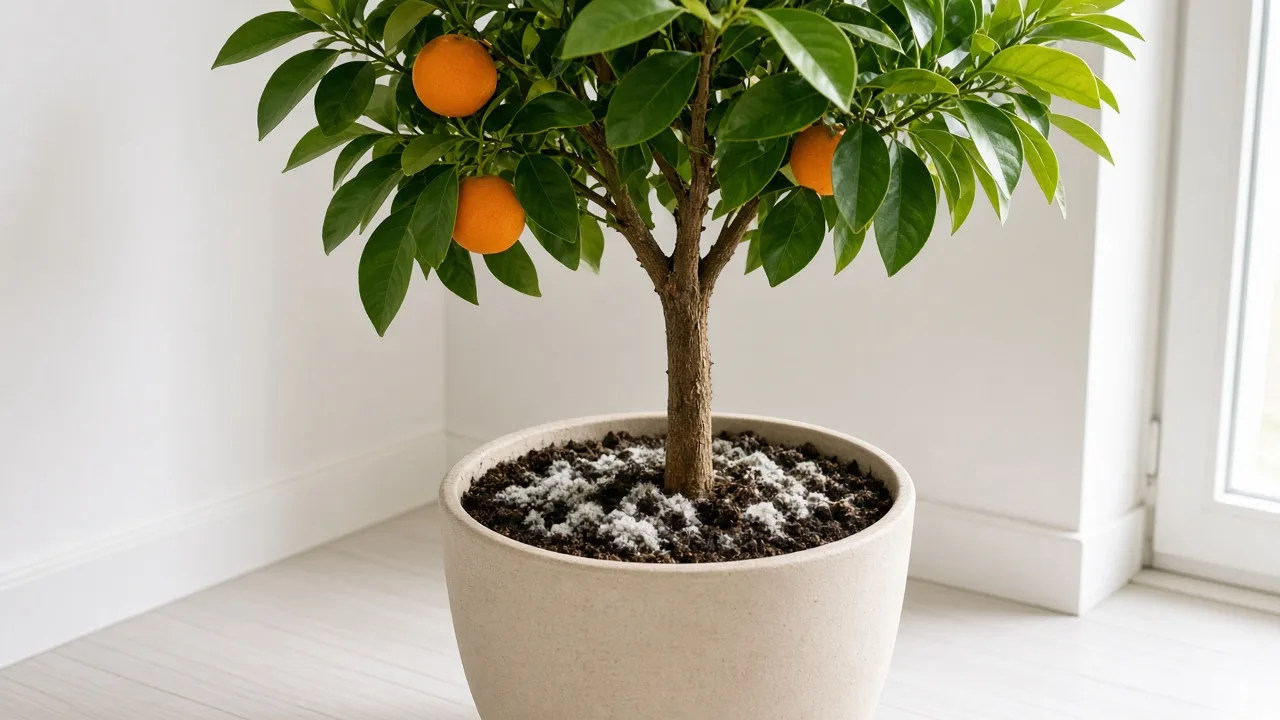
White or pale yellow fuzz on potted orange tree soil is typically a harmless saprophytic fungus decomposing damp organic bark or peat, not a disease infecting the living tree. First, scrape off the top 2–3 cm of colonized soil with a clean spoon or trowel, then withhold irrigation until the upper 3–5 cm dries thoroughly before watering again.
Mold on Soil on Orange Tree: Causes, Checks & Fixes
This guide covers mold on soil on Orange Tree. See also the general Mold on Soil guide, watering, and light pages for this plant.
Mold on Soil on Orange Tree: Causes, Checks & Fixes
Quick answer
Discovering a blanket of white or pale yellow fuzz across the potting mix of your container sweet orange tree (Citrus sinensis) can be alarming, but in most cases, the fungus itself is not attacking your tree. This surface fuzz consists of harmless saprophytic fungi breaking down damp organic matter such as pine bark, peat, and composted leaves within the soil blend. While the fungus feeds only on dead substrate, its presence serves as an unmistakable warning sign: the upper root zone is remaining moist and stagnant for far too long.
First action: gently scrape away the top 2–3 cm of colonized mix using a clean spoon or hand trowel, discard the debris in household trash, and withhold all water until the upper 3–5 cm of soil is completely dry.
This single mechanical cleanup immediately removes the fungal fruiting bodies and breaks the continuous moisture film that fuels spore germination. For the universal biological mechanisms behind container soil fungi, consult our comprehensive mold on soil disease guide. On a potted orange tree, however, successful remediation depends on recognizing the plant’s unique physiology—specifically balancing its heavy demand for bright direct sunlight with a fast-draining, highly porous citrus soil mix that prevents stagnant water from suffocating the fibrous root system.
What mold looks like on orange tree soil
Surface mold on container citrus rarely appears as a uniform sheet; instead, it develops in irregular patches, webbed filaments, or powdery clusters anchored to decaying organic matter. Inspecting the texture, color, and precise location of the growth is essential for making an accurate diagnosis.
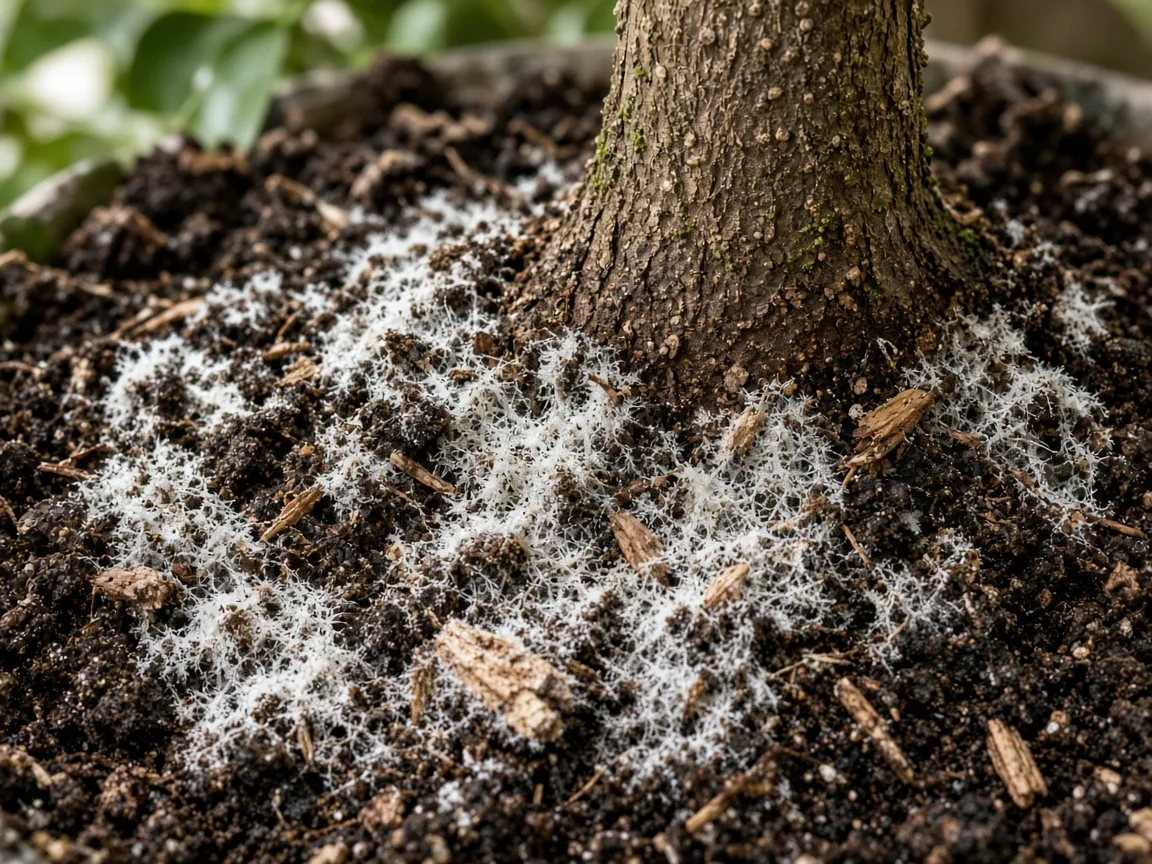
White saprophytic mold threads through damp pine bark and loam particles on the container surface; the trunk flare and root cortex below remain firm and disease-free.
A benign saprophytic colonization on citrus mix exhibits distinct characteristics:
- Cottony or threadlike texture: White, pale gray, or creamy yellow mycelium webbing across organic bark chips and peat moss.
- Surface confinement: The mycelium sits loosely on top of the soil and does not penetrate into the green or woody bark of the orange tree’s trunk flare.
- Debris hotspots: The heaviest fuzz clusters around fallen orange blossoms, discarded citrus fruitlets, or shed leaves resting on the soil surface.
- Earthy scent: The pot smells like fresh forest mulch or damp mushrooms, completely devoid of foul, rotting, or sour sulfur odors.
If the white material does not fit this description, you may be dealing with a completely different problem, such as accumulated fertilizer salts or root-rotting pathogens.
Differentiating saprophytes, Phytophthora, and mineral crust
Gardeners frequently confuse harmless soil mold with two other common container citrus issues: destructive water mold pathogens and mineral salt accumulation. Distinguishing among them is vital because treating a mineral crust with fungicides or ignoring a virulent root pathogen can prove fatal to your tree.
| Observation | Primary Cause | Physical Texture & Scent | Impact on Orange Tree | Required Action |
|---|---|---|---|---|
| White or yellow fuzz on mix | Saprophytic fungi (Peziza, Trichoderma, Coprinellus) | Soft, cottony, delicate threads; smears easily; earthy mushroom smell | None directly; signals slow dry-down | Scrape top 2–3 cm; extend watering interval; increase airflow |
| Chalky, brittle white crust | Soluble fertilizer salts or hard irrigation water | Hard, gritty crystals; adheres to terra cotta rims; odorless | High root-zone EC can burn root tips | Flush pot thoroughly with rainwater or distilled water; review feeding |
| Dark lesions, gummosis, sloughing roots | Soil-borne oomycetes (Phytophthora nicotianae / P. citrophthora) | Water-soaked dark bark; amber gum weeping from trunk; foul, sour smell | Highly lethal; rots fibrous feeder roots and girdles crown | Urgent root wash, surgical root pruning, and repotting in sterile substrate |
Harmless saprophytic fungi
Saprophytic molds are beneficial decomposers in outdoor forest soils. In container citrus cultivation, premium potting blends utilize composted pine bark, peat moss, or coco coir to establish structure and moisture retention. When these carbon-rich materials remain continuously damp in warm indoor rooms or sheltered patios, airborne fungal spores germinate and consume the dead plant debris. According to the University of Maryland Extension, these fungi live strictly as saprophytes, possessing no physiological capability to infect healthy, living citrus root tissue.
Destructive Phytophthora root and foot rot
In contrast, Phytophthora nicotianae and Phytophthora citrophthora are destructive soil-borne oomycetes (water molds) specialized in parasitizing citrus. As detailed by the UC Statewide IPM Program, Phytophthora produces motile swimming zoospores that thrive in saturated, waterlogged container soils. Unlike surface fuzz, Phytophthora attacks subterranean fibrous feeder roots:
- The outer fleshy cortex softens, turns water-soaked brown, and sloughs off effortlessly when pulled between your fingers, leaving behind only the threadlike inner vascular core (stele).
- Infection progressing upward causes foot rot or gummosis at the soil line, where trunk bark cracks, darkens, and weeps sticky amber sap.
- Above ground, the orange tree exhibits vein chlorosis, severe yellowing, and sudden leaf shedding while the potting mix remains wet.
If your orange tree displays these signs, you are not dealing with surface mold—you must immediately follow our Orange Tree root rot guide.
Hard mineral and fertilizer crust
A hard, dry, chalky white or yellowish deposit that cakes across the top layer of mix or coats the rim of terra cotta pots is not a fungus. As explained by Colorado State University Extension, this crust consists of dissolved mineral salts precipitated out of tap water (calcium and magnesium carbonates) combined with unused synthetic citrus fertilizer residues. When water evaporates from the container surface, it leaves these crystalline salts behind. Mineral crust feels gritty rather than soft, does not smear into threadlike fibers, and indicates that the pot requires periodic leaching with clean, low-salt water.
Why container orange trees develop surface mold
Understanding why your potted orange tree developed mold requires looking at the interplay between container physics and citrus biology. Several environmental and cultural factors commonly trigger mold growth:
1. Sluggish winter transpiration and cool indoor transitions
Sweet oranges thrive under the intense radiation of full Mediterranean or subtropical sun, as cataloged by the Missouri Botanical Garden. When gardeners transition container citrus indoors for winter protection, light levels plummet, temperatures cool, and humidity drops. In response, the tree enters a semi-dormant state where root water absorption and stomatal transpiration decrease by more than 70%. If you continue to apply water on a summer calendar schedule, the soil surface remains continuously wet for weeks, creating an ideal microclimate for fungal spore incubation.
2. Dense, moisture-retentive potting media
Citrus roots have exceptionally high oxygen demands. In standard nursery potting soils dominated by fine peat moss or unamended garden loam, micro-pores fill with water and remain saturated. The Royal Horticultural Society stresses that container citrus must be grown in an open, loam-based citrus compost incorporating coarse grit or perlite to maintain aeration and drainage. Heavy, dense soils trap surface water and suffocate root hairs while providing abundant moisture for fungal hyphae.
3. Standing water in cachepots and saucers
Placing a potted orange tree inside a decorative cachepot or deep saucer is convenient, but leaving drained runoff in the basin creates a perched water table. Capillary action wicks water back upward into the root ball, keeping the lower root zone anaerobic and the upper surface permanently humid.
4. Poor room airflow and high local humidity
Stagnant air pockets around dense indoor citrus canopies allow a humid boundary layer to linger over the container rim. Without ambient air movement, moisture cannot evaporate from the top centimeter of soil.
5. Decaying flower blossoms and fruit drops
Orange trees produce heavy flushes of fragrant white blossom, followed by natural thinning where dozens of pea-sized fruitlets drop. When spent petals and fruitlets fall onto the soil, they create nutrient-dense organic debris pockets that fungi colonize almost overnight.
Step-by-step diagnostic inspection
Before applying any treatments, complete this methodical 6-step inspection to confirm the diagnosis:
- Test the surface growth texture: Press a small pinch of the white material between gloved fingers. If it feels fluffy, cottony, or smears like mushroom fuzz, it is fungal mycelium. If it crumbles into gritty, brittle crystals, it is a mineral salt crust.
- Examine the trunk flare and graft union: Clear any mix away from the trunk base. The root flare (where the trunk widens into root tissue) and the graft union must sit proudly above the soil line. Verify that the bark is firm, pale green or brown, and completely free of soft sunken spots or oozing sap.
- Probe moisture at depth: Push a clean wooden chopstick or moisture probe 5–8 cm (2–3 inches) into the root zone. If the stick emerges dark and damp days after watering, the core is drying far too slowly. Cross-reference your routine with our orange tree watering guide.
- Smell the root zone: Lean down and inhale near the drainage holes. A healthy citrus root zone smells richly earthy. A sour, rotten-egg, or swampy odor indicates anaerobic bacterial decay and root suffocation.
- Inspect feeder root vitality: Gently push aside the top 3 cm of mix near the container wall to expose fine fibrous feeder roots. Healthy orange roots are creamy white to golden tan and resist gentle tugging. Mushy, blackened roots that slide apart signal active root rot.
- Check for fungus gnat larvae: Watch the soil surface closely. Small, dark, mosquito-like gnats walking across the mix or taking erratic flight indicate that fungus gnat larvae are feeding on the decaying organic matter and fungal mycelium, as documented by the UC Statewide IPM Program. If present, refer to our Orange Tree fungus gnats guide.
The first fix: scrape, aerate, and reset dry-down
When your inspection confirms harmless saprophytic mold on a vigorous, firm-stemmed orange tree, execute this targeted first fix:
[Isolate & Clean Surface] ➔ [Scrape Top 2–3 cm] ➔ [Improve Air Circulation] ➔ [Dry Down Soil]- Scrape off the visible fungus: Take a clean metal spoon or small garden trowel and scrape away the top 2–3 cm of colonized potting soil. Lift the material directly into a plastic trash bag, taking care not to throw spores into the air. Remove all fallen leaves, petals, and organic clutter from the soil surface.
- Lightly aerate the undisturbed surface: Use a small wooden fork or chopstick to gently loosen the top 1 cm of the remaining soil, breaking up any compacted crust without tearing fibrous roots. This restores oxygen exchange to the upper soil pores.
- Introduce gentle air movement: Position a small oscillating fan 1–2 meters away from your orange tree, directed across the top of the pot. Circulating air accelerates surface evaporation, dries the top soil particles, and prevents stagnant humidity pockets from forming.
- Enforce a strict dry-down cycle: Do not add a single drop of water until the top 3–5 cm (1.5–2 inches) of soil feels dry and crumbly to the touch. Check pot weight by lifting the container edge; water only when the pot feels noticeably lighter.
- Dump all saucer runoff: After every subsequent irrigation, allow the nursery pot to drain completely for 30 minutes, then discard all standing water from the saucer or outer container.
Avoid applying chemical fungicides, household bleach, vinegar, or cinnamon to the soil. Bleach and vinegar severely disrupt soil pH—which for sweet orange must remain strictly slightly acidic at pH 5.5–6.5—damaging delicate root hairs far more than the mold ever could.
Citrus-specific cultural remedies and substrate requirements
Long-term prevention of soil mold requires tailoring the growing medium and seasonal care to the precise biological demands of Citrus sinensis.
Formulating a free-draining citrus substrate
Standard commercial potting mixes contain too much fine peat, which compacts and holds excessive moisture. To prevent mold recurrence and shield roots from hypoxia, repot your orange tree into a dedicated, highly porous mix:
- 60% peat-free loam-based potting compost: Provides essential cation exchange capacity, stable weight, and micronutrient buffering.
- 20% coarse horticultural grit, pumice, or perlite: Creates permanent macro-pores that facilitate rapid gravity drainage and gas exchange.
- 20% fine composted pine bark: Supplies mild organic acidity (maintaining pH between 5.5 and 6.5) and a chunky texture that resists compaction.
Explore complete soil recipes and seasonal amendments in our dedicated orange tree soil guide.
Winter watering and light protocols
The UF/IFAS Citrus Research and Education Center emphasizes that container citrus water demand drops dramatically when light levels and ambient temperatures decline. During autumn and winter:
- Move indoor orange trees to the sunniest south-facing window available, supplementing with a full-spectrum LED grow light for 8–10 hours daily if natural light is insufficient. Review full lighting criteria in our orange tree light guide.
- Shift watering from a time-based schedule to a moisture-based protocol. Always test the top 5 cm of mix before watering.
- Water thoroughly until liquid runs freely from the drainage holes, ensuring full root hydration, but allow a deep dry-down before re-watering.
When surface mold signals destructive Phytophthora root rot
While saprophytic mold is harmless, persistent overwatering can quickly tip the scale toward fatal water mold infections. You must intervene urgently if you observe any of the following escalation triggers:
- Canopy wilt despite wet soil: The tree’s leaves curl inward, lose their glossy sheen, and droop limp while the pot feels heavy and waterlogged. This indicates that dead, rotting roots can no longer transport moisture up to the foliage.
- Lower leaf vein chlorosis: Leaf veins turn yellow while the rest of the blade remains pale green, followed by massive defoliation of mature leaves.
- Trunk base gummosis: Dark brown, soft, or water-soaked bark near the soil line that exudes amber-colored gum.
- Sour, putrid potting soil smell: Anaerobic fermentation occurring in the root zone.
Emergency salvage protocol
If these systemic symptoms emerge alongside soil mold, you must unpot the tree immediately:
- Slide the root ball out of the container and gently wash away the old, infected substrate under lukewarm running water.
- Inspect the root system under bright light. Using bypass pruners sterilized in 70% isopropyl alcohol, prune away all dark, mushy, or hollow roots back to firm, healthy white wood.
- Repot into a clean container with unobstructed drainage holes, using fresh, sterile citrus potting mix.
- Elevate the root flare so that the base of the trunk sits slightly above the surrounding soil level, ensuring trunk bark never remains in contact with damp compost.
- Place the tree in bright, indirect warmth and withhold fertilizer until vigorous new vegetative growth confirms root recovery.
For a comprehensive walkthrough of root surgery and pathogen control, see our detailed orange tree root rot guide and orange tree overwatering guide.
Mistakes to avoid with potted orange trees
Avoid these frequent grower errors that encourage mold growth and harm container citrus:
- Watering on a calendar schedule: Never water because “it’s Sunday.” Always check soil moisture depth and pot weight first.
- Burying the root flare: Piling soil or mulch against the trunk flare traps moisture against thin bark, creating an open pathway for both mold and Phytophthora foot rot.
- Using chemical drenches for surface-only mold: Drenching healthy soil with synthetic fungicides or household chemicals kills beneficial mycorrhizae and alters substrate pH without solving the underlying drainage problem.
- Letting fallen plant debris accumulate: Allowing spent orange blossoms, fruitlets, and leaves to decompose on the soil surface creates continuous food for fungal colonies.
- Overpotting into massive containers: Planting a small orange tree into an oversized tub surrounds the root ball with a vast reservoir of wet, uncolonized mix that takes weeks to dry.
- Fertilizing a stressed tree: Applying nitrogen fertilizer to an orange tree suffering from sluggish roots or moldy soil increases salt stress and burns compromised root hairs.
Related Orange Tree guides
Use this guide when white fuzz or mold is confined strictly to the potting soil surface and your orange tree maintains healthy green foliage and firm stems. When symptoms spread to the canopy, trunk, or roots, cross-reference these specialized guides:
- Orange Tree Care Overview: Comprehensive guide covering sweet orange climate zones, container sizing, and general culture.
- Orange Tree Problems Index: Complete diagnostic directory for all foliage, pest, and root disorders affecting Citrus sinensis.
- Orange Tree Watering Guide: Deep-watering techniques, seasonal volume adjustments, and how to read container weight.
- Orange Tree Soil Guide: Substrate blending, perlite-to-loam ratios, and managing target pH (5.5–6.5).
- Orange Tree Light Guide: Direct sunlight hours, indoor grow light supplementation, and photoperiod management.
- Orange Tree Root Rot Guide: Step-by-step salvage protocols for trees suffering from Phytophthora and waterlogged root collapse.
- Orange Tree Overwatering Guide: Diagnosing edema, leaf drop, and water stress before permanent root loss occurs.
- Orange Tree Fungus Gnats Guide: Eliminating fungus gnat infestations breeding in damp citrus soil.
Related tool
Water management is the single most critical factor in keeping citrus roots healthy and soil surfaces free of opportunistic fungal growth.
Use our Citrus Watering Calculator to calculate exact irrigation volumes and dry-down intervals for your potted orange tree based on container diameter, potting substrate composition, room temperature, and seasonal light exposure.
Conclusion
Surface mold on potted orange tree soil is not an incurable disease or an immediate death sentence; it is a visible diagnostic indicator that the potting surface is staying moist for too long. By scraping away the visible fungal growth, clearing fallen blossoms, establishing a proper dry-down cycle, and ensuring your tree grows in an open, gritty citrus mix, you can easily restore an aerobic root environment. Keep your orange tree in abundant direct sunlight, circulate the air, and allow the upper soil to breathe—your sweet orange tree will reward you with glossy foliage, fragrant blossoms, and bountiful fruit.