How to Garden on a Slope: 12 Hillside Landscaping Ideas
Garden on a slope without losing soil: 12 hillside landscaping ideas for retaining walls, terraces, groundcovers, rock gardens, and low-maintenance plants—plus slope math and drainage rules.
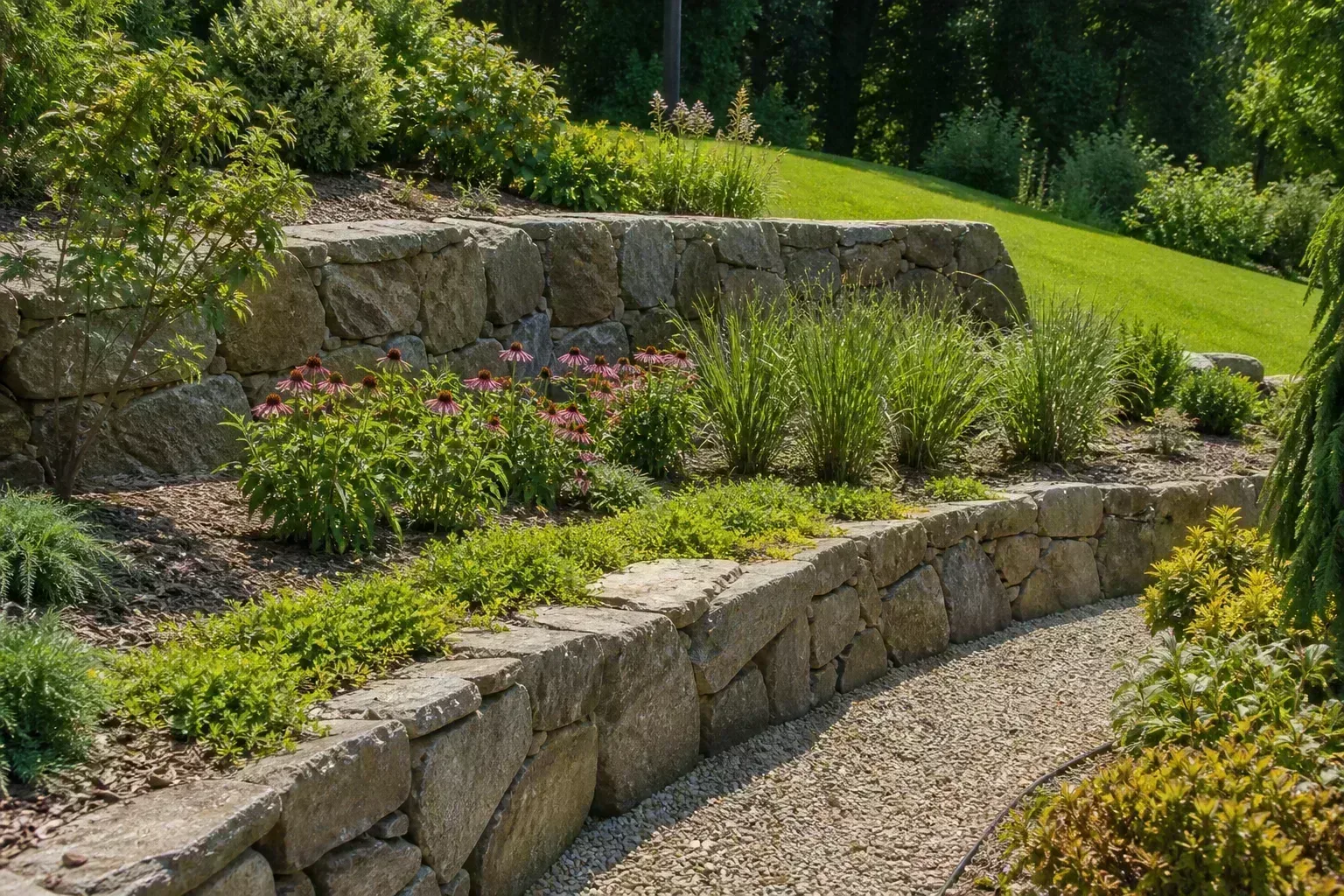
A sloped yard is not a flat garden tilted sideways. Water accelerates downhill, topsoil travels with it, and every planting decision either slows that movement or feeds it. The good news: hillsides also give you elevation, views, and microclimates stone walls and south-facing terraces can exploit. The job is to match the grade, drainage, and access you actually have to ideas that stabilize soil first and look beautiful second.
Measure your slope before you choose a design
Walk the incline after a rain if you can. Note where soil collects, where mulch washed away, and whether water sheets off the surface or cuts channels. Photograph those spots; they tell you more than a mood board.
Then measure grade. On a 10-foot run, measure the vertical rise in inches and divide by 120 (10 feet × 12 inches). Multiply by 100 for slope percentage. A 12-inch rise over 10 feet is a 10% slope—manageable for many groundcovers and shrubs with good establishment watering. Past about 25–33% (roughly 14–18 degrees), terracing, retaining structures, or engineered solutions become realistic rather than optional. Above 45–50%, treat walls and steps as structural work and confirm local permit thresholds before you dig.
Mark sun at three times of day. South- and west-facing slopes bake and dry fast; north slopes stay cooler and favor shade plants. Note how you will haul soil, stone, and plants—hand-carrying changes budgets and phasing.
Sketch a simple site plan: house footprint, driveway, utility lines, existing trees you will keep, and the direction water leaves the property. Slopes that drain toward a foundation need different solutions than slopes that shed water to a wooded ravine. A quick plan prevents planting the prettiest idea in the wettest or most dangerous spot.
Slope percentage, steepness, and when to stop DIY
Use this quick decision ladder:
- Under 15%: Groundcovers, shrubs, and phased planting boxes often suffice without major walls.
- 15–33%: Terraces, timber or stone walls, and rock anchors become worth the investment.
- Over 33%: Plan retaining structures, steps, and professional review; planting alone will not hold soil through heavy rain.
The RHS guide to landscaping a slope emphasizes working with the natural contour rather than fighting it—sound advice that still requires you to know how steep “it” is before picking plants.
Stop erosion and slow water before you plant
Planting into an actively eroding face wastes money. Roots need stable soil long enough to knit the surface. Slow water first with one or more of these: contour planting rows on the level (not straight up and down), short check logs or rock dams across flow lines, heavy mulch held by jute netting, or permanent terraces.
Retaining walls are the long-term fix on steeper grades, but a wall without drainage becomes a dam. Water pressure behind the face—hydrostatic pressure—pushes walls forward regardless of how handsome the stone looks. Proper builds include gravel backfill, filter fabric, and a perforated drain line daylighting to a lower point. USDA NRCS slope-stability guidance treats vegetation and structure together; copy that mindset on your lot.
Drainage behind walls and check structures
On any wall over about 3–4 feet, verify permit and engineering rules in your municipality—thresholds vary. Two shorter terraced walls often solve the same grade change more safely than one tall wall. Behind each wall: drain tile, clean gravel, and an outlet that does not flood a neighbor’s patio.
For gentler slopes, a dry creek bed in the main flow path can move stormwater without eroding soil. Line the channel with varied river rock, widen curves, and plant tough grasses on the banks. It is drainage infrastructure that reads as garden.
If the slope is long but not vertical, combine tactics: jute netting and mulch at the top where velocity is highest, shrubs with deep roots in the middle third, and a rock-lined swale at the toe where water collects. One method rarely solves an entire watershed on its own.
Idea 1: Tiered retaining walls for usable flat space
Best for: Steep front or back slopes where you need level seating, paths, or planting beds.
Stacked timber, concrete block, or mortared stone walls create flat tiers you can actually work on. Stagger wall heights so each terrace is wide enough for a path plus soil depth—18–24 inches minimum for shrubs, deeper for small trees. Tie tiers into steps so you are not scrambling sideways on loose soil.
Budget for invisible work: footing depth, drainage aggregate, and geogrid on tall walls. A cheap wall that leans after the second spring thaw costs more than doing drainage once. If the slope faces the house, also plan where roof runoff lands; gutters and downspout extensions belong in the same conversation.
Match wall material to context: timber sleepers suit informal woodland edges; mortared stone fits traditional homes; concrete block with veneer handles tall engineered walls. Seat walls on the upper terrace add function—wide caps at 18–20 inches make comfortable perches without a separate bench line item.
Idea 2: Terraced vegetable rows on a sunny hillside
Best for: South- or west-facing slopes with at least six hours of sun and access for a hose or drip line.
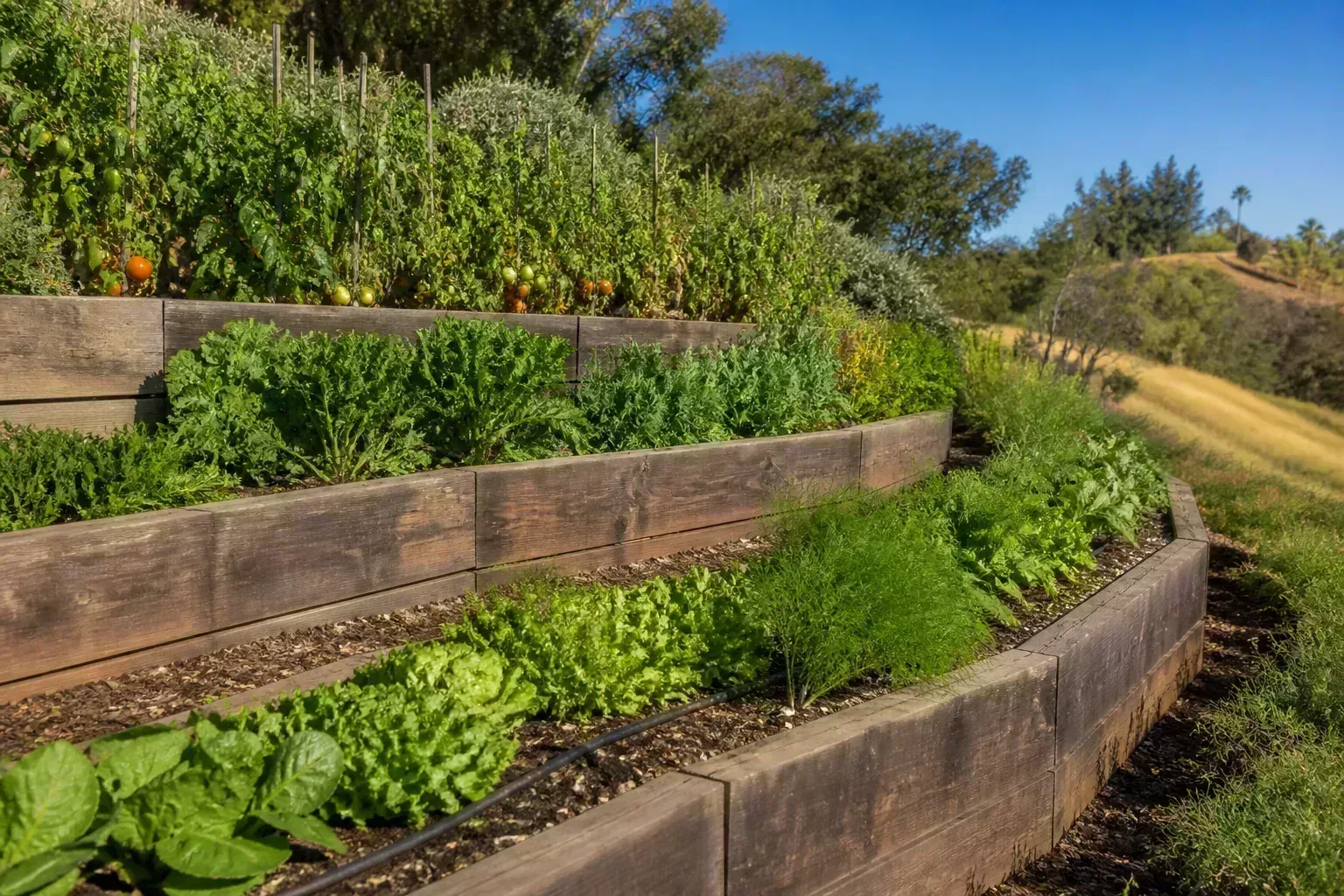
Terracing turns elevation into an advantage: each row gets direct light without the row above shading it. Pacific Horticulture has documented west-coast examples where flowers at the trellis line sit at eye level along the path—smart use of height ordinary flat beds cannot match.
Build level beds across the contour, not pointed uphill. Leave 18–24-inch paths between rows for harvest and wheelbarrows. Drip irrigation with timers beats overhead spray on inclines; spray runs off before it soaks in. Start with deep-rooted crops and mulch between plants until canopies close. If sun is marginal, pair this idea with shade-tolerant crops from our vegetables without full sun guide.
Trellis peas, beans, or cucumbers on the uphill side of a path so vines do not shade the row below. Rotate crops by tier if soil fertility differs—upper beds often dry faster and may need more compost. A small tool cache or hose bib halfway down the hill saves daily frustration once the garden is producing.
Idea 3: Groundcover carpets on gentle berms
Best for: Slopes under about 20% linking lawn to woodland, or berms along driveways.
Low mats of roots knit the surface: creeping phlox, sedum, creeping thyme, and hardy geraniums on sunny berms; vinca and sweet woodruff only where you truly want them contained. On slightly steeper grades, creeping juniper gives evergreen erosion control with minimal mowing—see it as living mulch with weight.
Plant in staggered grids, peg jute erosion cloth first, and water on a cycle-and-soak schedule until edges meet. White and pastel flowers keep a woodland edge feeling cool; variegated foliage extends interest after bloom. Avoid expecting groundcover to fix a 30% gully alone.

Idea 4: Anchor boulders and natural rock gardens
Best for: Rocky slopes where topsoil is thin and formal terraces would look out of place.
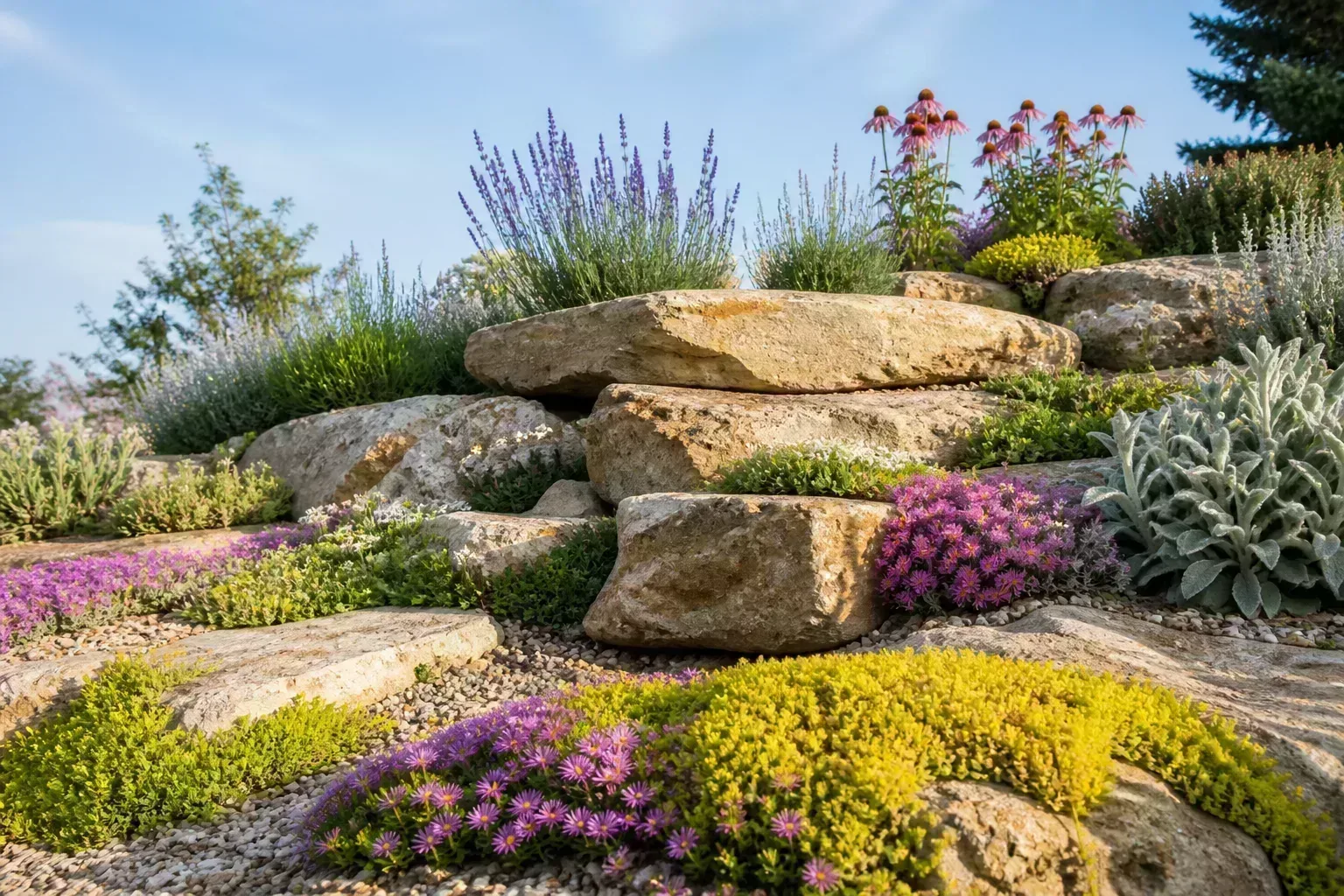
Set large stones one-third buried, clustered in groups of odd numbers, with pockets of amended soil between. Plant tough alpines, sedums, and small grasses into those pockets. Water gently and frequently the first season; bare rock plus spray irrigation equals runoff.
Let placement look accidental: varied sizes, some stones half-buried, gravel mulch in the gaps. Weed the first two years; after that, spreading plants do the maintenance. This pairs naturally with Idea 9 below on scree-heavy sites.
Idea 5: Shade woodland planting on creek banks
Best for: North slopes, wooded hillsides, and damp pockets near seasonal runoff.
Thin lower tree limbs for light and air (“limb up”), then underplant with hostas, astilbe, foamflower, and ferns. Both hostas and astilbe tolerate poor bank soil once established and spread by division—an economical way to cover ground. Our hosta companion planting guide and astilbe companions cover pairings that keep shade beds interesting without constant division.
Leave a buffer unmowed near water if regulations apply. Do not strip understory completely; roots and duff stabilize banks as much as showy perennials do.
Idea 6: Dry-stack stone terraces
Best for: Permanent terraces in stone-rich regions where you want craft and heat-holding microclimate.
Dry-laid stone terraces breathe and drain better than solid poured walls when built correctly. Each course should lean slightly into the hill (batter), with through-stones tying faces together. Wide terraces (4 feet or more) let you work comfortably and give roots depth.
Stone warms early in spring and holds heat at night—use that to grow marginally tender plants that fail on flat open ground. Cap walls wide enough to sit on and you gain seating without a separate hardscape line item.
Idea 7: Patio-level planting boxes you build in phases
Best for: Very steep hillsides where the only practical work zone is near the house—or budgets that cannot terrace the whole slope at once.
Build raised boxes at the patio edge first. Each box is a small retaining structure: level footprint, drainage holes, and rot-resistant lumber or stone. You get a garden room for dining and herbs while the upper slope waits.
Phase upward one terrace per year if access is hard. Machinery that cannot reach the site means hand-carrying soil and block—plan smaller boxes rather than one heroic wall. Our professional garden design basics help you align paths and sight lines before you commit lumber.
Idea 8: Prairie and ornamental grass slopes
Best for: Sunny slopes where you want seasonal movement, pollinators, and no mowing.
Switchgrass, little bluestem, prairie dropseed, and ornamental miscanthus (where not invasive in your region) form deep root systems that hold soil. Mix in purple coneflower and black-eyed Susan for color; leave seed heads standing for winter structure.
Do not sow turf on a real grade. Mowing sideways is dangerous; shallow grass roots fail on steep faces. If you want green, choose a low-growing grass species suited to slopes in your region, skip weekly mowing, or terrace a small flat lawn pad and plant the rest in prairie.

Idea 9: Alpine scree gardens on rocky hillsides
Best for: Slopes that are already rock and gravel with little topsoil.
Work with existing stone: reposition slabs for steps and planting ledges, tuck hypertufa troughs into pockets, and mulch with pea gravel to limit runoff. Large evergreens at the top anchor the composition visually and physically.
Allow self-sowers like corydalis to fill gaps. Gravel mulch unifies color and keeps crowns dry—critical on inclines where wet crowns rot. This is a low-water, high-character choice that looks intentional when rock is already the dominant material.
Idea 10: Stepping-stone walks through flowers
Best for: Moderate slopes where you need a path and want immersion in planting.
Terrace only the walk; leave planting beds slightly higher or lower for drama. Use broad, rough-textured stepping stones with minimal rise per step. Flank with exuberant perennials and a few elevated containers on the lowest levels for focal points passersby can see from the street.
Plan the path where foot traffic will actually go—fighting desire lines uphill fails quickly. Our perennial flower garden layout guide helps sequence heights so tall plants do not flop across stones.
Idea 11: Four-season shrub banks and roadside slopes
Best for: Front slopes visible from the road, hell-strip grades, and areas you do not want to replant yearly.
Mass shrubs with multi-season interest: summersweet for summer bloom and golden fall color, California lilac where hardy, prostrate rosemary on warm dry banks, and native sumac or viburnum where appropriate. Evergreen backbone at the top, lower perennials in front so sight lines stay open.
Shrubs need less division than perennials and resist washout once rooted. Prune lightly in late winter, refresh mulch in spring, and skip high-nitrogen fertilizer that pushes soft top growth weak on slopes.
On roadside hell strips, choose plants that stay under window height without constant shearing. Leave a low strip of gravel or pavers at the curb so snow plows and car doors do not crush branches. Evergreen structure at the back, flowering layers in front, and mulch renewed in spring keeps the bank tidy from the street.
Idea 12: Borrowed hillside views and woodland edges
Best for: Slopes that continue beyond your property line or taper into natural woodland.
You do not have to own the whole hill to benefit from it. Limb up neighboring trees you are allowed to touch, underplant your edge with woodland species, and frame views toward a focal point—bench, gate, or window. Lower plants near the house; taller texture farther out creates depth.
This is the lowest-earthmoving option and pairs well with Ideas 5 and 3 at the transition from tended garden to wild slope. Respect property lines and utility easements before cutting.
Best low-maintenance plants for hillside gardens
Group plants by job:
Erosion anchors (roots first): Shrubs, ornamental grasses, prairie perennials, creeping juniper, massed sedum, and deep-rooted natives chosen for your USDA zone.
Shade stabilizers: Hosta, astilbe, ferns, foamflower, and sedges in damp shade.
Sun groundcovers: Creeping phlox, thyme, hardy geranium, ice plant where hardy, and low sedums.
Avoid on steep faces: Annual-only color, shallow-rooted turf, large-leaf plants in wind corridors, and anything that needs frequent division on a grade you cannot comfortably kneel on.
Match plant to moisture as rigorously as slope. A dry south slope wants lavender, rosemary, and sedum; a seepy north bank wants ferns and astilbe—not the other way around.
When buying, favor small plugs or landscape plugs over large containers on steep sites—they are easier to carry and establish faster per dollar. Space closer than flat beds the first year so roots meet quickly; you can thin later once erosion risk drops.
Watering, mulch, and establishment on inclines
New slope plantings fail in the first dry week when irrigation runs off. Water short cycles with soak pauses so moisture penetrates instead of racing downhill. Drip lines along contours outperform overhead spray on anything past a gentle berm.
Mulch choice matters. Fine bark floats in heavy rain; shredded hardwood knits better, and gravel or stone mulch belongs in flow paths. Hold loose mulch with jute netting until plants cover at least 70% of bare soil. Our mulch guide explains depth and placement—on slopes, err slightly lighter on the upper edge and heavier in channels where water concentrates.
Expect two full growing seasons before you judge success. First-year wilting on a slope is often drought, not disease. Second-year spread means roots have locked soil. After that, shift to infrequent deep watering for trees and shrubs, and lean on mulch rather than constant feeding.
Conclusion
Hillside landscaping ideas only work when they respect physics: measure the grade, slow water, build drainage into walls, and choose plants for root depth and sun—not just flower color. The twelve approaches here span structural terraces, edible rows, groundcover carpets, rock gardens, woodland edges, and borrowed views. Pick one or two that match your slope angle and budget, phase the rest, and stabilize soil before you decorate. Done that way, the incline stops being the problem yard and becomes the reason your garden has depth, views, and year-round structure worth maintaining.



