How to Grow and Care for Philodendron Dark Lord
Grow a healthy Philodendron Dark Lord with bright filtered light, an airy mix, root-zone watering, a stable support, and clear troubleshooting steps.
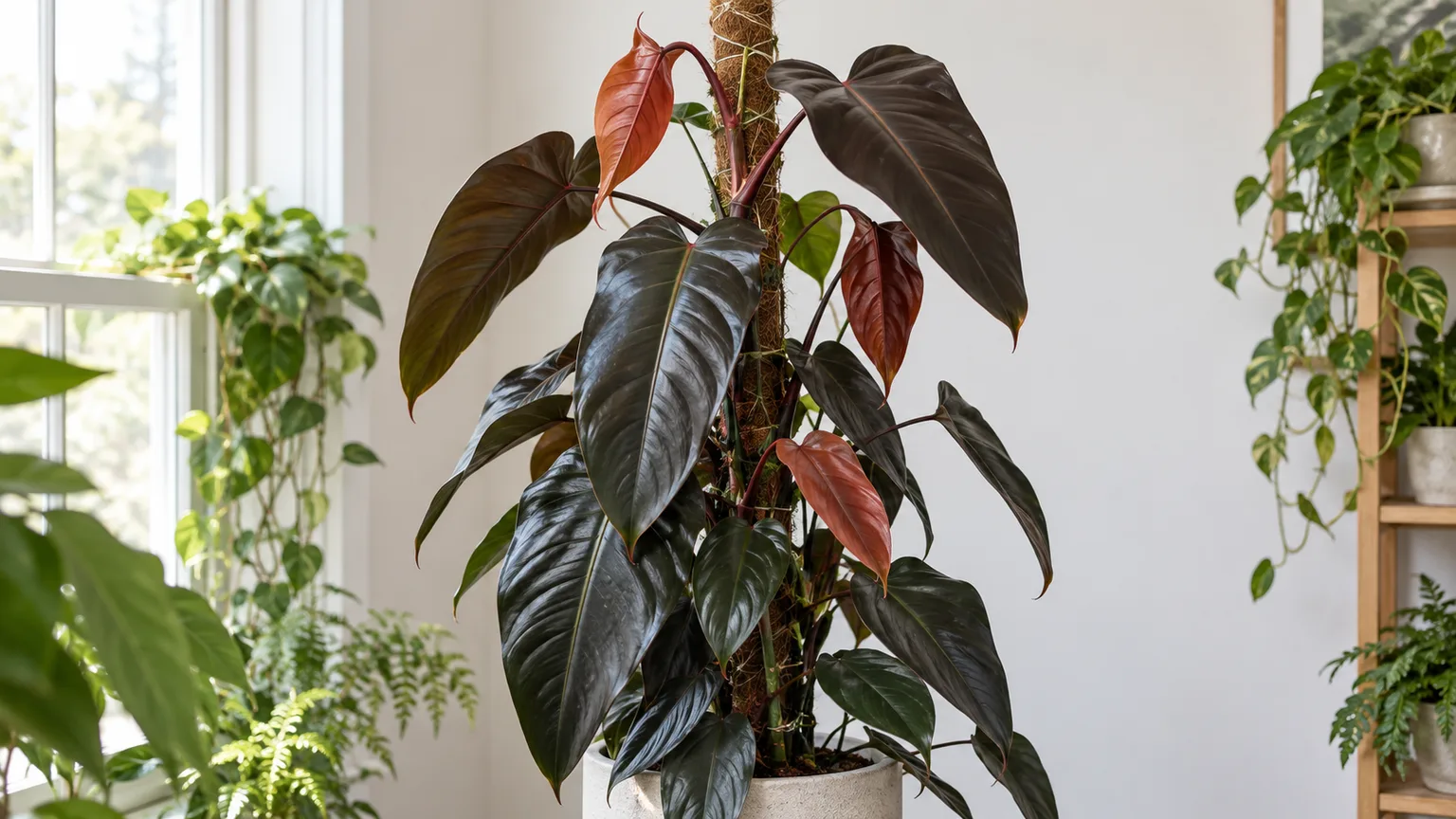
Philodendron Dark Lord earns its name from long, dramatic leaves that deepen from coppery or burgundy new growth to dark green, nearly black foliage as they mature. The plant is a climbing tropical aroid, so it looks best when it has enough light to make sturdy growth and a support that lets its stem climb instead of sprawling across a shelf.
The care is less mysterious than the name suggests. Give it bright, indirect light, an airy mix that drains, and a thorough drink only after the root ball has begun to dry. Then adjust for the conditions you actually have: a small plastic pot in a dim room dries much more slowly than a mature plant in a bright spot, while a moss pole and warm active growth can increase water use. Treat the schedule as a response to the plant, not a promise that it needs water every seven days.
What makes a Dark Lord philodendron different?
Dark Lord is a cultivated houseplant name, commonly sold with the botanical label Philodendron erubescens ‘Dark Lord.’ The label is useful as a starting point, but rare-plant trade names can be inconsistent, and a seller’s name does not prove a precise hybrid pedigree. What matters for day-to-day care is the plant’s climbing habit and the way its foliage changes as each leaf opens and hardens.
NC State Extension describes P. erubescens as a climbing tropical perennial with red-toned stems and foliage, and notes that the species can be grown indoors on a moss pole or trellis. Its species profile also cautions that leaf shape and color vary among plants, so do not diagnose a Dark Lord by comparing every leaf with a single photograph (NC State Extension’s P. erubescens profile). A new leaf that emerges copper or wine-colored and later darkens is part of the display; a leaf that turns yellow, collapses, or develops enlarging spots needs a closer look.
Indoors, the plant’s eventual size is a product of light, root space, support, and pruning. A strong climber can take up vertical room and produce larger leaves when the stem is allowed to mature, but there is no dependable one-size mature height for every cultivar and home. Decide whether you want a trained vertical specimen or a shorter plant with occasional cuts before choosing a location and support.
Give it bright, indirect light
Place Dark Lord near a bright window where the leaves receive abundant daylight without sitting for hours in harsh sun. Gentle morning sun can be tolerated in some rooms, but strong midday or afternoon rays through glass can scorch leaves, especially after a plant has spent weeks in lower light. If the only bright location has direct sun, use a sheer curtain or pull the pot back from the glass and watch the newest leaves for burn.
Light affects more than survival. In a dim corner, the stem may stretch between leaves, growth may slow, and the foliage can look less saturated. Gardening Know How also notes that long gaps between leaves are a useful low-light clue on philodendrons (Gardening Know How’s philodendron care guide). Move a dim plant in stages over several days rather than moving it from a dark room to direct sun in one step; sudden exposure can damage leaves before the plant adjusts.
If the window is bright but the plant still leans, rotate the pot a quarter turn every week or two. A simple grow light can help in a low-light room, but it does not compensate for cold drafts or wet soil. Judge success by new growth: compact spacing, firm leaves, and a stem that does not keep reaching toward the window are better signals than a fixed number of hours on a label.
Choose a loose, draining soil mix
Dark Lord likes moisture around its roots, but its roots also need air. A dense potting mix that stays heavy for days can suffocate the root zone and make a watering routine fail even if you use a small amount of water. Choose a mix that holds some moisture after irrigation yet releases excess water freely through a pot with open drainage holes.
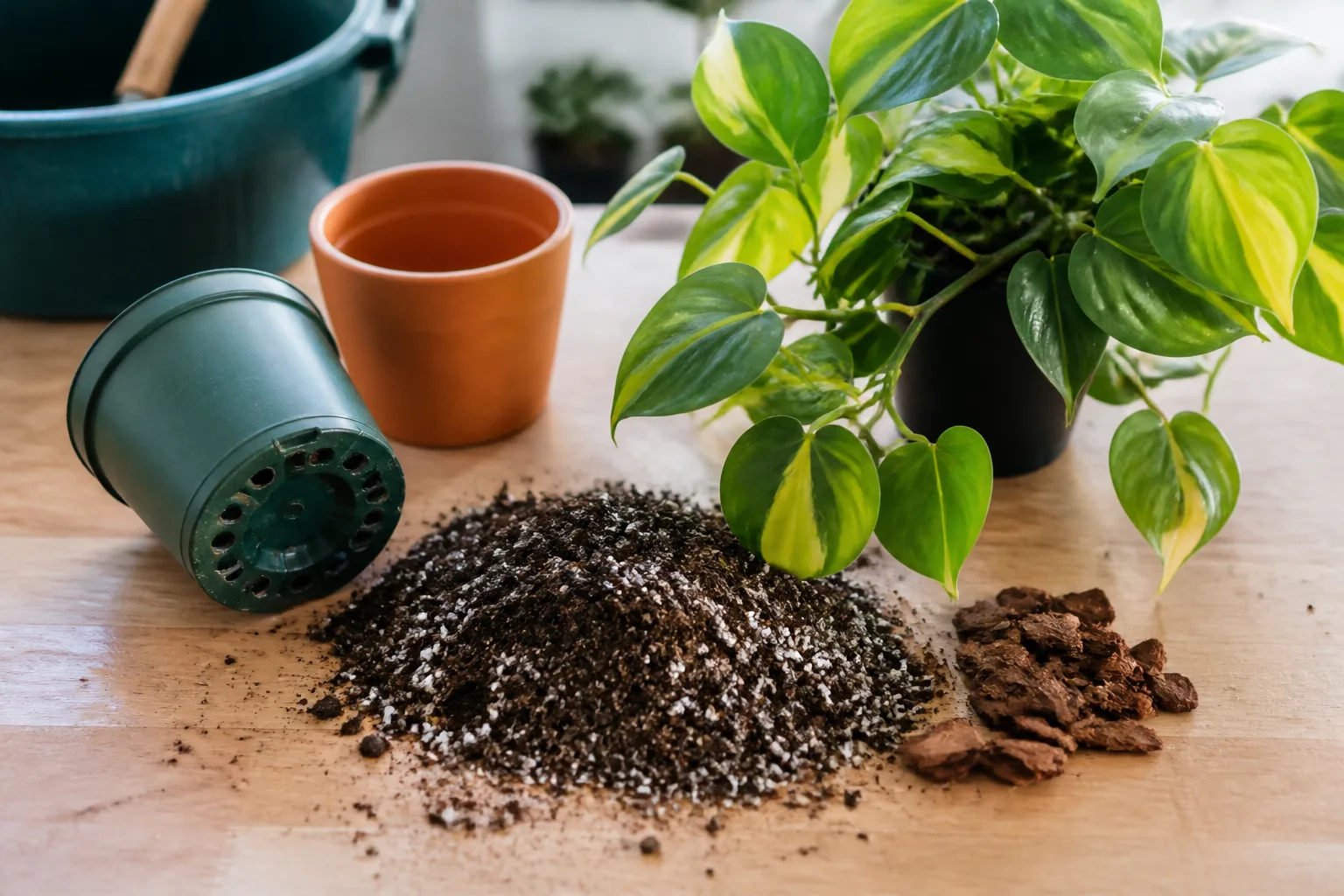
The image shows a different philodendron, but the setup principle is the same: use a mix with visible structure and a container that can drain. Epic Gardening’s general philodendron guidance likewise recommends a rich, airy medium and a pot with drainage rather than a waterlogged root zone (Epic Gardening’s heartleaf philodendron guide).
Build an aroid mix that stays open
An easy starting mix is two parts indoor potting mix, one part orchid bark, and one part perlite or pumice. The potting mix retains usable moisture, bark creates larger air spaces, and perlite or pumice helps keep the blend from packing down. If your room is hot and the mix dries very quickly, use a little more potting mix; if it stays wet for too long, use more bark or mineral aeration and check that the pot is not oversized.
You do not need a complicated recipe or a bag labeled “aroid” to grow this plant. What you need is a consistent, open texture and a pot that is only modestly larger than the root ball. Avoid adding a thick layer of stones to the bottom; it does not fix a compact mix and can leave the wettest layer right where the roots sit.
Water when the root ball begins to dry
Watering frequency changes with light, temperature, pot material, mix, and season. Instead of watering every week, check the soil an inch or two below the surface and feel the pot’s weight. When the upper mix has dried and the root ball is approaching dryness, water slowly until excess runs from the drainage holes, then empty the saucer or cachepot so the roots are not left standing in runoff.
The top can feel dry while the center of a large pot remains wet. Check near the root ball, not just the edge of the container, and use a wooden skewer or a finger if the mix is too deep to judge from the surface. A small plant in a nursery pot may need checking every few days in warm weather; a larger plant in a cool, dim room may remain moist much longer. Neither observation establishes a universal interval.
Philodendron guidance from NC State Extension describes the genus as preferring moist but well-drained soil and identifies overwatering as a root-rot risk (NC State Extension’s Philodendron profile). Gardening Know How recommends checking that the upper inch of mix has dried before watering a potted philodendron; use that as a practical starting point, then adjust for your pot and conditions. In winter, slower growth and lower light often stretch the time between drinks, but a warm, bright room or active grow light can keep a plant growing.
If the soil is still damp, do not add a small “splash” just because the surface looks pale. Wait, improve airflow if the room is stagnant, and check the drainage holes. If the soil has pulled away from the pot and water runs down the sides without wetting the root ball, soak the pot briefly in a basin, then let it drain completely. Repeated wilt in wet soil is not a cue for more water; inspect roots and substrate instead.
Keep it warm and adjust humidity thoughtfully
Keep the plant in a room that stays comfortably warm and away from cold window glass, exterior doors, and air-conditioning vents. NC State’s P. erubescens profile gives 65 to 85°F as a preferred temperature range and advises protecting it from cold drafts. The exact response to a brief temperature dip depends on duration and plant condition, but prolonged chill plus wet soil is a poor combination for tropical roots.
Average home humidity is often adequate if the plant is growing steadily and its leaves open without persistent crispy edges. Higher humidity can help a climbing tropical plant look its best, especially in a heated or air-conditioned room, but raising humidity is not the first fix for every brown tip. Check soil moisture, direct sun, fertilizer buildup, and drafts before buying a humidifier.
A room humidifier is more reliable than misting because it can raise ambient humidity for longer than a spray of water on the leaves. Keep air moving gently around the plant and avoid a damp, stagnant corner; moisture sitting on foliage for long periods can encourage leaf spotting. A small hygrometer can tell you whether the room is actually dry, which is more useful than guessing from the calendar.
Train the climbing stem on a support
Dark Lord is not a self-heading rosette; its stem extends and forms nodes with aerial roots that can attach to a support. A pole or trellis keeps the plant upright, makes its direction of growth easier to manage, and can help mature climbing foliage develop. Support is optional if you want a trailing or sprawling specimen, but that choice requires more horizontal space and may make the vine harder to display neatly.
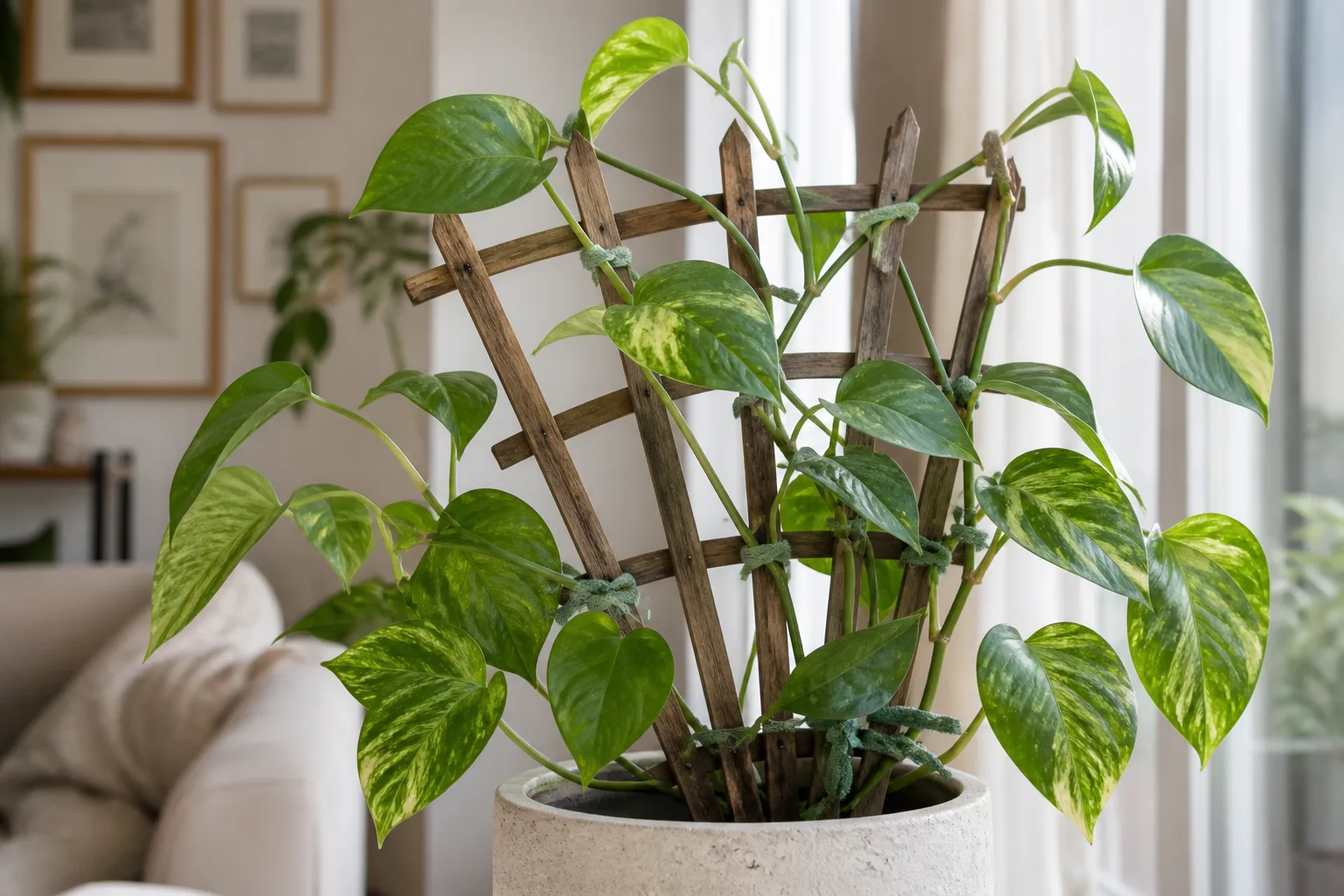
This example shows another vining aroid on a trellis; the useful detail is the loose attachment, not the leaf pattern. NC State confirms that P. erubescens can climb a moss pole or trellis indoors. Set the support close to the stem, then secure the vine with soft plant tape or a loose tie that will not cut into a thickening stem. Guide aerial roots toward the support without forcing them into place.
Choose a moss pole or trellis for your goal
A moss pole gives aerial roots a surface to grip and, if kept lightly moist, can imitate the humid support a climbing aroid encounters in nature. That can be useful when you want a vertical plant and are willing to maintain the pole. A dry coir pole or decorative stake offers structure but may not support the same root attachment; the plant can still climb if you tie it as it grows.
A trellis is simpler to keep dry and can spread stems across a wider shape. It is a good option if you want to avoid maintaining a damp pole or if the room is humid enough that the plant does not need a moist support. Pick a support that fits the plant now but can be extended later, and install a sturdy one before the vine becomes too heavy to reposition safely.
If you are comparing support styles for a larger collection, the moss pole versus trellis guide explains how each changes attachment and maintenance.
Feed during active growth without overdoing it
During active spring and summer growth, a balanced liquid houseplant fertilizer can support new leaves. Start at the label rate or a conservative dilution for container plants, apply to already moist mix, and follow the product directions; an exact “weekly” or “monthly” dose is not appropriate for every formula. If growth has stalled because the room is too dark, roots are stressed, or the plant is cold, fertilizer will not solve the underlying problem.
Reduce or pause feeding when growth slows in a cool or dim season. Salt buildup can show as a pale crust on the mix or pot rim, while damaged roots can make leaves yellow even when nutrients are present. If you suspect excess fertilizer, flush the mix thoroughly with clean water only if it drains well, then wait for the plant to resume active growth before feeding again. Never add a stronger dose to compensate for a missed application.
Repot when the roots need room
Repot when roots circle the root ball, emerge from drainage holes, or the mix dries unusually fast despite normal light and temperature. A plant with one root peeking out of a hole does not necessarily need a new pot immediately; check how much of the root mass is occupying the container and whether water still passes through the mix. Frequent wilting can have other causes, so inspect the root zone before treating it as proof of a too-small pot.
Move up only one pot size, ideally into a container about an inch or two wider than the existing root ball. A huge pot holds more wet mix than the plant can use, which increases the risk of root stress. Keep the stem at its previous soil depth, loosen only tightly circling roots, backfill with fresh airy mix, and water once to settle it. Avoid fertilizing immediately after repotting if the fresh mix already contains nutrients or the roots were disturbed.
Spring or early summer is convenient because active growth helps the plant recover, but a root problem should not wait for a preferred season. If you find soft, dark roots or a sour smell, remove damaged material with clean tools, discard waterlogged mix, and repot into a clean container with drainage. Afterward, keep conditions warm and bright, then wait until the mix begins to dry before watering again.
Prune for shape and healthy cuttings
Routine pruning is not needed to keep the plant alive, but a long vine can be shortened, trained, or divided into cuttings. Use clean, sharp shears and make each cut just above a node on the portion you want to keep; a dormant node below the cut may branch when growth resumes. Remove dead or badly damaged leaves at the base of their petiole rather than stripping healthy leaves to force a new shape.
Wear gloves if the sap irritates your skin, and keep cut stems away from pets and children. Wash hands and tools after pruning; avoid touching eyes while handling fresh cuts. NC State lists Philodendron as having poison characteristics, and Poison Control explains that philodendron tissues contain calcium oxalate crystals that can irritate the mouth and skin (Poison Control’s philodendron guidance).
Do not remove most of the foliage in one session just because the plant is leggy. Correct the light first, then prune gradually so the remaining leaves can support recovery. Healthy cut sections with nodes can become new plants, which makes spring or summer pruning useful when the plant is actively growing.
Propagate from a healthy node
The most dependable home method is a stem cutting with at least one visible node. A node is the point where a leaf and often an aerial root emerge; a leaf without a node cannot grow into a new vine. Select a healthy stem, use a disinfected blade, and cut just below the node so the piece retains that growing point and at least one healthy leaf.
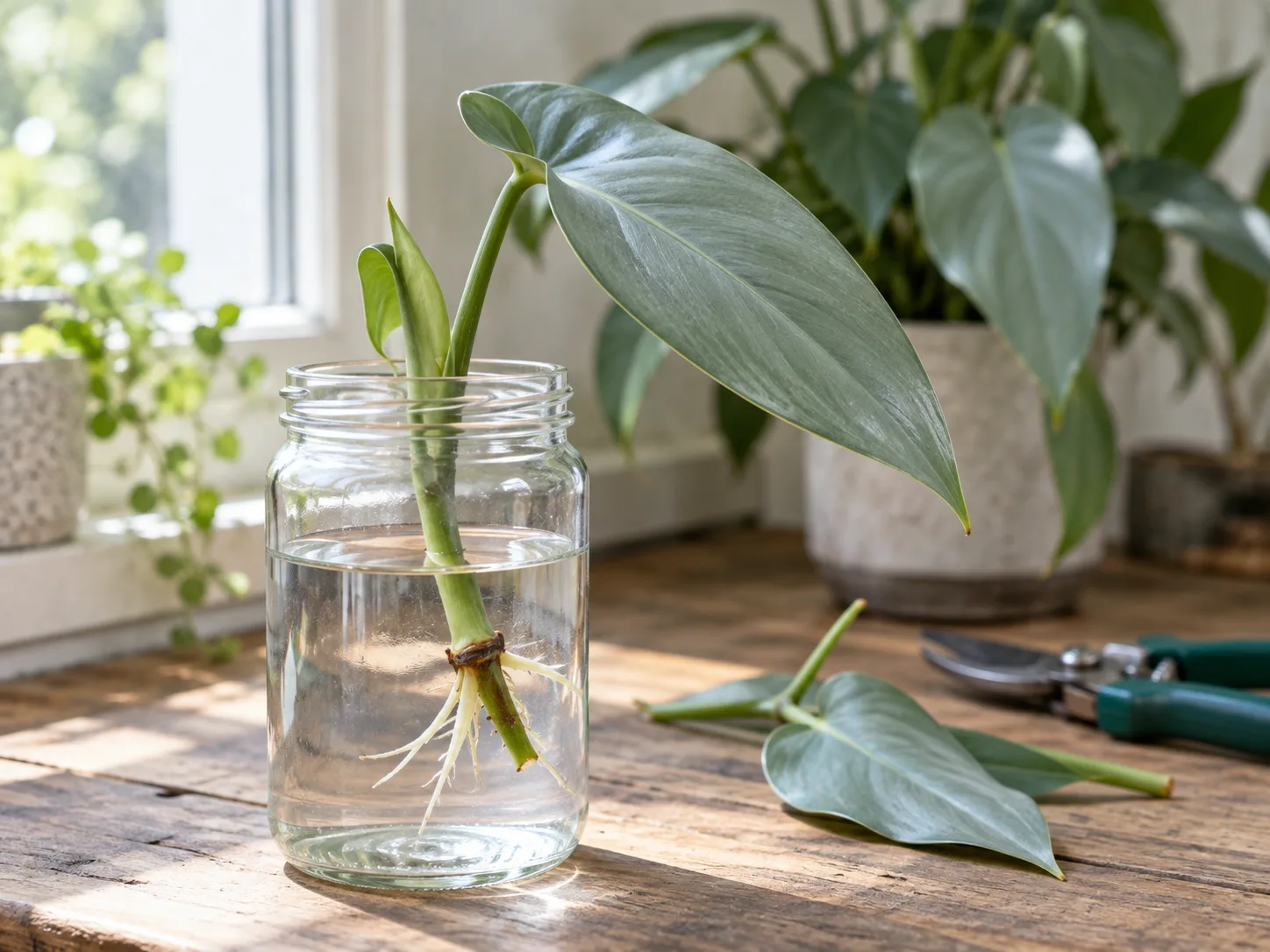
The photo shows a different climbing philodendron, but the propagation checkpoint is the same: keep the node in contact with the rooting medium and the leaf above it. Epic Gardening’s propagation guide similarly emphasizes choosing a node and keeping submerged leaves out of water so they do not rot (Epic Gardening’s philodendron propagation guide).
Root the cutting in water or potting mix
For water rooting, place the node below the waterline and keep all leaves above it. Set the jar in warm, bright indirect light, change the water when it becomes cloudy, and watch the stem for soft or dark tissue. When a healthy root system has formed, pot the cutting in a small container of airy mix and keep it lightly moist while it adjusts; roots grown in water need time to adapt to the different balance of air and moisture in potting mix.
For a soil start, place the node in moist—not saturated—propagation mix and keep the container warm in bright indirect light. A clear cover can slow moisture loss, but open it periodically and remove it if condensation is constant or mold appears. Soil rooting can be less visually obvious than water rooting, so resist pulling the cutting up to check it. In either method, warmth and a healthy node matter more than taking a large cutting.
Diagnose yellow leaves, brown marks, and slow growth
Look at the pattern and the growing conditions before choosing a fix. One older leaf yellowing as the plant adds new foliage is different from several leaves yellowing together; a crisp brown edge differs from a soft, spreading spot. Take a quick photo, check the underside of leaves, and note how damp the mix is before you change light, water, and fertilizer all at once.
Long gaps between leaves or a stem leaning toward the window usually point first to insufficient light. Pale or bleached patches on the window-facing side can mean harsh sun, while a plant that grows slowly through a cool, dim winter may simply be resting. Make one change, such as moving the plant a little closer to filtered light, and judge the next few leaves rather than expecting damaged foliage to turn green again.
Check moisture and roots before changing care
Multiple yellow leaves combined with wet soil, a heavy pot, or a sour smell are reasons to inspect drainage and roots. Healthy roots are firm; roots that are dark, mushy, or slipping out of their outer layer need attention. Remove only damaged roots, refresh the mix, and correct the cause—often a dense substrate, oversized pot, or repeated watering before the root ball dried.
Brown tips can follow a dry root ball, low humidity, mineral or fertilizer buildup, or direct sun, so they do not identify one cause on their own. Compare the timing of the symptom with a recent move, fertilizer application, or heating season. If brown areas are soft, spreading, or surrounded by water-soaked tissue, isolate the plant and remove affected foliage with clean tools; NC State notes that P. erubescens can develop leaf spot, especially when conditions favor persistent moisture on foliage.
Inspect for pests before treating
Check leaf undersides, the midrib, petiole joints, and the newest unfurling leaf for fine stippling, webbing, sticky residue, cottony clusters, or hard bumps. Spider mites are often easiest to spot as fine webbing and stippled leaves; mealybugs leave white cotton-like material, while scale can resemble small fixed shells. NC State Extension lists spider mites, mealybugs, aphids, and scale among pests to watch on P. erubescens.
Isolate a plant with a suspected infestation so pests do not move to nearby houseplants. Wipe or rinse what you can see, then use only a pesticide or insecticidal soap whose label permits the intended indoor plant and pest; test a small area first and follow all label precautions. Recheck weekly because eggs or hidden crawlers may remain after the first cleanup. Do not spray a stressed plant in strong light or apply home remedies that can burn foliage.
Place it safely around pets and children
Keep Dark Lord where curious pets and small children cannot reach or chew its leaves. Philodendron tissues contain calcium oxalate crystals; Poison Control describes these needle-shaped crystals as a source of immediate mouth and skin irritation when plant tissue is chewed or sap contacts the skin. A climbing plant can grow into reach over time, so recheck placement as the vine gets taller and pick up pruned leaves promptly.
If someone chews a leaf or gets sap in an eye, do not guess at treatment from a plant-care article. Poison Control advises contacting a poison center for exposure guidance; seek urgent help for severe mouth swelling, trouble swallowing, breathing difficulty, or eye symptoms. If a pet may have eaten plant material, contact a veterinarian or animal poison-control service. Our Philodendron toxicity guide covers the genus-wide risks in more detail. Households that cannot keep the vine out of reach should choose a non-toxic plant for that location instead.
Conclusion
Philodendron Dark Lord grows best when its care follows the condition of its roots and the pace of its new growth. Give it bright filtered light, a loose mix, a draining pot, and a thorough watering after the root ball begins to dry; keep it warm, then add humidity or fertilizer only when the plant and room give you a reason.
For the dramatic climbing form, provide a stable moss pole or trellis and attach the stem loosely as it grows. Check leaves and roots before diagnosing a problem, propagate only from a node, and keep the plant away from pets and children. Those simple checks make this striking aroid far more predictable than a fixed care calendar.