Nitrogen Deficiency on Ashwagandha: Causes, Checks & Fixes
Quick answer
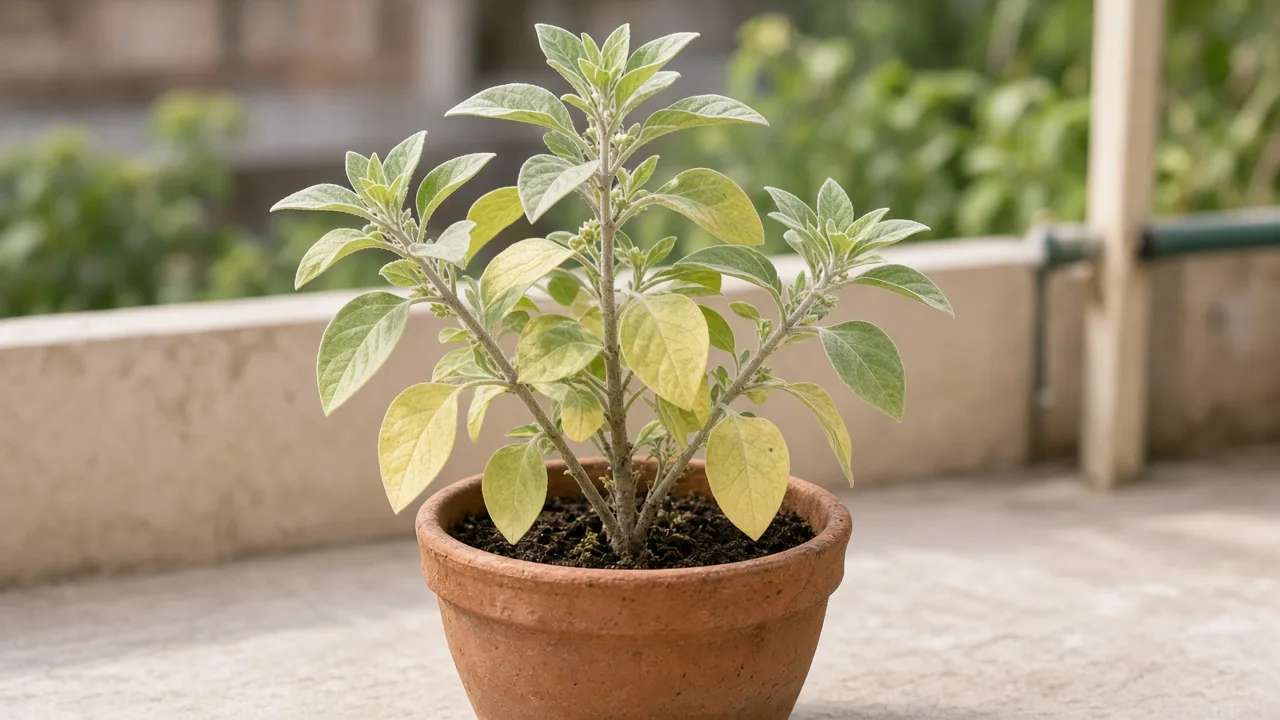
Nitrogen deficiency on Ashwagandha shows as uniform pale yellow-green on the oldest lower opposite silvery-hairy leaves along erect woody stems, with smaller or lighter new shoot-tip pairs and stalled warm-season growth while the stem base stays firm. First step: confirm even chlorosis on the lowest mature leaf pairs—not interveinal banding or green veins on new tips—then check years without complete fertilizer in leached sandy mix.
Nitrogen Deficiency on Ashwagandha: Causes, Checks & Fixes
This guide covers nitrogen deficiency on Ashwagandha. See also the general Nitrogen Deficiency guide, watering, and light pages for this plant.
Nitrogen Deficiency on Ashwagandha: Causes, Checks & Fixes
Quick answer
Nitrogen deficiency on Ashwagandha (Withania somnifera, Indian Ginseng) shows as uniform pale yellow-green on the oldest lower opposite silvery-hairy leaves along erect woody stems, with smaller or lighter new leaf pairs at shoot tips and stalled warm-season extension while the stem base stays firm. Nitrogen is mobile in plants, so deficiency symptoms show up first on the lower leaves as a general yellowing—veins and tissue fade together, unlike magnesium deficiency (interveinal banding on old leaves) or iron deficiency (green veins on new shoot-tip leaves).
See our nitrogen deficiency guide for general mobile-nutrient mechanics. On Ashwagandha, inspect the lowest mature opposite leaf pairs nearest the soil line—even washout there, with shoot tips still pushing thinner new silvery blades, is classic nitrogen starvation before wet-root failure or weak-light pale leaves.
First step: confirm uniform pale color on the oldest lower opposite leaves—not interveinal chlorosis, new-tip green veins, or cool-season dormancy—then check stem-base firmness and years without complete fertilizer in leached sandy mix.
When to use this page vs other Ashwagandha guides
| Pattern | Read next |
|---|---|
| Uniform pale oldest lower opposite leaves, smaller new shoot-tip pairs | Nitrogen deficiency (this page) |
| Yellow between veins on oldest leaves | Magnesium deficiency |
| Yellow new shoot-tip leaves with green veins | Iron deficiency |
| Cupped or margin-burned newest shoot-tip leaf | Calcium deficiency |
| Brown scorched margins on old leaves | Potassium deficiency |
| Washed-out green across whole shrub, dim balcony | Pale leaves or not enough light |
| All leaves yellow on persistently wet soil | Overwatering or root rot |
| Yellowing + leaf drop in cool short-day winter, firm dry stems | Watering guide — seasonal slowdown |
| Pale after heavy feed or white salt crust | Brown tips after checking fertilizer history |
What nitrogen deficiency looks like on Ashwagandha
Healthy Ashwagandha holds silvery-gray hairy leaves in opposite pairs along erect woody stems in full sun. Nitrogen stress breaks that pattern on mature foliage at the lowest positions on each stem, not with a vein-retained banding pattern.
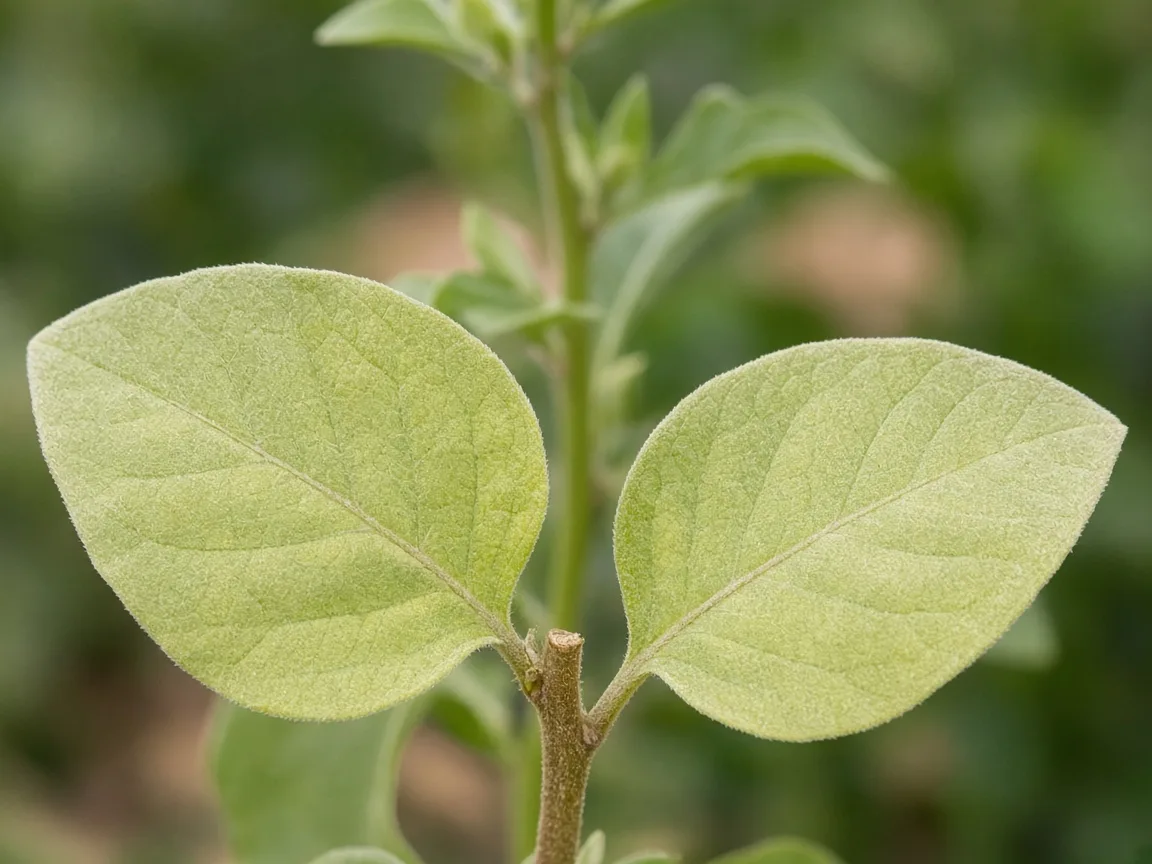
Oldest lower opposite silvery-hairy leaf with uniform pale yellow-green chlorosis—veins and tissue faded together, unlike interveinal magnesium banding.
Typical signs:
- Uniform pale yellow-green on the oldest lower opposite silvery-hairy leaves—veins and tissue lose color together
- Progressive climb upward along each woody stem over months as the plant strips nitrogen from old tissue to fund shoot-tip growth
- Smaller or thinner new opposite leaf pairs at shoot tips and slower woody extension during warm active growth
- Firm woody stem base when roots are healthy; soft mushy crown suggests overwatering instead
- Reduced branching on a terrace specimen that otherwise has enough sun for steady summer flushes
- Stalled flower or berry development when deficiency hits during bloom season on an otherwise mature shrub
Not nitrogen deficiency:
- Yellow tissue between dark green veins on oldest leaves—magnesium deficiency (magnesium deficiency initially develops on lower or older foliage with interveinal chlorosis)
- Yellow new shoot-tip leaves with dark green veins—iron deficiency
- Cupped or margin-burned newest silvery leaf still opening at a shoot tip—calcium deficiency
- Seasonal yellow and leaf drop when nights cool and days shorten—normal winter slowdown on a firm dry shrub, not hunger
- Uniform washed-out green across every stem in a dim corner—not enough light before assuming starvation
- All leaves yellow at once on persistently wet soil—overwatering or root rot
- One old lower leaf only while shoot tips push full-size green pairs—a normal aging pattern on yellow leaves
UC IPM notes slow growth and uniform yellowing of older leaves as the first symptoms of nitrogen deficiency. On a sun-loving medicinal shrub, that lower-leaf washout is easiest to read on the lowest mature opposite pair on each erect stem during warm months when the plant should be actively extending.
Why Ashwagandha gets nitrogen deficiency
Ashwagandha is a rapid-growing sun-loving shrub grown for firm medicinal roots, not soft ornamental foliage. Nitrogen is a core component of chlorophyll and proteins—when soil reserves run low, the plant dismantles chlorophyll in older lower opposite tissue and redirects nitrogen to shoot tips and new woody frame.
Ashwagandha-specific causes:
- Never fed or skipped years — Growers treat Ashwagandha as a “lean desert herb” while a terrace shrub sits in the same pot for multiple seasons. See the Ashwagandha fertilizer guide for conservative feeding rhythm.
- Leached sandy alkaline mix — Each dry-between-drinks watering cycle per the Ashwagandha watering guide flushes soluble nitrogen through drainage holes faster than owners replace it in airy sandy mix.
- Compost-only top-dress without nitrogen — Thin vermicompost layers help structure but may not supply enough available nitrogen for a sun-soaked shrub pushing continuous summer shoots.
- Years in the same terracotta pot — A dense root mass stays in exhausted mineral blend while lower opposite leaves slowly pale.
- Blocked uptake from wet roots — Chronic saturation in a cachepot prevents absorption even when nitrogen is present; see overwatering before feeding a waterlogged crown.
- Winter feeding gaps that never resume — Correct winter pause is necessary, but some growers never resume measured feed when spring shoot flushes return.
- Misread as “needs more sun” — Ashwagandha cannot grow in the shade; dim placement causes general pale leaves that mimic hunger, but true nitrogen deficiency still shows the oldest-lower-first mobile pattern on a sun-exposed plant.
Do not diagnose nitrogen deficiency on sour wet soil with a soft base at the crown—that is root failure until you confirm mostly firm roots and appropriate dry-down.
Lowest opposite leaf pairs on erect woody stems
Nitrogen deficiency on Ashwagandha shows on the lowest opposite silvery-hairy leaf pairs along each erect woody stem—a pattern that would be nonsense on a snake plant rosette or a fern frond crown. The dull gray-green tomentose surface makes even, vein-free pale yellow-green highly visible against firm brown-green stems: the whole opposite pair lightens together, sometimes from the tip backward, without the dark green vein rails of magnesium or iron chlorosis.
That lowest-stem locus distinguishes nitrogen from iron, which appears on the silvery leaf still expanding at the shoot tip. It also differs from calcium deficiency, which hits the newest expanding shoot-tip leaf while older lower opposite pairs stay normal.
Because Ashwagandha leaves are arranged in opposite pairs along woody axes, one uniformly pale lowest pair—firm stem base, normal dry-down watering—is enough to anchor your diagnosis before changing fertilizer, mix, or pot size.
Root-building season and the light-feeder paradox
Ashwagandha is grown for deep firm roots, not lush soft tops. Gardenish notes Ashwagandha is a light feeder and high-nitrogen products can push lush tops and reduce root quality—which makes some growers skip feeding entirely. The paradox: a sun-soaked terrace shrub in fast-draining sandy mix still depletes available nitrogen through repeated leaching soaks even when you avoid heavy feed.
Nitrogen deficiency during the warm root-building months matters because the plant allocates mobile nitrogen to new shoot-tip pairs and woody frame before it invests in root mass. A shrub with uniformly pale lowest opposite leaves and undersized new silvery blades at tips is under-fueling the very growth season growers care about most.
Closing the gap means half-strength complete balanced feed every four to six weeks during active growth per the fertilizer guide—not high-nitrogen leafy formulas that produce soft stems vulnerable to root rot on wet weeks.
Cool-season stall vs true nitrogen hunger
The diagnostic fork on Ashwagandha is when lower leaves pale, not just which leaves pale.
During cool short-day winter, many balcony shrubs slow growth sharply while older stems stay firm and soil stays appropriately dry. A few lower opposite leaves may yellow and drop as part of seasonal turnover—that fade is not nitrogen deficiency even if lower leaves yellow first. Mobile nutrients such as nitrogen show symptoms first on older lower leaves—but seasonal leaf drop on a firm dormant shrub is turnover, not soil hunger.
Nitrogen starvation shows during warm active growth when new shoot-tip pairs should be emerging, summer flushes should be regular, and the plant is receiving dry-between-drinks water on schedule.
Stem squeeze test: Pinch the woody base just above soil line. Firm erect angles with pale oldest lower opposite leaves during summer point here. A soft or mushy crown on wet mix points to overwatering regardless of leaf color. This crown-firmness rule is essential on erect medicinal shrubs and nonsense on a trailing pothos vine.
If the whole plant looks static in winter with firm dry stems, wait for spring shoot flushes before diagnosing nitrogen. Feeding a dormant specimen builds salts without uptake.
How to confirm nitrogen deficiency
Work through these checks in order before changing fertilizer strength:
- Pattern check — Oldest lower opposite leaves uniformly pale (veins and tissue together), not interveinal banding or new-tip green veins.
- Stem-base firmness — Woody crown firm; soft mushy base disqualifies nitrogen-first diagnosis.
- Soil moisture rhythm — Pot dries through the top 3–4 cm between drinks per the watering guide; chronic wetness blocks uptake.
- Feed history — Years in the same sandy mix with only plain water or no complete fertilizer during warm seasons.
- Season — Symptoms worsening during warm bright growth, not only during cool winter leaf turnover.
- Light baseline — Full sun terrace or south-facing ledge; dim rooms cause pale leaves that mimic hunger without the classic oldest-lower-first climb.
If all six align, nitrogen deficiency is the working diagnosis. If the crown is soft, soil stays wet, or new tips show green veins, pivot to the lookalike pages in the table above.
The first fix to try
Apply one half-strength complete balanced liquid fertilizer to moist sandy mix during active warm growth—then wait four to six weeks before feeding again.
That single measured dose replaces leached nitrogen without stacking repotting, pruning, and repeated full-strength feeds on the same day. Water the plant normally one to two days before feeding so roots are hydrated but not sitting in a cachepot of runoff. Use the Fertilizer Dilution Calculator if you are unsure how to halve your label rate.
Ashwagandha is toxic if ingested—wash hands after handling and keep fertilizer runoff away from pets and children per the Ashwagandha overview.
Do not feed if:
- The crown is soft on wet soil (overwatering first)
- White salt crust rings the pot (brown tips after checking fertilizer history first)
- The plant was repotted within the last two to three weeks (repotting guide — wait for stable new growth)
- Growth is paused in cool winter dormancy
Step-by-step recovery
After the first measured feed:
- Resume normal dry-between-drinks watering — Do not increase water to “help fertilizer work”; Ashwagandha prefers the existing rhythm that lets the top 3–4 cm dry.
- Scout shoot tips weekly — New opposite silvery pairs should emerge slightly larger and greener within four to eight weeks.
- Leave old pale leaves alone — They rarely re-green; let them drop naturally when the plant sheds them.
- Second feed only if needed — If shoot tips still push undersized pale pairs after four to six weeks and the crown stays firm, one more half-strength complete feed is reasonable during the same growing season.
- Refresh mix if the pot is root-bound — When lower opposite leaves pale again the next year in exhausted sandy soil, plan spring repotting into fresh lean mix before resuming light feed.
Avoid full-strength high-nitrogen houseplant food. Ashwagandha responds to excess nitrogen with soft stretched shoots and higher rot risk on wet weeks—see the fertilizer guide for conservative NPK choices.
Recovery timeline
Judge progress by new opposite leaf size and color at shoot tips, not by old silvery blades re-greening.
| Stage | What to expect |
|---|---|
| Week 1–2 | No visible change on old pale lower leaves; crown should stay firm |
| Week 3–4 | Slightly greener or larger new pairs at upper shoot tips |
| Week 5–8 | Clearer summer flushes; woody extension may resume on sun-soaked terrace pots |
| Month 3+ | Stable pattern if feed rhythm and mix match growth rate |
Mild cases on a young seedling often stabilize within one growing season. A mature shrub in the same exhausted pot may need repotting plus two light feeds across spring and summer.
Signs improvement is working: Larger new opposite pairs, deeper silvery-green on shoot tips, steady firm woody stems, resumed branching.
Signs the problem is worsening or misdiagnosed: Pale yellowing climbing fast while the crown softens, all stems yellowing together on wet soil, new tips with green veins (iron), or interveinal banding on old leaves (magnesium).
NC State notes that even plants with serious nitrogen deficiency may still have greener new leaves than older ones because nitrogen moves readily to younger, more productive foliage—on Ashwagandha that means shoot-tip pairs may look slightly better than the lowest opposite leaves even while both are undersized.
Mistakes to avoid
- Feeding a waterlogged crown — Nitrogen cannot enter damaged roots; dry the root zone first.
- Full-strength tropical houseplant food — Soft leggy shoots and salt crust follow quickly on this light feeder.
- Diagnosing nitrogen in dim winter — Seasonal leaf drop on firm dry stems is normal.
- Expecting old silvery leaves to re-green — Recovery shows on the next flush, not retroactively.
- Stacking repot, prune, and feed same week — Change one variable so you can read the response.
- High-nitrogen-only formulas — Pushing soft tops on a root crop shrub increases rot risk without fixing lower-leaf chlorosis.
- Growing in shade and chasing nutrients — The plant cannot grow in the shade; fix light before assuming soil hunger.
How to prevent nitrogen deficiency next time
- Follow the seasonal schedule in the Ashwagandha fertilizer guide—half-strength complete feeds every four to six weeks during warm growth is enough for most terrace pots.
- Refresh lean soil every one to two years when roots crowd the pot and lower opposite leaves pale despite correct watering.
- Match feed frequency to growth rate—a full-sun terrace shrub depletes nitrogen faster than a dim windowsill specimen.
- Track whether oldest lower opposite leaves wash out uniformly before shoot-tip pairs shrink; early pale lower leaves are easier to correct than a fully stunted woody frame.
- Resume measured feed when spring shoot flushes return after winter pause—do not let multiple warm seasons pass with only plain water.
Related Ashwagandha guides
- Ashwagandha overview — species baseline and care hub
- Ashwagandha fertilizer — light-feed timing and dilution
- Ashwagandha watering — dry-between-drinks checks that pair with nutrient uptake
- Ashwagandha soil — sandy mix that drains fast but needs nitrogen replacement
- Ashwagandha problems — full symptom index for this species
- Magnesium deficiency — when older leaves band between veins
- Iron deficiency — when new shoot-tip leaves yellow with green veins
- Calcium deficiency — when newest shoot-tip leaves cup or margin-burn
- Pale leaves — light-first diagnosis when color shifts broadly
- Yellow leaves — moisture and seasonal turnover when yellowing is widespread
Conclusion
Uniform pale yellow-green on the oldest lower opposite silvery-hairy leaves, with smaller new leaf pairs at shoot tips during warm active growth, is a nitrogen signal on Ashwagandha—confirm the pattern is not interveinal or new-tip chlorosis, rule out soft crowns and cool-season slowdown, then apply one measured complete feed on moist sandy mix.
Related tool
Use the Fertilizer Dilution Calculator to narrow causes for nitrogen deficiency on this plant before changing multiple variables at once.