Iron Deficiency on Ashwagandha: Causes, Checks & Fixes
Quick answer
Iron deficiency on Ashwagandha shows as interveinal yellowing on the newest silvery-hairy leaves at shoot tips while veins stay green and older opposite leaves lower on the stem often look normal. First step: confirm the pattern on expanding new growth—not pale old lower leaves from nitrogen shortage—and check whether alkaline tap water, incomplete fertilizer, or wet roots are blocking iron uptake before applying chelated iron.
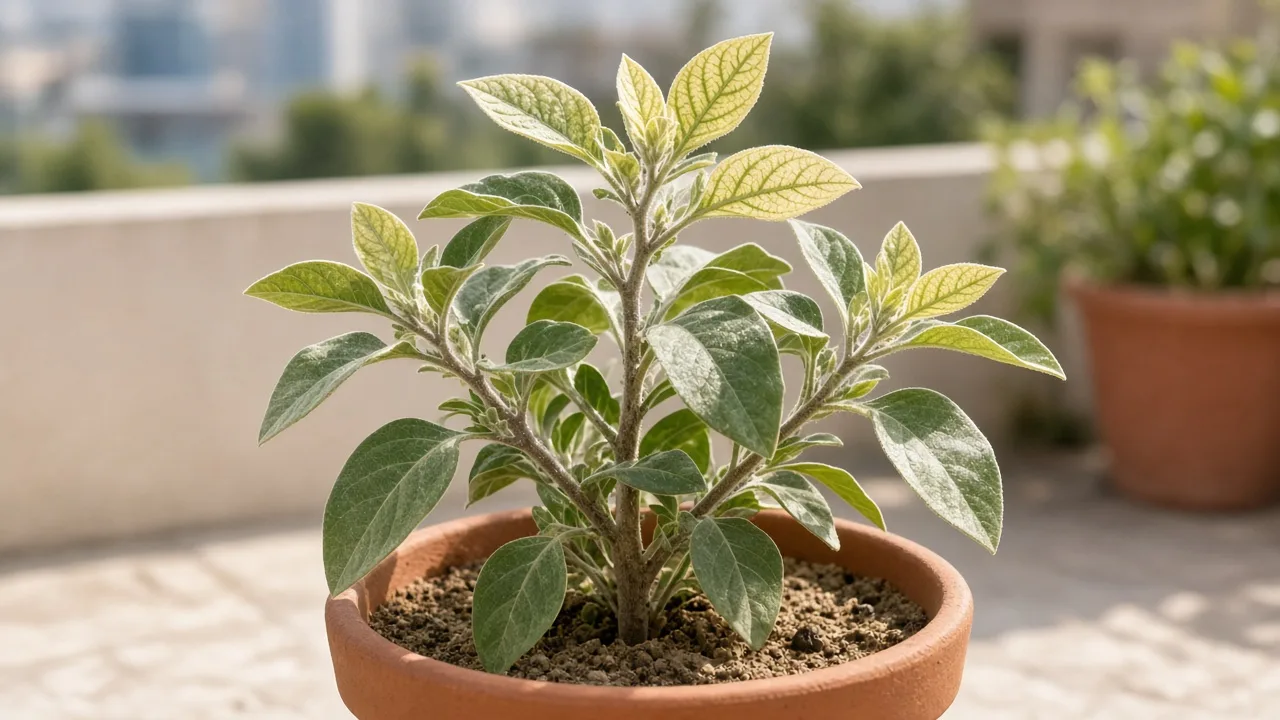
Iron Deficiency on Ashwagandha: Causes, Checks & Fixes
This guide covers iron deficiency on Ashwagandha. See also the general Iron Deficiency guide, watering, and light pages for this plant.
Iron Deficiency on Ashwagandha: Causes, Checks & Fixes
Quick answer
Iron deficiency on Ashwagandha (Withania somnifera, Indian Ginseng) shows as interveinal yellowing on the newest silvery-hairy leaves unfurling at shoot tips while veins stay green and older opposite leaves lower on the same stem often look normal. Iron is not mobile in plants and symptoms appear on new leaves first—not on mature lower foliage the way nitrogen deficiency does.
See our iron deficiency guide for general interveinal chlorosis mechanics. On Ashwagandha, inspect the newest silvery-hairy leaf pair still opening at each shoot tip—pale tissue between dark green veins there points to iron before magnesium, which hits older mid-stem leaves first.
First step: confirm yellow tissue between green veins on the newest shoot-tip leaf, not uniform pale old lower leaves or cupped margins from calcium shortage.
When to use this page vs other Ashwagandha guides
| Pattern | Read next |
|---|---|
| New shoot-tip leaf yellow between green veins | Iron deficiency (this page) |
| New shoot-tip leaf cupped or margin-burned | Calcium deficiency |
| Old lower leaves pale uniformly | Nitrogen deficiency |
| Yellow between veins on older mid-stem leaves | Magnesium deficiency |
| Brown scorched margins on old leaves | Potassium deficiency |
| All leaves uniformly pale, leggy stems | Not enough light or pale leaves |
| Soft stem base, wet soil, sour smell | Root rot or overwatering |
| White crust on soil, tip burn on many leaves | Brown tips after checking fertilizer history |
What iron deficiency looks like on Ashwagandha
Healthy Ashwagandha pushes silvery-gray hairy leaves in opposite pairs along erect woody stems in full sun. Iron supports chlorophyll formation in expanding tissue, so when uptake fails, the newest leaf still opening at a shoot tip bleaches yellow between veins while older opposite foliage on the same branch often stays green.
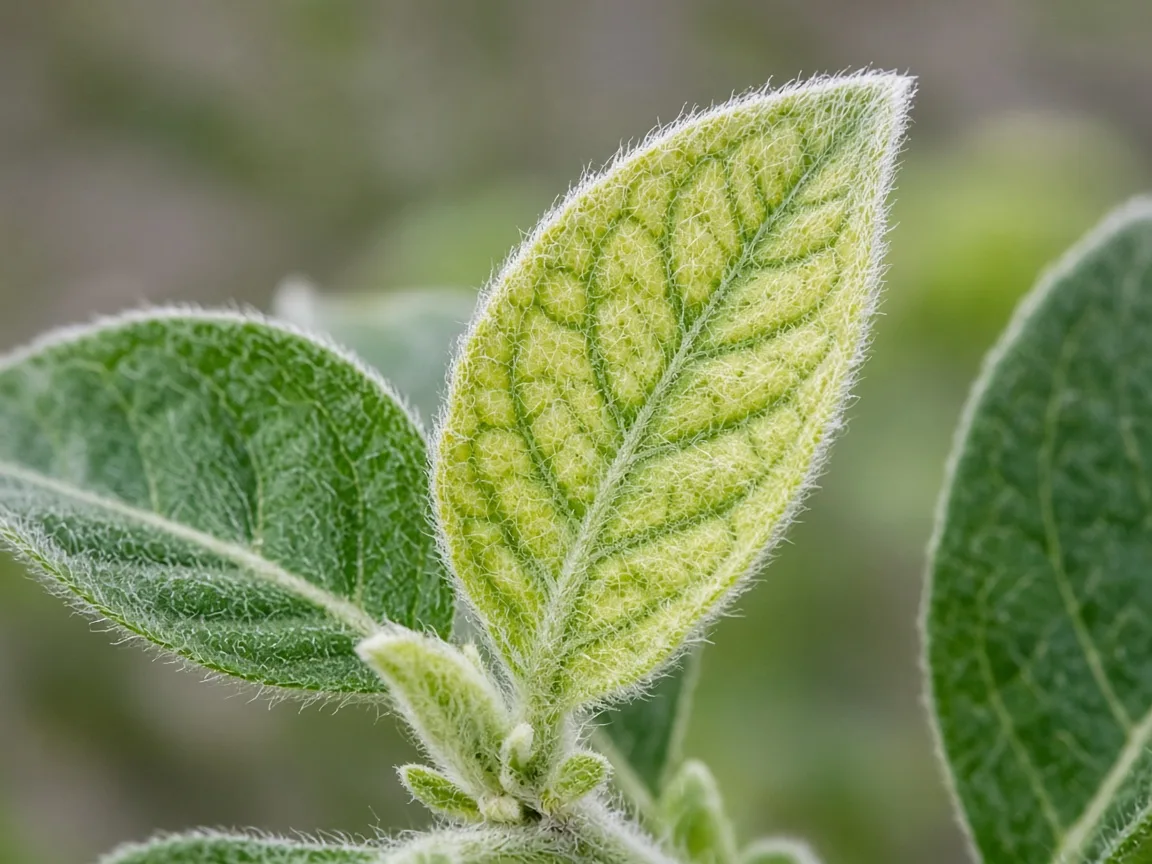
Interveinal chlorosis on a new Ashwagandha shoot-tip leaf—pale yellow tissue between dark green veins on expanding silvery-hairy foliage while older opposite leaves on the stem may look normal.
Typical signs:
- Pale yellow or whitish tissue between dark green veins on the newest silvery-hairy leaf at a shoot tip
- Bright yellow chlorosis of the younger leaves that may worsen as each new opposite pair unfurls
- Older opposite leaves farther down the same stem often look completely normal
- Firm woody stem base when roots are healthy; soft mushy crown suggests rot instead
- Symptoms appear during warm active growth when the plant pushes new shoots—not usually on a stalled winter specimen
- Severe cases: new leaves emerge almost white between veins with brown necrotic patches later
Not iron deficiency:
- Uniform pale yellow on old lower leaves without strong green veins—nitrogen deficiency
- Interveinal yellow on older mid-stem leaves while shoot tips stay green—magnesium deficiency
- Cupped or margin-burned new leaf without vein pattern—calcium deficiency
- Silver streaks inside rolled new leaf—thrips or distorted leaves
- All leaves yellow on persistently wet soil—overwatering or root rot
- Leggy pale stems with few new leaves—not enough light
Why Ashwagandha gets iron deficiency
Ashwagandha is a rapid-growing sun-loving shrub grown for firm medicinal roots in sandy slightly alkaline mix (pH 6.5–8.0). Iron may be present in the pot, but in high-pH alkaline soils iron is tightly bound and unavailable for plant use—a common trigger on terrace pots watered with hard alkaline tap water. Each unfurling silvery leaf at a shoot tip still demands iron for chlorophyll. Incomplete fertilizer, depleted mix, chronic wet roots, or shade that slows transpiration limits uptake—and shows on the newest expanding leaf while older foliage stays green.
Ashwagandha-specific causes:
- Hard alkaline tap water — Cities with pH above 7.5 gradually raise container mix pH and lock iron out even when fertilizer lists iron on the label. Terrace growers in North India and similar regions see chlorosis on fast summer growth pushes.
- Incomplete micronutrient fertilizer — Ashwagandha is a light feeder, but nitrogen-only or incomplete formulas during warm active growth leave new shoot tips pale while stems stay woody.
- Alkaline sandy mix with limestone or crushed shell — Slightly alkaline culture suits Ashwagandha outdoors, but container edges coated with white salt crust signal pH creep that blocks iron uptake.
- Chronic wet roots — NC State notes Ashwagandha does not like wet feet and stem and root rot can affect the plant. Soggy roots cannot reduce iron to the absorbable form at the root surface regardless of what is in the fertilizer bottle.
- Shade slowing uptake — Ashwagandha cannot grow in the shade. Dim balcony placement slows root function and mimics iron shortage on new growth—see not enough light before assuming a nutrient gap.
- Cool-season feeding on stalled growth — Iron correction only works when the plant is actively transpiring. Feeding a dormant winter specimen risks salt buildup without fixing spring shoot-tip chlorosis.
- Magnesium confusion — Iron deficiency yellows the newest leaves first with green veins intact; magnesium deficiency yellows the oldest leaves first by the same interveinal pattern.
Silvery shoot tips and opposite new leaf pairs
Ashwagandha allocates iron to each expanding silvery-hairy leaf as it opens from a tight roll at the end of an erect woody stem. When uptake fails, the blade between veins bleaches yellow or white while vascular tissue stays green—the classic symptom of iron deficiency is interveinal chlorosis where the leaf turns yellow and the veins remain green. Iron is not mobile in plants and symptoms appear on the new leaves first, with severely deficient leaves yellowish or almost completely white as they unfold.
That pattern differs from nitrogen deficiency, which shows on older lower leaves first. It also differs from magnesium deficiency, which yellows older mid-stem leaves while new shoot tips may stay green until the problem advances.
Judge severity by successive new leaves on the same shoot: one slightly pale unfurl after repotting differs from three consecutive white-between-veins leaves on stable summer care.
Sandy alkaline mix and hard-water terraces
Most home Ashwagandha grows in lean sandy or loamy mix with a target pH of 6.5–8.0. Iron availability drops as mix pH climbs toward 8.0, especially when hard irrigation water deposits bicarbonate at the pot rim. Problems cluster when growers treat the plant like a moisture-loving houseplant—heavy peat, frequent shallow watering, and shade—then chase nutrients when new shoots bleach between veins.
Because Ashwagandha is grown for root quality, not ornamental foliage, pale new leaves during the warm root-building months matter more than a single cosmetic blemish. A plant pushing chlorotic shoot tips while the crown stays firm still has time to correct before harvest season, but repeated meristem bleaching can stunt the woody frame that supports root mass.
If the pot stays wet for days after each drink, fix watering and drainage before any chelated iron label change. Uptake failure from soggy roots looks identical to alkaline lockout on the label.
Summer growth push vs cool-season stall
Ashwagandha metabolism tracks heat and sun. Iron correction only works when the plant is actively transpiring and taking up water—feeding a stalled winter specimen on a dim windowsill does not fix spring shoot-tip chlorosis and risks salt buildup on dry mix.
When new leaves emerge in late spring and summer, iron demand spikes at each shoot tip. Growers who skipped complete fertilizer through the prior warm season and then push heavy nitrogen feed in May sometimes see pale new shoots—the nitrogen drives expansion faster than available iron can support chlorophyll in new tissue.
Closing the gap means half-strength complete feed with chelated iron every four to six weeks during active growth per the fertilizer guide, not more nitrogen to force wider leaves the plant cannot green.
Lookalike symptoms
| Pattern | Check | Likely cause |
|---|---|---|
| New shoot-tip leaf yellow between green veins | New vs old tissue | Iron deficiency (this page) |
| New shoot-tip leaf cupped or margin-burned | Margin pattern | Calcium deficiency |
| Old lower leaves pale first | Leaf position | Nitrogen deficiency |
| Interveinal yellow on old mid-stem leaves | Mid-stem pattern | Magnesium deficiency |
| Soft stem base, wet soil | Crown feel | Root rot |
| Leggy pale stems, few new leaves | Light level | Not enough light |
| Uniform pale leaves, no vein contrast | Whole leaf | Pale leaves or light stress |
How to confirm
- New vs old tissue — Chlorosis confined to the newest shoot-tip leaf with green veins while older opposite leaves on the same stem look normal strongly suggests iron.
- Vein pattern — Pale tissue between dark green veins, not uniform whole-leaf yellow.
- Water source — Hard alkaline tap water or white salt crust at the pot rim.
- Fertilizer completeness — Chelated iron on the label vs nitrogen-only products or years without any feed.
- Stem base health — Firm woody crown and white roots vs brown mush from soggy soil.
- Light level — Full sun on the sunniest terrace ledge vs dim indoor placement.
- Successive new leaves — Two or more increasingly pale shoot-tip leaves in a row on stable summer care points to uptake failure, not one-time transplant stress.
- Season — Symptoms appearing during warm active growth with continuous new shoots fit deficiency better than winter leaf drop alone.
First fix for Ashwagandha
One half-strength dose of complete balanced fertilizer containing chelated iron on already-moist sandy mix—only after confirming interveinal yellowing on the newest shoot-tip leaf with green veins, firm stem base, stable dry-between-drinks rhythm, full sun, warm active growth, and no active thrips inside the newest rolled leaf.
Do not repot, prune, and triple-feed a recently relocated Ashwagandha the same week. Stabilize watering per the Ashwagandha watering guide first—let the top 3–4 cm dry before each drink, empty saucer standing water after each watering.
If hard alkaline tap water raised mix pH, flush the pot with plain water until runoff clears white crust before the chelated iron dose. For alkaline soils, FeEDDHA is the most effective chelated iron form—standard FeEDTA may fail above pH 7.5.
Step-by-step recovery
- Rule out lookalikes — Confirm green veins on pale new tissue; inspect old lower leaves for nitrogen or magnesium patterns.
- Flush salt crust if white buildup rings the pot rim—uptake often improves before any new product.
- Apply half-strength complete feed with chelated iron once on moist mix during active growth; repeat at four- to six-week intervals through the warm season if the next leaf responds per the fertilizer guide.
- Maintain consistent dry-down—uptake fails when roots alternate between saturated and desiccated in heavy decorative pots.
- Move the plant gradually into stronger direct sun if not enough light is slowing root function and iron transport to shoot tips.
- Repot into fresh sandy mix if roots fill the pot and chlorosis persists after two measured feeds on a firm crown—see Ashwagandha repotting.
- Monitor the next two shoot-tip leaves—the currently pale leaf rarely regreens; recovery shows on subsequent new growth with normal silvery-green color.
Recovery timeline
The currently pale shoot-tip leaf rarely regreens once chlorophyll loss sets as the silvery blade hardens. The next one or two leaves after corrected chelated iron feeding and stable watering usually open with normal green color between veins within two to four weeks on a firm crown—faster than slow woody shrubs because Ashwagandha can push new tissue rapidly in warm sun.
Severe crown damage from chronic overwatering may delay recovery a full growing season. If successive new shoot-tip leaves stay white between veins despite complete feed and stable summer care, inspect roots for rot before repeating fertilizer or repotting again.
Mistakes to avoid
- Do not treat uniform pale old lower leaves as iron deficiency—check nitrogen deficiency first.
- Do not use Epsom salt for iron chlorosis—it supplies magnesium, not iron.
- Do not heavy-feed Ashwagandha on wet soil or during cool stalled growth—fix drainage and wait for active warm-season shoots before fertilizer.
- Do not expect the current pale leaf to regreen—judge the next shoot-tip unfurl.
- Do not stack repotting, heavy pruning, and full-strength feed the same week on a stressed plant.
- Do not grow Ashwagandha in shade and chase micronutrients—the plant cannot grow in the shade and uptake stalls without transpiration.
- Do not apply foliar iron above 85°F (29°C)—high temperatures can burn foliage on foliar iron applications.
Prevention
- Feed lightly with complete balanced fertilizer including chelated iron during active warm-season growth per the Ashwagandha fertilizer guide.
- Flush pots every few months if hard tap water leaves white crust—prevent pH creep that locks iron out.
- Maintain consistent dry-between-drinks rhythm per the watering guide.
- Refresh depleted sandy mix every one to two years when roots crowd the pot.
- Inspect shoot tips monthly during spring and summer—early interveinal pale streaks are easier to correct than a stunted white shoot crown.
- Pause heavy feeding when growth stalls in cool weather and resume only when new shoots return in warm sun.
Related Ashwagandha guides
- Ashwagandha overview
- Ashwagandha fertilizer
- Ashwagandha watering
- Ashwagandha soil
- Magnesium deficiency
- Calcium deficiency
- Ashwagandha problems hub
- All plant symptoms
Conclusion
Interveinal yellowing on new silvery-hairy Ashwagandha leaves at shoot tips—with dark green veins still visible—points to iron uptake failure on expanding tissue. Confirm the new-vs-old leaf pattern, rule out magnesium on mid-stem foliage and nitrogen on lower leaves, stabilize dry-between-drinks watering and crown health, ensure complete fertilizer supplies chelated iron especially on hard alkaline water during warm active growth, and judge recovery by the next shoot-tip leaf flush.
Related tool
Use the Fertilizer Dilution Calculator to narrow causes for iron deficiency on this plant before changing multiple variables at once.